Quotulatiousness

April 4, 2026

Artemis II – later than hoped, but better now than never

Filed under: Cancon, Space, USA — Tags: , , , — Nicholas @ 03:00

CDR Salamander goes fullbore (because it’s Friday, and that’s what he normally does on a Friday):
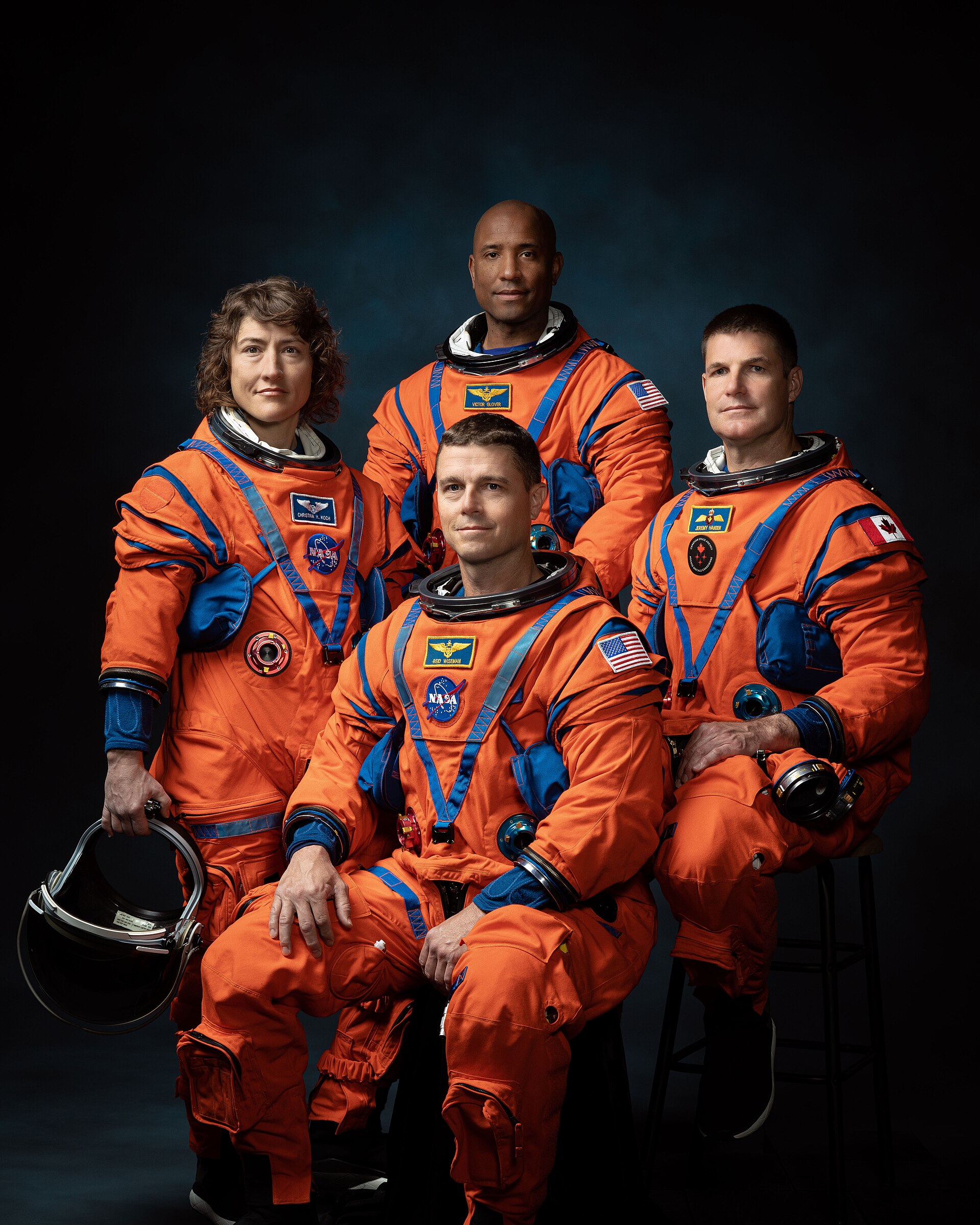
Official crew portrait for Artemis II, from left: NASA Astronauts Christina Koch, Victor Glover, Reid Wiseman, Canadian Space Agency Astronaut Jeremy Hansen.
Photo by Josh Valcarcel for NASA

I grew up with the Apollo Program and some of my earliest memories were watching astronauts during the lunar landings. You could see the Saturn V launches from my backyard.

Just as I was getting old enough to really enjoy it, it all stopped.

The 1970s.

The worst people for the worst reasons killed the space program as it became part of the national malaise of the 1970s, the core of which was defined by the period from the last person on the moon in 1972 through the fall of Saigon three years later, and bookended by the Iranian hostage crisis of 1979-80.

For those who received the promise of 1968’s 2001: A Space Odyssey as to what the future in space would be never fulfilled, we tried to get excited by partial measures — Skylab; the Space Shuttle and its disasters; the downgrading of Reagan’s Space Station Freedom into the “Model UN in space”, the International Space Station; and the lingering malaise and distraction that we endured during the Clinton and Obama administrations.

Here we are 53 years later, and at last we are reaching for the moon again. We never should have left.

[…]

And so North America—three Americans and a Canadian—is heading to the moon.

Back at last.

The Commander Reid Wiseman, is a U.S. Navy Captain and former F-14 driver. The Pilot is another U.S. Navy Captain, Victor Glover, though he was a F/A-18 bubba.

Navy wins again!

Mission Specialist Christina Koch comes from a great ACC school, and for comic relief, we have our Canadian Mission Specialist, Jeremy Hansen, the only one who is on their first space flight.

Somewhere there are plenty of young men and women who, I hope, are watching as my generation did, the best of mankind again reaching out.

Let’s not let the momentum stop this time. Keep pushing out. It is what our species does best, and it brings the best out of us.

April 3, 2026

“Rocket launches are America at its best”

Filed under: Space, Technology, USA — Tags: , , — Nicholas @ 04:00

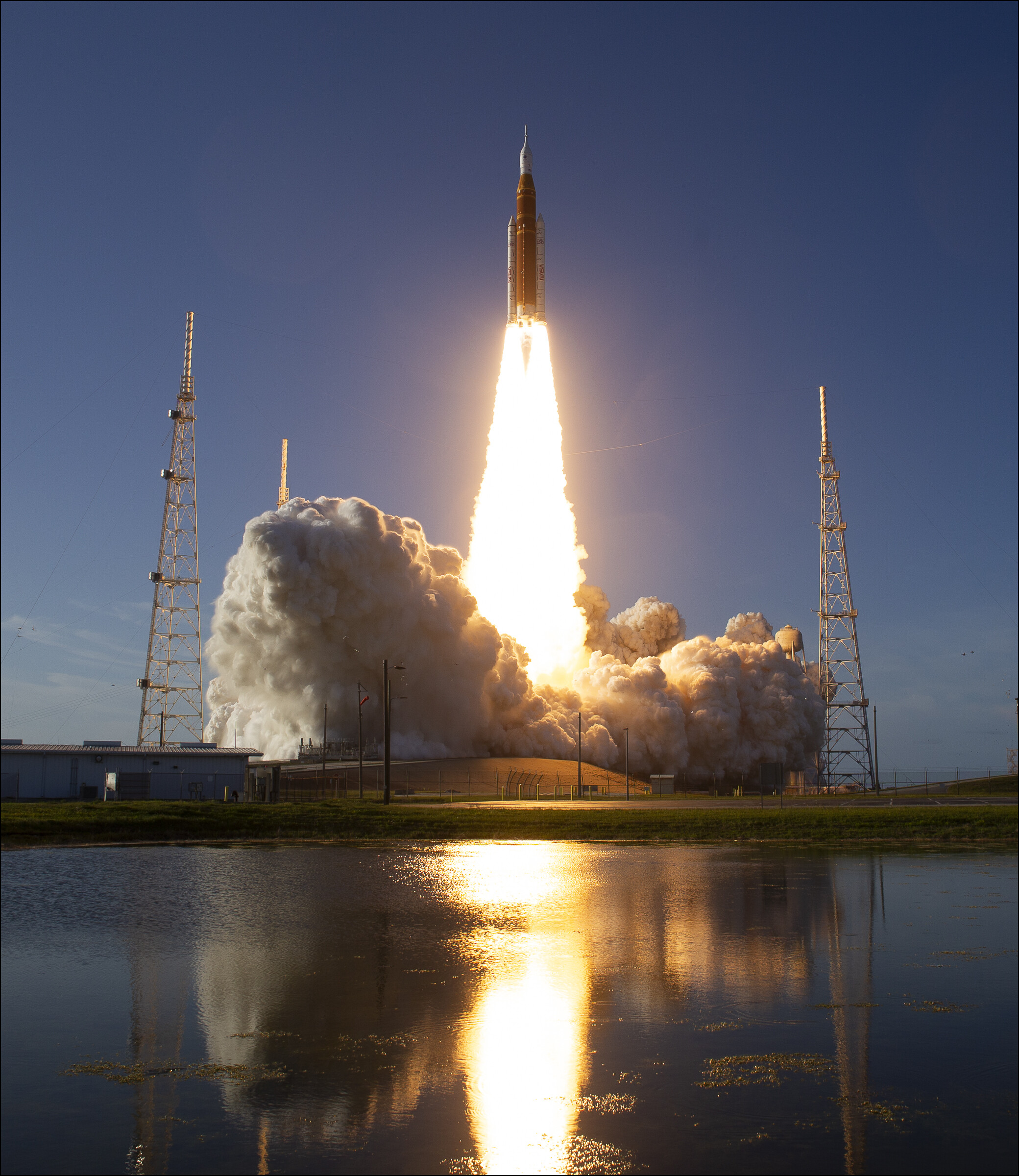
Jen Gerson on the Artemis II launch on April 1st:

Artemis II launch, 1 April, 2026
NASA image

I’m not The Line‘s resident space dork; and, yet, I, like everyone likely reading this piece, watched the launch of Artemis II last night, enraptured and hopeful for a successful slingshot around the moon.

My son watched with me, he counted down from 10, and he jumped up when the rockets lit up, throwing four astronauts in a tin can into space.

This stuff is cool on its own merit, but it hits us all somewhere a little deeper than mere wonder at the extraordinary mechanics.

Watching a manned rocket launch is the barest little window-crack opening into a distant future. It’s a monumental effort to throw a fine fishing line into the darkness, hoping against hope that some great destiny is on the other side just waiting for us to tug at it.

By all rational accounts space travel is dumb. It’s an extraordinarily expensive use of human capital and time and resources to reach into nothingness and expanse. We all love pictures of stars and planets and nebulae, but we may never glean much of real material value from these investments in our own lifetimes. Or our great-grandchildren’s lifetimes.

There may be nothing but lifeless rock and death beyond our own ecosystem; no other place we will ever call home.

In fact, from where we sit today, that’s probably true.

Yet we do this stupid thing anyway. We must do the stupid thing anyway.

[…]

Rocket launches are America at its best, and perhaps now more than usual, we need to remind ourselves that this best still exists. Perhaps especially on the same night we sat fearing the President would announce that NATO was over and the world was breaking. (He didn’t, and I guess it’s not for now.)

And regardless of what nation we belong to, whether we’re accountants, butlers, or mothers, every single one of us carries that thin thread of life forward. We all take part in the project. We all have a place. Some of the big roles may be assigned to individual players, but the destiny of humanity is shared. (Whether we like it or not.)

So, we can all be moved together in these moments. We can all imagine what great-great-great grandchildren who have long forgotten our own names might think while watching archival footage of the Artemis II launch. What even greater world might they achieve. What more fanciful ambitions might be open to them. Maybe they will say that this was the moment we started to get our priorities right and our acts together. Maybe things will get better.

Maybe Artemis II, absurd and wasteful, is neither. Who knows how my son will metabolize the video stream of this really cool rocket; I cannot say who he may come to be for witnessing it.

Our craziest aspirations are the way we send our love to the children too far distant for us to see or know.

For my own part, I caught the space bug very early through science fiction of the 1950s and 60s, especially from the writings of Robert Heinlein and Arthur C. Clarke. Earth is just our starting point, and one planet isn’t enough to ensure the survival of our species, so exploring space is an evolutionary necessity.

October 5, 2025

QotD: Why go to the Moon or Mars?

Filed under: Books, Bureaucracy, Economics, Government, Quotations, Space — Tags: , , , , — Nicholas @ 01:00

This, by the way, is the thing people don’t get about space. Every time humanity takes some tiny step along the path to becoming a multiplanetary species (by which I mean “every time SpaceX does something cool”), someone comes along and complains that it seems kind of pointless. The Moon is very far away, Mars is even farther, and we have this whole big planet right here that’s already full of “uninhabitable” regions like the Sahara or the Antarctic or, uh, the entire American West. Starting there seems easier, since they already have things important elements such as “air” and “water” and “a biosphere”. Play your cards right and you won’t even need a passport, let alone a spaceship. A friend of mine even coined the slogan: “Terraform Terra first”.

But this misses the point. Yes, space colonization appeals because it’s part of the wizardly dream of innovation, of building new and exciting things, and thus has an aesthetic draw that goes beyond practical arguments. Yes, long-term we probably shouldn’t put all our civilizational eggs at the bottom of one gravity well. And yes, many humans have a Promethean (Faustian? Icarusian?) drive to expand, to explore, to see what’s beyond the horizon. All of which is a pull to space.

Now pause for a moment and think about what would actually happen if you decided to set up your terran terraforming in, say, the Owyhee Desert of southwestern Idaho. There’s a river in parts of it. It rains occasionally, and snows in the winter. Whatever techniques you were planning to generate power and conserve water on Mars would certainly work in Idaho — more efficiently, for solar, since we’re closer to the source, and with more margin of error if you can add water to the system. Plus the desert is full of exciting minerals you can mine to sell or even to extract water from! And the second you tried, the Bureau of Land Management (which owns most of the Owyhee, and indeed most of the American West) and the Environmental Protection Agency (which has opinions about mining) and the ranchers (who would also like to use that water, thank you) will come down on you like a ton of bricks.

That’s the push to space.

The dream of space colonization is partly about all the ways it would be cool to live on Mars or the Moon. But it’s also, implicitly or explicitly, a claim that it’s easier to solve enormous technical challenges (air! water! food! solar radiation!) than it is to solve societal challenges on Earth. Terraforming is hard; eunomiforming is harder.1

Jane Psmith, “REVIEW: The Powers of the Earth, by Travis J.I. Corcoran”, Mr. and Mrs. Psmith’s Bookshelf, 2024-04-29.


  1. Though to his credit Corcoran has a diverse portfolio: in addition to the space colonization dreams, he’s tackling the “terraform Terra” angle with an active homestead (he’s written some guides) and the “improve society somewhat” approach through more direct political engagement than I’ve ever done.

January 31, 2025

QotD: “Did you know the government faked the moon landings?”

Filed under: Media, Politics, Quotations — Tags: , , , , — Nicholas @ 01:00

This is a deeply stupid thing to believe, and if you believed it in the 20th century I had nothing but mockery for you.

Today I am compelled to much more sympathy with people who have come to believe that. It’s still objectively stupid, but I understand how they got there. It’s an interaction between a low-trust, polluted information environment and the cheater-detection module wired into human brains.

If you pose people a logic problem phrased in two different ways, one of which is “spot the cheater” and one of which is not, they’ll do substantially better on the first version. We are social animals who survived by forming trust networks, and for millions of years spotting the cheater was a life or death matter.

Now put yourself in the shoes of a person of average intelligence — not very good at following complex arguments or extracting generative patterns from large masses of evidence. This person has gradually become aware over the last quarter century that public information sources are saturated with lies. The media is corrupt and partisan, corporations deceive to boost their profits, education is ideologically captured, and governments constantly peddle vast falsehoods to gain compliance.

In this environment, and given the capacity limitations of the average human, the cheater-detection module goes into overdrive. The least bad strategy is to try to spot the worst liars and then believe the opposite of everything they say.

“The moon landings were faked” has to be understood as a symptom not of individual insanity, but of governing institutions and elite classes who have repeatedly burned up their long-term credibility for short-term gains.

This trend had been building for a long time, but undoubtedly culminated with the series of colossal lies, blunders, and “we’ve always been at war with Eastasia” reversals around COVID.

I wish I knew a way back from this. I’m not sure anything less than the abolition of secrecy could do it.

ESR, Twitter, 2024-10-27.

September 18, 2024

Canucks. In. Space – “racist, exploitative, elitist, and environmentally destructive”

Filed under: Cancon, Military, Politics, Space — Tags: , , , , , — Nicholas @ 03:00

In the National Post, Tristin Hopper‘s First Reading on a recently commissioned report for the Canadian Armed Forces on space exploration from an intersectional feminist viewpoint:

As Canada prepares to send an astronaut on the first manned moon mission in more than 50 years, its own military has commissioned a $32,250 report on how space exploration may actually be “racist, exploitative, elitist, and environmentally destructive”.

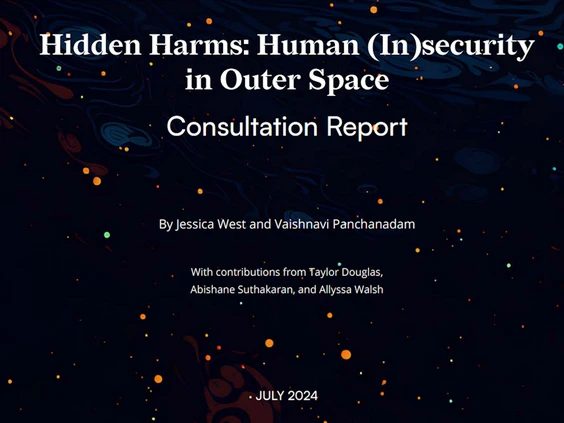
The 48-page report, entitled Hidden Harms: Human (In)security in Outer Space, concludes that human usage of space is currently “masculine, militarized and state-based”.

The authors also bemoan a space exploration field that is beholden to colonial concepts such as “technospeak” and “expertise”, and which doesn’t give appropriate weight to “spirituality, astrology, and cosmology, the last of which views celestial bodies in space as animated beings and not mere objects”.

As such, the report concludes that space will continue to be a realm of “hidden violence” against the world’s marginalized until “gender, race, class, ability, and sexuality” can be put at “the centre” of how decisions are made in the cosmos.

“Leadership is needed to normalize inclusion of different perspectives,” reads a conclusion.

The report has very little positive to say about the current state of human space exploration or space technology.

The whole endeavour is criticized as “technology-biased” because it fails to consider “gendered effects”. It’s “geography-biased”, because it doesn’t include equal participation from poorer countries.

It “normalize(s) violence and exploitation” by using language that depicts “outer space as a hostile and desolate environment that is unpeopled/inhuman and controlled so that it can provide an extractable resource”.

The construction of launch pads, satellite receivers and other ground infrastructure causes “disproportionate harm to Indigenous communities by severing their connection to ancestral lands”.

The report is also deeply critical of the fact that space is disproportionately inhabited by able-bodied males from wealthy countries. “Existing approaches are ahistorical and thus invisibilize diverse stakeholders and voices,” it reads.

Hidden Harms contains little to no discussion of the technical aspects of space exploration or technology. The word “rocket”, for instance, appears only once in a footnote in relation to how a falling rocket stage could hurt Inuit people. The word “orbit” appears in the text just once, when referencing how states could impose extraterrestrial harm by “permanently damaging objects on orbit”.

Nevertheless, the report is clear that all of these technical considerations should become secondary to “intersectional, decolonial, and humanitarian perspectives”.

“We must make space for the unfamiliar and the uncomfortable,” it reads.

It’s hardly surprising that an “intersectional feminist” view of space exploration would be harshly negative — what is surprising is that the Canadian Armed Forces paid to have this intellectual drivel written. A bit over $30k isn’t even a rounding error for the federal government, but as an indicator of just how federal bureaucrats are spending their departmental budgets it does seem to indicate that there’s a lot of fat in those budget numbers.

March 15, 2023

Mining the moon would be “harmful” to indigenous people, say activists

Filed under: Media, Politics, Science, Space, USA — Tags: , , , — Nicholas @ 03:00

Among the many, many things that are said to be harmful to indigenous culture we’re now told to include any kind of Lunar exploitation as modern colonialism:

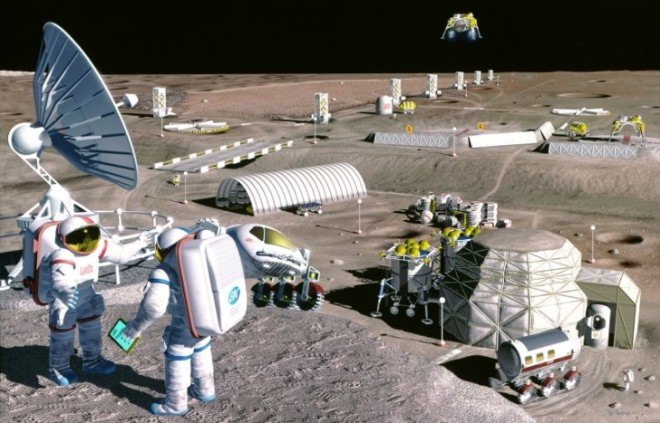
Artist’s conception of Helium-3 mining on the surface of the Moon.
Image from Inhabitat.com

Humans have boldly ventured beyond the Earth into space for more than half a century now. It’s a testament to the ambition of the modern world.

And today, humanity is still more ambitious. A new space race is underway between the US and China to mine the Moon for rare metals. NASA is even hoping to establish a long-term presence on the Moon and eventually send humans to Mars.

But it seems that some scientists-cum-activists, in hock to identity politics, want to rein in that ambition. Speaking ahead of a US conference on the ethics of space exploration, held by the American Association for the Advancement of Science (AAAS) last week, astrobiologist Dr Pamela Conrad told the Guardian that space exploration, particularly efforts to mine the Moon, is in danger of becoming an exercise in “colonialism” and “exploitation”. Conrad warned that “if something that’s not here [on Earth] is seen as a resource, just ripe to be exploited, then that [perpetuates] colonialism”.

Conrad’s fellow panellist at the conference, Dr Hilding Neilson, went even further. According to Neilson, a member of the Native American Mi’kmaq people, indigenous people have a deep connection with celestial bodies like the Moon. They therefore have a more profound and, by implication, superior “way of knowing” the Moon compared with those advocating space exploration. The latter merely see the Moon “as a dead object to be conquered”, Neilson says – meaning that those advocating space exploration are “essentially cheering on the history of colonialism”.

There are so many problems with this argument it’s difficult to know where to start. Both Conrad and Neilson appear to be using the specific and brutal practice of “colonialism” to describe – and demonise – humanity’s attempt to master nature in general. That’s a flawed enough approach to take to the history of our growing mastery of nature on Earth. But it’s even more flawed in the context of space.

After all, there’s one big difference between laying claim to the resources of other countries under colonialism and attempting to mine the Moon – nobody lives on the Moon! So no one would be “exploited” or “colonised” if humans were to mine it. Space exploration is therefore not the same as colonialism.

December 16, 2022

QotD: Little-known types of eclipse

Filed under: Humour, Quotations, Space — Tags: , , — Nicholas @ 01:00

A lunar eclipse occurs when the Earth gets between the Moon and the Sun.

A solar eclipse occurs when the Moon gets between the Earth and the Sun.

A terrestrial eclipse occurs when the Earth gets between you and the Sun. Happens once per 24 hours.

An atmospheric eclipse occurs when an asteroid gets between you and the sky. Generally fatal.

A reverse solar eclipse occurs when the Sun gets between the Moon and the Earth. Extremely fatal.

A motivational eclipse occurs when the Moon gets between you and your goals. You can’t let it stop you! Destroy it! Destroy the Moon!

A marital eclipse occurs when the Moon gets between you and your spouse. You’re going to need to practice good communication about the new celestial body in your life if you want your relationship to survive.

A capillary eclipse occurs when your hair gets between your eyes and the Sun. Get a haircut.

A lexicographic eclipse occurs when “Moon” gets between “Earth” and “Sun” in the dictionary. All Anglophone countries are in perpetual lexicographic eclipse.

A filioque eclipse occurs when the Holy Spirit gets between the Father and the Son.

An apoc eclipse occurs when the Great Beast 666, with seven heads and ten horns, and upon the horns ten crowns, and upon its heads the name of blasphemy, gets between the Earth and the Sun. Extremely fatal.

Scott Alexander, “Little Known Types of Eclipse”, Slate Star Codex, 2019-05-02.

September 2, 2021

Charles Stross predicts that Elon Musk will become a multi-trillionaire

Filed under: Business, Economics, Government, Space, Technology, USA — Tags: , , , , — Nicholas @ 03:00

Charles Stross isn’t exactly a fan of Musk’s, but he outlines why he thinks Musk is on a potentially multi-trillion dollar path:

Elon Musk at the 2015 Tesla Motors annual meeting.
Photo by Steve Jurvetson via Wikimedia Commons.

So, I’m going to talk about Elon Musk again, everybody’s least favourite eccentric billionaire asshole and poster child for the Thomas Edison effect — get out in front of a bunch of faceless, hard-working engineers and wave that orchestra conductor’s baton, while providing direction. Because I think he may be on course to become a multi-trillionaire — and it has nothing to do with cryptocurrency, NFTs, or colonizing Mars.

This we know: Musk has goals (some of them risible, some of them much more pragmatic), and within the limits of his world-view — I’m pretty sure he grew up reading the same right-wing near-future American SF yarns as me — he’s fairly predictable. Reportedly he sat down some time around 2000 and made a list of the challenges facing humanity within his anticipated lifetime: roll out solar power, get cars off gasoline, colonize Mars, it’s all there. Emperor of Mars is merely his most-publicized, most outrageous end goal. Everything then feeds into achieving the means to get there. But there are lots of sunk costs to pay for: getting to Mars ain’t cheap, and he can’t count on a government paying his bills (well, not every time). So each step needs to cover its costs.

What will pay for Starship, the mammoth actually-getting-ready-to-fly vehicle that was originally called the “Mars Colony Transporter”?

Starship is gargantuan. Fully fuelled on the pad it will weigh 5000 tons. In fully reusable mode it can put 100-150 tons of cargo into orbit — significantly more than a Saturn V or an Energiya, previously the largest launchers ever built. In expendable mode it can lift 250 tons, more than half the mass of the ISS, which was assembled over 20 years from a seemingly endless series of launches of 10-20 ton modules.

Seemingly even crazier, the Starship system is designed for one hour flight turnaround times, comparable to a refueling stop for a long-haul airliner. The mechazilla tower designed to catch descending stages in the last moments of flight and re-stack them on the pad is quite without precedent in the space sector, and yet they’re prototyping the thing. Why would you even do that? Well, it makes no sense if you’re still thinking of this in traditional space launch terms, so let’s stop doing that. Instead it seems to me that SpaceX are trying to achieve something unprecedented with Starship. If it works …

There are no commercial payloads that require a launcher in the 100 ton class, and precious few science missions. Currently the only clear-cut mission is Starship HLS, which NASA are drooling for — a derivative of Starship optimized for transporting cargo and crew to the Moon. (It loses the aerodynamic fins and the heat shield, because it’s not coming back to Earth: it gets other modifications to turn it into a Moon truck with a payload in the 100-200 ton range, which is what you need if you’re serious about running a Moon base on the scale of McMurdo station.)

Musk has trailed using early Starship flights to lift Starlink clusters — upgrading from the 60 satellites a Falcon 9 can deliver to something over 200 in one shot. But that’s a very limited market

As they say, read the whole thing.

January 9, 2021

QotD: Heinlein’s “Future History”

Filed under: Books, Quotations, Space, USA — Tags: , , , , — Nicholas @ 01:00

I’ve been planning to write about Elon Musk’s Bowie-blasting space car ever since the video footage was transmitted back to Earth in the middle of this week. But I did not even notice until I sat down to the job that I have also been rereading Robert A. Heinlein’s “Future History” short-story cycle. This is not exactly a coincidence: I go back to the Future History every few years. This time I had one of those “Surprise! You’re old!” moments upon realizing that my cheap trade paperback of The Past Through Tomorrow, a collection of the Future History stories, must be 30 years old if it’s a day.

Written between 1939 and 1950 for quickie publication in pulp magazines, the Future History is a series of snapshots of what is now an alternate human future — one that features atomic energy, solar system imperialism, and the first steps to deep space, all within a Spenglerian choreography of social progress and occasional resurgent barbarity. It stands with Isaac Asimov’s Foundation trilogy as a monument of golden-age science fiction.

In some respects the Future History has not aged any better than one might expect. Like other young nerds who created the science-fiction canon, Heinlein was interested in rocketry before it was thought to have any practical use. And Heinlein was really, really good at acquiring or faking expert knowledge of those topics in which he happened to get interested. The man knew his Tsiolkovsky.

The result, in the key story of the Future History, is an uncannily accurate description of the design and launch of a Saturn V rocket. (Written before 1950, remember.) But because Heinlein happened not to be interested in electronic computers, all the spacefaring in his books is done with the aid of slide rules or Marchant-style mechanical calculators (which, in non-Heinlein history, had to become obsolete before humans could go to Luna at all). Heinlein sends people to colonize the moon, but nobody there has internet, or is conscious of its absence.

Colby Cosh, “Heinlein’s monster? The literary key to Elon Musk’s sales technique”, National Post, 2018-02-12.

December 1, 2020

QotD: Elon Musk as a real life Delos D. Harriman

Filed under: Books, Business, Quotations, Space, USA — Tags: , , , , , , — Nicholas @ 01:00

The “key story” [in Robert Heinlein’s “Future History” stories] I just mentioned is called “The Man Who Sold The Moon.” And if you’re one of the people who has been polarized by the promotional legerdemain of Elon Musk — whether you have been antagonized into loathing him, or lured into his explorer-hero cult — you probably need to make a special point of reading that story.

The shock of recognition will, I promise, flip your lid. The story is, inarguably, Musk’s playbook. Its protagonist, the idealistic business tycoon D.D. Harriman, is what Musk sees when he looks in the mirror.

“The Man Who Sold The Moon” is the story of how Harriman makes the first moon landing happen. Engineers and astronauts are present as peripheral characters, but it is a business romance. Harriman is a sophisticated sort of “Mary Sue” — an older chap whose backstory encompasses the youthful interests of the creators of classic pulp science fiction, but who is given a great fortune, built on terrestrial transport and housing, for the purposes of the story.

Our hero has no interest in the money for its own sake: in late life he liquidates to fund a moon rocket, intending to take the first trip himself, because he is convinced the future of humanity depends on extraterrestrial expansion of the human species. (Also, the guy just really loves the moon.)

The actual stuff of the story consists of the financial and promotional chicanery that Harriman uses to leverage his personal investment. Harriman uses sharp dealing with governments, broadcasters, political groups: he plants fake news about diamonds on the moon to blackmail (a disguised version of) the de Beers cartel, and terrorizes companies with the threat of using the moon to advertise for competitors. He is, in short, not afraid to use questionable means to achieve a worthwhile higher end, and does not — Musk haters take note! — recoil from actual fraud.

Heinlein didn’t provide for live broadcasting of his imagined lunar mission, which is almost an afterthought in his Great Man business yarn. TV cameras were, like computers, one of his blind spots. But if he had thought to make Harriman the owner of a fancy-sportscar manufacturing concern, and if he had thought to have Harriman put a car in solar (trans-Martian!) orbit as one of his publicity stunts, that would have been there in “The Man Who Sold The Moon.” Selling the moon is just what Musk is doing. Except the moon is a tad worked-over as a piece of intangible property, so we get Mars instead.

Colby Cosh, “Heinlein’s monster? The literary key to Elon Musk’s sales technique”, National Post, 2018-02-12.

April 27, 2020

Entrepreneurs beyond the atmosphere

Filed under: Government, Law, Liberty, Space, USA — Tags: , , , , — Nicholas @ 03:00

Doug Bandow reacts to Donald Trump’s executive order that begins to clear the way for private enterprise in space:

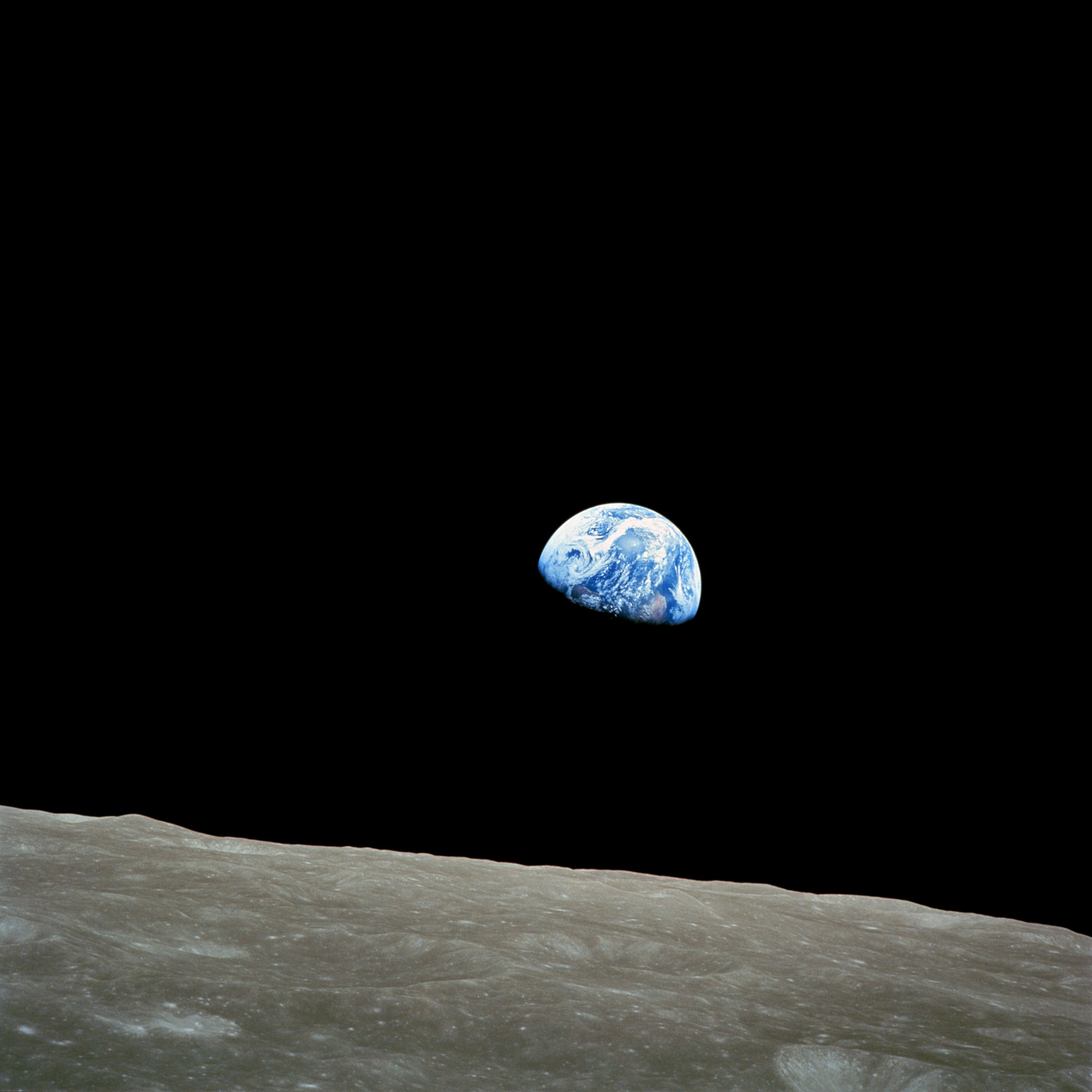
Taken by Apollo 8 crewmember Bill Anders on December 24, 1968, at mission time 075:49:07 (16:40 UTC), while in orbit around the Moon, showing the Earth rising above the lunar horizon.

Despite the current chaos caused by the coronavirus, Washington still must consider the future. Which explains the president’s new executive order that would allow private resource development on the moon and asteroids. It clearly rejects the “common heritage of mankind” rhetoric deployed by the United Nations on behalf of the Law of the Sea Treaty, which four decades ago created a special UN body to seize control of seabed resources.

The Future of Space Exploration

The EO issued earlier this month explained that

    Successful long-term exploration and scientific discovery of the Moon, Mars, and other celestial bodies will require partnership with commercial entities to recover and use resources, including water and certain minerals, in outer space.

The measure began the process of revising an uncertain legal regime which currently discourages private sector development.

The administration pointed to the 1979 Agreement Governing the Activities of States on the Moon and Other Celestial Bodies (known as the Moon treaty) and the 1967 Treaty on Principles Governing the Activities of State in the Exploration and Use of Outer Space, including the Moon and Other Celestial Bodies (typically called the Outer Space Treaty). Neither is friendly to entrepreneurs or explorers with a commercial bent.

In response, the president announced that

    Americans should have the right to engage in commercial exploration, recovery, and use of resources in outer space, consistent with applicable law. Outer space is a legally and physically unique domain of human activity, and the United States does not view it as a global commons. Accordingly, it shall be the policy of the United States to encourage international support for the public and private recovery and use of resources in outer space, consistent with applicable law.

Space is a Long-Term Prospect

The document’s main directive is for the Secretary of State, in cooperation with other agencies, to “take all appropriate actions to encourage international support for the public and private recovery and use of resources in outer space.” The secretary is to “negotiate joint statements and bilateral and multilateral arrangements with foreign states regarding safe and sustainable operations for the public and private recovery and use of space resources.”

Obviously, the administration’s attention is directed elsewhere at the moment. However, the potential benefits of turning to space are significant. The value of scientific research is obvious and continues to drive government agencies such as NASA. Launch services and space tourism have caught the interest of private operators. Such activities offer fewer legal and practical difficulties than attempting to establish some sort of long-term presence in the great beyond.

More complex development of space is a longer-term prospect. However, that makes it even more imperative to encourage innovation by creating institutions and incentives that encourage responsible development of what truly is the “final frontier.”

December 14, 2019

History of Space Travel – Guided by Starlight – Extra History – #6

Filed under: Bureaucracy, Government, History, Space, USA — Tags: , , , , — Nicholas @ 04:00

Extra Credits
Published 12 Dec 2019

What happened after we touched down on the moon? And where are we going in the future? While we may have lost the glitz and glamor of the Space Race, we have continued to make incredible progress in reaching the stars. We’ve come together to build space stations while in space, create the international space station, and started developing new technologies that could take us to Mars and beyond.

Start your Warframe journey now and prepare to face your personal nemesis, the Kuva Lich — an enemy that only grows stronger with every defeat. Take down this deadly foe, then get ready to take flight in Empyrean! Coming soon! http://bit.ly/EHWarframe

December 7, 2019

History of Space Travel – One Small Step – Extra History – #5

Filed under: History, Russia, Space, Technology, USA — Tags: , , , , , , — Nicholas @ 06:00

Extra Credits
Published 5 Dec 2019

Start your Warframe journey now and prepare to face your personal nemesis, the Kuva Lich — an enemy that only grows stronger with every defeat. Take down this deadly foe, then get ready to take flight in Empyrean! Coming soon! http://bit.ly/EHWarframe

The United States was losing the space race. A number of unfortunate missteps and mistakes had hindered their progress. But the United States had also structured its space program entirely differently from the USSR. Instead of being helmed by the military, the National Aeronautics & Space Administration was created by Eisenhower with an emphasis on exploration and research. And in the end, the later but more advanced satellites will collect the data required a dream firmly placed in the American consciousness by JFK. A dream to place a man on the moon.

From the comments:

Extra Credits
19 hours ago
The plaque still gives me goosebumps in the best way possible. Hopefully one day we can live up to its promise of peace. Be good to one another. ❤️

And thanks to Rebecca Ford (the voice of Lotus) for voicing space mom at the end of each of these episodes. They’ve been a blast to make and we hope that you all have enjoyed this trip to the stars.

November 6, 2019

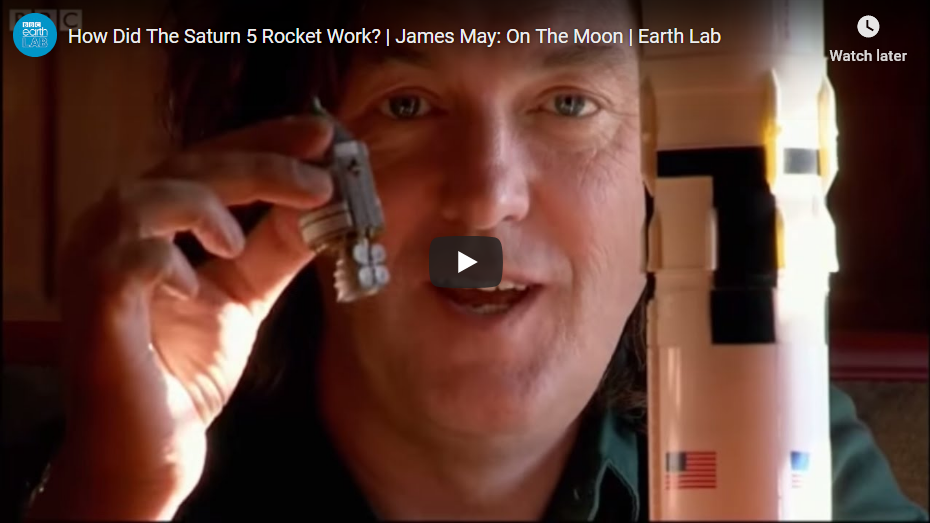
How Did The Saturn 5 Rocket Work? | James May: On The Moon | Earth Lab

Filed under: History, Space, Technology, USA — Tags: , , , , — Nicholas @ 02:00

BBC Earth Lab
Published 3 Jan 2017

James May meets Harrison Schmitt, one of the last men to ride Saturn 5 and learns a bit about the science behind a rocket with six million components.

Taken From James May: On the Moon

Welcome to BBC Earth Lab! Here we answer all your curious questions about science in the world around you (and further afield too). If there’s a question you have that we haven’t yet answered let us know in the comments on any of our videos and it could be answered by one of our Earth Lab experts.

July 20, 2019

50th anniversary

Filed under: History, Space, Technology, USA — Tags: , , — Nicholas @ 11:41

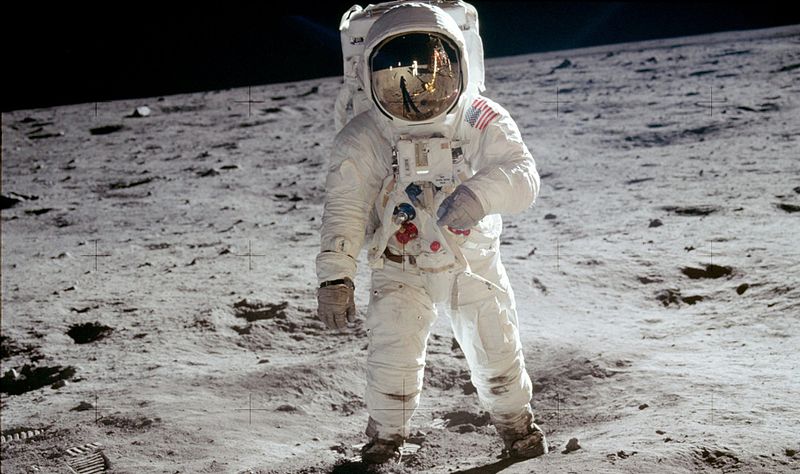
Astronaut Buzz Aldrin, lunar module pilot, stands on the surface of the moon near the leg of the lunar module, Eagle, during the Apollo 11 moonwalk. Astronaut Neil Armstrong, mission commander, took this photograph with a 70mm lunar surface camera. While Armstrong and Aldrin descended in the lunar module to explore the Sea of Tranquility, astronaut Michael Collins, command module pilot, remained in lunar orbit with the Command and Service Module, Columbia. *This is the actual photograph as exposed on the moon by Armstrong. He held the camera slightly rotated so that the camera frame did not include the top of Aldrin’s portable life support system (“backpack”). A communications antenna mounted on top of the backpack is also cut off in this picture. When the image was released to the public, it was rotated clockwise to restore the astronaut to vertical for a more harmonious composition, and a black area was added above his head to recreate the missing black lunar “sky”. The edited version is the one most commonly reproduced and known to the public, but the original version, above, is the authentic exposure.

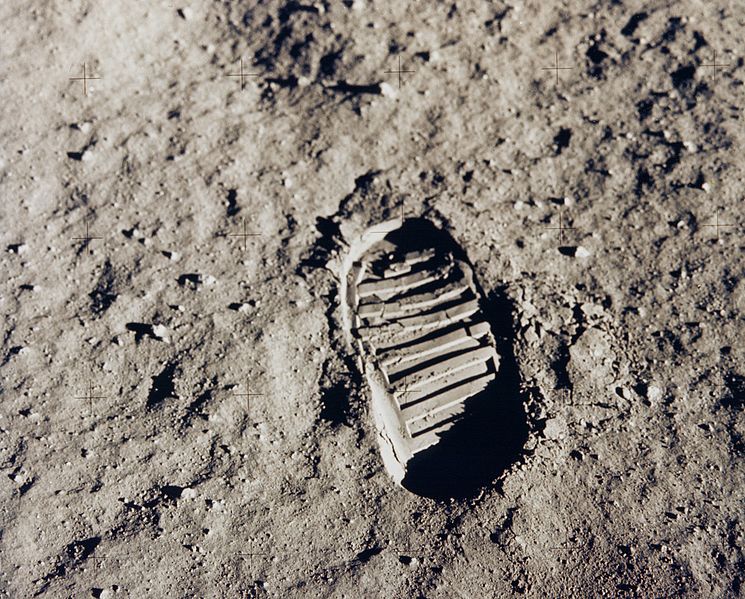
Bootprint in lunar dust created and photographed by Buzz Aldrin for the boot penetration (soil mechanics) task during the Apollo 11 moon walk.

Older Posts »

Powered by WordPress