Quotulatiousness

March 13, 2025

“Canadian liberalism has been regime ideology since at least Lester B. Pearson in 1963”

Filed under: Cancon, Media, Politics — Tags: , , , — Nicholas @ 03:00

Fortissax on “Leaflibs & Puckstick Patriots”:

The past week has been very special because something happened in Canada. This something is not anything I could have anticipated, but I find myself not particularly surprised. Prime Minister Justin Trudeau propped up the husk of Jeff Douglas like an old Fisher King from some retelling of Arthurian legend. Jeff Douglas is famous for his appearance in the Molson Canadian beer commercial, released in the year 2000. This commercial was possibly the hardest-hitting, if not among the top hardest-hitting, propaganda pieces ever produced in service of regime ideology. That regime ideology is Canadian liberalism — a form of left-liberalism that emerged out of the Second World War, in direct contradiction to American right-liberalism.

Many American correspondents have asked me to explain why it seems like liberals are patriotic in Canada, while conservatives are not. The answer is simple: Canadian liberalism has been regime ideology since at least Lester B. Pearson in 1963, Pierre Trudeau’s predecessor, who laid the groundwork for a sinister, transformative cultural revolution — the likes of which I can only compare to the USSR or Communist China.

What occurred in this era was a complete and total restructuring of society — an absolutely Orwellian mind-wipe of Canadian identity, a retconning of Canadian history, culminating in the explicit purpose of erasing the historic Canadian nation. So successful was this cultural revolution that, for my entire 30 years of life, the narrative has been that Canada is an illegitimate, post-national state on stolen land. Paradoxically, the people are viciously patriotic toward the hollow state, whose newfound identity obsesses over its own dissolution, its symbols and icons mostly channeled into corporate brands and products, like Canadian Tire, fast food chains like Tim Hortons, and the timeless bread and circuses of hockey.

Canada was transformed into an international economic zone of individuals with relatively maximal allotments for personal fulfilment — including the most licentious, disgusting, and degenerate, as long as it remains acceptable within the Overton window of the time.

A cornerstone of this identity is precisely outdoing the U.S. in how liberal it can be — true to the end goal of transnational liberals like Francis Fukuyama in The End of History and the Last Man. In this 63-year era, there are two archetypes of the average man or woman. These archetypes manifest as more moderate, more common versions of the populist American wannabe or the neurotic DEI cultist I discussed in my other article. These are what I’ve coined “leaflibs” and “puckstick patriots”. They represent the centre-left liberal and centre-right liberal majority of Canada.

There is often overlap between the two, but what they have in common is an extreme ignorance of Canadian and world history and national identity. Both regularly partake in the communion of the left-liberal civic religion but do so in different ways. They are also united in that the vast majority of information they obtain about local, regional, and national politics comes from legacy media outlets like the Canadian Broadcasting Corporation (state-owned, publicly funded broadcaster), CTV, and Global News — old-school news outlets whose private owners and shareholders differ little in belief.

What the Canadian ruling classes have in common is that they are extremely insular and scarcely interact with the public. In many ways, Canada resembles European countries. Canadians were, for a long time, educated along stratified British class lines, and everyone knew their place. Canada’s national value is Order, not Liberty, and traditionally, society functioned as a collective, organic whole in a proper communitarian model, where the social expectation of the enlightened and powerful elites was to tend to their responsibilities of responsible government.

Let’s discuss these two “normie” archetypes. International readers, especially Americans, may notice parallels with their own mainstream liberal and conservative, yet otherwise ill-informed, media-consuming relations.

March 12, 2025

Free speech in Canada takes yet another hit, as Palestinian activists granted special protections

In the National Post, Tristin Hopper outlines the jaw-dropping contents of the Guide to Understanding and Combatting Islamophobia published by the federal government recently:

The federal government has dropped a new guide that, according to critics, deems it “racist” to criticize Palestinian advocacy or extremism.

The guide also defines both “sharia” and “jihad” as benign terms that are misrepresented by Westerners, with sharia defined as a means “to establish justice and peace in society”.

It’s contained in “The Canadian Guide to Understanding and Combatting Islamophobia“, a document published last week by the Department of Canadian Heritage.

The report endorses the idea of “anti-Palestinian racism”, an activist term with such a broad definition that it technically deems any criticism of Palestinians or “their narratives” to be racist.

“Public discourse often unfairly associates Palestinian and Muslim identities with terrorism,” reads the guide.

The new guide specifically links to a definition of the term circulated by the Arab Canadian Lawyers Association. Their 99-word definition says that it’s racist to link the Palestinian cause to terrorism, to describe it as “inherently antisemitic” or to say that Palestinians are not “an Indigenous people”.

The term is broad enough that merely acknowledging the existence of Israel could fall under its rubric. The definition describes the Jewish state as “occupied and historic Palestine”, and its creation as “the Nakba” (catastrophe). “Denying the Nakba” is specifically cited as one of the markers of “anti-Palestinian racism”.

In a March 4 statement criticizing the new federal report, the Centre for Israel and Jewish Affairs (CIJA) said that the term is so vague that “denouncing Hamas – the terrorists behind the October 7 massacre – could be portrayed as an act of racism”.

The new report was praised, meanwhile, by the vocally anti-Israel Centre for Justice and Peace in the Middle East, which called Ottawa’s embrace of the term anti-Palestinian racism “groundbreaking.”

“We are extremely pleased that Canada, through this guide, finally recognizes the unique racism that Palestinians experience daily,” said the group’s acting president Michael Bueckert.

The federal government’s new guide writes that Canada’s “understanding of anti-Palestinian racism” is growing, and directs readers to a 2022 report on the phenomenon by the Arab Canadian Lawyers Association.

March 11, 2025

Could even William Shakespeare rescue Hollywood?

Filed under: Business, History, Media, USA — Tags: , , , , — Nicholas @ 03:00

Ted Gioia laments the apparent death of creativity in Hollywood over the last few decades:

They need somebody like Bill Shakespeare in Hollywood today.

That’s not as crazy as it sounds. We know very little about the Bard of Avon, but these facts are indisputable:

  • He worked successfully in the entertainment business for 30 years.
  • He mastered the art of the deal — all six of his surviving signatures come from legal documents.
  • He handled money wisely, as entrepreneur, grain merchant, property owner, money lender, etc.
  • He still sells tickets today — more than 400 years after his death.

Not even Harvey Weinstein can match that track record.

And — best of all—Shakespeare didn’t let business get in the way of creativity. He knew how to make a buck without compromising his Bard status.

Here’s another fact about Shakespeare: He never used the words “intellectual property” or “content” or “brand franchise”.

I was reminded of that recently when I encountered this headline in The Hollywood Reporter.

I’ve often accused the entertainment industry of abandoning creativity — and turning into boring IP [intellectual property] management companies run by lawyers, bankers, and accountants.

But they don’t even hide it anymore.

There was a day when they pretended to care about artistry — seeking out fresh talent and bold new ideas. But today it’s the exact opposite. They actually want content.

(This is where I concur with Barbara Broccoli, who had creative control over the James Bond films until last week. She forced Amazon execs to buy her out, after she called them “fucking idiots”. This outburst happened in response to the head of Amazon Studios describing the Bond films as content.)

So I read the Bain report and wept. So would Shakespeare — he would rage like King Lear on the heath if he saw a sentence like this:

    [Media] companies are essentially themselves converging to compete with the tech media platforms; they’re also acquiring to gain more evergreen IP that can be used across modalities. By owning these cross-sector assets and IP, they create fan communities and multimodal content …

I thought content was bad enough. But we’re now dealing with multimodal content.

That sounds like one of the seven plagues of ancient Egypt — a step above locusts, but definitely worse than frogs and hail. Somebody at the consultancy deserves to be smote down at bonus time.

March 10, 2025

“I, for one, welcome our new unelected globalist technocratic overlord”

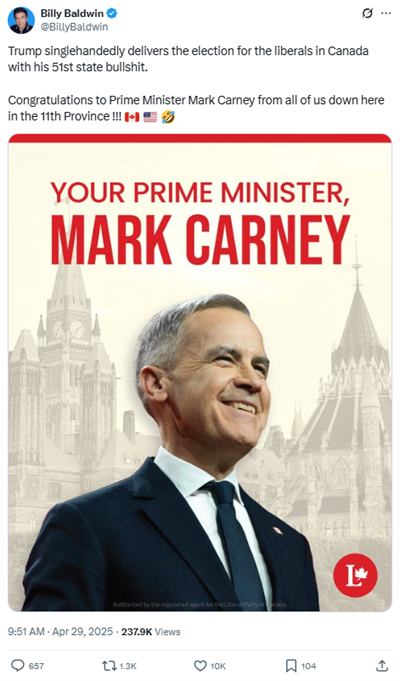
With a resounding 99% 85.9% of the voters whose votes were allowed, Maximum Leader Mark Carney has finally been elected to a position for the first time in his adult life:

With the support of most of Justin Trudeau’s team, Carney has been ushered in to continue on with more of Trudeau’s signature economic policies, the ones Carney has been advising Trudeau on since 2020.

Yes, Carney said that he will scrap the capital gains tax changes that have hurt so many small business owners, but that had to go. He also promised to drop the consumer carbon tax but would also increase the industrial carbon tax, a move that will have the same impact on manufacturing industries like steel as Donald Trump’s tariffs.

Few Canadians will know about the discrepancy in Carney’s plan or any others because there has never been a leader in this country elected to such high office with so little vetting. Carney preferred speeches and rallies over news conferences and interviews with U.S. media outlets over Canadian ones because the interviewer would know little about Canadian politics.

When he wasn’t appearing on The Daily Show or the podcast of Trump’s short-lived spokesman Anthony Scaramucci, Carney preferred to speak to friendly liberal media outlets like CBC. While the media narrative is that Carney has reinvigorated the Liberal party and closed the polling gap with Pierre Poilievre’s Conservatives, neither claim is demonstrably true.

While more than 400,000 people signed up as “registered Liberals” to vote in this nomination process, just over 151,000 actually took the time to vote. This is a chance to pick the next prime minister of our country at a time when we are facing a threat to our sovereignty and a threat to our economic future, yet our next PM was chosen by so few people.

By comparison, the last Conservative leadership race saw more than 400,000 people vote with 295,285 ballots cast for Poilievre alone. Sure, it might have been a longer timeline, but the stakes – becoming leader of the official Opposition with no election in sight – were much smaller.

In the National Post Chris Selley doesn’t seem to be a fan of the new unelected leader of the federal government (assuming that Justin Trudeau will actually step down, of course):

Every speaker of note [at the Liberal leadership hootnanny], from the four leadership candidates to outgoing leader Justin Trudeau to former prime minister Jean Chrétien, who held the room in the palm of his hand for what felt like a day and a half, mentioned the need for Canadians to stand together, united and altogether resolute against the threat of Donald Trump’s tariffs.

At the same time, of course, Liberals were insisting that the Conservatives — who have as much or more support nationwide, and until recently had a lot more — are bent on destroying all that’s good and holy about this country. That isn’t really a unifying message.

“Pierre Poilievre just doesn’t get it,” Carney averred in his victory speech. “He is the type of life-long politician … who worships at the altar of the free market without having made a payroll himself. And now … at a time of immense economic insecurity, he would undermine the Bank of Canada. Poilievre has called for the shutting down of CBC at a time when disinformation and foreign interference are on the march. He insults our mayors and ignores our First Nations.”

“A person who worships at the altar of Donald Trump will kneel before him, not stand up to him,” Carney said of Poilievre, who has been raining invective on Trump just as fast as he can in recent days — and indeed someone whom Trump himself denigrated in recent days as “not a MAGA guy”.

Oh, and Carney said “Pierre Poilievre would let our planet burn” — on the same night he promised to axe the consumer carbon tax as a first order of business.

Other than all that, though, we’re in it together. Okey-dokey.

Dan Knight is even less impressed:

And here’s where it gets even better. The polling — oh, the polling. For months, the Liberals have been sinking. Before Trudeau resigned, they were floundering at 24% support. Then, magically, within days of picking a new leader, they skyrocket to 33%? A 9-point jump in the blink of an eye? Wow, what a coincidence! You mean to tell me that the same Canadians who couldn’t be bothered to sign up for a free membership, the same Canadians who have overwhelmingly turned against this party, suddenly decided they’re on board again — just because the party swapped one out-of-touch elitist for another?

No. That’s not how this works. That’s not how enthusiasm works.

This isn’t some grand Liberal resurgence. This is the Liberal-friendly media manufacturing a comeback narrative because their government subsidies depend on it. The same journalists who screamed for years about the Conservative “far-right” threat are now bending over backwards to convince you that Mark Carney is a fresh outside

And you know what? Maybe if they had actually let Ruby Dhalla into this race, they would’ve stood a chance. Seriously. I had to do a double-take when I looked at her policies — supporting small business, tough on crime, actual immigration regulation — I mean, that’s how you win the center. That’s how you stop a Conservative majority and turn it into a minority government. If they had let her run, we’d be having a very different conversation right now.

But what did the Liberals do? Oh, they disqualified her over — get this — campaign finance irregularities. But guess what? They kept the money. That’s right. The party flagged “violations”, kicked her out, and then conveniently pocketed the cash. If that’s not the most Liberal Party thing I’ve ever heard, I don’t know what is.

Can you feel the Carneymentum? It’s supposed to sweep the land from sea to sea to sea … any minute now.

Rome (2004): HBO’s Untold 5 Season Story

Filed under: Business, History, Italy, Media — Tags: , , , , , — Nicholas @ 02:00

Little Wars TV
Published 6 Sept 2024

HBO’s Rome is one of the greatest television shows ever made, but the premium network infamously cancelled Rome after just two seasons. It is a decision HBO executives later admitted was a mistake. In this video essay, we explore why HBO cancelled Rome and what the showrunners envisioned as the full, five-season story arc. Which characters were meant to survive? What historical storylines would have been explored? And what was the show’s final scene supposed to be at the end of five seasons?

We’ll unearth interviews with Bruno Heller and William J MacDonald, hear from actors like Kevin McKidd, and attempt to piece together a vision of Rome‘s full potential if HBO had not cancelled the show prematurely.
(more…)

March 9, 2025

Mark “the human snooze button” Carney

Filed under: Cancon, Media, Politics — Tags: , , , , — Nicholas @ 03:00

In the National Post, Chris Selley explains the attraction of a Mark Carney-led Liberal Party to mainstream Canadians:

Then-Governor of the Bank of Canada Mark Carney at the 2012 Annual Meeting of the World Economic Forum in Davos, Switzerland.
WEF photo via Wikimedia Commons.

Ironically I suspect what Poilievre is up against is one of the most basic and powerful forces in Canadian politics: conservatism, but in one of its purest forms, namely suspicion of change — especially in a crisis. Recall that Canada saw 10 elections during the pandemic — one federal and nine provincial. The incumbent parties won eight of them, in some cases even as their health-care and long-term care systems collapsed on their heads and their “pandemic preparedness” folders turned out to contain nothing but some old Calvin and Hobbes cartoons.

No question, there are problems here specific to Poilievre and the Conservatives. The Royal Order of Laurentian Elites nearly fainted when Poilievre started saying “Canada is broken”, but people seemed to calm down about it and engage with it once it became clear most Canadians agreed: 70 per cent, according to a Postmedia-Leger poll last year.

Saying “Canada is broken” nowadays is likely to get you branded a traitor by a mob of people who think Beaver Tails, Tim Horton’s, Molson advertisements and a Tragically Hip playlist comprise a national identity. Canada can be broken and Trump can be a lunatic at the same time, but nationalist outbursts have little time for such nuance.

[…]

Change is unavoidable in the forthcoming election, of course. And by rights, Canadians should want it: Like COVID, Trump’s demands on border security and military spending, and his obviously sincere belief in the power of tariffs — as untethered from reality and sense as these demands are — have exposed massive weaknesses on our part that we should want to fix for our own sake. Poilievre should speak more to us about those fixes.

Mark Carney never made any sense to me as a potential saviour for the Liberals. The most obvious recent event they needed to replicate was Kathleen Wynne’s jaw-dropping majority win in 2014 for the Ontario Liberals, after Dalton McGuinty had driven the party into a pond and left it there to drown. Wynne was a proven, veteran campaigner. Carney is … well, certainly not an “outsider”, but this is his first go at politics, and it certainly hasn’t all been smooth sailing.

But Carney seems set to win the party’s leadership race on Sunday, anyway. He’s boring, and he’s a technocrat, and Trudeau is neither. And neither is Poilievre. A boring technocrat might well look like a safe harbour for a lot of Canadians. Poilievre needs to put a more positive spin on the changes we so desperately need.

March 8, 2025

Kevin Zucker on “The Big Fat Surprise”

Filed under: Media, Politics, USA — Tags: , , , , , — Nicholas @ 03:00

I just got the most recent free Wargame Design PDF from Operational Studies Group and found that Kevin Zucker, the head of the company and one of the best wargame designers ever, had indulged in a little bit of non-wargame writing to open this issue:

For decades, Teicholz tells us,

    … we have been told that the best possible diet involves cutting back on fat, especially saturated fat, and that if we are not getting healthier or thinner it must be because we are not trying hard enough. But what if the low-fat diet is itself the problem? What if the creamy cheeses, the sizzling steaks are themselves the key to reversing the epidemics of obesity, diabetes, and heart disease? Misinformation about saturated fats took hold in the scientific community, but recent findings have overturned these beliefs. Nutrition science has gotten it wrong, through a combination of ego, bias, and premature consensus, allowing specious conclusions to become dietary dogma.1

We are conditioned to think that some specialist always knows better than we do. Despite the common wisdom, I always ate butter, not margarine, despite the “experts”, because I trusted my instincts.2 With experts influencing you to disregard your senses and what you already know, you can learn to believe the opposite of what is natural and true … “Boys and girls are the same”; “men and women are the same”. The French structuralists, who have somehow taken over academia, talk as if the whole world is merely a verbal construct, and whatever we speak becomes literally true if repeated enough.3

In the 1960’s and ’70’s, males joined the feminine on a quest for identity through music, love and drugs. I too was taken-in by the “men and women are the same” argument, and fancied myself a feminist. For me, that illusion was eventually shattered upon contact with reality. Today, instead of liberation, in many quarters the feminine principle is actively denied and suppressed; to prove a point, many women have short-circuited their feminine side, while masculinity is reviled as toxic. So now we have feminized men and masculine women, and neither side is happy. Seventy percent of divorces are initiated by women.

During the recent campaign, women’s anger was used to divide the sexes. A wife filed for divorce in November because her spouse voted for the wrong candidate. Supporters of the two sides cannot even be in the same house, much less discuss their differences rationally. After all, someone might get “triggered”, a brand-new coinage that promotes a fatal lack of reflection. The media have abandoned the fig leaf of nuance and balance and have hit their stride in stirring up fear and polarizing hatred.

The main tool of the demagogue is to stir up one group against another: divide and conquer. How does a society remove the influence of demagogues? History shows that once democracy is destroyed, it doesn’t just grow back. Undemocratic methods, such as censorship, brainwashing, propaganda, and the stifling of dissent, cannot “protect” democracy — just the opposite. A government is only an instrumentality of power, and it is only as democratic as its administrative cogwheels. Power is either administered democratically or it is usurped by a strong man, by the administrative state, or by oligarchs such as the World Economic Forum (who meet regularly in Davos, Switzerland). So that is the choice we face at the moment. Ten years ago, a study by professors Martin Gilens and Benjamin Page found America to be no longer a democracy, but a functional oligarchy. Aside from the eternal vices of greed and projection, we urgently need a strong repudiation of the folly of structuralism. This conversation should be taking place in academia, whose original purpose was to foster such discussions, but academia has now become the stronghold of “safe spaces” where open dialogue cannot be held.

The main reason for studying history, in my view, is to understand the present moment: Where are we, where did we come from, how did we get here, where are we going?4

Today, I am hopeful, for the first time since January 2009. In a chat with my good friend John Prados, I remarked, “Surely, like the proverbial stopped clock, by sheer accident, Trump might be correct about a few things”.

“No, Kevin, everything he says is a calculated lie,” reducing politics to a cartoonish level. We are, after all, the first generation raised on cartoons, where good and evil are simplistically segregated into representative types. Donald Trump has been cast as “Bluto”. The President has certainly brought grist for the mill by his tweet of 15 February, echoing Napoleon: “He who saves his country does not violate any law”.5 We might not have Trump in office today if his first campaign hadn’t been assisted by the Clinton machine in 2016. He was the candidate they wanted to run against, so they promoted his tweets and made a star out of him — just to help him in the primaries. Unfortunately, they created a monster.

It is obvious that the two candidates in the recent election are not the best our country has to offer. This reveals the absolute corruption of the political system. It has been obvious for some time that most of our institutions are vastly corrupt, with disastrous consequences for all of us. As a historian it is not my job to take sides or make predictions about the future. In my view, no one can predict the future: neither of the stock market, nor even tomorrow’s weather. A historian has to be concerned with facts, known, established and well-documented, not gloomy prognostications. Many pundits make their gravy by spouting dire predictions, but there is no one to hold them to account if they are inaccurate or flat-out lies. The voices of hysteria are still tooting like they hadn’t been repudiated at the ballot box.

I was asked recently, which sources of information I trust. I don’t trust any of them. I agree with Suzanne Massie, a scholar of Russian history: “Trust, but verify”. With historical research, a single source is insufficient, especially on controversial issues. As you dig deeper, you find a more three-dimensional view that often lays bare the simplistic assumptions of your primary source.

I cannot claim to have any particular insight into the first five weeks of the Trump Administration, but I look forward to seeing how it all turns out.


    1. The Big Fat Surprise: Why Butter, Meat and Cheese Belong in a Healthy Diet, Simon & Schuster, 2014. Nina Teicholz

    2. Margarine can also affect the nervous system and lead to depression and mental illness.

    3. https://humanidades.com/en/structuralism/

    4. D’où Venons Nous, Que Sommes Nous, Où Allons Nous — Paul Gauguin

    5. Celui qui sauve sa patrie ne viole aucune loi—Maximes et pensées de Napoléon by Honoré de Balzac (1838), a compilation of aphorisms attributed to the emperor.

March 7, 2025

Trump marks the overdue end of the Long Twentieth Century, part 2

Filed under: History, Media, Politics, USA — Tags: , , , , , — Nicholas @ 05:00

In The Conservative Woman, N.S. Lyons continues his essay contending that the arrival of Donald Trump, version 2.0, may finally end the era we’ve been living in since immediately after the end of WW2:

The Long Twentieth Century has been characterized by these three interlinked post-war projects: the progressive opening of societies through the deconstruction of norms and borders, the consolidation of the managerial state, and the hegemony of the liberal international order. The hope was that together they could form the foundation for a world that would finally achieve peace on earth and goodwill between all mankind. That this would be a weak, passionless, undemocratic, intricately micromanaged world of technocratic rationalism was a sacrifice the post-war consensus was willing to make.

That dream didn’t work out, though, because the “strong gods” refused to die.

Mary Harrington recently observed that the Trumpian revolution seems as much archetypal as political, noting that the generally “exultant male response to recent work by Elon Musk and his ‘warband’ of young tech-bros” in dismantling the entrenched bureaucracy is a reflection of what can be “understood archetypally as [their] doing battle against a vast, miasmic foe whose aim is the destruction of masculine heroism as such”. This masculine-inflected spirit was suppressed throughout the Long Twentieth Century, but now it’s back. And it wasn’t, she notes, “as though a proceduralist, managerial civilization affords no scope for horrors of its own”. Thus now “we’re watching in real time as figures such as the hero, the king, the warrior, and the pirate; or indeed various types of antihero, all make their return to the public sphere”.

Instead of producing a utopian world of peace and progress, the open society consensus and its soft, weak gods led to civilizational dissolution and despair. As intended, the strong gods of history were banished, religious traditions and moral norms debunked, communal bonds and loyalties weakened, distinctions and borders torn down, and the disciplines of self-governance surrendered to top-down technocratic management. Unsurprisingly, this led to nation-states and a broader civilization that lack the strength to hold themselves together, let alone defend against external threats from non-open, non-delusional societies. In short, the campaign of radical self-negation pursued by the post-war open society consensus functionally became a collective suicide pact by the liberal democracies of the Western world.

But, as reality began to intrude over the past two decades, the share of people still convinced by the hazy promises of the open society steadily diminished. A reaction began to brew, especially among those most divorced from and harmed by its aging obsessions: the young and the working class. The “populism” that is now sweeping the West is best understood as a democratic insistence on the restoration and reintegration of respect for those strong gods capable of grounding, uniting and sustaining societies, including coherent national identities, cohesive natural loyalties, and the recognition of objective and transcendent truths.

Today’s populism is more than just a reaction against decades of elite betrayal and terrible governance (though it is that too); it is a deep, suppressed desire for long-delayed action, to break free from the smothering lethargy imposed by proceduralist managerialism and fight passionately for collective survival and self-interest. It is the return of the political to politics. This demands a restoration of old virtues, including a vital sense of national and civilizational self-worth. And that in turn requires a rejection of the pathological “tyranny of guilt” (as the French philosopher Pascal Bruckner dubbed it) that has gripped the Western mind since 1945. As the power of endless hysterical accusations of “fascism” has gradually faded, we have – for better and worse – begun to witness the end of the Age of Hitler.

“The Resistance” achieves lame nirvana

Filed under: Media, Politics, USA — Tags: , , , — Nicholas @ 04:00

President Donald Trump is a boisterous, noisy distraction in so many ways and rubs a heck of a lot of people the wrong way in everything he does … and yet the politicians who oppose him seem to be engaged in a scientific experiment to discover just how cringeworthy they can be:

“REMINDER: It Is Offensive And Possibly Illegal To Photoshop Anything On These Democrats’ Signs That Would Make Them Look Foolish.
The Babylon Bee, https://x.com/TheBabylonBee/status/1897140039777239181/photo/1

Remember when the phrase “the Resistance” would conjure up visions of sexy French youths in berets battling actual Nazis? Now all it brings to mind is ageing dullards in pink suits holding up signs saying “This is not normal” while sporting the most turbo-smug look on their faces. As US president Donald Trump spoke to a joint session of Congress last night, “across the aisle the Resistance was stirring”, gushed the Guardian‘s DC reporter. His piece was illustrated with a pic of some congresswoman in pearls and a balding Democrat looking aghast as Trump talked. Seriously, if this is “the Resistance”, the world’s tyrants can rest easy.

Yesterday’s “Democrat fightback” and “resistance to Trump’s rhetoric” – journalists are literally calling it that – was next-level cringe. It occurred during Trump’s 100-minute speech, the longest Congress talk in 60 years. As Trump bashed Joe Biden and bigged up Elon Musk, the Dems came over all soixante-huitard. Fury coursed through their ranks. Then the revolt started. The Squad’s Rashida Tlaib held up a scrawled sign saying “That’s a lie!”. Dem representative Al Green “shook his cane and pointed his finger” and cried “You have no mandate” to cut Medicaid. How the regime must have quaked at the sight of this revolution!

The way some hacks are talking about this tantrum masquerading as a protest you’d think it was a modern-day storming of the Bastille. The Dems’ “stirring” acts of rebellion will have “given hope to the Resistance” and sent a message to “the world”, said the Guardian. Nurse! Even leftists who’ve been disappointed with the Dem establishment seemed to get a moral kick from this political pantomime. So far, the “resistance” to the Trumpist tyranny has been “splintered”, but now we know it’s “getting better”, fawned Vox. Perhaps, it said, we’ll soon see the “aggressive resistance” we really need.

Can these people hear themselves? Overpaid politicians holding up mass-produced black placards with hackneyed complaints like “False” and “Liar” are not “the Resistance” – they’re the establishment cosplaying as campus radicals for likes and headlines. In one especially squirming scene, some Dems “removed their outer business wear” to reveal black t-shirts with the word “RESIST” in “bold white letters”. Their delusions of radicalism are off the scale. Resistance is when young Iranian women rip off their hijabs or Kurdish revolutionaries fight the neo-fascists of ISIS, not when politicians on $174,000 a year put on a t-shirt their stressed intern ordered from some hip printer on 7th Street.

Bricking the internet

Filed under: Business, Media, Technology — Tags: , , , , , — Nicholas @ 03:00

In The Line, Phil A. McBride explains how the “net giants” have steadily nibbled away at the built-in resilience of the original internet design so that we’re all far more vulnerable to network outages than ever before:

The Internet was originally conceived in the 1960s to be a resilient, disparate and distributed network that didn’t have any single point of failure. This is still true today. While there are large data centres around the world that aggregate traffic, we don’t depend on them. If one were to go offline, things would slow down, but the data would still flow.

The advent of the cloud, though, has completely changed how we use the Internet, especially in the worlds of business, education and government. And the cloud, alas, is not nearly as resilient.

Fifteen years ago, your average small or medium business would have their own servers. Those servers would be used to send/receive email, store files, and run various business or collaborative applications. Some of these servers may have been hosted offsite at a data centre to provide better security or speed of access, but the physical infrastructure belonged to someone — it was something you could touch and, more importantly, account for. Many companies kept their servers on site.

If a company’s server or network went down, it affected that company. They couldn’t send or receive email, they couldn’t open files, collaborate with staff or clients. They were offline.

But only they were offline.

Fast forward to today. Microsoft 365 dominates the corporate productivity services market with an estimated 45-50 per cent market share worldwide, with Google Workspace coming second, with around 30-35 per cent. This means that approximately 80 per cent of businesses are dependent on one of two vendors for their ability to transact business and communicate at even the most basic level.

Government and government-provided services, like education, health care and defence, are just as reliant on these services as the business world.

In today’s world, when Microsoft’s or Google’s services suffer a hiccup, it doesn’t affect one business. Or ten, or a hundred. Tens of thousands of business, and government offices and civil society institutions, all go offline. Simultaneously. Mom-and-pop stores, multi-billion-dollar corporations, elementary schools, hospitals, entire governments, all go out, all at once.

And we haven’t even talked about how Amazon, Microsoft and Google control almost two-thirds of the world’s web/application hosting market share. If one or all of those services go down, most of the websites you go to on a regular basis would suddenly become unreachable.

Kinda-sorta related to the above is Ted Gioia‘s “State of the Culture” post:

So remember the first rule: The culture always changes first. And then everything else adapts to it.

That’s why teens plugged into the most lowbrow culture often grasp the new reality long before elites figure it out. This was true 50 years ago, and it’s still true today.

So that’s our second rule: If you want to understand the emerging culture, look at the lives of teens and twenty-somethings — and especially their digital lives. (In some cases those are their only lives.)

The web has changed a lot in recent years, hasn’t it? Not long ago, the Internet was loose and relaxed. It was free and easy. It was fun. There wasn’t even an app store.

We made our own rules.

The web had removed all obstacles and boundaries. I could reach out to people all over the world.

The Internet, in those primitive days, put me back in touch with classmates from my youth. It reconnected me with friends I’d made during my many trips overseas. It strengthened my ties with relatives near and far. I even made new friends online.

It felt liberating. It felt empowering.

But it also helped my professional life. I had regular exchanges with writers and musicians in various cities and countries—without leaving the comfort of my home.

I made new connections. I opened new doors.

And this didn’t just happen to me. It happened to everybody.

“The world is flat,” declared journalist Thomas Friedman. All the barriers were gone — we were all operating on the same level. It felt like some imaginary Berlin Wall had fallen.

That culture of flatness changed everything. Ideas spread faster. Commerce moved more easily. Every day I encountered something new from some place far away.

But then it changed.

Twenty years ago, the culture was flat. Today it’s flattened.

I still participate in many web platforms — I need to do it for my vocation. (But do I really? I’ve started to wonder.) But now they feel constraining.

Even worse, they now all feel the same.

Instead of connecting with people all over the world, I now get “streaming content” 24/7.

Facebook no longer wants me stay in touch with friends overseas, or former classmates, or distant relatives. Instead it serves up memes and stupid short videos.

And they are the exact same memes and videos playing non-stop on TikTok — and Instagram, Twitter, Threads, Bluesky, YouTube shorts, etc.

Every big web platforms feels the exact same.

That whole rich tapestry of my friends and family and colleagues has been replaced by the most shallow and flattened digital fluff. And this feeling of flattening is intensified by the lack of context or community.

The only ruling principle is the total absence of purpose or seriousness.

The platforms aggravate this problem further by making it difficult to leave. Links are censored. Intelligence is punished by the dictatorship of the algorithms. Every exit is blocked, and all paths lead to the endless scroll.

All this should be illegal. But somehow it isn’t.

March 6, 2025

As Trump’s tariffs begin to bite, Canadians strike back at … King Charles and Wayne Gretzky?

Filed under: Cancon, Media, Politics — Tags: , , , , , — Nicholas @ 03:00

As if more evidence were needed that Canadians aren’t well-served by our political leaders, social media personalities and legacy media types are pointing at uninvolved figures to be rounded up as the targets of maple-flavoured Two Minutes’ Hate sessions:

Canada’s latest Emmanuel Goldstein replacement, “The Great One” aka Wayne Gretzky

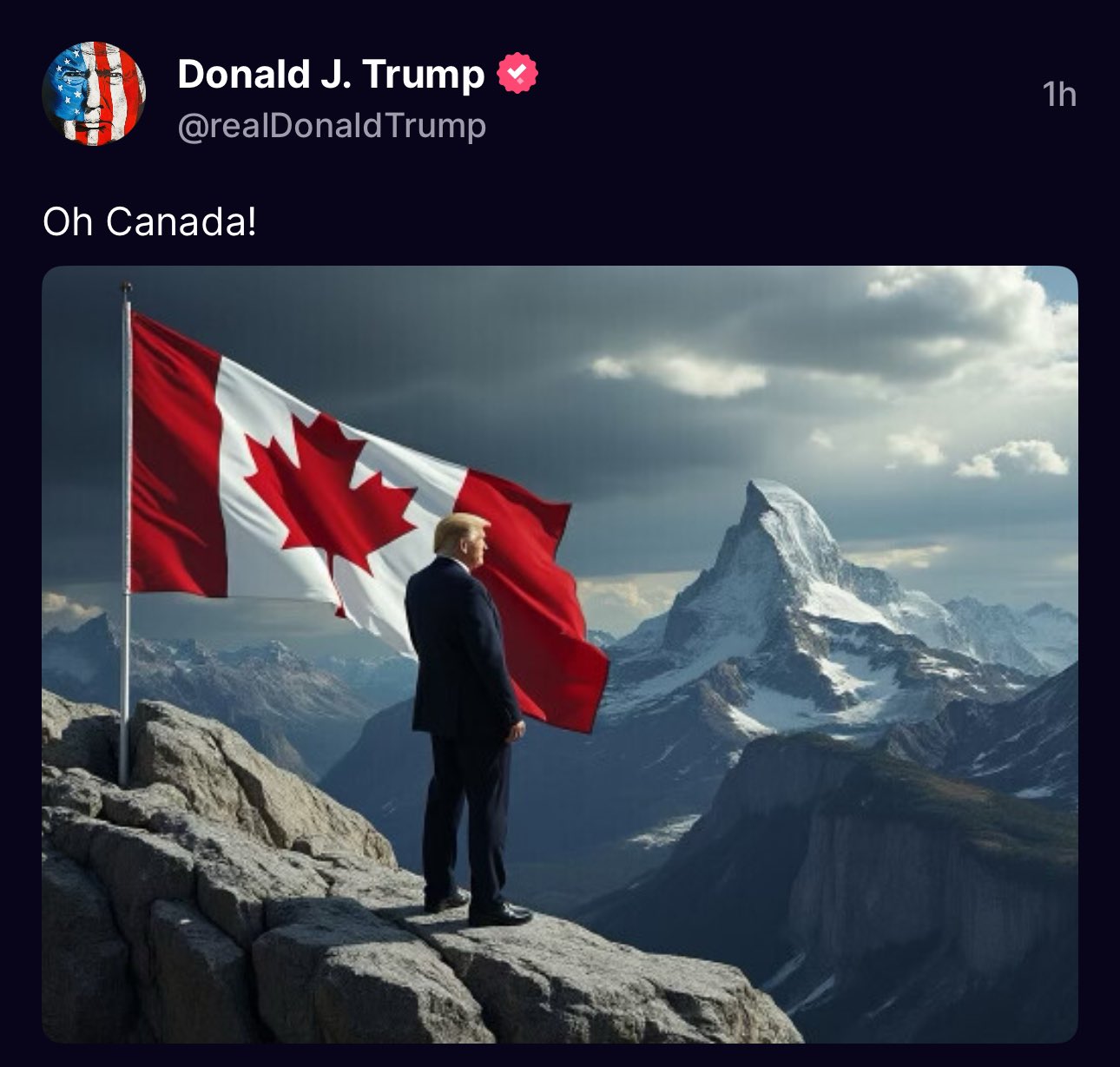
You can’t have an outburst of nationalism without purity tests coming into play, and two prominent Canadian figures have failed theirs in the court of chattering-class opinion: Wayne Gretzky and King Charles III, of all people.

In recent consecutive days, hilariously, The Globe and Mail‘s website published the following headlines to its online readers’-letters pages: “Wayne Gretzky’s fall from grace is a long time coming”; “Let Wayne Gretzky feel some pain”; and “Wayne Gretzky has always been held in the highest regard … now, he is dead to me”.

Gretzky is friendly with President Trump, you see, which is unacceptable. And if Gretzky isn’t willing to publicly disavow Trump, he should be using his influence to sit Trump down and explain that Canada will never be the 51st state … at which point, presumably, something useful is supposed to happen. It’s never clear what that useful thing would be, beyond a cheap nationalist thrill.

Gretzky’s Yankeeism was confirmed when he served as honorary captain of Team Canada in the final game of the 4 Nations tournament in Boston. (Imagine if he hadn’t served as honorary captain!) He gave the American players a thumbs up — which in any other context would have been considered simple good sportsmanship. He didn’t wear a Team Canada sweater, but rather a suit — which in any other context wouldn’t even have been noticed. He didn’t wear his Order of Canada pin — well, now we’re just grasping at straws.

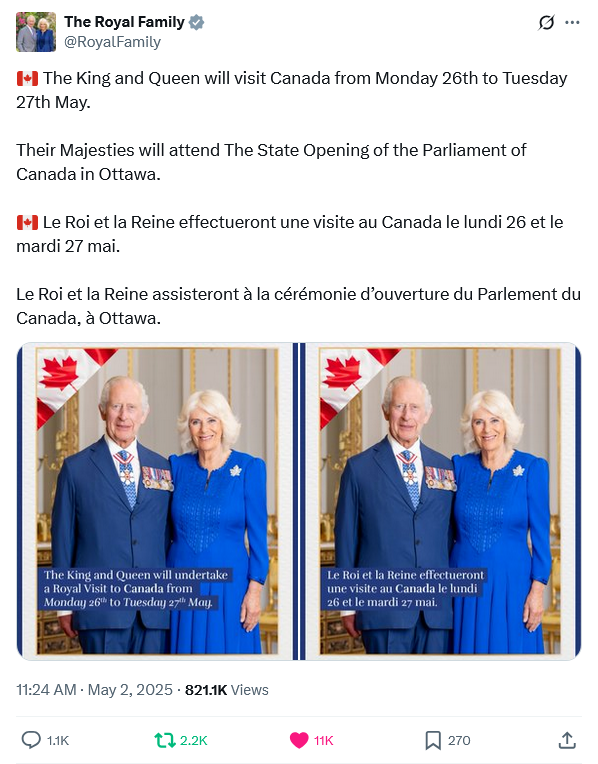
It’s funny that the same kind of people who have no time for the Crown under normal circumstances (even if they’re not quite out-and-out republicans) are delighted to pile on to any accusations that King Charles isn’t doing … something … to fight off the Bad Orange Man for us:

This brings us to our head of state, and the baffling calls in recent days for him to shake his sceptre toward Washington and declare that Canada shall never never never be the 51st state. If these calls were coming just from anti-monarchists, it would be understandable (though it’s odd to hear them suddenly demanding that the sovereign speak on our behalf). But all kinds of otherwise reasonable people jumped aboard as well, as if this was something the King should self-evidently be doing.

It is self-evidently not what the King should be doing — certainly not before receiving advice from the Canadian prime minister, and probably not at all. Charles’s mother wouldn’t have mouthed off, and I have to wonder if she would have gotten the same criticism were she still alive to see this mess.

Indeed, I think a moment like this is precisely when having an apolitical head of state — maybe even one that doesn’t live here — is most valuable. We have more than enough people, elected and unelected, completely and vocally embroiled in the Trump Tariff Wars, pursuing some combination of national, partisan and personal gain. Isn’t it nice to have precisely the sort of democratic constancy the United States now lacks? You don’t throw away an anchor, however rusty, with a gale on the horizon.

March 5, 2025

Trump’s next target – Europe

Andrew Doyle thinks that the next step of Donald Trump’s culture war will be highlighted by a struggle over freedom of speech with the UK and the regulators of the European Union:

British PM Keir Starmer talks with US President Donald Trump in the White House.

New battle lines are forming in the culture war. While the woke movement appears to be in retreat, the forces of authoritarianism are regrouping for a fresh assault. Rather than maintaining a straightforward conflict between right and left, the next phase of the culture war will most probably be waged between Europe and the United States. It has all the qualities of a novel by Henry James for the digital age, with the distinctions between the old world and the new brought once again into sharp focus.

Free speech will be the key issue. Most of us will have seen the footage of vice-president J. D. Vance last week in the Oval Office taking Keir Starmer to task for the “infringements on free speech that actually affect not just the British” but also “American technology companies and by extension, American citizens”. Starmer pushed back, saying “in relation to free speech in the UK, I’m very proud of our history there”. It’s a bit like Hannibal Lecter boasting about his ongoing commitment to vegetarianism.

The word “history” was apt, given that Starmer’s government is seemingly determined to ensure that free speech is consigned to the past. One of its first acts after seizing power was to ditch the Higher Education (Freedom of Speech) Act. In February, Angela Rayner revealed her plans for the establishment of a sixteen-member council on “Islamophobia” which could see the criticism of religion criminalised. Meanwhile, Yvette Cooper has been staunchly defending the police for recording “non-crime”, while the chairman of the College of Policing, Lord Herbert, has suggested that the best approach to tackling the controversy is to simply rename “non-crime hate incidents” as something more palatable. Apparently Lord Herbert believes that the problem is the nomenclature, not the fact that citizens are being investigated by the armed wing of the state for lawful behaviour.

All of this is before we get to Starmer applying pressure to the judiciary to mete out draconian sentences for offensive posts and memes on social media, and the government’s determination to crack down on online “disinformation”. Ours is an authoritarian government, and Starmer’s Orwellian denial of the truth of his position in the Oval Office is to be expected. Autocrats throughout history have enacted censorship “for the public good”. Today, they target “disinformation”, a term so vague that it can be applied to anyone who questions the narrative of the ruling class.

And so, as I say, the new front of the culture war will most likely be transatlantic. The US government will simply not tolerate the widespread censorship of its citizens by laws passed overseas. Jim Jordan, chairman of the Committee on the Judiciary of the House of Representatives, has already issued subpoenas to eight US tech companies to divulge all communications they have had with the UK government regarding “content moderation” (i.e., censorship). Jordan is particularly concerned about the Labour government’s intention to empower OfCom to regulate social media, and he has specifically mentioned UK officials who “have already threatened to use UK laws to police American speech”.

N.S. Lyons suggested in the latest post at The Upheaval that Vice President J.D. Vance’s real message to the European leaders can be rephrased as “Give Up the Information War and GTFO”:

The political elite of Europe and the Anglosphere appeared shocked by J.D. Vance’s wonderfully blunt speech in Munich last month. The U.S. Vice President declared Washington’s top security concern to be “the threat from within” the NATO alliance and castigated assembled leaders for their increasingly brazen assaults on “democratic values”, including censoring speech, suppressing popular opposition parties, and canceling elections. But if this shock isn’t feigned then it is rather remarkable, given that these elites were in their own way already effectively at war with the United States. All Vance did was point out the nature of this hidden conflict.

Vance delivered multiple messages with his speech, the broadest and most historic of which was that the era of “post-national” globalist liberalism is over. The United States, he indicated, now has a core interest in seeing a Western world that is collectively strong because its sovereign nations are strong, with the self-confidence to independently defend themselves physically, culturally, and spiritually. His emphasis on promoting free speech and democratic legitimacy tied into this message, but was about far more than the importance of “shared values” or even Washington’s new friendliness to nationalist parties. Practically, it was an implied warning that the role Europe has been playing as a proxy actor in the political and ideological conflicts raging in the United States will no longer be tolerated. More specifically, it was a declaration that ongoing transatlantic institutional, technological, and legal support for America’s embattled left-wing deep state must end – or else.

After Donald Trump’s election in 2016, America’s panicked establishment elites reacted by attempting to construct a system for managing public opinion through strict control of information, especially online information. The idea was that growing public support for populism was fueled by “low-information voters” and their consumption of “misinformation” and “disinformation”, including from foreign actors, and that if their “information diet” could just be controlled then they would stop voting wrong. The underlying assumption here was of course that the elite’s own increasingly radical policy preferences were the only rational path, opposable only by the stupid and easily manipulated. As Trump’s defeated opponent Hillary Clinton would later put it, social media platforms had fundamentally changed the information environment and “if they don’t moderate and monitor the content, we lose total control”.

This intended system of thought-control would later grow into the censorship industrial complex that was partially revealed following Elon Musk’s acquisition of Twitter. But a big obstacle initially stood in the way: the U.S. Constitution and its protection of free speech. The public might be receiving the “wrong” information on the internet, but “our First Amendment stands as a major block to be able to just, you know, hammer it out of existence”, as John Kerry lamented in a speech to the World Economic Forum.

Under the Biden administration, this legal problem was partially solved by simply ignoring it, the federal government directly colluding with technology companies and a network of “independent” (state-funded) “fact-checking” organizations to impose mass censorship on American citizens. The result was, as one federal judge later described it, effectively “the most massive attack against free speech in United States’ history”.

A more subtle and sustainable work-around was also discovered, however. This was to circumvent the U.S. Constitution by outsourcing the policing of the internet and populist movements to other countries around the world. This could be done because the internet is global and so the whole network is affected by government regulations on any local market of sufficient size. Leaders on both sides of the Atlantic immediately grasped that legal and regulatory structures imposed by the European Union, with the leverage of its huge unified market, could for example force internet companies the world over – including U.S. companies – to change their behavior in order to comply and avoid losing access (this imperialistic regulatory strong-arming was dubbed the “Brussels Effect”, becoming Europe’s only significant innovation this century).

March 4, 2025

Canada’s nasty authoritarian streak shows up in the “deprive Musk of his citizenship” online mob

Filed under: Cancon, Government, Media, Politics, USA — Tags: , , , — Nicholas @ 05:00

In The Line, Leonid Sirota explains why we can’t just arbitrarily deprive a Canadian of his citizenship rights just because Charlie Angus has riled up a social media mob to demand it:

Elon Musk wrapped in the Canadian flag – created with Grok.

One other incontrovertible fact about Mr. Musk is that he is a Canadian citizen. His mother was born in Canada — which made her a citizen — as are her children, even though they were born abroad.

A large number of Mr. Musk’s and my fellow Canadians find the coexistence of these facts to be obnoxious. Whether out of anger or embarrassment, they are lining up to sign a petition to Parliament to demand that he be deprived of his Canadian citizenship. As of this writing, the petition has been signed by about 300,000 people. (In theory, these are Canadian citizens or residents, though on the Internet, nobody knows you didn’t actually watch the McDavid goal 97 times on loop.) At least one member of Parliament, the NDP’s Charlie Angus, is supportive.

This is appalling. The reasons given for depriving Mr. Musk of his Canadian citizenship are fundamentally authoritarian, as is the contempt for both the substantive and the procedural legal requirements involved in deprivation of citizenship that the petition manifests. That a member of Parliament is supporting this abomination is especially disturbing (and one reason this whole mess is worth caring about).

To start with the substantive point, the idea that a Canadian could be deprived of his citizenship for political reasons ought to be beyond the pale of polite discussion. It is the sort of thing the Soviets did to Mstislav Rostropovich, Aleksandr Solzhenitsyn, and others. Is Mr. Musk a Solzhenitsyn? Well, no. But so what? The principles at stake here are universal. They do not depend on whether one is a martyr or a millionaire, a genius or a jerk. (Solzhenitsyn, at any rate, was both jerk and genius. So is Mr. Musk. Not that it matters.)

More to the point, do you want the Canadian government to have the power to deprive people of their citizenship for their political beliefs, statements, or activities? If you are okay with a government led by a Justin Trudeau or a Mark Carney having this power, do you agree that one led by Pierre Poilievre should? (Or, of course, vice versa.)

And yes, no matter how patriotic and indignant the people who sign the petition, or support it, may feel, the demand to take away Mr. Musk’s citizenship is political. The first recital of the petition accuses him of having “engaged in activities that go against the national interest of Canada”. I think the accusation is well-founded. But it is a political accusation: the national interest is a political concept. The petition then claims Mr. Musk “has used his wealth and power to influence our elections”. If he has, that is political action that Canadian citizens are entitled to take, subject to applicable laws, which the petition isn’t even alleging Mr. Musk broke. Finally, the petition claims that Mr. Musk “has now become a member of a foreign government that is attempting to erase Canadian sovereignty”. Stipulated. But the actions of this foreign government, no matter how dishonourable, distasteful, and dangerous for Canada, have so far stayed within the realm of politics.

QotD: Twitter-thought and the basic university student

Filed under: Education, Media, Quotations, Technology — Tags: , , , — Nicholas @ 01:00

Like most people, I gave [Twitter] a look-see when I first heard about it. I quickly concluded that it wasn’t for me. Not because it was vapid garbage, you understand — Facebook was always vapid garbage, but it had some utility for all that, as Twitter does — but because I just don’t think in discrete chunks the way Twitter requires. I just can’t process the fact that “replies” are their own distinct utterances, devoid of all other context, that can come in at random times. A Twitter “thread” is a mad babble of people shouting past each other; it’s not “communication” in any sense my brain can handle, so I dropped it …

Alas, Twitter is still a thing that exists, so even though I tried it for about five minutes and promptly forgot all about it, my students didn’t … which explains, like nothing else can, their bizarre approach to classwork. For every quiz I gave, no matter how straightforward the question, I’d have at least one barracks lawyer coming to me afterwards, trying to weasel her (always her, mentally if not biologically) way back into some points, with some elaborate rationale why her picking the wrong answer was really my fault, because in class I said “The Russians won the Battle of Stalingrad” and the question on the quiz was “Who lost the Battle of Stalingrad?” and how is she supposed to be expected to recognize that “lost” is the opposite of “won” when it comes to battles and blah blah blah (thanks, Greta!).

Or the other depressingly common thing, which was when that same kid, who went to the fucking mattresses for one point on one quiz — which amounts to something like 0.01% of her final semester grade — just didn’t turn in the term paper. This happened at all academic levels, from community college (where you often lose half a class or more by the end of a semester) all the way up through the SPLACs, which cost something in the neighborhood of $70K a year all in. I never could figure this out — I mean, how can they not know that the term paper is 30% of your final grade, while all the quizzes put together amount to 10%? — but then it hit me: Twitter.

Everything on social media has, of necessity, equal weight, in that whatever’s in your feed at the present time is the only thing that exists. So when Snowflake was in “schoolwork” mode and missed that one question on that one quiz, it was the only thing that mattered in her world. My quiz was at the top of her Twitter feed, so she had to put all her energy into battling me for it. By the end of the semester, though, she was in “sorority” mode, or “getting ready for that kickass ski vacation” mode, or “beefing with that basic bitch Becky” mode, so my term paper barely registered — if she bothered to turn anything in at all, it was copy-pasted straight from wikipedia, because who cares, when Becky is out there on Twitter, h8ing?

Severian, “Also Sprach Froggy”, Founding Questions, 2021-09-30.

March 3, 2025

Trump and Zelensky in “the most amazing bilateral meeting and press conference of all time”

Filed under: Media, Politics, USA — Tags: , , , — Nicholas @ 03:00

In the free-to-cheapskates portion of his latest post, eugyppius considers the most newsworthy press conference in living memory between US President Donald Trump and Ukrainian President Vladimir Zelensky that went theatrically wrong:

tfw you have no cards.

Since 2022, the Ukrainian President Vladimir Zelensky has been running about the globe in his weird focus-grouped jumpers and combat boots, lecturing all of our parliaments on the unity and mutual interests of Europe, the goodness of democracy, the genocidal evils of Vladimir Putin and the importance of ever more weapons deliveries to his country’s armed forces. In the process, he has become one of the more obnoxious political phenomena in recent memory, and I hope I would be able to see this even if I were firmly convinced that German interests aligned perfectly with Ukrainian interests and that we should do nothing but give the AFU all of our tanks and all of our Taurus missiles and possibly even all of our soldiers to defend our shiny wonderful and deeply liberal European democracy, where we are so free that riot police will bash your head in for protesting Covid restrictions and if you call the wrong cabinet minister a moron the speech crimes battalion will raid your house.

Here in Europe, our political leaders have treated the shouting, remonstrating Zelensky with nothing but egregious reverence, and the man has grown accustomed to his noxious political celebrity. Nothing else can explain the amazing press conference Zelensky and Trump held yesterday, ahead of afternoon plans to sign an agreement concerning Ukraine’s rare-earth minerals. We got to witness nothing less than the near-total meltdown of American and Ukrainian relations, live and in colour. Historians of the Ukraine war will be writing about this press conference for years and decades to come.

The meeting almost didn’t happen at all. Zelensky has been publicly irritated that Trump reversed the American policy of isolating Russia, after the American president opened talks with Vladimir Putin to end the war. Two weeks ago, Trump suggested that Ukraine was at fault for the hostilities, Zelensky said Trump was “living in a [Russian] disinformation space“, and Trump said Zelensky was “a dictator without elections“. Trump’s administration initially planned to cancel Zelensky’s visit to Washington this week, but French President Emmanuel Macron persuaded the Americans to go ahead with it. Imagine how much the man regrets that now. After receiving his verbal beat-down in the Oval Office, Zelensky and the rest of the Ukrainian delegation decamped to the Roosevelt Room, while Trump and his advisers decided that the President of Ukraine “was in no position to negotiate“. White House officials told them to leave before they could even eat lunch.

Foreign relations are typically pounded out in back rooms, out of sight, and that was also the intent here. Somewhere in the midst of the journalists’ questions and Trump’s banter, however, yesterday’s event ceased being a press conference and became at first a subtle unacknowledged negotiation and then a hostile disagreement – one which Zelensky got the worst of.

Mark Steyn examines what was said both before and during the Zelensky-Trump slap fight:

The Beltway rumour is that, on his flight to DC, Zelenskyyyy was telephoned by Victoria Nuland, She-Wolf of the Donbass, plus Susan Rice and Anthony Blinken and advised to get tough with Trump. If true, that’s gotta be the worst episode of “Phone-a-Friend” since the plucky little Ukrainian started playing Who Wants to Be a Billionaire (in Euros)? For all you nuanced diplomatists out there, there is now a rather arcane dispute as to whether Z called the Vice President of the United States a “bitch” or merely interjected “f**king hell”:

    He literally didn’t. He said “suka blyat“, which, like “kurwa mać” in Polish, is an expression of annoyance equivalent to “fucking hell”. Not ideal politics, granted, but not the same.https://t.co/mOgGZN9iwh

    — Ben Sixsmith (@BDSixsmith) March 1, 2025

UPDATE! From Leonid in our comments section:

    If the audio is not altered, it does sound like ‘suka, blyad‘ which is akin to ‘f**king piece of sh*t’. It is not necessarily directed at Vance personally, but I specifically translated this as ‘f**king piece of sh*t’, not ‘f**king hell’ because it can indeed be taken as directed at Vance, too. Obviously, even the milder reading doesn’t absolve Z of being an a**hole.

The Ukrainian ambassador seemed to be the only member of Z’s delegation who grasped how badly things were degenerating: the cameras captured her at one point with her head in her hands. The President booted the guy from the White House and gave the Ukrainian’s lunch to the Oval Office interns. I have always found the American vernacular “oh, the guy totally ate my lunch” incredibly lame, but, if Trump is now proposing to make it literal, I wish he’d started with Keir Starmer. Fortunately, America’s wanker media could be relied upon to agree that, when it comes to Z vs T, “the world” sides with Ukraine.

    World opinion has been swift, loud and mostly unanimous against the childish behavior today of Trump and Vance. The only question now is if other countries realize that the USA they’ve long known, loved and respected is no longer a reliable ally.

    — Aaron Astor (@AstorAaron) February 28, 2025

By “world opinion”, Mr Astor means not China, India, South Africa, Brazil or Saudi Arabia, but the Prime Minister of Luxembourg:

    Luxembourg stands with Ukraine. You are fighting for your freedom and a rules based international order. 🇱🇺🇺🇦

    — Luc Frieden (@LucFrieden) February 28, 2025

From the blissful ignorance of a California congressman:

    My grandfather and the Greatest Generation didn’t fight in World War II to see our country side with murderous thugs like Putin. This is a disgrace. https://t.co/3ZrB8ur2Au

    — Mike Levin (@MikeLevin) February 28, 2025

Er, in your extensive researches into World War Two, did you ever happen to come across a photograph of, say, the Yalta summit?

Churchill, FDR, and Stalin at Yalta

Still, if Luxembourgish prime ministers are going through one of their periodic butch phases, I prefer the words of Mr Frieden’s predecessor, Jacques Poos, who a third-of-a-century back, as Yugoslavia was disintegrating, told the Yanks to butt out and declared “The hour of Europe has come!” He was right, kind of: shortly thereafter, Bosnian Serbs began tying Continental peacekeepers to trees.

Mr Frieden, like many other politicians and geopolitical experts, has failed to grasp the essential dynamic of yesterday’s meeting – which is very simple:

Zelenskyyyy needs Trump far more than Trump needs Zelenskyyyy.

« Newer PostsOlder Posts »

Powered by WordPress