
… the basics of the confidence game have not changed all that much with the new technology. The confidence man gets his name because he is adept at winning the confidence of the mark. The mark then lowers his defenses and foolishly trusts the con man, rather than his own natural skepticism. The mark is manipulated into thinking the con man is a friend or at least someone who can be trusted. The con man then uses that trust to exploit the mark.
The way in which the con men does this is by flattery. The mark trusts the con man, because the con man finds small ways to confirm the beliefs of the mark. The adept grifter will be a good listener and pick up the little things that the mark thinks are important, like religious beliefs or opinions about personal matters. Seemingly out of the blue, the con man will express those same opinions, which flatters the mark. After all, everyone likes being told that their private opinions are smart.
That’s something you see with the internet grifters. They often have worn a lot of masks as they seek out on-line audiences. […]
Another aspect of the con that remains constant is how the con man uses his alleged status as a victim to work the mark. Con men will use their mark’s natural empathy to win their confidence. Today that often means claiming the big bad tech companies are censoring them. Alternatively, they will claim evil trolls are haunting their internet activity, causing them harm. The term troll has been changed from meaning someone seeking attention to something almost supernatural.
The Z Man, “Carny Town”, The Z Blog, 2019-12-29.
April 29, 2025
April 28, 2025
A potential positive to the explosion of AI-generated fake porn
The one thing we have always been able to predict with 100% confidence is that every new media will be used for pornography and crime, often in the same product. However, No Pasaran makes a case for there being a socially useful side to the ever-increasing realism of fake porn from popular LLM generators:

Seriously?! Am I the only person that sees the benefits of this “troubling trend” of online bullying?!
Think about it.
Blackmail is now a thing of the past.
That’s it.
It’s over.
Whether you are a teen or an adult, whether the photos are real or not, you can simply pass all of them off — indeed, you can do so nonchalantly — as fakes or deepfakes. To your classmates, to your spouse, to your constituents. Who will know whether you are fibbing or telling the truth? (Maybe you hardly know yourself …)
(In a totally different context, of course, that is exactly what Joe Biden’s White House did …)
As it happens, a considerable size of the audience for these sex photos/videos — maybe far more than half — will already be assuming that they’re fakes … (Thanks for the Instalink, Sarah.)
Depression at 16? Suicide at 17? Why fear sextortion at this point? Compliment instead the (anonymous) photo/video creators for doing a good job — for doing an outstanding job.
On my phone I keep receiving photos of Donald Trump tenderly cuddling with Joe Biden or Vladimir Putin or Stormy Daniels. Lots of apps now make you “repair” snapshots that are decades or (over) a century old, colorize them, and make them into mini-movies (the latest one I saw delighted me as it involved Civil War daguerreotypes from the 1860s).
I also keep receiving AI ads where, by combining a couple of photos of myself and of any girl (someone I know and am perhaps infatuated with or some rock or movie star or someone — Marilyn Monroe? Rudolph Valentino? Che Guevara? Queen Victoria? — who has been dead for decades) I can make myself hug or kiss that person — hungrily — on the mouth.
Years ago (long before AI), I was writing a TV script imagining a politician who was on national television and who was all of a sudden ambushed with private photos of him in a compromising position (with a woman other than his wife, with a man, with many women, with many men, at an orgy, in a BDSM cave, with a money shot, whatever …). Talk of falling victim; talk of bullying; talk of harassment (justified or otherwise)!
How should he react?
Ignore the content. And, with an admiring voice, let out a whistle and praise the work: “Wow, that’s well done!”
“What do you mean?!” interrupts the TV presenter, visibly frustrated. “No no no! Don’t tell me you are claiming they’re fake?! We have proof that you were seen at—”
Again, this was before AI, needless to say, which only made the politician’s next words even more startling: “It is so how admirable the degree to which studios have made progress with special effects!”
QotD: “Redpill poisoning”
Hunter Ash @ArtemisConsort
There is a phenomenon I call redpill poisoning where someone sees through the establishment matrix, but then starts assuming the exact opposite of that narrative is always true. This oneshots a lot of smart people.Absolutely. Among other things, I think this explains why a large minority of conservatives have become suckers for Russian propaganda about the Ukraine war.
I like your term “redpill poisoning” and will adopt it.
ESR, Twitter, 2025-01-25.
April 27, 2025
“[T]he practical reality of electoral politics throughout the west: the choice is between a Leftward Ho! party and a Ratchet party”
Mark Steyn on the steady leftward march of pretty much every western nation that never, ever stops and only rarely slows down:
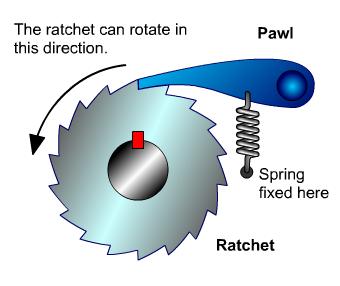
A ratchet allows rotation in one direction, but prevents rotation in the other direction. That’s been a common explanation of most western governments for decades … leftward motion occurs, but can only be stopped, never reversed.
In a shrewd assessment of the current campaign Down Under, Paul Collits cites a certain “niche Canadian”:
Mark Steyn says that we cannot vote our way out of the Western mess. The 2025 Australian election is living proof of the truth of his claim. Whoever wins here will inherit an unholy mess, and will not have the will to address it.
Of course, he could be talking about next week’s Canadian election or last month’s German election. As we have noted, Fred Merz, the incoming chancellor in Berlin, has yet to take office but what Americans call the honeymoon is over before the coalition has been officially pronounced man and wife. Hermann Binkert, head honcho of Germany’s INSA polling agency, says the country has never seen loss of approval on this scale between the election and the formation of the government. The so-called “far-right” AfD is now leading in multiple polls. Which would be super-exciting if voting hadn’t already taken place.
In America, the new administration certainly has the “will to address” the “unholy mess” but the Trumpian Gulliver is beset on all sides by District Court Lilliputians whose position is that what a Democrat president has done cannot “lawfully” be undone. This is a pseudo-“constitutional” recognition of the practical reality of electoral politics throughout the west: the choice is between a Leftward Ho! party and a Ratchet party. If the Left wins, they dissolve the border and trannify your kids. If the “Right” wins (Stephen Harper, Scott Morrison), they may pause some of the more obviously crazy stuff but they never actually reverse the direction of travel. Unless they’re the UK Tories (Cameron, May, Johnson, Sunak), in which case they stay in the leftie lane without even shifting down to third gear.
So “politics”, as increasingly narrowly defined, is less and less likely to save you. Because the gap between “politics” and reality grows ever wider. Consider the instructive example of one Hashem Abedi. Mr Abedi and his brother plotted the Ariana Grande concert bombing in Manchester. It was, from the Abedi viewpoint, a huge success: twenty-two dead, half of them kids, plus a thousand injured. It was a big deal at the time: lots of flowers, teddy bears, and heart-rending renditions of “Don’t Look Back in Anger”.
So you’d have thought even the British state would have at least pretended to take it seriously. Hashem Abedi was detained at His Majesty’s Pleasure, and under one of the three supposedly toughest prison regimes in England and Wales. Nevertheless, on April 12th he put three of his guards in hospital with what were described as “life-threatening injuries“. A fortnight later, two are still there. How did a maximum-security prisoner manage to do that? Well, he used boiling cooking oil and weaponised kitchen utensils.
So how did he get hold of boiling cooking oil? Was he a finalist for Maximum Security Masterchef? Ah, well. The details remain vague, and as usual the worthless UK media has shown not the slightest curiosity in how the Ariana Grande perp came close to bulking up his death toll by fifteen per cent.
April 26, 2025
The week-before-the-vote Bullshit Bulletin
The Line‘s invaluable bullshit tracker includes some steaming bullshit from Mark Carney, the Conservative campaign, and, perhaps the most acrid bullshit from the NDP’s Jagmeet Singh:

Jagmeet Singh, the empty turban. He is the current (and possibly last) leader of the federal New Democratic Party, and it’s his conscious actions that may have doomed his party to parliamentary oblivion.
This article, about a recent meeting between Singh and the Toronto Star editorial board, is just absolutely bonkers. Jagmeet. Our dude. We like you. We do. But this is some epic bullshit.
This passage, in particular:
The NDP leader stood by his decision not to plunge the country into an early election last fall while support for Justin Trudeau’s Liberals plummeted, telling the Star‘s editorial board he “couldn’t stomach” the idea of causing Pierre Poilievre’s seizure of power, and that he made the choice to put Canada’s interests ahead of those of the New Democratic Party.
“While we could have won lots of seats, it would have meant a Pierre Poilievre majority Conservative government, and I could not stomach that,” Singh said, making the argument that an election would have jeopardized progress on pharmacare deals and dental care expansion. “I love my party. I care deeply about it. I want us to win. I want us to up our seats. I know we’re good for people. But in that moment, I made a decision for the interest of the country ahead of my party. And that was a decision I made wide-eyed, and I stand by that decision.”
Hmmm. Okay. So. Let’s take that at face value. If only for the sake of argument.
Singh realizes what the logical endpoint of that argument is, right? … right?! The story of this election, to the extent there is a single one, is that the NDP collapse made it impossible for the Conservatives to win. We have lots of criticisms of the CPC campaign; we’ve made some already and we’ll have more to say when it’s over. But we recognize the truth that without a strong NDP, even a perfect and flawless Conservative campaign was always going to be an uphill battle. It’s just a really difficult situation for the Conservatives to overcome.
And you know what Singh could do to make that a permanent state of affairs? Give up! Tank the NDP completely. Do a national tour asking everyone to vote Liberal. Defect and become a Liberal. Spend his post-politics career, which seems set to start sometime early next week, campaigning for a two-party system, under which the Liberals defeat the Conservatives over and over.
End the vote splitting by ending the NDP. That’s a case that many Liberals have made before. And fair enough. But it’s some kind of bullshit to see Singh himself making it, and we can’t imagine his NDP colleagues are particularly pleased to see their leader taking a position that the Liberals took years ago: that the best way for left-leaning voters to stop the Conservatives is to put the country first, and vote for them.
Lies, damned lies and government statistics
Francisco at Small Dead Animals linked to this interesting examination of the difference between the official inflation rate and the actual inflation ordinary Canadians are coping with:

Great news! We’ve brought inflation back under control and stuff is now only costing you 2.4 percent more than it did last year!
That’s more or less the message we’ve been hearing from governments over the past couple of years. And in fact, the official Statistics Canada consumer price index (CPI) numbers do show us that the “all-items” index in 2024 was only 2.4 percent higher than in 2023. Fantastic.
So why doesn’t it feel fantastic?
Well statistics are funny that way. When you’ve got lots of numbers, there are all kinds of ways to dress ‘em up before presenting them as an index (or chart). And there really is no one combination of adjustments and corrections that’s definitively “right”. So I’m sure Statistics Canada isn’t trying to misrepresent things.
But I’m also curious to test whether the CPI is truly representative of Canadians’ real financial experiences. My first attempt to create my own alternative “consumer price index”, involved Statistics Canada’s “Detailed household final consumption expenditure“. That table contains actual dollar figures for nation-wide spending on a wide range of consumer items. To represent the costs Canadian’s face when shopping for basics, I selected these nine categories:
- Food and non-alcoholic beverages
- Clothing and footwear
- Housing, water, electricity, gas and other fuels
- Major household appliances
- Pharmaceutical products and other medical products (except cannabis)
- Transport
- Communications
- University education
- Property insurance
I then took the fourth quarter (Q4) numbers for each of those categories for all the years between 2013 and 2024 and divided them by the total population of the country for each year. That gave me an accurate picture of per capita spending on core cost-of-living items.
Overall, living and breathing through Q4 2013 would have cost the average Canadian $4,356.38 (or $17,425.52 for a full year). Spending for those same categories in Q4 2024, however, cost us $6,266.48 – a 43.85 percent increase.
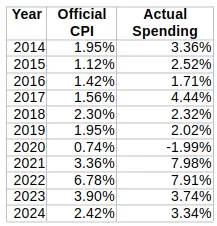
By contrast, the official CPI over those years rose only 31.03 percent. That’s quite the difference. Here’s how the year-over-year changes in CPI inflation vs actual spending inflation compare:
As you can see, with the exception of 2020 (when COVID left us with nothing to buy), the official inflation number was consistently and significantly lower than actual spending. And, in the case of 2021, it was more than double.
Since 2013, the items with the largest price growth were university education (57.46 percent), major household appliances (52.67 percent), and housing, water, electricity, gas, and other fuels (50.79).
QotD: “Woke”
Moreover, this monomaniacal need to expose an ever-expanding set of “phobias” in society means that they end up detecting prejudice even where it does not exist. In the absence of evidence of racism the woke have a habit of simply concocting it; hence the continual emphasis on “unconscious bias”, “white privilege” and “institutional power structures”. Such ideas have germinated over many years in academia – particularly in the postmodern branches of critical theory – and have since seeped into the mainstream.
This is why the public is routinely confronted with absurd articles in the media grounded in an extreme form of intersectionality. One, for instance, claims that white women are “evil”, another that white DNA is an “abomination”. Barely a day goes by without some frenzied denunciation of a movie or a television series for its lack of diversity and positive representation, as though the function of the arts is to send a message that accords with identitarian values.
Few members of the public are entirely familiar with the jargon (“cisgender”, “mansplaining”, “toxic masculinity”), but are assured nonetheless that the premises are indisputable. There’s a very good reason why the Catholic Church resisted translating the Bible into the vernacular for so long. Those in power are always threatened when the plebeians start thinking for themselves and asking difficult questions.
Some commentators have recently raised concerns that “woke” has been weaponised by the far right as a slur against anti-racist campaigners. Afua Hirsch, for instance, has claimed in the Guardian that anyone using the word is “likely to be a right-wing culture warrior angry at a phenomenon that lives mainly in their imagination”. This strikes me as particularly odd, given the Guardian‘s own frequent use of the word, including in headlines such as “Can a woke makeover win Barbie and Monopoly new fans?” and “My search for Mr Woke: a dating diary”. Perhaps Hirsch’s colleagues are further to the right than is generally supposed.
Andrew Doyle, “Why I’m anti-woke”, Spiked, 2020-02-04.
April 25, 2025
Canada’s lost decade, 2015-2025
It’s quite remarkable how many economic charts show the US and Canadian economies tracking along similar paths up until “something” happened in 2015 that knocked the Canadian economy well below the US trend line. I wonder what happened in 2015 that could account for this quite visible change in fortune?
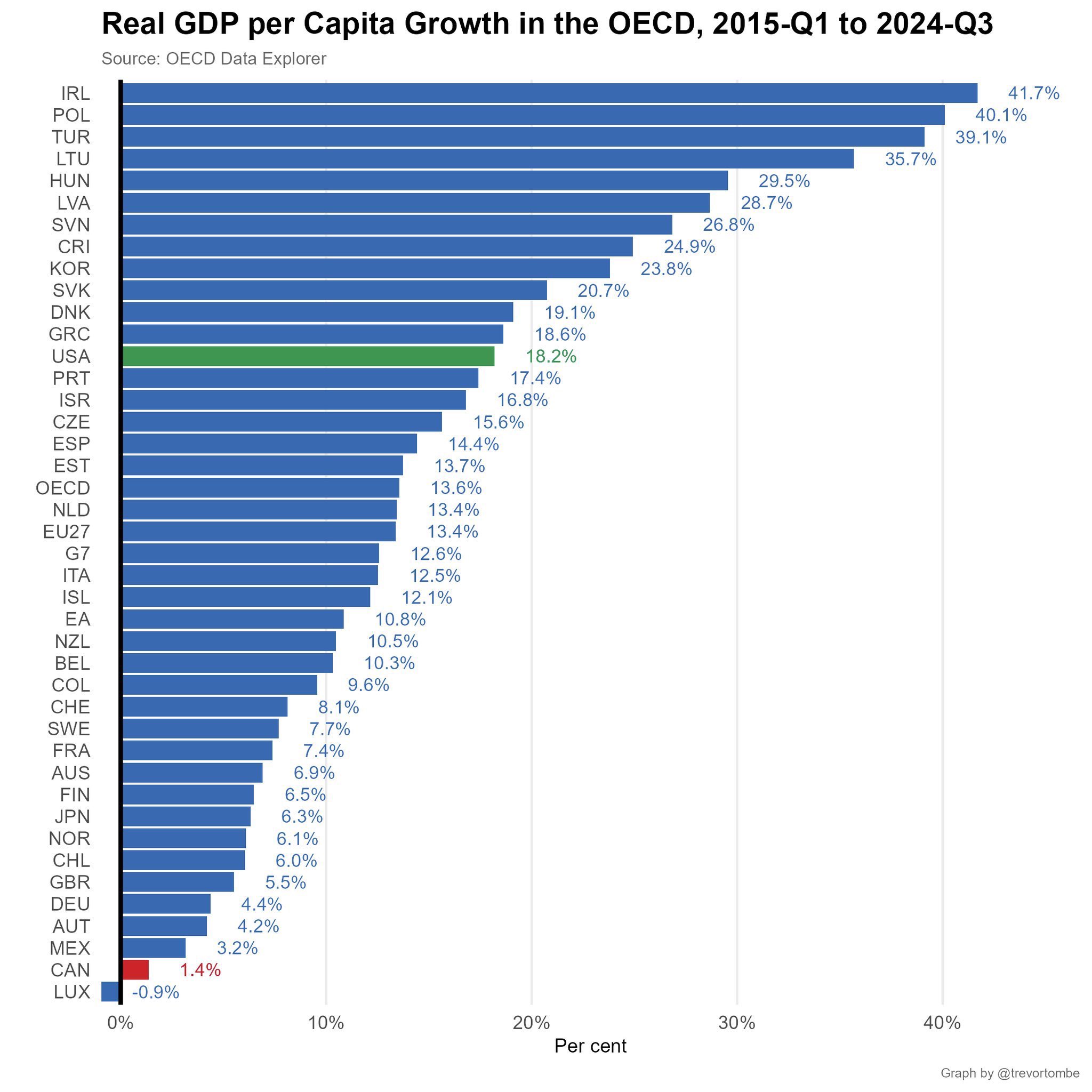
GDP growth in Canada fell off a cliff over the period from 2015 onwards. This kinda matters.
Throughout the 2025 campaign, the Conservatives have frequently referred to what they call the “Lost Liberal Decade”, a reference to the fact that Canada has lagged dramatically on virtually every available indicator since the Liberals first came to power in 2015.
In sum, the economy is worse, crime is worse, public services are worse, affordability is worse — and there’s a whole galaxy of niche indicators, such as firearms incidents, refugee backlogs, even life expectancy, that are worse than they’ve ever been.
Below, a quick guide to the fact that, whatever you think of the Liberals, the last decade has really not been great for Canada.
In the year the Liberals took office, 604 people were murdered across Canada. This was already a slight uptick from the year before, when murder rates hit a low not seen since the mid-1960s.
Just seven years later, in 2022, homicides would hit a high of 874. In raw numbers, that’s 270 more murdered Canadians.
But even when accounting for population growth, there are way more murders happening now than in 2015. The homicide rate in that year was 1.71 murders per 100,000 people. As of 2023, the most recent year for which Statistics Canada has released data, it was 1.94.
Put another way, if Canada had stuck to the homicide rates of 2015, we’d have had 94 fewer murders in 2023, 216 fewer murders in 2022, and about 150 fewer murders in 2021.
And it’s a similar story when it comes to virtually every other category of crime. Statistics Canada maintains a “crime severity index” that attempts to aggregate the raw amount of criminality each year in Canada. The index bottoms out just before the Liberals came to power in 2015, and has been on the upswing ever since.
Unfortunately, this is particularly true when it comes to violent crime. For one thing, the number of guns being turned on people each year in Canada has never been higher.
In 2015, for every 100,000 Canadians, there were 28.6 incidents of firearm-related violent crime. By 2022, the last full year for which data is available, this had surged to 36.7 incidents — nearly a 30-per-cent increase in just seven years.
The Correctional Service of Canada publishes annual statistics on incarceration rates, and a noticeable trend begins to emerge starting in 2015: The prison population begins to plummet.
April 24, 2025
“Call for Admiral Ackbar! Paging Admiral Ackbar. Admiral Ackbar to the white courtesy phone, please.”
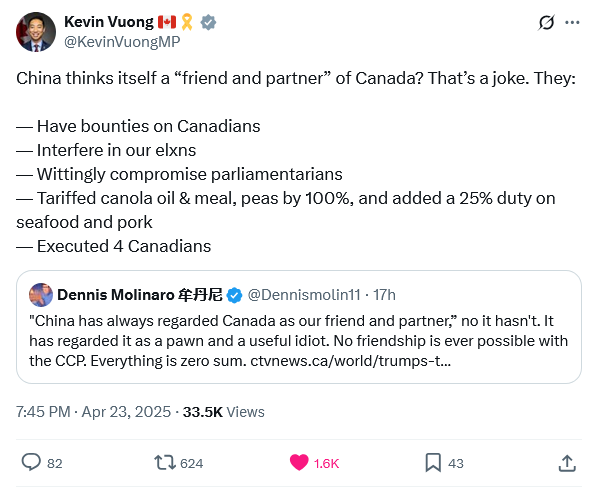
What a wonderful, heartwarming story: those cuddly folks in Beijing are reaching out to Canada to “partner with” as a way of warding off American “bullying”. How nice! What a great idea! With the best possible intentions. What could possibly go wrong?
China’s ambassador says Beijing is offering to form a partnership with Canada to push back against American “bullying”, suggesting the two countries could rally other nations to stop Washington from undermining global rules.
“We want to avoid the situation where humanity is brought back to a world of the law of the jungle again,” Chinese Ambassador Wang Di told The Canadian Press in a wide-ranging interview.
“China is Canada’s opportunity, not Canada’s threat,” he said through the embassy’s interpreter.
Wang — whose office requested the interview with The Canadian Press — said that China and Canada appear to be the only countries taking “concrete and real countermeasures against the unjustified U.S. tariffs” imposed by U.S. President Donald Trump.
“We have taken notice that, faced with the U.S.’s unilateral bullying, Canada has not backed down,” he said. “Instead, Canada is standing on the right side of the history, on the right side of international fairness and justice.”
He said Beijing and Ottawa should work together to convince other countries not to placate the Trump administration and to make Washington pay a price for breaking global trade rules.
Roland Paris, who leads the University of Ottawa’s graduate school of international affairs, said Beijing has long sought to reshape international institutions to advance its own interests — efforts that often have put China at odds with Ottawa’s foreign policy.
He said Canadian businesses should take a cautious approach to China, where they still face the risk of import bans and arbitrary detainment.
“The mercenary use of tariffs and non-tariff barriers that we’re seeing from the Trump administration has been practised for a long time by China in different forms,” Paris said.
“China has played its own version of hardball and abused trade rules in the past to coerce countries, including Canada, that have dared to displease Beijing.”
As the rivalry between the U.S. and China has intensified, Canada has generally followed Washington’s lead on restricting certain types of commerce with China.
Last fall — in an effort to protect Canadian auto sector jobs and allay American concerns about threats to supply chains — the federal government imposed 100 per cent tariffs on imports of Chinese-made electric vehicles that all but banned Chinese EVs from the Canadian market.
Canada alleged unfair trade practices including “a state-directed policy of overcapacity and oversupply,” and “lack of rigorous labour and environmental standards”.
Beijing retaliated by imposing large tariffs on Canadian canola and pork — duties Wang said Beijing is happy to drop if Ottawa drops its own tariffs.
In totally unrelated news, a Conservative candidate has been advised by the RCMP to “pause in-person campaigning” in the current federal election campaign due to threats originating in the People’s Republic of China:

Joseph Tay, the Conservative candidate identified by federal authorities as the target of aggressive Chinese election interference operations, paused in-person campaigning yesterday following advice from federal police, The Bureau has learned.
Two sources with awareness of the matter said the move came after the SITE Task Force — Canada’s election-threat monitor — confirmed that Tay is the subject of a highly coordinated transnational repression operation tied to the People’s Republic of China. The campaign seeks not only to discredit Tay, but to suppress the ability of Chinese Canadian voters to access his campaign messages online, via cyber operations conducted by Beijing’s internet authorities.
Now, with six days until Canada’s pivotal vote — in an election likely to be decided across key Toronto battleground ridings — it appears that Tay’s ability to reach voters in person has also been downgraded.
Tay, a journalist and pro-democracy advocate born in Hong Kong, is running for the Conservative Party in the Don Valley North riding. Federal intelligence sources have confirmed that his political activities have made him a top target for Beijing-linked online attacks and digital suppression efforts in the lead-up to next week’s federal election.
Tay’s need to suspend door-knocking yesterday in Don Valley North echoes concerns raised in a neighbouring riding during the 2021 federal campaign — where The Bureau previously uncovered allegations of Chinese government intimidation and targeting of voters and a Conservative incumbent. According to senior Conservative sources, Chinese agents attempted to intimidate voters and monitor the door-to-door campaign of then-incumbent MP Bob Saroya in Markham–Unionville.
Update: Spotted on the social network formerly known as Twitter:
Saving German democracy by banning the most popular party
As eugyppius frequently points out, German democracy is at risk of being taken over by mere voters, so the great and the good of the nation seem to be leaning toward making the Alternative für Deutschland only the third political party to be banned in modern German history:
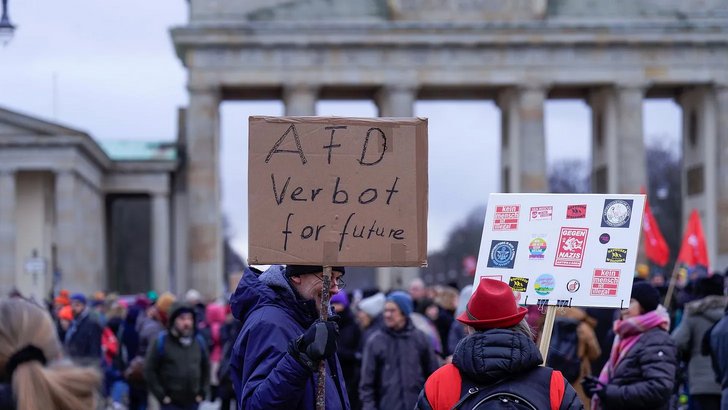
I fear they will try to ban Alternative für Deutschland.
I spent many months last year saying this would not happen, and my reasons were fourfold:
1) Key figures in the major parties, including Chancellor Olaf Scholz of the SPD and Friedrich Merz of the CDU, opposed banning the AfD.
2) Marco Wanderwitz’s much-publicised initiative to ban the AfD was therefore a doomed movement among Bundestag backbenchers, overhyped by idiotic German journalists. As I predicted, it went nowhere.
3) Throughout much of 2024, the AfD were strong enough to be a problem, but not quite strong enough to cause prohibitive difficulties for the political cartel that runs the Federal Republic. They persisted in a sweet spot that ruined the risk-reward calculus of trying to ban them.
4) Through last summer, the NGO-coordinated and government-led “fight against the right” succeeded in seriously damaging AfD support. If the AfD could be kept in bounds via propaganda, a ban seemed additionally unlikely.
None of these considerations apply anymore: Support for banning the AfD is building within both the SPD and the CDU. Much more serious efforts to the ban the party are on the horizon; the Wanderwitz clownshow is yesterday’s foible. The AfD seem increasingly immune to state media propaganda and leftist political agitation.
More important than all of that, however, is the fact that the CDU have proven vastly more incompetent than I or anybody else anticipated. Through their own failures they are making the AfD into the strongest political party of the Federal Republic. Soon they will be in a position to threaten outright majorities in the East. This was going to happen sooner or later, but the CDU have accelerated the process massively. Things that should’ve taken years are now taking months, and that is very dangerous. It is far from inconceivable that the AfD will end up with a Minister President (i.e., a governor) in Mecklenburg-Vorpommern or Sachsen-Anhalt following the state elections in 2026. And however that turns out, the 2029 federal elections will be a nightmare. By then the AfD will be so strong that all other parties will have to form the world’s shittiest of shit coalitions to keep them out of power.
CDU General Secretary Carsten Linnemann warned in January that “if we in the democratic middle don’t stop illegal migration, the fringes will become so strong in the next election that they will be able to govern alone“. Well, it turns out that the “parliamentary middle” have no interest in stopping mass migration, not even to ensure their own political survival. Men like Friedrich Merz and Lars Klingbeil are like automata, locked via institutional imponderables on a predetermined course of national and political self-destruction. Unable to change their politics, they will try instead to remove the AfD from the map. If you can just ban the opposition you don’t have to solve problems, you don’t have to win arguments and you don’t have to persuade voters of anything.
Last October, Merz said he would be open to banning the AfD, if and when the Federal Office for the Protection of the Constitution (BfV) upgrades their political status. Later thinly sourced reports have Merz emphasising again at a closed CDU meeting that he would be “open” to banning the AfD, but that this would have to wait until “just after” the February elections.
At issue is a long-awaited report on the political crimes of the AfD from the domestic intelligence agents of the BfV. As of now, the BfV classifies the AfD as being “under suspicion of right-wing extremism”. This has been the case since 2021, and the classification has allowed the BfV to use their wealth of spy agency tactics against the party. They tap their phones, read their emails and send their agents to infiltrate AfD ranks.
April 23, 2025
Germany’s extremely extreme extreme right AfD now the most popular party
Friedrich Merz, the leader of the “main” right-wing party in the Bundesrat seems to have a problem with math, as he keeps promising to cut the AfD support in half, yet ends up doubling it:
Many years ago – in 2018, to be precise – a man named Friedrich Merz was in the running to succeed Merkel as chairman of the CDU.
Merz said many interesting things back then. On 14 November 2018, for example, he gave an interview to BILD, in which he denounced Alternative für Deutschland as a party “that does not distance itself from the right” and said that “this makes them unsuitable for any coalition”. Merz pledged to win back all the CDU voters who had defected to the AfD over the years. “In the short term,” he said, “it will probably be impossible to get rid of the AfD,” but if he were chosen to succeed Merkel, he pledged that he could “cut their support in half“.
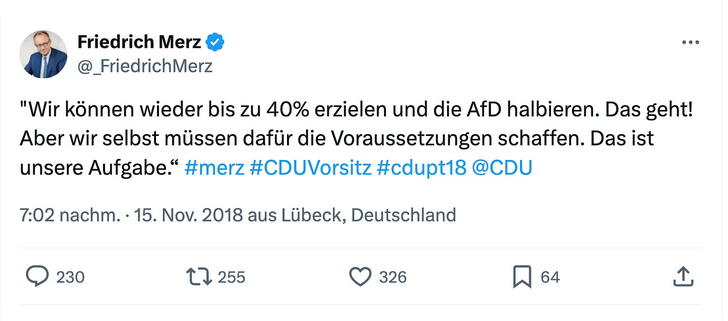
The very next day he tweeted the exact same thing – promising to lead the CDU back to 40% in the polls and to “halve the AfD“.
At a regional CDU conference around this time, Merz yet again promised to “cut the AfD in half,” adding that “this really is possible”. If I looked harder, I could probably find even more examples of Merz repeating this exact same promise. He made it such a core component of his campaign for the party chairmanship that the Frankfurter Allgemeine Zeitung observed in retrospect: “The whole idea of Merz as party chairman was based on the notion that he would win back votes that Angela Merkel had lost“.
[…]
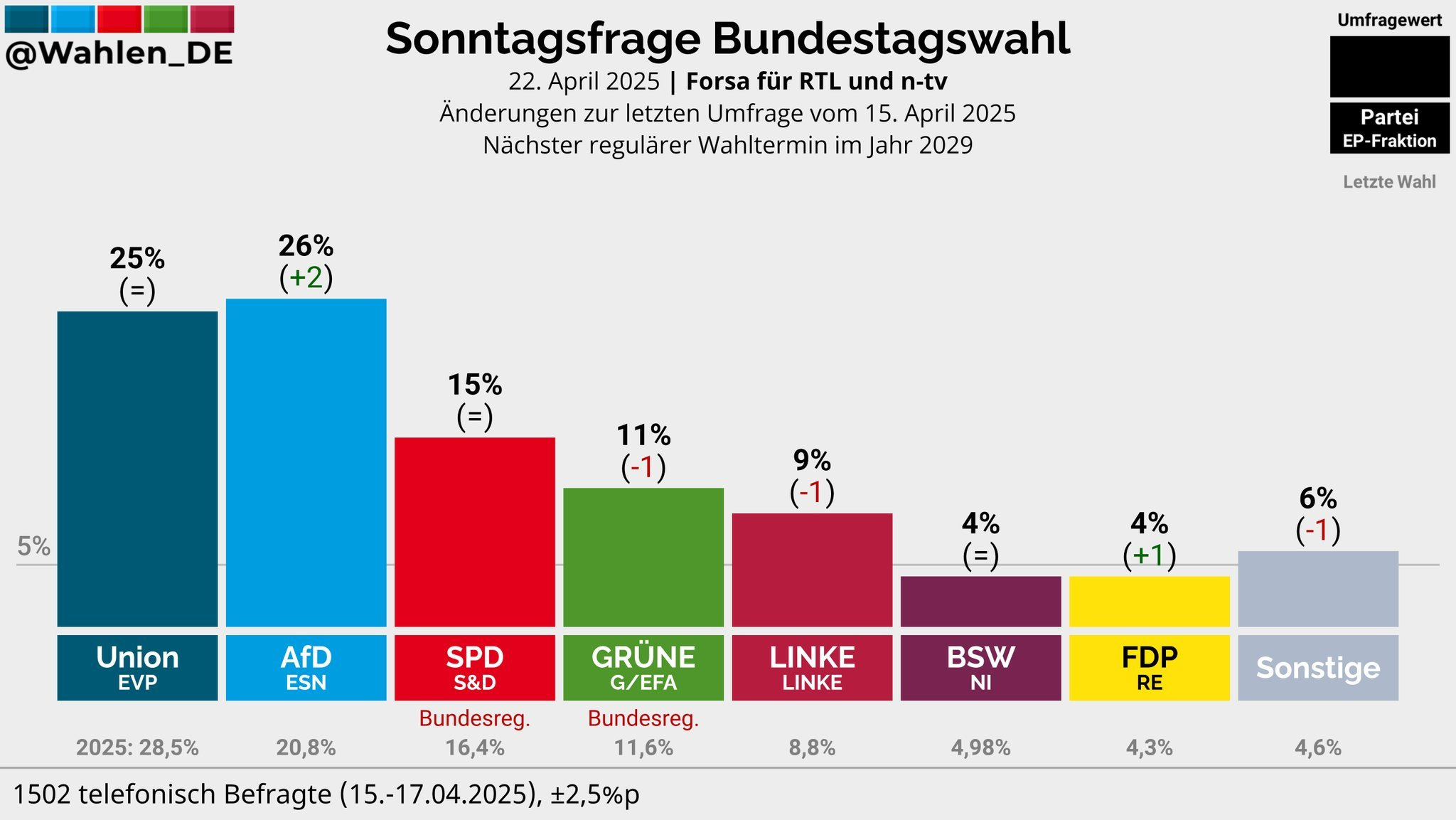
The latest Forsa poll (conducted for RTL and ntv) has Alternative für Deutschland at a cool 26%. That is their best result in history, and it makes them the strongest party in the Federal Republic. This is the second such poll that places AfD in first place, following an Ipsos survey from 9 April that pegged them at 25%.
Merz has indeed done something to AfD support involving the operand of 2. It’s just not exactly what he imagined.
Now all of that rhetoric we one once heard from the cartel parties – about the importance of dealing with the AfD on the issues and of making convincing appeals to the “democratically inclined” among AfD voters – have become yesteryear’s pablum. They are going to try to ban the AfD now. Because they can’t beat them in any other way, and because they believe Germans shouldn’t be allowed to cast their votes beyond the narrow confines of the political cartel that runs the Federal Republic, they’re going to try to remove the AfD from the board via legal trickery.
Of course, if the AfD is now the most popular party in Germany, it must be suppressed ASAP, and the individual members of the party must be punished “to save democracy”:
In Germany, owning guns is a privilege that can be taken away — not for breaking the law, but for holding the wrong political opinion.
Members and supporters of the right-leaning Alternative für Deutschland (AfD) party are now facing mass gun license revocations. The reason? The German government has labeled the AfD a “right-wing extremist” group — a political designation that suddenly makes its members “unreliable” under the country’s gun laws. And just like that, firearms must be surrendered or destroyed.
If that sounds outrageous, it should. But it’s not surprising.
[…]
In 2021, Germany’s domestic intelligence agency, the Bundesamt für Verfassungsschutz (BfV), designated the entire AfD as a “suspected threat to democracy”. That move allowed the government to surveil, wiretap, and investigate the party and its members.
It didn’t stop there.
Courts have now upheld revoking gun licenses from AfD members, based solely on their political affiliation. In one case, a couple in North Rhine-Westphalia lost legal ownership of over 200 firearms. They weren’t criminals. They weren’t accused of wrongdoing. They were just AfD members.
Another court in Thuringia blocked a blanket gun ban for all AfD members — but left the door wide open for revocations on a case-by-case basis.
In Saxony-Anhalt, officials are reviewing the gun licenses of 109 AfD members. As of last fall, 72 had already been targeted for revocation, with the rest under active review. The justification? Supporting a party the state now claims is “working against the constitutional order”.
And the courts are backing it up. According to a March 2024 ruling, former or current AfD supporters “lack the reliability” required to legally own firearms.
April 22, 2025
Douglas Murray’s On Democracies and Death Cults
James Pew reviews Douglas Murray’s latest book, On Democracies and Death Cults: Israel and the Future of Civilization (I was first made aware of the book by the sudden uptick in antisemitic posts on social media that directly attacked Murray and his work).
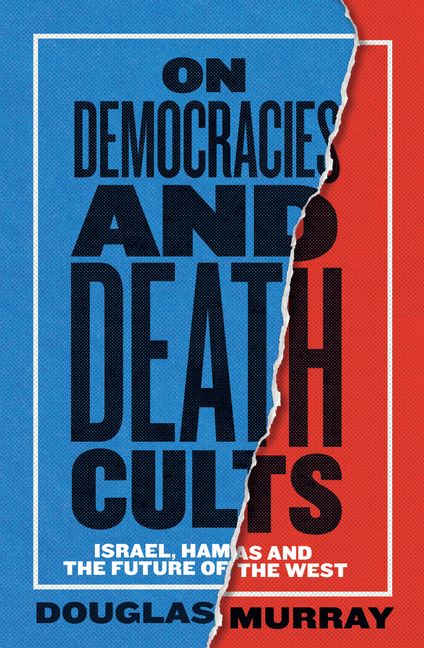
The opening words of On Democracies and Death Cults by Douglas Murray contains a disturbing fact about the situation Israel, and the entire Western world, were thrust into immediately following the barbaric terrorist attacks of October 7, 2023:
Sometimes a flare goes up and you get to see exactly where everyone is standing.
Indeed. Out of all the conflicts occurring all over the world, many of which are more devastating by orders of magnitude and in terms of the scale of humanitarian catastrophe than the IDF’s Gaza campaign, why would Westerners care so much about it? Why do Canadians and Americans take to the streets and occupy college campuses over it? These and many other vital questions are asked by Douglas Murray in On Democracies and Death Cults.
So why should this particular October 7th event, and the IDF’s subsequent military response, which is taking place halfway around the world, be the one that reveals “exactly where everyone is standing”? Murray knows the answer, as do his readers and most clear thinking people who do not harbour secret loathing’s for the Jewish people. The reason is clear and plain as day: the Jews are defending themselves and their homeland from a terroristic death cult bent on their destruction, but for some reason hoards of people from all political stripes from virtually all corners of the world, believe this to be a wholly unacceptable thing for the Jews to do.
The shame I felt for Canada, or more correctly, for things that had been allowed to take place in Canada following the October 7th massacre in Israel, was immediately apparent in the introduction when Murray wrote:
In Canada alone, after October 7, synagogues were firebombed and shot at, Jewish schools were shot at, Jewish shops were fire-bombed, and Jewish-owned bookshops were vandalized.
Future generations will need to contend with the fact that in the immediate aftermath of the worst crisis to strike the Jewish people since the Holocaust, anti-Semitism erupted throughout the West. An inexplicable “shapeshifting” hatred that “locks Jews in an unresolvable set of challenges.” Murray writes:
Jews were once hated because of their religion. Then sometime after the Enlightenment it became hard to hate people because of their religion. At that point the Jews were hated because of their race. Then, after the twentieth century it became unacceptable to hate people because of their race. So, in the twenty-first century, when civilized people cannot hate the Jews for their religion or their race, Jews can be hated for having a state–and for defending it.
Murray’s head is constantly in two places: 1) Israel, including the war zone in Gaza 2) The West. The question of why Israel seems always to be the object of relentless and obsessive international scrutiny, is top of Murrays mind. But as well, the infiltration of radical Islamic ideologies into the Western institutional edifice is not lost on him. Indeed, this knowledge leads him to such observations as the following:
While there were certainly plenty of non-Muslim politicians in the West who decided to attack Israel from the moment the conflict started, it should also be noted that elected Muslim politicians across the West seemed to have a special beef with the Israelis and supported the Palestinian side …
Canada has no shortage of the exact political personage Murray is referring to. The signs of Islamic infiltration and subversion into Canadian society are everywhere. The recent adoption by the Toronto District School Board of policies concerning Anti-Palestinian Racism, is but one example of the phenomenon.
Early in the book Murray mentions the Iron Dome – the Israeli missile defense system. One thing I never considered was the economics involved with the constant rocket attacks on Israel from Gaza. Whereas the cost of a rocket shot from Gaza is estimated at around $300 US, the cost of one of the defense missiles deployed to eliminate Hamas’ rockets is around $100,000 US, and sometimes two defense missiles are required to shoot down one $300 dollar terrorist rocket. The vast amount of economic resources eaten up by the asymmetrical terrorist warfare waged by Hamas is astounding, when one considers the years over which these rocket assaults have taken place.
QotD: Fear, uncertainty, and doubt from the Reagan era
“There is, for instance, enough water in the planet to drown everyone four thousand times; there are enough matches to set fire to every wooden building; enough kitchen knives to murder all the husbands of the world; enough hairspray (if drunk) to poison all their wives; enough pillows to smother the entire population of Asia; enough pencils to put out everyone’s eyes; enough fishbones to choke the combined population of France and Italy; enough ties, belts, suspenders, and pyjama draw strings to hang everyone over the age of forty; enough cigarettes (if eaten) to make everyone in Africa south of the Sahara throw up; enough stairs for all the toddlers in the world to fall down; enough statues to crush the inhabitants of the fourteen largest cities in the American Midwest; enough piano wire to garrot three-quarters of the population of Roumania; enough frozen lamb chops to club to death the entire Scottish aristocracy.”
Granted, the weight of human suffering. Granted, that we all progress to biological death, after a brief illusion of invincibility. But would it be entirely irresponsible, to dance our way through the interim? Even while the vultures are circling in the sky?
David Warren, “Be afraid, be very afraid”, Essays in Idleness, 2020-04-14.
April 20, 2025
The essence of (most) modern western governments
Chris Bray on the paradox of how many western governments manage the alchemy of being both omnipresent and yet absent simultaneously:
Adding to my last post about covering language that masks the massive expansion of government behind performative language about limiting government: The most Los Angeles thing I have ever seen happened behind the Yoshinoya Beef Bowl.
See the alley between the Yoshinoya and the pharmacy? As I drove by on Wilshire, two extremely alert LAPD officers on motorcycles were sitting at the edge of that parking lot, postures tight and poised for action, urgently scanning the street. It was like watching a gunfighter movie, in the scene when the camera closes in on the gunfighter’s eyes, watching his opponent for the draw. These dudes were ready. If you did 38 in the 30 MPH zone, then brother, you were dead-ass done, nailed up in the trophy case.
Also, no more than thirty feet away from them, a little gaggle of filthy human zombies was passing a glass pipe around the circle, throwing up clouds of smoke, at the top end of an alley wall-to-wall full of open drug use and not terribly subtle drug dealing (and probably the prostitution that pays for the drugs, but I didn’t wander into the alley to look). But California made the possession and use of heroin, meth, and cocaine a misdemeanor, and the DA at the time was very proud that he wouldn’t allow his office to file most misdemeanor cases, because misdemeanors are lifestyle crimes that punish people for being poor, or for being “individuals experiencing homelessness”. So that alley full of people Hunter Bidening all day out in the open weren’t doing anything that could lead to prosecution, but your expired registration tags would bring down an immediate police response in you happened to roll by them.
Grand Guignol human depravity and ruin: no big deal. Minor traffic offenses: front and center.
This is Blue Zone governance, full stop, the thing people describe as anarcho-tyranny. Common San Francisco business owner experience: Police don’t intervene in the constant vandalism and tagging that degrades business property, but the highly alert army of code enforcement officers fine business owners for failing to clean up the damage that the city hasn’t prevented.
I forget who recently suggested this on I-still-call-it-Twitter, but go to Yelp and read some reviews for gas stations in Oakland:


QotD: “Hate speech”
This is why they balk and protest when the words free speech are used against them. They detest the idea that they are enemies of liberty. But of course that is precisely what they are. Just consider that nonsensical chant “Hate speech is not free speech”. There are two profound moral problems with this idiotic tautology. The first is that, actually, even genuinely hateful speech, including racist gibberish and misogynistic blather, should be free speech. By its very definition freedom of speech should extend to all speech, even speech we detest. And secondly, “hate speech” has become a slippery, amorphous category that now covers not only foul old nonsense like Holocaust denial, but also trans-sceptical feminism, criticism of Islam, opposition to mass immigration, and so on. “Hate speech” really means thoughtcrime. It is an utterly ideological category used by the cultural and intellectual elites to demonise and censor ideas, beliefs and moral convictions they disapprove of. The war on “hate speech” is the new war on heresy, on free-thinking, on minority opinion, on challenging beliefs. It is blatant censorship.
The illiberal liberals’ conflation of genuine hatred with moral opinion, all of which then gets cynically collapsed under the name of “hate speech”, was beautifully captured in an exchange on the BBC’s Politics Live yesterday. Pushing back against the FSU’s Inaya Folarin Iman, Baroness Kennedy arrogantly predicted that the FSU would be embraced by “racists … people who hate homosexuals, who hate trans people, [and] people … who have hostile views towards Islam”. Hold on. One of these things is not like the others. What is wrong with having hostile views on Islam? Is hostility towards a powerful world religion now a form of “hate speech”? Yes, it is. Kennedy’s conflation of criticism of Islam with racism and homophobia perfectly encapsulated the way in which “hate speech” is now used to police not only genuinely hateful ideas, but also blasphemy against religious ideas. Even that key freedom human beings fought so hard for – the right to mock gods and prophets and religious ideology – is now threatened by the censorious ideology of “hate speech”.
Brendan O’Neill, “Why we must win the fight for free speech”, Spiked, 2020-02-26.


