
I respect [sprawl] as people’s choice – the suburbs, highways and byways, strip malls, cookie-cutter houses, whether small semi-detached or McMansions, the whole lot of it.
It gets a lot of bad press, it has got a lot of influential haters, ridiculers and deriders. There are the urbanists, the town planners, the architects, most of whom can’t abide the sprawl. It’s ugly, inefficient, unsustainable, it lacks amenities and it lacks a sense of community, it prioritises – or privileges, as they would say – cars over pedestrians, it wastes space and it wastes resources, it’s barbaric. Those much smarter and more creative than us have offered a lot of alternatives: high-density living, modernist spaces, Le Corbusier’s houses as “machines for living”. They tore down the slums and erected high rise projects, council flats, banlieues and osiedla. They designed and built whole new districts, rich in concrete and wide bare expanses of public space.
Then there are the cultural as opposed to professional haters, and they too are as old as the suburbs themselves. The sprawl is a prison, a conformist hell. It deadens imagination and stifles creativity. It’s full of dumb people leading dumb lives. It’s a triumph of materialism, selfishness and narrow mindedness over selflessness, community and commonweal. From literature through movies and music to TV shows, suburbs don’t get a break; they are the hotbed of reaction, sexism, racism, homophobia, xenophobia, intolerance, prejudice, oppression and kitsch. “Revolutionary Road”, “Stepford Wives”, “American Beauty”, “Weeds”, “Little Boxes”, Stephen King novels, the list is endless, but you get the drift.
There are many differences between the suburbanites and the suburbs haters, but the one big one is this: the suburbanities are the live-and-let-live crowd – they know what they like but they don’t give a shit if you don’t like it. It’s your business and it’s your life – you can do whatever you like. The suburbs haters, on the other hand, not only know what they like but they believe that everyone else should like it to, and if they don’t, tough luck, they should be forced to change for the sake of what’s really good for them and for the whole community. Suburbs are not something that can be tolerated as an option; they should be destroyed, land reclaimed, ideally by nature, their former residents corralled and concentrated.
In many ways it’s yet another example of the old elite versus the masses cultural clash. The masses essentially just want to be left alone. The elites want to remake the whole world so it accords to their vision of what’s good and useful. The masses’ is not to question why …
Arthur Chrenkoff, “In praise of sprawl”, Daily Chrenk, 2020-05-21.
May 17, 2025
QotD: Suburbs and their critics
May 16, 2025
Those scary “Brexity books”
Andrew Doyle on the sudden interest British police seem to be taking about what kind of books you may have on your shelves at home:
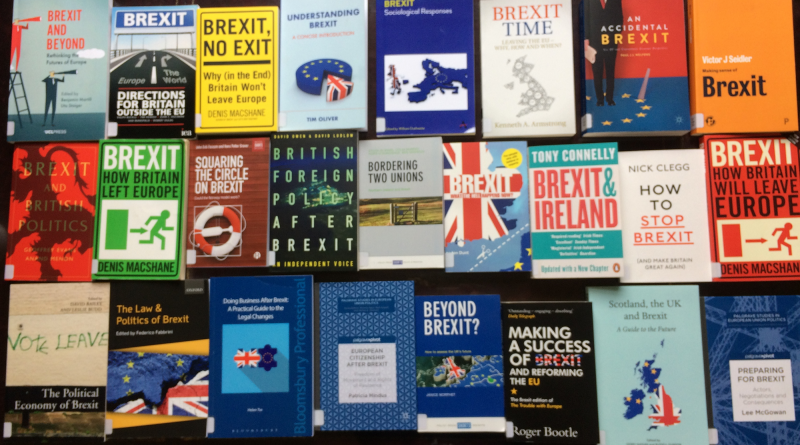
If the British police saw this collection, you’d be lucky to get out of prison in fifty years!
The UK police certainly seem to believe in that old aphorism that that “You can tell everything you need to know about a person from their bookshelf”. There has been much press coverage this week of the case of Julian Foulkes, a former policeman who was arrested at his home in Gillingham for tweetcrime. It took six officers to handcuff the pensioner and take him to a cell, and bodycam footage from the arrest shows them assessing the contents of his bookshelves. One was seen singling out The War on the West by Douglas Murray and another remarked that there were “very Brexity things”.
I have a fair few “Brexity” books on my shelf too. I have just as many “anti-Brexity” books, as it happens. It seems to have escaped the attention of these officers that it is possible to read multiple points of view without necessarily subscribing to any of them. They have also apparently forgotten that “Brexity” views are fairly commonplace, enough so to win the largest democratic mandate the country has ever seen. If it’s a majority view, is it really all that controversial?
I recall during the lockdown I was scheduled for a television interview and, having set up the webcam, I suddenly realised that the two volumes of Ian Kershaw’s excellent biography of Hitler were not only visible, but prominent. The design of the books’ spines is such that the word “HITLER” is displayed in huge letters. Very dramatic and marketable, but not so helpful if you’re about to appear on live television. I must confess that I repositioned my chair to ensure that the books were obscured.
But why? It isn’t as though any sensible person could possibly believe that my interest in the history of tyranny implies an endorsement of it. I could just as easily have a copy of Mein Kampf on the shelf and still retain my wholehearted opposition to its author and everything he stood for. If I owned a copy of the Koran, would that make me a Muslim? If I owned a copy of Jilly Cooper’s Riders, would that make me prone to passionate romps in stables? As a chronic hay fever sufferer, this hardly seems likely.
The assumption that the books we choose to read are a mirror-image of our private thoughts, or that we are so malleable that any opinion we encounter will automatically be assimilated, is very much a core tenet of faith in today’s woke mindset, one that has quite palpably infected the justice system. Those who are currently serving prison time for offensive tweets will be aware that the unevidenced belief that the public act on cue to the language they read has some very authoritarian consequences.
For some reason, men who sleep around don’t want to marry women who sleep around
Young women who approach casual sex the way that young men do (or used to, anyway) are shocked to find that men don’t want to settle down in a long term relationship with a woman with a similar “bodycount”:

A young woman at a club with unrealistically disinterested young men.
Image generated by Grok.
First of all, men are very different than women, but guys are also fairly simple creatures.
Here are the fundamentals, ladies …
If a man sees you as a potential match, is attracted to you, you feed him, seem to want to take care of him, you’re a good mom (if you have kids), have good sex with him, are nice to him, he enjoys talking to you and you genuinely seem to think he’s great, he will think he’s the luckiest guy on earth. The great thing about all of this is that it’s mostly under your control. Yes, you might have to dress up and have some open conversations about what the two of you like in bed, but it’s a doable list. Being 6’4′ or making $500,000 per year to get some woman’s attention may be outside of a man’s control, but if a man considers a woman relationship material, she is probably capable of locking him in if she wants to do it.
Of course, like everything else in life, there is some nuance involved here.
For one thing, good sex is a key part of a good relationship, BUT unlike a lot of women, men are also generally very comfortable with the idea of having sex OUTSIDE OF RELATIONSHIPS. A lot of men can enjoy sex with women they just met, women they know they’ll never see again, or even women THEY DON’T EVEN LIKE AS HUMAN BEINGS. Men just have a biological drive toward sex, the same way, for example, a lot of dogs have a biological drive toward prey. The second my dog sees a cat; she wants to chase it. If she catches up to the cat, she doesn’t even know what to do, but she does know she wants it to run so she can have the fun of running after it. It’s an innate drive for her and most men have that same kind of innate drive around sex, even though most of us never have the opportunity to fully express it.
[…]
For example, all other things being equal, just about every man would prefer a virgin to a woman with say 50 previous partners. Why? Well, in a man’s book, being promiscuous is a huge negative in a woman you’re interested in long term for reasons great and small, fair and unfair.
Like what?
Well, first and foremost, the traditional concern is that if she’s sleeping around, how do you know your child is yours? The last thing any man wants to do is get cucked and end up spending his life raising a child some other man impregnated his wife with right under his nose. Along similar lines, the more a woman has slept around, the more likely it is that she may cheat. After all, unless you’re the absolute peak of the pyramid for men, having sex requires a lot of effort and work. For women? Not so much. She’ll have easy opportunities every day of the week, probably multiple times per day, and if she feels comfortable sleeping around, can you trust her?
How easy is it? Well, once, I remember talking to a female friend of mine who had moved to another city, was lonely, and she complained to me that she “Just needed to get laid.” I laughed at her over the phone and told her something like, “All you have to do is dress up, go to a hotel bar, look for any attractive single man, sit next to him, and talk to him for 5 minutes, then ask him to take you up to his room. You’ll be having sex 5 minutes after. It’s that easy” – and it is, for women.
We can go on. Promiscuous women are statistically less likely to stay married. You also have to think they probably aren’t going to be as satisfied in bed if they’re comparing you to a large number of men. You know, “Well, Brett had that amazing 8 pack, Jimmy was really hung, Paul could go forever, and Todd did that really cool thing with his tongue, so how good is this compared to those guys?” Furthermore, it’s natural for men to want large numbers of female partners, but not so much for women, which usually means women who sleep around have issues. How many mentally healthy, happy women are racking up truly large numbers of guys? Not many.
May 14, 2025
We welcome (almost) all refugees
Mark Steyn notes the odd situation of rabid pro-refugee organizations suddenly finding that there are some refugees they don’t want to come to the United States after all:
We are told, relentlessly, that “diversity is our strength”. But it’s a delicate balance, isn’t it? After Biden’s untold millions of drug mules and sex fiends, just fifty-nine whites from South Africa could completely destroy all the multiculti harmony:
I confess to mixed feelings about those scenes myself. When I was a kid, the Boers had a reputation, unlovely as they might be in certain aspects, as the toughest buggers on the planet. In Britain and Canada, it was not uncommon to hear fellows, depressed at how their own countries were going, talk breezily about emigrating to South Africa. Yet in the end they folded in nothing flat — and the country’s new masters don’t want them and they have to find somewhere to go. Gee, it’s almost like that might be a lesson of more general application in the year ahead.
So it’s interesting to see the American left tiptoe all the way up to making the real purpose of “diversity” explicit: We’re in favour of open borders … except for whites. Rather than sully their hands with fifty-nine Afrikaners, the Episcopal Church has declared it’s willing to forego the moolah from the federal “refugee resettlement” racket. The spousal-abusing MS-13 gangbanger may be the quintessential “Maryland man”, but these white guys never can be.
Watching hoity-toity upper-class whites like NBC’s Andrea Mitchell finger-wagging from the anchor chair about their anti-whiteness is instructive. They assume that they will never have to face the consequences of their virtue-signalling. But the chasm between Eliteworld and Reality yawns wider with every day, and it will one day consume most of the west’s high-status “progressives” too. There are limits to kingly power. That’s the lesson Canute tried to teach his courtiers when he took them to the water’s edge and commanded the tide to lay off his loafers. But King Canute would never have ordered his staff to tell the peasantry to eat crickets on a bed of cockroach coulis. Because that would be too ridiculous.
For that we had to wait until Justin Trudeau, sinking bazillions of dollars into bug farms as part of the masterplan: that’s not just a bug, it’s an indispensable feature. Because at the World Economic Forum all the clever guys decided that, in the interests of saving the world from “climate change”, our rulers had to do to our own farmers what the mob is doing to white South Africans: destroy their farms, kill all the cows and sheep, and ensure that nothing grazes there ever again.
There are few things sadder than a post-developed society. If you walk around South African towns at the end of the day, you will notice in high-rise buildings the absence of lights on the upper floors: the inability to maintain skyscrapers is one of the first signs of a society in decline. It starts at the heights and then sinks to the basement, whether those heights are Boeing or bug farms. If you’re in on the racket, you can still live high off the hog-simulating scorpions … for a while. But the people who make the running in the western world are mad, and their fever dreams are boundless.

Carney’s new cabinet – remarkably similar to Trudeau’s cabinets
Prime Minister Mark Carney talked as if he was initiating a new era in Canadian politics, but when it came to nominating his first cabinet, it’s plus ça change, plus c’est la même chose with most of the same cast of incompetents, crooks, lickspittles, and fart-catchers. Justin Trudeau would feel right at home:

Prime Minister Mark Carney promised change, a new way of doing things at speeds never before seen. Yet to help him do this, he is relying on the same old, tired, incompetent ministers who got us into the mess we’re currently in.
The Liberals will trumpet the large number of new faces in Carney’s 28-member cabinet — there are 15 MPs who have never served before.
But the top tier of ministers — the ones sitting in the front row at the swearing-in ceremony on Tuesday — were all former Trudeau acolytes, cabinet ministers now committed to rescuing us from a crisis of their own making.
In the front row was Sean Fraser, our new justice minister and attorney general, and the man who, under former prime minister Justin Trudeau, was responsible for immigration and then housing, two files he spectacularly failed at. If we want to know how bad Fraser was in those jobs, we need only look to Carney’s election platform.
“The last time we faced a housing crisis at such a broad scale was after the Second World War”, read the platform. This crisis “has left younger generations facing rents, down payments and mortgage payments so high that it turned housing into a barrier to opportunity instead of a cornerstone of opportunity”.
What about Fraser’s record at immigration? According to the Liberal platform, the Trudeau government let immigration “grow at a rapid and unsustainable pace”.
In December, when Liberal fortunes were in the toilet, Fraser announced that, for family reasons, he was quitting politics. Strangely, after the party witnessed a reversal in the polls, he announced he was returning.
In Carney’s eyes, Fraser’s blundering on two key files qualifies him to become justice minister. The only thing worse than Fraser as a cabinet minister may be Carney’s judgment.
Also in the front row was Chrystia Freeland, who served as deputy prime minister and finance minister under Trudeau and is now returning to cabinet as minister of transportation and internal trade.
Freeland’s record is best summed up, again, by the Liberal platform: “Business investment in Canada has dropped from 14 per cent of GDP in 2014 to 11 per cent in 2024, undermining long-term economic growth”.
Meanwhile, long-time Trudeau lieutenant Mélanie Joly, whose reign at foreign affairs was about as successful as Fraser was at housing and immigration, moves to industry.
Well, if we’re stuck with Carney’s retreads, at least we can laugh about ’em. Through the tears:
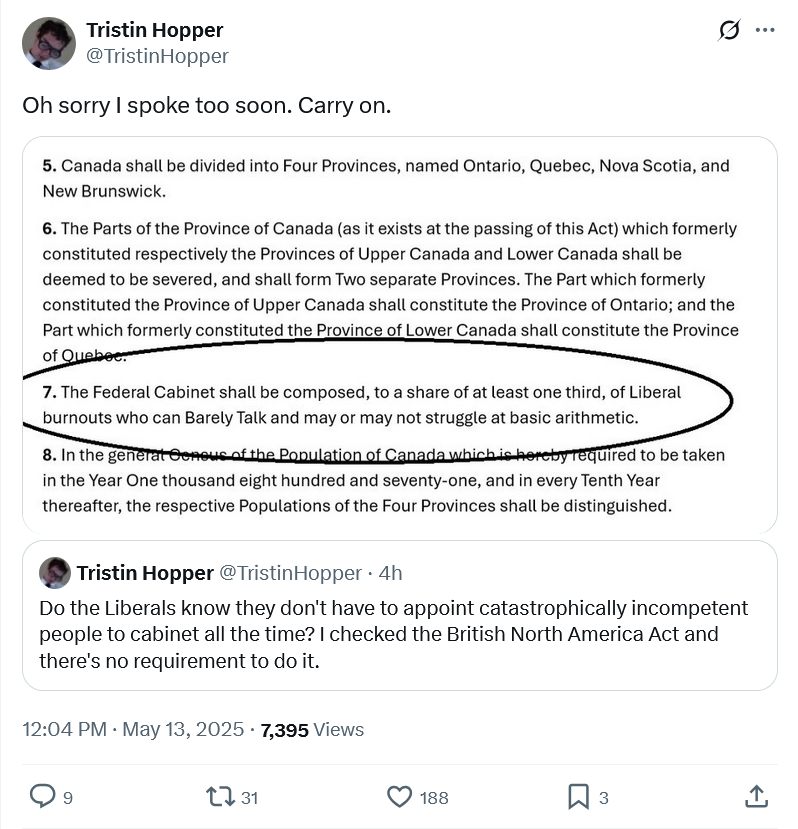
Noah has some faint praise for the new minister of National Defence and the new Secretary of State for Defence Procurement:
Welp it’s official. Bill Blair is out.
I cant say that it’s overly shocking. I don’t think anyone truly expected Blair to be MND by the end of today. While I will give Blair some credit for holding the fort, most of you already know I wasn’t his biggest fan.
He was a great placeholder who was able to smoothly roll out the plans left to him. He also did have several good public showings, such as his efforts in Korea last year. I will give credit where it is due.
However, he was also uninspiring, too passive in his role, and while I have no doubt he took it seriously, was never going to be a great long-term option. He had long overstayed his welcome […] Now he’s out completely from cabinet and in his place we have not one but two new ministers on the defence profile!
David McGuinty, best known for his eight-year stint as Chair of the National Security and Intelligence Committee has taken the reigns as the new Minister of National Defence While Kelowna MP and veteran Stephen Fuhr will take on a new role as Secretary of State for Defence Procurement.
In this role Fuhr will work under McGuinty specifically to tackle the file of Defence Procurement ahead of the establishment of the DPA. He is one of eight new secretaries of state that will operate on a “junior” level in cabinet.
Now McGuinty wouldn’t have been my first pick. I will openly admit that, but it is hard [not] to argue that he is the most prepared for the role, and likely the best we have available.
McGuinty previously held the NSICOP chair from 2017 all the way until December when he was appointed Minister of Public Safety. He has a background in International Development before becoming a parliamentarian, including stints with UNICEF.
He isn’t coming into this without a background on the current security climate we’re facing. He certainly can’t be said to be ill-prepared to take the role at a time when CAF and the DND are at one of their most pivotal moments in restructuring.

QotD: To hell with visual distractions on your desktop GUI
My desktop layout doesn’t have a background, or icons, or action buttons, or gradients, or any of that crap. It barely even has color.
I’m not going to name my window manager here, because I don’t want to sound like I’m evangelizing for a particular one. The important part is that it’s all tiled windows all the way down with an absolute minimum of dead space and visual noise.
And I am so much happier than I was with conventional desktop GUIs. I love not having that visual noise constantly pull at my attention.
In hindsight, we spent decades being obsessed with UI details that were just meaningless, distracting fluff. That not only didn’t help us get work done, they were actually a drain on our concentration.
Only part of that can be blamed on pixel-pushing “UX” designers who got erections every time they changed the color or shape of a button. The rest of it’s on us, on people who bought into this glittery fake progress. I used to be guilty of this myself, but I’ve learned better.
Fancy visually-noisy desktop GUIs that suck your attention are the enemy. Fuck all that sideways with a chainsaw. Go simple, go tiled, go minimalist — stop abusing your brain!
Eric S. Raymond, Twitter, 2024-05-28.
May 13, 2025
Checking on the parlous state of German democracy this week
First, Sabine Beppler-Spahl points out how difficult it was for the new ruling coalition to get their candidate for Chancellor actually installed:

German Chancellor Friedrich Merz, 5 May 2025.
Photo by Sandro Halank for Wikimedia Commons.
The spectacle in the Bundestag this week sent shockwaves through Germany’s political establishment. For the first time in modern German history, a chancellor candidate – Christian Democratic Union (CDU) leader Friedrich Merz – failed to get elected by parliament. In the first round of voting, he received just 310 out of 621 votes – six votes short of the necessary majority. A total of 18 members of his own coalition brazenly refused to support him.
A second round of voting was then called and Merz managed to scrape through with 325 votes. But this was a stinging embarrassment for both Merz himself and the new coalition government more broadly. “Never before has there been a political car crash on such a scale”, wrote Berthold Kohler, editor of the conservative FAZ.
In hindsight, Merz’s failure shouldn’t have been such a surprise. From the beginning, the new government was always going to be in for a rough ride. For a start, it is made up of two parties that both received phenomenally bad results in February’s federal elections. The CDU suffered its second-worst result since its founding. Meanwhile, the CDU’s coalition partner, the Social Democrats (SPD), received its worst result ever.
Worse still, the coalition was losing even more support in the polls in the weeks running up to the chancellor vote. At times, the governing parties barely managed 40 per cent between them. Hermann Binkert, head of the INSA polling institute, described this as a “loss of approval like never before in the period between a federal election and the formation of a new government”.
Many commentators are now questioning whether Merz and his coalition will ever truly recover from this humiliation. The fiasco certainly confirms that Germany is in a deep political crisis, which isn’t going anywhere. It also undermines the smug assertions of Europe’s anti-populist establishment, which has been claiming, against all evidence to the contrary, that German politics is less prone to populist upheavals than those of other Western democracies.
Outside parliamentary machinations, the move to declare the largest opposition party to be a formal threat to German democracy isn’t going smoothly either:
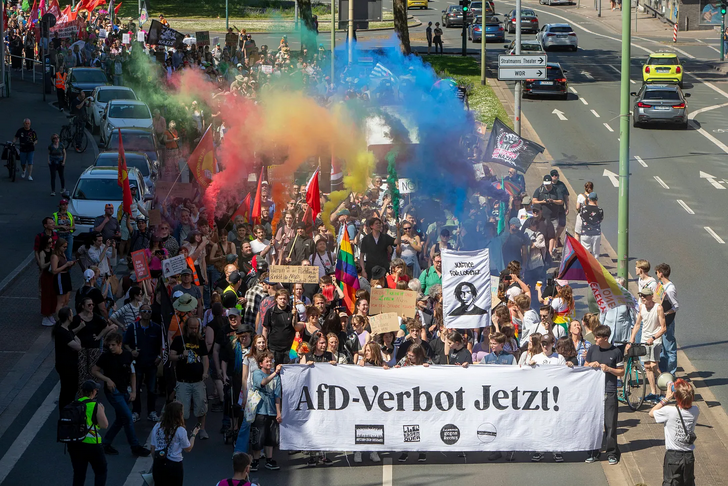
The anti-AfD protest in Essen on Sunday, photographed carefully lest the viewer see how small it was.
On 2 May, the Federal Office for the Protection of the Constitution (BfV) yielded to intense pressure from their boss, Interior Minister Nancy Faeser, and declared Alternative für Deutschland to be a “confirmed right-wing extremist organisation“. The media filled with hit pieces and leftoids began a new round of shouting and morally hyperventilating about the evil fascist Nazi Hitler party. I thought we might be seeing the beginning of an earnest campaign to prohibit the AfD and that over the coming weeks the momentum would just build and build.
Instead it’s kind of fizzled out.
One thing that went wrong, was the roll-out. The AfD immediately filed suit with the Cologne Administrative Court to have their extremist status lifted, and the BfV ended up temporarily suspending their assessment for tactical reasons – above all, to avoid a temporary court injunction that the AfD could portray as a victory. I’ve said many times that a lot of the media pressure against the AfD seems to be coordinated by the constitutional protectors themselves. Now that they’re no longer agitating behind the scenes, the steady drumbeat of pearl-clutching news stories has ground to a halt.
The second thing that has gone wrong, is the publicity campaign. You may remember that the constitutional protectors have produced a 1,100-page assessment documenting the right-wing extremism of the AfD. This dossier, however, remains entirely secret, and so journalists have been leaking choice passages from its pages instead. Their leaks strongly suggest that this document is little more than a vast assemblage of public statements by AfD politicians and functionaries that people in the BfV find untoward.
First we had the three leaks in Welt, which I covered in my first post on this topic. These featured people saying such benign things as “There is more to being German than simply holding citizenship papers” and “Failed migration policy and asylum abuse have led to the importation of 100,000 people from deeply backward and misogynistic cultures”.
That did not impress anybody, so Der Spiegel rushed out a new round of leaks. This piece tells us, breathlessly, that “politicians from the party have been ‘continuously’ agitating against refugees and migrants”, that “they have made xenophobic and Islamophobic statements” and that they have an “ethnic-ancestral understanding” of human descent groups that “is not compatible with the free democratic basic order”. They particularly deplore the use of terms like “knife migrants” (“Messermigranten“) which “attribute an ‘ethnocultural propensity for violence to entire groups'”. They say that the party does not consider Germans “with a migrant background from Muslim-influenced countries” to be equal citizens and that the AfD thus “devalues entire population groups in Germany”, violating their human dignity.
QotD: The song is correct – video did kill the radio star
One reason for this assumption is youth culture. In liberal democracy, the young are treated like gods, in the same way novel social ideas are treated as gifts from the gods, so whatever young people like is heralded as pure and beautiful. Young people, especially children, are first drawn to images, then sounds and finally as they mature into adults, the written word. In modern liberal democracies, therefore, video platforms are treated like sacred altars where our most sacred members perform.
The youth culture phenomenon has co-evolved with the rise of mass media. In the days before mass media, young people were at the bottom of the cultural hierarchy. The first flicker of youth culture in America was the jazz age, but even there the people driving it were old by modern standards. The characters in The Great Gatsby, for example, are mostly early middle-aged. It was after the war with the explosion of Hollywood that youth culture blossomed into the centerpiece of modern life.
Another reason why video maintains a privileged place at the top of our social hierarchy is Baby Boomer culture. For Boomers, for whom mass media evolved, video was always the top. In the golden age of television, for example, the whole country would watch popular television programs. No newspaper or radio broadcaster had the reach of a popular television program. Hitting the big time in the field of news or entertainment meant getting on TV or in the movies.
As much as young people, and not so young people, complain about the Baby Boom generation, the Boomers still control the culture. That is plainly obvious with the panic over the Chinese virus. If the Boomers were twenty years younger, the virus would rate a few mentions in the New York Times science section. Since Boomers are now deeply involved in the health care system, anything medical is going to be of utmost importance to everyone. It is why nurses are now heroes.
The Z Man, “Thoughts on Modern Media”, The Z Blog, 2020-05-09.
May 12, 2025
Is modern fiction in any way intended to be read by a male audience?
I belong to several genre-specific groups on various social media platforms, most of which appear to be disproportionally female in membership, and I read very little new fiction of any sort these days, partly for diminished interest and largely from diminished disposable income. I’ve often seen the assertion that men no longer read much fiction, but is it actually true?
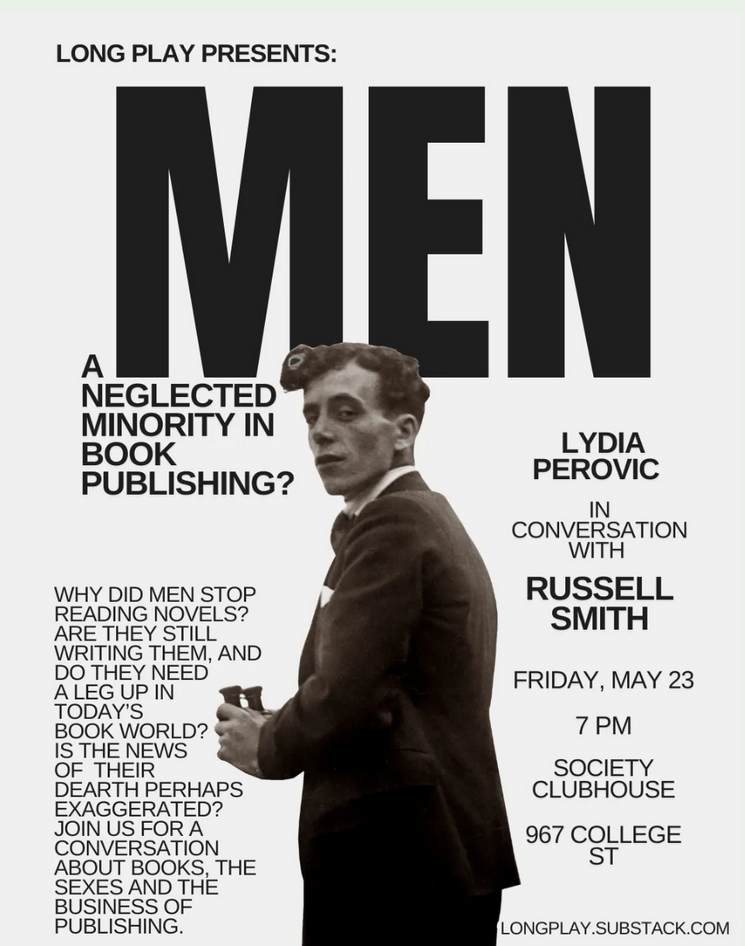
You can see here some of the challenges involved in measuring reading habits. Are we talking reading books or purchasing books? Does buying correlate to reading or are women better gift givers? What about those hugely popular 20-part, 60-page-per-instalment romance series that might ratchet up purchases by women — anything like that in the fiction market for men? Should we base assumptions about readership of literary fiction on data about readership of general fiction, as many of the articles I’ve read do?
All we can safely say is that it does seem men read somewhat less fiction than women; they also read fewer books of any kind. As a person in the book industry, I wish that weren’t so, but it may not be a cultural calamity.
The most interesting article I came across in last night’s binge was published in 2009 by the University of Saskatchewan’s Virginia Wilson in Evidence Based Library and Information Practice. She undertook a small study of boys aged four through twelve, interviewing them about their reading habits. Her theoretical perspective was that if anyone was ever going to understand the reading habits of boys, they needed to recognize that the experts were the boys themselves. She quizzed forty-three of them about their book collections, what they liked and didn’t like, and their motives for reading.
Each of the boys had a personal collection of books. These ranged from eight to 398 volumes, with a median of 98. All but one of the boys had fiction in his collection. The most prominent genres were fantasy, science fiction, sports stories, and humour. The boys had no time for love stories, books about groups of girls, and such classic children’s fiction as The Adventures of Robin Hood.
Asked about their favourite books, most of the boys pointed to a non-fiction title: joke books, magic books, sports books, survival guides, science books, references, atlases, dinosaur books.
The boys also read a good deal of non-book material: comics, manga, magazines, sticker books, puzzle books, and catalogues. A number mentioned reading video game manuals, both to learn more about the games, but also to heighten their enjoyment of the narratives within the games.
The manuals were part of a bent toward pragmatic reading, something they found useful as much as pleasurable. The boys often read to support another hobby — Pokémon, for instance. They also appreciated non-linear texts and plenty of illustrations.
Interestingly, many of the boys tended to discount their own reading. They often described the informational stuff they liked—those video game manuals or computer guides or research materials for science projects—as “not really being reading”. Serious reading, in their minds, involved novels and conventional non-fiction books.
Wilson’s conclusion was that at least part of the “boys and reading problem” might come down to what counts as reading. Informational nonfiction, comic books, computer magazines, graphic novels, and role-playing game manuals were “not necessarily privileged by libraries, schools, or even by the boys themselves”.
Of course, as Wilson notes, one shouldn’t generalize too much from a small qualitative study involving forty-three boys. There’s nothing definitive to be learned here about Trump or contemporary masculinity (although I’ve read several lengthy screeds based on less).
Wilson’s paper simply reminds us that reading is complicated, and most of the available research on reading habits isn’t. Survey respondents are typically asked if they read books for leisure, or if they’ve read a book in the last year. There are many reasons to read other than for leisure. There are many things to read other than books. And not all books are equal.
I haven’t seen a study that tracks if men spend more minutes per day reading sentences than women. Or one that drills down to find who reads the most newspapers, magazines, websites, newsletters, contracts, annual reports, research papers, instruction manuals, catalogues, and cereal boxes. Each of those formats is as potentially edifying (if not as much fun) as Morning Glory Milking Farm: A Monster Bait Romance, with its 47,570 enthusiastic ratings on Goodreads.
I read so many concerns for and condemnations of contemporary males last night that it came as a surprise to learn that our most reliable measure of reading competence, the Program for the International Assessment of Adult Competencies, finds no real difference in literacy of men and women aged 16 to 64 in the US or Canada. We should all revisit that baseline before assigning responsibility for the state of civilization to whoever is or isn’t reading or buying contemporary fiction. (PIAAC did find that while Canadian literacy scores have been stable, US scores have slipped 5 percent since Trump was first elected. Make of that what you will.)
Does the men-and-fiction problem exist? I think yes, and my sense is that it’s one of both supply (what’s getting published) and demand (what men will read). I thought I’d have more than that to say. This is my kind of issue — the whole point of SHuSH is ill-considered opinion drawn from shaky evidence on a weekly timetable — but I can’t compete with what I’m reading, so I’m backing off for now.
I certainly find myself reading almost nothing that has been published recently with a few exceptions for well-researched and well-written histories and military histories. My preferred genre reading got taken over by the “jam the narrative into every story” crowd a few decades back, so I stopped buying SF and fantasy titles except those from authors I’d already read.
Hiding Sir John A. from the woke mob
Woke iconoclasm swept across the country, but the statue of Sir John A. Macdonald outside the Ontario Legislature in Queen’s Park was hidden away inside a plywood box. James Pew catches up on the situation inside Queen’s Park Crescent:
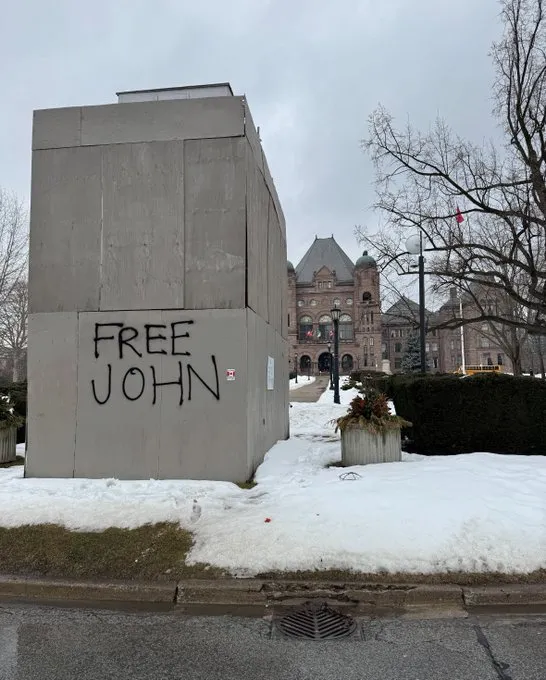
“Free John” spray painted on the plywood boards covering the statue of Sir John A. MacDonald in Queen’s Park Toronto.
It’s not just historical content distorted by bad actors, it is the entire way history is thought about, taught, and used to legitimize all sorts of nefarious agendas, which forms a broader set of concerns. For instance, a Toronto man recently found himself in trouble over a meaningful act of non-destructive civil disobedience involving a monument to a beloved and needlessly contentious Canadian historical figure. Daniel Tate is an ardent patriot and founder of a civic advocacy group called IntegrityTO, who describe themselves as “a coalition of concerned citizens who want to restore integrity-driven leadership so that Toronto can be a great city once again”. In a minor act of public vandalism, and in a moment of frustration over the disrespect shown to Canada’s boxed up father of confederation, Tate spray painted “Free John” on the plywood hoarding covering the statue of Sir John A. Macdonald at Queen’s Park in Toronto. No paint touched the statue itself, just the plywood that hides it away from the public, and protects it from the angry and destructive social justice mob.
Sir John A’s Queen’s Park statue initially became the unseen centerpiece of the current unsightly plywood enclosure after an incident which took place in 2020; three radical social justice activists splashed it with pink paint. It is worth pointing out that this cherished monument to the father of confederation was first installed in 1894. And although Black Lives Matter activists Daniel Gooch, Danielle Smith, and Jenna Reid initially found themselves in hot water over their costly and disrespectful acts of public vandalism (they also painted statues of Egerton Ryerson and King Edward VII Equestrian), all charges were withdrawn in 2021. In their statement to the media the group said, “along with a coalition of artists, the group artistically disrupted statues of slaveholders and monuments to colonialism at Ryerson University and at Queen’s Park”. One would think Daniel Tate should be extended the same leniency for his “artistic disruption”.
Image of Black Lives Matter activists vandalizing the Queen’s Park statue of Sir John A. MacDonald, (via CBC)
As it stands, Tate has been criminally charged with mischief under $5000 which carries a maximum penalty of two years in prison. Still in the preliminary stages, his next court appearance is scheduled for June 30.
Last month Tate appeared on AM 640’s The Oakley Show where he remarked, “The sad irony of it, people were defacing and vandalizing national monuments with impunity … four or five years ago. No Charges. We were all watching aghast at how this was all happening. And, it was acceptable somehow. And here I am five years later. I didn’t even deface a statue or a monument, it was literally a piece of plywood – the cheapest plywood you could find. And now I’m clogging the criminal justice system with this completely frivolous charge.”
While covering Tate’s case, independent journalist Daniel Bordman said, “This is a great example of 2-Tier policing because if he wrote Free Palestine instead he’d probably be given the key to the city”. And journalist Anthony Furey posted the following on X: “There has been so much lawlessness and disorder on Toronto streets in recent years that goes totally unchecked … But if you write FREE JOHN on a boarded up statue of Sir John A, police handcuff and arrest you on the spot – which is what happened to Daniel Tate the other week”.
This begs the question, if security was on-site to arrest Tate in the immediate moments that followed his minor spray paint transgression, why does Sir John A. need to be boxed up at all? One security guard around the clock would suffice. Does the Queen’s Park premises not already have security? It appears they keep a close eye on Sir John A’s unfortunate wooden container. So, why not free John? Beef up security a little if necessary, but let our first Prime Minister once again be visible and unadulterated in his rightful place of honour. For the sake of our blessed Holy Peter, it’s been five bloody years!

May 11, 2025
The devastating toll of Trump’s reckless plan to dismiss transgendered members of the armed forces
Chris Bray called this to our attention back in November, as President-elect Donald Trump foolishly planned to purge the US military of transgendered troops, regardless of the vast impact it was predicted to have on military readiness:
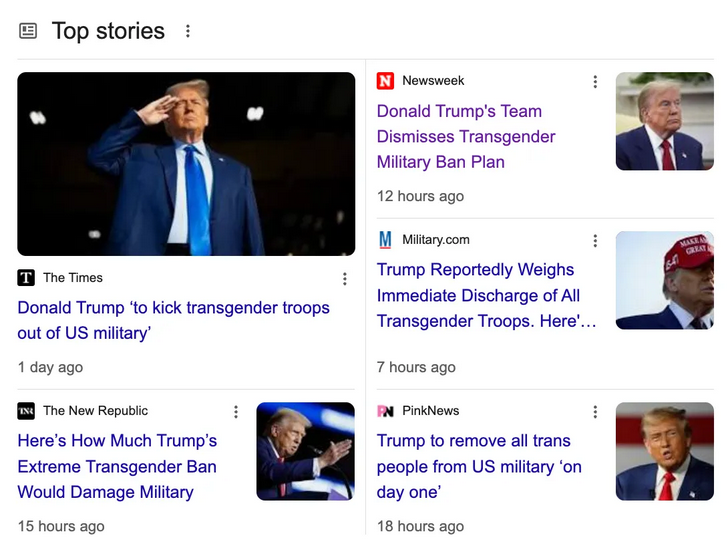
We’ll practically have no military left! It would be like a whole infantry division suddenly just vanishing: 15,000-plus transgendered service members.
You’re going to see this number a lot in the weeks ahead. The New Republic, today: “Donald Trump’s plan to ban transgender people from the military would have a devastating effect: At least 15,000 members would be forced to leave.”
That number comes from a 2018 report by the now-defunct Palm Center, a pro-LGBT independent research institute in California, which reached this conclusion: “Transgender troops make up 0.7% (seven-tenths of one percent) of the military (Active Component and Selected Reserve)”. Their best guess about a total number: 14,707. The media is just rounding that number up to the next thousand.
And … Chris Bray follows up on his November post, documenting the huge, unimaginable scale of long-term damage to US military preparedness:
As the new Trump administration prepared to issue an order forbidding transgender people to serve in the armed forces, a bunch of profoundly stupid news stories issued panicked warnings that military readiness would DEVASTATED by a giant purge of at least 15,000 transgender servicemembers, the very core of our military strength. Warplanes grounded! Ships trapped in port as all their trans sailors were tossed out! Whole artillery batteries sitting silent! […]
The removal of trans servicemembers would inflict such a ghastly crisis on the armed forces that it would take twenty years to recover our military strength! Destruction and ruin and crisis and collapse!
[…]
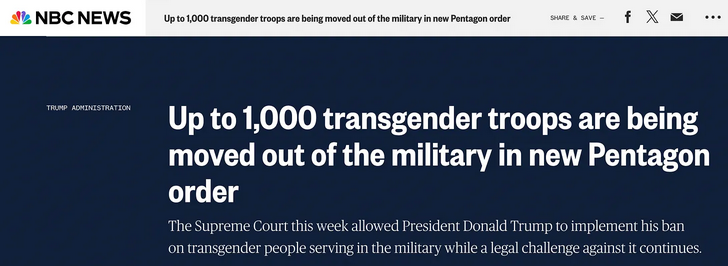
Now the removal of transgender troops is actually underway, and guess what?
The number is “up to” 1,000. It’s in the hundreds.
So. When — quite recently! — dozens of panicked news stories reported as fact that 15,000-plus transgender servicemembers were about to be purged, the news was frankly and nakedly a complete invention. They made it up. They sold an invented panic. The “news” was entirely fake.
Remember that, and apply that lesson widely.
May 10, 2025
“Train how you fight” – British plod edition
At Restoration, Connor Tomlinson looks at how British police forces are training and what it tells us about who they think they’ll be fighting:

Britain’s police aren’t training to stop riots—they’re preparing to crush the public.
One of the infamous quotes from George Orwell’s Nineteen Eighty-Four is, “If you want a picture of the future, imagine a boot stamping on a human face — forever”. He forgot to add, “on TikTok”. Last Thursday, the Metropolitan Police posted a montage of officers at the Metropolitan Police Specialist Training Centre in Kent, undergoing riot training. The caption read, “Bricks, bottles and fire bombs – our officers prepare for every eventuality at the Met’s elite training centre in Gravesend so they can keep you safe. Stronger tactics means safer communities.” It seems they had one specific “eventuality” in mind, as the mock rioters were wearing the Union flag. There wasn’t a keffiyeh or “Only good TERF is a dead TERF” sign in sight.
But fear not. The same Met Police who defended now-proscribed group Hizb ut-Tahrir’s demonstration after October 7th, saying “The word jihad has a number of meanings“, now insist that “The fact one of the t-shirts has a union flag on it is entirely coincidental”. Well, that’s me convinced. In fact, the Met are exhausted by your conspiracy theories, writing that “It’s disappointing we are increasingly having to challenge this sort of misinformation which only serves to increase divisions and tensions”. But the plummeting public trust in Britain’s police and justice system are of its own making. Britain’s security state is setting itself in opposition to the largely law-abiding indigenous host majority, while gaslighting them about the non-existence of a two-tier justice system that favors tribal minorities.
One might think, as Sam Bidwell suggests, the police should preoccupy themselves with preventing street conflicts not between Britain’s indigenous host and immigrant populations, but between its Indian diaspora and Pakistani enclaves. On April 22, Pakistani Islamist group Lashkar-e-Taiba killed 26 and injured 20 more in Indian-controlled Kashmir. Both nations cancelled the other’s visas, and are in the process of expelling foreign nationals before they expire. Pakistan has suspended all trade with and air travel from India. Hindu nationalist Prime Minister Modi has warned, “India will identify, track and punish every terrorist, their handlers and their backers, [and] we will pursue them to the ends of the earth.”
Thanks to decades of mass immigration and multiculturalism, Britain is home to powerful Indian and Pakistani ethno-political lobbies. Around 3 million Indians and 1.9 million Pakistanis live legally in the UK. They are substantially younger than the white British host population, and already brought Leicester to an ungovernable standstill in 2022 when Muslims and Hindus rioted for a month over a cricket match. Last Friday, both factions gathered outside the Pakistani Embassy in London for a mixture of a protest and a dance-off, replete with Indian, Pakistani, Israeli, and Palestinian flags. Most alarming was when Colonel Taimur Rahat of the Pakistani military appeared to make a throat-slitting gesture toward Indian protestors.
Both subcontinental factions have sympathetic politicians. They weaponize domestic antidiscrimination law to pursue foreign policy goals: for example, listing the denial of an independent Palestine and Kashmir as an example of Islamophobia, in guidance adopted by local councils. Conservative-party candidates committed to a Hindu Manifesto at the last general election, promising to further liberalize visa rules for dependents and elderly parents of Hindus already in Britain. Indian-heritage cabinet ministers, like Priti Patel and Rishi Sunak, instigated an unprecedented rise in Indian migration after Brexit. Patel described these migrants as “living bridges”, using Prime Minister Modi’s term.
May 9, 2025
They keep saying the quiet part out loud – democracy is a threat to the establishment
N.S. Lyons went to Barad-dûr Ottawa earlier this month to speak at the 2025 Civitas Canada Conference, and posted his remarks on his Substack:

The 2022 Freedom Convoy induced a state of panic in the Canadian federal government, yet the elected representatives proved completely unwilling to even talk to anyone from the protests. The government clearly persuaded itself that this was an actual insurrection, and waited for the violence to break out … and there was no violence, other than that provided by the police and a few paid actors.
A screenshot from a YouTube video showing the protest in front of Parliament in Ottawa on 30 January, 2022.
Photo via Wikimedia Commons.
Good evening ladies and gentlemen! It’s a pleasure to visit the North and get a glimpse behind the new Iron Curtain …
As it happens, the official theme of this conference is “Freedom and its Discontents: Liberal Democracy at a Crossroads”. That is a timely theme indeed. Because I think it isn’t too extreme to say that, all around the Western world today, democracy is under assault — even that it risks extinction. It risks extinction because the authorities that run our societies seem to find the practice, values, and very spirit of democracy to be increasingly intolerable.
In France, where the ruling government maintains power despite being the most widely hated in decades, the most popular candidate of the most popular political party has been barred from challenging that government in upcoming elections, on legal grounds that are openly political.
In Romania, when the “wrong” outsider candidate appeared poised to win an election, authorities simply canceled the election outright and then had him arrested, the unelected national security state inventing entirely unsupported excuses about foreign meddling to justify their coup d’état against the democratic process.
In Germany, the state has now begun the process of banning the country’s most popular party, supported by more than a quarter of the voting population, in order to avoid facing any real political opposition. “We did it in Romania, and we will obviously have to do it in Germany, if necessary”, is how a former European Commissioner confidently foreshadowed events on live television a few months ago.
One gets the sense that the honest view of our exasperated political elites is as captured in a Bloomberg News headline from last year which read: “2024 is a year of elections, and that’s a threat to democracy”.
In country after country, governments are moving to desperately tighten their grip over the people they rule, sharply curtailing freedom of speech and access to information, and using alleged threats to security and stability to justify granting themselves emergency powers, weaponizing the law, criminalizing dissent, and suppressing any meaningful political opposition.
In the United Kingdom, more than 12,000 people per year (that’s 33 per day on average) — are now arrested for speech- and literal thought-crimes, including silent prayer. UK jails now hold hundreds of political prisoners, more than anywhere else in Europe outside of Russia and Belarus. These are people persecuted for, essentially, voicing dissent over their government’s catastrophic policies. Recently, for instance, a British woman with no criminal history was jailed for more than two years for a single Facebook post criticizing the state’s willful failure to stop illegal migration.
In Brazil, a single Supreme Court judge, in alliance with the country’s leftist president, has effectively established a judicial dictatorship, locking up political rivals by decree, silencing the speech of opposition figures, and utilizing state leverage over the financial system to punish political enemies by banishing them from public economic life.
But of course Brazil’s authorities learned these tactics by observation. Observation of Canada, to be precise, where Justin Trudeau’s government first employed debanking — along with a little brute force — as a tool to crush peaceful protest of his draconian and disastrous pandemic lockdown policies.
Today, the Canadian government’s weaponization of the legal system and public institutions, including state-funded media, to impose a quasi-totalitarian progressive ideological regime, censor and jail dissenters, and effectively transform Canada into a one-party state, has, I’m afraid, won your country a real measure of global infamy. Many Canadians here may not be aware of just how your government appears from the outside, but I’m afraid it’s not a good look at all. Unfortunately I must report that when many of us look at Canada what we see is a global leader in progressive authoritarianism, out-of-control migration, growing anarcho-tyranny, foreign subversion, and ideologically-induced economic stagnation.
But then, what we might realistically call the liberal-authoritarian model is, sadly, the new normal in the West, where many hyphenated liberal-democracies seem to have concluded that they must now begin to cast off the democratic half of that historical compact.
It may seem that this hardening of control is a response to the rise of so-called populism, which has swept the Western world. Certainly many authoritarian measures have been justified, without any sense of irony, as necessary to defend “our democracy” (so-called) against the dissatisfaction of the actual demos. And it’s true that fear of populism — which is really fear of genuine democracy — does seem to consistently provoke a spiral of ham-fisted reactions by our increasingly authoritarian states. But the reality is that populism is itself a reaction, an organic immune response to the particularly unresponsive and anti-democratic new form of governance that has visibly overtaken the West in recent decades.
The growing problem of antisemitism in Canada
In The Free Press, Casey Babb considers the growing risks to Jews on the streets of Canadian cities after the October 2024 terror attack and resulting Israeli military reaction:

“Free Palestine/Anti-Israel protest” by Can Pac Swire is licensed under CC BY-SA 2.0 

 .
.
Late last year I sat down to breakfast in Ottawa, Ontario, with Dr. Einat Wilf, one of the world’s foremost experts on the Israeli-Palestinian conflict. She had come to Canada’s capital to speak about the war in Israel, what Palestinians really want, and the future of a possible two-state solution. Near the end of our chat, I asked if she had seen any of the “pro-Palestinian” rallies that had become a weekly occurrence in the city. “One of them went by my hotel last night,” Wilf said. “There’s a very dark energy to them. Serious pre-pogrom vibes.”
The word pogrom is the Yiddish word for “devastation” or “destruction”. What it refers to, historically, are the mob attacks that were a regular feature of life for Jews in the 19th and early 20th centuries — attacks that most often were passively or openly supported by the state.
Wilf chose it deliberately.
In the roughly six months since we sat down together, the situation in Ottawa and across the country has only worsened. Canada has become one of the most antisemitic countries in the Western world.
If you doubt that assertion, it’s important to note that’s how others have described it, too.
In a report released on May 6 by Israel’s Ministry for Diaspora Affairs and Combating Antisemitism, it states that from October 7, 2023 through the end of 2024, antisemitism in Canada skyrocketed an astounding 670 percent. Further, between October 7, 2023 and October 7, 2024, there were 1,500 pro-Palestinian rallies in Toronto alone. That’s over four a day — every day — for a year straight.
While the outbreak of antisemitism throughout the West has been precipitous in virtually every country — the tenor, violence, and extremist nature of Jew-hatred in Canada has ratcheted up in a way few other places on Earth have experienced.
Consider the following — much of which has gotten scant media attention.
Targeting Jews in Their Backyards
- In September 2024 protesters sympathetic to Hamas and the “resistance” jubilantly rallied outside a Jewish retirement facility in Ottawa where several Holocaust survivors live, and where 60 percent of the residents suffer from dementia. Chants of “Go back to Europe” and “We want bullets and missiles!” in Arabic could be heard from their bedrooms.
- On Remembrance Day in 2024 at Sir Robert Borden public school in Ottawa, where there is a large Jewish student body, a Palestinian protest song was the only song played during an event to honor Canadian soldiers. When pressed on the choice of music, Principal Aaron Hobbs said it was chosen to add some diversity and inclusion to a day usually about “a white guy who has done something related to the military”.
- There have been numerous instances where, in predominantly Jewish neighborhoods, protesters have dressed up like Palestinian terrorists, including the October 7 mastermind Yahya Sinwar.
- Hundreds of pro-Palestinian protests surrounded the Holocaust Museum in Montreal in March 2024, where they shouted, “Death to Israel” and “Death to the Jews”.
- At a softball game for teenage girls between Canada and Israel as part of last year’s Canada Cup Women’s International Softball Championship in Surrey, British Columbia, protesters stood on the sidelines wearing keffiyehs, holding signs that read “Israel is a genocidal state”, with another equating Israel with Nazi Germany.
- In April, a pro-Hamas rally was staged in Winnipeg, just steps from a Jewish community center where children attend school and day care.
- During Israel’s official day of remembrance for fallen soldiers and victims of terrorism on April 29, protesters stood in front of Beth Emeth Bais Yehuda Synagogue in Toronto waving Palestinian flags. One man wore a sweater that read “Palestinian Holocaust: Never Again Is Now”.
- Earlier this month in Montreal, protesters were filmed chanting “All the Zionists are racists” through megaphones at a school for students ages 4 to 16 with intellectual disabilities and autism-spectrum disorders.
These activities aren’t normal protests. They aren’t in front of the Israeli embassy in Ottawa or the Israeli consulate in Toronto. They aren’t directed toward a specific Israeli policy, law, regulation, or act, and they certainly make no mention of Hamas, Hezbollah, or any other terrorist organization that has brought immense death and destruction upon the Palestinians. These are belligerent acts of aggression designed to intimidate Canada’s Jewish community, to coerce them into silence, and ultimately, to extinguish their public presence.
May 8, 2025
Ted Gioia is apparently “the guy you consult about the total collapse of everything“
I’ve been reading Ted Gioia‘s work for a few years now, but I somehow failed to pick up on the fact that he’s some kind of Bond supervillain:
Many articles have been written about me over the years. But I’ve never been hit with an opening sentence like the one published on Monday by The Atlantic.
Last year, I visited the music historian Ted Gioia to talk about the death of civilization.
Whoa! That makes me feel like a Bond villain.
I need some henchmen — any volunteers?
Ted appears to like the classic goon uniforms for his to-be-recruited legion of minions.
What an unexpected turnabout! For many years, I was known as an expert on music, especially jazz and blues.
But now I’ve taken on a new guise. I’m the guy you consult about the total collapse of everything.
I don’t sing the blues. I don’t write about the blues. I now deliver the blues.
I originally declined the interview request from The Atlantic. But their staff writer Spencer Kornhaber pushed back, insisting that I was an essential source for his article.
The subject was, he explained, a “pervasive suspicion that we’re in an era of cultural decline, especially in arts and entertainment”.
He said that I needed to be part of the story — because everybody saw me as the decline-of-culture guy.
This caught me surprise. But I thought it over. maybe this is why I don’t get invited to many parties anymore.
Dammit, Ted, we’re trying to have some fun here — and you keep droning on about the collapse of the Roman empire.
I eventually agreed to a phone conversation with Spencer, and that went well. And this led to him getting on a plane, and visiting me at home here in Austin.
To help him in his research, I laid out more than 40 books on a countertop in my library — these were essential works, I explained, for anyone studying social or cultural decline.
[At a future date, I will provide more details about these books, and share a reading list on — to quote The Atlantic — the “death of civilization”.]
But this begs the question: Is our culture really collapsing?
I spoke with Spencer for many hours about this subject. But only a few of my comments found their way into the finished article.
So today I’ll offer a fuller diagnosis for your benefit.




