
Forgotten Weapons
Published 24 Jun 2026The DeLisle Commando Carbine is one of the coolest special operation weapons of the Second World War — an SMLE rebuilt in .45ACP with a ginormous suppressor. It fed from slightly modified 1911 magazines, and thanks to .45ACP being subsonic in its normal loading, it is incredibly quiet. Because the gun is relatively easy to make (being based on a readily available receiver), one-off and limited-run reproductions have been around for a while, but always hard to find.
US Armament has begun making a serial-production new DeLisle, and they send me one on loan to film. It is very, VERY quiet, and runs more smoothly and reliably than I expected, as the originals have a reputation for being finicky. The reproduction elements are quite good, although not quite perfect in the details (like the muzzle assembly, sights, and handguard). However, I believe the price is quite high for the product.
(more…)
October 26, 2026
US Armament Reproduction DeLisle Commando Carbine (Silenced .45ACP)
QotD: When Lester Pearson “invented” peacekeeping
… most Canadians neither know nor care much about either foreign or defence policy. They, the societal mainstream, were and are still being fed a load of codswallop in schools and universities about Canada’s military history. It begins with the lie about how Canada “invented” peacekeeping. Anyone who believes that “baby-blue-beret” style United Nations peacekeeping was Lester B. Pearson’s idea is too bloody stupid to walk around loose. In fact, Dr. Ralph Bunche, a distinguished American diplomat got the Nobel Prize (1950) for “inventing” peacekeeping in the late 1940s. The outcome of his negotiations was UNTSO, The United Nations Truce Supervisory Organization, the UN’s first ever peacekeeping mission. There was parallel work going on at the same time, involving Canadians like General Andrew McNaughton and Lester Pearson, to use military officers to supervise the India-Pakistan truce in Kashmir. The two original missions, UNTSO and UNMOGIP (the United Nations Military Observer Group in India and Pakistan) are still working.
What Lester B. Pearson did was to use his diplomatic and political skills — and both were of a high order — to, almost literally save the Western alliance after Britain and France made a strategically stupid decision to capture the Suez Canal after Egyptian President Nasser nationalized it. That move infuriated US President Eisenhower because it upset his own Middle East strategy, and nearly destroyed the Western alliance. Mike Pearson, under orders from Canadian Prime Minister Louis St. Laurent, repaired the damage before the USSR and its cronies could take strategic advantage of the rift that had opened in the US-led West. Mike Pearson moved peacekeeping from small observer and truce supervisory missions to major undertakings involving troops in a “trip-wire” role. He and UN Secretary General Dag Hammarskjöld were able to stick handle a complex plan through President Eisenhower and around the Soviet bloc in just a few days. Some people said the pair “saved the world”; they certainly saved the Western Alliance.
If you don’t know that then you are a typical Canadian who has been failed by the education system.
Ted Campbell, “Being prepared”, Ted Campbell’s Point of View, 2020-12-17.
October 25, 2026
“This alliance between Islamist and left-wing forces is known in France as islamo-gauchisme“
After an earlier post of his went viral, Maarten Boudry revisits the same topic but this time with references and footnotes that he regretted not including in the original:
This was not a carefully argued analysis, but an impassioned cry from the heart, dashed off in the heat of the moment after watching the horrific scenes of wanton destruction in France. To my surprise, the post blew up: it received thousands of likes and reposts, was translated into multiple languages and was cited in several newspapers. I was flooded with interview requests, which I declined because I’m still working on my book.
As a sometime academic, however, I felt a bit embarrassed that my little rant contained no sources and little in the way of actual argumentation. A dereliction of duty! So, to make it up to you, I want to elaborate on one of its underlying ideas: that “useful idiots” on the left have been marching alongside Islamists, and that the Palestinian flag has become the joint symbol of hatred for Western civilization. This alliance between Islamist and left-wing forces is known in France as islamo-gauchisme (Islamo-leftism), and elsewhere as the Red-Green alliance. Does it really exist, and in what sense? Is it an orchestrated plot, or more of a rapprochement of convenience?1 And are the warm feelings mutual?
Come to think of it, I happen to have some academic expertise on the topic.
Photo from Maarten Boudry’s Substack
A conspiracy theory?
If we are to believe the vast majority of academics and journalists, Islamo-leftism is nothing but a “conspiracy theory” — a far-right fever dream in the same category as the Great Replacement or Judeo-Bolshevism. In 2021, more than 600 academics said as much in an open letter in Le Monde. As someone who has written several academic papers on conspiracy theories, I’m here to tell you: not only are these people clueless, they are part of the problem. They are abusing the valuable concept of “conspiracy theory” to shut down debate, much like the premature dismissal of the lab-leak hypothesis during the pandemic.
A conspiracy theory, in the pejorative sense, is an unproven and speculative hypothesis about a secret and sinister plot hatched by a relatively small group of people. Typically, the very lack of hard evidence for the conspiracy is taken as proof that the conspirators are fiendishly clever and have covered their tracks. In my academic work, I have dubbed such self-sealing theories the intellectual equivalent of a black hole: once you’ve dived in, it’s hard to claw your way back out.
The rapprochement between parts of the left and Islam is none of these things. It is hiding in plain sight and has been extensively documented. Granted, some of the leftist romance with Islam may stem from secret funding by Qatar and Iran — which would qualify as a genuine “conspiracy”2 — but by and large these factors are incidental. The Red-Green alliance does not rest on covert coordination behind the scenes, but on ideological kinship, a shared enemy (Western civilization, modernity and capitalism) and a hefty dose of naivety on one side.
- See Rob Henderson’s interview with Franziska Sittig, co-author of the 2025 book Intellectual Self-Destruction: How the West Gambles Away Its Future (the book is on my to-read pile)
- See this shocking piece by Ella Kenan about the secret plans of the Muslim Brotherhood and Qatar, which amount to an actual conspiracy.

Penguins, man
Penguins may be the reason we can’t have nice things … or they would be if they hadn’t gone extinct. You didn’t hear that? That’s because it didn’t happen, like so many events predicted by climate scientists over the last few decades. John Robson has the details:

Emperor Penguins on Snow Hill Island, Antarctica.
Photo by Ian Duffy via Wikimedia Commons.
We read in Phys.org that “Penguin poop is melting Antarctic snow by keeping algae green”. And of course we ask: Haven’t penguins lived there for millions of years? Answer: yes. Penguins evolved some 60 million years ago but Antarctica has only had significant ice coverage for 34 million. Yet they never kept it green, or turned it green, despite their predilection for dramatic defecation, until we invented climate. A story that caught our eye not just for the notion that a long-standing natural process could suddenly transform a continent but because we’d just also been told by National Geographic that climate change is driving penguins to extinction. But climate science is not like other kinds.
Despite waddling around looking comically unfit to survive in nature red in tooth and claw, penguins, with the very cool scientific name Sphenisciformes, actually flourish from the equator to the South Pole, with larger and thus better-insulated ones obviously being more common where it’s colder. It’s all part of the marvel of nature, including that having first developed the power of flight, which seems to us terrestrials like the A1 supreme deluxe way of avoiding being eaten, getting to food fast etc., some birds then chucked it to go back to running around but with fewer legs, like ostriches and emus but also kiwis and, in the good old terrifying days, the “terror birds” who ran up to 30 mph, stood up to 9 feet tall and “ripped the flesh from the body of other animals” and whose very name “Phorusrhacidae” is already frightening.
Others even decided running was also not for the birds, and walking was barely tolerable, so they jumped back into the water from which their ancestors had emerged during the Devonian. And it worked. Indeed, speaking of penguins’ evolution, Wikipedia adds that:
There was a great diversity of species in subantarctic regions, and at least one giant species in a region around 2,000 km south of the equator 35 mya, during the Late Eocene, a climate decidedly warmer than today.
Warmer than today? Say it ain’t so! But it is. And a giant penguin, due to the fact that life likes warmth and struggles in cold. (There’s a reason Emperor Penguins are as lonely as they are hardy.) Now however we are doing them in. The NG article starts:
In the storm-driven wilderness between South America’s southern cape and the frozen boundary of mainland Antarctica, the South Sandwich Islands form an isolated, crescent-shaped archipelago of rock and ice. Its rugged, northernmost isle, Zavodovski Island – where chinstraps and macaroni penguins blanket the hillsides that surround an active volcano – has held the title of the largest penguin colony on Earth.
And we know what you’re thinking. If the place is bristling with penguins, they must have pooped away the snow long ago. Unless they all died, which apparently they did:
as chinstrap penguins began facing steep decline across the Antarctic Peninsula starting in the 1980, scientists wondered whether this remote island was faring any better. Through an analysis combining aerial drone surveys and manual population counts, researchers from the British Antarctic Survey (BAS) have discovered that in fewer than fifteen years, the island’s chinstrap population has plummeted by 63 percent – a loss of over half a million penguins.
And not for climate biologists the boom-and-bust cycle we learned about back in ye day in high school biology. Heck no:
Their findings, published today in the journal Current Biology, identifies the island as home to the fastest-declining chinstrap population in the world, with climate-driven losses documented continuously since 2011. The decline wipes out more than a quarter of the total penguin population on Zavodovski, ceding the island’s title of world’s largest penguin colony to Cape Adare in Antarctica’s Ross Sea.
Note the phrase “climate-driven losses”. Since we don’t know what climate is driving or how it’s untestable. But it’s taking us with the penguins:
The Southern Ocean is no stranger to loss. This news comes just six months after Emperor penguins and Antarctic fur seals were officially declared endangered with declining sea ice levels cited as a leading culprit. Acting as the planet’s primary climate buffer, the Southern Ocean absorbs nearly three-quarters of global ocean warming and a fifth of man-made carbon.
Again, how you’d test any of those assertions is anyone’s guess, though whether they’re going to ask for and get grants to test them is a certain no.
Come to think of it, we’ve discussed the plight of the Emperor Penguin before. Even if you don’t read the old post, I do encourage you to watch the embedded video.
The Little Panzers That Said I Think I Can – Panzer I & II – Rearmament 11
World War Two
Published 24 Oct 2026How did the Panzer I and Panzer II help Germany defeat armies equipped with more powerful tanks? Armed with machine guns or a 20mm cannon, these little panzers helped spearhead a very big, very ugly war.
In this episode of Nazi Rearmament, Spartacus Olsson follows Germany’s early light tanks from their interwar development and the Spanish Civil War to the invasions of Poland, France, and the Soviet Union. We examine their design, armament, armor, production, and battlefield performance, and how they helped build the Panzerwaffe before more capable tanks were available in sufficient numbers.
Against opponents such as the French Char B1 bis and British Matilda II, their limitations were severe. But tank battles alone did not decide campaigns. Training, communications, concentrated mobile formations, and cooperation with infantry, engineers, artillery, and aircraft helped turn these modest vehicles into effective instruments of conquest. In France in 1940, those advantages combined with a risky German operational plan and Allied command failures to produce a devastating victory.
Their story also exposes the growing gap between Hitler’s ambitions and Germany’s industrial resources. Early victories encouraged further aggression, bringing occupation, exploitation, and mass murder to millions while drawing Germany into a war against an increasingly powerful coalition.
The generational difference in how young right wingers see the left
On the social media site formerly known as Twitter, Christian Heiens says that there’s a signficant difference in how older and younger conservatives view their opponents on the left:
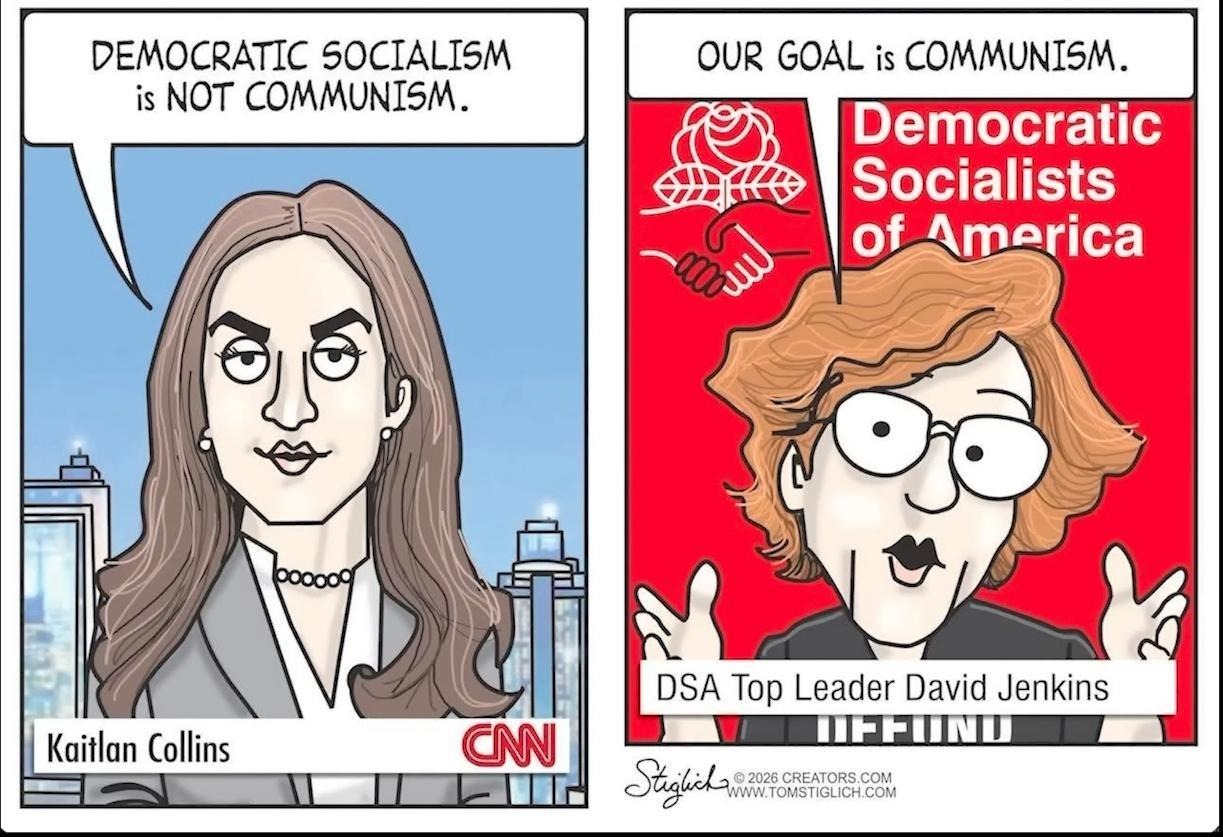
You need to understand how Right-wing people under 40 view the Left.
When we think of Leftists, we do not think of Barack Obama or Ezra Klein. Yes, these guys are on the Left, but younger Millennials and Zoomers on the Right do not think of Leftists in their own age bracket as polished technocrats.
These are not the sort of people that make up our Left-wing counterparts that we grew up with, went to school with, or work with.
When we think of Leftists, the first thing that pops into our head are a bunch of disgusting, depraved, spiteful mutants who want to destroy everything around them as payback for the crime of being born.
We think of Discord troons that invaded our hobbies, Reddit mods who are drunk on the most insignificant power imaginable, that one girl from high school or college who became a literal Communist, and that friend or family member who cut off all contact because we refused to treat their mental illness like a status symbol.
We think of people who, if they ever became a majority of the country and actually managed to possess political power, would inevitably kill tens of millions of people out of blind envy and petty cruelty.
Younger people on the Right come across as impatient and anxious in their mindset and mannerisms because they understand what will eventually happen when these people succeed their Gen X and Boomer predecessors in the Democratic Party.
They know what is to come if their own generational cohorts on the Left actually take power, and they feel incredibly exasperated that it seems like none of their parents or grandparents understand just how late the hour truly is.
A few days later, he also commented:
This blew up because people realize the age of discourse is coming to a close.
Discourse itself is meaningless at this point because discourse requires moral alignment, which is precisely the thing we are now fighting over.
Every other question has already been answered and there is nothing more to debate. The only thing left to do is to act, or be destroyed.
Planet of the Apes: Part 1 – Beginnings
Feral Historian
Published 26 Jun 2026Let’s begin a look at the Planet of the Apes franchise, starting with Pierre Boulle’s novel that started it all. The book sets up all the themes that get reworked and reimagined through every subsequent take on the story, from the 1968 film to the most recent series of films.
00:00 Intro
01:52 Beginnings
05:09 Essentialism
08:08 Aping
10:02 Iterations
12:15 Endings🔹 Patreon | patreon.com/FeralHistorian
🔹 Ko-Fi | ko-fi.com/feralhistorian
🔹 and Merch! | feral-shop.fourthwall.com
QotD: Feminism as a luxury belief
However, just as most people aren’t members of Heath’s self-control aristocracy, most women do not combine high intellect with disagreeableness and conscientiousness. Some feminists have realised this — albeit in an ad hoc way — and because feminism as a wider movement was/is wedded to blank-slatism, they believed they could shift the dial on what was then called “female socialisation”. That is, they thought it would be possible to make women as a group more closely resemble the able, disagreeable women who were by the 70s and 80s entering the professions, politics, academia, lobbying outfits, and think-tanks.
Or, of course, men. Men more often combine high trait disagreeableness with high trait conscientiousness (although even among males, the combination is rare). This is despite the fact that there are more agreeable women than agreeable men, and more conscientious women than conscientious men.
No woman should be authorized to stay at home to raise her children. Society should be totally different. Women should not have that choice, precisely because if there is such a choice, too many women will make that one. It is a way of forcing women in a certain direction.
“A Dialogue with Simone de Beauvoir”, in Betty Friedan, It Changed My Life: Writings on the Women’s Movement, Random House, 1976, p. 397.
de Beauvoir’s suggestion is both authoritarian and hilarious, and represents a panicked response — not unlike the howls from Marxists when it became clear the proletariat was uninterested in revolution — to women unlike her. While it’s true (at least historically) that there were a number of strands to feminism — including a pro-motherhood one — careerist feminism finished up dominating all the others. I’m old enough to remember campaigns for wages for housework. If some old school wonks got hold of this idea, it could form part of a suite of policies directed to increasing the fertility rate.
You don’t see those feminist campaigns any more, though. They’ve been submarined. As I say, I’m old.
Women throughout the developed world — notoriously — tell pollsters they want more children than they have. Usually three is the preferred number, as opposed to two or one. The so-called “gender wage gap” exists because women have children.
Economists often decry this finding as a case of stated versus revealed preferences: what people do is more salient than what they say, something known since Roman times. Hence the Stoic quip acta non verba (“deeds not words”). However, even if fully half the “I want more kids than I have” response served up to pollsters is nothing more than windy stated preferences, that still leaves a lot of unborn but wanted children. Feminism, as Louise Perry is fond of pointing out, has simply dropped the ball on this one.
This insight is, I recognise, a genuine example of ad hominem. It suggests that people plump for ideologies that will give them a leg-up, and do so deliberately. That said, political ideology is, like conscientiousness, heritable. Henderson’s and Heath’s insight reminds us that everything social is emergent from the biological (the basis of Lorenzo Warby’s essays on this Substack). That’s why libertarianism is the way it is, and feminism is, and probably other ideologies too.
Helen Dale, “People Unlike Me”, Not On Your Team, But Always Fair, 2024-05-29.
October 24, 2026
Everyone has an opinion on Oliver Cromwell
On Substack, Charles Haywood reviews The Making of Oliver Cromwell by Ronald Hutton:
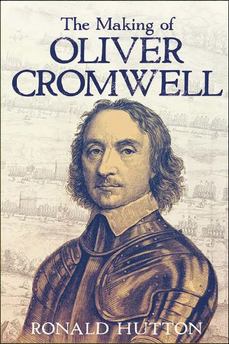
If you know anything about Oliver Cromwell — and few do nowadays — you probably have an opinion about the man. Some vilify him; “A curse upon you, Oliver Cromwell, you who raped our Motherland”, the Irish rock band The Pogues sang. Others praise him as an enemy of arbitrary rule and a proto-republican. Ronald Hutton’s new biography of Cromwell’s early life and his climb to prominence makes no final judgment on the man, but it does offer a nuanced view of this complex historical figure. From Hutton’s excellent book we get not just history but the realization, in this desiccated age, that men such as Cromwell always emerge during great turmoil, rising as if from sown dragon’s teeth.
Hutton wisely focuses on his subject, and makes no attempt to tease out the political and social complexities behind the Civil War. He expertly evokes the England of the mid-seventeenth century, both in politics and the natural world. As to the latter, quite often Hutton describes in detail the flora of the region and season, at the same time he narrates a particular historical event, which makes the reader feel more immersed in the story, as if he were there. It also makes the reader a little sad, though. Why? Because it brings to the mind’s eye a lost time and a lost country, before industrialization, liquid modernity, and alien invitees destroyed both the English landscape and England’s ancient culture.
The short version of Hutton’s biography is that Cromwell “was both godly and wily, and the two at times seem to jar with each other”. No doubt this is often true for a godly man called to be a temporal leader. Hutton believes that most Cromwell biographers focus too much on the godliness and too little on the wiliness. This is not really a popular history; it offers extensive notes, and Hutton often refers to controversies among Cromwell scholars of little interest to the casual reader. Nonetheless, it is very readable, so any reader who is willing to put in a little effort will be rewarded.
Until he was forty, Cromwell lived as an obscure provincial, a collateral descendant of Thomas Cromwell, Henry VIII’s minister who fell from grace. In his thirties, however, he became a devout Puritan, something about which we know very little. (He kept no archive of correspondence, and while he left voluminous public words, he left no record of his own private thoughts other than letters to others.) Hutton fleshes out what we can know about Cromwell’s life prior to 1640, in the East Midlands, in and near Huntingdon. There was no reason to expect great things from Cromwell; he was on the lower border of the gentry, a man of no importance. In fact, for a time until he inherited money from his uncle, he directly worked the land as a tenant farmer.
[…]
For the next two years, relations between Parliament and King deteriorated, and the countryside began to separate into armed factions. When Charles sought to fund himself by asking for donations from Cambridge colleges, Cromwell returned to Cambridge, apparently on his own initiative, and raised a militia, successfully preventing the dispatch of gold and silver to the King. Soon he was formally commissioned a cavalry officer in the army being raised by Parliament, and so he remained for the entire war, rising ever higher in rank.
From 1642 until 1646, the end of the period covered by Hutton’s book, Cromwell alternated vigorous military activity with political activity. He remained a member of Parliament. In 1645 Parliament, in order to resolve a dispute between the Lords and Commons, forbade members to also be military officers. Such a separation was part of creating the famous New Model Army—but Cromwell alone was given a dispensation. This was meant to be very temporary, meeting an immediate critical need, not an acclamation of Cromwell, who had made plenty of internal enemies. But as it happens, Cromwell’s greatest military successes immediately followed, at the most crucial period of this first phase of the Civil War, and so he continued to both lead soldiers and serve in Parliament. This lucky confluence of events was what ultimately made Cromwell.
The Winter War, 1939-40
After joining with Hitler’s Third Reich to dismember Poland, and occupying the Baltic states of Latvia, Lithuania, and Estonia, Stalin turned his attention to Finland. From the Soviet point of view, the Finnish border was uncomfortably close to Leningrad and the fortified defensive lines along the Karelian Isthmus were a reminder that the Finns could cause trouble if a war came. Stalin’s solution was to demand that the Finns give up the region northwest of Leningrad (including the defences), along with several islands in the Gulf of Finland and allow a Soviet naval base to be established on the Finnish coast near Helsinki. All this in exchange for a larger chunk of Soviet territory north of Lake Ladoga and the “firm friendship of the Soviet Union” for whatever that might be worth. The Soviets backed up their claim with an overwhelming military superiority in men, tanks, artillery and air power. The Finns declined the generous offer, which took Stalin aback:

Not actually much of an exaggeration: Finnish snipers were a constant threat to Soviet military operations in Finland during the Winter War and the Continuation War.
On 30 November 1939, the Soviet Union invaded Finland through an immensely samey, tree-covered morass. Across hundreds of miles of deep snow and borderland, the Red Army unleashed 450,000 men, roughly 1,100 tanks, and hundreds of combat aircraft, expecting to overwhelm its smaller neighbour through sheer weight of armour, heavy artillery, and manpower.
Joseph Stalin overturned the original campaign plan, discarding the slower but sounder 4-month plan for a lightning campaign in just two months. Beneath that rigid political deadline lay an atmosphere of terror. No senior Soviet commander dared challenge Stalin, correct his unrealistic timetables, or point out that the Red Army was unready for a winter invasion. Officers who raised logistical concerns risked being branded defeatists or traitors—a real possibility the purges proved.
This fear spread in the ranks.
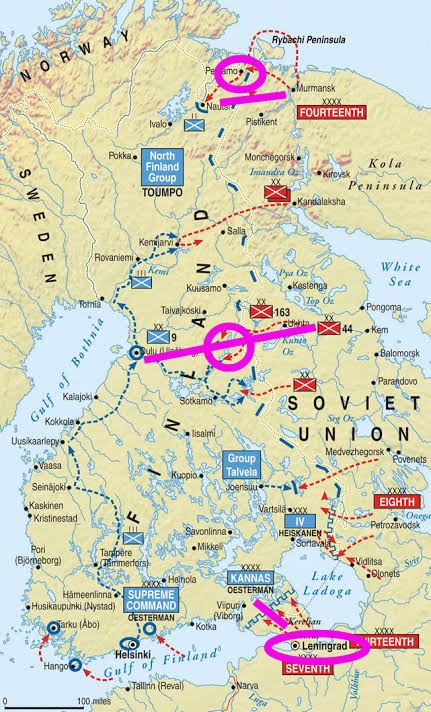
Despite the low state of morale, the Red Army struck along three operational axes:
- The Southern Main Effort (Karelian Isthmus): The heavy Soviet 7th Army would drive toward Helsinki, intent on punching through the main Finnish defences: the Mannerheim Line.
- The High North (Lapland & Arctic Coast): The 14th Army would advance across the tundra to seize Finland’s ice-free Arctic port at Petsamo, to cut off fears of foreign supplies inbound to aid the Finns.
- The Central Thrust (the “Waist” of Finland): The Soviet 9th Army would strike west across the country’s narrowest stretch toward Oulu on the Gulf of Bothnia.
Soviet pressure in three main spots, excuse my art!
Image and caption from WW2 MattersIn the central sector, Soviet planners harboured an ambitious but possible objective: advance west toward Oulu, reach the Gulf of Bothnia, and slice Finland in two.
The plan looked reasonable on map overlays at Leningrad headquarters. The target was Suomussalmi — a quiet logging settlement enveloped by lakes, swamps, and primaeval pine. Its importance lay not in its economic value, but in its position on the regional dirt road network running west toward Oulu. A successful Soviet drive here would sever the rail network connecting northern and southern Finland, cutting the vital land artery to neutral Sweden through which western supplies flowed.
To execute this strategic cut, Soviet planners committed two heavily reinforced divisions under the 45th Rifle Corps — the 163rd Rifle Division and the 44th “Blue” Rifle Division. With their attached tank battalions, corps artillery, and massive logistical columns, this combined force brought nearly 50,000 men into the narrow forest corridors.
In the Suomussalmi sector, the Finns initially faced fewer than 1,000 local Civil Guardsmen, later reinforced into Colonel Hjalmar Siilasvuo’s 9th Division to total 11,000 to 17,000 men. Outnumbered more than four to one, the Finns had no tanks and only 11 outdated artillery pieces — some dating back to the 1904 Russo-Japanese War — and severely rationed shells.
The Soviet plan depended on numerical dominance. But in the dense taiga forests of northeastern Finland, it became a bloody lesson in the difference between possessing a large army and knowing how to use it.
The classic communist mistake: measuring quantity instead of value
Denmark invested heavily in wind power, on the assumption that they could generate enough electricity from their vast wind farms on the North Sea coast to replace other forms of generation. As Bjorn Lomborg points out, it’s not adding up the way the Danes hoped it would:
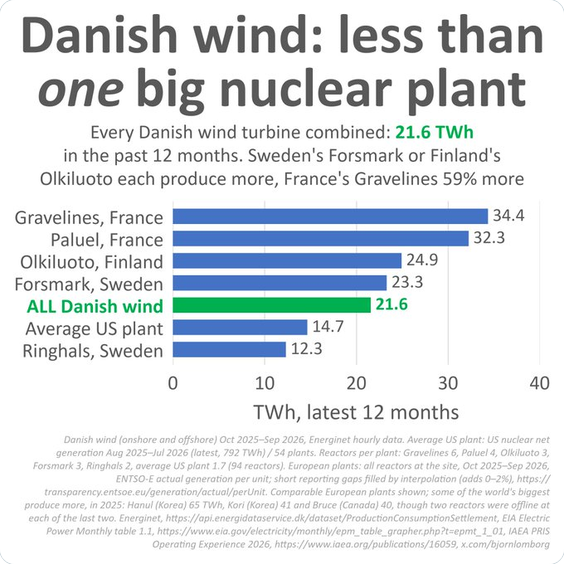
Denmark spent decades building nearly 5,000 wind turbines
Together, they produced 21.6 TWh in the last 12 months
One nuclear plant in Sweden made 23.3 TWh
Oh, and nuclear runs 24/7 — wind doesn’t
There’s one big reason Denmark has some of the most expensive electricity in the world
https://transparency.entsoe.eu/generation/actual/perUnit
https://api.energidataservice.dk/dataset/ProductionConsumptionSettlement
https://eia.gov/electricity/monthly/epm_table_grapher.php?t=epmt_1_01
Krzysztof Szczawinski explains the mistake is the same one that Soviet bureaucrats made repeatedly:
Counting terawatt-hours is the classic communist mistake: measuring quantity instead of value.
The Soviet Union produced record tonnes of steel nobody needed and millions of left shoes. There’s an old Soviet joke: when the nail factory’s quota was set by weight, it produced one giant nail. When it was set by number, it produced millions of tiny useless ones.
What matters in electricity is not how much – it is when. Electricity when it is needed has value. Electricity when nobody needs it has none. Wind turbines often produce exactly then – on a windy night, when demand is low. The price turns negative: the system is literally paying someone to take it, and the surplus only strains the grid. And when the wind stops, someone else has to keep the lights on.
A price is a message: this is needed, now. A negative price says: please, stop. A system that keeps producing anyway isn’t green. It’s deaf.
That’s mental communism applied to energy: the wish before reality.
Regimes that entertain such delusions end up going broke – and then they collapse.
Paul’s Chisel Choices | Paul Sellers
Paul Sellers
Published 10 Jul 2026Many people struggle to work out which general and every-purpose chisel they need because there are too many people out there with their various opinions.
My consideration comes from a lifetime of using chisels, and I think I have used every type or make. In this video, I explain what I am looking for in my day-to-day chisels.
I take no profit from the makers, no freebies or backhanders, not a thing.
This video will take the guesswork out of what to get, whether you are new to woodworking or new to hand tools. Thank you for watching!
For more Information about chisels follow: https://commonwoodworking.com/guides/buying-a-chisel/
QotD: Was Hitler stupid?
Hitler didn’t have that problem. It’s a mug’s game, trying to tie “measured IQ” to anything, much less to try to retroactively guess any given historical figure’s IQ. But it’s a useful-ish concept, so let’s call that “processor speed”. My buddy Jeremy was right at the apex of the bell curve re: processor speed. Hitler was clearly on the right hand side of that particular curve. Probably a fair ways out there, if the truth be known — no genius, Hitler, but pretty sharp nonetheless.
Unfortunately, that degree of smart makes one especially vulnerable to a certain kind of stupidity — let’s call it “the stupidity of misplaced self-esteem”. Snowflake stupid, maybe, for short. I’m sure we’ve all had the experience of being the smartest guy in the room. I mean clearly, unquestionably the sharpest knife in that particular drawer. If you have too many experiences like that, you start thinking you’re the sharpest knife in every drawer; the smartest guy in any possible room. Which means you veer out of your lane on the regular.
It’s endemic in academia, so I’m particularly sensitive to that kind of stupidity. Most profs actually are fairly bright, processor speed-wise. […] If he’d used those brains to, say, open up a mechanic shop or something, he’d fall victim to Big Man Syndrome — every babymomma’s cousin’s sister’s former roommate would start coming around, expecting him to pimp her ride for free. Since academia produces nothing useful, the homies can’t freeride on you).
Throw in the fact that you control the grade book, and it’s really, really easy to convince yourself you’re the smartest guy in any room. With no one to hold you in check, and in the absence of reality testing — which the entire ivory tower ecosystem is designed to avoid — it’s sometimes a real battle not to let your freak flag fly. Indeed you frequently come to wonder why you bother …
… and that’s the kind of stupid Hitler was. Snowflake stupidity is, obviously, situational. There were lots of legit very smart guys in the Nazi party. I doubt Hitler was ever the processor-speed smartest guy in any room, but he was up there, and in the early days he knew it — both ways. Moreover, he had charisma. What the PUAs study like crazy to learn, he just naturally knew how to do. Even the people who were constitutionally immune to his charm could see how and why so many others fell for it.
That’s the most dangerous combo. He was smart enough to be right in there in most rooms … but he could dominate any room with his charisma. Which leads to another special kind of stupidity, what you might call “messianic stupidity”. Things just kind of work out for that kind of guy; have you noticed? I’m sure everyone has known someone like that — probably not to Hitler’s degree, but I’m sure there’s someone in your life that just seems to catch every possible break, all the time, and when something does start going south for him, he can just turn on those baby blues and it all kinda just … goes away.
That kind of person — and I had a buddy like this; I saw it at close range — “knows better”. In the sense that if you gave him a situation on paper, and had him dope it out Heuer-style, he’d come up with the “correct” choice. Nothing wrong with his decision making process in a vacuum, and of course he was smarter than the average bear, too. If you went to Ross with a problem and pitched it as something that might hypothetically happen to some guy, he’d give you solid to excellent advice.
If, however, you went to him with one of your problems, in a situation involving mutual acquaintances, his advice would be terrible. For instance, he was one of those guys who don’t look like anything special, but every girl in the room starts drooling when he walks in. So you ask him “Hey, what should I do about Jane?” and though he’ll try his best to help, it really just doesn’t compute. Because while whatever he advises would work out great for him — of course it would — for you it’ll be a big mess, even if you do your very best Ross impersonation, because you don’t have that thing he has, the one the Germans call je ne sais quoi.
Hitler did. His successes were due, in large part, to doing zany, completely off-the-wall shit, the kind no rational planner would ever even bother planning against. Which can work out spectacularly well — Joan of Arc had the same gift. Lenin did, too. Combine that with the devil’s own luck (at least initially) and you get the mystique of the messianic leader. He does zany stuff, and it just kinda works out … until it doesn’t.
Combine that with ideological stupidity and you’re bound to have tears before bedtime. The Nazis had absolutely no idea what they were going to do with Grossdeutschland. Not the first clue. There’s a wonderful book on this, by Mark Mazower, called Hitler’s Empire. To say “they had no clue” is actually an understatement. His thesis, which I agree with, is that Hitler — being a 19th century guy — thought of the conquered territories in terms of Germany’s lost colonies in Africa. Really. A kind of Bismarckian Weltpolitik, except in France instead of Tanzania.
That’s just dumb. It’s not processor-speed dumb; it’s a lifetime of mental habit dumb, combined with ideological enstupidation. Add to this Adam Tooze’s The Wages of Destruction, which is buried in my to-read pile somewhere, but you can find good reviews on it with a little googling. Is that IQ-dumb? No. Is it really fucking stupid? Oh yeah.
Severian, “Friday Mailbag”, Founding Questions, 2022-08-12.
October 23, 2026
The Praetorian enforcer for Tiberius Caesar
In Quillette, an excerpt from Guy de la Bédoyère’s new book, Brief Lives of the Ancient World: Rulers, Rebels, and Robbers, on Sejanus, Praetorian Prefect for much of the reign of Tiberius Caesar:
The story of Sejanus is dependent on the accounts of Roman historians, in particular Tacitus, who indulged himself with an unforgettable tale of treachery and dissimulation. His main purpose was to portray Tiberius as a sinister and manipulative tyrant, but he also succeeded in creating an allegory of cynicism at the heart of power.
Shortly after Tiberius’ accession in AD 14, the son of praetorian prefect Seius Strabo — Lucius Aelius Sejanus (born Lucius Seius) — was appointed co-prefect. Like his father, he was an equestrian, Rome’s second aristocratic tier, but had been adopted into the senatorial Aelii clan, hence his name change.
The adoption entitled Sejanus to a senatorial career, but he must have decided that the prefecture of the Praetorian Guard offered him more real power and personal access to the emperor. It also allowed him to avoid the suspicion that surrounded ambitious senators. Tiberius chose a few trusted equestrians to form part of his most intimate circle.
Within a year, Sejanus held the position on his own when his father was promoted to the prefecture of Egypt. Enjoying a trusted pedigree, he quickly inveigled himself into Tiberius’ favour. Sejanus was the first of the praetorian prefects to experiment with the power and influence the position enjoyed, and thereby also with the potential power of the guard as a political force.
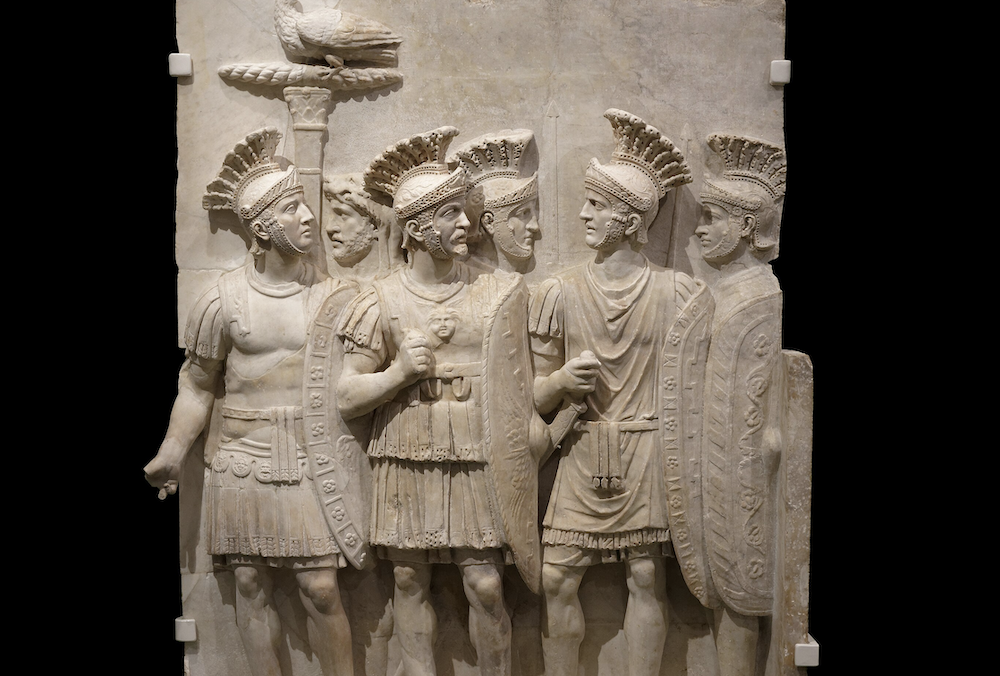
Detail from the Praetorian Relief, a Roman marble relief dated to c. 51–52 AD from the Arch of Claudius in Rome.
Sejanus was helped by chance, so often the principal agent in realising ambition. The huge theatre that had been built in Rome by Pompey Magnus in 55 BC burst into flames in the year AD 22. The fire was contained thanks to quick work by Sejanus, who used his position to tackle the emergency. Tiberius heaped praise on Sejanus for averting a catastrophe. The senate voted that a statue of Sejanus be erected on the grounds of the theatre.
In time, the career of Sejanus would expose how dangerous the commander of the guard could become. Tiberius ignored the signs, preferring to take as little interest as possible in the job of being emperor.
Sejanus made his first significant move in AD 23 when he installed all the praetorian cohorts in the Castra Praetoria, a fortified military camp in the northeastern part of the city. Under Augustus, they had been based at several locations in Italy, safely dispersed away from Rome, but may have already been brought into various barracks around the city under Tiberius. Their new dedicated fortress transformed the significance of the prefecture of the guard. The Castra Praetoria, which would remain a permanent feature until the guard’s disbandment under Constantine almost three centuries later, meant that the men were now directly and immediately under Sejanus’ control.
Faint signs of civilizational hope: “The Great Un-Karening”
It’s become old hat for Generation Jones and Generation X grizzled grognards to moan on about the almost-unsupervised “come back when the streetlights come on” childhood they remember in comparison to the over-scheduled, over-organized, over-computerized, hyper-supervised situation too many children now find themselves in. But there’s an occasional glimmer that things are changing:
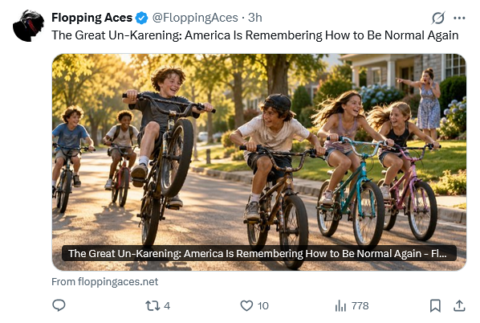
The Great Un-Karening has begun, and decades of cultural engineering have finally run into something their architects cannot fucking control: human nature.
A seven-year-old conquers El Capitan, breaking his older brother’s record, and some sanctimonious busybody responds by reporting his father to Child Protective Services. Apparently, raising children capable of extraordinary achievements now qualifies as suspicious parenting.
And that tells you everything about the suffocating bullshit we’ve allowed to masquerade as progress.
For years, the helicopter-parenting crowd, DEI bureaucrats, ideological school administrators, and professional grievance merchants have worked to remake childhood in their own miserable image. Courage became recklessness. Masculinity became toxic. Independence became neglect. Every hurt feeling became an emergency, and every whining control freak acquired a fresh excuse to interfere.
They built entire systems around rewarding fragility, policing behavior, and teaching children to view the world through the narrow lens of identity, victimhood, and institutional permission.
And now the machinery is encountering resistance.
Kids are reportedly refusing school Pride Day activities. Parents are defending their children’s right to adventure. Twenty to forty neighborhood kids organized their own nighttime pursuit game, complete with strategies, head starts, and a mile-long course. Some neighborhood hall monitor called security.
The kids kept playing.
Fucking beautiful.
There’s the nightmare for the self-appointed guardians of acceptable behavior: children discovering they can organize their own lives without a diversity consultant, a school psychologist, or some miserable asshole clutching a rulebook.
And every independent decision chips away at the authority these people spent years accumulating.
The Karens can scream. The bureaucrats can threaten. The ideological busybodies can keep issuing commandments from their increasingly ridiculous little thrones.
The generation they expected to mold into obedient, perpetually offended dependents is discovering the exhilarating pleasure of telling them to piss off.
They tried to rewrite normalcy.
Now they’re watching the next generation reclaim it without asking their fucking permission.


