
The Romans had no doubt who their greatest intellectual was — the astonishing polymath Marcus Terentius Varro
Yes, the clever Romans did plenty for us, but just who was the cleverest of them all? A tricky question, to be sure, but the Romans were confident about their own answer. The doctissimus was Varro — a man who wrote 620 books, and really is one of the most impressive polymaths that people have never heard of.
Marcus Terentius Varro (116–27 BC) was born in the Sabine town of Reate (Rieti) but found his proper education in Rome. There he studied under Lucius Aelius Stilo, the Stoic grammarian and antiquarian, who can perhaps be called the first bona fide scholar of Roman descent. Later he spent time in Athens under Antiochus of Ascalon, the celebrated Platonist and reformer of the Academy. Both proved to be major influences on the intellectual scene of first-century BC Rome (Cicero also studied with both).
[…]
What built Varro’s enduring reputation was his writing. His volume of work remains truly staggering. As Augustine observed, “Varro read so much that we are amazed he had any spare time to write; but he wrote so much that we can scarcely believe he could have read anything”. His output exceeded every other Roman writer, and was scarcely equalled by any Greek writer except Callimachus. He is said to have written 490 books by the time he was 77, which would mean that, in his last twelve years, he wrote almost a book per month. No surprise that he was rumoured to have died with pen in hand.
The sheer breadth of his learning was also astounding: he wrote on the full gamut of human knowledge (with the possible exceptions of medicine and advanced mathematics): the history of Rome, its civilisation, its customs and its people, civil law, Roman literature and drama, philosophy, grammar, the history of libraries, linguistics, tidal motion, sea navigation, Greco-Roman biography, as well as a three-book account of his own life.
But we must now the bad news: over 95 per cent of Varro’s writings do not survive to us, and of over 70 separate works authored by him only one – a three-book treatise on farming (De Re Rustica) – survives in a complete state. Mercifully, we are also able to read several extant books of his fascinating treatise on the Latin language (De Lingua Latina), a work that shows such fervour for its subject that the author completely forgot about his own Latin style.
Varro’s prodigious life-span for a Roman — of ninety years — allowed him to be born ten years before Cicero and outlive him by sixteen. This gave him an unparalleled perspective of the rapidly changing social, political and intellectual narrative of the late-second and first centuries BC. No-one had seen more and learned more than this self-driven scholar.
Although Cicero regarded him as an “amazingly odd” character (mirabiliter moratus), he did bestow lavish praise on Varro for the remarkable contribution of his 41-book Antiquitates: Romans previously wandered around like strangers in a city which seemed alien and confused; but Varro’s rich researches shed new light on the capital, whose reflection in turn revealed to them their own true identity. Cicero’s private letters reveal that he worried greatly about what Varro thought of him: that fact alone is proof that, in the ancient respublica litterarum, Varro really was the apex predator.
David Butterfield, “Varro and wide”, The Critic, 2026-07-21.
October 29, 2026
QotD: The Roman polymath Marcus Terentius Varro
October 28, 2026
Operation Maple Curbstomp – an imaginary US invasion of Canada
As every red-blooded American knows, an invasion of Canada would be as one of the Founding Fathers put it, “a mere matter of marching”. So glance at the thumbnail summary of the two nations’ military capabilities should some future American president decide that the US should formally own “America’s Hat”, courtesy of Operational Art of War (most of the article is paywalled … this is an excerpt from the teaser email send out to cheapskate free subscribers like me):
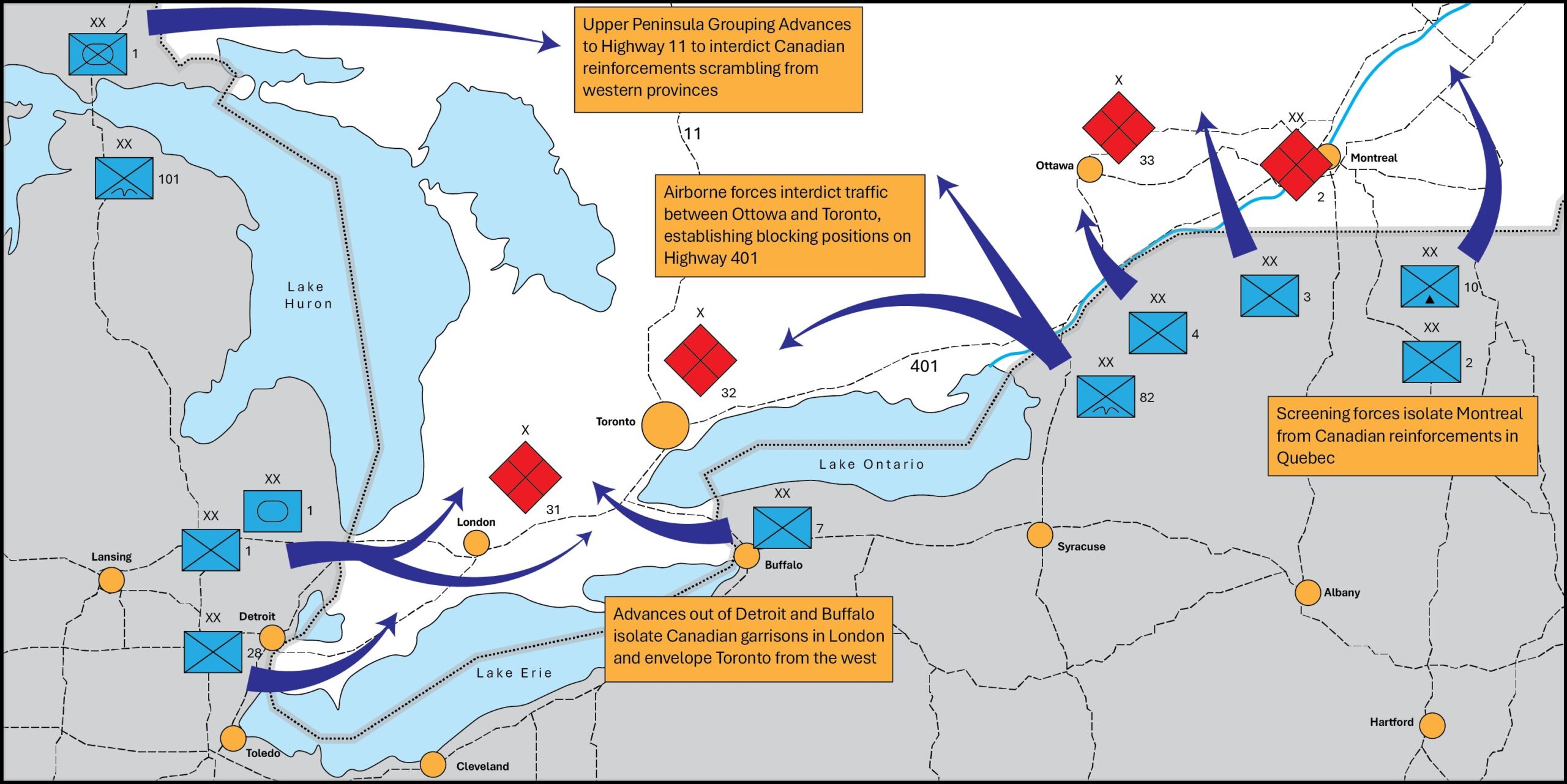
Manifest Destiny, 2025? Big Serge’s updated map for the Ontario portion of the old US War Plan Red for an invasion of Canada.
The first two posts looked at the capabilities and force structure of the Canadian and American side of this highly unlikely conflict. This post will look at what Force structure America would be able to assign to an invasion of Canada given its other security concerns.
The short answer is that the U.S. military can only deploy a minority of its combat power against any one enemy. This is a geostrategic problem faced by every global great power in history. It explains why the British Empire was strangely vulnerable even at the peak of its power. It also explains several patterns in post-World War II American geopolitical strategy, such as holding back the majority of its Corps HQs during Desert Storm or currently being quite silent about China while it resolves the Iran conflict.
A Summary of Military Capabilities
Conclusions about Canada
The first post concluded that a significant insurgency in Canada is very unlikely. The groups capable of one are rarely those interested in one, mainly because Canada’s rural-urban gap in firearm ownership is far wider than America’s.
The Canadian military is a different story. At least initially, it would resist a US invasion if ordered. Those citing political, ideological, or cultural reasons otherwise misunderstand the profession of arms.
It is small but highly professional, largely because its non-commissioned members serve nearly twice as long as their US counterparts.
Counting all categories, it has about 103,000 personnel, rising to about 123,000 with 30-60 days’ notice. Lower figures usually reflect misunderstandings of the Canadian Armed Forces’ structure.
Canada’s small but capable navy and air force cannot challenge American air and sea dominance, and their expeditionary design would make them near non-factors in a US invasion.
Against an invasion, Canada could field about 8.5 maneuver brigades:
- Regular Force Army: 3x CMBGs (equivalent to US Combined Arms Brigade Tactical Groups).
- Regular Force special forces at brigade (-) strength.
- Reserve Force: 10x CBGs (motorized infantry at brigade (-) strength) and an Arctic reconnaissance brigade. The CBGs currently generate 10x TBGs (equivalent to US light infantry task forces or British infantry battle groups).
- Under total mobilization after an invasion, the CBGs would likely generate 15x TBGs, about 5 infantry brigades.
At brigade level and below, Canadian Army equipment roughly matches that of US Army field units. America’s on-paper advantage stems mostly from strategic reserve stockpiles, which Canada lacks but which would not matter in a 2-4 week war.
Conclusions about America
In defense spending and high-end weapon systems, America is the unquestioned dominant power. At the highest level, America outnumbers Canada 21:1 in military personnel and 63-14:1 in key equipment (aircraft, tanks, and AFVs).
But raw-number comparison is the hallmark of poor military analysis. To understand the U.S. military, we must look at what it is designed to do and what combat power it could bring to bear in an invasion of Canada.
Militaries broadly fit two types: Volunteer Professional Expeditionary and Continental Conscript. Expeditionary militaries field a few maneuver brigades that can fight anywhere indefinitely, at enormous cost in money and manpower per brigade.
Continental militaries mass maneuver brigades to defend the homeland and its borders. This is far cheaper, but they can only mobilize briefly and cannot project power.
The U.S. has the most expeditionary focused military in history, able to project power globally on a scale matched only, perhaps, by its own World War II and Cold War forces.
Conversely, it devotes a smaller share of resources to ground operations than almost any other nation. Within its ground forces (the U.S. Army and the USMC’s non-air component), much of the personnel and spending goes to capabilities of little use in invading Canada.
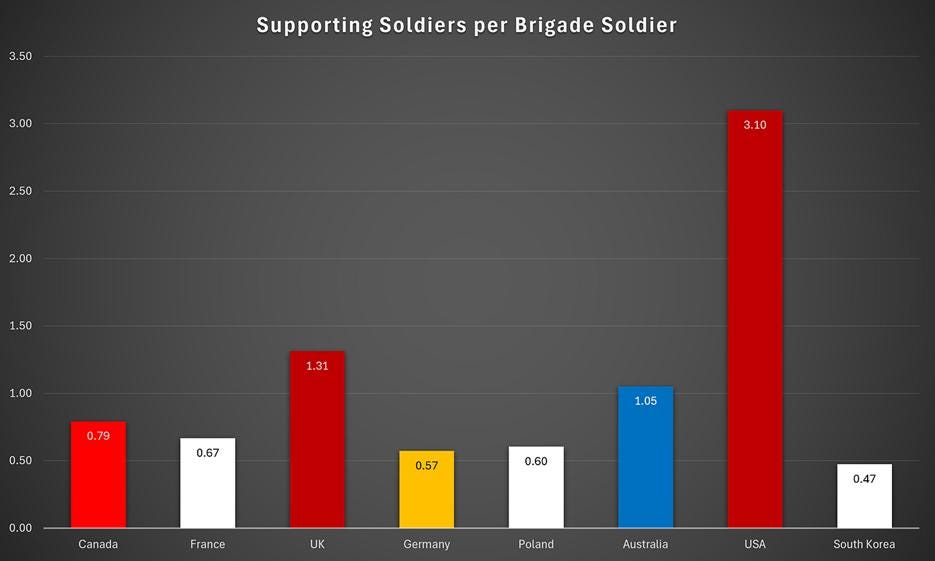
The brigade slice ratio illustrates this best: for every soldier in a maneuver brigade, how many serve in supporting units outside it? Continental militaries run about 0.5 to 0.6:1, other expeditionary militaries 0.8 to 1.3:1, and the US Army 3.1:1. That reflects capabilities like a flat-pack petroleum port and over 100,000 soldiers whose only job is moving supplies between continents. These let America project power like no one else, but they are largely irrelevant in an invasion of Canada.
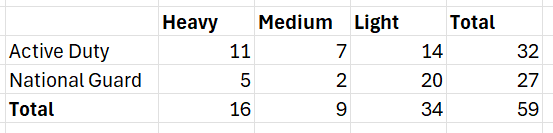
After all this, the Active Duty US Army has 32 maneuver and 3 special forces brigades; the National Guard adds 27 more.
Sixty-two brigades is huge by modern standards, but small for an army of 1,028,6000 and a $954 billion military budget.
Investing half your budget in strategic and operational logistics does little in a war needing no strategic and minimal operational logistics. A 2-4 week invasion of Canada would be almost entirely tactical logistics, where America has an edge over other Western militaries, but not a dominant one.
So while America outnumbers Canada 21:1 in personnel, the ground ratio is 15.9:1 and the maneuver brigade ratio just 8.8:1, still enough to curb stomp Canada. But as this article explores, Canada can commit every maneuver brigade to defending its homeland; America cannot commit even most of its brigades to invading Canada (or any single country).
I’m sure the full article considers this in-depth, but the Canadian military would be extremely vulnerable to a “bolt from the blue” attack, given where the bulk of troops and equipment are located relative to the most likely areas of incursion from the continental US.
The major population centres of central and western Canada are in easy reach of the border and it might be a race between American advances and Canadian reaction forces to get to most big cities. Activating the reserve would also be very difficult, as it’s highly likely the US would degrade or interdict most channels of communication at the start of such an operation, and as Canadian reservists do not keep their personal weapons at their homes, they’d need to get to their local armouries to draw weapons and what minimal amounts of ammunition stored locally. Forming the reserve units into combat-ready formations would take a lot of time that the Canadian military might not have …
The Korean War Week 123 – I Shall Go To Korea!- October 27, 1952
The Korean War by Indy Neidell
Published 27 Oct 2026After months of the people of the United States wondering what he would do about Korea if elected President, Republican Presidential Candidate Dwight Eisenhower this week announces that he will go to Korea in person to observe the situation first hand to see how best to settle it. In the field, Operation Showdown continues, and the Battle of Jackson Heights begins.
00:00 Intro
00:28 Recap
00:55 FLAK Suppression
02:16 The Hook
03:52 Jackson Heights
08:32 Operation Showdown
11:47 I Shall Go To Korea
15:11 Summary
15:21 Conclusion
15:55 Call to Arms
Germany wants to control social media content (and Carney is taking notes)
As I’ve mentioned before, I get a lot of useful information from the German perspective from eugyppius‘s Substack, and it’s especially interesting right now as Germany explores greater state control over social media platforms:



You know what we really need in Germany, what we just don’t have enough of?
Rules.
Specifically, we need more rules about what you can say and to whom you can say it, and more rules about what you’re allowed to read and watch and the kinds of content third-party platforms are allowed to serve you.
We need these rules because right-wing extremism and because Russian disinformation and because Trump and because Alternative für Deutschland and because all the other evils that exist solely and exclusively because of people being allowed to say things and hear things and see things in unmonitored unregulated ways.
Above all we need more rules because we don’t yet have enough rules, even though I swear we have an order of magnitude more rules governing media and speech than any other country in the developed world. We need more rules to rein in scary technological demons that live in the internet, like Social Media Algorithms, which are Literally Destroying Our Democracy by feeding German social media users a steady diet of far-right Russian Trumpist fascist Hitler propaganda. If only it weren’t for these demonic fucking algorithms putting wrong opinions into everyone’s brains, everything in the Federal Republic would be peace joy and pancakes right now, Friedrich Merz would have a 70% approval rating, Sachsen-Anhalt would be in the capable hands of a Green government and Ukrainian Armed Forces would be approaching the gates of Moscow.
The main problem with Social Media Algorithms, apparently, is that they give you too much of the content you like and not enough of the content you don’t like. Stopping these exploitative tactics and ensuring that your feed is filled also with things you don’t care about and never want to see is among the goals of our powerful Broadcasting Commission, as they hammer out the second part of their new Digital Media State Treaty (DMStV).
The intensely necessary, urgently needed and desperately required additional regulations of the DMStV include a provision addressing “the diversity of journalistic content on social media“. This item will foil the demon algorithms by requiring social media platforms to lard users’ feeds with 20% diversity-certified journalistic content. One out of every five videos YouTube recommends and one out of every five tweets in your X feed will have to be diverse! journalistic! content! if and when these draft rules take effect. For the purposes of these obviously warranted rules, anything produced by German public media outlets will be considered diversity-certified automatically, because why not. Private media companies, on the other hand, will have to prove their journalistic integrity and “diversity-promoting” nature before their posts can count towards this 20% quota. The individual State Media Authorities, bastions of far-sighted integrity and wisdom, will decide which private media companies get to count as “diverse”.
Rommel’s Rampage – Battle for North Africa Spring 1941
Real Time History
Published 5 Jun 2026The Italian Army in North Africa is in disarray after the British Operation Compass. Hitler reluctantly sends help in the form of the newly formed Afrika Corps under Erwin Rommel. Despite his orders, he immediately goes on the offensive and pushes back the British who are also reeling from the Axis invasion of Greece and Yugoslavia. But Rommel’s bold leadership style has drawbacks and in May 1941, the vital port town of Tobruk still holds out.
(more…)
QotD: “Our Gallant Allies, the Kurds (and other fairy tales)”
My first experience of the Kurds – rather, of how the rest of the area thinks of and feels about them – was before I’d ever met my first one. This was at a majlis, in the town of Judah (or Goodah), Saudi Arabia, sometime in December or so, 1990. Citizenship is kind of an iffy and flexible concept in that part of the world, so there were folk from Saudi, from Oman, from the Emirates. There was even one Arab who insisted he was a citizen of the Gulf Cooperation Council, since he was a fully documented citizen of so many places in the GCC. I had my doubts right up until he pulled out a bilingual ID card which, indeed, did seem to list him as a citizen of the GCC. One of the attendees had brought with him a book detailing the results of the chemical attack on the Kurdish town of Halabja by the army and air force of Saddam Hussein.
It was really heartbreaking, all those picture of gassed, dead, discolored, and decomposing Kurdish kids, who are, in fact, every bit as cute as the papers and television made them out to be. At least when they’re not dead they are. My team sergeant, Sig, and I were duly appalled and sickened.
The Arabs, though, didn’t seem to understand. To paraphrase, “What’s the problem? Don’t you understand that these were Kurds who got gassed?”
At the time, I found that attitude completely inexplicable.
Fast forward a few months; we’ve incited the Kurds and Shia to rise up and overthrow Saddam. They didn’t, of course, while such an uprising would have looked difficult and might have done us some good. Oh, no; instead the Shia – whose rebellion was spontaneous, anyway – waited until it looked like the Iraqi Army was crushed and such an uprising would be easy. The Kurds – who were organized – waited even longer.
Sorry, boys, but when we offer you a quid pro quo, that doesn’t translate into “free lunch”. Moreover, when we’ve already offered someone a ceasefire it’s a bit late to try to get us to start hostilities again. In short, we owed them nothing.
Fast forward, again, to late May, 1991. I’d come home from the Middle East, hung around a while, and been sent back, this time to Operation Provide Comfort, the Kurdish Rescue, there to quasi-govern a few towns, run refugee camps, coordinate humanitarian relief, and such like. While we’re waiting in the camp on the Turkish side of the border, not too far from Silopi, overwatched by a Turkish police fort on a hill, some Kurds got in position to fire at the fort such that, should the fort return fire, the Turks will be shooting at us. So much for gratitude from people you’re trying to save, eh?
Fortunately, Turkish discipline held firm and enlightened Kurdish dreams of advancing the cause of having a homeland of their own by getting their rescuers killed came to naught. After a couple of days at the camp, the crew I’m with and I are ordered forward to link up with the British Marines and their Dutch counterparts, already inside Kurdestan. We’re riding in on the back of a British Bedford Lorry, one which, based on the comfort of the ride, probably crossed the Rhine with Monty in 1945 … after enduring the entire war in North Africa. If it had a suspension it was tolerably hard to see, and impossible to feel.
Sitting next to me is a Staff Sergeant Farnsworth. Farnsworth and I are both grunts, so we’re doing what grunts do when there’s nothing better to do and neither sleep nor playing cards nor reading are possible; we’re analyzing the terrain. It is fiercely rugged, with winding roads going through narrow passes between hills and mountains difficult enough to climb on foot and impossible for vehicles. Reverse slopes were of such an angle as would make defenders largely invulnerable to artillery and would make even high angle mortar fire of much reduced effect. In any case, at a certain point, looking over a particularly defensible pass, Farnsworth and I looked at each other. I no longer remember who spoke first but the conversation went like this: “If the Kurds” “couldn’t defend themselves” “in this kind of terrain” “they don’t deserve” “their own country”. And that was before we even knew how much they used mines.
A little digression is in order here. As mentioned previously, Kurdish kids are adorable. (The women are also quite fetching, right up until they’re worn out, usually by age twenty-four or so, from being used like mules, which is to say, beasts of burden, but who, unlike mules, can still bear young … and must.) Most people shy away from or are at least ignorant of the reason so many of those adorable kids died. It’s simple; the Kurds starved them to death themselves. It’s a cultural imperative among them, when times get hard, to let the little girls die of starvation (first, of course), and then the little boys. Good guess, dear reader; why, no, I didn’t like that for beans. As a matter of fact, now that you ask, I’m not much for multiculturalism, in general, either.
Interestingly, before we even arrived in our area, there had been an incident – a firefight resulting in several Iraqi dead – between the British Marines and some Iraqi troops guarding one of Hussein’s palaces in that part of Iraq. I asked a British officer about it and his answer was to the effect that, “As near as we can figure, as one of our patrols was passing, two Kurds, from different positions but surely with coordination, took a shot each, close to simultaneously. One shot was at our patrol, the other at the Iraqi on the gate to the palace. Both shots missed, but the Iraqis and our men, thinking they were under attack, reacted as one would expect. We were just a lot better shots, better led, than they were. Poor bastards. One of the reasons we’re quite sure that the Iraqis didn’t shoot first was that, as our men passed, they waved at each other, as soldiers will who have no particular reasons for enmity.”
The main town I ran was Assyrian and Christian, Catholic, actually, having their own rite but being in full communion with Rome. It was an experience to attend mass held in Aramaic, the language of Jesus, a memory I rather cherish despite not understanding a word of it. They are nice people, the Assyrians, seriously nice people. I’ve dealt with a lot of different kinds of foreigners, over the years, even married one, for that matter, and liked almost all of them. But the Assyrians have a special place. They’re also amazingly hardworking. They can’t defend themselves or, at least, they don’t think they can, which amounts to the same thing.
Everyone knows about the Armenian genocide. The genocide of the Assyrians, around the same time period, was about as bad and may have been worse, as a percentage of the premassacre population. And among the chief agents of that genocide? Of both of them, really? You guessed it, the Kurds.
I asked my Assyrian translator there, once, what he and the other Assyrians really wanted. He answered, “We’d like the British to come back and run the place, permanently. Failing that, we’d be very happy to be subjects of the American Empire, if you would just declare one. If that’s not possible, then letting the Iraqis back would be minimally acceptable. Under no circumstance, however, do we want to be under the Kurds.”
That main town was the only one in which no Kurdish babies died, of the smallish number that the Kurds didn’t let starve anyway, and the only one in which there were no political or ethnic murders in that time period. Part of that was probably my own rather forthright approach to domestic harmony – “One incident, just one, and I’ll cut off your food, medical care, and other goodies, causing all your followers to desert you for other groups and leaders I haven’t proscribed!” – but part of it, too, at least for the long term maintenance of the thing, was probably the perception among themselves that the various Kurdish groups needed one safe area in which to engage in local diplomacy, and, since this one area was peaceful, well, why not? That meant a lot of luncheons, meaning, yes, I had the chance to meet most of the bright lights of Kurdish domestic politics and self-determination of the day. I’ve long since forgotten their names, but am pretty sure I could identify most of them in a police lineup and wouldn’t, of course, mind doing so. One in particular stands out in my mind, a rather distinguished looking middle aged barbarian who had once, over what amounts to a domestic dispute, murdered some thirty-seven Christian men, women, and children. And then there was the day the Kurds demanded to be paid. Paid? Why, yes, we were providing free food, free medical care, free shelter, and free security, but they saw no reason not to be paid for unloading the free food and other goodies. I sent the trucks back with the food until they knuckled under.
Thus, it might be better for the United States, before pinning too much hope and faith on the Kurds, to understand that they’re military imbeciles with an unearned and undeserved reputation, that their culture is barbaric, they their one talent seems to be propagandizing and manipulating liberal Western opinion, which is eager to be manipulated, anyway, that any kids who die usually do so because of their own neglect of those kids, that they have no sense of gratitude for any help you give them, that they treat women like donkeys, and that they place zero value on the lives of those who try to help them.
Why we, or anyone, would place our faith and trust in them … well, it eludes me. To help that lesson stick in your mind I offer a Kurdish National Anthem, written by my team sergeant, Sig, in a moment of complete disgust with them. Every line tells a story: (Tune: O Tannenbaum)
A voice without a hint of shame
Cries, “It’s all your fault; you’re all to blame.
We must be clothed, we must be fed
And when that’s done build our homesteads”Chorus:
A Kurd can have no greater love
Than his brand new Kalashnikov;
O Kurdestan, my Kurdestan,
Do what you want; grab what you can.You gave us shelter overhead
Doctors and blankets for our beds.
You’ve saved us from Iraqi raids,
Now tell us when do we get paid?Chorus
We fought the Turks, we fought Iran
We fought Iraq for Kurdestan.
And now you’ve made us free and strong,
We’ll kill the Christians when you’re gone.Chorus
This column is dedicated to the memory of Father Hanna Marko, of Mangesh, Iraq
Tom Kratman, The social media site formerly known as Twitter, 2026-07-25.
October 27, 2026
“Originalism” doesn’t mean freezing rights to the technology of the Founding Fathers
Have you ever been in a conversation with an intelligent-but-undereducated youngster? They’re likely to come up with highly original takes on issues, like “the US Bill of Rights only applies to the kind of guns they had at the time it was written“:
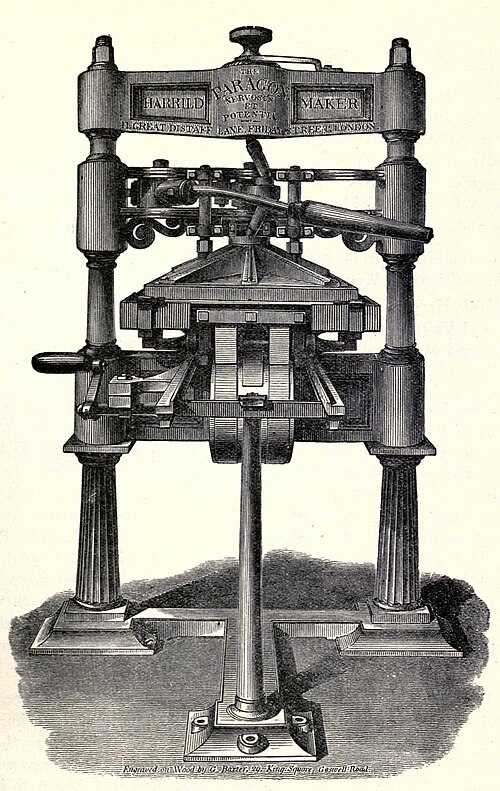
An 1829 printing press. The Founders clearly didn’t intend the freedom of the press to only apply to the printing technology of their era.
Woodcut by George Baxter, Public Domain.
Abdul El-Sayed, Michigan’s Democratic U.S. Senate candidate, is the latest politician to suggest that the Second Amendment might shield the right to bear arms, but only those that existed at the time that it was adopted: namely, flintlock muskets. It’s a not-so-clever way of trimming back the Constitution’s protections. The argument’s flaws should be clear: the U.S. Supreme Court has already dismissed that line of reasoning, and a world in which the Bill of Rights applies only to 18th century technology would be one where freedom exists only in museum exhibits.
“Everyone Should Have Equal Rights to a Musket”
“I’m gonna swear an oath to the Constitution. The Constitution has a Second Amendment in it, but the Second Amendment, just so we all are clear, even the most conservative folks, they hew to this idea called originalism, and originalism is the idea that you should interpret the Constitution in the context in which the Constitution was written”, El-Sayed insisted at a campaign rally. “When they promised the right to bear arms, they had muskets. So, yeah, everyone should have equal rights to a musket.”
So clever. The Bill of Rights passed in the 1780s, so it must only apply to 1780s things. Except that the courts have thoroughly dismissed that ridiculous line of reasoning.
“Some have made the argument, bordering on the frivolous, that only those arms in existence in the 18th century are protected by the Second Amendment”, Justice Antonin Scalia wrote for the majority in District of Columbia v. Heller (2008). “We do not interpret constitutional rights that way. Just as the First Amendment protects modern forms of communications … and the Fourth Amendment applies to modern forms of search … the Second Amendment extends, prima facie, to all instruments that constitute bearable arms, even those that were not in existence at the time of the founding.”
The Founders Lived in a Time of Rapid Innovation
The reason for this should be obvious. The founders were not unaware of progress. Many of them were scholars and innovators. They were certainly aware of (and enthusiastic about) continuing advancements in technology. During the then-recent revolution, American troops had faced off against a small unit of redcoats armed with Ferguson breech-loading rifles. A decade before the Bill of Rights was adopted, the 22-shot Girandoni repeating air rifle was introduced, one of which was later sent along on the Lewis and Clark expedition. And Kalthoff and Lorenzoni repeating flintlock firearms had existed for well over a century.
Not to mention, the founders made extensive use of printing presses to distribute pamphlets and official government documents, including the new Constitution, rather than having them hand-copied as they would have been a few centuries earlier. Technology marches on.
That last point illustrates the foolishness of the only-1780s-tech argument, as Scalia pointed out. What use is a First Amendment that applies only to hand-cranked printing presses and unamplified voices? That would leave the internet, television, radio, telephones, and all post-revolutionary means of communications unprotected from government censorship.
Farewell, BioWare
I’m not really a gamer, although I have enjoyed playing several online games over the years, including Baldur’s Gate 3 which I’d assumed was a BioWare game (as the first two in the series had been) but was apparently developed by a different studio (Belgium’s Larian). So, perhaps I’m less disturbed by the demise of the Edmonton-based company than I thought:

Though it was just announced on Wednesday that the legendary Canadian game studio BioWare was shutting down, it did not come as a shock. Many of us already mourned it years ago when it was clear that the company had become a Ship-of-Theseus simulacrum of the original.
Back in its era of peak performance, BioWare delivered a steady stream of hits. The company’s 1998 Baldur’s Gate packed the rules and lore of Dungeons and Dragons into a game similar in calibre to Blizzard’s Diablo and Warcraft. The sequel, Baldur’s Gate 2, still tops best games of all time lists. Another notable early entry was 2003’s Star Wars: Knights of the Old Republic, and subsequent MMO in 2011.
Later, BioWare proved it could bring its formula for rich characters, story and combat to its own original worlds. In 2009, Dragon Age: Origins updated fantasy adventuring for modern tech and grew into a trilogy by 2014 Game of the Year winner Dragon Age: Inquisition. But it was the Mass Effect science fiction trilogy, with releases in 2007, 2010 and 2012, that catapulted the studio from maker of niche role-playing games into a AAA developer.
The studio was highly effective at multi-tasking.
The great pull of a flagship BioWare game in those days came down to the writing: the epic story arc at the centre of a given franchise would play out differently depending on the player’s choices in the game. Some choices could mean the death of an entire people; some could kill off a beloved character — and there were many of those, because they had their own flaws, motivations and unique relationships to the protagonist which would grow and change for better or worse as the story progressed. Player agency truly mattered.
For the Canadian fans, there was extra pride in BioWare’s success because the beating heart of the machine was in Edmonton. The studio’s three founders, Ray Muzyka, Greg Zeschuck and Augustine Yip, met at the University of Alberta while studying medicine and taking on related programming projects.
They drew much of their staff from local sources. The lead writer of the first two Mass Effect games, Drew Karpyshyn, grew up in an Edmonton suburb and was working on a Master’s degree in English at the University of Alberta when a writing position at BioWare was advertised in the faculty newsletter. He got the job, and minus a three-year break that he took to work on a book series, he remained with BioWare until 2018.
Preston Watamaniuk, lead designer of the entire Mass Effect trilogy, studied political science and history, and then worked a garbage route in Edmonton for several years before getting his start at BioWare. He was still with the company as of the shutdown announcement.
But the company changed significantly to attract [Critical Drinker voice] “modern audiences”. It lead to the recent announcement that the company was shutting down.
If only BioWare wasn’t so emblematic of Canada: once well-respected and economically strong for its small size, but now hollow from its unstomachable efforts to push a social mission to an unreceptive audience. Had it stuck to what made it exceptional in the first place, it might still be alive today. Instead, the very best parts of its legacy were exported and are now thriving somewhere else.
The Russo-Ukraine conflict is driving technological change on the front line
Over the weekend, Peter Caddick-Adams had a post in The Critic discussing how the fighting between Russian and Ukrainian forces has been changing in response to new technologies and capabilities:
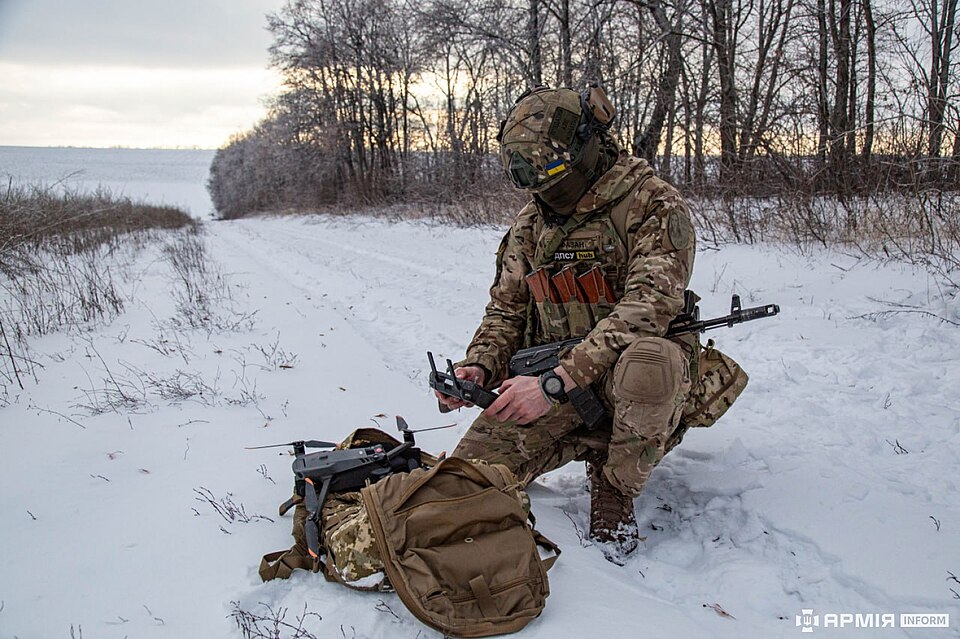
Ukrainian Border Guard operating a DJI Mavic drone, 13 February 2024.
Ministry of Defense of Ukraine photo, CC BY-SA 4.0
At the same moment Zelensky’s Starshield cover was disintegrating, I was being briefed by military colleagues just back from Ukraine. They began with the observation that there is no such thing as a front line any more. The forward edge of the battle areas — the so-called fortress belt, shielding Ukraine from Russian forces in the Donbass — are held very lightly, with none of the density of troops or foxholes found in either world war. Instead, they have been replaced by a dense mesh of unmanned systems, optical devices and other sensors, some concealed on the ground, which can cover forward areas 24/7, day and night, in all weathers. Dozens of kilometres can now be held by a few hundred well-equipped defenders, who can call on precision-guided artillery and/or drones in the event of trouble. Small raiding parties of interlopers from both sides, often armed with tactical quadcopters, occasionally filter through the notional front on foot, having navigated minefields and concrete anti-tank obstacles, but cannot achieve much and do not linger. My friends believe the days of banning anti-personnel mines appear to be over.
To skimp on manpower, both sides have found it expedient to cover terrain by fire, rather than the traditional methodology of humans dug deep into the earth. Painful memories of days wasted on NATO exercises digging trenches flashed through my mind. Furthermore, outside of urban areas, combat zones with an ever-present risk of drone or artillery interception may stretch as deep as 20km, so the concept of front and rear has also disappeared. However, such tactical depth is not always available to small countries, such as the Baltic states. In urban areas, whenever Russia claims possession of a new settlement or objective, its troops are rarely able to move around above ground by day, due to opposing drone activity. New gains announced by Moscow are in fact merely of cellars and subterranean passages. It takes us back to the old adage that to take and hold ground, you need ‘boots on the ground’, not a few nervous moles. My colleagues suggested, “It’s like claiming control of an ocean, from the seabed”.
And those drones? The latest figures from Ukraine are suggesting 85 per cent of Moscow’s human and equipment casualties are allegedly caused by unmanned aerial vehicles (UAVs), or artillery and mortars directed by them. According to retired General David Petraeus, including long-range strikes and air defence, Kyiv is routinely expending between 9,000-10,000 UAVs per day and aims to manufacture 7m in 2006. On that basis, any NATO partner that boasts of being drone-ready for the next war, will need an arsenal of a minimum of 3.5 million cutting-edge UAVs and the manufacturing capability to replace them, to conduct operations for a year.
Often of the First Person View (FPV) type, identifiable by the spools of gossamer-thin wire they carry (which keeps them proof against electronic interference, but limits their range) UAVs come with the advantage of being cheap and easy to assemble. Crucially, these cunning little devices and their longer-range brethren have largely replaced (often American-built) cruise missiles, regarded as exorbitantly expensive by comparison, with long lead times. It is, put simply, the economics of interception, and a logic that is starting to spread to Western navies.
Via UAVs and waterborne drones, Unmanned Surface Vehicles (USVs), Kyiv now controls huge swathes of the Black Sea. Recently a Ukrainian USV successfully intercepted and destroyed a Russian USV in a world-first tactical clash of this type. This activity has pushed the Russians to begin to use their Caspian Sea flotilla to launch long-range missiles, as their Black Sea warships are so degraded. Practical combat experience is also suggesting that all soldiers, in every arm or service, will need to be trained in small drone operation, which is proving to be as basic a required skill in war as operating a rifle. Furthermore, the most important figure to whom troops now report seems not to be the ranking infantry officer, but the network engineer or coder. They are the ones who need to know of the success or otherwise of their various integrated unmanned systems and can make on-the-spot adjustments, or send the necessary reports up the command chain.
Tweaks might include the ability of drones to take prisoners (Russians are now known to be surrendering to machines), and the availability of unmanned ground vehicles (UGVs) to not only bring up all manner of logistics, but return with casualties. All the engineers have a price on their heads, and as a result, their workshops are better protected than traditional headquarters because their signature across the electromagnetic spectrum is huge. This is becoming a perennial problem for the Ukrainians but one they have exploited amongst Russian positions for some time.
Another drone development was unveiled very recently by Kyiv’s 475th Assault Regiment who sent a Challenger 2 tank and a Bradley M2 infantry fighting vehicle against Russians in a forward area. Normally this would result in instant destruction, but addition to being surrounded by protective metal cages (‘turtles’) and armed with welded-on spikes to trigger incoming warheads (‘hedgehogs’), the armoured vehicles were protected by new classes of crewless aerial scouting and escort craft, devised to protect friendly ground assets from air interference. Drone apparently fought drone, while others dropped grenades to suppress Russian positions and clear mines.
Update, 29 October: Welcome, Instapundit readers! Have a look around at some of my other posts you may find of interest. I send out a daily summary of posts here through my Substack – https://substack.com/@nicholasrusson that you can subscribe to if you’d like to be informed of new posts in the future.
Counterproductive climate fearmongering
Maarten Boudry on Substack Notes:
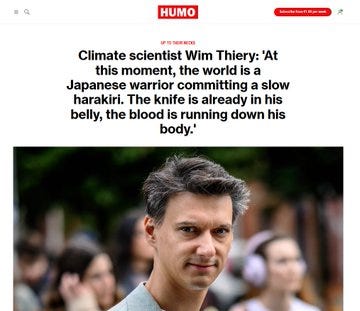
Climate scientist: “The world is a Japanese warrior committing a slow harakiri. The knife is already in his belly, the blood is running down his body“.
I am, quite frankly, fed up with this. This kind of extreme fearmongering is not only scientifically unfounded; it is actively harmful. It breeds paralysis and defeatism, fuels mental health problems, and leads young people to decide against having children.
For a long time, I tried to maintain the utmost respect for climate scientists. But it’s time we confronted a paradox: experts are often not the best guides when it comes to assessing the dangers within their own field—and even less so when it comes to deciding which policies should address them.
The same goes for AI, where even the field’s pioneers are now recklessly speculating about their “p(doom)” — the probability of human extinction.
Years of specializing in a single domain can narrow your perspective until everything else pales in comparison. Climate change — or AI — becomes the existential threat to humanity, eclipsing every other danger we face.
Self-selection plays a role, too. If you choose to specialize in a field because you believe humanity’s future depends on it, you’re hardly a representative sample of people who think the threat is manageable, or that the real dangers lie elsewhere. Those people are less likely to pursue a career in climate science or AI safety in the first place.
And, I’m sorry to say, there’s also a certain narcissism inherent in this kind of doomsday rhetoric: the belief that the fate of the entire world hinges on your particular area of expertise. That you possess privileged knowledge and occupy a central role in humanity’s existential drama.
Odd Man Out | A Film Portrait of Enoch Powell (1995)
Eugenus Rex
Published 6 Jun 2021In an insightful and sobering documentary, journalist Michael Cockerell chronicles the life and career of the politician, classical scholar, linguist, soldier, poet and altogether self-identifying outcast; the Right Honourable Brigadier John Enoch Powell. Featuring interviews with Mr. Powell, his family, friends and the former Prime Minister, the Baroness Thatcher.
Originally broadcast: 11th November, 1995.
(more…)
QotD: The outer “zones” surrounding a typical pre-modern city
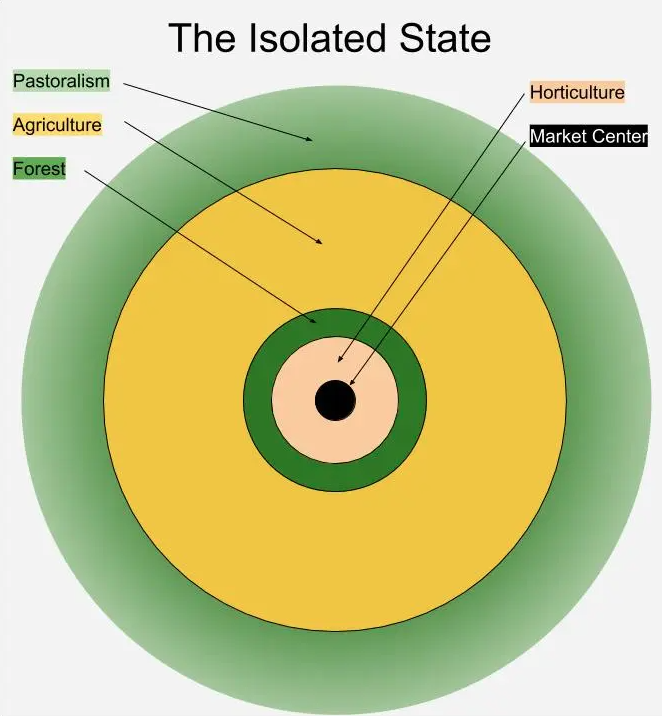
Diagram of von Thünen’s model from The Isolated State, after Morley (1996), 62. The agriculture ring is subdivided by intensity (intensive, long-lay and three-field), but here I have merged them for simplicity. The agriculture zone is wider because it did, in fact, tend to cover a larger area. The fade in the pastoralism zone is meant to indicate shifts from ranching to transhumance.
Once out of the innermost zone of very high intensity usage, we reach the middle zones of von Thünen’s model, which are devoted primarily to agriculture, falling in degrees of intensity as we move away from the city. This is where you should expect to see rolling seas of wheat and barley, as well as large scale cultivation of things like olives and grapes, as the climate permits. This seems to be what, for instance, Tolkien has in mind when he describes the Pelennor as fair and fertile townlands running down to the Anduin.
(I should note this this zone is subdivided into three groups: intensive agriculture, long-lay agriculture and three-field agriculture. We might discuss those terms further if future posts bring us to discussing how pre-modern farms work, but for now, I don’t want to get too – pardon the pun – deep in the weeds.)
Now, I noted before that for small cities, the horticultural zone might be entirely contained inside the city walls. The reverse is true as well – the larger the city, the further out these zones can get pushed – and this is especially true of the middle zone. As it extends, it tends to create miniature population centers within it (villages) – usually along roads (we’ll get to them).
But for very large cities, the area of grain cultivation can be truly massive. As I’ve noted in an earlier post, a city of around 500,000 would need to pull cereal production from an area of arable land close to the size of the state of Massachusetts. Rome – at nearly a million – imported grain from up and down the entire Italian coast, North Africa and even Egypt. A middle zone that large could contain not merely villages, but other towns and even large cities, whose own land-use patterns would be substantially distorted by the “pull” of the mega-city at the center. […] as a rule of thumb, if the cereal cultivation zone extends more than 20 miles out from the center, you should expect to see smaller market towns within it (because people want a market within a day’s walk).
What does this kind of zone look like? That actually depends a lot on terrain – expect villages surrounded by fields on areas of good, arable land. In a fairly wet environment (like Northern Europe), those villages might radiate out from the city. In arid environments like Egypt or Mesopotamia, the farmland (and thus the peasant population) is densely concentrated along the rivers, because water availability becomes a strong determinant of arability.
One thing Americans specifically tend to get a bit off here is that the farms are not likely to be evenly spaced over the terrain. We are very used to the agricultural landscape created by things like the Homestead Acts (1862-1930), which offered very large chunks of land (often as many as 640 acres) for purchase, creating a lot of very spaced out farms. Peasant agriculture in the pre-modern period doesn’t tend to organize like this.
Instead, peasant agriculture tends to cluster in villages, with fields radiating out from the villages (which in turn, often have their own micro-garden zone and local forests for wood). Part of the reason for this is that farmland within the village is typically not held as big, standalone farmsteads. Instead, it is either held communally, or else each family owns several small plots spread over different ecological zones (the better to be protected from the risk of a year being wet or dry or cold or whatever – if you have a little land everywhere, then probably something will grow somewhere every year. I’ll talk more about subsistence survival strategies in a future post).
In some societies, these peasant villages may also be mixed in with large elite-held (often slave worked) estates, but there’s an important caveat here. The grand estates – like Roman villas and latifundia – generally do not completely displace the local peasantry (in part because they rely on that peasantry to supply surplus labor). The role of the “big man” and these sorts of large market-oriented estates is complex and worth its own post. But in terms of land-use patterns, such estates generally exist within a landscape of smaller farmers, not in a vast sea of other large estates.
The outermost zone in the model is dedicated to pastoralism (“ranching” technically, but I’d like to be a bit more broad). Pastoralism can take the form of enclosed ranching, but can also be mobile in various ways. I won’t describe ranching too much – this human terrain is still much in evidence and well documented. But mobile forms of pastoralism are more foreign, I suspect, to most of my readers. Transhumance – the moving of livestock between seasonal summer and winter pastures (often up the mountain in summer and down the mountain in winter, for instance – this is “vertical” transhumance) is a common form of limited pastoral mobility.
Transhumant pastoralists do tend to have permanent homes at one end of the route (typically the lower winter pastures for vertical transhumance). These may cluster in villages and are likely to plug into the infrastructure network spreading out from the city. I bring this up mostly because this is how you do get the “rolling hills of empty grassland” terrain so common in depictions of fantasy cities: these areas aren’t empty at all, but merely transhumant pastures not currently in use.
(Side note: This fact about pastoralism is especially worth noting: pastures which are regrowing in the “off” season often might look empty and unused to an outsider, but trespassing on such grounds can bring lethal retaliation. Because these pastures are not unused, but in fact engaged in the vital task of regrowing to support the herd in the following season. This is also the case for true nomads as well, by the by. The reason, of course, is that if those pastures are not grown when the herds are migrated back, the pastoralist’s entire pattern of subsistence is disrupted, endangering his survival. This is a not infrequent cause of friction between pastoralists and agricultural peoples who neighbor each other).
Pastoralism exists on the outer edge of the model for two reasons. First, it is very low density. While the goods it produces (wool, milk, meat) are important, it produces them at a very low density. Agriculture can support massively greater population densities than pastoralism, so high population density tends to push the pastoralists out. There’s a political/military dimension to this as well: the concerns of the farmers tend to dominate political thinking in the city (where, you will recall, the political and military elite are), and the farmer’s greater population density tends to allow them to “push” the pastoralists further from the city and onto marginal lands – either economically (buy the land) or militarily (fight the pastoralists and shove them off).
Second, pastoralism has very low transportation costs. This is because the goods produced by pastoralists can, by and large, walk themselves to market. This is called transporting them “on the hoof”, a phrase my students continue to find funny and are surprised to learn is a real term. Major cattle and animal markets are often still located within city centers, but a shepherd can simply walk his animals to market for sale. That greatly reduces transportation costs, which also tends to push pastoralism out to the edges of the economic network.
Bret Devereaux, “Collections: The Lonely City, Part I: The Ideal City”, A Collection of Unmitigated Pedantry, 2019-07-12.
October 26, 2026
“Christofascism” seen as harmful
I must not hang out in the progressive cool kids’ areas of the internet, as I’d only occasionally heard the term “Christofascism” and I’d never encountered even a vague definition of what the pejorative might mean. Copernican to the rescue with an extended discussion on that very thing (it’s a long piece, these excerpts just skim the surface):
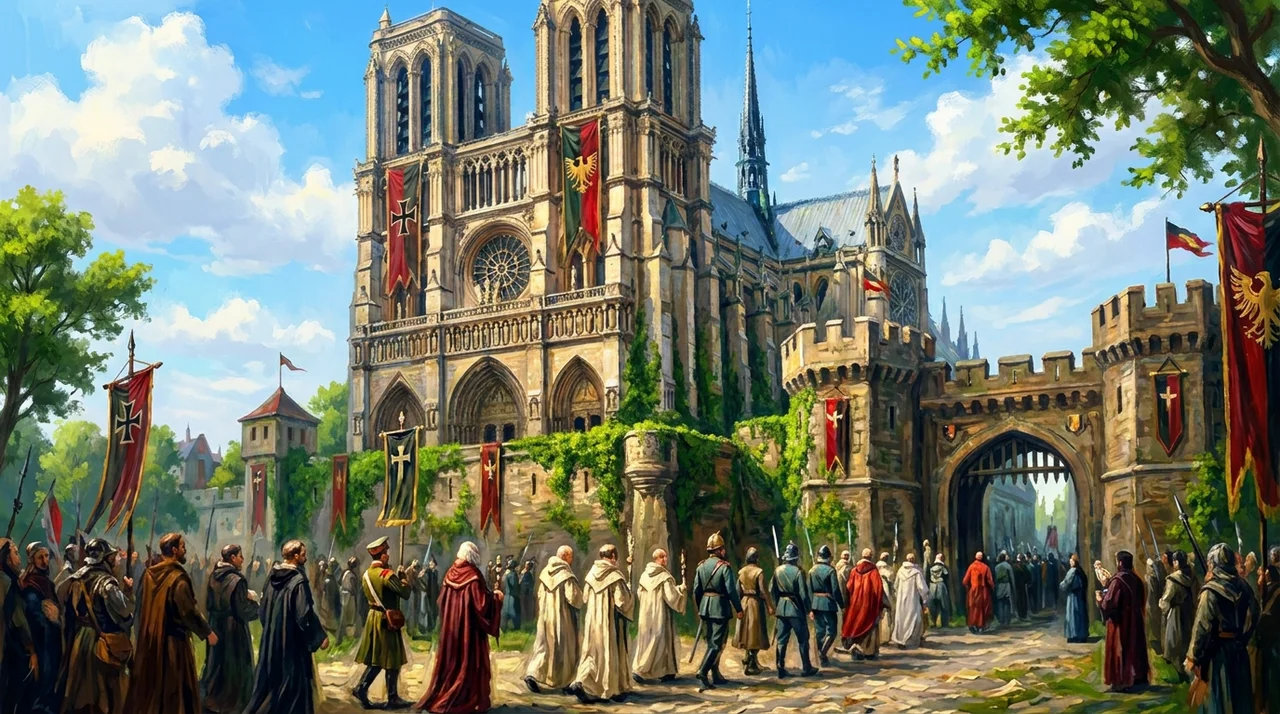
Image from Seeking Always the Horizon
Long has the progressive movement decried “ChristoFascism”, representing it as the greatest threat to Western civilization. The alphabet-soup squad has mostly moved on. Like most words uttered by the progressive mind, the term is used entirely for the reaction it elicits, and has nothing to do with describing the real world. Christofascism was just another word in their toolbox, like “nazism” or “racist” or (now) the ever-popular “if you date a girl two years younger than you, you’re a pedophile”.
All these are words uttered merely to enforce the progressive’s bizarre form of destructive totalitarian thought-control.1
While the [CURRENT THING] horde has moved on from accusations of Christofascism, I have not. There’s something archaically elegant in that formulation of words and the compound thought-form they represent. Hiding in the spiteful accusation is a memetic complex that deserves further investigation. Christofascism was a mere combination of “bad things” that the Left hates … but that doesn’t mean it should be taken as mere braindead progressive gurgling.
It may well be far more than that. There’s a new cultural theology hidden in there.
[…]
ChristoFascism
Individuals like Kulak identify modern (what I’d call “liberal”) Christianity as a fundamental inhibitor to the people of the West.2 That analysis is not entirely wrong. Christianity in its modern incarnation developed alongside the fall of Rome, the High Medieval Period, and then through the Enlightenment and the Industrial Revolution. Christianity was a governance apparatus for regional tribal conflicts and the occasional crusade. It was the centerpiece of the Holy Roman Empire, but the theological framework has a great deal of trouble squaring with modernity.
Simultaneously, all of the alternatives, the materialist religions of the 20th century, have been absolute disasters ending in nihilism, hedonism, or cruelty. The human collective unconscious is not a static thing.3 It’s frothing with new ideas, particularly during times of great change and turmoil. The Hegelian dialectic.
Notably, the Hegelian dialectic ends in the creation of a new thesis. The original Thesis is the Universalist heritage of the West. That would be Christianity from 300 AD up until the 19th century. Then there is the antithesis, the materialist religions that seized the zeitgeist in the 20th.
[…]
A Christofascist cultural foundation must express:
- The moral recognition of a higher power and that it is the duty of the state to nurture a heroic righteousness in its own people, granting Duties, and Guidance in addition to liberty.4
- A masculine Will to Power in the development of its own practices, heritage, and promotion of its own cultural ideals to the exclusion of hostile, foreign, or corrosive ones.
- That the State, and the individuals who make up the State, are responsible for adhering to higher moral standards. One cannot simply blame “the voters” for the evil actions of the state. The leadership of the state holds personal responsibility for imposed policies.
- An intense sense of national exceptionalism, particularly in the eyes of God. As a spiritually exceptional state, the people of the nation uphold a higher scientific and spiritual ideal as individuals, families, and citizens.
- A recognition of other similar nations as being siblings seeking the same ultimate goals through alternative means, rather than pawns in a game of Great Powers.
- Paternalism with God as father to the nation’s people, and the nation’s people not beholden to the operational state but being the actuators of it. A father that expresses temperance in governance.
- I think that John Carter wrote the best analysis of this phenomenon in his work on “Homo Umbrans“. The product of man willingly handing over sapience in exchange for the reprieve from intellectual rigor. To very roughly summarize one of the best articles on Substack: if you feel like you’re under psychic attack when trying to communicate with a progressive, it’s because you are. The Leftist attempts to annul the meaning of words required for thought to render sapient cognition and abstract reasoning impossible.
- Here’s a direct link to some of the work that Kulak has done. This one is of particular interest to those in the proverbial Pagan camp. Here’s an article that was written by Millennial Woes on the same topic. A great article that I would recommend regarding this perpetual confrontation within the Spiritual Right.
- Here’s my own article on how best to conceptualize the collective unconscious.
- We will assume a Christian higher power, it’s in the name after all.
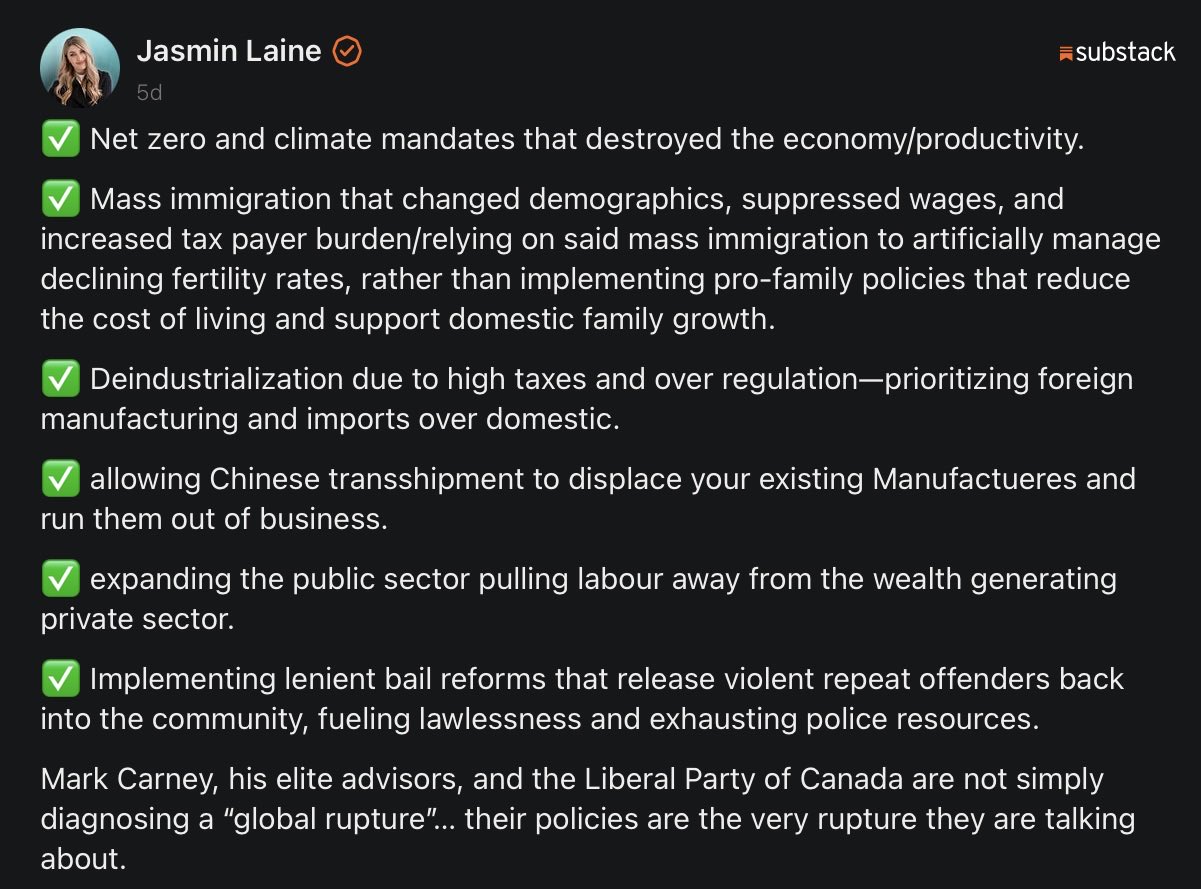
Canada’s economic plight is largely self-inflicted
On the social media site formerly known as Twitter, L. Wayne Mathison responds to a Substack Notes post by Jasmin Laine:
I agree with Jasmin. What Carney calls a “global rupture” is, in many respects, the accumulated consequence of political decisions made right here in Canada.
For more than a decade, Liberal governments have pursued policies whose economic consequences deserve far more scrutiny.
Climate mandates and regulatory costs have made investment and industrial development more difficult. Immigration expanded faster than housing, infrastructure and public services could reasonably accommodate. Rather than addressing why young Canadians struggle to afford homes and raise families, Ottawa increasingly relied on immigration to sustain population and labour-force growth.
High taxes, regulatory uncertainty and unfair foreign competition have weakened the conditions for domestic manufacturing. Government employment expanded much faster than private-sector employment, while productivity and business investment remained persistent concerns.
And years of public frustration over repeat violent offenders exposed serious weaknesses in our bail and justice systems.
These problems have different causes, and global pressures are real. But governments must accept responsibility for the consequences of their own decisions.
Carney speaks about rebuilding Canadian sovereignty, competitiveness and economic security. Those are worthwhile objectives. The question is whether his government is prepared to reconsider the policies that contributed to Canada’s vulnerabilities.
You cannot spend years weakening the foundations of an economy and then describe the resulting cracks as an unexpected global rupture.
Jasmin is asking the question every government should face: How much of the problem are you actually responsible for creating?
Reality refuting the beliefs of the gun-grabbers
The shooting in Bend, Oregon is turning out to not follow the gun-grabbers’ narrative even a little bit. It’s getting noticed:

I was told by anti-gun extremists that any “Good Guy with a Gun,” would be mistaken for the bad guy and immediately shot by the police, after he was easily shot by the bad guy because the Good Guy with a Gun wouldn’t know how to use his own gun …
What happened in Bend, Oregon? None of that happened …
ESR responds:
Yes, I’ve been thinking that the Bend shooting turned into the graboids’ worst nightmare, and it keeps getting more so as people process it.
Oregon has an A- rating from Giffords. That means its laws were already doing almost everything that the graboids claim should prevent mass shootings. But obviously didn’t.
Giamfranco is soft spoken, articulate, and photogenic. There’s no dismissing him as a scary redneck. And he’s not a veteran or a hunter or anything, just an ordinary family guy who stepped up.
He popped the bad guy with surgical precision. He didn’t hit a bystander, and he didn’t get shot himself either by the bad guy or the cops. Of course this is usually the way it goes, but most people who aren’t gun-culture themselves don’t know that.
The obvious questions is raises are: if gun control didn’t work in Bend, why would it work anywhere? And if an ordinary chill dude can step up to save lives when the laws failed, what kind of idiot do you have to be to want to stop that from happening?
What is it the kids say nowadays? Ah, yes. Cope, seethe, and mald, graboids. This intervention was everything you hate, and that’s good news for the rest of us.


