
As every red-blooded American knows, an invasion of Canada would be as one of the Founding Fathers put it, “a mere matter of marching”. So glance at the thumbnail summary of the two nations’ military capabilities should some future American president decide that the US should formally own “America’s Hat”, courtesy of Operational Art of War (most of the article is paywalled … this is an excerpt from the teaser email send out to cheapskate free subscribers like me):
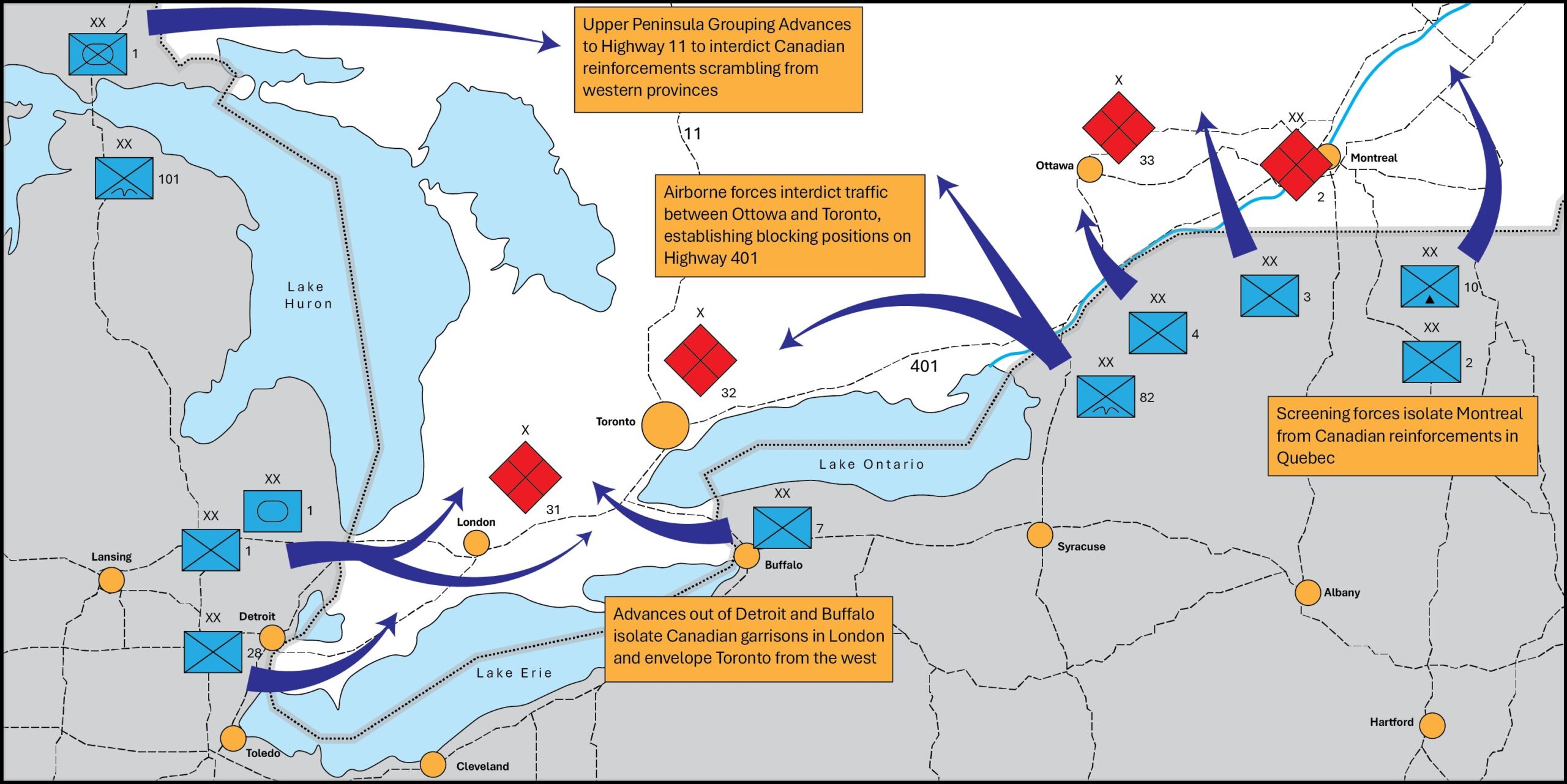
Manifest Destiny, 2025? Big Serge’s updated map for the Ontario portion of the old US War Plan Red for an invasion of Canada.
The first two posts looked at the capabilities and force structure of the Canadian and American side of this highly unlikely conflict. This post will look at what Force structure America would be able to assign to an invasion of Canada given its other security concerns.
The short answer is that the U.S. military can only deploy a minority of its combat power against any one enemy. This is a geostrategic problem faced by every global great power in history. It explains why the British Empire was strangely vulnerable even at the peak of its power. It also explains several patterns in post-World War II American geopolitical strategy, such as holding back the majority of its Corps HQs during Desert Storm or currently being quite silent about China while it resolves the Iran conflict.
A Summary of Military Capabilities
Conclusions about Canada
The first post concluded that a significant insurgency in Canada is very unlikely. The groups capable of one are rarely those interested in one, mainly because Canada’s rural-urban gap in firearm ownership is far wider than America’s.
The Canadian military is a different story. At least initially, it would resist a US invasion if ordered. Those citing political, ideological, or cultural reasons otherwise misunderstand the profession of arms.
It is small but highly professional, largely because its non-commissioned members serve nearly twice as long as their US counterparts.
Counting all categories, it has about 103,000 personnel, rising to about 123,000 with 30-60 days’ notice. Lower figures usually reflect misunderstandings of the Canadian Armed Forces’ structure.
Canada’s small but capable navy and air force cannot challenge American air and sea dominance, and their expeditionary design would make them near non-factors in a US invasion.
Against an invasion, Canada could field about 8.5 maneuver brigades:
- Regular Force Army: 3x CMBGs (equivalent to US Combined Arms Brigade Tactical Groups).
- Regular Force special forces at brigade (-) strength.
- Reserve Force: 10x CBGs (motorized infantry at brigade (-) strength) and an Arctic reconnaissance brigade. The CBGs currently generate 10x TBGs (equivalent to US light infantry task forces or British infantry battle groups).
- Under total mobilization after an invasion, the CBGs would likely generate 15x TBGs, about 5 infantry brigades.
At brigade level and below, Canadian Army equipment roughly matches that of US Army field units. America’s on-paper advantage stems mostly from strategic reserve stockpiles, which Canada lacks but which would not matter in a 2-4 week war.
Conclusions about America
In defense spending and high-end weapon systems, America is the unquestioned dominant power. At the highest level, America outnumbers Canada 21:1 in military personnel and 63-14:1 in key equipment (aircraft, tanks, and AFVs).
But raw-number comparison is the hallmark of poor military analysis. To understand the U.S. military, we must look at what it is designed to do and what combat power it could bring to bear in an invasion of Canada.
Militaries broadly fit two types: Volunteer Professional Expeditionary and Continental Conscript. Expeditionary militaries field a few maneuver brigades that can fight anywhere indefinitely, at enormous cost in money and manpower per brigade.
Continental militaries mass maneuver brigades to defend the homeland and its borders. This is far cheaper, but they can only mobilize briefly and cannot project power.
The U.S. has the most expeditionary focused military in history, able to project power globally on a scale matched only, perhaps, by its own World War II and Cold War forces.
Conversely, it devotes a smaller share of resources to ground operations than almost any other nation. Within its ground forces (the U.S. Army and the USMC’s non-air component), much of the personnel and spending goes to capabilities of little use in invading Canada.
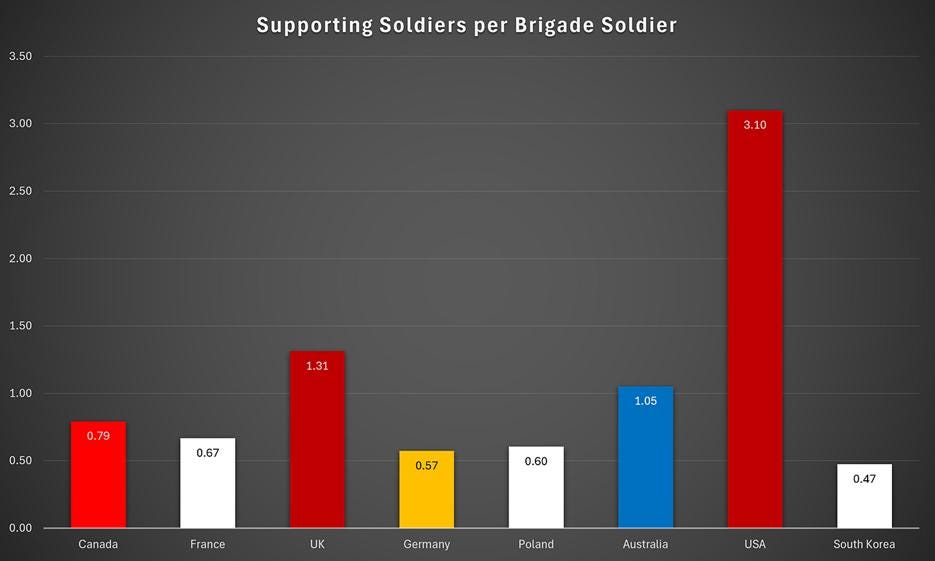
The brigade slice ratio illustrates this best: for every soldier in a maneuver brigade, how many serve in supporting units outside it? Continental militaries run about 0.5 to 0.6:1, other expeditionary militaries 0.8 to 1.3:1, and the US Army 3.1:1. That reflects capabilities like a flat-pack petroleum port and over 100,000 soldiers whose only job is moving supplies between continents. These let America project power like no one else, but they are largely irrelevant in an invasion of Canada.
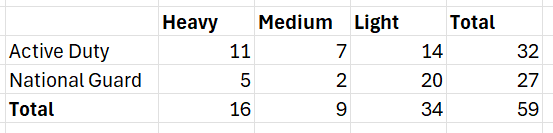
After all this, the Active Duty US Army has 32 maneuver and 3 special forces brigades; the National Guard adds 27 more.
Sixty-two brigades is huge by modern standards, but small for an army of 1,028,6000 and a $954 billion military budget.
Investing half your budget in strategic and operational logistics does little in a war needing no strategic and minimal operational logistics. A 2-4 week invasion of Canada would be almost entirely tactical logistics, where America has an edge over other Western militaries, but not a dominant one.
So while America outnumbers Canada 21:1 in personnel, the ground ratio is 15.9:1 and the maneuver brigade ratio just 8.8:1, still enough to curb stomp Canada. But as this article explores, Canada can commit every maneuver brigade to defending its homeland; America cannot commit even most of its brigades to invading Canada (or any single country).
I’m sure the full article considers this in-depth, but the Canadian military would be extremely vulnerable to a “bolt from the blue” attack, given where the bulk of troops and equipment are located relative to the most likely areas of incursion from the continental US.
The major population centres of central and western Canada are in easy reach of the border and it might be a race between American advances and Canadian reaction forces to get to most big cities. Activating the reserve would also be very difficult, as it’s highly likely the US would degrade or interdict most channels of communication at the start of such an operation, and as Canadian reservists do not keep their personal weapons at their homes, they’d need to get to their local armouries to draw weapons and what minimal amounts of ammunition stored locally. Forming the reserve units into combat-ready formations would take a lot of time that the Canadian military might not have …


