
Penguins may be the reason we can’t have nice things … or they would be if they hadn’t gone extinct. You didn’t hear that? That’s because it didn’t happen, like so many events predicted by climate scientists over the last few decades. John Robson has the details:
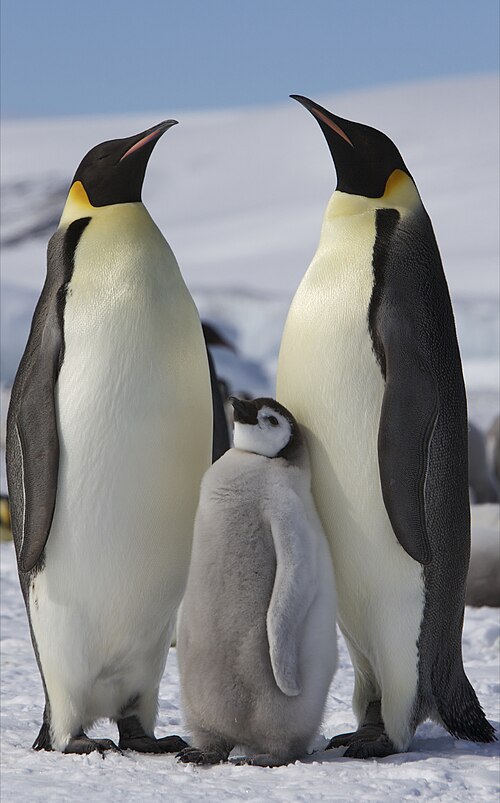
Emperor Penguins on Snow Hill Island, Antarctica.
Photo by Ian Duffy via Wikimedia Commons.
We read in Phys.org that “Penguin poop is melting Antarctic snow by keeping algae green”. And of course we ask: Haven’t penguins lived there for millions of years? Answer: yes. Penguins evolved some 60 million years ago but Antarctica has only had significant ice coverage for 34 million. Yet they never kept it green, or turned it green, despite their predilection for dramatic defecation, until we invented climate. A story that caught our eye not just for the notion that a long-standing natural process could suddenly transform a continent but because we’d just also been told by National Geographic that climate change is driving penguins to extinction. But climate science is not like other kinds.
Despite waddling around looking comically unfit to survive in nature red in tooth and claw, penguins, with the very cool scientific name Sphenisciformes, actually flourish from the equator to the South Pole, with larger and thus better-insulated ones obviously being more common where it’s colder. It’s all part of the marvel of nature, including that having first developed the power of flight, which seems to us terrestrials like the A1 supreme deluxe way of avoiding being eaten, getting to food fast etc., some birds then chucked it to go back to running around but with fewer legs, like ostriches and emus but also kiwis and, in the good old terrifying days, the “terror birds” who ran up to 30 mph, stood up to 9 feet tall and “ripped the flesh from the body of other animals” and whose very name “Phorusrhacidae” is already frightening.
Others even decided running was also not for the birds, and walking was barely tolerable, so they jumped back into the water from which their ancestors had emerged during the Devonian. And it worked. Indeed, speaking of penguins’ evolution, Wikipedia adds that:
There was a great diversity of species in subantarctic regions, and at least one giant species in a region around 2,000 km south of the equator 35 mya, during the Late Eocene, a climate decidedly warmer than today.
Warmer than today? Say it ain’t so! But it is. And a giant penguin, due to the fact that life likes warmth and struggles in cold. (There’s a reason Emperor Penguins are as lonely as they are hardy.) Now however we are doing them in. The NG article starts:
In the storm-driven wilderness between South America’s southern cape and the frozen boundary of mainland Antarctica, the South Sandwich Islands form an isolated, crescent-shaped archipelago of rock and ice. Its rugged, northernmost isle, Zavodovski Island – where chinstraps and macaroni penguins blanket the hillsides that surround an active volcano – has held the title of the largest penguin colony on Earth.
And we know what you’re thinking. If the place is bristling with penguins, they must have pooped away the snow long ago. Unless they all died, which apparently they did:
as chinstrap penguins began facing steep decline across the Antarctic Peninsula starting in the 1980, scientists wondered whether this remote island was faring any better. Through an analysis combining aerial drone surveys and manual population counts, researchers from the British Antarctic Survey (BAS) have discovered that in fewer than fifteen years, the island’s chinstrap population has plummeted by 63 percent – a loss of over half a million penguins.
And not for climate biologists the boom-and-bust cycle we learned about back in ye day in high school biology. Heck no:
Their findings, published today in the journal Current Biology, identifies the island as home to the fastest-declining chinstrap population in the world, with climate-driven losses documented continuously since 2011. The decline wipes out more than a quarter of the total penguin population on Zavodovski, ceding the island’s title of world’s largest penguin colony to Cape Adare in Antarctica’s Ross Sea.
Note the phrase “climate-driven losses”. Since we don’t know what climate is driving or how it’s untestable. But it’s taking us with the penguins:
The Southern Ocean is no stranger to loss. This news comes just six months after Emperor penguins and Antarctic fur seals were officially declared endangered with declining sea ice levels cited as a leading culprit. Acting as the planet’s primary climate buffer, the Southern Ocean absorbs nearly three-quarters of global ocean warming and a fifth of man-made carbon.
Again, how you’d test any of those assertions is anyone’s guess, though whether they’re going to ask for and get grants to test them is a certain no.
Come to think of it, we’ve discussed the plight of the Emperor Penguin before. Even if you don’t read the old post, I do encourage you to watch the embedded video.


