
Forgotten Weapons
Published Jul 31, 2024During its Homeland War, Croatia manufactured a wide variety of ad-hoc firearms including a number of anti-materiel rifles. The RT-20 was the largest of these, and its development began with the discovery of a stash of Yugoslav M55 anti-aircraft cannon barrels chambered for 20mm Hispano in a warehouse. These barrels were cut down, fitted with single-shot bolt actions, bipods, and bullpup stock assemblies and became the RT-20s. The most unusual element of the design is the use of gas vents about halfway down the barrel which open into a hollow tube which vents over the shooter’s shoulder. This creates a gas exhaust jet upon firing to help counteract recoil (and also reducing the muzzle velocity by about 25%). The recoil from firing is still pretty brutal, but the guns can be used — and were during the war for Croatia’s independence. A few remain in Croatian police inventory today …
A big thanks to the Croatian Police Museum (Muzej Policije) in Zagreb for giving me access to film this rare piece for you! Check them out at: https://muzej-policije.gov.hr
(more…)
November 16, 2024
RT20: Croatia’s Insane Kludged 20mm Anti-Materiel Rifle
QotD: Mao Zedong’s strategy of “protracted war” is a “strategy of the weak”
… the strategy of protracted war [Wiki] has to be adapted for local circumstances and new communications technologies and the ways in which it can be so adapted. But before we talk about how the framework might apply to the current conflict in Ukraine (the one which resulted from Russia’s unprovoked, lawless invasion), I want to summarize the basic features that connect these different kinds of protracted war.
First, the party trying to win a protracted war accepts that they are unable to win a “war of quick decision” – because protracted war tends to be so destructive, if you have a decent shot at winning a war of quick decision, you take it. I do want to stress this – no power resorts to insurgency or protracted war by choice; they do it out of necessity. This is a strategy of the weak. Next, the goal of protracted war is to change the center of gravity of the conflict from a question of industrial and military might to a question of will – to make it about mobilizing people rather than industry or firepower. The longer the war can be protracted, the more opportunities will be provided to degrade enemy will and to reinforce friendly will (through propaganda, recruitment, etc.).
Those concerns produce the “phase” pattern where the war proceeds – ideally – in stages, precisely because the weaker party cannot try for a direct victory at the outset. In the first phase, it is assumes the stronger party will try to use their strength to force that war of quick decision (that they win). In response, the defender has to find ways to avoid the superior firepower of the stronger party, often by trading space for time or by using the supportive population as covering terrain or both. The goal of this phase is not to win but to stall out the attacker’s advance so that the war can be protracted; not losing counts as success early in a protracted war.
That success produces a period of strategic stalemate which enables the weaker party to continue to degrade the will of their enemy, all while building their own strength through recruitment and through equipment supplied by outside powers (which often requires a political effort directed at securing that outside support). Finally, once enemy will is sufficiently degraded and their foreign partners have been made to withdraw (through that same erosion of will), the originally weaker side can shift to conventional “positional” warfare, achieving its aims.
This is the basic pattern that ties together different sorts of protracted war: protraction, the focus on will, the consequent importance of the political effort alongside the military effort, and the succession of phases.
(For those who want more detail on this and also more of a sense of how protracted war, insurgency and terrorism interrelate as strategies of the weak, when I cover this topic in the military history survey, the textbook I use is W. Lee, Waging War: Conflict, Culture and Innovation in World History (2016). Chapter 14 covers these approaches and the responses to them and includes a more expensive bibliography of further reading. Mao’s On Protracted War can be found translated online. Many of Giáp’s writings on military theory are translated and gathered together in R. Stetler (ed.), The Military Art of People’s War: Selected Writings of General Vo Nguyen Giáp (1970).)
Bret Devereaux, “Collections: How the Weak Can Win – A Primer on Protracted War”, A Collection of Unmitigated Pedantry, 2022-03-03.
November 15, 2024
The Final Solution to the German Question
World War Two
Published 14 Nov 2024Millions of Germans continue to be expelled from their homes in Central and Eastern Europe. They run a gauntlet of violence, robbery, and even murder before arriving in the shattered remains of Berlin. By the end of 1945, the Allied Powers have at least agreed that further expulsions must be “orderly and humane”. But isn’t that a contradiction in terms?
(more…)
QotD: Battles are over-rated
Start with theory. States fight to impose their will on another state in pursuit of some political goal. To do that requires that they achieve sufficient local military superiority that the other state can’t stop them from achieving their political goal.
Nazi Germany wanted to be the new administrators of the agricultural area of the western Soviet Union. To do that, they had to evict the Soviet military, whether through direct destruction or forcing the Soviet government to withdraw their armed forces. Individual battles for control of a localized area only matter if they are a means to that end.
Does the occupation or non-occupation of that point on the map affect the ability of a combatant to keep fighting?
In some limited cases, yes. Battlefield victory enabled Germany to overrun France before France could really focus its productive effort on the war. After their surrender, the French could not produce weapons, and they functionally could not organize their manpower to fight the Germans. But if the German army conquered, say, a random city in the Soviet Union, like Stalingrad, Soviet production and manpower was barely affected. The war goes on.
In theory, the German army could destroy so much of the Soviet military in one battle (or even a few discrete battles) that the Soviets run out of men or weapons. If there was ever a time this could have happened, it would have been the German invasion of the Soviet Union in 1941, when the Germans basically won a series of crushing victories.
The problem for the Germans was that by World War II, people in the combatant countries were good at building stuff in vast quantities, and the major combatants of World War II generally had access to sufficient natural resources. Even massive armies could not destroy produced weapons systems (e.g., tanks, airplanes) on the battlefield fast enough to remove the other side’s ability to continue fighting. What could (and did) happen was the destruction of the other side’s ability to produce and distribute weapons.
Sure enough, if you look at the actual data from even the largest battles, neither side really destroys a hugely significant amount of stuff. Take the Battle of Kursk — the largest tank and air battle of World War II. Wikipedia will dazzle you with the numbers of soldiers involved (millions), tanks deployed (in the ballpark of 10,000), and aircraft in the sky (in the ballpark of 5,000).
In this entire vast battle that supposedly dictated the outcome of the Eastern Front, the Germans lost approximately 350 armored fighting vehicles (AFVs) during the most intense 10 days of fighting. In the two months around when the battle took place, the Germans lost 1,331 AFVs on the entire Eastern Front. In the year of the battle, 1943, the Germans built more than 12,000 AFVs. Also worth noting: they disproportionately lost older, obsolete tanks at Kursk, and built new, capable tanks. The Germans lost a very manageable amount of equipment at Kursk — less than a month’s worth of AFV production.
If modern war means you cannot realistically destroy enough weapons in one battle to matter — if the largest battle of all time didn’t really matter — what did?
Anonymous, “Your Book Review: How the War Was Won“, Astral Codex Ten, 2024-08-09.
November 14, 2024
Early Christianity – from ~1,000 to 40 million believers in the Roman Empire
The latest book review at Astral Codex Ten is Rodney Stark’s The Rise of Christianity:
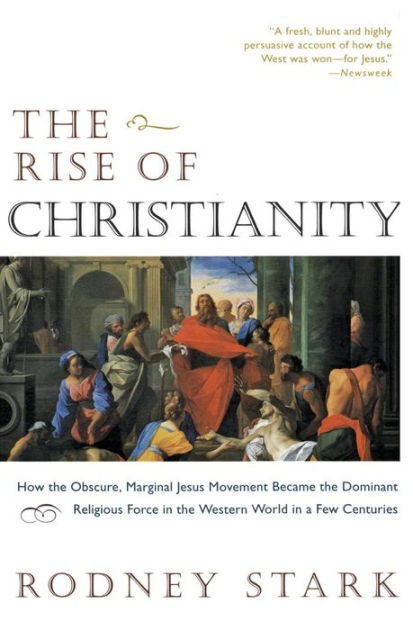
The rise of Christianity is a great puzzle. In 40 AD, there were maybe a thousand Christians. Their Messiah had just been executed, and they were on the wrong side of an intercontinental empire that had crushed all previous foes. By 400, there were forty million, and they were set to dominate the next millennium of Western history.
Imagine taking a time machine to the year 2300 AD, and everyone is Scientologist. The United States is >99% Scientologist. So is Latin America and most of Europe. The Middle East follows some heretical pseudo-Scientology that thinks L Ron Hubbard was a great prophet, but maybe not the greatest prophet.
This can only begin to capture how surprised the early Imperial Romans would be to learn of the triumph of Christianity. At least Scientology has a lot of money and a cut-throat recruitment arm! At least they fight back when you persecute them! At least they seem to be in the game!
Rodney Stark was a sociologist of religion. He started off studying cults, and got his big break when the first missionaries of the Unification Church (“Moonies”) in the US let him tag along and observe their activities. After a long and successful career in academia, he turned his attention to the greatest cult of all and wrote The Rise Of Christianity. He spends much of it apologizing for not being a classical historian, but it’s fine — he’s obviously done his homework, and he hopes to bring a new, modern-religion-informed perspective to the ancient question.
So: how did early Christianity win?
Following the Longest Roman Aqueduct
Scenic Routes to the Past
Published Jul 19, 2024Tunisia’s Zaghouan Aqueduct, built to serve Carthage in the second century, is among the longest and most impressive of all Roman aqueducts. This video follows the aqueduct from the monumental fountain at its source to the grandiose baths at its terminus.
Historic tours with toldinstone: https://toldinstone.com/trips/
Check out my other channels, @toldinstone and @toldinstonefootnotes
November 13, 2024
The Korean War Week 21 – US Elections Threaten MacArthur! – November 12, 1950
The Korean War by Indy Neidell
Published 12 Nov 2024MacArthur’s forces struggle to make sense of the recent Communist Chinese intervention in Korea, especially when the Chinese vanish as quickly as they arrived. Back in the US, the war’s popularity has reached an all-time low on the eve of the crucial 1950 midterm elections. Is MacArthur about to pay the price for his failure to deliver results on the ground?
Chapters
00:00 Intro
01:01 Recap
01:24 The Chinese Vanish
02:37 The East
04:35 The US Situation
11:28 Bombing the Yalu
13:03 Summary
13:23 Conclusion
14:26 CTA
(more…)
“The term ‘Maple MAGA’ is a derogatory slur used by Canadian liberals”
I have to admit I was only vaguely aware of the “Maple MAGA Mafia” identified by Canadian Deputy Prime Minister Christia Freeland, so I’m glad Fortissax is here to provide some background for me:
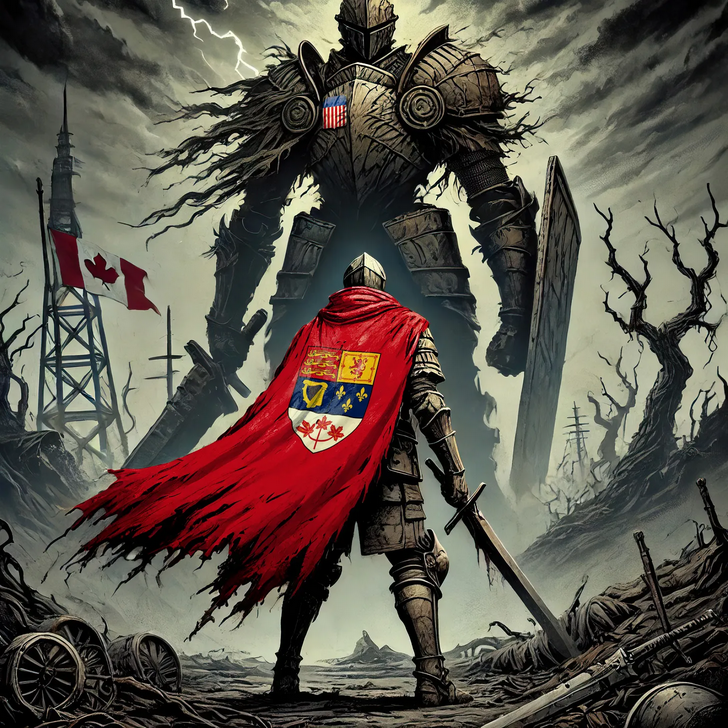
An insignificant yet loud minority among right-wing Canadian populists on Xitter are calling themselves “Maple MAGA”, with some expressing a reasonable desire for Canada to restore itself with a “MAGA ideology”. The term “Maple MAGA” is a derogatory slur used by Canadian liberals, coined by Chrystia Freeland, Deputy Prime Minister — Wicked Witch of the North — and is not intended as a term of endearment. The more extreme accounts are even calling for the outright annexation of Canada by the United States, which all Canadians should oppose if they value their dignity and self-respect. I’d invoke the memory of our Fathers of Confederation, the innovation behind the Avro Arrow (once the world’s most advanced bomber interceptor), possessing the fourth largest navy in the world after WWII, Samuel de Champlain’s great expedition and exploits, the Filles du Roi, and the Loyalist Americans who, like Aeneas leading the Trojans after the fall of Troy in the Iliad, marched north to Canada after the Revolutionary War to found a new civilization. Yet, if they already knew or identified with our glorious past, they wouldn’t be so quick to support an even greater loss of independence and sovereignty to the almighty American empire.
Make no mistake, I admire and appreciate the United States, if that wasn’t clear. There are no people more similar to the Canadian people in the world than Americans. They are Canada’s largest trading partner. Both countries were born of Albion’s Seed, sharing the North American frontier experience, and forming a family of five great Anglo nations spread on four continents, once united under a single imperial government, and now vassals of its successor. Had the United States not elected Donald J. Trump, it would have continued down a path unopposed, as bad or worse than Canada under the liberal party. There is a very real opportunity for this American Caesar to reverse much of the socioeconomic and cultural damage wrought upon it by enemies foreign and domestic. Elon Musk’s acquisition of Twitter, now X, once the bias was removed quickly became a right-wing dominant forum where truths long-feared would embolden many, everywhere to speak their minds. Elon fulfilled the ancient internet prophecy that all public forums with no censorship become right wing, simply because of the objective truths.
Elon didn’t turn it right-wing, he simply removed the government censorship of the DEI cultist board, and their allied state goons in the intelligence agencies from suppressing stories and information from reaching the American public, and the world. The Counter-Elite, a loose alliance of the Paypal Mafia, Peter Thiel, Elon Musk and MAGA populists, in America are a force of nominal good, a positive for right-wing dissidents around the world fighting their own existential struggles against local managerial regimes. If Trump and the cast of would-be heroes succeeds, the United States will enter an era of unprecedented recovery for the forseaable future—though it’s not a magic bullet for the civilizational decline as recently written about by fellow Substacker Dave Green, aka The Distributist.
The United States was Canada’s first, and arguably still its greatest, existential threat — ironically, mostly through no fault of its own, but rather due to its Jupiterian gravity beside little Canada. Canada may be the second-largest country on the planet after the Russian Federation, but it’s a small nation, with only an estimated 28 million ethnic Canadians, 90% of whom live within 200 kilometres of the U.S. border, as much of the country is an inhospitable wasteland of spruce bog and rock, almost impossible to settle due to permafrost. The habitable areas are extremely hot in summer, or extremely cold in winter. Canadians have often looked southward at the Titan with a sense of fatalism. Many intellectuals and journalists over the centuries have wondered when, if, how, and where Canada would meet what felt like its “inevitable” dissolution into the hands of the Yankees. Despite these fears, that dissolution never came.
Yet whispers of provinces seceding — making the “great escape” from the failing post-national economic zone Canada has become to join the booming, recovering United States — are on the lips of some Canadians. If not outright secession, than abandoning the monarchy, establishing a constitutional republic modelled off of the United States of America, copying the constitution, and pathetically copying its culture. I believe the majority of right-wing Canadians would favour constitutional reform to enshrine our own equivalent of legally protected freedom of speech and the right to bear arms. These are ancient English traditions of the “Yeoman” or Free Man, with roots visible in free speech and weapon-carrying practices across the ancient Germanic world. They are by no means exclusive to the United States. Canada and England had considerably relaxed gun laws until recent decades, and changes like these wouldn’t require us to sacrifice our sovereignty to the U.S.
Anglo-German Dreadnought Arms Race – Anything you can build I can build better!
Drachinifel
Published Nov 17, 2021Today we take a whistlestop tour behind the driving forces and outcome of the Anglo-German Naval Arms Race that led up to WW1.
QotD: The 1990s
Consider that if we really do live in a computer simulation, then everything the #wokesters are always going on about is actually true. Everything really IS a “social construction”, because “society” was literally constructed. All that stuff about “systemic racism” is true, too, because again, we’re dealing with a design. Nothing evolves organically inside The Matrix, because there’s nothing organic in there at all. It’s ALL on purpose …
… and you, #wokester, are the only one who can see it. Unlike Karl Marx, who was able to see beyond his class situation enough to say that no one can see beyond his class situation, because reasons, you, #wokester, can do it because you’re Neo. That, too, is built into the system. It’s an endless recursion … but one that entails that you, and you alone, are special, on purpose.
That, kameraden, was the 1990s. Even those movies our author mentioned — Beverly Hills Cop III, Lethal Weapons 3 and 4 — weren’t just copies of copies, they were ironic, snarky commentaries on copies of copies. See also Scream, which was a “deconstruction” of every slasher picture ever made. If you can’t beat ’em, join ’em … but since both beating ’em and joining ’em entail making a sincere effort and sincerity is forbidden, all you can do is mock ’em. That’s what “deconstruction” is, one long polysyllabic mockery of the very idea of excellence. It’s the perfect philosophy for people who know themselves to be mediocre but have been told from day one that they’re special.
See also the tv show Friends, where five ludicrously attractive people and David Schwimmer all pretend to be just normal folks (who happen to live in 3,000 square foot apartments in Manhattan) — each episode is “the one that’s just like The Brady Bunch, but snarky”. Or Seinfeld, which was deliberately designed to be a grating mockery of stuff like The Odd Couple. All snarky mockeries of the very concept of sincerity.
See what I mean? That’s normal now, which is why the 90s must be dragged into an alley and shot, for Western Civ’s sake.
Severian, “Why the 90s Was the Worst Decade Ever”, Rotten Chestnuts, 2021-07-04.
November 12, 2024
Type 92 Japanese HMG
Forgotten Weapons
Published Mar 9, 2015The Type 92 was the final iteration of a machine gun that began as the Model 1897 Hotchkiss HMG made in France. The Japanese army purchased many of these guns, and then produced their own slightly refined version. These in turn were replaced by the updated Type 3 (1914) heavy machine gun, and finally the Type 92 (1932). A lightened upgrade to the Type 92 was prototyped (the Type 1, 1941), but never went into production. Mechanically, the Type 92 is very much like a scaled-up Type 11 light machine gun, using 30-round strips to feed. Despite being generally derided today, these machine guns were very reliable, accurate, and effective. This particular one happens to have a 7mm Mauser barrel in it, from a South American contract.
http://www.forgottenweapons.com
Theme music by Dylan Benson – http://dbproductioncompany.webs.com
November 11, 2024
In memoriam
A simple recognition of some of our family members who served in the First and Second World Wars:
The Great War
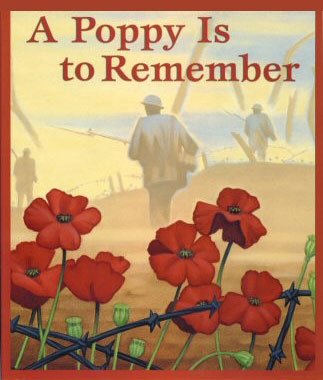 Private William Penman, Scots Guards, died 16 May, 1915 at Le Touret, age 25
(Elizabeth’s great uncle)- Private Archibald Turner Mulholland, Argyll & Sutherland Highlanders, mortally wounded 25 September, 1915 at Loos, age 27
(Elizabeth’s great uncle) - Private David Buller, Highland Light Infantry, died 21 October, 1915 at Loos, age 35
(Elizabeth’s great grandfather) - Private Harold Edgar Brand, East Yorkshire Regiment. died 4 June, 1917 at Tournai.
(My first cousin, three times removed) - Private Walter Porteous, Durham Light Infantry, died 4 October, 1917 at Passchendaele, age 18
(my great uncle, who had married the day before he left for the front and never returned) - Corporal John Mulholland, Argyll & Sutherland Highlanders, wounded 2 September, 1914 (shortly before the First Battle of the Aisne), wounded again 29 June, 1918, lived through the war.
(Elizabeth’s great uncle) - John Eleazar (“Ellar”) Thornton, (ranks and dates of service unknown, served in the Royal Garrison Artillery, the East Surrey Regiment, and the Essex Regiment (dates of service unknown, but he likely joined the RGA in 1899). Put on the “Z” list after the war — recall list. He died in an asylum in 1943.
(my grandfather’s eldest brother) - Henry (Harry) Thornton, (uncertain) Lancashire Fusiliers. (We are not sure it is him as there were no identifying family or birth date listed. Rejected for further service.)
(my grandfather’s second older brother)
The Second World War
- Flying Officer Richard Porteous, Royal Air Force, survived the defeat in Malaya, was evacuated to India and lived through the war.
(my great uncle) - Able Seaman John Penman, Royal Navy, served in the Defensively Equipped Merchant fleet on the Atlantic convoys, the Murmansk Run (we know he spent a winter in Russia at some point during the war) and other convoy routes, was involved in firefighting and rescue efforts during the Bombay Docks explosion in 1944, lived through the war.
(Elizabeth’s father. We received his Arctic Star medal in July, 2024.) - Private Archie Black (commissioned after the war and retired as a Major), Gordon Highlanders, captured during the fall of Singapore (aged 15) and survived a Japanese POW camp (he had begun to write an autobiography shortly before he died)
(Elizabeth’s uncle) - Elizabeth Buller, “Lumberjill” in the Women’s Timber Corps, an offshoot of the Women’s Land Army in Scotland through the war.
(Elizabeth’s mother) - Trooper Leslie Taplan Russon, 3rd Royal Tank Regiment, died at Tobruk, 19 December, 1942 (aged 23).
Leslie was my father’s first cousin, once removed (and therefore my first cousin, twice removed). - Reginald Thornton, rank and branch of service unknown, hospitalized during the war with shellshock and was never discharged back into civilian life. He died in York in 1986.
(my grandfather’s youngest brother)
My maternal grandfather, Matthew Kendrew Thornton, was in a reserved occupation during the war as a plater working at Smith’s Docks in Middlesbrough. The original design for the famous Flower-class corvettes came from Smith’s Docks and 16 of the 196 built in the UK during the war (more were built in Canada). My great-grandmother was an enthusiastic ARP warden through the war (she reportedly enjoyed enforcing blackout compliance in the neighbourhood using the rattle and whistle that came with the job).
For the curious, the Commonwealth War Graves Commission the Royal British Legion, and the Library and Archives Canada WW1 and WW2 records site provide search engines you can use to look up your family name. The RBL’s Every One Remembered site shows you everyone who died in the Great War in British or Empire service (Canadians, Australians, New Zealanders, South Africans and other Imperial countries). The CWGC site also includes those who died in the Second World War. Library and Archives Canada allows searches of the Canadian Expeditionary Force and the Royal Newfoundland Regiment for all who served during WW1, and including those who volunteered for the CEF but were not accepted.
In Flanders fields the poppies blow
Between the crosses row on row,
That mark our place; and in the sky
The larks, still bravely singing, fly
Scarce heard amid the guns below.We are the Dead. Short days ago
We lived, felt dawn, saw sunset glow,
Loved and were loved, and now we lie
In Flanders fields.Take up our quarrel with the foe:
To you from failing hands we throw
The torch; be yours to hold it high.
If ye break faith with us who die
We shall not sleep, though poppies grow
In Flanders fields.Lieutenant Colonel John McCrae, MD Canadian Army Medical Corps (1872-1918)
Here is Mark Knopfler’s wonderful song “Remembrance Day” from his Get Lucky album, set to a slideshow of British and Canadian images from World War I through to more recent conflicts put together by Bob Oldfield:
The Angel of Victory: Canada’s Processing of The Great War (Vancouver, BC)
Valour Canada
Published Jan 9, 2024This video, by Hania Templeton, discusses the historical context, significance, and current meaning of The Angel of Victory in Vancouver, BC. Hania’s work received first place in Valour Canada’s 2023 History & Heritage Scholarship (VCHHS) contest.
To learn more about this annually awarded #scholarship, including the rules and regulations for eligible entrants, please visit https://valourcanada.ca/education/vch…
QotD: Military glamour
In the 19th century, warfare was one of the first contexts in which English speakers used the term glamour in its modern metaphorical sense. (The word originally meant a literal magic spell that made people see things that weren’t there.) “Military heroes who give up their lives in the flush and excitement and glamour of battle”, opined a U.S. congressman in 1885, “are sustained in the discharge of duty by the rush and conflict of physical forces, the hope of earthly glory and renown”.
Even people who hated military life could feel the attraction. Writing after the briefest of conscriptions (a single night in the barracks), D.H. Lawrence in 1916 lamented “this terrible glamour of camaraderie, which is the glamour of Homer and of all militarism”.
The slaughter and apparent futility of the Great War changed all that. Peace activists and bitter veterans now saw the “glamour of battle” as a dangerous delusion rather than a valuable inspiration. “Are you going to tell your children the truth about what you endured,” an American challenged fellow veterans in 1921, “or gild your reminiscences with glamour that will make them want to have a merry war experience of their own?” In 1919, the British painter Paul Nash wrote that the purpose of The Menin Road, his bleak portrait of a desolate and blasted landscape, was “to rob war of the last shred of glory, the last shine of glamour.”
Virginia Postrel, “Casualty of War”, Virginia’s Newsletter, 2023-08-10.
November 10, 2024
WW2 in Numbers
World War Two
Published 9 Nov 2024World War II wasn’t just the deadliest conflict in history — it was a war of unprecedented scale. From staggering casualty numbers to military production and economic costs, this episode breaks down the biggest statistics that defined the global conflict.
(more…)


