
Armies generally had to move over longer distances via roads, for both logistical and pathfinding reasons. For logistics, while unencumbered humans can easily clamber over fences or small ridges or weave through forests, humans carrying heavy loads struggle to do this and pack animals absolutely cannot. Dense forests (especially old growth forests) are formidable obstacles for pack and draft animals, with a real risk of animals injuring themselves with unlucky footfalls. After all the donkey was originally a desert/savannah creature and horses evolved on the Eurasian Steppe; dense forest is a difficult, foreign terrain. But the rural terrain that would dominate most flat, arable land was little better: fields are often split by fences or hedgerows which need to be laboriously cleared (essentially making a path) to allow the work animals through. Adding wagons limits this further; pack mules can make use of narrow paths through forests or hills, but wagons pulled by draft animals require proper roads wide enough to accommodate them, flat enough that the heavy wagon doesn’t slide back and with a surface that will be at least somewhat kind on the wheels. That in turn in many cases restricts armies to significant roadways, ruling out things like farmer’s paths between fields or small informal roads between villages, though smaller screening, scouting or foraging forces could take these side roads.
(As an aside: one my enduring frustrations is the tendency of pre-modern strategy games to represent most flat areas as “plains” of grassland often with a separate “farmland” terrain type used only in areas of very dense settlement. But around most of the Mediterranean, most of the flat, cleared land at lower elevations would have been farmland, with all of the obstructions and complications that implies; rolling grasslands tend to be just that – uplands too hilly for farming.)
The other problem is pathfinding and geolocation. Figuring out where you off-road overland with just a (highly detailed) map and a compass is sufficiently difficult that it is a sport (Orienteering). Prior to 1300, armies in the broader Mediterranean world were likely to lack both; the compass (invented in China) arrives in the Mediterranean in the 1300s and detailed topographical maps of the sort that hikers today might rely on remained rare deep into the modern period, especially maps of large areas. Consequently it could be tricky to determine an army’s exact heading (sun position could give something approximate, of course) or position. Getting lost in unfamiliar territory was thus a very real hazard. Indeed, getting lost in familiar territory was a real hazard: Suetonius records that Julius Caesar, having encamped not far from the Rubicon got lost trying to find it, spent a whole night wandering trying to locate it (his goal being to make the politically decisive crossing with just a few close supporters in secrecy first before his army crossed). In the end he had to find a local guide to work his way back to it in the morning (Suet. Caes. 31.2). So to be clear: famed military genius Julius Caesar got lost trying to find a 50 mile long river only about 150 miles away from Rome when he tried to cut cross-country instead of over the roads.
Instead, armies relied on locals guides (be they friendly, bought or coerced) to help them find their way or figure out where they were on whatever maps they could get together. Locals in turn tend to navigate by landmarks and so are likely to guide the army along the paths and roads they themselves use to travel around the region. Which is all as well because the army needs to use the roads anyway and no one wants to get lost. The road and path network thus becomes a vital navigational aid: roads and paths both lead to settlements full of potential guides (to the next settlement) and because roads tend to connect large settlements and large settlements tend to be the objectives of military campaigns, the road system “points the way”. Consequently, armies rarely strayed off of the road network and were in most cases effectively confined to it. Small parties might be sent out off of the road network from the main body, but the main body was “stuck” on the roads.
That means the general does not have to cope with an infinitely wide range of maneuver possibilities but a spiderweb of possible pathways. Small, “flying columns” without heavy baggage could use minor roads and pathways, but the main body of the army was likely to be confined to well-traveled routes connecting large settlements.
Bret Devereaux, “Collections: Logistics, How Did They Do It, Part III: On the move”, A Collection of Unmitigated Pedantry, 2022-08-12.
November 22, 2024
QotD: Pre-modern armies on the move
November 21, 2024
1966: Chieftain Tank Simulator | Tomorrow’s World | Retro Tech | BBC Archive
BBC Archive
Published Jul 15, 2024“All the tension, the excitement, and indeed the technical demands of driving a modern tank into battle … but, in fact, I haven’t moved a yard.”
Raymond Baxter test drives the British Army’s Chieftain tank simulator, used for training tank drivers. The illusion is created using a large 1:300 scale model of the battlefield, a computer, and a roving mirror connected to a television camera. The battlefield can be altered simply by swapping out the model trees and buildings.
Mr Baxter can attest to how realistic the experience is, and it costs just one tenth of the price of training in a real Chieftain tank.
Clip taken from Tomorrow’s World, originally broadcast on BBC One, 28 September, 1966.
QotD: The 1965 Immigration Act
Caldwell’s book is far too nuanced and expansive to cover here. But he identifies key moments and key changes. The 1965 Immigration Act was the beginning of a huge experiment in human history. It was complemented by open bipartisan-elite toleration of mass undocumented immigration across the southern border. And civil rights became something other than ending racial discrimination by the state: It became a regime of ending discrimination by individuals in economic and social life; then it begot affirmative action, in which race played an explicit part in an individual’s chance of getting into college; and it culminated in the social-justice agenda, which would meaningfully do away with the American concept of individual rights and see it replaced by a concept of racial group rights. Caldwell sees the last 50 years as a battle between two rival constitutions: one dedicated to freedom, the other to equality of outcomes, or “equity.” And I think he is right to see the former as worth fighting for.
But how do we get out of this trap? That’s where the depression sinks in. Neither Caldwell nor Klein see a way back to a common weal and a common good. Ezra offers some technical corrections — ending the Electoral College, the filibuster, and winner-takes-all voting. And they might help, although their potential unintended consequences should be carefully considered. Then he recommends meditation to control our own primal instincts — a role that Christianity traditionally held. (I don’t disagree with Ezra on the benefits of meditation, but it’s hardly a game-changer in America in 2020.) Caldwell proposes something far more drastic: a repeal of the 1964 Civil Rights Act. Yes, you read that right. The proposal’s perversity matches its impossibility — and it’s buried in one sentence on the penultimate page of the book.
So much of Caldwell’s polemical history is fresh air; but the bleakness of its reactionary mood reveals how tribal Caldwell has become. He can barely eke out a few sentences reluctantly acknowledging some of the good things that the last 50 years have brought — in the lives of many women, in the prospects for African-Americans, in the dignity of homosexuals. He never acknowledges that Obama actually stood a chance of healing racial divides, if the GOP hadn’t demonized him from the start. And as an old friend of Chris’s, I know him to be a more gracious and humane person than this polemic might, at times, suggest. But that such a good man has gotten caught up in polarization and tribalism and such a brilliant man sees no hope for a peaceful resolution merely reveals how deep our problem is.
I have a smidgen more optimism. I see in the long-delayed backlash to the social-justice movement an inkling of a new respect for individual and creative freedom and for the old idea of toleration rather than conformity. I see in the economic and educational success of women since the 1970s a possible cease-fire in the culture wars over sex. I see most homosexuals content to live out our lives without engaging in an eternal Kulturkampf against the cis and the straight. Race? Alas, I see no way forward but a revival of Christianity, of its view of human beings as “neither Jew nor Gentile, neither slave nor free, nor is there male and female, for you are all one in Christ Jesus”. This means such a transcendent view of human equality that it does not require equality of outcomes to see equal dignity and worth.
Yes, I’m hoping for a miracle. But at this point, what else have we got?
Andrew Sullivan, “America Needs A Miracle”, New York, 2020-01-31.
November 20, 2024
The Korean War Week 22 – Winter is Coming! – November 19, 1950
The Korean War by Indy Neidell
Published 19 Nov 2024Eighth Army commander Walton Walker makes his final preparations for the big push north to the Yalu River. The Communist Chinese prepare their own forces and wait for the Americans to make their move. At the same time, the freezing Korean winter arrives in force, plunging temperatures well below freezing. The Americans must get this done, and soon.
(more…)
November 19, 2024
The state and society
Lorenzo Warby explains why Karl Marx was wrong about the origins of what he called “the three great inventions” and therefore also mistaken about the societal impact of those inventions:
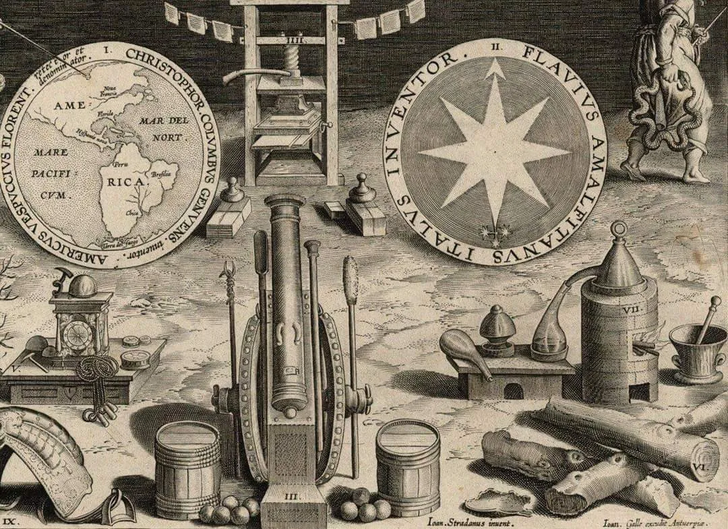
Gunpowder, the compass, and the printing press were the 3 great inventions which ushered in bourgeois society. Gunpowder blew up the knightly class, the compass discovered the world market and founded the colonies, and the printing press was the instrument of Protestantism and the regeneration of science in general; the most powerful lever for creating the intellectual prerequisites.
Karl Marx, “Division of Labour and Mechanical Workshop. Tool and Machinery” in Economic Manuscripts of 1861-63, Part 3) Relative Surplus Value.
With this quote we can see what is wrong both with Marx’s notion of the role of technology in social causation and with a very common notion of the relationship between state and society.
The false — but very common — view of the relationship of state and society is that the state is a product of its society, that the state emanates from its society. This gets the dominant relationship almost entirely the wrong way around. It is far more true to say that the state is a fundamental structuring element of the social dynamics of the territory it rules rather than the reverse.
It is perhaps easiest to see this by noting the glaring flaw in Marx’s reasoning. The gunpowder, the compass and the printing press were all originally Chinese inventions. Indeed, Europe acquired — via intermediaries — gunpowder and the compass from China. (Gutenberg’s printing press appears to have been an independent invention.)
Source: Nova Reperta Frontispiece, 1588.
Yet, as Marx was very well aware, China did not develop a bourgeoisie in his sense. Indeed, Marx’s notion of the Asiatic mode of production grappled with precisely that lack.1
In 1620, Sir Francis Bacon wrote in his Instauratio magna that
… printing, gunpowder, and the nautical compass … have altered the face and state of the world: first, in literary matters; second, in warfare; third, in navigation …
This was true of the effect of these inventions in European, but not Chinese, hands.
Why were these inventions globally transformative in European, but not Chinese hands? Because of the differences in the structure of European state(s) compared to the Chinese state.
Unified China …
The first difference is that the European states were states, plural. Europe had competitive jurisdictions, it had centuries of often intense inter-state conflict. From the Sui (re)unification (581) onwards China was, with brief interruptions, a single polity.2 What the evidence — both Chinese and Roman — shows quite clearly is that civilisational unity in a single polity is bad for institutional, technological and intellectual development.
The second difference is with the internal structure of European states compared to the Chinese state. The Sui dynasty, by introducing the Keju, the imperial examination — refining the use of appointment by exam that went back to the Warring States period — created a structure that directed Chinese human capital to the service of the Emperor.
There were three tiers of examinations (local, provincial, palace). You could sit for them as often as you wished. So a significant proportion of Chinese males devoted decades of their lives to attempting to pass the exams. Over time, the exams became more narrowly Confucian — probably because it required a high level of detailed mastery, so had more of a sorting effect — thereby promoting intellectual conformism.
[…]
… and divided Europe
Conversely, when gunpowder, the compass and the printing press came to Europe, European states already had a military aristocracy; self-governing cities; an armed mercantile elite; organised religious structures; so a rich array of cooperative institutions. Moreover, kin-groups had been suppressed across manorial Europe, forcing — or giving the social space for — alternative mechanisms for social cooperation to evolve.3, 4 In particular, due [to] its self-governing cities with armed militias, medieval Europe had an (effectively) armed mercantile elite before gunpowder, the compass or printing reached Europe.
Alfonso IX of Leon and Galicia (r.1188-1230) first summoned the Cortes of Leon in 1188. This became the start of the first institutionalised use of merchant representatives in deliberative assemblies. Emperor Frederick Barbarossa (r.1155-1190) had tried something similar earlier, but the mercantile elites of North Italy preferred de facto independence, defeating him at the Battle of Legnano in 1176.
The first European reference to the compass is in a text written some time between 1187 and 1202, with its use appearing to expand over the 1200s. The first reference to gunpowder in Europe is not until 1267 and it took centuries before gunpowder played a major role in European warfare.
Both the compass and gunpowder really only have transformative effects from the late C15th onwards, which is also when the printing press is spreading across Latin Europe. By that time, medieval Europe has already become a machine culture and it had been for centuries the civilisation with the most powerful mercantile elite. A reality driven by competitive jurisdictions, a rural-based military aristocracy, law that was not based on revelation (so it could entrench social bargains), suppression of kin-groups, and self-governing cities.
Competition between European states was a powerful driver of the transformative use of technologies. But so was the level of striving within such states: adventurers able to mobilise resources — and seeking wealth, power, prestige — had far more room to operate (and receive official sanction) in Europe than in China.
In other words, the differences in the development and use of technology — and in social dynamics and formations — between China and medieval Europe was fundamentally driven by the differences in state structures, in how the relevant polities worked.
1. Marx was not an honest intellectual reasoner:
As to the Delhi affair, it seems to me that the English ought to begin their retreat as soon as the rainy season has set in in real earnest. Being obliged for the present to hold the fort for you as the Tribune’s military correspondent I have taken it upon myself to put this forward. NB, on the supposition that the reports to date have been true. It’s possible that I shall make an ass of myself. But in that case one can always get out of it with a little dialectic. I have, of course, so worded my proposition as to be right either way.
Marx to Engels, [London,] 15 August 1857, (emphasis in the original).2. The Song (960-1279) failed to fully unify China, but they were the only significant Han polity. That the Song were effectively within a mini-state system does seem to have affected their policies, including the unusually — for a Chinese imperial dynasty — strong focus on trade and technological development.
3. Kin-groups had already been suppressed in the city-states of the Classical world, including Rome. They re-emerged with the incoming Germanic peoples, and then were suppressed again by the Church and the manorial elite, remaining in the agro-pastoralist Celtic fringe and Balkan uplands.
4. Economists Avner Greif and Guido Tabellini define clan (i.e. kin-group) as “a kin-based organization consisting of patrilineal households that trace their origin to a (self-proclaimed) common male ancestor“. They contrast this with a corporation: “a voluntary association between unrelated individuals established to pursue common interests“. They note they perform similar functions: “they sustained cooperation among members, regulated interactions with non-members, provided local public or club goods, and coordinated interactions with the market and with the state“. Triads, tongs and cults can also perform these functions.
WF-51: A Swiss Intermediate-Cartridge Copy of the FG-42
Forgotten Weapons
Published Aug 5, 2024After World War Two the Swiss needed a new self-loading military rifle to replace their K-31 bolt actions. Two major design tracks followed; one being a roller-delayed system based on the G3 at SIG and the other being a derivative of the German FG-42 at Waffenfabrik Bern. Bern, under the direction of Adolph Furrer, had been experimenting with intermediate cartridges since the 1920s, and they used this as a basis to develop an improved FG-42 using an intermediate cartridge (7.5x38mm). The program began in 1951 and went through about a half dozen major iterations until it ultimately lost to the SIG program (which produced the Stgw-57).
Today we are looking at one of the first steps in the Bern program, the WF-51. The most substantial change form the FG42 design here is the use of a tilting bolt instead of a rotating bolt like the Germans used. It is a beautifully manufactured firearm, and a real pleasure to take a look at …
Many thanks to the Royal Armouries for allowing me to film and disassemble this rifle! The NFC collection there — perhaps the best military small arms collection in Western Europe — is available by appointment to researchers:
https://royalarmouries.org/research/n…You can browse the various Armouries collections online here:
https://royalarmouries.org/collection/
(more…)
QotD: The Reformation
Your hotter Protestants, your John Calvins and Oliver Cromwells and so on, saw all of this as mere ritual. And to be fair to them, late-medieval Catholicism was very elaborate, and very, very weird — slog through a few chapters of The Stripping of the Altars if you want the details. To the Prods, this was cheating — you can’t just go through the motions and expect to get into Heaven. They made a similar distinction between “natural magic” and the unlawful stuff — the one was undertaken only after deep study and the most rigorous self-purification, while the other “worked” entirely mechanically, because what the sorcerer was really doing was cheating; he was really making a deal with a (or The) devil, to short-circuit the natural processes.
Now, it’s important to realize that the Protestants were not saying anything close to “do your own thing, man”. They were NOT hippies, encouraging everyone to read the Bible and decide for themselves how best to commune with the Big JC. The German peasants thought that’s what Martin Luther was saying back in 1524, but Luther himself was out there urging the authorities to smash the peasants with extreme prejudice. The Protestants were, in fact, extremely concerned about ritual. It just had to be the right ritual, the Biblically sanctioned ritual, and nothing but that — that’s what “Puritanism” (originally an insult) means.
Severian, “Faith vs. Works”, Rotten Chestnuts, 2021-09-07.
November 18, 2024
“The Great Canadian Lie is the claim that we’ve ‘always been multicultural'”
Fortissax thinks that the rest of Canada has lessons to be learned from Quebec:
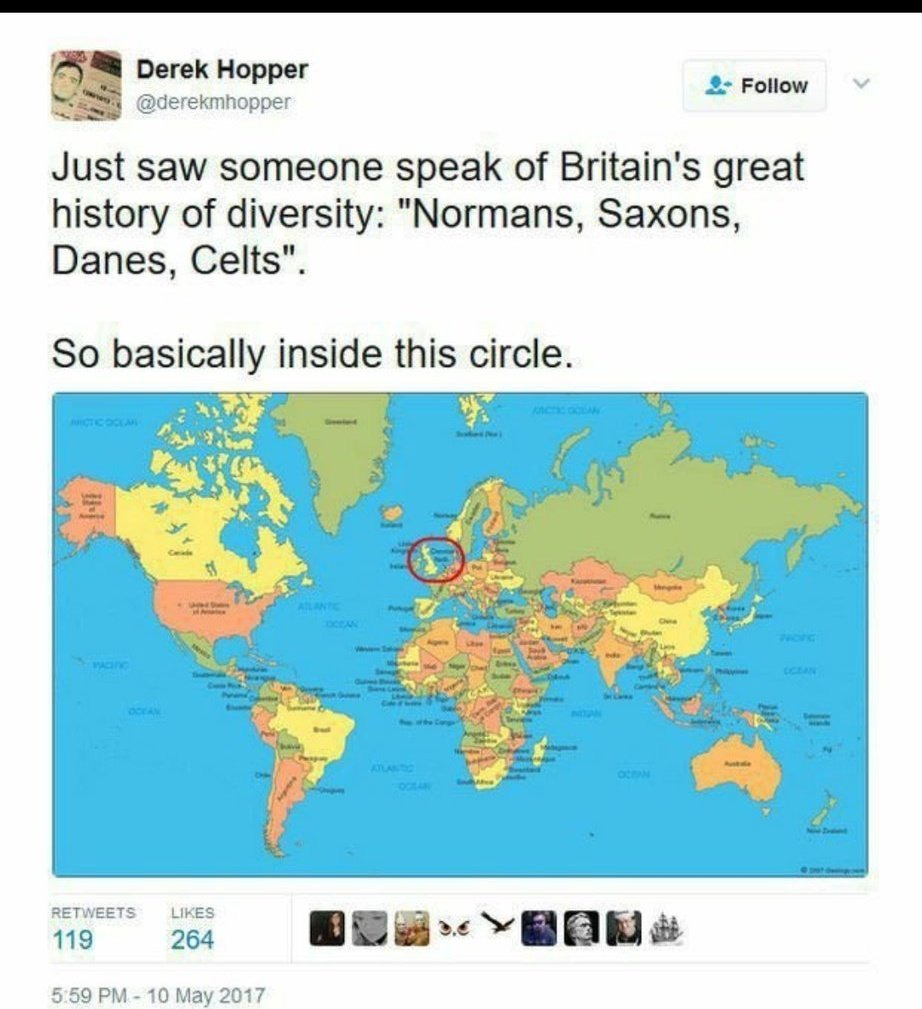
If you are a Canadian born at any point in the Post-WWII era, you have been subjected to varying degrees of liberal “Cultural Mosaic” propaganda. This narrative exploits the historic presence of three British Isles ethnic groups (which had already been intermixing for millennia) and the predominantly Norman French settlers to justify the unprecedented mass migration of people from the Third World into Canada. This process only began in earnest in the 1990s before accelerating rapidly in the 2010s.
The Great Canadian Lie is the claim that we’ve “always been multicultural”, as though the extremely small and inconsequential presence of “Black Loyalists” or the historically hostile Indigenous groups (making up only 1% of the population at Canada’s founding in 1867) played any serious role in shaping the Canadian nation, its identity, institutions, or culture. Inspired by Dr. Ricardo Duchesne’s book Canada in Decay: Mass Immigration, Diversity, and the Ethnocide of Euro-Canadians (2017), which chronicled the emergence of two ethnic groups uniquely born of the New World, I delved into the 2021 Census data collected by the Canadian government to explore the ethnic breakdown of White Canadians in greater detail
The evidence is clear. In 2021, just four years ago, 72.7% of the entire Canadian population was not just White, but Anglo-Canadian and French-Canadian, representing an overwhelming presence compared to visible minorities and other White ethnic groups, such as the small populations of Germans and Ukrainians.
In the space last night, I highlighted this historical fact and explained to the audience the ethnogenesis of the Anglo-Canadian and its significance. While we all recognize that the Québécois are a homogeneous group descended predominantly from Norman French settlers — such as the Filles du Roi and Samuel de Champlain’s 1608 expedition, which established Quebec City with a single-minded purpose — the Anglo-Canadian story also deserves similar recognition for its role in shaping Canada’s identity.
But what is less known is that Anglo-Canadians are just as ethnically homogeneous as the Québécois, from Nova Scotia to British Columbia. Anglo-Canadian identity emerged from Loyalist Americans in the 1750s, beginning with the New England Planters in Nova Scotia — “continentals” with a culture distinct from both England and the emergent Americans. After the American Revolutionary War, they marched north with indomitable purpose, like Aeneas and the Trojans, to rebuild their Dominion. Author Carl Berger, in his influential work The Sense of Power: Studies in the Ideas of Canadian Imperialism, demonstrates that the descendants of Loyalists were the one ethnic group that nurtured “an indigenous British Canadian feeling.” The following passage from Berger’s work is worth citing:
The centennial arrival of the loyalists in Ontario coincided with the fiftieth anniversary of the incorporation of the City of Toronto and, during a week filled with various exhibitions, July 3 was set aside as “Loyalist Day”. On the morning of that day the platform erected at the Horticultural Pavilion was crowded with civic and ecclesiastical dignitaries and on one wall hung the old flag presented in 1813 to the York Militia by the ladies of the county. Between stirring orations on the significance of the loyalist legacy, injunctions to remain faithful to their principles, and tirades against the ancient foe, patriotic anthems were sung and nationalist poetry recited. “Rule Britannia” and “If England to Herself Be True” were rendered “in splendid style” and evoked “great enthusiasm”. “A Loyalist Song”, “Loyalist Days”, and “The Maple Leaf Forever”, were all beautifully sung
The 60,000 Loyalist Americans, who arrived in two significant waves, were soon bolstered by mass settlement from the British Isles. However, British settlers assimilated into the Loyalist American culture rather than imposing a British identity on the new Canadians. The first major wave of British settlers after the Loyalists primarily consisted of the Irish. Before Confederation in 1867, approximately 850,000 Irish immigrants settled in Canada. Between 1790 and 1815, an estimated 6,000 to 10,000 settlers, mainly from the Scottish Highlands and Ireland, also made their way to Canada.
Another large-scale migration occurred between 1815 and 1867, bringing approximately 1 million settlers from Britain to Canada, specifically to Ontario, Nova Scotia, and New Brunswick. New Brunswick was carved out from the larger province of Nova Scotia to make room for the influx of Loyalists. During this time, settlers from England, Scotland, and Ireland intermingled and assimilated into the growing Anglo-Canadian culture. Scottish immigrants, who constituted 10–15% of this wave, primarily spoke Gaelic upon arrival but adopted English as they integrated.
All settlers from the British Isles spoke English (small numbers spoke Gaelic in case of Scots), were ethnically and culturally similar, and had much more in common with each other than with their continental European counterparts.
Settlement would slow down in the years immediately preceding Confederation in 1867 but surged again during the period between 1896 and 1914, with an estimated 1.25 million settlers yet again from Britain moving to Canada as part of internal migration within the British Empire. These settlers predominantly also [went] to Ontario and the Maritimes, further forging the Anglo-Canadian identity.
A common misconception among Canadians is that Canada “was a colony” of Britain, subordinate to, or a “vassal state”. This is wrong. Canadians were the British, in North America. There were no restrictions on what Canadians could or could not do in their own Dominion. From the first wave of Loyalists onward, Canadians were regularly involved in politics and governance, actively participating in shaping the nation.
Like the ethnogenesis of the English, which saw Angles, Saxons, Jutes, and Frisians converge into a new people and ethnicity (the Anglo-Saxons), Anglo-Canadians are a combination of 1.9 million English, 850,000 Irish (from both Northern and Southern Ireland), and 200,000 Scots, converging with 60,000 Loyalist Americans from the 13 Colonies. These distinct yet similar ethnic groups no longer exist as separate peoples in Canada. Anglo-Canadians are the fusion of the entire British Isles. The Arms of Canada, the favourite symbol of Canadian nationalists today, represents this new ethnic group with the inclusion of the French:
Arms of England, Scotland, Ireland and France in that order.
It’s no coincidence that, once rediscovered, the Arms of Canada exploded in popularity as the emblem of Canadian nationalists. Unlike more controversial symbols that appeal to pan-White racial unity, such as the Sonnenrad or Celtic cross, the Arms of Canada resonate as a distinctly Canadian icon, deeply rooted in the nation’s true heritage and history — a heritage that cannot be bought, sold, or traded away. This is an immutable bloodline stretching into the ancient past. If culture is downstream from race, and deeper still, ethnicity, then Canadian culture, values, and identity are fundamentally tied not just its race, but its ethnic composition. The ethnos defines the ethos. Canadians are not as receptive to the abstract idea of White nationalism for the same reason Europeans aren’t — because they possess a cohesive ethnic identity, unlike most White Americans.


Changing the way “our leaders” speak to us
Ted Gioia says that the old rules of communicating to the public are undergoing a major shift.
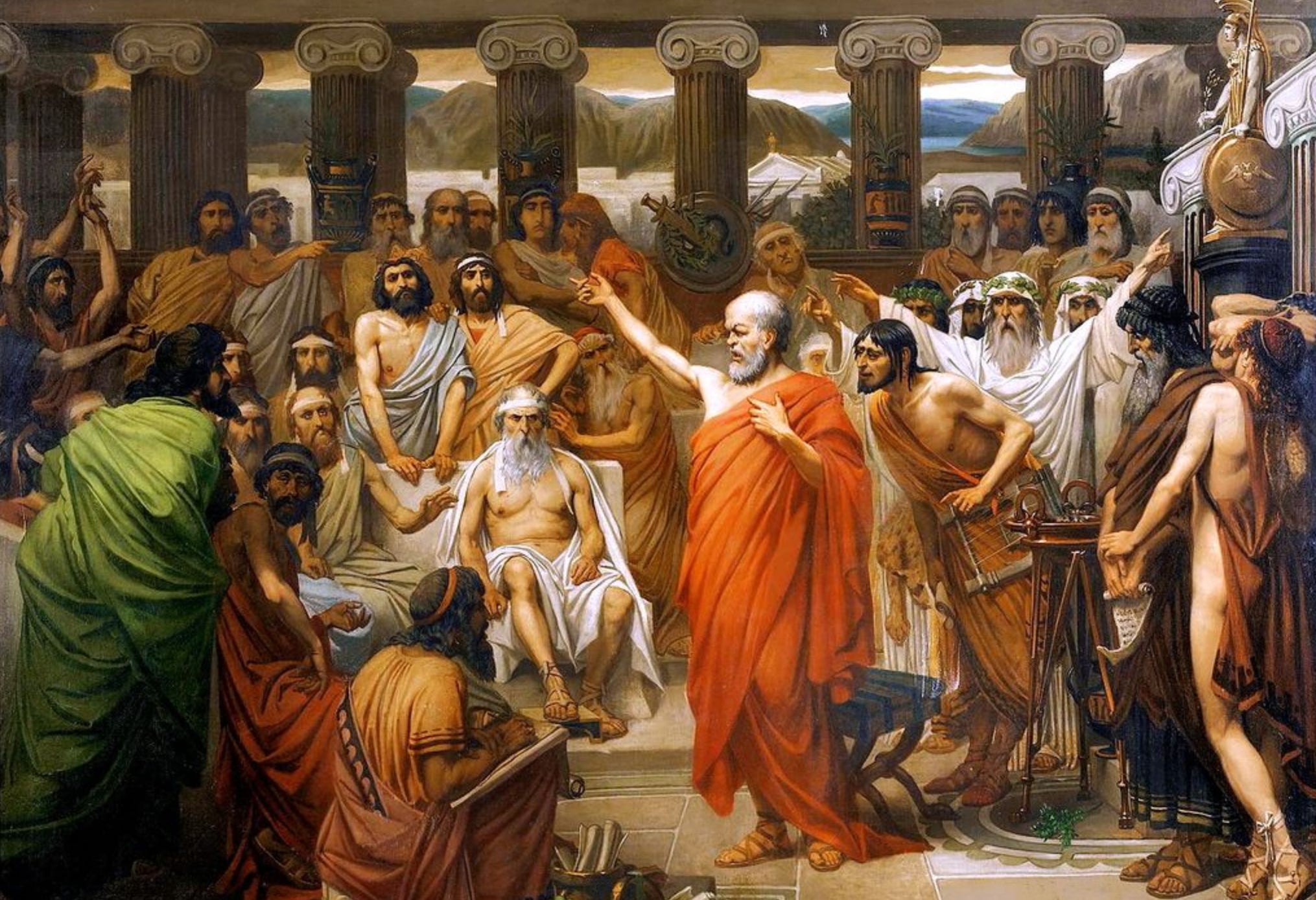
Before they executed Socrates in the year 399 BC — on charges of impiety and corrupting youth — the philosopher was given a chance to defend himself before a jury.
Socrates started his defense with an unusual plea.
Socrates defends himself at his trial (painting by Louis Joseph Lebrun, 1867)
He told his listeners that he had no skill at making speeches. He just knew the everyday language of the common people.
Socrates explained that he had never studied rhetoric or oratory. He feared that he would embarrass himself by speaking so plainly in his trial defense.
“I show myself to be not in the least a clever speaker,” Socrates told the jurors, “unless indeed they call him a clever speaker who speaks the truth.”
He knew that others in his situation would give “speeches finely tricked out with words and phrases”. But Socrates only knew how to use “the same words with which I have been accustomed to speak” in the marketplace of Athens.
Socrates wasn’t exaggerating. His entire reputation was built on conversation. He never wrote a book — or anything else, as far as we can tell.
Spontaneous talking was the basis of his famous “Socratic method” — a simple back-and-forth dialogue. You might say it was the podcasting of its day. He aimed to speak plainly — seeking the truth through open and unfiltered conversation.
That might get you elected President in the year 2024. But it didn’t work very well in Athens, circa 400 BC.
Socrates received the death penalty — and was executed by poisoning.
Is that shocking? Not really.
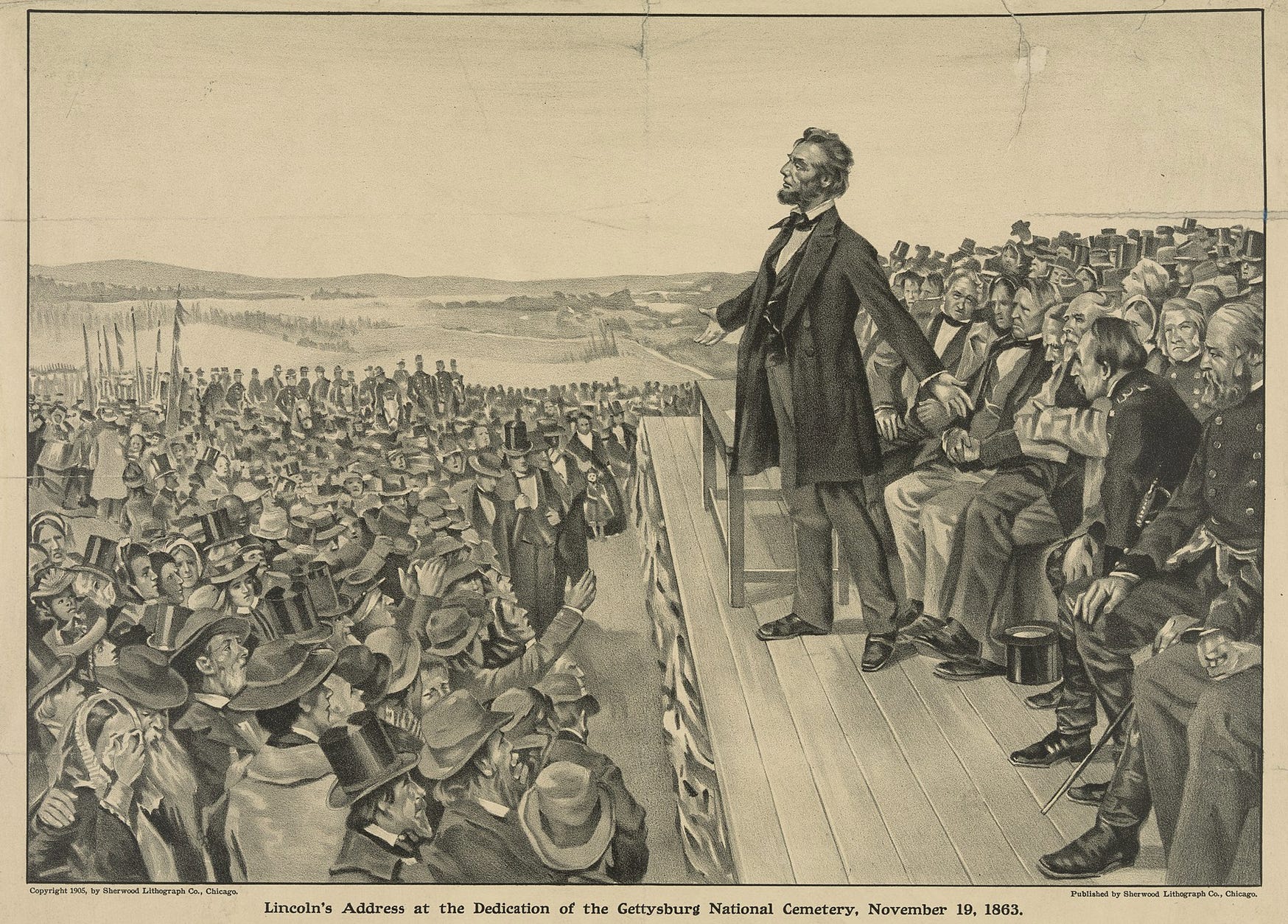
Western culture was built on one-way communication. Leaders and experts speak — and the rest of us listen.
This is how leaders once spoke to the people — but it’s now changing.
Socrates was the last major thinker to rely solely on conversation. After his death, his successors wrote books and gave lectures.
That’s what powerful people do. They make decisions. They give orders. They deliver speeches.
But not anymore.
In the aftermath of the election, the new wisdom is that giving speeches from a teleprompter doesn’t work in today’s culture. Citizens want their leaders to sit down and talk.
And not just in politics. You may have seen the same thing in your workplace — or in classrooms and other group settings. People now resist one-way orders from the top.
The word “scripted” is now an insult. Plainspoken dialogue is considered more trustworthy. This is part of the up-versus-down revolution I’ve written about elsewhere — a conflict that, I believe, may have even more impact on society than Left-versus-Right.
For better or worse, the hierarchies we’ve inherited from the past are toppling. To some extent, they are even reversing.
This is now impacting how leaders are expected to speak. Events of the last few days have raised awareness of this to a new level — but the “experts” should have expected it. That’s especially true because the experts will be those most impacted by this shift.
HBO’s Rome Ep. 3 “The owl in a thorn bush” – History and Story
Adrian Goldsworthy. Historian and Novelist
Published Jul 17, 2024Episode Three: Now that Caesar has crossed the Rubicon, the Civil War has begun and the series gathers pace.
Vidcaps taken from the dvd collection and copyright belongs to the respective makers and channels.
Transcript
QotD: Napoleon and his army
Napoleon’s easy rapport with his troops also gives us some glimpses of his freakish memory. On multiple occasions he chats with a soldier for an hour, or camps with them the eve before a battle; and then ten years later he bumps into the same guy and has total recall of their entire conversation and all of the guy’s biographical details. The troops obviously went nuts for this kind of stuff. It all sort of reminds me of a much older French tradition, where in the early Middle Ages a feudal lord would (1) symbolically help his peasants bring in the harvest and (2) literally wrestle with his peasants at village festivals. Back to your point about the culture, my anti-egalitarian view is that that kind of intimacy across a huge gulf of social status is easiest when the lines of demarcation between the classes are bright, clear, and relatively immovable. What’s crazy about Napoleon, then, is that despite him being the epitome of the arriviste he has none of the snobbishness of the nouveaux-riches, but all of the easy familiarity of the natural aristocrat.
True dedication to the welfare of those under your command,1 and back-slapping jocularity with the troops, are two of the attributes of a wildly popular leader. The third2 is actually leading from the front, and this was the one that blew my mind. Even after he became emperor, Napoleon put himself on the front line so many times he was practically asking for a lucky cannonball to end his career. You’d think after the fourth or fifth time a horse was shot out from under him, or the guy standing right next to him was obliterated by canister shot, the freaking emperor would be a little more careful, but no. And it wasn’t just him — the vast majority of Napoleon’s marshals and other top lieutenants followed his example and met violent deaths.
This is one of the most lacking qualities in leaders today — it’s so bad that we don’t even realize what we’re missing. Obviously modern generals rarely put themselves in the line of fire or accept the same environmental hardships as their troops. But it isn’t just the military, how many corporate executives do you hear about staying late and suffering alongside their teams when crunch time hits? It does still happen, but it’s rare, and the most damning thing is that it’s usually because of some eccentricity in that particular individual. There’s no systemic impetus to commanders or managers sharing the suffering of their men, it just isn’t part of our model of what leadership is anymore. And yet we thirst for it.
Jane and John Psmith, “JOINT REVIEW: Napoleon the Great, by Andrew Roberts”, Mr. and Mrs. Psmith’s Bookshelf, 2023-01-21.
1. When not flinging them into the face of Prussian siege guns.
2. Okay, there are more than three. Some others include: deploying a cult of personality, bestowing all kinds of honors and awards on your men when they perform, and delivering them victory after victory. Of course, Napoleon did all of those things too.
November 17, 2024
Nazi Uniforms banned across three States – Rise of Hitler 06, June 1930
World War Two
Published 16 Nov 2024In June 1930, the Weimar Republic faces escalating tensions as Nazi uniforms are banned in three states to curb political violence. The French withdrawal from the Rhineland marks a major milestone while Saxony’s elections leave the state in political deadlock. Meanwhile, Chancellor Brüning battles to save his government amidst growing financial turmoil and party divisions.
(more…)
Contrasting origin stories – the 13 Colonies versus the “Peaceful Dominion”
At Postcards From Barsoom, John Carter outlines some of the perceived (and real) differences in the origin stories of the United States and Canada and how they’ve shaped the respective nations’ self-images:
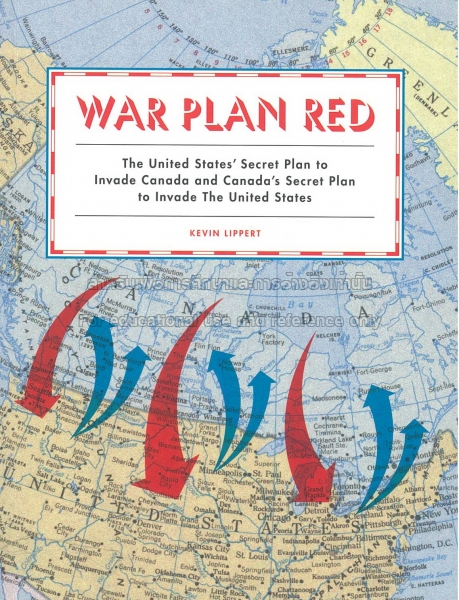
The US had plans to invade Canada that were updated as recently as the 1930s (“War Plan Crimson”, a subset of the larger “War Plan Red” for conflict with the British Empire). Canada also had a plan for conflict with the US, although it fell far short of a full-blooded invasion to conquer the US, designated as “Defence Scheme No. 1”, developed in the early 1920s.
In perennial contrast to its tumultuous southern neighbour, Canada has the reputation of being an extremely boring country.
America’s seeds were planted by grim Puritans seeking a blank slate on which to inscribe the New Jerusalem, and by aristocratic cavaliers who wanted to live the good life while their slaves worked the plantations growing cash crops for the European drug trade. The seeds of America’s hat were planted by fur traders gathering raw materials for funny hats.
America was born in the bloody historical rupture of the Revolutionary War, casting off the yoke of monarchical tyranny in an idealistic struggle for liberty. Canada gained its independence by politely asking mummy dearest if it could be its own country, now, pretty please with some maple syrup on top.
America was split apart in a Civil War that shook the continent, drowning it in an ocean of blood over the question of whether the liberties on which it was founded ought to be extended as a matter of basic principle to the negro. Canada has never had a civil war, just a perennial, passive-aggressive verbal squabble over Quebec sovereignty.1
America’s western expansion was known for its ungovernable violence – cowboys, cattle rustlers, gunslingers, and Indian wars. Canada’s was careful, systematic, and peaceful – disciplined mounties, stout Ukrainian peasants, and equitable Indian treaties.
Once its conquest of the Western frontier was wrapped up, America burst onto the world stage as a vigorous imperial power, snatching islands from the Spanish Empire, crushing Japan and Germany beneath the spurred heel of its cowboy boot, and staring down the Soviet Union in the world’s longest high-stakes game of Texas Hold’Em. Canada, ever dutiful, did some stuff because the British asked nicely, and then they went home to play hockey.
America gave the world jazz music, rock and roll, and hip-hop; Canada contributed Celine Dion and Stan Rogers. America has Hollywood; Canada, the National Film Board and the Canadian Broadcasting Corporation. America dressed the world in blue jeans and leather jackets; Canadians, flannel and toques. America fattened the people with McDonald’s; Canada burnt their tongues with Tim Horton’s, eh.2
The national stereotypes and mythologies of the preceding paragraphs aren’t deceptive, per se. Stereotypes are always based in reality; national mythologies, as with any successful mythology, need to be true at some level in order to resonate with the nations that they’re intended to knit together. Of course, national mythologies usually leave a few things out, emphasizing or exaggerating some elements at the expense of others in the interests of telling a good story. Revisionists, malcontents, and subversives love to pick at the little blind spots and inconsistencies that result in order to spin their own anti-narratives, intended as a rule to dissolve rather than fortify national cohesion and will. Howard Zinn’s People’s History of the United States is a good example of this kind of thing, as is Nikole Hannah-Jones’ tendentious 1619 Project.
Probably the most immediately obvious difference between Americans and Canadians is that Americans don’t suffer from a permanent identity crisis. Demographic dilution due to decades of mass immigration notwithstanding, Americans by and large know who they are, implicitly, without having to flagellate themselves with endless introspective navel-gazing about what it means to be an American. The result of this is that most American media isn’t self-consciously “American”; there are exceptions, of course, such as the occasional patriotic war movie, but for the most part the stories Americans tell are just stories about people who happen to be American doing things that happen to be set in America. Except when the characters aren’t American at all, as in a historical epic set in ancient Rome, or aren’t set in America, as in a science fiction or fantasy movie. That basic American self-assurance in their identity means that Americans effortlessly possess the confidence to tell stories that aren’t about America or Americans at all, as a result of which Hollywood quietly swallowed the entire history of the human species … making it all American.
As Rammstein lamented, We’re All Living in Amerika …
Since we’re all living in Amerika, the basic background assumptions of political and cultural reality that we all operate in are American to their very core. Democracy is good, because reasons, and therefore even de facto dictators hold sham elections in order to pretend that they are “presidents” or “prime ministers” and not czars, emperors, kings, or warlords. Insofar as other countries compete with America, it’s by trying to be more American than the Americans: respecting human rights more; having freer markets; making Hollywood movies better than Hollywood can make them; playing heavy metal louder than boys from Houston can play it. It’s America’s world, and we’re all just along for the ride.
America’s hat, by contrast, is absolutely culturally paralyzed by its own self-consciousness … as a paradoxical result of which, its consciousness of itself has been almost obliterated.
Canada’s origin – the origin of Anglo-Canada, that is – was with the United Empire Loyalists who migrated into the harsh country of Upper Canada in the aftermath of the Revolutionary War. As their name implies, they defined themselves by their near-feudal loyalty to the British Crown. Where America was inspired by Enlightenment liberalism, Canada was founded on the basis of tradition and reaction – Canada explicitly rejected liberalism, offering the promise of “peace, order, and good government” in contrast to the American dream of “life, liberty, and the pursuit of happiness”.
1. Quebec very nearly left the country in a narrow 1995 referendum in which 49.5% of the province’s population voted to separate. It is widely believed in Anglo Canada that had the rest of the country been able to vote on the issue, Quebec would be its own country now.
2. Well actually a Brazilian investment firm has Timmies, but anyhow.
Three (more) Forgotten Roman Megaprojects
toldinstone
Published Jul 19, 2024This video explores another three forgotten Roman megaprojects: the colossal gold mines at Las Médulas, Spain; the Anastasian Wall, Constantinople’s outer defense; and Rome’s artificial harbor at Portus.
Chapters:
0:00 Las Médulas
3:13 The Anastasian Wall
5:24 Portus
(more…)
November 16, 2024
The 1980 Iterated Prisoner’s Dilemma Tournament
At Astral Codex Ten, Scott Alexander starts a post titled “The Early Christian Strategy” with some relevant back-story (fore-story?) involving game theory and the famous Prisoner’s Dilemma:
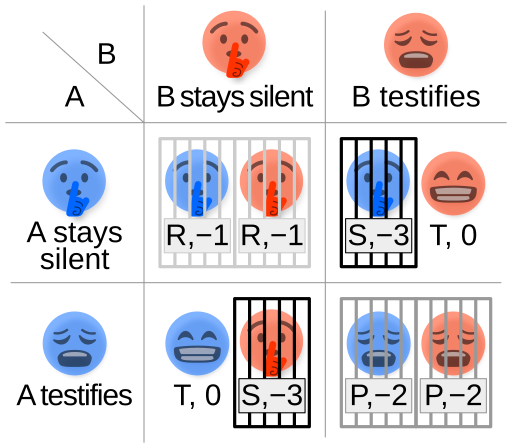
An example prisoner’s dilemma payoff matrix drawn by CMG Lee using emojis from Wikimedia Commons.
In 1980, game theorist Robert Axelrod ran a famous Iterated Prisoner’s Dilemma Tournament.
He asked other game theorists to send in their best strategies in the form of “bots”, short pieces of code that took an opponent’s actions as input and returned one of the classic Prisoner’s Dilemma outputs of COOPERATE or DEFECT. For example, you might have a bot that COOPERATES a random 80% of the time, but DEFECTS against another bot that plays DEFECT more than 20% of the time, except on the last round, where it always DEFECTS, or if its opponent plays DEFECT in response to COOPERATE.
In the “tournament”, each bot “encountered” other bots at random for a hundred rounds of Prisoners’ Dilemma; after all the bots had finished their matches, the strategy with the highest total utility won.
To everyone’s surprise, the winner was a super-simple strategy called TIT-FOR-TAT:
- Always COOPERATE on the first move.
- Then do whatever your opponent did last round.
This was so boring that Axelrod sponsored a second tournament specifically for strategies that could displace TIT-FOR-TAT. When the dust cleared, TIT-FOR-TAT still won — although some strategies could beat it in head-to-head matches, they did worst against each other, and when all the points were added up TIT-FOR-TAT remained on top.
In certain situations, this strategy is dominated by a slight variant, TIT-FOR-TAT-WITH-FORGIVENESS. That is, in situations where a bot can “make mistakes” (eg “my finger slipped”), two copies of TIT-FOR-TAT can get stuck in an eternal DEFECT-DEFECT equilibrium against each other; the forgiveness-enabled version will try cooperating again after a while to see if its opponent follows. Otherwise, it’s still state-of-the-art.
The tournament became famous because – well, you can see how you can sort of round it off to morality. In a wide world of people trying every sort of con, the winning strategy is to be nice to people who help you out and punish people who hurt you. But in some situations, it’s also worth forgiving someone who harmed you once to see if they’ve become a better person. I find the occasional claims to have successfully grounded morality in self-interest to be facile, but you can at least see where they’re coming from here. And pragmatically, this is good, common-sense advice.
For example, compare it to one of the losers in Axelrod’s tournament. COOPERATE-BOT always cooperates. A world full of COOPERATE-BOTS would be near-utopian. But add a single instance of its evil twin, DEFECT-BOT, and it folds immediately. A smart human player, too, will easily defeat COOPERATE-BOT: the human will start by testing its boundaries, find that it has none, and play DEFECT thereafter (whereas a human playing against TIT-FOR-TAT would soon learn not to mess with it). Again, all of this seems natural and common-sensical. Infinitely-trusting people, who will always be nice to everyone no matter what, are easily exploited by the first sociopath to come around. You don’t want to be a sociopath yourself, but prudence dictates being less-than-infinitely nice, and reserving your good nature for people who deserve it.
Reality is more complicated than a game theory tournament. In Iterated Prisoners’ Dilemma, everyone can either benefit you or harm you an equal amount. In the real world, we have edge cases like poor people, who haven’t done anything evil but may not be able to reciprocate your generosity. Does TIT-FOR-TAT help the poor? Stand up for the downtrodden? Care for the sick? Domain error; the question never comes up.
Still, even if you can’t solve every moral problem, it’s at least suggestive that, in those domains where the question comes up, you should be TIT-FOR-TAT and not COOPERATE-BOT.
This is why I’m so fascinated by the early Christians. They played the doomed COOPERATE-BOT strategy and took over the world.


