
Information velocity had increased exponentially by the 1630s, such that the English Civil War was, in a fundamental way, a propaganda war, an intellectual war.
Some of the battles of the Wars of the Roses were bigger than some of the Civil War’s battles – an estimated 50,000 men fought at Towton, in 1461 – but the Civil War was inconceivably harder and nastier than the Wars of the Roses, because the Civil War was an ideological war. The Wars of the Roses could’ve ended, at least theoretically, at any time – get the king and five dukes in a room, hammer out a compromise, and simply order everyone in each lord’s affinity to lay down his weapons. The Civil War could only end when everyone, in every army, was persuaded to lay down his arms.
Thus the winners had to negotiate with the people, directly. The Putney Debates didn’t involve everyone in the realm, but they were representative, truly representative, of everyone who mattered. Though no one explicitly made an appeal to competence alone, it was – and is, and must be – fundamental to representative government. Guys like Gerrard Winstanley had some interesting ideas, but they were fundamentally impractical, and Winstanley was not popularly viewed as a competent leader. Oliver Cromwell, on the other hand, was competence personified – the Protectorate became Cromwell’s military dictatorship largely because the People, as literally represented by the New Model Army, wanted it so … and, thanks to much faster information velocity, could make their wishes known.
Severian, “Inertia and Incompetence”, Founding Questions, 2020-12-25.
November 30, 2023
QotD: “Information velocity” in the English Civil War
November 29, 2023
Grover Cleveland – more “republican” than any Republican alive today
Not having studied American history in school, I don’t know a lot about most American presidents, especially those of the 19th century whose names aren’t Jefferson, Jackson, or Lincoln. One of the presidents I only knew about because his name turned up in a lot of original Trivial Pursuit questions was Grover Cleveland, the only man (so far) who has ever been elected to non-consecutive terms:
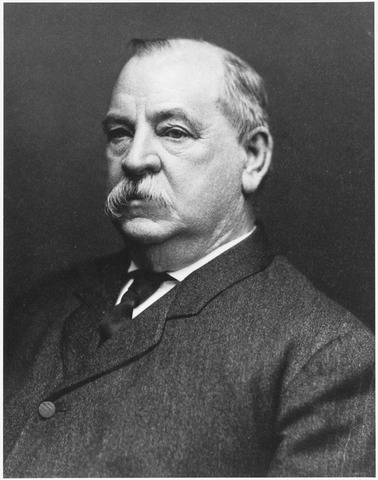
Grover Cleveland (1837-1908), President of the United States, 1885-89 and 1893-97.
Photo from the National Archives and Records Administration (NAID 518139) via Wikimedia Commons.
Cleveland won the White House in 1884 on a platform of restraining federal spending and corruption. Running for re-election in 1888, he won the popular vote but lost to Republican Benjamin Harrison in the Electoral College. A major reason he came out of retirement to run again in 1892 was the reckless spending of the Harrison administration. He beat Harrison that year and became the only man ever elected to non-consecutive terms (1885-89 and 1893-97).
I call to the reader’s attention an article ex-President Cleveland wrote three years after the end of his second term, in June 1901. Titled “The Waste of Public Money”, it was one of half a dozen he penned for The Saturday Evening Post. In this one, he referred to “a malign condition which threatens us,” an “evil” that he saw as “calamitous and destructive to our national character and integrity”.
In 1901, the federal government spent half a billion dollars over the whole year, roughly equivalent in real terms to around $12 billion today. Washington spends that much now in about half a day. Lest you think the feds were misers in 1901, ponder what Cleveland had to say in his article that year:
Probably no one will have the hardihood to deny that the cost of our Government is excessive and wasteful, and that for this condition the heedless neglect and indifference of our people are in some degree responsible … If the aggregate mass of our people are at all blameworthy on account of the present advanced stage of public prodigality, it is largely because they overlooked and tolerated its small beginnings, when at all times they should have been vigilant and uncompromising. A self-ruling people … should constantly remember that nothing multiplies itself more abundantly than national extravagance, and that neither an individual nor a popular government can easily correct or check habits of waste.
The former president did not for a moment believe that only the politicians were to blame for excessive spending. He boldly asserted that many Americans embraced it. They were effectively bought and paid for, guilty of “accepting the bribes of selfish and personal advantage which public waste and extravagance offer”.
Cleveland was often warned by advisers to moderate his stances to avoid controversy. Biographer H. Paul Jeffers quotes him as responding once to such advice by asking, “What is the use of being elected or re-elected unless you stand for something?” When he vetoed a bill to relieve drought-stricken farmers with federal money, he made it plain that “though the people support the government, the government should not support the people”. He saw his job as upholding the Constitution and keeping the federal government in its proper place, not weakening “the bonds of common brotherhood” by robbing Peter to pay Paul.
This was a man who said what he meant and meant what he said, come Hell or high water. He spoke with a clarity of principle that makes a nation great, and the absence of which makes a great nation fail. He understood that no society in history that allowed itself to be bribed by its politicians ever survived such legal larceny.
In the final paragraphs of his June 1901 Saturday Evening Post article, Cleveland admonished his fellow Americans. With these words, he urged them to muster the character to resist being bribed with their own money:
The lessons of extravagance and paternalism must be unlearned; economy and frugality must be reinstated; and the people must exact from their representatives a watchful care for the general welfare and a stern resistance to the demands of selfish interests, if our Government is to be an enduring and beneficent protection to a patriotic and virtuous people.
Many Americans today would undoubtedly dismiss Cleveland’s warnings as “quaint” and “old-fashioned”. They want the government to give them stuff and they don’t think much about who will pay for it. They think even less about how it corrupts the national character.
November 27, 2023
“A law for which no enforcement mechanism exists is not a law. It is a LARP or a declaration of feeling”
Kulak takes on politics and violence:
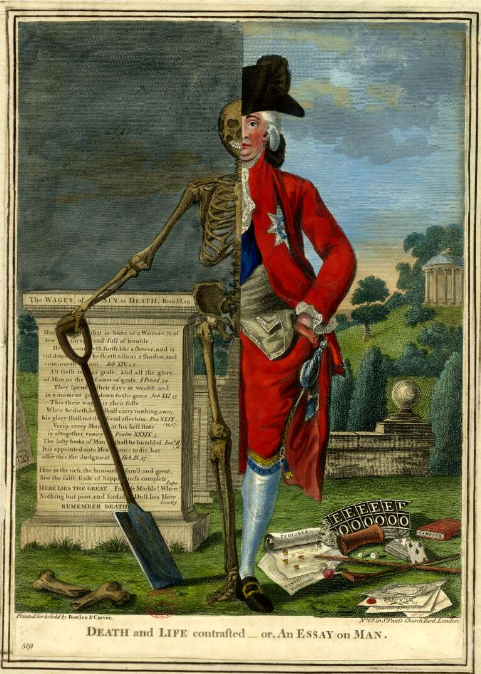
“Death and Life constrasted … or, an Essay on Man” by Robert Dighton, 1784.
British Museum number 1935,0522.3.55.
The power of any law comes from the fact that armed men stand ready to commit an escalating series of violence against those who do not comply. And even the lightest touch, subtlest “Nudge” laws gain their power via subtly manipulating the circumstances in which violence by state is already applied. (When you fill out the tax form you must fill out or be dragged to prison, this new law will let you fill in a box to receive $200 back if you have a dog … whom the IRS would shoot before taking you to prison if you had not surrendered the money to them in the first place)
To say someone has political power whether a voter, an activist, or a politician … is to say they can effect political outcomes such that they can make violence more or less likely to be exercised against someone.
If your political activism and activity is not connected to any mechanism to commit violence, whether through the states agents, or through an illegal organization … you are not a political actor. You are a “citizen”, “voter”, “activist”, “politician” in the same way the madman at the asylum is “Napoleon”, you may play-act with the symbols of power … but you do not interact with it.
All Political Discussion Terminates in Violence
All discussions of politics is inevitably, and CAN ONLY BE, a conspiracy to commit violence, whether legally through the state, illegally through some form of direct action or “terrorism”, or Stochastically through some impact on the culture or wider discussion which will make the prior two more likely or effect their nature.
If your supposedly political speaking’s have no connection to state or non-state “policy” Ie. Violence … then they are not political. You are engaged in fantasy at best, grovelling at worst.
This is why so many in the safety brigade and regime are not incorrect when they call the political speech of their opponents “Dangerous” or a form of “violence” all political speech is necessarily, by the nature of being political, directed to altering the atmosphere, calculus, mechanisms, and willing committal of state and non-state violence.
.
None of this should be shocking
Clausewitz observed “War is politics by other means”
Vladimir Lenin observed the inverse: “Politics is warfare by other means”
In both they merely restated Hobbes: The state of nature is a state of war and peace is merely an artifice mutually consented to by all sides under a sovereign … which can be unilaterally terminated at will by any party, and rationally must be terminated in any one of a thousand circumstances.
That Rights and Liberties are “Given by God” is a euphemism for the violence and threat implicit in the claims of free men.
The founders saying their rights were “endowed by God”, was no different than Carolus Rex declaring he was “Chosen by Heaven” … It was a euphemism and a flex that their violence and dominance of fate had left them masters of their domain, and that they’d meet any challenge with as much violence as a crusader or Inquisitor would visit upon a heretic challenger.
November 26, 2023
It’s apparently political earthquake season
Elizabeth Nickson wonders if you can feel the Earth shaking in your area:
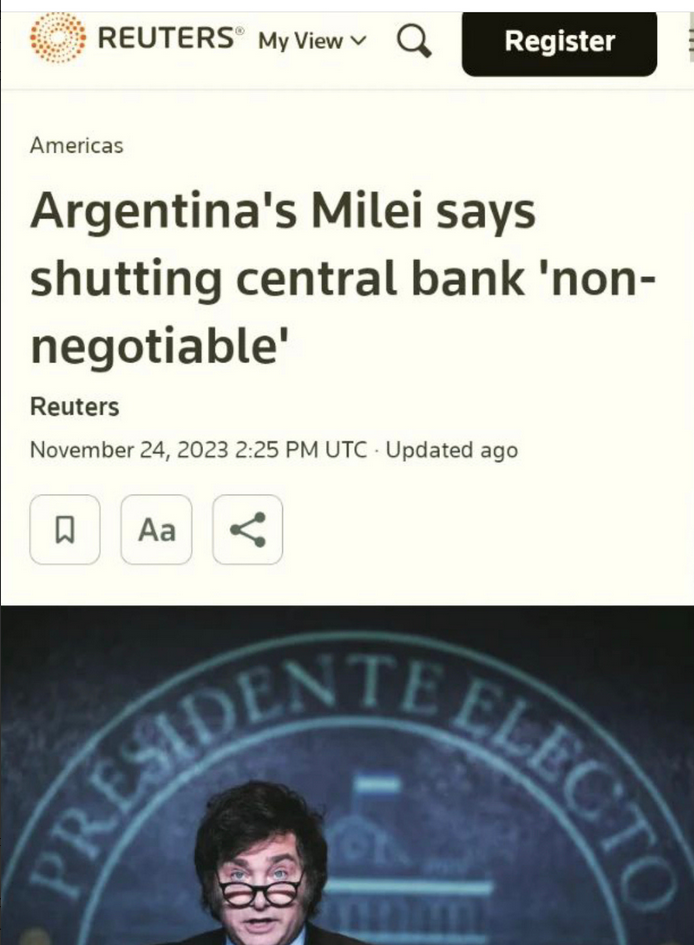
Did you hear the roar on the streets when Milei won Argentina? It built and built, and then everyone was out on the streets shouting, from windows, inside shops, houses. It is the future, all over the world. The Netherlands on Friday. Same same. Universal rejoicing.
Absurdistan does a solid line in doom, but our firmly held first principle is that every single one of us should be two or three times as rich, with massively increased scope and ability to do the things we want to do. Defeating the criminal cartel that runs Big Pharma, Big Ag, Big Government, Big Tech and Big Charity will light up the galaxy if not the universe. And … this. Especially this:
Unlike almost everyone in the media, Absurdistan knows regulation is the principal reason we are hornswoggled serfs. Even Trump’s team was surprised at the economic boom that came from his mild de-regulation; they thought tax relief was the key. It was important, none of us should be paying more than 25% in taxes, if that, but the regulation! You have no earthly idea how fiendish it has become until you start a business or require permission to create anything in the material world. Few journalists ever do that, the most they do is join a bank in “communications”, design an app or website, do PR, or “consult”. They are virtually, to a man or woman, children in the real world. So no one reports on the most brutal crippler of every man, woman and child on earth. Equally, virtually no writer I read has any grasp on the ingenuity, the creativity, the strength of the ordinary man. They all seem to think we need guidance from them, which is laughable. They have screwed up everything so utterly, we teeter daily on the edge of fiscal catastrophe.
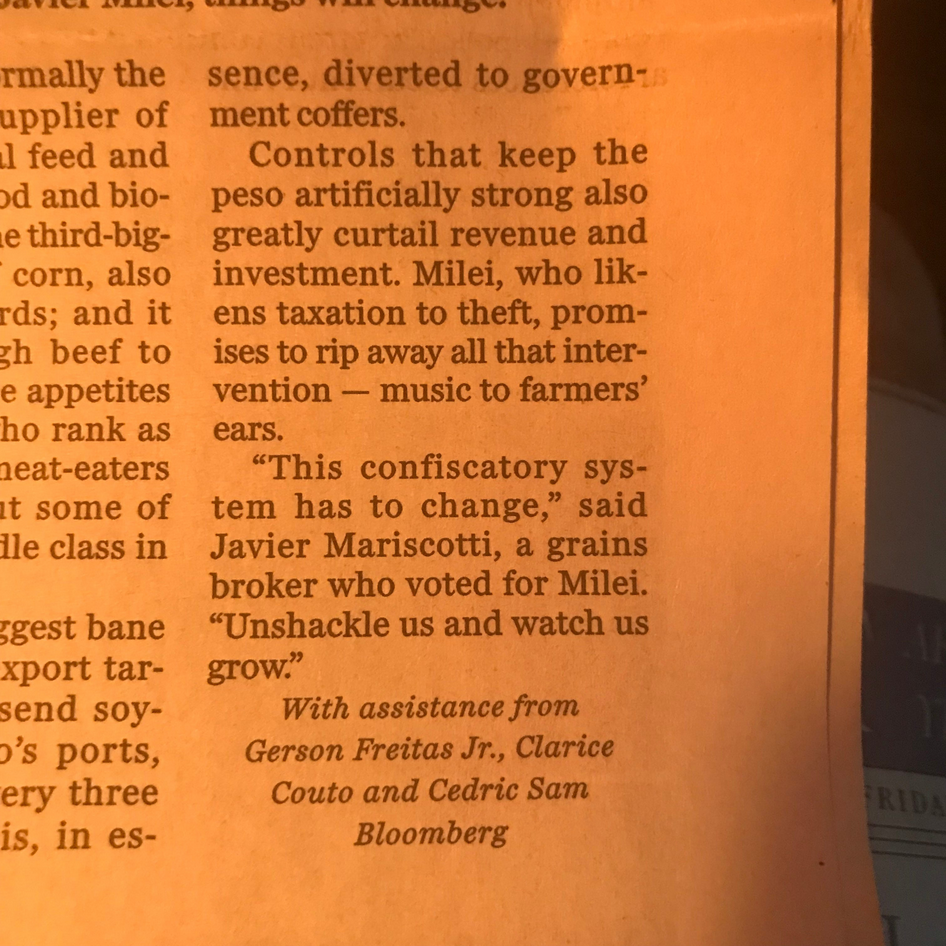
Bloomberg reports on Milei victory
When Vivek Ramaswamy proposed instantly firing 50% of federal bureaucrats on Day One, I stood on my office chair and cheered.
When Javier Milei tore strips of paper representing government ministries off the whiteboard, I had to go out and run around the house a few times.
Africa is not limited by anything but confiscatory corrupt government, as asserted by Magatte Wade in her new book. Wade should be running things in Africa, which is polluted by commies, plutocrats, crooked multinationals, ravening bureaucrats, corrupt politicians and the brutalist green movement. The Chinese would stun the world if they could get rid of the vicious predatory communist regime that enslaves every man, woman and child. And not in the sense that they are “taking over”.
The mop-up will take decades. But unpicking the bad regs and shooing the bad legislators off to permanent exile, prosecuting the army of government thieves, and creating a multi-polar world, will be more absorbing than our endless self-cherishing, self-indulgence. Have we not all shopped enough? We have powerful enemies, but they are fully aware of how destructive they have been, their guilt written on their exhausted pouchy faces.
Trump is a symptom, not a cause
People fighting the Borg wish for leaders but this is not a movement that requires leadership by anyone but each and every one of us. Trump is a symptom, not a cause. This is multi-headed, like Medusa, representing tens, hundreds of millions of individuals saying NO. Real politicians like Mike Johnson, Geert Wilders, Pierre Poilievre, Javier Milei, and Danielle Smith are listening to us and stepping up.

Ontario’s beer market may see radical changes soon
For beer drinkers outside Ontario, the province’s weird beer retailing rules may seem to be from a different time, but that’s only because they are. Until fairly recently, the only place to buy beer was from one of two quasi-monopoly entities: the provincially owned and operated LCBO or the foreign brewery owned Beer Store. LCBO outlets were limited to single containers and six-packs, while Beer Stores sold larger multipacks and also handled bottle deposits and returns. In the last few weeks, the Ontario government has indicated that long overdue changes are coming:

“The Beer Store” by Like_the_Grand_Canyon is licensed under CC BY-NC 2.0


The only thing we really know at this point (and it’s been reported by the Toronto Star and now CBC, and earlier by this website, all from sources) is the horribly unfair deal The Beer Store has had since 1927 in Ontario is about to come to an end. It’s expected that The Beer Store will be given notice by the end of December under the Master Framework Agreement (MFA) that the deal will be all but dead. They will have two years to wrap things up while a more modern system of booze retailing is fine-tuned and prepared for implementation. There’s a new era dawning in Ontario, one that would seemingly benefit grocery and convenience stores, local brewers, Ontario wineries, and obviously consumers who will get wider selection, more convenience and competitive pricing.
“The MFA has never been about choice, convenience or prices for customers, it has always been about serving the interests of the big brewing conglomerates, and that’s what needs to be addressed,” Michelle Wasylyshen, spokesperson for the Retail Council of Canada, whose board of directors includes members from Loblaw, Sobeys, Metro, Walmart, and Costco, told Mike Crawley of the CBC.
The end of The Beer Store MFA in whatever iteration it will look like will have a cascading impact on local VQA wine. Ontario wineries hope that it’s a positive impact and are cautiously optimistic that wide open beer and wine sales at grocery and convenience stores means more sales and less levies for their products.
As the CBC pointed out in its story, the looming reforms “pit a range of interests against each other, as big supermarket companies, convenience store chains, the giant beer and wine producers, craft brewers and small wineries all vie for the best deal possible when Ontario’s almost $10-billion-a-year retail landscape shifts. And — this is a biggie — the LCBO lobbying efforts to keep its antiquated system of monopoly retailing intact, which seems to be a big ask with what we now know from sources. Something must give.
Some key bullet points from the CBC report:
- Will the government shrink the LCBO’s profit margins, including its take from products that other retailers sell?
- Will retailers such as grocery and convenience stores be required to devote a certain amount of shelf space to Ontario-made beer and wine, or will they have total control over the inventory they stock?
- Will small Ontario wineries get any help in competing against big Ontario wineries whose products can contain as much as 75% imported wine?
The government has been listening to all stakeholders in the booze industry in Ontario for over a year now. Three key associations — Ontario Craft Wineries, Tourism Partnership Niagara, and Wine Growers Ontario — joined together to commission a report titled Uncork Ontario. That report, which concludes that the Ontario wine sector is well positioned to drive sustainable economic growth for the region, the province, and the country and has the potential to drive at least $8 billion in additional real GDP over the next 25 years, launched a campaign to lobby the government for radical changes to reach those lofty goals, or at least put the wheels in motion.
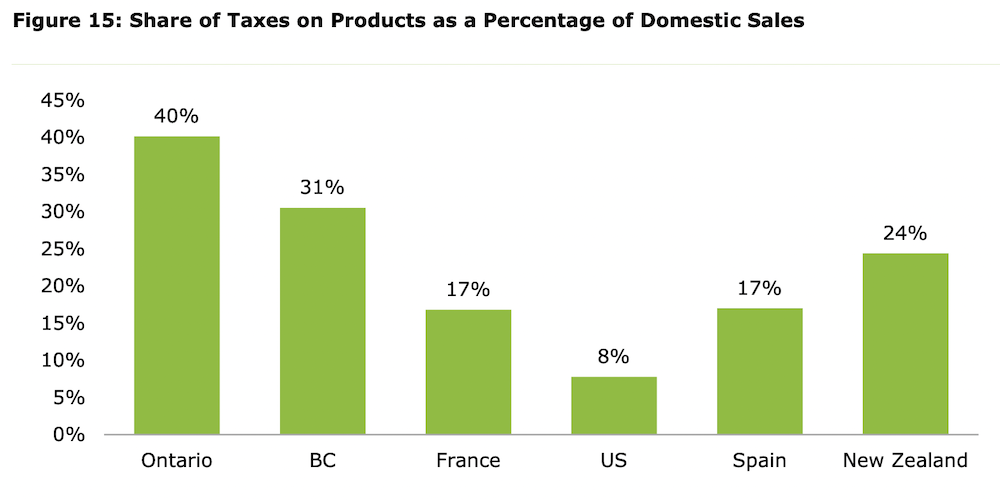
One of the big issues for Ontario wineries is a punishing 6.1% “sin” tax charged on every wine made in Ontario but not foreign wines. It’s a tax that’s been hurting Ontario wineries for years even though a grant was issued to wineries to help pay that tax back. To this date, the tax has not been cancelled and wineries keep remitting the tax owed monthly and can only hope the grant keeps getting extended. Ontario wines are among the highest taxed in the world with up to 73% of every bottle sold going to taxes and severe levies at the LCBO.
November 25, 2023
QotD: Political language mirrors the ritualized nature of political life
In a crisis, they recite. We’ve all watched them do this. “This is not who we are.” “Let me be clear: Hate has no home here.” You know what they’re going to say before they say it, and you know the tone before you hear it. The current mayor of Los Angeles is very fond of “our message has been very clear” and “we’re going to link arms and stand together”, so you’re not surprised to hear her respond to a question with something like, “Well, Maria, thank you for that great question. Our message has been very clear: We’re going to link arms and stand together.” Listening to elected officials speak is qualitatively different than listening to people speak. They perform the ritual behaviours of their status group.
[…]
They become debilitated by a lifetime of ritual language. If a staffer hasn’t told them to look somber and say “I’m sorry for your loss”, they don’t know how. It isn’t a line they’ve been equipped with for the event. Hey man your kids burned to death I almost lost my Corvette once, man. All kiddin’ aside, man!
[…]
They aren’t people anymore. They can’t talk like people. They don’t have normal human affect. What’s particularly interesting is that this learned inability to read human cues is recent and narrow. Bill Clinton, as much a politician as anyone who has ever lived, had a well-known ability to see people and signal his empathy, or at least to do a brilliant job of faking it. Similarly, Donald Trump is obviously very very fond of Donald Trump, who is amazing, trust me, everybody says so, but he has a normal human ability to spontaneously bullshit with the normals. Elite disconnection isn’t inevitable.
The broken personal thing behind all the broken institutional things is a loss of basic human connection and behavior. It’s a learned disconnection, and they can’t hide it.
Chris Bray, “The Mask Becomes Your Face”, Tell Me How This Ends, 2023-08-22.
November 24, 2023
More than 1,500 new jobs thanks to federal and provincial subsidies … except the jobs are for South Koreans
Tristin Hopper applauds the great job creation scheme that the federal and Ontario governments have put in place … if you ignore the inconvenient fact that most of the newly created jobs aren’t even going to Canadians:

When the Ontario and federal governments greenlit one of the biggest corporate subsidy payouts in Canadian history last summer, their main pitch was the deal would create jobs.
“The governments of Canada and Ontario are partnering to attract once-in-a-generation projects that will anchor our auto manufacturing sector and keep good jobs in Canada,” reads the opening line of a July 6 joint statement announcing a record-breaking $28 billion in government “performance incentives” to secure two foreign-owned EV battery factories in Southern Ontario.
The subsidy-per-job ratio was never great. Even according to the most optimistic estimates of government spokespeople, the two factories — one operated by Volkswagen, the other by Stellantis — would create about 5,500 jobs. Per job, that’s roughly $5 million in lifetime subsidies and tax credits.
But now, it appears that many of those jobs may not even go to Canadians.
Last week, during a visit by South Korean Ambassador Woongsoon Lim to Windsor, Ont., a social media post by the Windsor Police casually mentioned that “1,600 South Koreans” would soon be arriving in the community to staff the Stellantis plant, which is set to open next year.
With the new LGEngergy Solutions battery plant being built, we expect approximately 1,600 South Koreans traveling to work and live in our community in 2024.
— Windsor Police (@WindsorPolice) November 16, 2023
The CEO of NextStar — the Stellantis joint venture operating the factory — hasn’t confirmed the 1,600 figure, but said in a statement that the “equipment installation phase of the project requires additional temporary specialized global supplier staff”. He added that the company was “committed” to hiring Canadians to fill the 2,500 full-time jobs at the completed plant
The revelation has sparked a wave of confusion and finger-pointing among the very officials who, mere months ago, were championing the plant as an unalloyed triumph for Canadian manufacturing jobs.
When the subsidy arrangement was first announced in July, Ontario Economic Development Minister Vic Fedeli called it a “historic deal” and “a great agreement” that “protects the thousands of jobs quite frankly that were at stake”.
November 23, 2023
Canada’s bold move in an increasingly unsettled world is to … cut the military budget
The rest of Canada’s friends and allies are almost all beefing up their military spending because the world situation has become objectively more dangerous, but Justin Trudeau has never been one to follow the trend, especially when it comes to icky military stuff. Tristin Hopper has the details:

Just as the Liberal government’s fiscal update confirms that they will be staying the course on high spending backed by high deficits, they’re making a notable exception when it comes to the perennially underfunded Canadian Armed Forces.
According to the latest budgetary projections, Canadian military spending is set to fall in absolute terms for at least the rest of Trudeau’s third term – the only G7 country to do so.
For the current fiscal year, Canada is set to spend $26.93 billion on its military. For the 2024/2025 fiscal year, that will drop to $25.73 billion, and then drop again to C$25.33 billion by 2026.
These cuts are all in spite of increasingly desperate calls by the minister of defence and the military’s own internal reports that the Canadian Armed Forces may soon struggle to fulfill even basic tasks. It also stands in sharp contrast to virtually all of Canada’s peer countries, who are roundly beefing up their defence spending in response to an increasingly volatile global environment.
While Bill Blair’s turn as Defence Minister has mostly involved shepherding nearly $1 billion in cuts, at the Halifax International Security Forum over the weekend he struck a very different tone of saying that Canada’s “aspirations” required “more resources”.
“We need to spend more on munitions. We need to spend more on military platforms, planes, submarines and ships. We need to spend more on the equipment, the resources and the training that the Canadian Armed Forces needs,” he said in comments published by the CBC.
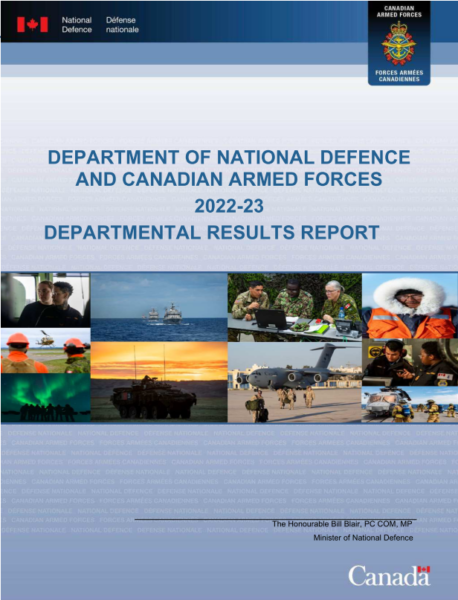
And Blair’s assessment was comparatively rosy when compared to the Department of National Defence’s annual departmental results report.Click image to download the PDF version
The 152-page document, which dropped earlier this month, painted a picture of a Canadian military that is hemorrhaging personnel and capability with no end in sight.
Among the highlights is a table indicating the “percentage of operations that are capable of being conducted concurrently”. Last year it was 100 per cent, but right now it’s plunged to a meagre 40 per cent.
“The CAF is currently unable to conduct multiple operations concurrently,” reads a footnote, adding that military readiness has been hit hard by “decreasing number of personnel and issues with equipment and vehicles”.
Recruiting is suffering an “applicant crisis”. There’s a shortage of “qualified aircraft technicians”. The military’s bases are in serious deterioration because they can’t afford “maintenance and repair”. Only about 40 per cent of the RCAF is operational due to “ongoing personnel shortages” and “inadequate maintenance infrastructure”.
It wasn’t too long ago that another defence minister, Anita Anand, was openly musing about raising Canada’s defence budget to the point where it would finally start meeting NATO’s minimum threshold for military spending.
November 20, 2023
The latest scam – Natural Asset Companies (NACs)
Elizabeth Nickson on the US Securities and Exchange Commission’s plan to magic up some new ways to “financialize” national parks and other federally regulated places for the benefit of the hyper-wealthy and well-connected:
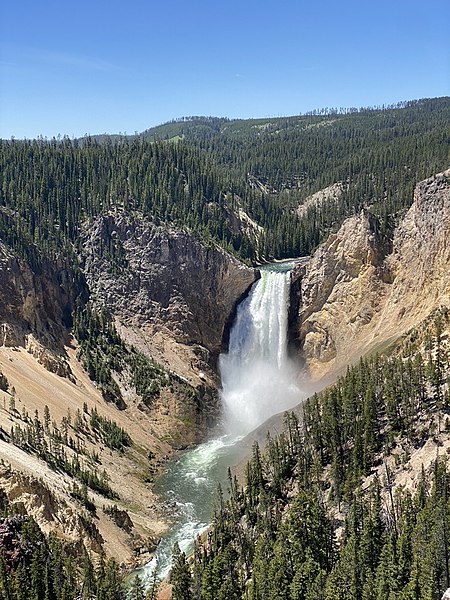
Soon to be a financially performing asset of BlackRock?
Grand Canyon of the Yellowstone, 21 June 2021. Photo by Grastel via Wikimedia Commons.
Delayed but not stopped, the U.S. government is planning a rule that allows for America’s protected lands, including parks and wildlife refuges, to be listed on the N.Y. Stock Exchange. Natural Asset Companies (NACs) will be owned, managed, and traded by companies like BlackRock, Vanguard, and even China.
The deadline was Friday, but earlier this week, the deadline was postponed until January. This is the usual criminal feint from the environmental movement and the administrative state. People are complaining? Let’s put it off till they go back to sleep. Then we will steal their birthright late at night, in precisely the manner we have stolen everything else.
[…]
The entire universe envies the lush interior of the U.S. Increasingly empty, it is filled with a cornucopia of minerals, fiber, food, waters, extraordinarily fertile soil as well as well-ordered, educated, mostly docile people. Worth in the quadrillions, if one could monetize and trade it, financialize it, the way the market has financialized the future labor of Americans, well, it would be like golden coins raining from the sky.
On October 4th, the Securities and Exchange Commission filed a proposed rule to create Natural Asset Companies (NACs). A twenty-one day comment period was allowed, which is half the minimum number of days generally required and when they postponed passing the rule, they did not extend the comment period. “Nope, shut up,” they said.
NACs will allow BlackRock, Bill Gates, and possibly even China to hold the ecosystem rights to the land, water, air, and natural processes of the properties enrolled in NACs. Each NAC will hold “management authority” over the land. When we are issued carbon allowances, owners of said lands will be able to claim tax deductions and will be able to sell carbon allowances to businesses, families and townships. In the simplest of terms, that’s where the money will be made. WE peons will be renting air from the richest people on earth.
The following are eligible for NACs: National Parks, National Wildlife Refuges, Wilderness Areas, Areas of Critical Environmental Concern, Conservation Areas on Private and Federal Lands, Endangered Species Critical Habitat, and the Conservation Reserve Program. Lest you think that any conserved land is conserved in your name, the largest Conservation organization in the U.S., is called The Nature Conservancy, or TNC, which, while being a 501(c)3, also holds six billion dollars of land on its books. Those lands have been taken using your money via donations and government grants, and transferred to the Nature Conservancy, which can do with those lands what it wills.
If this rule passes, America’s conserved lands and parks will move onto the balance sheets of the richest people in the world. Management of those lands will be decided by them and their operations, to say the least, will be opaque.
μολὼν λαβέ, buddy.
The Fact-Checkers found the phrase “kill switch” isn’t in the bill, “proving” it false
Jon Miltimore has yet another example of “fact-checkers” carrying water for politicians to obscure actual facts when they’re politically inconvenient:
In November 2021, former US Representative from Georgia Bob Barr wrote a little-noticed political column claiming that buried inside President Joe Biden’s $1 trillion bipartisan infrastructure legislation was a dangerous provision that would go into effect in five years.
“Marketed to Congress as a benign tool to help prevent drunk driving, the measure will mandate that automobile manufacturers build into every car what amounts to a ‘vehicle kill switch'”, wrote Barr, who was the Libertarian Party’s nominee for president in 2008.
Like most Americans, I had never heard of this alleged “kill switch” until a few days ago when Representative Thomas Massie, a libertarian-leaning Republican, proposed to strip the mandate’s funding.
“The right to travel is fundamental, but the government has mandated a kill-switch in new vehicles sold after 2026,” said Massie. “The kill-switch will monitor driver performance and disable cars based on the information gathered.”
Nineteen Republicans joined all but one Democrat in opposing Massie’s amendment, which failed.
True or False?
The claim that the feds would mandate that every new motor vehicle include technology that could disable the vehicle seemed ludicrous. So I started Googling.
To my relief, I saw several fact-checkers at legacy institutions had determined the “kill switch” mandate was not true.
“Our rating: False,” said USA Today.
“ASSESSMENT: False,” said the Associated Press.
“We rate it Mostly False,” concluded PolitiFact.
(Snopes, a reliably left-leaning fact check group, was a little less conclusive, saying the claim was a “mixture” of true and false.)
Unfortunately, my relief evaporated once I looked at the bill itself.
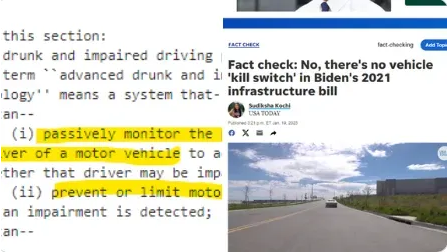
Sec. 24220 of the law explicitly states: “[T]o ensure the prevention of alcohol-impaired driving fatalities, advanced drunk and impaired driving prevention technology must be standard equipment in all new passenger motor vehicles.”
The legislation then goes on to define the technology as a computer system that can “passively monitor the performance of a driver of a motor vehicle” and can “prevent or limit motor vehicle operation if an impairment is detected” (emphasis added).
How the system will make this determination is unclear, as is the government’s potential role in apprehending suspected drunk drivers (more on that later).
But the law’s language could not be more clear: New motor vehicles must have a computer system to “monitor” drivers, and the system must be able to prevent vehicle operation if it detects impairment.
November 19, 2023
“This was a law despised by almost everybody who hasn’t personally had intimate relations with an old-growth tree or an orca”
Colby Cosh meditates on the unexpectedly sensible decision by a Federal Court judge, striking down the Feral government’s virtue-signal-made-law on single-use plastic items:

“Single use plastic objects on pink background” by wuestenigel is licensed under CC BY 2.0 
 .
.
On Thursday a Federal Court judge, the Hon. Angela Furlanetto, startled the Dominion by essentially sweeping aside the Liberal government’s ban on a short list of single-use plastic items, including grocery bags, cutlery, takeout containers and drinking straws. This was a law despised by almost everybody who hasn’t personally had intimate relations with an old-growth tree or an orca. We all now live in a world where we accumulate large numbers of cloth grocery bags and eat takeout meals off of wooden disposable cutlery in the name of the environment; meanwhile, we no longer accumulate the “single-use” grocery bags that us skinflints used to hoard and reuse before consigning them harmlessly to a landfill.
All right, maybe it’s a stupid law that does more environmental harm than good. Federal governments are allowed to make those! But Justice Furlanetto, asked for judicial review by Alberta and Saskatchewan and a coalition of petrochemical processors, concluded that the actual rule was “both unreasonable and unconstitutional”.
Her judgment is a thorny 200-paragraph monster, but the innermost logic of it is simple. The federal Environmental Protection Act allows Ottawa to ban or restrict “toxic” substances that might enter the environment. In 2021 the Liberals made a cabinet order essentially saying “These here single-use plastic items are hereunto declared to be toxic. Abracadabra!” No one can show that these items are actually poisonous in the ordinary sense, and the listed items weren’t condemned as substances, i.e., for their chemical content or composition. The reasoning of the government was that if an Arctic lynx might choke on the ring from a six-pack of Labatt Blue, that kinda sorta makes the plastic in the ring “toxic”, and justifies the federal government in the use of its criminal-law power.
I don’t know if anyone at the cabinet table anticipated how this argument would fare under a “reasonableness” analysis with lawyers for two provinces, plus Dow Chemical and Imperial Oil, among others, on the opposite side. But the government almost certainly faced a piece of extra bad luck in having the case go before Justice Furlanetto, a jurist with hard-science credentials that include a master’s degree in biochemistry. She did not like the slippery game being played with the concept of “toxicity”, not one bit.
In her judgment she observes that the explicitly stated rationale for the plastics ban was that “all plastic manufactured items have the potential to become plastic pollution”. Justice Furlanetto found this reasoning to be puzzlingly ass-backward. “The basic principle of toxicity for chemicals is that all chemical substances have the potential to be toxic,” she writes. “However, for a chemical substance to be toxic it must be administered to an organism or enter the environment at a rate (or dose) that causes a high enough concentration to trigger a harmful effect. In this instance, the reverse logic appears to be applied: all PMI are identified as toxic because they are made of plastic and because all plastic is deemed to have the potential to become plastic pollution.”
November 17, 2023
Israeli government responds strongly to Justin Trudeau’s accusations of deliberate killings of civilians
I guess the electoral calculus shows that there aren’t enough Jewish votes to be gained by backing Israel, so Justin Trudeau is going for the Islamic vote instead:
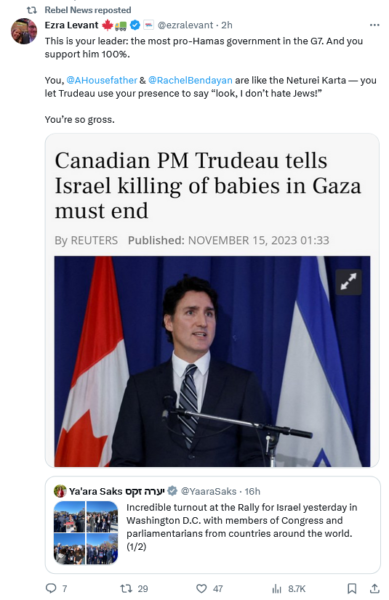
It’s not typical that an Israeli leader will issue an English-language excoriation of a friendly government in a time of war, but this week Israeli Prime Minister Benjamin Netanyahu made an exception for Prime Minister Justin Trudeau.
“While Israel is doing everything to keep civilians out of harm’s way, Hamas is doing everything to keep them in harm’s way,” said Netanyahu in a statement addressed to the Canadian leader. He added, “the forces of civilization must back Israel in defeating Hamas barbarism.”
.@JustinTrudeau It is not Israel that is deliberately targeting civilians but Hamas that beheaded, burned and massacred civilians in the worst horrors perpetrated on Jews since the Holocaust.
While Israel is doing everything to keep civilians out of harm’s way, Hamas is doing …
— Benjamin Netanyahu – בנימין נתניהו (@netanyahu) November 15, 2023
Netanyahu was reacting to prepared remarks Trudeau delivered in B.C. where he accused Israel of killing “women, children and babies”. The statement — which did not place any blame on Hamas for the carnage — urged Israel to exercise “maximum restraint” as “the world was watching”.
It’s but the latest incident in an official Trudeau government response to the Israel-Hamas conflict that has been checkered by confusion, contradiction — and a noticeable alienation from Canada’s usual international allies.
In the first days after the Oct. 7 massacres, Canada was left out of a strongly worded joint statement issued by five fellow members of the G7.
“The terrorist actions of Hamas have no justification, no legitimacy and must be universally condemned,” read the statement co-signed by the leaders of the U.S., U.K., Germany, Italy and France. The statement then urged Israel to “set the conditions for a peaceful and integrated Middle East region.”
Ottawa explained that the statement was issued by Quint – an organization of five countries separate from the G7 that has never included Canada.
But while it might make sense for Quint to exclude its other G7 ally, Japan, it’s more conspicuous that the co-signers never called the G7 member with a substantial Jewish population and a lengthy history of diplomatic support for Israel.
And while Trudeau’s official reaction to the Oct. 7 massacres carried much of the same sentiments, it did include a routine equivocation absent from the Quint statement: Israel had a right to defend itself “in accordance with international law”.
November 16, 2023
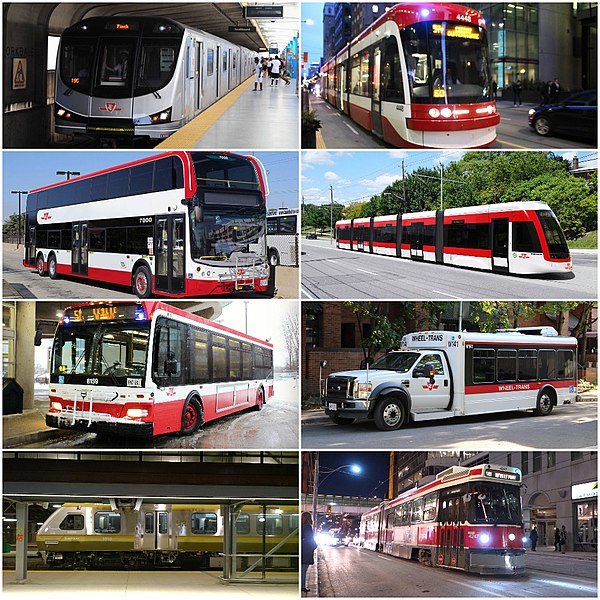
Why progressives love all forms of public transit
Theophilus Chilton reminds conservatives and other non-progressives that trains, buses, and other forms of mass transit are beloved of the left at least partly because the more people depend on it, the more control the government gains over their freedom of movement:
TTCImages by Canadian8958
Wikimedia Commons
Ask most people on the broad Right what they think about public transportation and they’d probably tell you that they don’t like it. And it’s not just because of the smell and the gum stuck to the seats. Most of us, deep down inside, at least in some subconscious way, feel that mass public transportation is just a little bit communist.
[…]
This is probably much of the reason why we’re in love with the automobile. With the wide-open spaces and abundant road system we enjoy in America, most Rightists would never dream of trying to force everyone to use an archaic, 19th century technology like trains now that we don’t have to. The automobile is a symbol of freedom. You can go wherever there’s a road, no matter how big or small, when you’re in an automobile. You’re not boxed in with dozens of other people on a line that goes one place only. This is why we generally tend to view air travel as a necessary evil — if somebody invented a car that could get us from Boston to Los Angeles in six hours for a business meeting, we’d probably opt for that instead of getting groped by your friendly neighborhood TSA agent.
Progressive leftists know all of this. They know that the freedom to travel where we want, when we want, how we want, is a psychological buttress to our sense of liberty. Pod-people stay put and go where they’re told. Free men hop into their ’67 Mustang and lay rubber in front of a Dairy Queen three towns over from their own.
Hence, in their never-ending quest to gain total control over our lives, the Left has been putting into play a number of plans designed to limit our freedom of travel.
In case you weren’t aware, one of the purposes served by forcing gasoline prices sky-high is to make private automobile travel prohibitively expensive for more and more people. This has been a major thrust in the “global warming” nonsense that the Left has pushed as well — cars supposedly account for the lion’s share of carbon dioxide emissions (even though they actually don’t), so their use needs to be reduced. Way back in the Obama administration, somebody in the Congressional Budget Office accidentally let the cat out of the bag that it would be a great, absolutely smashing, idea to tax Americans for each mile they drive. Every so often the idea gets resurrected in the media, but thankfully doesn’t seem to have gotten much traction yet. Of course, this is essentially what already happens to us anywise, since we have to pay taxes on each gallon we buy to drive those miles. Presumably, this mileage tax would be added on top of the gas taxes already in place.
The whole point to this is not to “stop global warming”. Let’s face it, those in the know at the top of the progressive hierarchy know that global warming is a hoax. They know it’s just prole-feed for the useful idiots in their own ranks and for the easily swayable among the public at-large. The point to inducing people to stop driving cars is not to save the earth, but to reduce the freedom of movement that people have. Take away cars and you take away the ability of most people to travel for pleasure. You take away their means of conveniently conducting much of their commerce and other business. You would prevent them from being able to have forest hideaways and beach homes. In short, you prevent the middle and working classes from having the same things that the rich can have, you keep them from having lifestyles that even begin to approach the type, if not the extent, of the global transnational elite. Most of all, you would take away that psychological sense of freedom that the ability to move about unhindered gives to people. It’s about forcing us all into the Agenda 2030 “You’ll own nothing and be happy” scenarios that the globalist world-planners have prepared for us.
More recently, and more concretely, is the Congressional effort (which ineffectual Republicans failed to stop) that would direct automobile manufacturers to include a “kill switch” into all vehicles made after 2026, a device which would allow authorities to shut down a vehicle remotely. Ostensibly, the reason would be if the driver is acting like he or she is driving while impaired (i.e. it’s FoR yoUr SaFeTy!!1!). Of course, we know the actual reason is to provide bureaucrats and functionaries in the managerial state the means to freeze the movement of dissidents and others who run afoul of the Regime’s dictates. Don’t think they’d do that? Well, these are the same people who just put the infant son of a J6 defendant on the no-fly terrorist watch list.
So, what would have to replace private automobile travel, once nobody but the super-rich will be allowed it? Public mass transportation, of course. Buses, light rail, subways. This has already largely happened to those poor unfortunates who dwell within our large cities and for whom the lack of parking, expensive personal property taxes, and archaic road systems have already removed the automobile from being a viable alternative. The lefties work to extend this system even to places, such as smaller cities, the suburbs, and even the exurbs, where such systems normally would not be “needed” or desired. Make parking in the city so scarce as to be impossible to find, or so expensive that you’d rather take the bus. Provide “free” bus service (paid for by the taxes of productive, automobile-driving people, of course) to encourage people to stop polluting. In several places, the lefties keep trying to push their light rail boondoggles so that the system can be extended between cities — no more need to have people killing Mother Gaia with highway driving. These public systems are there to take up the slack once private transportation is turned into road pizza.
So how does this affect our freedom? Well, it’s because of the fact that mass transportation is inherently restrictive in its approach to people delivery. A bus route can’t include every single possible place that people might want to get on or off the bus. It only follows certain routes. Same with AmTrak, with light rail, subways, etc. It’s easier, then, to control the access which people have to transportation.
November 14, 2023
Australian voters rejected “The Voice”, fearing “they were being sold a pig in a poke”
Theodore Dalrymple on the recent failure of the Austrialian government to install a nebulous and ill-defined advisory body for Australian Aboriginal and Torres Strait Islander representation to Parliament:

Uluru Dialogue co-chair Pat Anderson in an early ad for “The Voice” referendum.
Screen capture from YouTube.
Among my wife’s family papers dating from the Occupation of France are a couple of certificates of aryanité issued to her forebears, that they might continue to be employed and not deported. In Australia, people apply for certificates of aboriginality, in order that they might receive various advantages, subventions, etc.
The former is bad racism, the latter good, at least for those who believe in positive racial discrimination. Unfortunately, it is logically impossible to believe in positive racial discrimination without also believing in the negative kind, irrespective of one’s supposed good intentions.
Australia recently held a referendum on a proposed race-based amendment to the constitution. The amendment proposed something called “The Voice” to be inscribed in the constitution: an advisory body composed of Aborigines who would advise parliament on matters specifically affecting Aborigines. The details of the proposed body — how it was to be chosen or appointed, its purpose, its powers, its duties, its emoluments — were not specified, and those in favour of it, up to and including the Prime Minister, Anthony Albanese, were either unwilling or unable to specify further, relying entirely on the Australian emotional equivalent of Noel Coward’s famous song, “Don’t Let’s Be Beastly to the Germans”. The latter was not much of a policy.
Australian voters, initially favourable to the proposal, rejected it by a large majority, suspecting, rightly in my view, that they were being sold a pig in a poke. They also suspected, I surmise, that what was being proposed was a corrupt and corrupting bureaucratic pork barrel that would reward a small class of Aboriginal Al Sharptons. Far from improving the situation of Australian Aborigines, which is sometimes but not always tragic, the Voice would permanently raise the ideological temperature and prevent measured debate about practical improvements. Benefits would be received without gratitude and, would never, virtually by definition, be sufficient. And of course, the Voice would be the end of the ideal of racial equality. Australia would join the old South Africa in its inscription of race in its constitution.
The abysmal intellectual level of the proponents of the Voice was very well instantiated in an article by Thomas Keneally, the famous Australian novelist, in the Guardian newspaper. It began as follows:
Last Sunday, many in Australia profoundly mourned the loss of the Indigenous voice to parliament referendum, the greatest kindly Amendment ever to be proposed for the Australian constitution, those dreary old articles of association by which our states and territories rub along together in far-flung federation.
I will overlook the use of the word profoundly in this context: I think the words superficially, self-satisfactorily, and exhibitionistically would have been better. But note that, even if the loss were deeply mourned, only the grossest of sentimentalists would claim that such mourning would have any bearing on the rightness or otherwise of the loss that was mourned. Many Nazis and many communists mourned the loss of Nazi Germany and Soviet Russia far more deeply than any Australian mourned the loss of the referendum, but no one, I think, would sympathise with them because of the depth of their sorrow.
November 13, 2023
Lessons for Canada from the Australian referendum on “The Voice”
Conrad Black contrasts the experiences of First Nations in Australia and Canada after contact with European explorers and settlers and the recent attempt to create a formal role for Aboriginal representation in the Australian Parliament.
Uluru Dialogue co-chair Pat Anderson in an early ad for “The Voice” referendum.
Screen capture from YouTube.
Canadians should perhaps pay more attention than we have to the referendum in Australia on Oct. 14 on the subject of the Aboriginal peoples. There are just under one million designated Aboriginals in Australia, slightly below four per cent of Australia’s 25 million people. The roughly corresponding figures in Canada are that Indigenous Canadians, including in both countries a good number of mixed ancestry, are slightly under five per cent — just, at under two million in a population of 40 million. The issue in the referendum was a proposed amendment to the Australian Constitution by which a federal advisory body comprised of native people would be set up which would have only a consultative role. How this body would be selected and its recommendations presented would be dealt with later. The idea was just to give Aboriginal people, in the wording of the referendum, a “voice” in the politics of the country.
The history of the white settlers of Australia and the natives whom they encountered there is fairly parallel to the Canadian experience. Initial contact was friendly enough, but there was a native vulnerability to certain diseases to which the Australian natives had had no occasion to develop an immunity. Their lands were gradually encroached upon although the inconvenience to them was for a time not as great as it was in Canada where the conversion of huge tracts of arable land on the prairies into immensely productive grain producing farms made it steadily more difficult for our native people to maintain that part of their diet based on the buffalo. Australian Aboriginals had less difficulty, at least for some time, retreating to places that did not especially attract the settlers, and where it was comparatively possible to maintain a traditional life.
However, there was soon inevitably interaction, some of it successful intermarriage, and some of it outright racial friction with not infrequent outbursts of violence, though nothing on the scale of the Riel rebellions in this country, let alone the outright warfare of the American Indian Wars. But eventually, reservations were created for some Australian Aboriginals. In contrast to this country, there was practically no attempt to help formally educate them or to assist them in integrating into the larger Australian society. They were gradually pushed to the nether regions of the immense country, almost as large as Canada and with a greater habitable area, and the provision of health and education services to the natives was greatly less generous in the amounts of money and numbers of personnel involved than the corresponding efforts in Canada.
Gradually the theory developed and took hold in Australia that perhaps the early settlers and the autonomous government of Australia created by the British in 1901, could have been more generous and thoughtful. As these matters tend to do, the issue gnawed somewhat at the conscience of white Australia and finally in 2008, the government of Australia passed through both houses of its Parliament an apology and expression of regret for past injustices. There was nothing remotely like the orgy of self-defamatory penitence backed by stupefying amounts of money that has flowed in this country like the Niagara River onto the native people.
Shortly after the new Labor government in Australia was elected in 2022, it proceeded with its declared intention to hold a referendum on the issue of giving the Aboriginal peoples a “voice”. And soon after this campaign began, it became clear that the proposed measure was going to have a rocky ride with the country. The predominant opinion among Australians above the age of 45 was that the native had the opportunity to participate fully in Australian life and that there were some substantial gestures of assistance made to them that the more purposeful native people took up.


