So it goes with the Juggalos. There are still nodes of the Apparat that perform competently to brilliantly. Since we’ve been using the Pacific War, let’s go ahead and call Tubman’s Illegitimate Gangster Regime (TIGR) the “Flying TIGRs”. It’s clear that the Flying TIGRs really really want their war with China, in the same way it seemed clear at the time that Wheels Roosevelt really really wanted his war with Japan (more correctly, really really wanted his war with Germany, but Japan had to be the patsies). And yet, they keep doing things that make no goddamn sense — indeed, they make anti-sense.
I suppose this should be a post unto itself, but very briefly, If They Were Serious about war with China, you’d expect a few very basic things. Massively stepped-up armaments production, if nothing else, and if you wanted to be really slick about it, you’d do it under the guise of replenishing all the stocks we sent to our plucky allies in Ukraine — purchase orders for 100x the total amount shipped to Keeeeeve, that kind of thing. But that’s the kind of retooling that’s hard to hide, because it would also involved massively stepped-up mining, refining, and so on, not to mention upgrading the transportation infrastructure and so on.
None of those things appear to be happening. And since even an all hands on deck, Nazi-style crash rearmament program has a lag time of a few years, If They Were Serious about premiering Showdown in the Taiwan Strait anytime in the next decade, they’d be jamming that shit out NOW. Right now. Afterburners full.
You also need soldiers to use all that stuff, so you’d expect massively stepped-up military recruiting. Which would entail, at minimum, a push to get American boys into some kind of fighting shape. Which not only isn’t happening, but the exact opposite is happening. Unless you want Uncle Sugar to pay for your “top surgery” or your addadicktome, why would anyone enlist? When you further consider that the same TLAs who are so smoothly rolling out their Hate the Han™ campaign could easily order up some ultra-jingoistic remakes of Stallone movies from the 1980s, it seems as if They are not, in fact, Serious …
… but some of the nodes are, because failure is a distributed system. I love playing If They Were Serious — it’s my favorite drinking game — but alas for me, it relies on the Assumed Internal Consistency Fallacy. Like the Japanese Navy, or the Wehrmacht on the Eastern Front, or even poor Adm. Kimmel, you’ve got certain nodes of the Apparat performing competently to brilliantly in the service of skull-fuckingly stupid objectives, or NO objectives. The Flying TIGRs are even dumber than [Hitler], who at least called a meeting to say “Hey, how’s about we invade Russia in the winter?” While it’s clear to everyone who matters that the TIGRs really really really really really want their war, nobody’s in charge, so everyone is left to figure it out as best they can, on their own initiative, with the resources they have to hand.
And again, much like the Wehrmacht etc., the better the competent nodes perform, the harder and faster the overall system failure. We’re going to end up charging headlong into a war with China because the TLAs at Twitter etc. are doing such a great job making Hate the Han™ the Current Thing. Meanwhile, one imagines Brandon’s handlers telling their Chinese paymasters that no no, that won’t be happening, please don’t cut off our paychecks. And since they’re pretty good at their job, too — their job being “telling Beijing what they want to hear while lugging away huge sacks of cash” — it’s gotta fuck with the People’s Liberation Army command staff.
Consider further that the Army (etc.) are, Kimmel-style, doing a pretty decent job of carrying out their on-paper objectives. Kimmel was told “Get the Fleet ready for a likely confrontation with Japan a few years down the line”, and he did it. The Fistagon has told all its commanders to get ready for a war with China, yeah, sometime down the line … but right now, the important thing is to get as many gays, girls, and trannies as possible into uniform while promoting the Diversity that’s already in uniform as far up the chain of command as possible. General Sasqueetchia, in command of the Fightin’ 45th Mechanized Hairdresser Battalion, says thanks for a job well done … and it IS a job well done, according to the only actual orders anyone has received.
Fun times, right?
Severian, “Failure Nodes”, Founding Questions, 2023-04-18.
July 19, 2023
QotD: If they were serious …
July 18, 2023
QotD: “Nothing to lose”
The article was written in a for-and-against fashion, giving both sides a fair opportunity to put their case. And the case for the practice was that it allowed people to express their anger, whose object was not specified. In other words it was their anger which made them and their actions morally right; presumably, therefore, the angrier they, or anyone else, felt, the more rightful they became. This does not seem to me to be a recipe for psychic, let alone, social, harmony, but rather for a permanent Balkan war of the soul.
In line with the notion that people need “a stake in society” in order to refrain from breaking shop windows and taking what they think they have been wrongfully denied (interestingly, the bookshop was the only shop in a very badly looted commercial street that went completely unscathed during the riots), a man called Earl Jenkins — “who was one of up to 60 youth workers who went on to the streets of Toxteth [a poor area of Liverpool] during the disturbances to persuade youngsters not to get involved” — was reported in the Guardian to have said, “If you’ve got nothing to lose, you’ll do what you can to survive, won’t you?”
There was no comment in the newspaper on the deep contradiction in the attitude of Earl Jenkins (let us leave aside the question of how many “youth workers” in Toxteth are needed to prevent a riot there). For if it is true that the riots were a survival mechanism, why was Earl Jenkins trying to persuade young people not to join in? Did he not want them to survive? Suffice it to say that the objects looted during the riots were not such as people on the verge of famine, or who fear that famine is around the corner, might be expected to loot. They were, rather, the things that spoilt children might be expected to want for their birthday.
The term “If you’ve got nothing to lose” in this context is ambiguous. It might mean such penury, such drastic poverty, that you possessed nothing that could have been removed from you. But it clearly cannot mean this, since all the rioters were at liberty, and were clothed, fed, housed, educated (if unsuccessfully), provided with medical care, and given at least a small income, much of which could, in theory at any rate, be removed from them. They could be made homeless; their central heating could be turned off; they could go hungry and literally penniless, made to wear rags; their telephones could be taken from them; they could be deprived of their liberty and even enslaved.
But none of this was going to happen to them and they knew it perfectly well; so in this sense it was indeed true that they had nothing to lose. One of the commissioners appointed to enquire into the riots actually put it succinctly:
When people don’t feel they have a reason to stay out of trouble, the consequences for communities can be devastating …
But the reason they “don’t feel a reason to stay out of trouble” is not because they have nothing to lose in the sense of being so deeply impoverished that they have nothing removable from them, it is because they have nothing to lose because they know that whatever they have will never be removed from them, under any circumstances whatever.
Theodore Dalrymple, “It’s a riot”, New English Review, 2012-04.
July 17, 2023
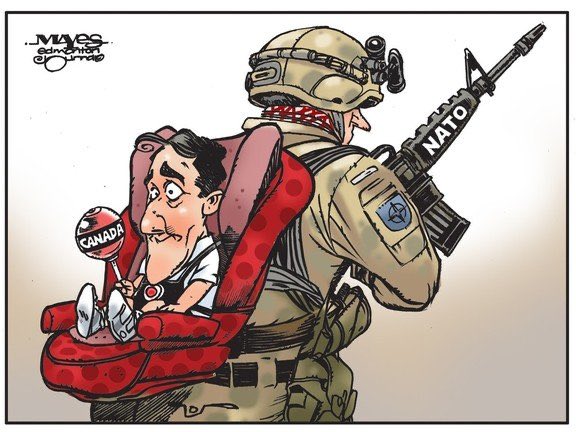
Canada has been one of the biggest freeloaders in NATO for more than 40 years
From the weekend Dispatch from the editors of The Line, some indication that even the American legacy media are tired of Canada’s generations-long peace dividend freeloading at the expense of our allies:
American media doesn’t often notice Canada, and as much as Canadians like to whinge about being ignored, the lack of interest in our affairs from south of the border is usually a good thing. If you’re looking for a rule of thumb here, it’s this: attention from the Americans is almost always negative.
A case in point this week was an editorial published by the Wall Street Journal on Wednesday, headlined “Canada is a military free-rider in NATO”. The subhed was “Ottawa still spends only a pathetic 1.38% of GDP on defense”. The editorial makes a number of points almost all of which will be familiar to readers of the Line, which are all variations of: Canada shirks its NATO commitment to spend two per cent of GDP on defence, while engaging in relentless virtue signalling and moral preening, both domestically and to its allies. It treats national defence as social project, while doing little to nothing in the way of actually projecting the power that is needed to defend the values it purports to advance.
There are some absolutely killer lines in the editorial, beginning with the lede: “Canadian Prime Minister Justin Trudeau was in Lithuania this week for the annual NATO summit, but it’s too bad there wasn’t a junior table where he could sit.” A few paragraphs later: “Last week Ottawa put in its two cents against cluster munitions. But asking its citizens to meet their actual obligations to the cause of freedom is apparently too much to ask.” And then: “Nowadays Ottawa can be counted on to ‘fight’ for human rights, which is to say that it talks a lot about them.”
Again, for anyone paying attention here in Canada, these are not new arguments. But the editorial does add one twist at the end, suggesting that if Canada can’t be bothered keeping its NATO commitments, then perhaps it should be kicked out of the G7 and replaced by a country willing to play a leadership role. They suggest Poland as a possibility.
Reaction in Canada has been surprisingly muted. On our own social media feeds, we noted a lot of rather sad attempts at dismissing the editorial — the paper is a Rupert Murdoch owned rag; this is Trumpist nonsense; Europeans juice their defence spending through useless mandatory service requirements. But curiously, we didn’t see anyone try to pull a Julie Dzerowicz and argue that, despite all evidence to the contrary, Canada is actually punching above its weight in NATO.
Look, some of us here at The Line have been reading harsh editorials on Canada’s defence spending for decades. (We’ve written a few, too!) And we’ve never seen anything remotely this harsh from an American outlet. This is absolutely devastating stuff, and it can’t be simply shrugged off because of the source.
A bit of history: In 1995, the Wall Street Journal published an editorial calling Canada “an honorary member of the Third World” in an editorial that also referred to the Canadian dollar as the “northern peso”. This was in response to Canada’s national debt and tax rates hitting unsustainable levels. We were an economic basket case, and the Americans were starting to notice.
Lots of Canadian commentators dismissed the editorial on the grounds that the WSJ was just pushing the supposedly-discredited Reagan/Thatcher/Mulroney “neoliberal” agenda. But later that year the Chrétien government, with Paul Martin as finance minister, introduced one of the most significant budgets in Canadian history. They slashed federal spending in ways not seen since the end of the Second World War, slashed the public service, gutted the department of defence. But three years later they had balanced the budget, inaugurating an extended period of federal fiscal responsibility that lasted until the election of the Trudeau Liberals in 2015.
The point is not that there’s a cause and effect here — Jean Chrétien and Paul Martin didn’t sit down and go “oh shit, the Journal has weighed in, we have to do something”. It’s that when serious American media get around to noticing stuff about Canada, it is usually because the stuff they are noticing has become such a problem for other countries that our national Emperor’s New Clothes routine is no longer tenable. It is a sign that things have to change, and quickly.
Remember, the Liberal government doesn’t deny that Canada is a NATO laggard and a free rider on defence. Justin Trudeau has admitted as much, both publicly and privately. But up till now, his attitude has been to sort of smirk at the Americans, give his usually smarmy shrug, and say “what are you going to do about it?”
What the Wall Street Journal editorial does is suggest that there could be real consequences for our professed indigence. It is one thing to be left out of AUKUS, which the Liberals continue to falsely characterize as a submarine procurement deal. Getting kicked out of the G7 would something else entirely — it’s the sort of thing the sorts of people who vote Liberal tend to care about.
Canada’s current attitude to collective defence is not sustainable. Our allies have noticed. Either we change, or our allies will change things for us.
July 15, 2023
The French Intifada
Ed West on the origins of the rising violence in French towns and cities:

I ran an image search for “Paris rioting” and there was a plentiful supply of fiery, eye-catching photos. Not all of these are from the most recent outbreak of violence, but they are certainly representative of how the legacy media is covering the situation.
The recent violence in Paris and elsewhere, which saw attempts to ram the home of a mayor, once again highlighted the trouble the country has with integration. But the French police union describing themselves as being “at war with vermin” illustrated the different mindset to the English-speaking world, and the far more belligerent approach to the problems of diversity.
Like Britain, the Netherlands, Germany and Sweden, France has had difficulties assimilating the children of immigrants from beyond Europe, yet its recent history has proved especially violent and troubled. Britain has jihadi terrorism – 2017 was especially grim – but it has never reached such intensity. Today, as over 130,000 police officers stand guard to protect the Republic on the day of its celebration, it is worth considering the journey that brought it to such a state.
Analysts have often compared Britain’s state multiculturalism with France’s system of laïcité, which tends to downplay the existence of “communities” even to the point of not taking demographic statistics. Although neither country’s approach has entirely been a success, France’s refusal to recognise immigrants as anything but French has often been blamed for the widespread sense of alienation.
Others point to the housing system, which tends towards concentrations of North and West Africans in suburban banlieues, or the less laissez-faire economic policy which results in higher unemployment (in exchange for better social security).
While they no doubt play a part, the biggest single difference is history, as Andrew Hussey recounted back in 2014 in The French Intifada, in particular France’s history with North Africa. To put it in British terms, imagine that Britain’s rule in Pakistan had involved not a small number of administrators and soldiers but instead hundreds of thousands of British settlers arriving in the country, many with the intention of making it a “new America” (i.e. driving the natives out).
That Britain had declared Pakistan an integral part of the country, and that, rather than scarpering in indecent haste when the empire began to disintegrate, Britain had dug in to preserve its rule in a sadistic war of independence, one in which natives and white settlers committed countless atrocities against each other.
And that this violence had spilled into Britain with assassination attempts and terrorism, by both sides, destabilising the country to the point where there was talk of a coup. And that this was happening just as large-scale immigration to the colonial power was taking place.
Britain experienced nothing like as much violence in the dying days of empire, and indeed the only real comparison with our history was the moment when there was almost all-out conflict between Britain’s Protestant and Irish Catholic populations before the First World War.
If French politicians so casually talk of “civil war” between its right wing and the Algerian-descended population, it is because it has already played out this conflict before – one that was never healed, and so invites a sequel.
One heartbeat away
Joe Biden is old and his age is clearly a factor in his declining ability to carry out his duties as President. If he dies or is forced to leave office before his term is up, Kamala Harris would succeed him. If that isn’t a scary thought, you haven’t been paying attention:
When it comes to preferences based on identity of one kind or another, it is difficult to know where to start with this insufferable and corrupt woman who may be the next President of the United States of America. First, she is a woman, or at least identifies as one. Second, she is a woman of colour. Third, she is black. Fourth, she is an Indian American woman. And last, but definitely not least, she is a woman of Afro-Caribbean heritage. In other words, she is highly qualified to achieve success in Biden’s America.
The daughter of two college professors, Kamala Harris is poised to become the first female president of the United States for one reason alone: her demographics. She is a very visible poster child for all that is wrong with the system of preferences and favoritism based on identity and immutable characteristics which has replaced the ideals of meritocracy and colour blindness.
Sadly, Vice President Harris is not alone. Those willing to trade their identity for professional advantage are growing in number by the day. Indeed, such individuals are being encouraged and are found aplenty throughout state and federal government, public schools and academia, corporations, and increasingly in law enforcement and the military.
Recently, Harris attended the Essence Festival of Culture, organised by Essence, a magazine aimed at black women. Asked to explain the role of culture in enhancing and securing the achievements of African-Americans, she treated her audience to one of her delectable word salads that have become the hallmark of her vice presidency.“Culture is …” she informs us after a slight pause, “it is a reflection of our moment and our time. Right?” she asks, seeking reassurance from her interlocutors. “And present culture is the way we express how we’re feeling about the moment and we should always find times to express how we feel about the moment. That is a reflection of joy. Because,” she adds, in an inexplicable allusion to Psalm 30, “[joy] comes in the morning,” before bursting into that cackling laughter which can engender suicidal thoughts in vulnerable people, including the current author.
She goes on: “We have to find ways to also express the way we feel about the moment in terms of just having language and a connection to how people are experiencing life. And I think about it in that way too.”
My goodness! Are those the words of a woman who could have access to the nuclear codes in just under two years? I am afraid they are. They are the words of someone whose rise to legislative and executive power has been determined entirely by the immutable characteristics of sex and race and the calculus of political advantage.
Only a nation which has abandoned the meritocratic values that made it great could produce such a paragon of ineffable mediocrity as Kamala Harris. Only a nation which has lost its aspirations to greatness will continue to elevate men and women to positions of high rank on the basis not of talent, ingenuity, and character, but demographic attributes that check the right boxes and ignore merit, privileging cosmetics over competence. If this madness continues (and it will take a lot more than the recent SCOTUS ruling to make it go away) such a policy will eventually spell doom for America, maybe sooner than you think.
July 14, 2023
Bread rationing in the United States during WW2
I haven’t studied the numbers, but I strongly suspect that most US government food rationing during the war was effectively theatre to encourage more support of the war effort: except in a very few areas, the US was more than self-sufficient in most foodstuffs. At the Foundation for Economic Education, Lawrence W. Reed recounts one of the least effective government moves in food rationing:
According to an old joke from the socialist and frequently underfed Soviet Union, Stalin goes to a local wheat farm to see how things are going. “We have so many bags of wheat that, if piled on top of each other, they could reach God himself!” the farmer told Comrade Stalin.
“But God does not exist,” the dictator angrily replied. “Exactly!” said the farmer. “And neither does the wheat.” Nobody knows what happened to the farmer, but at least Stalin died in 1953.
Soviet socialism, with its forced collectivism and ubiquitous bread lines, gave wheat a bad name. Indeed, it was lousy at agriculture in general. As journalist Hedrick Smith (author of The Russians) and many other authorities noted at the time, small privately owned plots comprised just three percent of the land but produced anywhere from a quarter to a half of all produce. Collectivized agriculture was a joke.
America is not joke-free when it comes to wheat. We are a country in which sliced bread was both invented and banned, and a country in which growing wheat for your own consumption was ruled to be an act of “interstate commerce” that distant bureaucrats could regulate. No kidding.
On this anniversary — July 7 — of both the birth in 1880 of sliced bread’s inventor and of the day in 1928 that the first sliced bread from his machine was sold, it’s fitting to recall these long-forgotten historical facts.
The Iowa-born jeweler and inventor Otto Rohwedder turned 48 on the very day the first consumer bought the product of his new slicing machine. The bread was advertised as “the greatest forward step in the baking industry since bread was wrapped” and it quickly gave rise to the popular phrase, “the greatest thing since sliced bread.” Before 1928, American housewives cut many a finger by having to slice off every piece of bread from the loaves they baked or bought. Sliced bread was an instant sensation.
Rohwedder earned seven patents for his invention. The original is proudly displayed at the Smithsonian Institution in Washington, D.C. He likely made a lot more money from the bread slicing machine than he ever did as a jeweler. He died in 1960 at the age of 80.
Enter Claude Wickard, Secretary of Agriculture under Franklin Roosevelt from 1940 to 1945. On January 18, 1943, he banned the sale of sliced bread. Exactly why seems to be in dispute but the most likely rationale was to save wax paper and other resources for war production. He rescinded the ban two months later, explaining then that “the savings are not as much as we expected.”
I’m sure Hitler and Hirohito were relieved.
July 13, 2023
“… if Ukraine were to join NATO in the middle of a war, then congrats – most of Europe and North America are at war”
As I’ve said several times, I have great sympathy for ordinary Ukrainians caught up in a war not of their making, but I’m not a fan of the awesomely corrupt Ukrainian government. NATO nations providing weapons, ammunition, and training is fine, but in no way is Ukraine ready to become a member of the alliance and will not be until after this war is over and they conduct a very significant set of anti-corruption reforms in their national government. CDR Salamander points out the insanity of western pundits demanding that NATO add Ukraine to the alliance in the middle of a major war:
I understand the desire for Ukraine — and others for that matter — to be part of NATO. I also understand why the frontline states in Central Europe such as the Baltics republics and Visegrad Group would like Ukraine in as well. Defense in depth and long fronts are a thing.
As much as I can sympathize with the above, I also understand the reasons that Ukraine and other nations may never be right for NATO membership, or at best be a decade or two out. Single points of failure triggers to another world war — where every new member state increases the aggregate risk to all members — is not a minor thing to consider.
There is also the very real fact that Ukraine is in a war right now, for her an existential war with Russia. This CNN article is a perfect example of some of the absolutely foolish questions people are even considering right now. I’m not even going to quote from it as there are dozens like it out as the NATO summit is going on. It is a waste of your time.
You don’t need to be an international lawyer to understand that if Ukraine were to join NATO in the middle of a war, then congrats — most of Europe and North America are at war. As history tells us, when Europe and North America goes to war, eventually the world joins in.
For today’s post, I’d like to pull some quotes from a superb Financial Times article, NATO’s dilemma: what to do about Ukraine’s bid to join?
Membership represents the long-term security that Kyiv wants and was promised 15 years ago. But Russia’s war has complicated things
When Ukrainian President Volodymyr Zelenskyy strides into Nato’s annual summit in Vilnius on Wednesday, his country will have been fighting a full-scale war of survival against Russia for 503 days.
2008, in the last year of the Bush-43 administration. The year it looked like we had Iraq stabilized yet were already planning to take the keys in Afghanistan back from NATO after the alliance culminated in the summer of 2007.
The year of imperial overreach in denial;
It was over breakfast in Bucharest in 2008 that the seeds of Nato’s current dilemma were sown.
At an early morning meeting on the second day of the alliance’s summit that year, then secretary-general Jaap de Hoop Scheffer met with US president George W Bush and his French and German counterparts Nicolas Sarkozy and Angela Merkel.
The outcome of that breakfast, and a result of Merkel softening her opposition to Bush’s proposal to offer membership to Ukraine and Georgia, was a statement by the entire Nato alliance.
Both countries “will become members of Nato”, it said, without providing a timeline. That declaration, at the same time both unequivocal and non-committal, was hailed as a major achievement. It has since sunk into infamy.
Amazing how people forget that other nations get a vote. Your actions will cause reactions by those who either think they will benefit from or be endangered by them. Roll that simple context in to the 1,000 year record of people west of the Vistula misreading Russia and you have this;
Four months later Putin’s tanks rolled into northern Georgia. In 2014 his special forces annexed Ukraine’s Crimean peninsula. Nato, as Putin knew well, refuses to accept new members with “frozen conflict” on their territory. Aside from condemnatory rhetoric, Nato did little to punish Moscow. Putin, who had been present at the Bucharest summit as a guest, had called Nato’s bluff.
Putin was right. No one will join NATO who has border disputes or are best known for their globe-spanning corruption.
NATO and the USA’s natsec “blob” was, again, wrong. Being wrong isn’t the problem. It is an imperfect business where mistakes are going to be made. The important thing is to learn from them and if the same people and institutions are perpetually wrong, you get new people and institutions to help you make decisions. That is the danger. It isn’t that we “remember everything but learn nothing” it is more that we “remember only what confirms our priors and only learn to try harder next time.”
July 11, 2023
The obesity crisis … fuelled by iatrogenic public health warnings about certain food groups
Here’s The Armchair General with another example of what he calls COGOs – Crisis of Government Origin:
So, after the decades-long crusade against saturated fats, we have a population that has been repeatedly told that fat will kill us. So, many people eschewed fats in favour of salt and sugar. Which, apparently, are also bad for us.
But without saturated fats, remember, people are not going to feel sated. So, what is likely to happen? Well, just what did happen — never feeling full, people feel hungry throughout the day so eat continually through the day: a behaviour known as “snacking” …
Nutritionists believe many people are obese not because they binge on fatty main meals but because they indulge in constant grazing throughout the day without even realising it.
This pattern, dubbed “auto-eating”, involves resorting to snacks and treats at the slightest indication of hunger.
Or, rather, people always feel hungry because they have been told to avoid saturated fats. And they snack on chocolate bars and biscuits and small things that provide a pleasant sugary boost.
Combine this with an increasingly sedentary population — both at home and at work — and other comforts (such as central heating which leads to fewer calories being expended on maintaining body temperature), and…
BOOM! You have an obesity problem.
And now — nearly seventy years after some arrogant doctors used some extremely dodgy studies to enhance their reputations, we now know that what we were told about the harms associated with saturated fats was all absolute bollocks.
And so, once again, we can demonstrate another Crisis of Government Origin (COGO), ably assisted by the arrogant fuckers of the medical profession.
Unfortunately, the government legislation is already in place, and it will take at least three years for the fuck-nuggets in politics to catch up — if they ever do. After all, they are going to have to undo decades of medical advice, government food advice, leaflets, bus adverts, nutritionist training, and social conditioning.
Just another reason why governments should stay the hell out of our private lives. Such up — and fuck off.
QotD: The Calgary Stampede
… there are those in Calgary who, in their most secret of hearts, would love to abolish the Stampede and wipe out its memory. The Stampede, to the Calgarian, is both curse and blessing, and when all the curses are thrown into the balance, you cannot help being impressed by their weight. For starters, the Stampede kills. And we’re not just talking about the chuckwagon races. There’s a scholarly paper from 2006 in which statisticians from Montreal and Edmonton wrote about their efforts to develop forecasting models for EMS demand in Calgary. They found the numbers don’t quite work unless the Stampede is included as a variable: ambulance and rescue services become so busy during the 10-day party that it throws all the equations off-kilter.
The Stampede itself is very solvent, earning an operating surplus of $3.1 million in 2011, but if the costs and benefits to the city were all counted up, the former would have to include the salaries of the thousands of high-paid Calgary professionals who see major parts of their calendar devoured by Stampede preparations and aftermath. It would include the tacit outright cancellation of nine-to-five work for the duration of the Stampede at key Calgary oil patch companies and law firms. And it would include the arms race of conspicuous consumption that sees expensive entertainers like Cirque du Soleil and the Tragically Hip brought into town for exclusive corporate affairs at Stampede time.
Meanwhile, the perceived importance of the Stampede has led to the entrenchment of a shadowy, at least slightly sinister relationship between the city’s government and the Stampede board. It took a long skein of bailouts, sweetheart deals and low-interest loans from Calgary’s city government to make the show what it is today. Over the decades, Calgary has repeatedly used its power to borrow cheaply to fund Stampede expansions, and even expropriated land outright in the Victoria Park neighbourhood in the late 1960s when some homeowners were reluctant to sell. Because the city technically owns the Stampede grounds, the Stampede pays no property tax on them. Conflicts of interest are rampant and ignored, except on those occasions when the Stampede tries to pull off some particularly ambitious business or real estate deal. Local media know they must tread carefully before broadcasting or printing anything even slightly negative about the various entities that sustain the city’s totemistic event.
Of course the Stampede has made the name of Calgary world-famous. Calgarians abroad are as sure to be asked about their Stampede as Edmontonians are to be asked about their big mall. But the marketing effect is double-edged. Andy Sayers, a communications specialist for a mid-sized Calgary oil-patch-service company, says he and others in his field “struggle with themselves” every year as the bacchanal he compares to “the last days of Rome” approaches. “I spend most of my time trying to inculcate the image of our firm as ultra-modern thought leaders”, he says. “Then I have to create the invitations to our Stampede event. It’s tricky to wrap yourself in the blanket of the Stampede — to offer a down-home feeling to visitors without making yourselves look small-time.”
Colby Cosh, “The Calgary Stampede at 100: It may be over-the-top and at times dangerous, but Calgary’s Wild West show is the best party in Canada”, Maclean’s, 2012-07-06.
July 10, 2023
“… the Western world is failing — culturally and economically — because the government now has a hand in so much of society”
The Armchair General would almost certainly agree with my frequent lament that the more the government tries to do, the less well it does everything:
There is a famous quote by American journalist and satirist H.L. Menken, which has been deployed by many political writers over the years:
The whole aim of practical politics is to keep the populace alarmed (and hence clamorous to be led to safety) by an endless series of hobgoblins, most of them imaginary.
It is an enduring quote because it has the ring of truth1, and it certainly fits with the Machiavellian aspect of politics. This attitude was, without doubt, deployed by governments across the world during Covid (and, to some extent, still is).
Your jaundiced2 General would like to propose a related, alternative and rather more plausible soundbite that, I believe, more adequately describes the Western world in the twenty-first century:
The whole consequence of practical politics is the keep the ignorant populace alarmed (and hence clamorous to be kept in comfort) by an endless series of colossal fuck-ups, labelled as crises, caused entirely by the government.3
Every time that you see the media whipping up a frenzy about a “crisis“, you can be 99% sure that the issue in question has been caused by the state — and that the real solution is to remove the government intervention. And that is never, ever the action actually proposed.
Crises of Government Origin
Your jaundiced General refers to these phenomena as “Crises of Government Origin” (COGO), and will form the back-bone of a series of posts titled with that acronym. Many of the issues are interlinked, and most are absolutely critical if we are ever to confront the economic and social issues facing us today.These include (but are not limited to):
- the energy crisis;
- the Climate Warming / Change / Heating crisis;
- the housing crisis;
- the NHS staffing crisis;
- the police shortage crisis;
- the obesity crisis;
- the education crisis;
- the pandemic crisis;
- the productivity crisis;
- the activist “charity” crisis;
- the drugs crisis (Scottish edition);
- the rape gang crisis;
- the intersectional and gender crisis;
- just about any other “crisis” you can think of.
To be sure, the UK government is not the worst in some of these areas — but, since it is in UK that my comfy leather armchair is situated, it is the rampant stupidity of our own governments that I shall concentrate on. And no, not all of these posts will include reminding people that Grant Schapps is a prick.
I can promise that every one of them will include illustrations demonstrating the mind-gargling incompetence of our governments (of all persuasions) and “Rolls Royce” civil service4.
The law is a blunt instrument, and the government is really inefficient at doing anything at all.
Fundamentally, the Western world is failing — culturally and economically — because the government now has a hand in so much of society. And the UK is in the vanguard of this malaise as Sharon White, at the time Permanent Secretary to the Treasury (and currently fucking things up in typically Rolls Royce civil servant fashion at John Lewis), said (in a rare example of her being right) in 2015 at the Institute for Government:
The UK is “almost the most centralised developed country in the world”.
Indeed it has been observed that, by some measures, the UK is more centralised than Soviet Russia. This is why we are failing.
The Crises Of Government Origin (COGO) series aims to examine some of these failures — large and small. For starters, let’s have a look at Hate Speech laws and why they are so dangerous.
1. The same applies to Menken’s definition of Puritanism: “The haunting fear that someone, somewhere, may be happy”.
2. Caused less by poor mood than incipient liver failure. Now pass the port, would you, old chap. No, to the left, you fool!
3. Yes, yes — I realise that it needs honing, but it will do for now. Feel free to submit more elegant versions in the comments.
4. Snork.
July 8, 2023
Iowa votes to re-impose child labour in ways that violate federal labour laws
Chris Bray covers the breathless excitement of national media covering recent changes to Iowa labour laws:
Suddenly, though, this message is all over social media:
These messages are not exactly false, and not entirely true. They take note of a real development, but strip away all the limits and caveats to fake up the creation of a 21st-century Upton Sinclair novel. But the effects of this successful legislation — this is where it gets complicated.
Start here (or here) with Iowa Senate File 542: signed into law in May, took effect on July 1. A bunch of the first-glance shocking details are more complicated than the outrage-farming Twitter takes suggest: 16 year-olds can serve alcohol in restaurants, with at least two adults to supervise, but not in bars; 15 year-olds can work on assembly lines in school-based work training programs, with parental permission; teenagers can work until 11 p.m. in the summer, but not during the school year. Allowing a 16 year-old coffee shop waitress to bring you a beer strikes me as … not the end of the world?
But all of those details aside, the new Iowa law expands child labor (while ending some earlier measures allowing even younger workers to do a few jobs like migrant farm labor), and will, in fact, put 14 year-olds to work in what will look a great deal like adult settings. So red state legislatures are expanding child labor at the moment they’re banning gender mutila— uh, gender-affirming medical care for teenagers, and making that latter choice on the highly defensible grounds that teenagers lack the maturity to make decisions like that. So a 15 year-old working in a factory lacks the maturity to make adult decisions, is where we end up when we put all of this together.
During the pandemic, governments across the world chose the worst way to respond
In City Journal, John Tierney explains why western governments’ almost universal grabbing of extraordinary powers was the worst possible way to handle the public health crisis of the Wuhan Coronavirus:
Long before Covid struck, economists detected a deadly pattern in the impact of natural disasters: if the executive branch of government used the emergency to claim sweeping new powers over the citizenry, more people died than would have if government powers had remained constrained. It’s now clear that the Covid pandemic is the deadliest confirmation yet of that pattern.
Governments around the world seized unprecedented powers during the pandemic. The result was an unprecedented disaster, as recently demonstrated by two exhaustive analyses of the lockdowns’ impact in the United States and Europe. Both reports conclude that the lockdowns made little or no difference in the Covid death toll. But the lockdowns did lead to deaths from other causes during the pandemic, particularly among young and middle-aged people, and those fatalities will continue to mount in the future.
“Most likely lockdowns represent the biggest policy mistake in modern times,” says Lars Jonung of Lund University in Sweden, a coauthor of one of the new reports. He and two fellow economists, Steve Hanke from Johns Hopkins University and Jonas Herby of the Center for Political Studies in Copenhagen, sifted through nearly 20,000 studies for their book, Did Lockdowns Work?, published in June by the Institute for Economic Affairs (IEA) in London. After combining results from the most rigorous studies analyzing fatality rates and the stringency of lockdowns in various states and nations, they estimate that the average lockdown in the United States and Europe during the spring of 2020 reduced Covid mortality by just 3.2 percent. That translates to some 4,000 avoided deaths in the United States — a negligible result compared with the toll from the ordinary flu, which annually kills nearly 40,000 Americans.
Even that small effect may be an overestimate, to judge from the other report, published in February by the Paragon Health Institute. The authors, all former economic advisers to the White House, are Joel Zinberg and Brian Blaise of the institute, Eric Sun of Stanford, and Casey Mulligan of the University of Chicago. They analyzed the rates of Covid mortality and of overall excess mortality (the number of deaths above normal from all causes) in the 50 states and the District of Columbia. They adjusted for the relative vulnerability of each state’s population by factoring in the age distribution (older people were more vulnerable) and the prevalence of obesity and diabetes (which increased the risk from Covid). Then they compared the mortality rates over the first two years of the pandemic with the stringency of each state’s policies (as measured on a widely used Oxford University index that tracked business and school closures, stay-at-home requirements, mandates for masks and vaccines, and other restrictions).
The researchers found no statistically significant effect from the restrictions. The mortality rates in states with stringent policies were not significantly different from those in less restrictive states. Two of the largest states, California and Florida, fared the same — their mortality rates both stood at the national average — despite California’s lengthy lockdowns and Florida’s early reopening. New York, with a mortality rate worse than average despite ranking first in the nation in the stringency of its policies, fared the same as the least restrictive state, South Dakota.
July 7, 2023
July 4, 2023
It’s not “bullying” for corporations to act in their own (and their shareholders’) best interests
The weekly round-up from The Line editors wasn’t happy reading for fans of the Canadian mainstream media:

The Canadian government approached this as if it was “Big Tech” who were reaping all the rewards … when in fact it was the Canadian media companies getting most of the benefit from the arrangement. No wonder “Big Tech” chose to take their bat and ball and go home.
There are two major items up for consideration, and we’ll deal with each in turn. The first is a proposed merger between Postmedia and the Torstar/Metroland newspapers. The second, and most significant, news item, is that following on Meta/Facebook’s decision to stop featuring news on its feeds, Google is promising to drop the Google News Showcase feature, and to stop surfacing Canadian news links on its search feeds. All of this is in response to C-18, the Online News Act.
This law is trying to force Facebook and Google to compensate news organizations for the links that appear on their platforms; so the companies reacted in an entirely predictable way after the bill received Royal Assent last week — they announced they are going to absent themselves from the scope of the bill by no longer providing those links.
The government, its supporters, and many in the media itself reacted to this announcement with the same inane bluster that has come to dominate the conversation around this byzantine and poorly conceived bill. The Liberals promised to stand up to “Big Tech”; and the media organizations that pinned their survival on milking this new revenue stream are now accusing Google et al. of “bullying”. We at The Line don’t consider this rhetoric to be rational or in good faith. We are annoyed — we are horrified — by these companies’ decisions, but we understand them.
Both Facebook and Google made it clear that C-18 was untenable from a business point of view; they both warned that they would consider pulling news links in response. From Big Tech’s perspective, the decision-making tree is real simple here: does the revenue generated by news outweigh the potential uncapped financial liability that C-18 would present? Further, would complying with C-18 in Canada present a greater risk to the company globally if the bill were replicated in larger media markets? Or are the companies better off to withdraw from a low-priority market pour encourager les autres. We can scream about the evils of Big Tech all we want, but ultimately, these are just math conversations.
No one ought to be surprised that the math didn’t go our way. But almost everyone was. Because — and there’s no nice way to say this — this country’s media industry is both painfully parochial and embarrassingly self-important. For people whose job it is to understand and explain the world to Canadians, it often astonishes us at how incompetent we are at understanding and explaining that world to ourselves. Canadian journalists have an unshakeable faith in our vocation; we genuinely believe that our work is a vital service to democracy. Therefore the fruits of that labour — the news content — must be valuable to the digital platforms that we now depend upon to distribute it. This is why many in the industry were so unshakeably convinced that Facebook and Google were bluffing during the course of C-18. Incredibly, many seem to remain convinced that Big Tech will capitulate to their demands for capital, even now. To quote this old gem: “It is difficult to get a man to understand something, when his salary depends on his not understanding it”.
The flaw in this reasoning ought to be apparent, yet the industry lacks the digital savvy to understand the risk it is courting. “What about Bing, amiright?” Denial and self-importance are now sucking Canadian journalism straight into the maw of an existential crisis. To lose Facebook is a major set back; to lose Google is death.
The thing our colleagues and peers need to come to terms with is that Canadian journalism just isn’t that important in the global scheme of things. Facebook and Google aren’t out to get us — they are indifferent to us. Canadian news comprises a small and un-lucrative segment of even Canadian traffic flows. And Canada is a mid-tier market, at best. Optics aside, global tech oligopolies simply don’t lose very much by cutting us off. Facebook and Google are in the business of advertising, not journalism. They share neither our self regard, nor our democratic mandate; as a result, there is no internally coherent reason for them to take losses in order to save our industry. We just don’t matter to them.
On her Substack, Tasha Kheiriddin doesn’t blame Google for the impending destruction of what’s left of mainstream Canadian media:
The funeral has begun. The pyres are lit; the mourners are weeping. RIP, Canadian media industry, we hardly knew ye. Between mergers, acquisitions, closures, and layoffs, you didn’t stand a chance. And then came Bill C-18.
The legislation, passed last week, compels internet behemoths Meta and Google to compensate Canadian news outlets in exchange for featuring links to their content. Bill C-18 is modeled on an Australian law that saw the two tech giants enter into financial arrangements with media outlets in that country. Here in Canada, the Parliamentary Budget Office estimates similar deals could produce annual revenues of $329 million, a juicy sum for the cash-strapped news business.
Instead, Meta and Google announced that they would no longer include Canadian news links. Rather than reap a profit, Canadian media companies now face the prospect of far fewer eyeballs on screens – and the decimation of their ad revenue. Meta also cut its funding to CN2i, the Coopérative nationale de l’information indépendante, which supports six print publications, including La Presse, further damaging media companies’ bottom line.
Cue the sound of “Taps” and political outrage. Heritage Minister Pablo Rodriguez had this to say:
Big tech would rather spend money to change their platforms to block Canadians from accessing good quality and local news instead of paying their fair share to news organizations … This shows how deeply irresponsible and out of touch they are, especially when they make billions of dollars off of Canadian users.
No, this shows how deeply out of touch the government is with the business model of these companies – and with internet technology in general.
July 3, 2023
Nuclear power
One of the readers of Scott Alexander’s Astral Codex Ten has contributed a review of Safe Enough? A History of Nuclear Power and Accident Risk, by Thomas Wellock. This is one of perhaps a dozen or so anonymous reviews that Scott publishes every year with the readers voting for the best review and the names of the contributors withheld until after the voting is finished:
Let me put Wellock and Rasmussen aside for a moment, and try out a metaphor. The process of Probabilistic Risk Assessment is akin to asking a retailer to answer the question “What would happen if we let a flaming cat loose into your furniture store?”
If the retailer took the notion seriously, she might systematically examine each piece of furniture and engineer placement to minimize possible damage. She might search everyone entering the building for cats, and train the staff in emergency cat herding protocols. Perhaps every once in a while she would hold a drill, where a non-flaming cat was covered with ink and let loose in the store, so the furniture store staff could see what path it took, and how many minutes were required to fish it out from under the beds.
“This seems silly — I mean, what are the odds that someone would ignite a cat?”, you ask. Well, here is the story of the Brown’s Ferry Nuclear Plant fire, in March 1975, which occurred slightly more than a year after the Rasmussen Report was released, as later conveyed by the anti-nuclear group Friends of the Earth.
Just below the plant’s control room, two electricians were trying to seal air leaks in the cable spreading room, where the electrical cables that control the two reactors are separated and routed through different tunnels to the reactor buildings. They were using strips of spongy foam rubber to seal the leaks. They were also using candles to determine whether or not the leaks had been successfully plugged — by observing how the flame was affected by escaping air.
The electrical engineer put the candle too close to the foam rubber, and it burst into flame.
The fire, of course, began to spread out of control. Among the problems encountered during the thirty minutes between ignition and plant shutdown:
- The engineers spent 15 minutes trying to put the fire out themselves, rather than sound the alarm per protocol;
- When the engineers decided to call in the alarm, no one could remember the correct telephone number;
- Electricians had covered the CO2 fire suppression triggers with metal plates, blocking access; and
- Despite the fact that “control board indicating lights were randomly glowing brightly, dimming, and going out; numerous alarms occurring; and smoke coming from beneath panel 9-3, which is the control panel for the emergency core cooling system (ECCS)”, operators tried the equivalent of unplugging the control panel and rebooting it to see if that fixed things. For ten minutes.
This was exactly the sort of Rube Goldberg cascade predicted by Rasmussen’s team. Applied to nuclear power plants, the mathematics of Probabilistic Risk Assessment ultimately showed that “nuclear events” were much more likely to occur than previously believed. But accidents also started small, and with proper planning there were ample opportunities to interrupt the cascade. The computer model of the MIT engineers seemed, in principle, to be an excellent fit to reality.
As a reminder, there are over 20,000 parts in a utility-scale plant. The path to nuclear safety was, to the early nuclear bureaucracy, quite simple: Analyze, inspect, and model the relationship of every single one of them.