
For most of the Stone Age, this problem was insurmountable. You can’t tax hunter-gatherers, because you don’t know how many they are or where they are, and even if you search for them you’ll spend months hunting them down through forests and canyons, and even if you finally find them they’ll just have, like, two elk carcasses and half a herring or something. But you also can’t tax potato farmers, because they can just leave when they hear you coming, and you will never be able to find all of the potatoes and dig them up and tax them. And you can’t even tax lentil farmers, because you’ll go to the lentil plantation and there will be a few lentils on the plants and the farmer will just say “Well, come back next week and there will be a few more”, and you can’t visit every citizen every week.
But you can tax grain farmers! You can assign them some land, and come back around harvest time, and there will be a bunch of grain just standing there for you to take ten percent of. If the grain farmer flees, you can take his grain without him. Then you can grind the grain up and have a nice homogenous, dense, easy-to-transport grain product that you can dole out in measured rations. Grain farming was a giant leap in oppressability.
In this model, the gradual drying-out of Sumeria in the 4th millennium BC caused a shift away from wetland foraging and toward grain farming. The advent of grain farming made oppression possible, and a new class of oppression-entrepreneurs arose to turn this possibility into a reality. They incentivized farmers to intensify grain production further at the expense of other foods, and this turned into a vicious cycle of stronger states = more grain = stronger states. Within a few centuries, Uruk and a few other cities developed the full model: tax collectors, to take the grain; scribes, to measure the grain; and priests, to write stories like The Debate Between Sheep And Grain, with immortal lines like:
From sunrise till sunset, may the name of Grain be praised. People should submit to the yoke of Grain. Whoever has silver, whoever has jewels, whoever has cattle, whoever has sheep shall take a seat at the gate of whoever has Grain, and pass his time there
And so the people were taught that growing grain was Correct and Right and The Will Of God and they shouldn’t do anything stupid like try to escape back to the very close and easily-escapable-to areas where everyone was still living in Edenic plenty.
… turns out lots of people in early states escaped to the very close and easily-escapable-to areas where everyone was still living in Edenic plenty. Early states were necessarily tiny; overland transportation of resources more than a few miles was cost-prohibitive; you could do a little better by having the state on a river and adding in water transport, but Uruk’s sphere of influence was still probably just a double-digit number of kilometers. Even in good times, peasants would be tempted to escape to the hills and wetlands; in bad times, it started seeming crazy not to try this. Scott suggests that ancient Uruk had a weaker distinction between “subject” and “slave” than we would expect. Although there were certainly literal slaves involved in mining and manufacturing, even the typical subject was a serf at best, bound to the land and monitored for flight risk.
Scott Alexander, “Book Review: Against The Grain“, Slate Star Codex, 2019-10-15.
August 3, 2024
QotD: Grain farming and the rise of organized states
August 1, 2024
“There is nothing more worn out in natsec discussions coming from the Imperial City than ‘all elements of national power'”
CDR Salamander reads through a recent RAND report on the US National Defense Strategy and has thoughts:
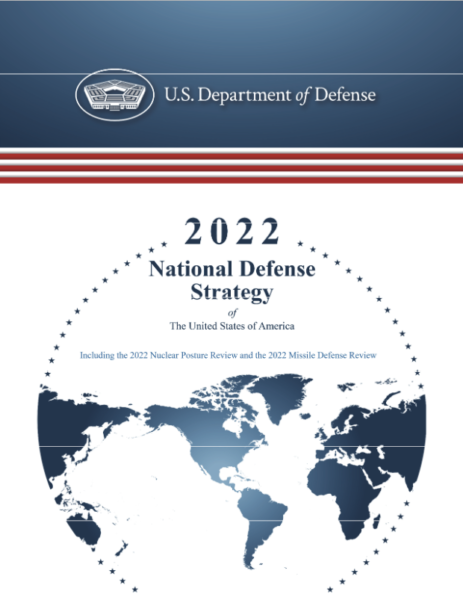
[Click to open PDF document]
Were you aware this tasker was working its way through the system?
Congress established the Commission on the National Defense Strategy by statute to examine and make recommendations with respect to the National Defense Strategy.
Well, RAND has the goods,
As part of the Commission’s role, it conducted a review of the “assumptions, strategic objectives, priority missions, major investments in defense capabilities, force posture and structure, operational concepts, and strategic and military risks” associated with the 2022 National Defense Strategy (PDF). The Commission called on RAND to provide administrative and analytic support.
Did you catch this yummy little morsel?
The current National Defense Strategy (NDS), written in 2022, does not account for ongoing wars in Europe and the Middle East and the possibility of a larger war in Asia. Continuing with the current strategy, bureaucratic approach, and level of resources will weaken the United States’ relative position against the gathering, and partnering, threats it faces.
Remember this tasty nougat center for later:
… does not account for ongoing wars in Europe and the Middle East and the possibility of a larger war in Asia.
Basically, they’re reminding us that we have a nation’s security running on an obsolete autopilot. Bravo Zulu for putting that marker out early. In a fashion, the report could have ended there. Probably should have ended there, but alas … no.
As Noah Robertson noted in his reporting, this report was not due until the end of the year. However, the commissioners decided to deliver it early so it could be part of the election conversation.
This election cycle has different plans.
While I appreciate the move — one I would have encouraged — I’m not sure either party wants to engage on the topic as there is only so much bandwidth in an election year … and … will you look at what happened in the last month?
However, there is a mission to complete … and they completed it early. There is praise due for that.
[…]
I have … concerns in other foundational issues as well.
There is plenty to chew on and it is a meaty document, so I am just going to touch on a few things in the Summary that I hope will encourage you to dive in for yourself for the details. No one wants me to fisk a 100+ page report.
My primary concern came early when the Balrog of Beltway natsec theory appeared;
In its report, the Commission on the National Defense Strategy recommends a sharp break with the way the U.S. Department of Defense (DoD) does business and embraces an “all elements of national power” approach to national security. It recommends spending smarter and spending more across the national security agencies of government.
In the name of all that is holy. There is nothing more worn out in natsec discussions coming from the Imperial City than “all elements of national power“. The “whole of government” mating with the “interagency”. Yes, yes, yes, we know — the four walls of the food trough. This is not an insight, this is rice bowl protection.
Yawn.
That is just a tell that people were invited inside the tent were very concerned that DOD might get more money and the civilian part of the natsec bureaucracy wouldn’t get an equal plus up of funds. Requirements be damned, we have budget-pie ego issues that need to be addressed.
As the kids would say, “basic“.
Buddha forbid that DOD get $1 and at the same time we don’t give $1 to every other kid at the table. It really is one of the most unimaginative instincts of the established natsec nomenklatura.
As we’ll see again, this DC habit of holding defense spending hostage for “less icky” levers of power or petty domestic programs making everything unaffordable. People tasked with “hard decisions” decide the “hard decision” is to decide to say “yes” to every good-idea fairy that threatens to heavily pout if their #1 goal is not your #1 goal.
If your shields don’t go up, your wallet pushed deeper in your pocket, your eye twitch start, your children hidden, and you don’t instinctively reach for your side-arm when you see a Beltway entity mention, “spending smarter and spending more across the national security agencies of the government” then you have not paid attention the last quarter century.
July 31, 2024
The Jasper wildfire – climate change or blatant government incompetence and neglect?
In The Line, Jen Gerson points out that the federal government had been given plenty of warning — literally years — about potentially serious problems near Jasper and had done nothing about them:
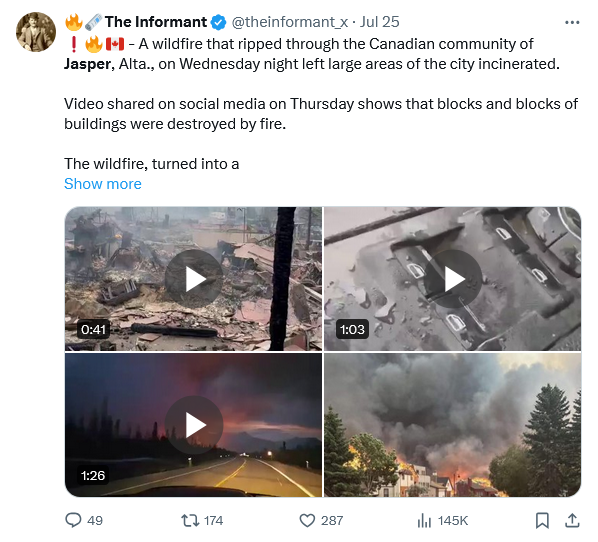
When Ken Hodges heard about the devastating wildfire that took out part of the historic mountain town of Jasper this week, he said he was “frustrated”.
“All I could say is that we tried to warn them that it was coming. We told them constantly. It’s not a matter of if, it’s a matter of when.”
The retired forester, along with his colleague Emile Begin, spent years repeatedly warning the parks service, the federal and provincial government, city council, and residents, that mis-management of the forests around Jasper had created a tinderbox that would inevitably spark a massive wildfire.
“I just feel so badly for the people who have lost their homes and their businesses. Could it have been prevented? I don’t know. If they had done everything they could have? Maybe. Something was going to happen over time, so it’s so frustrating and devastating.”
Hodges first spotted the problem almost a decade ago while skiing near Marmot Basin. From his years working in forestry in B.C. — a province that had previously been devastated by both wildfires and infestations of the Mountain Pine Beetle — Hodges was able to identify similar patterns of decay in the forests in Alberta.
“It was a hillside on the way up to Marmot that I looked up and thought ‘holy crap. The Mountain Pine Beetle is here.'” His experience told him exactly what would follow — fire.
Not just any fire. “It’s the intensity and the ferocity of the fire that can cause the problem. With climate change, that exacerbates the situation as well.”
Eventually Hodges connected with Begin. The two men between them had 40 years of experience in forestry in B.C. and Alberta, respectively. They feared the Parks service was not prepared for what the men had seen in B.C. — and told them so. Repeatedly. Vociferously. They also sent letters of warning to several ministers; they met with the local municipality. They were interviewed by the CBC for a story that was headlined “Jasper National Park not prepared for potential forest fire ‘catastrophe’, researchers say“.
That was in 2018.
Also in 2018, the pair issued an open letter that read: “The potential for a huge fire or mega fire is real. Fires of this type and magnitude generally occur in mid August to early September. With climate change it may occur earlier.”
The response?
“They just wrote us off,” Hodges told The Line this week.
July 30, 2024
The new and improved malaise for the 21st century
Back in the 1970s, US President Jimmy Carter identified the theme of the decade as “malaise”, and now, thanks to generations of feckless politicians, burgeoning bureaucratic empires, and economic stagnation, it’s back in an even malaisier form for the Current Year:

“Kamala Harris” by Gage Skidmore is licensed under CC BY-SA 2.0 

 .
.
Some time ago, I noticed that a general fatigue had taken a place alongside the malaise that was already being felt by many Americans and Canadians. The malaise stemmed from the overdue recognition that their lives were not going to get any better, and that they would have to work harder to just maintain a standard of living that they were already used to.
The fatigue came from a different, but not too distant place; the politicization of everything these past one and a half decades meant that there was no escape [from] the political. Whether sports, video gaming, or even fashion, everything had to be run by the cultural police before it could be deemed “not problematic”. The problem was (and still is) that everything to this type is “problematic”. This would not be a problem at all if this type were not empowered by the powers-that-be, but for some strange reason the cultural police quickly became ubiquitous, and their constant hectoring and lecturing ground most people down to the point where fatigue set in.
Everything became political, so therefore there was nothing that was not political. The fact that sanctions began to be placed against those who dared to buck the new trends in social mores meant that this was a totalizing form of politics. It wasn’t fascism, nor was it communism … but it was (and is) totalitarianism in a new form all its own. The rise of populism on the right in the West (as this trend is also present in Europe, but is not as thoroughly embedded there as it is in North America) is almost entirely a reaction to this. Freedom and liberty, as traditionally understood in the Anglosphere (i.e. “as long as I don’t harm others, I can do or say what I want”) took a back seat to what they call “equality”, a first step towards the more extreme demand known as “equity”.
Economic precariousness combined with the permanent presence of the Sword of Damocles above your head is a brilliant way to get people to shut up and get with the program. It is very coercive, but it is for the “greater good”, they tell us. What we already see is that it does not convince all, and that it has a negative effect on trust in governing institutions and national elites. The level of control by the managerial elite over the daily lives of its citizens is now at a micro-management one. Everyday, most people have to think carefully before speaking for fear of committing some aggression that could lead to the termination of their employment. They must mouth elite-approved social mores just in order to be able to tread water, as boat rocking is a secular sin. Why would the powers-that-be want to ever give up such a tool of mass control? The people are not to be trusted, which is why this totalizing system must remain in place. Just imagine if it were removed: the dreaded 1990s would return … or something.
Jacob Siegel has written an interesting essay on the concept known as “Whole of Society”, and how it has become a totalizing system:
To make sense of today’s form of American politics, it is necessary to understand a key term. It is not found in standard U.S. civics textbooks, but it is central to the new playbook of power: “whole of society“.
The term was popularized roughly a decade ago by the Obama administration, which liked that its bland, technocratic appearance could be used as cover to erect a mechanism for the government to control public life that can, at best, be called “Soviet-style”. Here’s the simplest definition: “Individuals, civil society and companies shape interactions in society, and their actions can harm or foster integrity in their communities. A whole-of-society approach asserts that as these actors interact with public officials and play a critical role in setting the public agenda and influencing public decisions, they also have a responsibility to promote public integrity.“
In other words, the government enacts policies and then “enlists” corporations, NGOs and even individual citizens to enforce them — creating a 360-degree police force made up of the companies you do business with, the civic organizations that you think make up your communal safety net, even your neighbors. What this looks like in practice is a small group of powerful people using public-private partnerships to silence the Constitution, censor ideas they don’t like, deny their opponents access to banking, credit, the internet, and other public accommodations in a process of continuous surveillance, constantly threatened cancellation, and social control.
The catch:
“The government” — meaning the elected officials visible to the American public who appear to enact the policies that are carried out across the whole of society — is not the ultimate boss. Joe Biden may be the president but, as is now clear, that doesn’t mean he’s in charge of the party.
Siegel writes that the “whole of society” approach arose during Obama’s shift away from the War on Terror to something called “CVE” (Countering Violent Extremism) i.e. the shift away from focusing on Islamist terror towards fighting America’s own citizens who are not with the new political, social, and cultural programs:
But the true lasting legacy of the CVE model was that it justified mass surveillance of the internet and social media platforms as a means to detect and de-radicalize potential extremists. Inherent in the very concept of the “violent extremist”, was a weaponized vagueness. A decade after 9/11, as Americans wearied of the war on terror, it became passé and politically suspicious to talk about jihadism or Islamic terrorism. Instead, the Obama national security establishment insisted that extremist violence was not the result of particular ideologies and therefore more prevalent in certain cultures than in others, but rather its own free-floating ideological contagion. Given these criticisms Obama could have tried to end the war on terror, but he chose not to. Instead, Obama’s nascent party state turned counterterrorism into a whole-of-society progressive cause by redirecting its instruments — most notably mass surveillance — against American citizens and the domestic extremists supposedly lurking in their midst.
A reflection on the 20-year anniversary of Sept. 11 written in 2021 by Nicholas Rasmussen, the former director of the U.S. National Counterterrorism Center, captures this view. “Particularly with the growing threat to public safety and security posed by domestic violent extremism, it is essential that we move beyond the post-9/11 counterterrorism strategy paradigm that placed the government at the center of most counterterrorism work.” Instead of expecting the government to deal with terrorist threats, Rasmussen advocated for “a much wider, more expansive and inclusive ‘whole-of-society’ approach” that he said should encompass “state and local governments, but also the private sector (to include technology companies), civil society in the form of both individual voices and non-governmental organizations (NGOs), and academia.”
July 25, 2024
QotD: Why devolution has not worked in the United Kingdom
I remember when arguments were originally made for devolution, commentators would claim that devolution would work in the same way that the federal structure of the US works, or, for that matter, how the cantonal system works in Switzerland. By which they meant that if a state such as Zug in Switzerland or Wisconsin in the US tried a specific policy (encouraging cryptos, or enacting Workfare, to take two actual examples), that the perceived success or failure of these policies would be studied by other cantons and states. Hence the idea that devolution allows a sort of “laboratory experiment” of policy to take place. It creates a virtuous kind of competition. That’s the theory.
What seems to have happened is that since devolution in the UK, Scotland, Wales and to some extent, Northern Ireland, have competed with England in who can be the most statist, authoritarian and in general, be the biggest set of fools. Whether it is 20 mph speed limits spreading to many places and harsh lockdowns (Wales) or minimum pricing on booze and “snitching” on your own family for views about gender (Scotland), the Celtic fringe appears to be more interested in being more oppressive, rather than less. I cannot think of a single issue in which the devolved governments of the UK have been more liberal, and more respectful, of liberty under the rule of law. (Feel free to suggest where I am mistaken.)
One possible problem is that because the UK’s overall government holds considerable budgetary power, the devolved bits of the UK don’t face the consequences of feckless policy to the extent necessary to improve behaviour.
Even so, I don’t entirely know why the Scots and Welsh have taken this turn and I resist the temptation to engage in armchair culture guessing about why they tend to be more collectivist at present. It was not always thus. Wales has been a bastion of a kind of liberalism, fused to a certain degree with non-conformity in religion, and Scotland had both the non-conformist thing, and the whole “enlightment” (Smith, Hume, Ferguson, etc) element. At some point, however, that appears to have stopped. Wales became a hotbed of socialism in the 20th century, in part due to the rise of organised labour in heavy industry, and then the whole folklore – much of it sentimental bullshit – about the great achievements in healthcare of Nye Bevan. Scotland had its version of this, plus the resentments about Mrs Thatcher and the decline of Scotland as a manufacturing power.
[…]
Maybe the “test lab” force of devolution will play a part in demonstrating that, as and when we get a Labour government for the whole of the UK, it will be a shitshow on a scale to put what has happened in the Celtic parts of the UK in the shade.
Johnathan Pearce, “Why has devolution not worked in a liberal direction?”, Samizdata, 2024-04-23.
July 24, 2024
Investigate one assassination attempt, reveal the truth about two earlier assassinations?
I have to admit that I’m skeptical about this, as conspiracies tend to unravel the larger they get (hence the old joke about three being able to keep a secret, if two of them are dead), and the tradition of deathbed confessions has had six decades to reveal itself. However, Benjamin Dichter thinks that a full, honest investigation into the attempt on Donald Trump’s life in Butler, PA would also yield historical dividends on the assassinations of JFK and RFK in the 1960s:
On July 13, 2024, both tragedy and an iconic photograph in American political history emerged from the attempted assassination of the 45th president. Even the harshest critics of Donald J. Trump among the legacy media were forced to acknowledge the moment, which many believe has cemented President Trump as an American icon. This failed assassination has become one of the most pivotal moments in American history, akin to tragedies such as 9/11, Pearl Harbor, and the attempted assassination of Reagan. It is rapidly emerging as a unifying moment for many Americans, signaling that the media’s rhetoric and repeated attempts to label Trump as a dictator, a neo-Nazi, and other unsubstantiated vitriolic claims have gone too far.
Donald Trump, surrounded by Secret Service agents, raises his fist after an attempt on his life during a campaign speech in Butler, PA on 13 July, 2024. One spectator was killed and two others were reported to be in critical condition. The shooter was killed by Pennsylvania State Troopers, according to reports in the succeeding hours.
As a Canadian who has spent much of my life traveling to the US, I have always sensed an underlying, unresolved collective emotional trauma that lingers like morning fog. This trauma stems from the assassinations of President John F. Kennedy and his brother Robert F. Kennedy — both murders believed by the majority of Americans to remain unsolved. More on that in a bit.
A friend of mine, working with the Department of Defense in the domain of security readiness for the US government, has told me the level of incompetence and fumbling of security obligations during Trump’s speech in Butler, PA, was inconceivable. He is not one to be hyperbolic, and we are both believers in Hanlon’s Razor. However, after his long career in the military and then at the Department of Defense, where he learned there is no shortage of incompetence due to government bureaucracy, he insists that the most basic protocols were violated in this case.
How is it possible that anyone could get within 125 yards of a former President and current candidate with a rifle? Not just a small pistol hidden in a pocket, but a large AR-15 platform rifle. “The idea that this could happen uncoordinated is absurd” he said. Even the legacy media is unable to spin their usual ridiculous deflections, which often appear like a frenzy of spawning sharks whenever President Trump is in their midst.
The gravity of this situation has changed everything and heralds a dawn of opportunity for America. For Trump, it is a chance to show the world how the gears of the machine turn. How things really work behind the scene. He is presented with a massive opportunity to seek retribution on behalf of the American people, who are still grappling with unresolved issues from past traumas.
Unlike the tragic assassinations of JFK and Robert F. Kennedy, Trump survived and will likely return to office. Also caught in the chaos were innocent bystanders, notably Corey Comperatore, who sacrificed himself by shielding his family from gunfire, along with two other victims whose injuries were not life-threatening. The innocent victims and their families who will vote in November, make this a situation that hits home with many Americans regardless of party affiliation.
July 23, 2024
The next phase of the campaign to replace “Orwellian” with “Trudeaupian”
On the Fraser Institute blog, Jake Fuss and Alex Whalen outline the Trudeau government’s latest attempt to drive the word “Orwellian” out of common usage by making “Trudeaupian” the more authoritarian descriptor:
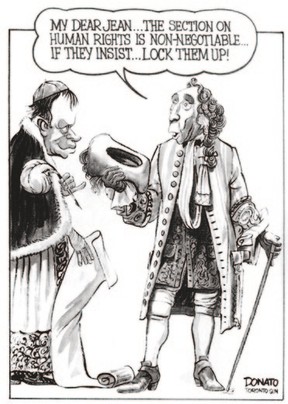
A Toronto Sun editorial cartoon by Andy Donato during Pierre Trudeau’s efforts to pass the Canadian Charter of Rights and Freedoms. You can certainly see where Justin Trudeau learned his approach to human rights.
This year marks the 75th anniversary of George Orwell’s classic novel 1984 (and it’s been 40 years since the actual year 1984). In the novel, Orwell explains the dangers of totalitarianism by exploring what happens when government exercises extreme levels of control over citizens including censoring and controlling language. While Canada is a relatively free country in 2024, there are aspects of Orwell’s world reflected in government policy today.
The Human Freedom Index, published annually by the Fraser Institute and Cato Institute, defines freedom as a social concept that recognizes the dignity of individuals by the absence of coercive constraint. In a free society, citizens are free to do, say or think almost anything they want, provided it does not infringe on the right of others to do the same.
Canada currently fares relatively well compared to other countries on the Human Freedom Index, placing 13th out of 165 countries. However, our score has dropped six spots on the index since 2008 when Canada recorded its highest ever rank.
This is not surprising given the Trudeau government’s recent efforts to control and manage the free exchange of ideas. The recent Online Streaming Act imposes various content rules on major streaming services such as Netflix, and requirements to extract funds to be redirected toward favoured groups. The Act seemingly seeks to bring the entire Internet under the regulation of a government body.
In another piece of recent legislation, the Online News Act, the government attempted to force certain social media platforms to pay other legacy news outlets for carrying content. In response, the social media platforms chose simply not to allow content from those news providers on their platforms, resulting in a dramatic reduction of Canadians’ access to news.
Now, a new piece of federal legislation — Bill C-63, the Online Harms Act — seeks to control language and grant government power to punish citizens for what the government deems to be unfavourable speech.
The government has sold Bill C-63 as a way to promote the online safety of Canadians, reduce harms, and ensure the operators of social media services are held accountable. In reality, however, the bill is Orwell’s Big Brother concept brought to life, where government controls information and limits free exchange. The legislation seeks to punish citizens not just for what the governments deems as “hate speech” but also grants the state power to bring Canadians before tribunals on suspicion that they might say something hateful in the future. Not surprisingly, many have raised concerns about the constitutionality of the Bill, which will surely be tested in court.
Trudeau announced new submarines for the RCN … don’t assume he’s really serious
At The Hub, J.L. Grantastein explains why Trudeau’s hasty commitment under pressure from our exasperated NATO allies is not likely to be met, and almost certainly not to be met fully:

HMCS Chicoutimi escorts Peoples Liberation Army (Navy) ships visiting Victoria on behalf of the Chinese military, 13 December 2016.
Photo: Cpl Carbe Orellana, MARPAC Imaging Services, ET2016-0468-03 ©2016 DND-MDN CANADA
Canada has no capacity to construct submarines, and the country’s shipyards are struggling to build destroyers, icebreakers, and supply ships. This means that submarines will need to be purchased from European or Asian shipyards with experience in building them. (There will be a certain irony if the RCN, having fought against U-boats in two world wars, ends up with German submarines.)
As of Trudeau’s announcement, let us be clear, no submarine design has been selected, and naval officers are said only to have been engaged in seeking the best models for the RCN. Given Canada’s broken defence procurement system, this is unlikely to be a quick process. The RCN may soon know what it wants but the bean counters will rule as they always do, and orders most likely will not be placed for at least three to five years.
Few expect that the Liberals will be in power in 2027, and if the Conservatives do form the government, it is worth noting that Pierre Poilievre has refused to commit to a date for Canada to meet its 2 percent pledge. New subs may not be an idea the Tories will accept.
If an old or new government does decide to continue with a submarine program, it is certain that a new conventional sub will cost at least $1 billion, many millions more to make it strong enough to operate for long periods in the Arctic, and millions more for its torpedoes, missiles, other weapons, radars, and electronic systems. The costs involved all but guarantee that 12 submarines are a pipedream — the RCN will be lucky to get four to six. Trudeau did not offer a timetable in his remarks, but it is highly unlikely that even a single submarine would be ready to go to sea before the early 2030s and the last by the 2040s.
Then there is the problem of manning a fleet of underwater vessels. The RCN has four Victoria-class boats now. These subs, purchased used from the Royal Navy, have not worked well, are constantly undergoing expensive repairs, and scarcely leave the dock. In other words, the crews have relatively little sea-going experience, the RCN is short of sailors already, and experienced mechanics and skilled technicians are in even shorter supply. Each sub will need more than sixty officers and sailors, and there must be at least three times that number on leave, on courses, or in training to support each crew.
There is little point in acquiring new submarines if there are no crews to sail in them, and with the fifteen new destroyers planned and just beginning construction, the senior service’s personnel needs must be a top priority. That need will not be met until the Canadian Armed Forces’ problems with recruitment are fixed, and that problem has bedevilled the military for decades. (I served on a Department of National Defence Special Committee in 1995 that advanced recommendations to improve recruiting, but nothing changed. Nothing has improved in the three decades since.)
Note that referring to the navy as “the senior service” is only appropriate when talking about Britain’s Royal Navy. The Royal Canadian Navy was established in 1910, long after the Canadian Army came into existence. I’m sure members of the RCN won’t mind if you make that mistake, however.
July 22, 2024
QotD: Post-apartheid South Africa
All of this brought tons of international condemnation onto the Zimbabwean regime, and a lot of countries looking for ways to pressure it to stop the atrocities. The glaring exception was Mbeki’s South Africa, which staunchly defended Zimbabwe for years as the killing and the starvation just kept ratcheting up. It’s unclear why they did this, beyond the ANC and ZANU-PF (the Zimbabwean ruling party) having a certain ideological and familial kinship, both being post-colonialist revolutionary parties that had overthrown white minority rule. But whatever the reason, this was the straw that finally caused Western politicians and celebrities to wake up a little bit and realize that South Africa was now ruled by thugs.
The second, even more catastrophic event that caused the South African government to lose the sheen of respectability was the AIDS epidemic and their response to it. The story of how Mbeki buried his head in the sand, embraced quack theories on the causes of AIDS, and condemned hundreds of thousands of people to avoidable deaths is well known at this point, but Johnson’s book is full of grimly hysterical details that turn the whole story into the darkest comedy you’ve ever seen.
For example: I had no idea that Mbeki was so ahead of his time in outsourcing his opinions to schizopoasters on the internet. According to his confidantes, at the height of the crisis the president was frequently staying up all night interacting pseudonymously with other cranks on conspiracy-minded forums (an important cautionary tale for all those … umm … friends of mine who enjoy dabbling in a conspiracy forum or two). These views were then laundered through a succession of bumbling and imbecilic health ministers such as Nkosazana Dlamini-Zuma or Mantombazana Tshabalala-Msimang who gave surreal press conferences extolling the healing powers of “Africanist” remedies such as potions made from garlic, beetroot, and potato.
Actually, the potions were a step up in some respects, the original recommendation from the South African government was that AIDS patients should consume “Virodene”, a toxic industrial solvent marketed by a husband-wife con-artist duo named Olga and Siegfried Visser. Later documents came to light revealing large and inexplicable money transfers between the Vissers and Tshabalala-Msiming. The Vissers then established a secret lab in Tanzania where they experimented on unsuspecting human subjects, engaged in bizarre sexual antics, and performed cryonics experiments on corpses. Despite this busy schedule, they also produced a constant stream of confidential memos on AIDS policy that were avidly consumed by Mbeki.
The horror of it all is that by this point there were very good drugs that could massively cut the risk of mother-child HIV transmission and somewhat reduced the odds of contracting the virus after a traumatic sexual encounter. There were a lot of traumatic sexual encounters. A contemporaneous survey found that around 60 percent of South Africans believed that forcing sex on somebody was not necessarily violence, and a common “Africanist” belief was that sex with a virgin could cure AIDS, all of which led to extreme levels of child rape. The government then did everything in its power to prevent the victims of these rapes from accessing drugs that could stave off a deadly disease. At first the excuse was that they were too expensive, then when the drug companies called that bluff and offered the drugs for free, it became that they caused “mutations”.
John Psmith, “REVIEW: South Africa’s Brave New World, by R.W. Johnson”, Mr. and Mrs. Psmith’s Bookshelf, 2023-03-20.
July 21, 2024
LCBO strike reportedly settled
A tentative deal was announced on Friday afternoon, then un-announced after the LCBO claimed the union had added financial demands to the return-to-work conditions after the contract itself had been agreed, and then on Saturday, re-announced. If the deal is ratified by the union, LCBO stores across Ontario should re-open on Tuesday.
It was the first LCBO strike in Ontario history, and it’s open to debate whether the union members will get all that much for their two-week unpaid break. The National Post‘s Chris Selley thinks not, calling it the “Stupidest. Strike. Ever.”

“LCBO at Parkway Mall” by Xander Wu is licensed under CC BY-SA 4.0 .
A week into the strike, a scant 15 per cent of Ontarians told Leger marketing that shuttered LCBO outlets had “affected (them) personally”. Only 29 per cent said they felt the government should legislate or arbitrate LCBO workers back into stores as soon as possible. Eleven per cent said they didn’t even know the strike was happening. And 32 per cent said they had explored “alternative locations” to buy booze, of which there are nowadays myriad.
Many more explored those opportunities in week two of the strike, I suspect, as fridges and wine racks were depleted. That’s potentially bad news for the LCBO’s future retail market share. But you didn’t even need an alternative to the LCBO: With a few days’ planning you could get all your regular brands delivered for free. Delivery and wholesale options were running as normal. Restaurants and supermarkets supplied by the LCBO were still supplied, and though there were reports of empty shelves at some supermarkets, that wasn’t truer than normal at the one I visit.
[…]
So this all looks like a terrible miscalculation by union leadership on behalf of its members — both a fundamental misreading of who had leverage, and a bizarre tactical choice to make the strike first and foremost about expanding the sale of ready-to-drink cocktails and seltzers (RTDs) to supermarkets and convenience stores.
Not wages; not benefits; not the number of full-time positions — things people can at least relate to — but where you can and cannot buy a White Claw or a Caesar in a can. Did they really think people would care?
Near as I can tell, it was an attempt to make this about the LCBO’s retail future: RTDs are a big and growing slice of the alcohol market in Ontario, only accessible (before the strike) at the LCBO. OPSEU wanted us to believe that by allowing supermarkets to sell them, Ontario would make no profit on them. And that’s their baked-in advantage: An incredible number of Ontarians, including far too many journalists, cannot wrap their minds around the notion of the government taking its cut at wholesale rather than retail.
Still, this gambit clearly fell flat.
Update: Fixed broken link to NP.
July 20, 2024
When diversity and competence requirements conflict
Janice Fiamengo compares the iconic Trumpian reaction after being wounded by a sniper with the cries for diversity at all costs from others:

Donald Trump, surrounded by Secret Service agents, raises his fist after an attempt on his life during a campaign speech in Butler, PA on 13 July, 2024.
Many observers have had harsh words for the female Secret Service agents who performed poorly in response to the attempt on Trump’s life last Saturday (see this Wired article for a catalogue of the charges, in which the author cannot muster a single rebuttal). Some noted that Trump’s security detail for the Republican National Convention is now, it appears, exclusively male. And rightly so. There is no equality when bullets start to fly, and it is lethal to pretend there is.
When the first shot rang out, 50-year-old Pennsylvanian firefighter Corey Comperatore is reported to have done what men typically do in such situations: he shielded his wife and daughters, taking a bullet to the head. Women far more rarely perform such acts of self-sacrifice.
Comperatore lost his life because of a multitude of errors on the part of the Secret Service, including a long hesitation by snipers tasked with neutralizing threats. Video shows that at least one of these snipers, seemingly with the gunman in his sites, failed to take action until seconds after the gunman began firing. The agent seemed befuddled, scrambling back when the first shot came. Was he new on the job, inadequately trained, or sub-par in his skills? Or directed not to fire?
I am not equipped to answer these or the many other, darker, questions about the bungled security operation. What can be said for certain is that if some element of the Secret Service was not treasonously complicit in the attempt on Trump’s life, it was certainly massively inadequate to its task of protecting him and others at the rally. The gunman was allowed to gain access to his rooftop shooting position, and Trump was not extracted the moment the shooter’s presence became known.
Director Kimberly A. Cheatle, who expressed to CBS News in interview her concern with “developing and giving opportunities to everyone in our work force, and particularly women“, has a lot to answer for.
Perhaps the women we saw in Trump’s security detail were new recruits helping Cheatle reach her target of 30% women by 2030. They looked amateur, panicked, and unpracticed. One of the women attempting to remove Trump from the stage was simply too small, and hesitant, for the task; she looked at one point as if she were engaged in a group hug at a United Church reconciliation ceremony. (As many have noted, her small stature enabled Trump’s fist-raised gesture of masculine defiance and his exhilarating “Fight! Fight! Fight!”). As Trump was being taken into the security vehicle, the four women surrounding the car looked jumpy and confused, scared and awkward. One woman was visibly unable to holster her gun.
I’ve never seen so many women guarding a former president, and I’ve never seen so many women obviously incapable.
We know that men and women have different strengths and aptitudes. Nearly a decade ago, the United States Marine Corps demonstrated through a year-long study of hundreds of Marines that even women who could pass the physical exam simply could not carry out standard military tasks as efficiently as men. The study found, unsurprisingly, that “The males were more accurate hitting targets, faster at climbing over obstacles, better at avoiding injuries.” The women struggled to carry weapons and ammunition, and even to use the weaponry properly. Women’s higher injury rate was marked: “The well documented comparative disadvantage in upper and lower-body strength resulted in higher fatigue levels of most women, which contributed to greater incidents of overuse injuries such as stress fractures.”


July 17, 2024
What do “‘elf an’ safety” concerns have to do with VIP protection details? A lot, it seems
I haven’t been following every twist and turn of the post-assassination-attempt story, but this one really does have me scratching my head. According to the person who had the overall responsibility, the reason the shooter’s location was not properly secured was due to health and safety concerns … for the Secret Service agents, rather than the person they were supposed to be protecting:
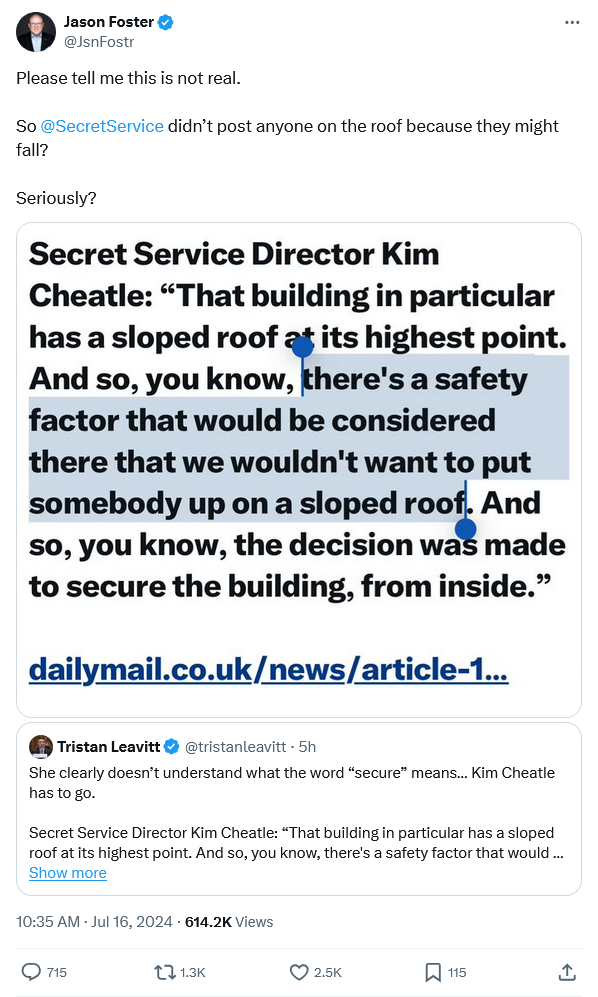
Oddly, the roof that the counter-sniper team was occupying visually seems to have a steeper pitch than the one identified as too dangerous:

Since we’re looking at the biggest news event of the year (so far), let’s consider what N.S. Lyons calls “The World Spirit on a Golf Cart“:
I’m going to do something I normally resist doing and offer some hot take thoughts based on recent events. Not on the details of the attempted assassination of Donald Trump specifically (there’s already plenty of that out there), but on what feels like his role in our general moment in time.
In the minutes after Trump dodged a bullet on live television, I joked on Substack Notes that “one does not simply shoot Napoleon”. This proved open to misinterpretation in a few different directions, but what I meant was this:
Napoleon famously led from the front, charging time and again into a hail of bullets and cannon shot, and yet not once was he ever seriously injured. In fact his luck seemed so impervious that he quickly acquired a legendary aura of invincibility. This became part of his overwhelming charisma – meaning not just his social charm but the inexplicable sense of unstoppable destiny that he seemed to exude. This aura proved so captivating to normal men that when he escaped from exile and landed alone in France to … well let’s call it make his “reelection” bid, the army sent to stop him promptly surrendered and switched sides at the mere sight of him.
Napoleon had seemed to become something more than mere mortal: he was a living myth, a “man of destiny” whom Providence had handed some great role to play in history (for good or for ill) and who therefore simply couldn’t be harmed until that role had been fulfilled and the world forever changed. This is why when Hegel witnessed Napoleon he described him with awe as “the world-spirit on horseback”: he seemed truly an “epic” figure, the sweep of history seeming to have become “connected to his own person, [to] occur and be resolved by him” alone, one way or another.
This, it should be noted, used to be the standard way of explaining how the course of the world’s history was shaped. Thus was Alexander understood; thus was Caesar. Only after the Enlightenment and the onset of rationalistic modernity did this mythic view begin to wither away with the broader disenchantment of the world, to be replaced by a depersonalized and mechanistic view of historical causality.
We’re so back now though. Donald Trump has always been something of a bafflingly lucky man, as even his enemies are prone to admit. But witnessing him, in response to whatever whisper of Providence, tilt his head at precisely the right moment and degree to cheat death, I and it apparently many others can’t help but feel like he may be more than lucky – that he now seems as much myth as man.
And when he emerged, shaking off his bodyguards and streaked with blood, to stand and pump his fist in defiance beneath the American flag (as captured by a photographer who just happened to be there at the perfect place and time to reveal an era-defining symbolic image), this was rightly described by awed watchers in the stands and across the nation as “epic”. Maybe epic is the word that comes to their mind only because it’s become internet parlance for “cool shit”. But I suspect that they may mean more than that, that they may be attempting to describe the deeper charisma of someone who really seems to somehow have become a man of destiny, and that they intuited the scene as truly epochal in its meaning.
Donald Trump, surrounded by Secret Service agents, raises his fist after an attempt on his life during a campaign speech in Butler, PA on 13 July, 2024.
Earlier, Mark Steyn wondered whether the security failures in Butler were caused deliberately or through utter incompetence:

Let’s cut to the chase — the US Secret Service: In on it? Or just totally crap?
Well, I’ve thought the Secret Service were rubbish not just since we learned of the Cartagena hookers but for at least another decade before that. And increasingly, when it comes to American officialdom — from Kabul to Uvalde — to modify Henry Ford, you can get it in any colour as long as it’s bloated, lavishly over-funded and entirely dysfunctional.
And yet and yet … it’s hard to believe even these guys (plus their bevy of five-foot-two-eyes-of-blue Keystone chorus girls) could be this crap. Assuming for the purposes of argument that the body on the roof is actually that of the perp, a goofball barely out of high school hatched a plan to have Donald Trump’s head explode in close-up on live TV – and, wittingly or otherwise, the world’s most flush money-no-object security state did their best to help him pull it off.
In any accountable “public service”, the Secretary of Homeland Security and the Secret Service gal would already be gone. By this point after the Argentine invasion of the Falklands, Lord Carrington (Foreign Secretary), Sir Humphrey Atkins (Lord Privy Seal) and Richard Luce (Minister for Latin-American Affairs) had already resigned: see my column of September 17th 2001 expressing in my naïve Canadian way mystification as to why, six days later, all the 9/11 flopperoos had not been similarly dispatched.
Because that’s how it goes in the Republic of Non-Accountability, and, if he’s harbouring any doubts about his fitness for the job, Mayorkas figures it can wait till someone takes out RFK Jr. This is a depraved political culture.
What’s the old line? When seconds count, the police are minutes away? Not at a Secret Service event: even when the police are on site in massive overwhelming numbers, they’re still minutes away.
July 16, 2024
Real world economic experiment to test Card & Krueger’s minimum wage theory
Tim Worstall points out that the California state government is — intentionally or not — running an interesting economic validation of the Card & Krueger study in New Jersey that seemed to show raising minimum wages didn’t have a negative impact on overall employment:
“Fast food” by Daniel Barcelona is licensed under CC BY 3.0 .
For think back to that New Jersey minimum wage study, Card and Krueger. That showed that acshully, employment in fast food joints rose when the minimum wage went up. Now, I’ve been saying for a long time now that I think there’s a fallacy of composition there.
“Fast food” isn’t “fast food”. There are — at least — two sectors here. There’re those big national chains, lots of advertising, franchisees, MaccyD’s and the like. Then there’s a vast hinterland of Mom and Pop places. The financial structures are entirely different. The chains are capital intensive. I think I’ve seen that buns for burgers come in pre-cut. Salad definitely arrives in bags, already shredded. There’s no prep – not even prep areas in those kitchens. Mom and Pop run differently. One reason I know is because I’ve owned and run one. There’s an awful lot of labour that goes into turning blocks of stuff into those sandwiches. Stuff is sliced, diced, soups are cooked on site, from identifiable ingredients, bread is sliced and on and on.
No, this isn’t to try and riff off The Bear. But there is a difference in economic structure between those who are large corporates vending fast food and not-large corporates vending fast food.
And I think — think, me, I do — that the problem with the Card and Krueger study was that it didn’t account for this. A change in the general labour rate might push people to the capital intensive end of this market. Certainly could do, it would be possible to model it that way. Which means that using only the data from the fast food chains, as C&K did, would pick up only part, perhaps half, of the reaction. The Mom and Pops shed labour, the capital intensive chains modestly pick it up, the net effect is — well, the net effect could be anywhere actually.
Which is what makes this CA minimum wage change so interesting. Because the $20 an hour applies only to those working for the big national chains — or their franchisees.
Mom and Pop have to pay the normal CA minimum wage, not the $20. So, the labour intensive part of the overall system has just been handed a competitive advantage against the capital intensive end of it. We would expect, could possibly measure, that the overall employment outcome is positive.
No, really. I’d be willing to defend the idea that it could be, certainly. Note that “could”. So, we’ve two sectors, capital intensive, labour intensive. We’ve just said that the capital using guys now have to pay more — much more — for their labour than the labour intensive guys. The capital intensive guys can only respond by higher prices or worse service (ie, fewer labour hours). The labour intensive sector might end up picking up so much of the traffic that they expand employment — expand employment so much as to actually increase overall fast food sector employment. By shifting from the capital to the labour intensive sectors.
This should be studied, right? Now, my actual economic skills — rather than ruminations — are zero so it’s not going to be me checking this out. But I recommend it as something for someone looking for a PhD subject to think about. Possibly even someone more senior than that looking for a point upon which to make their bones.
Does a higher minimum wage that only — only — applies to the capital intensive portion of an economic sector like fast food actually increase employment? By shifting the sector over to the more labour intensive sector not subject to that higher minimum wage?
Logically, it could, significant empirical work would be necessary to show it though.
Britain’s Tories – “It is hard to think of any political Party that has so relentlessly thrown away its political mandate”
Lorenzo Warby considers a few of the early lessons that can be drawn from the British general election results:
I dislike the term “the deep state”. It mystifies what is much more straightforward, even bland: how metastasising bureaucracy is undermining the resilience of Western societies and their political systems.
The British Labour Party has won a massive Parliamentary majority in the House of Commons even though its total votes fell: from 10,269,051 in 2019 — 32.1% of total votes — to 9,704,655 in 2024 — 33.7% of total votes. Labour’s massive Parliamentary majority is not a product of enthusiasm for Labour, but the fracturing of the votes of its opponents.
The Scottish National Party (SNP) vote fell dramatically — from 1,242,380 votes in 2019 to 724,758 in 2024. This was largely a casualty of the SNP embracing the genderwoo of Transactivism. Outside some narrow urban enclaves, no one votes for “woke” but, given a genuine opportunity, folk will vote against it. As Scots have.
The Liberal Democrats did very well, as they have a regionally concentrated vote — which, this time, they targeted properly — and disgruntled (posh) Shire Tories will protest vote Lib-Dem. Clearly, lots did.
The Tories did so badly because their already low vote was further reduced by the Reform vote surge. The Reform vote represented voters punishing the Tories for their failure to do anything they had promised. As political scientist Matt Goodwin puts it:
They failed to control our borders.
They failed to lower legal immigration.
They failed to cut taxes and the size of the state.
They failed to take on woke, exposing our children to ideas with no basis in science.
And they failed to level-up the left behind regions.
It is hard to think of any political Party that has so relentlessly thrown away its political mandate.
So, an angry, unhappy electorate (rightfully) punished two governing Parties (Tories and SNP) and has given Labour a massive majority, with little enthusiasm — almost two-thirds of voters voted for someone else — on a relatively low turnout.
There is, however, a deeper institutional issue underlying these results. Why are voters so disgruntled? Why did the Tories fail so spectacularly?
The answer to these questions is a mixture of how institutions have evolved, the development of media culture, the Anywhere-Somewhere divide and technocratic delusions.
Technocratic delusion
The technocratic delusion is multi-layered. It holds that governing is a managerial input-output problem, government bureaucracy simply implements policy, and that politics is not a motivation and coordination problem.
None of these presumptions are true, so technocratic politics fails. It does not connect to voters and does not understand, or grapple with, the actual institutional landscape.
The technocratic delusion is a way for clever people to be spectacularly clueless. Not the only such mechanism in the modern world.
QotD: Corruption and crony capitalism
Surely we have seen enough to know that large organisations like the government and their crony capitalists in the corporate sector are deeply resistant to independent investigations, whistleblowers and all other genuine threats to their status?
Whereas those that battle away in the competitive private sector don’t even get the chance to be that corrupt – they either treat their customers and employees well, or they crumble into dust like the costumed retards in the entertainment industry are doing so reliably these days, those beloved of progressive dunces the world over.
There are few cover-ups in the world of dogwalking and fishmongering – these people do a good job or they get told to piss off by their customers. But in the public sector and the corporate world that depend upon it …?
When we catch a corrupt civil servant or corporate lackey, we are seeing the Tip of An Iceberg. But when we catch a corrupt landscape gardener or carpenter, we are finding a Rotten Apple.
My claim is that terrible government officials and corrupt crony capitalists are the both the tips of icebergs, so the cries from Left and Right about rotten applies need to go away. Those that work in the public sector or depend upon their relationship with it, are routinely terrible and usually without consequence.
Alex Noble, “Corruption In The Coercive And Voluntary Sectors: Rotten Apples? Or The Tips of Icebergs?”, Continental Telegraph, 2019-12-02.


