
Forgotten Weapons
Published Mar 25, 2024The Charlton was a conversion of a bolt action Lee rifle into a light machine gun, designed by New Zealander Phillip Charlton. Some 1500 were made in New Zealand, but a bit later it appears that there was an effort to also produce the gun in Australia. The Electrolux company (the same one that makes washing machines and other home appliances today) made a few prototypes.
The Electrolux version is different from the original in a couple ways. While the basic conversion mechanism is the same, the Electrolux is more refined, with a shorter gas system and a fairly clean action cover over the working parts. It is also semiautomatic only, intended to be a shoulder-fired rifle where the original was made for the LMG role. Electrolux also used standard No1 MkIII rifles as its base, where the originals were made from a variety of mostly worn out Lee Metfords and Long Lees.
The Electrolux contract was cancelled in June 1944, and only a few prototypes were made. This example is in the British Royal Armouries collection, to whom I am grateful for the access and the trust to take it apart for you!
My video on the standard production Charlton:
https://forgottenweapons.vhx.tv/video…
(more…)
July 7, 2024
Electrolux Charlton: Washing Machine Company Converts Bolt Action to Semiauto
July 6, 2024
Labour’s “landslide”
I put the scare quotes around the word “landslide” because Labour’s eye-popping total of seats in Parliament was won on a remarkably narrow share of the actual votes cast in the British general election on Thursday (less than Jeremy Corbyn’s Labour party won in 2019). Fratricide on the right allowed a lot of Labour candidates to squeak in the win as the combined Tory/Reform votes would have been more than enough to top Labour.
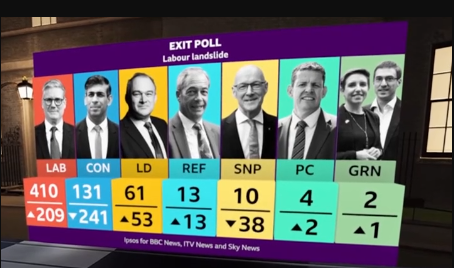
Labour has won a landslide and the largest swing in British history without even increasing its vote share in England, and winning perhaps only 35% nationally. Its only significant gains in proportional terms were in Scotland, largely at the expense of the SNP, who have suffered catastrophic losses, meaning they are only 1 seat ahead of Sinn Fein, now the largest party in Northern Ireland — who are in turn 3 seats ahead of Reform, the third largest party in Britain by vote.
But these Reform MPs are — as I write — outnumbered by the five pro-Gaza independents, who won seats in Yorkshire, Lancashire, the Midlands and London in reaction to Keir Starmer’s position on Israel. Labour are down an average of 18 points in seats where the Muslim population is 20%, and in seats where that figure is above 25%, they are down 23 percentage points. While Labour lost a huge share of the Muslim vote, what is more worrying is the atmosphere in which this has taken place.
In Birmingham Yardley Jess Phillips held on by 700 votes, and in a remarkably unpleasant – I might even say upsetting, although I’ve only had three hours’ sleep — count she lamented that “This election has been the worst election I have ever stood in”, as she was booed.
“I understand that a strong woman standing up to you is met with such reticence”, she told her antagonists, and described how opponents had filmed a Labour activist in the streets and slashed her tyres, while another was screamed at by a man. She told how Jo Cox’s family had wanted to come and campaign but she couldn’t let them endure it. “Can you throw them out?” she asked the authorities of her hecklers.
There were similar scenes in Birmingham Ladywood as Shabana Mahmood was heckled as she gave her speech, the returning officer pleading with the supporters of independent Ahkmed Yakoob to stop.
Yakoob was described by the Sunday Times‘s Will Lloyd as “the one man in Britain who embodies the way our politics have changed”. He described “a 36-year-old defence solicitor who wears black Prada trainers, a glittering diamond watch, tinted gold-framed sunglasses and Gareth Southgate-like waistcoats. He has 195,000 followers on TikTok, a platform he understands more intuitively than 99 per cent of the politicians in this country. He speaks in clipped, brutal epigrams that sound like they are only ever a few” and “The word ‘genocide’ is never far from his mouth with ‘For Gaza’ printed on his leaflets.”
Labour hung on in Ladywood, a historic constituency in England’s second city where in 1924 Neville Chamberlain very narrowly beat a rising star of the Labour Party called Oswald Mosley.
Gaza independents also narrowly lost Birmingham Hodge Hill by just 1000 votes, and Ilford North, the constituency of Wes Streeting by just 528 votes.
While the media focus was largely engaged in catching out the musing of some of Reform’s less intellectually capable candidates, this other populist revolt has been carried out in an atmosphere of anger and intimidation perhaps not seen in English elections since the days of Rotten Boroughs.
There was police intervention in Oldham last month, Naz Shah MP was abused as a “dirty, dirty Zionist … paid by Friends of Israel”.
Fellow Canadian observer Damian Penny refuses to apologize for his headline “The Sunak Sets over the British Empire” (and I don’t blame him in the slightest):
Canadian readers, stop me if you’ve heard this before: an historically unpopular center-right Tory government heads into an election under a hapless leader running a catastrophically poor campaign and finds that even its traditional support is being badly eroded by an upstart right-wing populist party called Reform.
What happened in Britain on July 4 (weirdly symbolic, that) is not exactly what we experienced in Canada in 1993 – the Tories suffered the worst election result in their history, but they’re left with 119 more seats than the venerable Progressive Conservative party under Twitter-troll-in-waiting Kim Campbell, and at least the outgoing PM managed to hold on to his own seat — but it’s kind of nice to see the Mother Country adopting our traditions for once.
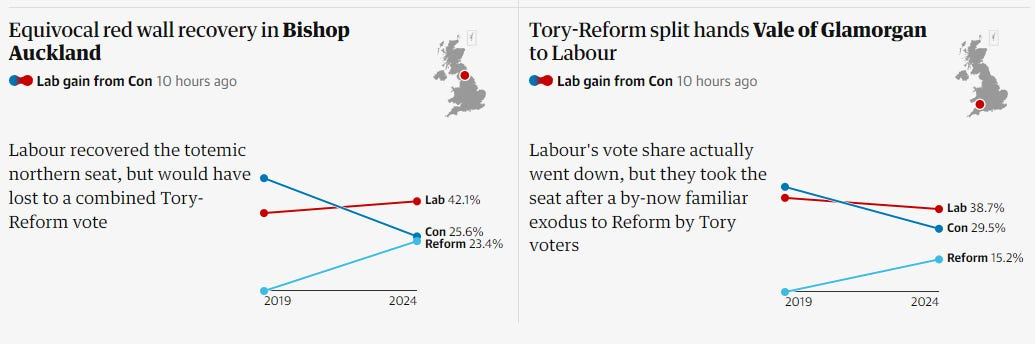
Honestly, 121 seats for Rishi Sunak’s Conservative Party is much better than I’d expected at the start of this campaign. And had it not been for Nigel Farage’s Reform Party, they might have managed a much less embarrassing defeat, because this kind of thing happened many times over last night:
Not everyone who voted Reform defected from the Conservatives – had Farage’s protest party not been on the ballot, many of its supporters would have stayed home or cast their votes for fringe parties and independent candidates — but it might have made the difference between a bad night for the Tories and the worst election in the Tories’ history.
Reform won four seats outright – less than a hyperbolic exit poll predicted, but four more than most observers expected at the start of the campaign. They can’t really affect much at the national level, especially with Keir Starmer’s Labour Party holding an absolutely massive majority of seats in Parliament, but they will make things very difficult for the Conservatives.
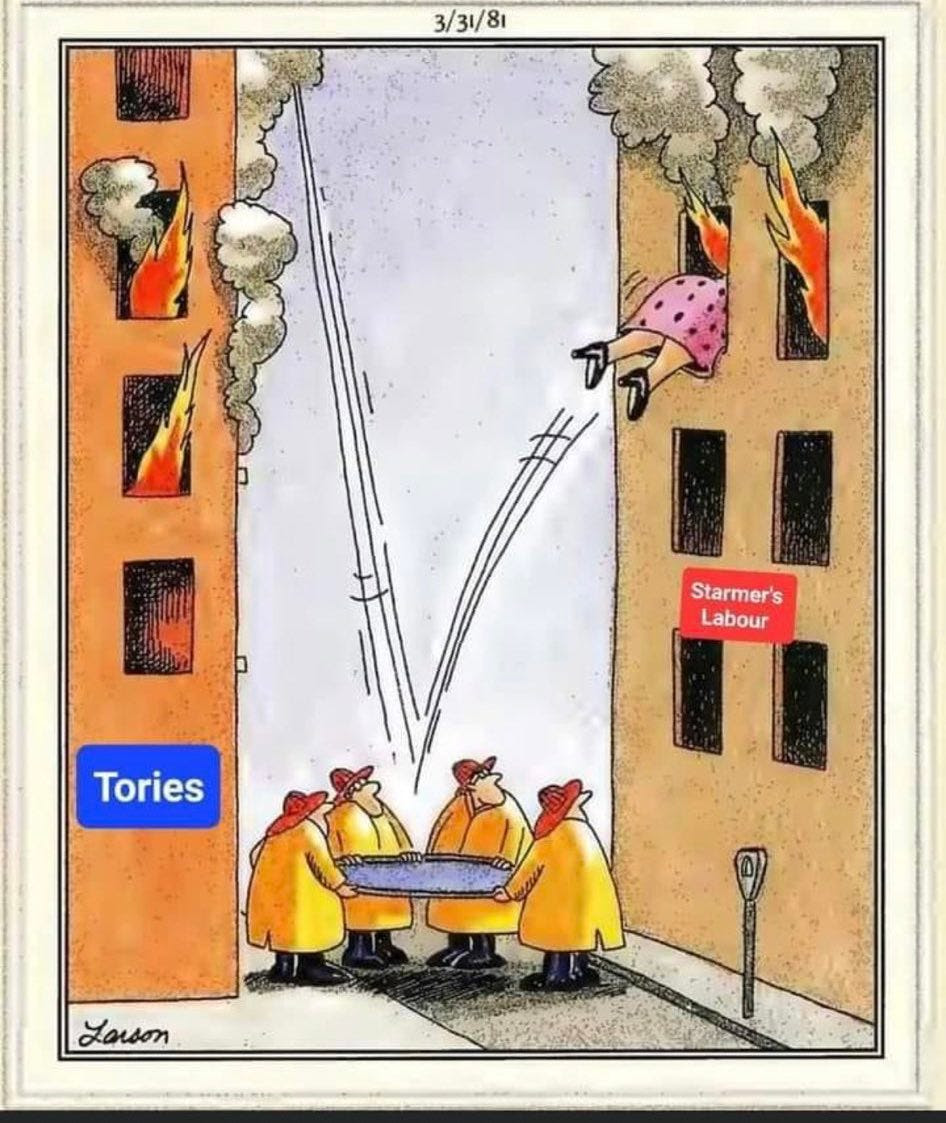
Helen Dale summarized the British general election result in a modified Gary Larson image:
Andrew Doyle points at the disproportional share of the vote won by Nigel Farage’s new Reform UK party compared to the tiny number of seats as a condemnation of the first-past-the-post system (also used here in Canada):
Keir Starmer surely cannot believe his luck. He has achieved a landslide victory by doing very little. He received fewer votes than Jeremy Corbyn in 2019, and yet has ended up with a whopping 412 seats in parliament. The rise of Nigel Farage’s Reform Party has split the right-wing vote and ushered the Conservatives along to their worst ever election result, plunging them to even greater depths than the disastrous election of 1906 under Arthur Balfour.
This was very much a Conservative loss rather than a Labour victory. There is no great enthusiasm for Starmer, and his majority is an indictment of the “First Past The Post” system which, as I have argued previously, should be abandoned in favour of Proportional Representation. It is unsurprising that upon his victory in Clacton-on-Sea, one of Farage’s first public statements has been a commitment to campaign for electoral reform. His party received over 4 million votes and has returned only 5 seats. So that’s 1% of the seats for 14% of the votes. Compare that with the Liberal Democrats, who have 11% of the seats for only 12% of the votes. Most of us will see that there is a problem here, irrespective of our political affiliations.
Worse still, Labour’s victory will empower the culture warriors, those identity-obsessed activists who have accrued so much power already in our major institutions. While the Tory party claimed to be fighting a “war on woke”, all the while enabling the ideology of Critical Social Justice to flourish, leading Labour politicians have cheered on the culture warriors while pretending that they were nothing more than a right-wing fantasy. We have seen some pushback over the past two years in regards to the worst excesses of this movement, but all of this may soon be undone. Now that the identitarians have their political wing in power, we should expect a few years of regression.
In Spiked, Brendan O’Neill thinks the real lesson to be learned from this election is that populism is here to stay:
To see the true quake, you need to look beyond Labour’s mirage-like landslide. As is now becoming clear, Labour has not been swept to power on anything like a wave of public enthusiasm. On the contrary, it won its 412 seats on the second lowest electoral turnout since 1885, and more as a result of people’s exhaustion with the Tories than their love for Sir Keir. No, it is those who refused to vote Labour who have brilliantly unsettled British politics. It is those who took a punt on Nigel Farage’s Reform party who have planted a bomb in the political landscape that will not be easily defused.
For me, the most fascinating stat of the election is the share of the vote received by Labour and the Tories. Labour won around 34 per cent of vote, the Tories around 24 per cent. Let’s leave to one side what a lame landslide it is if only 34 per cent of the people who could be bothered to vote put an X in your box. More striking is the fact that the combined vote share of Labour and the Tories, the parties that have dominated British politics for a century, was 58 per cent. That is staggeringly – and, if you will allow me, hilariously – low.
To put it in historical context: at the last General Election, in 2019, their combined vote share was 75.8 per cent. In 2017 it was even higher: 82.4 per cent. In the elections of the 2000s it hovered around 70 per cent. Why has it now dropped to less than 60 per cent, giving rise to the possibility that in the next few years the two parties that have run this country for decades might see their combined vote drop to less than half of all votes cast? Largely, because of Reform. And a few independents, too. Reform’s vote share is around 14 per cent, enough to shatter the Labour / Tory duopoly and to unravel the two big parties’ arrogant belief that they and they alone have a right to rule.
The speedy turnaround of the Reform revolt was extraordinary. It was only a few weeks ago that Farage ditched his plans to go to America to assist the Trump campaign and instead decided to become leader of Reform. He has now been elected MP for Clacton. Reform has won four seats in total. What’s shocking is that the Liberal Democrats won 71 seats despite getting fewer votes than Reform. The Lib Dems got around 12 per cent of the vote, to Reform’s 14 per cent. That the democratically less popular party of the two will wield far greater power in the Commons is a testament to how busted our first-past-the-post electoral system is. This is unsustainable. It is outright undemocratic.
And yet, even without the parliamentary representation their vote share deserves, Reform has struck a blow for democracy. Their voters, in thinking for themselves and rejecting both the Labour and Tory variety of technocracy, have forcefully created a new opening in political life. They have burst a few of the buckles on the political straitjacket that is our two-party system. The last time this happened was with Farage’s UK Independence Party, in the 2015 General Election, when it won 12.6 per cent of the vote, reducing the Tory / Labour vote share to 67.3 per cent. But where UKIP was mostly a one-issue party, dedicated to getting Britain out of the EU, Reform has broader policy goals. The millions of working-class people who voted for it are saying something very clear indeed: “We want something different”.
July 4, 2024
How the First Tanks CONQUERED the Trenches
The Tank Museum
Published Mar 16, 2024This is the story of the evolution of the tank during World War One. Notorious for its appalling human cost, the First World War was fought using the latest technology – and the tank was invented to overcome the brutally unique conditions of this conflict.
Arriving at the mid-point of the war, they would be built and used by the British Commonwealth, French and German armies – with the US Army using both British and French designs.
00:00 | Intro
01:17 | The Beginnings of WWI
02:13 | The Solution to Trench Warfare
03:47 | Initial Ideas
05:42 | How to Cross a Trench
08:08 | How Effective was the Tank?
15:40 | Battlefield Upgrades
17:09 | New Designs
24:32 | ConclusionThis video features archive footage courtesy of British Pathé.
#tankmuseum #evolution #tank #tanks #ww1 #technology
July 3, 2024
Tanks! – Allied tanks of WW2 – Sabaton History 127
Sabaton History
Published Mar 14, 2024Sabaton has written several songs about tanks — the boys are tank CRAZY! Songs like “Ghost Division” or “Panzerkampf” are about the German panzers and even the Soviet ones, but what about those of the Western Allies? Were they any good? And if so, how did they lose the Battle of France?
(more…)
July 2, 2024
Jonathan Kay on real Canadian history
Canadians have never really been encouraged to learn much about our own history. When I was in school, the history content skewed as far away from anything that might be stirring or exciting as it possibly could (we skipped over all the wars, for example), so that they could emphasize the legislative assemblies, the treaties and conferences, and the mix-and-match bearded and mustachioed “great and the good” of the time. If nothing else, you could catch up on your sleep for an hour. (I exaggerate a bit, but history in the primary grades at least covered the initial discovery and exploration of what would become Canada by French and English fur traders, adventurers, and scoundrels (some were all three). We even got a relatively unbiased (for the time) introduction to some of the First Nations, mostly in Ontario and Quebec.) These days, of course, kids learn that Canada is a genocidal colonialist white supremacist horror show that has no right to exist … hardly the kind of improvement one would hope for.
In the National Post Jonathan Kay suggests the only way to really understand Canadian history is to utterly ignore the politicians (and the bureaucrats) and learn it for yourself:
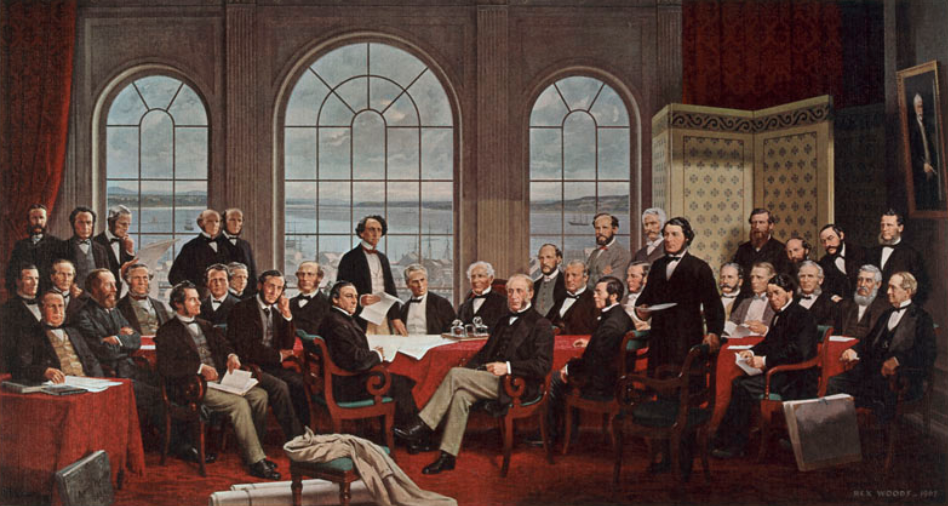
These guys are important, no question, but you need to go back a long way before them to really understand Canadian history. The nation didn’t burst fully formed from Sir John A.’s forehead, Athena-style.
Libraries and Archives Canada item ID number 3013194.
The surest way to make me treasure something is to take it away. So it was with Canada Day, whose annual appearance I’d once greeted with scarcely more excitement than the Ontario Civic Holiday and Aromantic Spectrum Awareness Week. Then came 2021, when the high priests of social justice demanded that we cancel Canada’s birthday celebrations, so that we might spend July 1 in morbid contemplation of our original sin. Not being one for rituals of confession and penitence, I instead began to think harder about why I love this country, despite its flaws — even if expressing such sentiments in public was now viewed as hate speech.
“This country was built on genocide”, ran one major-newspaper headline, amid the national meltdown following reports that hundreds of unmarked children’s graves had been found at former residential schools. Calgary dropped its fireworks program on the basis that (among other reasons) such scenes of celebration might hamper “truth and reconciliation”. Justin Trudeau, who’d come into office urging Canadians to “celebrate this amazing place we call home”, now took Canada Day as an occasion to instruct us that “the horrific findings of the remains of hundreds of children at the sites of former residential schools in British Columbia and Saskatchewan have rightfully pressed us to reflect on our country’s historical failures”.
The prime minister’s suggestion that children’s corpses were being plucked from the ground en masse turned out to be a reckless falsehood. Even the Tk̓emlúps te Secwépemc Nation, whose chief once claimed that “the remains of 215 children” had been found in Kamloops, now seems to be acknowledging that her original statements were wrong. While Canada has much to answer for when it comes to the legacy of residential schools, no graves or bodies were found at these locations in 2021. And none have been found since.
[…]
The unfortunate truth about Canada’s 19th-century origin story is that our country’s initial contours were sketched out by a group of middle-aged binge drinkers whose focus was less on life, liberty and the pursuit of happiness than on the mundane task of diffusing the high capital costs associated with rail construction and defending northern rivers and ports from rampaging Americans and Irishmen. (Yes, Irishmen: Visitors to Charlottetown’s Victoria Park will find a trio of ocean-facing nine-pounder guns that were installed in 1865 to guard against the Fenian Brotherhood, whose troops, many residents feared, were set to invade and conquer the island. But faith and begorrah, I do digress.) In this project, the Fathers of Confederation were successful. But the ensuing separation from Britain was a slow, bureaucratic affair that makes for dull reading (and duller television). I wish it were otherwise, fellow patriots. But alas, these are the facts.
Which is to say that if we’re looking to develop a compelling, historically accurate and, dare I say, inclusive, understanding of Canada’s national story, the story has to begin earlier. Specifically: the early 1600s — two and a half centuries before John A. Macdonald and his fellow Fathers of Confederation were knocking back the giggle juice in Charlottetown Harbour. As you might imagine, this means giving a starring role to Indigenous peoples — though not as the sacred martyrs and magical forest pixies of modern progressive imagination, but rather as the true-to-life diplomats, traders, craftsmen, hunters and soldiers that the first waves of Europeans knew them to be.
[…]
Toronto-born Greg Koabel spent most of his early academic career studying James I’s England (with a particular focus on the 1641 treason trial of the Earl of Strafford). And so, crucially, he approached the history of Canada laterally, through the prism of English and (primarily) French geopolitics. In telling the story of the first sustained European settlements in North America, he pays Indigenous populations the respect of examining them through this same geopolitical lens.
The resulting narrative, told in his brilliant Nations of Canada podcast, is so fascinating that you’ll have to keep reminding yourself he’s talking about Canada. This past week, Koabel hit a major milestone, releasing his 200th episode. And with his permission, I’ve been adapting his long-form audio chronology to written publication at Quillette. So far, we’ve published more than 100,000 words, and Samuel de Champlain hasn’t even left the stage yet.
I’m not much of a podcast listener, aside from The Rest is History and some Minnesota Vikings-specific sports podcasts, but the Quillette serializations of Koabel’s podcast episodes really are excellent and more than repay the effort to read them.
The virtue-signalling Olympics … aka “Glastonbury”
In Spiked, Brendan O’Neill documents the awesomely awful human beings at the Glastonbury music festival this year (like most years):
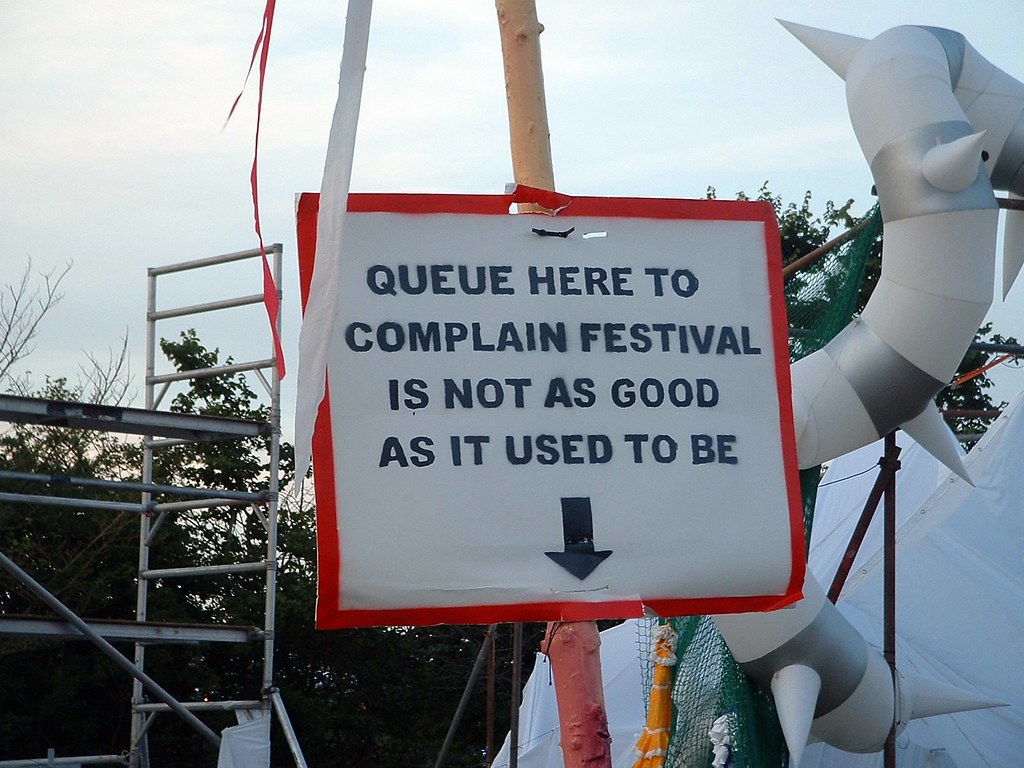
“Sign of the times @ Glastonbury Festival” by timparkinson is licensed under CC BY 2.0 
 .
.
Virtue-signalling reached its nadir on Friday night. It was at the Glastonbury music festival. Of course it was. A swaying crowd of the time-rich, turbo-smug thirtysomethings who make up Glasto’s clientele passed around an inflatable dinghy filled with dummies designed to look like migrants crossing the English Channel. As some band you’ve never heard of sang a song about “beautiful immigrants”, the audience hoisted the blow-up boat above their heads and basically crowd-surfed it. What a gauche display of phoney virtue. What an orgy of hollow vanity. Surely it would have been cheaper to rustle up a banner saying, “Aren’t we fucking wonderful?”.
It will surprise not a living soul that the boat was the handiwork of Banksy, every posh twat’s favourite graffiti artist. Banksy has never once seen a moneyed, mostly white audience that he didn’t want to titillate with platitudes about Tory scum and cruel capitalism, so it was only natural he would gravitate towards Glastonbury. He knows it’s rammed with people called Archie and Poppy who lap up his unsubtle stencils about the rat race that is neoliberal society and how dreadfully frightful war can be. So who better to dragoon into his boat stunt than these folk who likewise love advertising to the world how much they care about migrants and stuff?
Let’s leave to one side how unbelievably crude it is for a rich graffitist and Brits who can afford to fork out £355 to listen to crap music for five days to celebrate boat journeys that often end in death. One wonders if any of the audience members who cheered illegal immigration later retired to one of Glasto’s luxury yurts, which contain not only “proper flushing toilets” but also toilet attendants. You can hire one for £5,000, which, ironically, is around the same amount of money dirt-poor migrants are forced to stump up to criminal gangs for a seat on one of their perilous crossings that the righteous of Glasto think it’s a hoot to sanctify.
No, even worse than the sight of the well-off of Worthy Farm using the wretched of the Earth to burnish their moral credentials is the fact that if any Channel-crossing migrant were to rock up to Glastonbury they’d be cuffed and shoved in the back of a paddy wagon faster than you could say “What time’s Dua Lipa on?”. Glastonbury is one of the most fortified zones in Britain. It is surrounded by a fence that is 4.12m high and 7.8km long and which has numerous “unique high-security features”, including an “external roadway to prevent tunnelling”, a “45-degree overhang to prevent climbing” and “zero nuts and bolts to stop the fence being tampered with”. “No borders!”, cry the virtuous of Glasto while surrounded by a border fence that the screws of Alcatraz would have envied.
July 1, 2024
Fifty ways to leave your leader
Okay, I exaggerate in the headline … Mitch Heimpel only offers a list of eight factors that matter when it’s time for a political party to take their leader out behind the barn, so to speak:
Caucus revolts have gotten more common in Canadian politics of late.
They’ve always been commonplace in Westminster politics. In recent years, they’ve dethroned three prime ministers in the U.K. They’re almost as common as general elections for removing prime ministers in Australia. They’re a sign of a healthy parliamentary system … sort of. Our system runs on confidence. Prime ministers are supposed to be responsive to pressure from the backbench.
Canada has been something of an exception to this, and not always to our national benefit. Though less so lately. We’ve seen sitting governments in revolt (Jason Kenney in Alberta, 2022) We’ve also seen opposition leaders taken out by frustrated caucus (Erin O’Toole federally in 2022, Patrick Brown as Ontario Progressive Conservative leader, 2018.) The Chrétien-Martin feud was more of a civil war than a revolt.
Still, despite the examples above, these events remain relatively rare in Canada, compared to many of our Westminster peers, because of how centralized power has become in leaders’ offices (especially in the PMO). Our normal, as described in Jeffrey Simpson’s The Friendly Dictatorship, is how our system evolved, not how it was meant to be.
Now, since there are signs (see here and here and here) that at least some Liberals are musing about taking a shot at Prime Minister Justin Trudeau, it’s perhaps a good time to set some ground rules for caucus revolts. This is what we’ve learned not just from recent Canadian experience, but also from what our British and Australian cousins have learned over the years.
[…]
If things are going so badly that the caucus wants to revolt, you probably do need to make changes. Showing you’re listening, demonstrating accountability at the senior levels and demonstrating change can take the wind out of a caucus revolt before it gets out of hand.
The above are general rules — exceptions can obviously apply. And as noted at the beginning, Canada doesn’t have much experience with these situations. That’s why Australia and the U.K. are so instructive. But things do seem to be changing in Canada, and certainly, things seem to be changing in the Liberal caucus. The above rules are offered free of charge to mutineers and loyalists alike. Good luck!
Letter from Britain / Canadian Soldiers (1945) – British Council Film Collection
Charlie Dean Archives
Published Sep 22, 2013Three Canadian servicemen visiting London discuss the experiences of Britain that they have been writing home to loved ones about.
Trivia:
This film was specifically produced for Canadian audiences, in order to boost the relationship between the two countries, although it did receive distribution in other countries as well.Letter from Britain and Ulster are the only two films in the British Council Film Collection to feature Northern Ireland. It is also unusual in that it features real servicemen, rather than actors.
The poster seen on the Underground train at 06:00 was part of the government-sponsored “Billy Brown of London Town” series.
Letter from Britain was filmed no earlier than March 1945, as this is when the “Merchant Navy” class steam train Elders Fyffes — seen at 04:40 — was built.
Several ships are seen around Londonderry in Letter from Britain. These include HMCS Glace Bay, HMS Launceston Castle, HMS Loch Katrine, HMCS Penetang, and HMCS Petrolia. By comparing convoy listings, it can be deduced that these scenes were filmed around 15 March, 1945.
The song sung by “Paddy” at 13:05 is entitled “If You Ever Go To Ireland”, written by Art Noel. The song sung by the solider around 14:45 is an Irish ballad called “The Rose of Tralee”. The piece sung in the pub around 15:40 is “My Gal’s a Corker”.
(more…)
June 29, 2024
Oh no! The filthy proles are getting too many calories! Let’s re-impose rationing!
Tim Worstall suggests that the regular “viewing with alarm” thumbsuckers about purchased meals having “too many calories” are actually an indication of a strong desire by the great and the good to stick their regulatory noses into the lives of ordinary people:
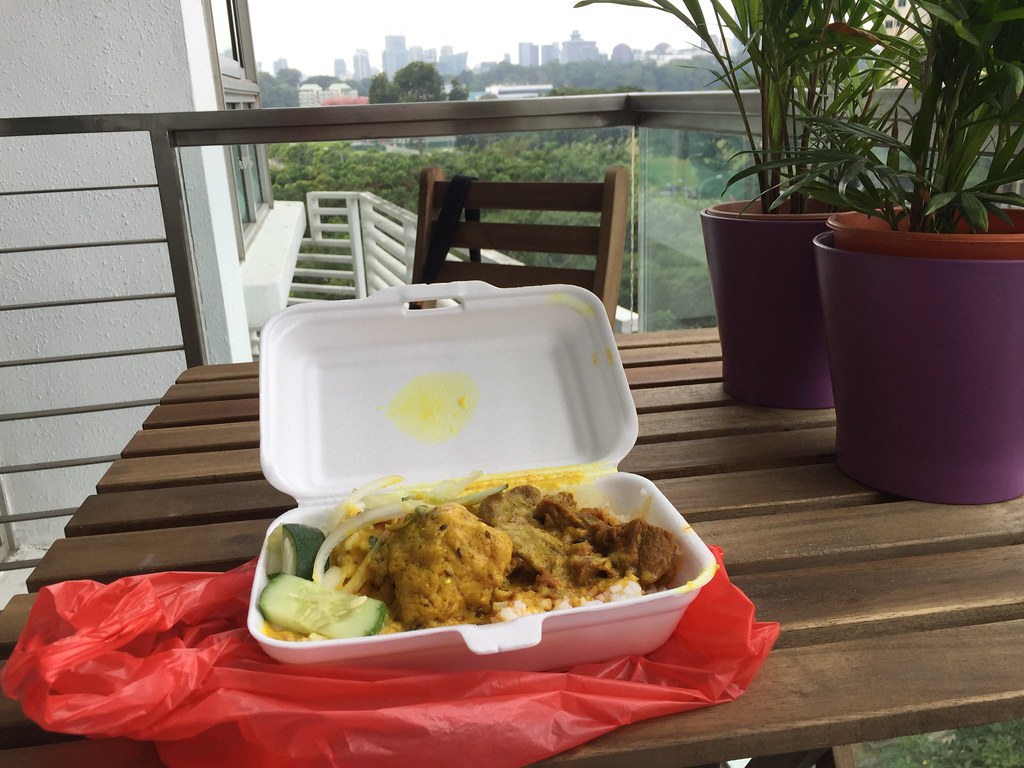
“Indian take away in Farrer Park” by Kai Hendry is licensed under CC BY 2.0 .
This headline is, of course, wrong.
Some takeaway meals contain more calories than daily limit, UK study finds
There is no daily limit. We do not have laws stating how much food we are allowed to eat. Of course, there are those who want there to be such laws but there aren’t, as yet. What there is is a series of recommendations about the limits we should impose upon ourselves:
Some takeaway meals contain more calories in one sitting than someone is advised to consume in an entire day, a study of British eating habits has revealed.
That’s better.
Cafes, fast-food outlets, restaurants, bakeries, pubs and supermarkets are fuelling the UK’s obesity crisis because so many meals they sell contain dangerously large numbers of calories, it found.
That’s not better. Because a plate of food containing a lot of calories is not a danger. Eating many of them might be but that the average household can get a gutbuster for some trivial portion of household earnings is a glory of modern civilisation, the very proof we require that we’re all as rich as Croesus.
And this is actually true too. That we are gloriously rich and it’s our food supply that proves this. As Brad Delong likes to point out back 200 years (yes, about right, 1820s is as it was really changing but 300 years would be better) it took a full day’s work to be able to gain 2,000 calories a day for a day labourer. There are 800 million out there still living at that standard of living. We can buy 2,000 calories — if we go boring stodge — for 30 minutes work now.
By history and by certain geographies we are foully rich these days. Which is the complaint of the wowsers of course. They’re a revival of the puritans and their sumptuary laws. How dare it be true that people fill their bellies with food they actually like?
Six out of 10 takeaway meals contain more than the 600-calorie maximum that the government recommends people should stick to for lunch and dinner in order to not gain weight, according to the research, which was carried out by the social innovation agency Nesta.
One in three contain at least 1,200 calories – double the recommended limit.
And? So, folk can buy lots of food for not much money. This is the very thing that makes having a civilisation possible — cheap food. My wife and I do indeed partake of an Indian occasionally — and find the takeout portions rather large. So, we have one amount for lunch or dinner and we’ve a refrigerator in which to keep the excess for a supper or snack another day. This is not beyond the wit of man to organise.
We don’t order in food very often, but when we do we usually manage to get both dinner on the night and lunch on the morrow from a typical order. If the nosey parkers have their way, they’d limit what we were allowed to buy — for our own good, of course — so we’d almost certainly still pay the same amount for less food. Such a deal!
Underground, Tube, Subway or Metro?
Jago Hazzard
Published Mar 15, 2024Why do we have so many terms for the same thing?
[NR: So far as I know, Toronto’s subway system has always been called “the subway”, while Montreal’s system is “le Métro“. Goodness knows what those barbarians in New York City might have called their below-ground railway systems over the years …]
(more…)
June 27, 2024
The Toronto Star wants Ontario to adopt Scottish booze regulation (but ignore the failure)
The Toronto Star always loves a good moral crusade, and if it also happens to fly in the face of whatever Premier Ford wants to do, then so much the better:
The Toronto Star is looking to Scotland to teach it how to reduce alcohol-related deaths. In an article titled “How Scotland started to kick its alcohol problem — and what Ontario could learn from it“, it pushes back on plans to liberalise Ontario’s state monopoly on alcohol retail, saying:
Ontario officials say they are fulfilling a 2018 election promise to increase “choice and convenience for shoppers and support Ontario retailers, domestic producers and workers in the alcohol industry”.
But Scotland has cut alcohol-related hospital admissions by 40 per cent and deaths by almost half. While in Ontario, alcohol-related admissions have risen by a third and deaths by almost half, according to the Canadian Centre on Substance Use and Addiction.
How did Scotland supposedly achieve this public health miracle?
The key part of Scotland’s landmark policy was aimed at reducing drinking by introducing minimum unit prices to make drinking more expensive.,/p>
Ontario already has minimum pricing and Scotland doesn’t have a state alcohol monopoly, so it is not obvious what lessons Ontarians are supposed to be learning, but put that to one side for a moment and consider the main claim.
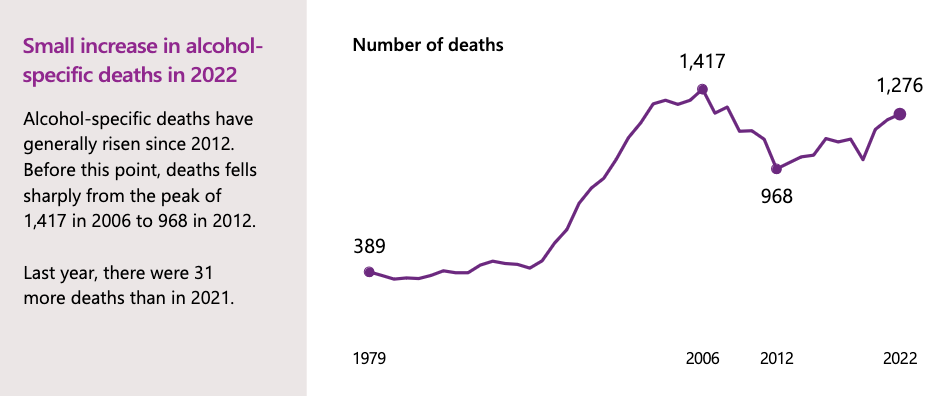
Anyone who has been following events in Scotland knows that alcohol-specific deaths have risen since minimum pricing was introduced in 2018 and have generally risen since 2012 following a significant downturn in the years prior.
It is that drop between 2006 and 2012 that the Toronto Star must be referring to when it claims that deaths fell by “almost half” (actually a third). But the Scottish government didn’t pass any anti-alcohol legislation in those six years and it certainly didn’t have minimum pricing. The newspaper mentions that the drink-drive limit was cut, but that didn’t happen until 2014 and the evidence is clear that it had no effect on road accidents.
Since the Toronto Star doesn’t mention when the decline in alcohol-specific deaths took place, it is leading its readers to believe that it coincided with the introduction of minimum pricing and the lowering of the drink-drive limit. I call that lying.
It is strangely fitting that Canadians are being lied to about the “success” of Scotland’s alcohol strategy since the Scottish public were conned into accepting minimum pricing, in part, on the basis of lies told about the “success” of minimum pricing in Canada. The neo-temperance academic Tim Stockwell, who is quoted in the Star article, published a series of studies in the 2010s making some absurd claims about minimum pricing that were parroted by campaigners in the UK.
June 26, 2024
Lord Balfour
Arthur Lord Balfour, Conservative Prime Minister from 1902 to 1905, is perhaps best known for the Balfour Declaration issued during World War 1 that established the formal goal of an independent homeland for the Jews in the Holy Land. Who was he? Barbara Kay’s essay originally published in the Dorchester Review was recently reposted at Woke Watch Canada:
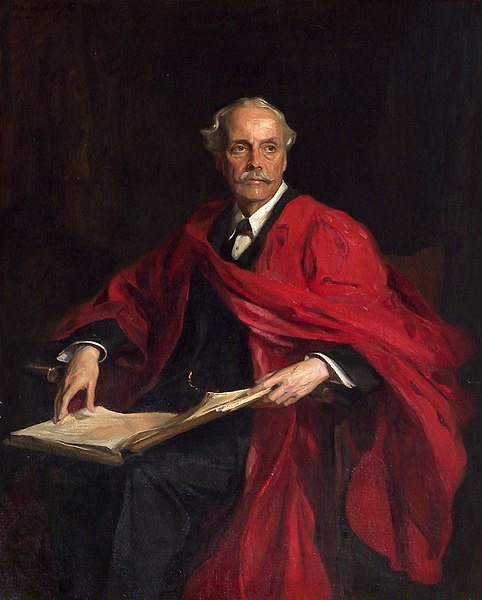
“Arthur James Balfour, 1st Earl of Balfour, KG, OM, PC, Prime Minister and Philosopher” portrait in oil by Philip de László, 1914.
From the Trinity College collection via Wikimedia Commons.
Why was the aristocrat Lord Balfour, the social antithesis of this humble Jew from the Pale of Russia, so taken with Weizmann’s vision that he was willing to expend political capital and exert so much effort to see it realized? Who was Balfour? What was he?
Arthur James Balfour was born at his family seat, Whittingehame, in East Lothian, the “granary of Scotland”. A forebear had made a fortune in India in military materials, so he was financially secure for life, and socially connected at the highest levels.
Having lost his father when he was 7, Balfour was lucky in his mother, a strong-willed and educated woman who, according to Mrs Dugdale, inculcated the idea of duty as “the uncompromising foundation of his character”. He attended Eton and Cambridge, where he was described by a friend as “a man of unusual philosophy and metaphysics”, who could hold his own with the Dons (professors), “some of them men of undoubted genius”. He was devoted to his extended family, and much beloved by his nieces and nephews.
In his essay “Arthur Balfour: a Fatal Charm”1 cultural critic Ferdinand Mount cites “nonchalance” as Balfour’s defining trait. Legendarily indolent, he rarely rose before 11 a.m., claimed never to read newspapers, and disdained the ritual schmoozing of fellow backbenchers expected by his peers in the Members’ Smoking Room. Mount says he was “indifferent to what his colleagues, the public or posterity thought of him or his policies”.
This loftiness — echoed in his unusual physical height — was perceived as admirable or maddening according to the observer and circumstances. Churchill said of him: “He was quite fearless. When they took him to the Front to see the war, he admired the bursting shells blandly through his pince-nez. There was in fact no way of getting to him.”
His self-sufficiency was no act. Sports-mad, he skipped lunch with the Kaiser to watch the Eton and Harrow cricket match, and when in Scotland might play two full rounds of golf a day (his handicap of 10 was better than P. G. Wodehouse and about the same as thriller writer Ian Fleming’s).
Balfour sounds from my description so far as if he was something of a playboy, but that is a very partial portrait. He was also known as “Bloody Balfour” for his readiness to endorse police action and his apparent indifference to their cost.
The Irish loathed him. In 1887 he became personal secretary for Ireland under his uncle, Lord Salisbury, just in time to enforce the Coercion Act against the volatile Irish Land League. Indeed, Balfour’s parliamentary critic William O’Brien saw him as a man who harboured a “lust for slaughter with a eunuchized imagination” who took “a strange pleasure in mere purposeless human suffering, which imparted a delicious excitement to his languid life”.
One hopes this accusation of actual sadism is an exaggeration of Balfour’s indubitable detachment. Yet indifference to human life is certainly not an uncommon charge laid against intellectuals for whom ideas loom larger in their claims to attention than the fate of those beyond their particular tribes.
For balance, we have Barbara Tuchman’s assessment:
Balfour had a capacious and philosophical mind. Words to describe him by contemporaries are often “charm” and “cynicism”. He had a profound and philosophic mind, he was lazy, imperturbable in any fracas, shunned detail, left facts to subordinates, played tennis whenever possible, but pursued his principles of statecraft with every art of politics under the command of a superb intelligence.
Fortunately for his temperament, Balfour’s life circumstances had landed him at the centre of a genuinely intellectual circle. His brothers in-law, for example, were Lord Rayleigh, who became head of the Cambridge Laboratory and won the Nobel Prize for Physics, and Henry Sidgwick, the Cambridge philosopher who with his wife Elaine Balfour founded Newnham College.
Politically, Balfour enjoyed both dramatic success and dramatic failure. He led the Unionist Party longer than anyone before him since Pitt the Younger. And he was a minister longer than anyone else in the 20th century, including Winston Churchill. Balfour was the only Unionist who was invited to join Asquith’s first war cabinet, and continued as foreign secretary after the coup that brought Lloyd George to power.
As Churchill put it: “He passed from one cabinet to the other, from the prime minister who was his champion to the prime minister who had been his most severe critic, like a powerful, graceful cat walking delicately and unsoiled across a rather muddy street”.
One of Balfour’s teachers at Eton described him as “fearless, resolved and negligently great”. On the other hand, Mount tells us, “indecisiveness” was his bane. He would stand paralyzed in the mezzanine of his London home agonizing over which of the matching staircases to descend by. He could love — the great love of his life died after an unreasonably long engagement — but, allegedly too staggered by the loss of his almost-fiancée, he never married.2 He could not be pinned down politically on many issues, a matter of great frustration to his colleagues, and this cost him dearly. As Mount notes, his charm was indisputable, “but more than charm he would not give” and “in the end, the charm is all that remains.”
Balfour fought three general elections as party leader and lost them all. His premiership lasted less than four years and ended in a Liberal landslide in 2006, a great electoral humiliation in making him the only prime minister in the 20th century to lose his own seat. He did not seem greatly to repine at the rejection, though, and it is thanks to the loss that he had time to further his education on the Zionist movement.
1. Mount, Ferdinand, English Voices (2016), pp 358 ff.
2. One suspects that even if May Lyttleton had lived, Balfour would have avoided marrying her on some pretext or other. There is no evidence that Balfour was a closeted homosexual, but he may have been asexual. He enjoyed an “amitié amoureuse” with (married) Mary Elcho for 30 years involving little or nothing in the way of sex, after which she wrote to him, “I’ll give you this much, tho, for although you have only loved me little, yet I must admit you have loved me long”.
Why the Allies Lost The Battle of France
Real Time History
Published Mar 1, 2024In May 1940, Nazi Germany attacks in the West. The Allied armies of France, Britain, Belgium, and the Netherlands have more men, guns, and tanks than the Germans do – and the French army is considered the best in the world. But in just six weeks, German forces shock the world and smash the Allies. So how did Germany win so convincingly, so fast?
(more…)
June 25, 2024
The ebbing tide of Corbynism
In Spiked, Brendan O’Neill finds the humour in the staggering collapse of the Corbynist wing of the British Labour Party, from being tantalizingly close to forming a government to today’s political knife-fight for a single seat in North London:

Jeremy Corbyn, then-leader of the Labour Party speaking at a rally in Hayfield, Peak District, in 2018.
Photo by Sophie Brown via Wikimedia Commons.
Schadenfreude is an unbecoming emotion, I know. But if you think I am not going to derive at least fleeting pleasure from the fact that the Corbynista movement went from being on the cusp of government to fighting tooth and nail to hold on to one poxy constituency in north London, then you are off your rocker. We must all find mirth wherever we can in this drabbest of elections. And I find mine in the staggering contraction of Corbynism, the almost total collapse of this cause that was once so beloved of every trustafarian Trot, Glasto wanker and they / them fruitloop.
It’s nearly too funny for words. Five years ago, Jeremy Corbyn and his crew were eyeing up Downing Street. They were in the running to run the country. Now they’re entirely concentrated in Islington North. Corbyn once commanded vast crowds of affluent youths at Glastonbury, basking in their posh chant of “Oh, Jeremy Corbyn!”. He had whole armies of time-rich tweeters who put their expensive education to good use by barking at us “gammon” about how “Jez” was “the absolute boy”. Now he can just about rustle up a few score political anoraks to go canvassing for him in a little bit of north London. It would require a heart of stone not to laugh.
Much has changed for “Jez” in the past five years. He was leader of the Labour Party back then. Now he isn’t even a member of the Labour Party. He was suspended in 2020 after he said the scale of Labour’s anti-Semitism problem under his leadership from 2015 to 2020 had been “dramatically overstated for political reasons“. Then he was officially expelled this year after he announced his intention to stand as an independent in Islington North, the constituency he represented for Labour since 1983. The man who wanted to be PM is now fighting for his life to remain an MP. We’ve gone from “socialism in one country” to “socialism in one constituency”.
Die-hard Corbynistas are flocking to Islington North as if it were the Paris Commune under attack from Versailles. They’re beating the streets to plead with constituents to return the absolute boy to parliament in order that socialism might yet live. The list of starry names Corbyn has dragooned to his door-knocking cause reads like a Sky News producer’s rolodex of wankers. Shola Mos-Shogbamimu, anyone? Yes, I’m sure her post-truth bollocks about “all white people [having] white privilege” will go down a treat among the white working classes on the council estates of Archway.
There’s Grace Blakeley, too, a privately educated flapper-girl socialist who thinks flouncing out of a book festival is “collective action“. That’s how she described her decision to withdraw from the Hay Festival over its receipt of funds from the investment management firm, Baillie Gifford. Tweeting “I’ve decided not to go to Hay” is the well-heeled millennial’s Battle of Orgreave. Perhaps Ms Blakeley will compare her class-war wounds with those of some old Irish fella she meets in a pub in Holloway when she’s out electioneering for the boy.
“Nigel Farage’s sin […] was to tell the truth which our rulers and their bought, sycophantic media are desperate to hide from us”
As the British general election rumbles into its final days, most media outlets reacted very strongly to Nigel Farage’s willingness to break with the narrative over the outbreak of the Russo-Ukrainian war:
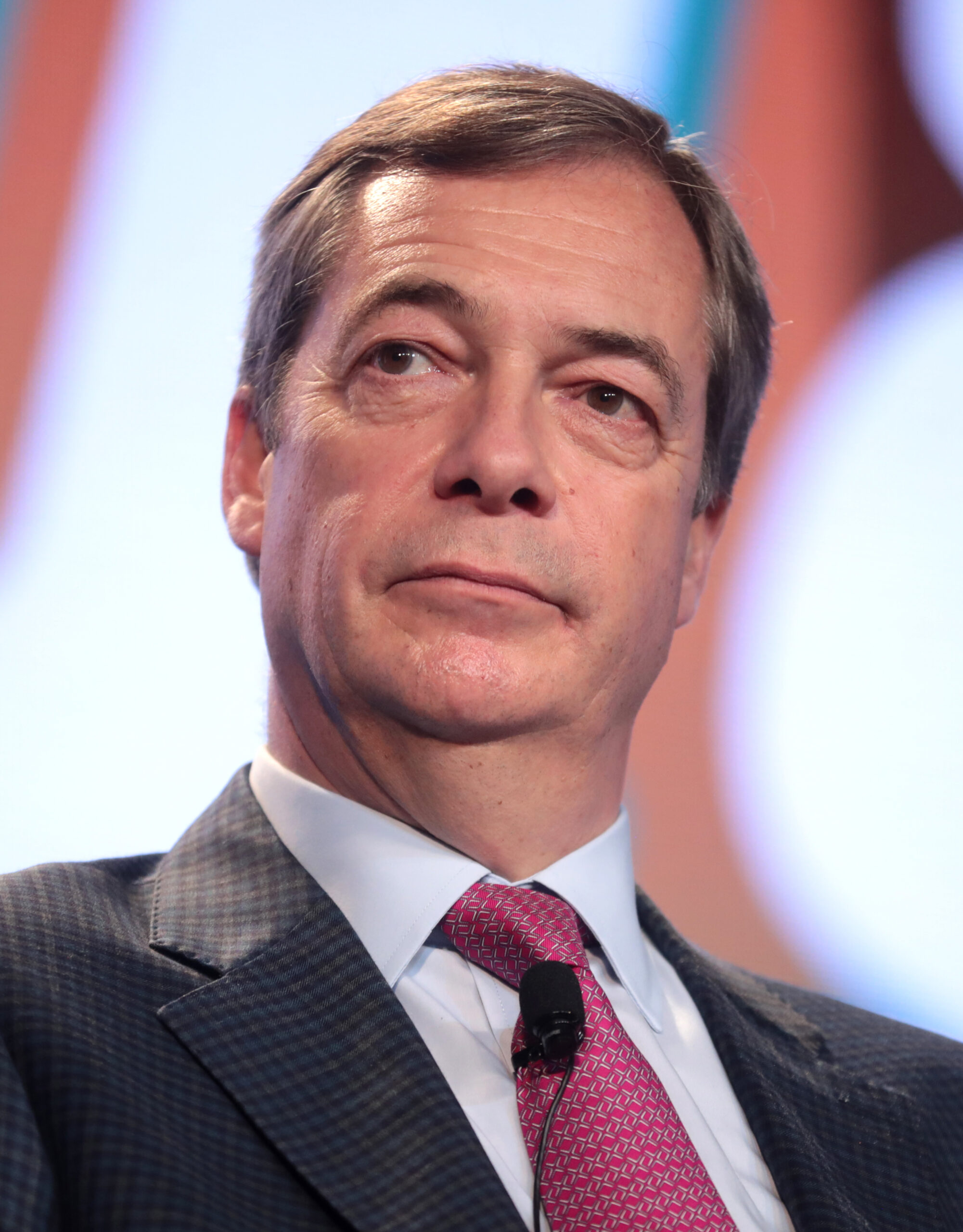
Nigel Farage has really got the elites and their prostitute mainstream media panicking, this time by being the only politician who dares tell the truth about the origins of the Russia-Ukraine war.
First let me stress that I am not condoning Putin’s invasion of Ukraine. But Putin has made it very clear for at least the last 15 years that he saw Ukraine and Georgia, which both have long borders with Russia, joining Nato as an existential threat to his country and warned “not an inch eastwards”.
The West arrogantly ignored Putin’s warnings. That was dumb.
At a conference in April 2008, where Putin was invited to address Nato leaders, he warned that inviting Ukraine and Georgia to join Nato, and thus parking Nato troops and missiles directly on Russia’s borders, would be seen as an existential threat to Russia’s security. This was even reported in the BBC’s in-house rag, the Guardian, on April 4 2008: “The Russian president, Vladimir Putin, today repeated his warning that Moscow would view any attempt to expand Nato to its borders as a ‘direct threat'”.
In December 2021, Putin yet again warned the West that allowing Ukraine and Georgia to join Nato would be unacceptable, in the first minute of this three-minute video. In this video Putin (sensibly in my opinion) asks whether the US would allow Russian troops and missiles to be positioned along its borders with Canada or Mexico and reiterates his “not an inch eastwards” threat.
Yet in January 2022, the US presented its written response to Russian demands on Ukraine not joining Nato and on Nato troops being withdrawn from Romania and Bulgaria, but made clear that it did not change Washington’s support for Ukraine’s right to pursue Nato membership, the most contentious issue in relations with Moscow.
The reply, which was delivered to the Russian Foreign Ministry by the US ambassador in Moscow, John Sullivan, repeated the US offer to negotiate with Russia over some aspects of European security, but the Secretary of State, Antony Blinken, said the issue of eventual Ukrainian membership of the alliance was one of principle.
Blinken was speaking hours after his Russian counterpart, Sergei Lavrov, threatened “retaliatory measures” if the US response did not satisfy the Kremlin.
“Without going to the specifics of the document, I can tell you that it reiterates what we said publicly for many weeks, and in a sense for many, many years. That we will uphold the principle of Nato’s open door”, Blinken said, adding: “There is no change. There will be no change.”


