
World War Two
Published 17 Feb 2022It’s 1943, the preparations for D-Day have already begun: deceive the Wehrmacht. Here at TimeGhost, we have begun to prepare our D-Day for 2023, and we want you to join us! Find out how in the pinned comment.
(more…)
February 21, 2022
D-Day – The Biggest Trick in History – WW2 Special
Comments Off on D-Day – The Biggest Trick in History – WW2 Special
February 17, 2022
Andrew Doyle on our current age of hoaxes
Last week in UnHerd, Andrew Doyle, the comedian behind the wonderful Twitter troll account “Titania McGrath”, explained why trolling today is so likely to succeed:

“Titania McGrath” and Andrew Doyle
This technique is the precursor to what we now call “trolling”. The term is often misused as a synonym for malicious and bullying online behaviour but, as traditionally understood, trolling is the art of coaxing people into a reaction. Motivations vary from troll to troll. For some, it is simply a matter of revelling in the gullibility of strangers. For others, the intention is to expose the vices and shortcomings of those in power.
Jonathan Swift was an early exponent of this kind of trolling in the creation of his alter-ego Isaac Bickerstaff, who wrote pamphlets which predicted, and then announced, the death of the astrologer John Partridge. Swift resented Partridge because of his attacks on the church, and must have been immensely gratified that Bickerstaff’s announcement had been taken on trust by so many. It is said that Partridge was thereafter continually having to fend off queries about his uncanny resemblance to a dead man.
[…]
Many of those duped by [Chris] Morris [in the TV series Brass Eye, 1997] were seemingly happy to read aloud any hogwash from an autocue in return for television exposure and the impression that they were on the right side of history. Such hoaxes could potentially be even more effective in today’s climate, with so many soft-witted celebrities eager to endorse fashionable but illiberal notions they barely understand. All major political, educational, artistic and corporate bodies are seemingly in submission to a new identity-obsessed religion of “social justice” that couches its regressive ideas in progressive terminology.
But, unlike the days of Brass Eye, the jesters are now in lockstep with these establishment lines, and so the most pertinent sources for satire are generally left untapped. They are, as Morris recently put it, more interested in “doing some kind of exotic display for the court” than exposing the follies of the powerful.
It is perhaps inevitable, then, that one of the most impressive hoaxes of recent years has come from outside the comedy industry. In October 2018, it was revealed that Peter Boghossian, James Lindsay and Helen Pluckrose had spent a year writing and submitting bogus academic papers to various journals in order to show how certain branches of the humanities were now routinely prioritising ideological goals over the pursuit of truth and knowledge. By the time the hoax was exposed, seven of their 20 articles had been accepted for publication, and a further seven were in the process of review.
As a work of satire, this project was an undoubted success. It provided evidence of what many had long suspected, that nonsensical ideas could thrive within the academy so long as they were camouflaged in vogueish jargon. One paper purported to be a study of the sexual activity of dogs in urban parks, and used this phoney data to draw conclusions about contemporary “rape culture”. Another argued that white male students ought to be chained to the floor during lessons as a form of reparation for slavery. Most audacious of all was the article based entirely on a chapter of Mein Kampf, rewritten in the language of intersectional feminist theory.
That all of these articles were accepted for publication in peer-reviewed journals should have alerted academics to a troubling strain of corruption and fraudulence in their field. They should have resolved to rectify the problem, but instead chose to demonise and smear the hoaxers who had exposed it. When satirists hit on uncomfortable truths, they are rarely thanked for their efforts.
Comments Off on Andrew Doyle on our current age of hoaxes
February 16, 2022
The railway built for dead passengers – London Necropolis Railway
Train of Thought
Published 29 Oct 2021It’s close to Halloween, so lets have a look at a railway built to transport a very macabre type of cargo … the recently deceased …
Please subscribe for more
This video falls under the fair use act of 1976
If you’re interested in a bit more than is covered in the video, here’s a post from 2013 discussing this railway.

Comments Off on The railway built for dead passengers – London Necropolis Railway
February 15, 2022
King James I and his court favourites
In the latest Age of Invention newsletter, Anton Howes continues the tale of King James I of England (also King James VI of Scotland at the same time, the crowns still being legally separate) and his use of favourites to help him avoid going back to Parliament to ask for money:
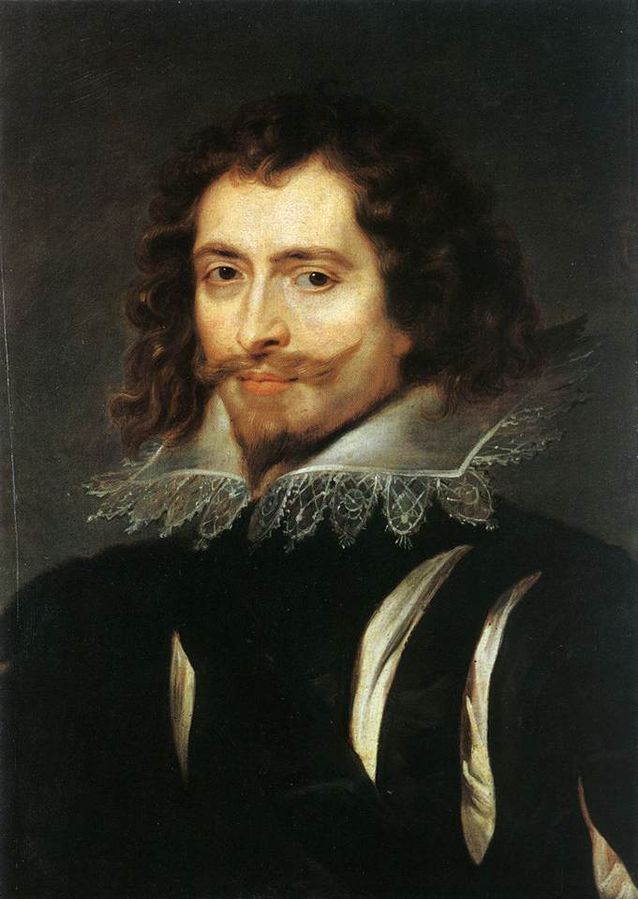
Portrait of George Villiers, First Duke of Buckingham, 1625.
Oil painting by Peter Paul Rubens (1577-1640) via Wikimedia Commons.
At the same time, James found a way to filter many of the petitions before they even reached him. This was something he already did in his original kingdom, Scotland, occasionally sending a noble “favourite” — like his kinsmen the duke of Lennox and the marquess of Hamilton — to dispense patronage and manage its parliament. Yet he increasingly, and even scandalously, relied on favourites in England too.
Using a favourite could make some sense from a political standpoint. Favourites often owed everything they had in terms of wealth, protection, titles and standing to the king personally. As creatures of the king, their loyalty was assured. They served an important practical function by dispensing patronage and absorbing pesky petitions, and could insulate the king himself from blame. Should the king make a mistake, his favourite was the obvious man to take the fall.
But for James, the use of favourites went beyond mere practicality, if they were ever practical at all. His interest could also be romantic.
Although James was married with kids, his favourite by 1607 was one Robert Kerr, the younger son of a minor Scottish laird. A mere groom of the bedchamber, about twenty years James’s junior, he had fallen from his horse in a jousting accident and broken his leg. The king helped nurse him back to health, and was soon besotted. Kerr — often anglicised to Carr — was very rapidly given money, titles, and lands. Within a year he had been knighted, after four years made a viscount, and in 1613 an earl.
But what had been so rapidly gained, could be just as rapidly lost. In 1614, a rival faction at court made sure that another, even younger and more attractive man would catch the king’s eye. This was George Villiers, the 22-year-old younger son of an obscure knight. With his “effeminate and curious” hands and face, as well as a remarkable physique — a clergyman, later a bishop, marvelled at his “well compacted” limbs — Villiers’s rise made Kerr’s seem slow. Every year brought him a new title: in 1615 Villiers was made a knight, 1616 a viscount, 1617 an earl, and 1618 a marquess — a very rare title in England, last given to an influential co-regent of Edward VI, and before that to Anne Boleyn so that she could marry king Henry VIII.
Eventually, incredibly, in 1623 James made Villiers a duke. This was a title that was typically reserved for members of the royal family, or else given by very powerful regents to themselves — Villiers was the first in neither of those categories to be made a duke in 140 years. And he hadn’t even been born into the nobility! The apparent lesson: working on your triceps can really, really pay off.
Yet Villiers had more than just an angelic face and muscles. He seems to have had a real talent for politics, very quickly asserting independence from the faction that had put him before the king. And he would somehow remain the favourite even after James died and was succeeded by his heterosexual son, Charles I. In the dangerous waters of courtly faction — Robert Kerr had meanwhile been found guilty of murder and was imprisoned in the Tower — Villiers knew how to keep himself afloat, and even to chart a course of his own.
And he was extraordinarily corrupt.
Comments Off on King James I and his court favourites
QotD: Breaking the trench stalemate with tanks
Where the Germans tried tactics, the British tried tools. If the problems were trenches, what was needed was a trench removal machine: the tank.
In theory, a good tank ought to be effectively immune to machine-gun fire, able to cross trenches without slowing and physically protect the infantry (who could advance huddled behind the mass of it), all while bringing its own firepower to the battle. Tracked armored vehicles had been an idea considered casually by a number of the pre-war powers but not seriously attempted. The British put the first serious effort into tank development with the Landship Committee, formed in February of 1915; the first real tanks, 49 British Mark I tanks, made their first battlefield appearance during the Battle of the Somme in 1916. Reliability proved to be a problem: of the 49 tanks that stepped off on the attack on September 15th, only three were operational on the 16th, mostly due to mechanical failures and breakdowns.
Nevertheless there was promise in the idea that was clearly recognized and a major effort to show what tanks could do what attempted at Cambrai in November of 1917; this time hundreds of tanks were deployed and they had a real impact, breaking through the barbed wire and scattering the initial German defenses. But then came the inevitable German counter-attacks and most of the ground taken was lost. It was obvious that tanks had great potential; the French had by 1917 already developed their own, the light Renault FT tank, which would end up being the most successful tank of the war despite its small size (it is the first tank to have its main armament in a rotating turret and so in some sense the first “real” tank). This was hardly an under-invested-in technology. So did tanks break the trench stalemate?
No.
It’s understandable that many people have the impression that they did. Interwar armored doctrine, particularly German Maneuver Warfare (bewegungskrieg) and Soviet Deep Battle both aimed to use the mobility and striking power of tanks in concentrated actions to break the trench stalemate in future wars (the two doctrines are not identical, mind you, but in this they share an objective). But these were doctrines constructed around the performance capabilities of interwar tanks, particularly by two countries (Germany and the USSR) who were not saddled with large numbers of WWI era tanks (and so could premise their doctrine entirely on more advanced models). The Panzer II, with a 24.5mph top speed and an operational range of around 100 miles, depending on conditions, was actually in a position to race the train and win; the same of course true of the Soviet interwar T-26 light tank (19.3mph on roads, 81-150 mile operational range). Such tanks could have radios for coordination and communication on the move (something not done with WWI tanks or even French tanks in WWII).
By contrast, that Renault FT had a top speed of 4.3mph and an operational range of just 37 miles. The British Mark V tank, introduced in 1918, moved at only 5mph and had just 45 miles of range. Such tanks struggled to keep up with the infantry; they certainly were not going to win any race the infantry could not. It is little surprise that the French, posed with the doctrinal problem of having to make use of the many thousands of WWI tanks they had, settled on a doctrine whereby most tanks would simply be the armored gauntlet stretched over the infantry’s fist: it was all those tanks could do! The sort of tank that could do more than just dent the trench-lines (the same way a good infiltration assault with infantry could) were a decade or more away when the war ended.
Moreover, of course, the doctrine – briefly the systems of thinking and patterns of training, habit and action – to actually pull off what tanks would do in 1939 and 1940 were also years away. It seems absurd to fault World War I era commanders for not coming up with a novel tactical and operational system in 1918 for using vehicles that wouldn’t exist for another 15 years and yet more so assuming that they would get it right (since there were quite a number of different ideas post-war about how tanks ought to be used and while many of them seemed plausible, not all of them were practical or effective in the field). It is hard to see how any amount of support into R&D or doctrine was going to make tanks capable of breakthroughs even in the late 1920s or early 1930s (honestly, look at the “best” tanks of the early 1930s; they’re still not up to the task in most cases) much less by 1918.
Bret Devereaux, “Collections: No Man’s Land, Part II: Breaking the Stalemate”, A Collection of Unmitigated Pedantry, 2021-09-24.
Comments Off on QotD: Breaking the trench stalemate with tanks
February 14, 2022
In The Highest Tradition — Episode 2
British Army Documentaries
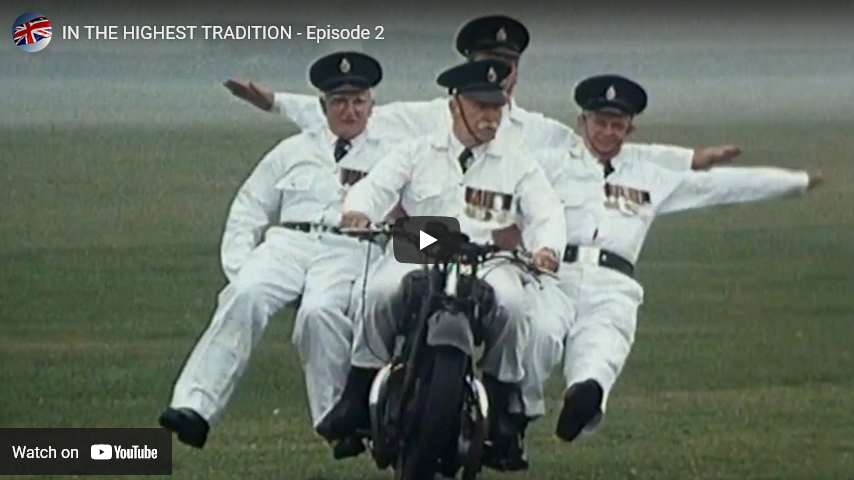
Published 22 Oct 2021This episode includes the story of Millie the Mule and just why a rose is still eaten, raw, in one battalion’s mess. It also features the “White Helmets”, a team of motorcycle stunt riders. One team of retired soldiers has an average age of 74 years but they still meet up to perform stunts in front of their successors.
© 1989
This production is for viewing purposes only and should not be reproduced without prior consent.
This film is part of a comprehensive collection of contemporary Military Training programmes and supporting documentation including scripts, storyboards and cue sheets.
All material is stored and archived. World War II and post-war material along with all original film material are held by the Imperial War Museum Film and Video Archive.
I have to mention that the primrose hackle, once worn with great pride by the Lancashire Fusiliers is still worn by the Lorne Scots (Peel, Dufferin & Halton Regiment) of the Canadian Army Reserve.
Comments Off on In The Highest Tradition — Episode 2
February 13, 2022
Victory at Guadalcanal – WW2 – 181 – February 12, 1943
World War Two
Published 12 Feb 2022Operation KE, the Japanese evacuation of Guadalcanal, concludes this week and the campaign has been a big loss for the Japanese. The Axis forces are also withdrawing — and the Red Army advancing — in the Donbas and the Caucasus, closing in on both Kharkov and Rostov. And a front that’s been quiet for a while, the Burma front, begins heating up again with an Allied advance out of India.
(more…)
Comments Off on Victory at Guadalcanal – WW2 – 181 – February 12, 1943
In full: Rowan Atkinson on free speech
Defend Free Speech
Published 15 Aug 2018The forerunner of the Defend Free Speech campaign was called “Reform Section 5”. This speech by Rowan Atkinson at the launch event in Parliament in 2012 should be heard by every politician, journalist and campaigner before they start calling for laws to silence those they regard as “extremists”.

Comments Off on In full: Rowan Atkinson on free speech
February 12, 2022
Victorian Vinegar Valentines
Tasting History with Max Miller
Published 11 Feb 2022Hayman Sloe Gin: https://bit.ly/maxbottlescollection
Support the Channel with Patreon ► https://www.patreon.com/tastinghistory
Merch ► crowdmade.com/collections/tastinghistory
Instagram ► https://www.instagram.com/tastinghist…
Twitter ► https://twitter.com/TastingHistory1
Tiktok ► TastingHistory
Reddit ► r/TastingHistory
Discord ► https://discord.gg/d7nbEpy
Amazon Wish List ► https://amzn.to/3i0mwGtSend mail to:
Tasting History
PO Box 766
Burbank, CA 91503LINKS TO INGREDIENTS & EQUIPMENT**
Sony Alpha 7C Camera: https://amzn.to/2MQbNTK
Sigma 24-70mm f/2.8 Lens: https://amzn.to/35tjyoW
Home Oak Bar: https://amzn.to/37QGNdE
Industrial Pipe Liquor Shelves: https://amzn.to/37OR61S
Monin Raspberry Syrup: https://amzn.to/3HqFW3v
Nick & Nora Crystal Martini Glass: https://amzn.to/3L9zuzWRecipe
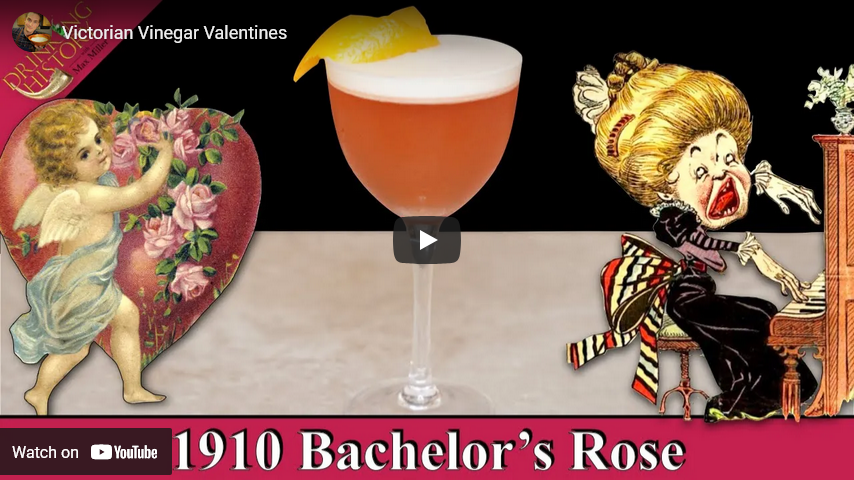
Bachelor’s Rose
Juice of a half a lemon
Juice of half a lime
Juice of half orange
White of an egg
25% raspberry syrup
75% Sloe gin
Fill glass with cracked ice.
Shake well, strain and serve.
1910 Jack’s Manual by J A Grohusko (Jacob Abraham)**Some of the links and other products that appear on this video are from companies which Tasting History will earn an affiliate commission or referral bonus. Each purchase made from these links will help to support this channel with no additional cost to you. The content in this video is accurate as of the posting date. Some of the offers mentioned may no longer be available.
Subtitles: Jose Mendoza | IG @ worldagainstjose
PHOTO CREDITS
Sloe berries: CC BY-SA 3.0, https://commons.wikimedia.org/w/index…#tastinghistory #valentinesday
Comments Off on Victorian Vinegar Valentines
From the “it could actually be worse” file — royal succession alternatives
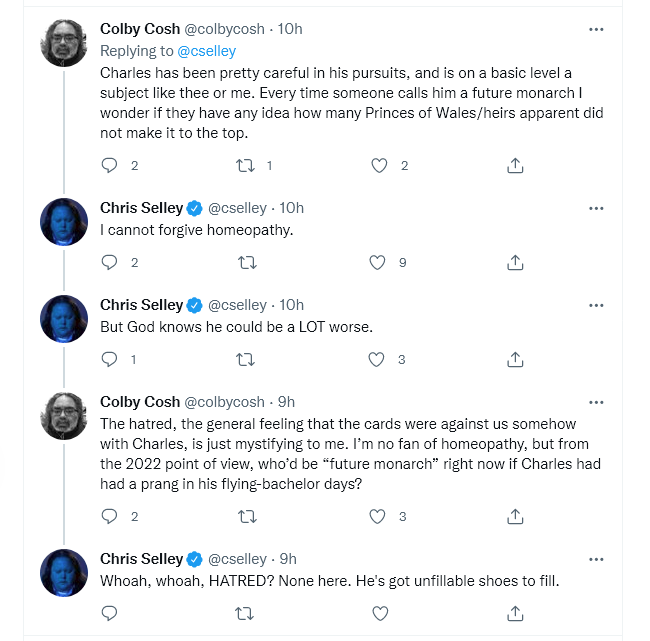
Chris Selley and Colby Cosh had an exchange on Twitter where Colby actually somehow made me appreciate Prince Charles a tiny bit:
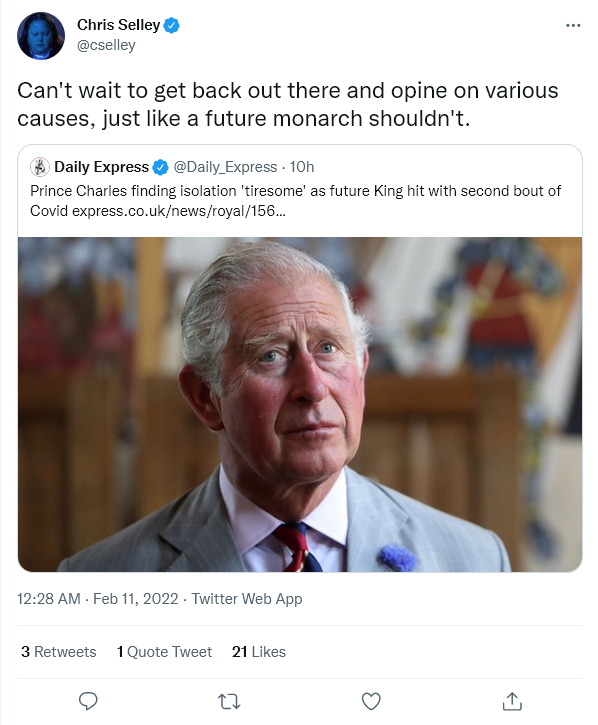
For some reason, the Twitter UI is only showing a portion of the exchange here:
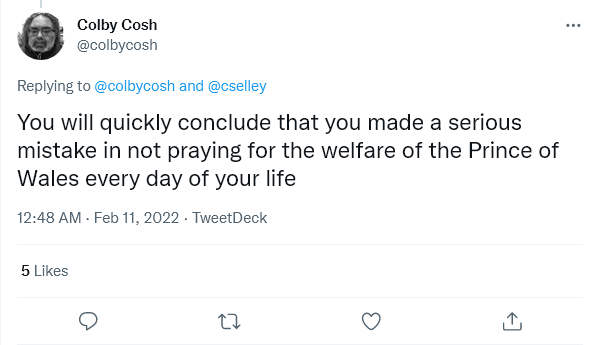
And here’s the part that ever-so-slightly improved my opinion of Charles, not for his own sake, but for succession reasons:
Comments Off on From the “it could actually be worse” file — royal succession alternatives
February 10, 2022
MI6’s Secret War – WW2 – Spies & Ties 13
World War Two
Published 9 Feb 2022Britain’s MI6 is caught off guard when war breaks out. As the Germans advance across Western Europe MI6’s networks collapse, and Britain becomes almost blind. MI6 have their secret weapons at Bletchley Park but they now face a painful struggle to rebuild their eyes in Europe.
(more…)
Comments Off on MI6’s Secret War – WW2 – Spies & Ties 13
HMCS Quebec – Guide 145
Drachinifel
Published 28 Sep 2019HMCS Quebec, formerly HMS/HMCS Uganda, is today’s other entry.
Want to support the channel? – https://www.patreon.com/Drachinifel
Want a shirt/mug/hoodie – https://shop.spreadshirt.com/drachini…
Want a medal? – https://www.etsy.com/uk/shop/Drachinifel
Want to talk about ships? https://discord.gg/TYu88mt
Want to get some books? www.amazon.co.uk/shop/drachinifel
Drydock Episodes in podcast format – https://soundcloud.com/user-21912004

Comments Off on HMCS Quebec – Guide 145
February 9, 2022
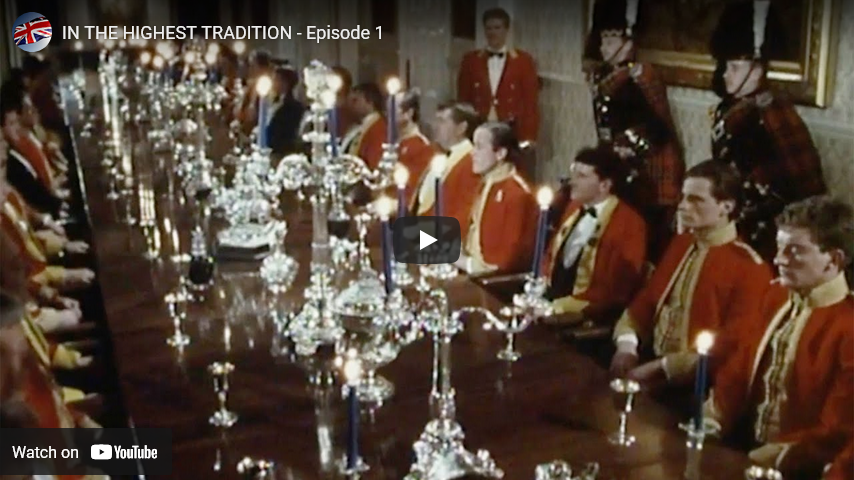
In The Highest Tradition – Episode 1
British Army Documentaries
Published 18 Oct 2021[From the episode transcript – “Apart from discipline what emerges when you delve into British military tradition is that there’s no such entity as a British army. What you find is a confederation of regiments hopefully fighting on the same side all fiercely preserving their individuality by being as different from one another as possible.”]
First transmitted in 1989, this is the first episode in a six-part series that delves into the world of regimental tradition. This programme includes looks at the origins of Emperor Joseph Bonaparte’s chamber pot, a druid oration, and the story of a goat who escaped being eaten to become a regimental mascot.
© 1989
This production is for viewing purposes only and should not be reproduced without prior consent.
This film is part of a comprehensive collection of contemporary Military Training programmes and supporting documentation including scripts, storyboards and cue sheets.
All material is stored and archived. World War II and post-war material along with all original film material are held by the Imperial War Museum Film and Video Archive.
Comments Off on In The Highest Tradition – Episode 1
February 8, 2022
Neil Young and the rebellion of “the Grumpy Old Woke Bros”
Julie Burchill on the (one hopes) last opportunity for elderly, wrinkly 60s and 70s rock stars to virtue signal their protests to a rapidly diminishing body of fans:

For a while now the generation gap has been making a comeback in politics in a way not seen since the youthquake of the 1960s. “Don’t trust anyone over 30” has become “OK Boomer”. Oldsters have been demonised for everything from Brexit to Covid. Personally, at 62, looking at the lives today’s teenagers can expect, I thank my lucky stars that I was young in the 1970s and 80s, when you could say what you liked and go where you wanted. But this dwindling of fun and freedom has as much to do with the stifling nature of woke culture as it does with the other virus.
So I wouldn’t blame teenagers if they were cross. But those doing the most to promote the alienation of young and old aren’t hot-blooded bright young things. They are old men who appear to identify as young, despite sharing the same unsavoury grey whiskers. Of course, if someone with a penis can be a woman, a greybeard can be a teenager. They’re the Grumpy Old Woke Bros.
We can trace this unhappy breed from the then 68-years-young Ian McEwan spluttering at an anti-Brexit rally in 2017: “A gang of angry old men, irritable even in victory, are shaping the future of the country against the inclinations of its youth. By 2019 the country could be in a receptive mood: 2.5million over-18-year-olds, freshly franchised and mostly Remainers; 1.5 million oldsters, mostly Brexiters, freshly in their graves.” Since then the likes of Alexei Sayle, Billy Bragg and Stewart Lee have joined in from the monstrous regiment of woke entertainers, adding Damon Albarn (a youthful 53 – and an OBE, the rebel!) to their rankled ranks last week when he said of Taylor Swift “She doesn’t write her own songs”. (This isn’t the first time Albarn has had beef with young female pop stars. He said of Adele in 2015: “She’s very insecure”, to which she replied “It ended up being one of those ‘Don’t meet your idol’ moments … I was such a big Blur fan growing up. But it was sad, and I regret hanging out with him.”)
Though we think of grumpiness as being an English trait, let’s not forget Neil Young (76) who spat his dummy out last week over sharing Spotify with Joe Rogan. Young is a latecomer to the wonderful world of wokeness, whose welcome to the spotless ranks was somewhat marred by the emergence of a 1985 interview in which he backed Ronald Reagan’s gun control policy and added for good measure, AIDS having recently been discovered, “You go to a supermarket and you see a faggot behind the cash register – you don’t want him to handle your potatoes”.
Comments Off on Neil Young and the rebellion of “the Grumpy Old Woke Bros”
QotD: The East India Company’s rise to power
In many ways the EIC was a model of corporate efficiency: 100 years into its history, it had only 35 permanent employees in its head office. Nevertheless, that skeleton staff executed a corporate coup unparalleled in history: the military conquest, subjugation and plunder of vast tracts of southern Asia. It almost certainly remains the supreme act of corporate violence in world history. For all the power wielded today by the world’s largest corporations – whether ExxonMobil, Walmart or Google – they are tame beasts compared with the ravaging territorial appetites of the militarised East India Company. Yet if history shows anything, it is that in the intimate dance between the power of the state and that of the corporation, while the latter can be regulated, it will use all the resources in its power to resist.
When it suited, the EIC made much of its legal separation from the government. It argued forcefully, and successfully, that the document signed by Shah Alam – known as the Diwani – was the legal property of the company, not the Crown, even though the government had spent a massive sum on naval and military operations protecting the EIC’s Indian acquisitions. But the MPs who voted to uphold this legal distinction were not exactly neutral: nearly a quarter of them held company stock, which would have plummeted in value had the Crown taken over. For the same reason, the need to protect the company from foreign competition became a major aim of British foreign policy.
The transaction depicted in the painting [Wiki] was to have catastrophic consequences. As with all such corporations, then as now, the EIC was answerable only to its shareholders. With no stake in the just governance of the region, or its long-term wellbeing, the company’s rule quickly turned into the straightforward pillage of Bengal, and the rapid transfer westwards of its wealth.
Before long the province, already devastated by war, was struck down by the famine of 1769, then further ruined by high taxation. Company tax collectors were guilty of what today would be described as human rights violations. A senior official of the old Mughal regime in Bengal wrote in his diaries: “Indians were tortured to disclose their treasure; cities, towns and villages ransacked; jaghires and provinces purloined: these were the ‘delights’ and ‘religions’ of the directors and their servants.”
Bengal’s wealth rapidly drained into Britain, while its prosperous weavers and artisans were coerced “like so many slaves” by their new masters, and its markets flooded with British products. A proportion of the loot of Bengal went directly into Clive’s pocket. He returned to Britain with a personal fortune – then valued at £234,000 – that made him the richest self-made man in Europe. After the Battle of Plassey in 1757, a victory that owed more to treachery, forged contracts, bankers and bribes than military prowess, he transferred to the EIC treasury no less than £2.5m seized from the defeated rulers of Bengal – in today’s currency, around £23m for Clive and £250m for the company.
William Dalrymple, “The East India Company: The original corporate raiders”, Guardian, 2015-03-04.
Comments Off on QotD: The East India Company’s rise to power


