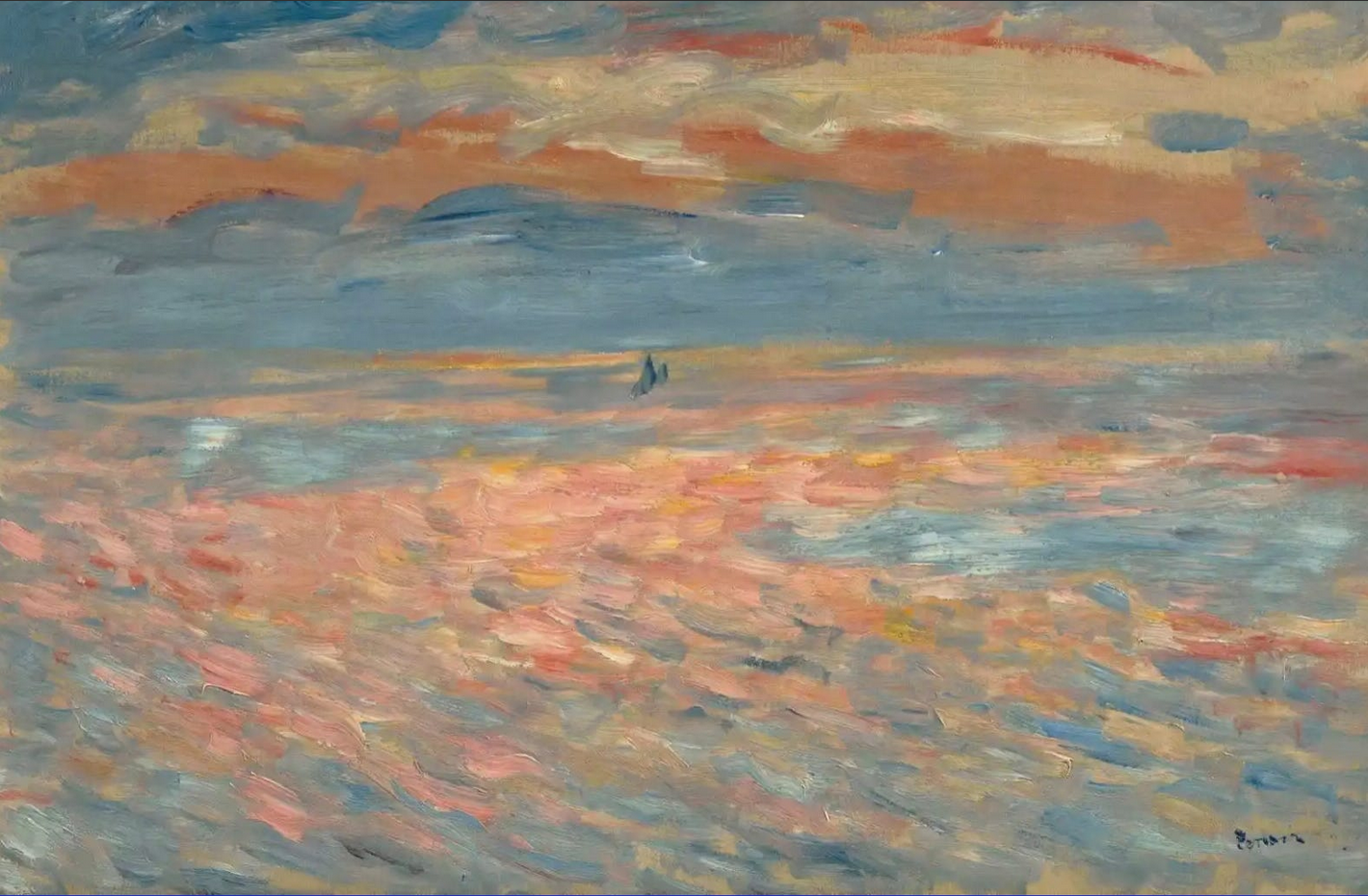
There’s a clichéd history of civilization which goes something like: once upon a time all human beings lived in wandering hunter-gatherer bands where everybody was directly involved in food production. Then while sojourning through a fertile river valley, some of these groups discovered agriculture. The relative predictability and reliability of farming, coupled with the much higher caloric yield per hour of labor,1 made it possible to support a denser population, and for only a portion of it to be directly involved in food production. The rest of them could become soldiers, artisans, priests, and scribes. They could develop technology, pass on their knowledge through writing, and develop complex systems of taxation, bureaucracy, and forced labour. Along the way, they made picturesque little walled farming villages […]
This is not their story. Instead it’s the story of the people who live in the hills behind that village. Without knowing anything at all about the place that picture depicts, you can probably tell me a lot about the people in those hills. Hill people are hill people, the world over. What are the odds that they’re clannish? Xenophobic? Backwards! Unusual family structures. Economically immiserated (probably due to their own paranoia and indolence). Deviant in their religious, commercial, and sexual practices. Illiterate, or at best poorly-read. They also probably talk funny. Basically they’re barbarians, but not the impressive kind who ride out of the steppe to massacre and enslave the soft city-dwellers. No, something more like living fossils — our ancestors were once like that, but then they got with the program. Well if they could do it, why don’t those hill dwellers move down here too, like normal people?2 They’re up to no good up there.
That’s certainly been the traditional view from the valleys, and there’s some truth to it, but there’s one important detail that we valley-dwellers get wrong. Far from being aboriginal holdovers of some previous phase of humanity, it’s relatively easy to determine from genetic, linguistic, and archaeological evidence that the hill people are largely descended from … the valley people!3 But … that would mean that there are people who look around at our beautiful civilization and reject its fruits — you know, art, technology, fusion cuisine, and uh … taxation, conscription, epidemic disease, corvée labour … How dare they!
You would never know it from reading the reports of the valley-bureaucrats, but the great agricultural civilizations of classical antiquity were in a near-constant state of panic over people wandering away from their farms and becoming barbarians.4 There are estimates that over the course of the empire something like twenty-five percent of the inhabitants of Roman border provinces quietly slipped across the limes for the proud life of the savage. In Ancient China, the movement was more cyclical — in times of war, or epidemic, or famine, entire villages might give up rice agriculture and vanish into the hills. Then, when the situation had stabilized, the human tide would reverse, and the hills would disgorge barbarians eager to be Sinicized (or really re-Sinicized, as their parents and grandparents had been). In both these cases and more, the boundary between “civilized” and “savage” was a great deal more porous, and the flow a great deal more bi-directional than we might realize. Like a single substance in two phases, now boiling, now condensing, changing back and forth in response to changes in the temperature.
So why then is it that hill people5 the world over have so much in common? Scott argues pretty convincingly that something like convergent cultural evolution for ungovernability is at work — that is, the qualities we stereotypically associate with backwards and barbarous peoples are precisely the traits that make one difficult to administer and tax. Some examples of this are very obvious to see — for instance physical dispersal in difficult terrain makes it harder to be surveilled, measured, or conscripted. Scott also talks a lot about the crops that hill people like to grow, and how the world over they tend to be either crops that are amenable to swiddening and don’t require irrigation, or things like tubers that mature underground and can be harvested at irregular times. Both patterns make it easy to lie about how much food you’ve planted and where, hence difficult for others to tax or control you.
What about illiteracy? Scott finds that many hill people around the world have oral legends about how they once had writing, but no longer do. Of course this is exactly what we would expect if, contrary to the usual story, the hill people are not the ancestors of the valley people, but their descendants. Yet the question remains, why give up writing? Scott posits several benefits of illiteracy: one is just that the inability to write removes any temptation to keep written records of anything, and written records are the kind of thing that can be used against you by a tax collector or an army recruiter.
But more fundamentally, a reliance on oral history and genealogy and legend is powerful precisely because these things are mutable and can be changed according to political convenience. Anybody who’s read ancient Chinese accounts of the steppe peoples or Roman discussions of Germanic barbarians has probably recoiled from the confusing profusion of tribes, peoples, and nations; the same ethnonyms popping in and out of existence over a vast area, or referring to a band of a few hundred one year and a nation of millions a decade later. Scott argues that the reason we see this is that the very notion of stable ethnic identity is a fundamentally “valley” conceit. Out in the hills or on the far wild plains, people exist in more of a quantum superposition of identities, and the nonsensical patterns you see in the histories come from imperial ethnographers feverishly making classical measurements in a double-slit experiment and trying to jam the results into a sensible form.
John Psmith, “REVIEW: The Art of Not Being Governed by James C. Scott”, Mr. and Mrs. Psmith’s Bookshelf, 2023-01-16.
1. Scott has yet another book about how this important detail of the stock story is totally false. In Scott’s telling, early agriculture produced fewer calories per hour of work than hunting and foraging. The entire increase in social complexity associated with primitive agriculture came not from a food surplus, but from the fact that it was easier to measure how much food everybody was producing and confiscate a portion of it.
2. Maybe then one of their descendants can go to Yale Law School and write a book about it.
3. Next time you’re driving through Montana, try to count how many people are transplants from New York or California.
4. Once you know this fact, you can go back and read those classical texts esoterically, and nervous panic over people defecting from civilization is practically all you will see.
5. I’ve used “hill people” throughout this review as a synecdoche for groups that have rejected a life-pattern involving settled agriculture and tax-paying, but as Scott points out there are many kind of terrain unsuitable or difficult for state administration. Marshes have historically been another magnet for those rejecting polite society, as have deserts and open plains.
September 10, 2023
QotD: The hill people and the valley people
September 6, 2023
“[T]he preemptive hype about [Bottoms] has been fundamentally false, fundamentally dishonest about what constitutes artistic risk and personal risk in 2023″
Freddie deBoer — whose new book just got published — considers the way a new movie is being marketed, as if anything to do with LGBT issues is somehow still “daring” or “risky” or “challenging” to American audiences in the 2020s:
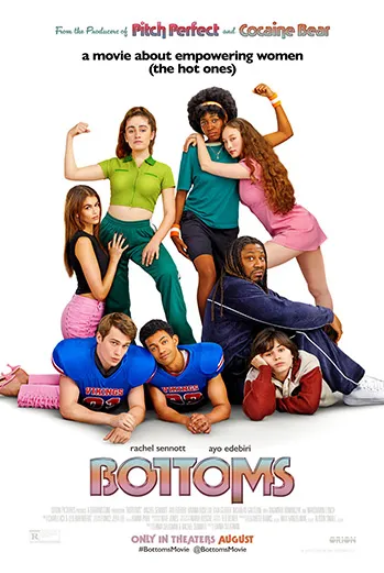
Consider this New York magazine cover story on the new film Bottoms, about a couple of lesbian teenagers (played by 28-year-olds) who start a high school fight club in order to try and get laid. I’m interested in the movie; it looks funny and I’ll watch it with an open mind. Movies that are both within and critiques of the high school movie genre tend to be favorites of mine. But the preemptive hype about it — which of course the creators can’t directly control — has been fundamentally false, fundamentally dishonest about what constitutes artistic risk and personal risk in 2023. The underlying premise of the advance discussion has been that making a high school movie about a lesbian fight club, today, is inherently subversive and very risky. And the thing is … that’s not true. At all. In fact, when I first read the premise of Bottoms I marveled at how perfectly it flatters the interests and worldview of the kind of people who write about movies professionally. As New York‘s Rachel Handler says,
[Bottoms has] had the lesbian Letterboxd crowd, which treats every trailer and teaser release like Gay Christmas, hot and bothered for months. After attending its hit SXSW premiere, comedian Jaboukie Young-White tweeted, “There will be a full reset when this drops.”
And yet to read reviews and thinkpieces and social media, you’d think that Bottoms was emerging into a culture industry where the Moral Majority runs the show. One of the totally bizarre things about contemporary pop culture coverage is that the “lesbian Letterboxd crowd” and subcultures like them — proud and open and loud champions of “diversity” in the HR sense — are prevalent, influential, and powerful, and yet we are constantly to pretend that they don’t exist. To think of Bottoms as inherently subversive, you have to pretend that the cohort that Handler refers to here has no voice, even as its voice is loud enough to influence a New York magazine cover story. This basic dynamic really hasn’t changed in the culture business in a decade, and that’s because the people who make up the profession prefer to think of their artistic and political tastes as permanently marginal even as they write our collective culture.
Essentially the entire world of for-pay movie criticism and news is made up of the kind of people who will stand up and applaud for a movie with that premise regardless of how good the actual movie is. And I suspect that Rachel Handler, the author of that piece, and its editors at New York, and the PR people for the film, and the women who made it, and most of the piece’s readers know that it isn’t brave to release that movie, in this culture, now. And as far as the creators go, that’s all fine; their job isn’t to be brave, it’s to make a good movie! They aren’t obligated to fulfill the expectation that movies and shows about LGBTQ characters are permanently subversive. But the inability of our culture industry to drop that narrative demonstrates the bizarre progressive resistance to recognizing that things change and that liberals in fact control a huge amount of cultural territory.
And here’s the thing: almost everybody in this industry, in media, would understand that narrative to be false, were I to put the case to them this way. This obviously isn’t remotely a big deal — in fact I’ve chosen this piece and topic precisely because it’s not a big deal — and I’m sure most people haven’t thought about it at all. (Why would they?) Still, if I could peel people in professional media off from the pack and lay this case out to them personally, I’m quite certain many of them would agree that this kind of movie is actually guaranteed a great deal of media enthusiasm because of its “representation”, and thus is in fact a very safe movie to release in today’s Hollywood — but they would admit it privately. Because “Anything involving LQBTQ characters or themes is still something that’s inherently risky and daring in the world of entertainment and media, in the year of our lord 2023” is both transparently horseshit and yet socially mandated, in industries in which most people are just trying to hold on and don’t need the hassle.
September 5, 2023
“… the misogyny myth persists because both sexes want to believe it”
In City Journal, John Tierney disassembles the “misogyny myth” of modern culture:
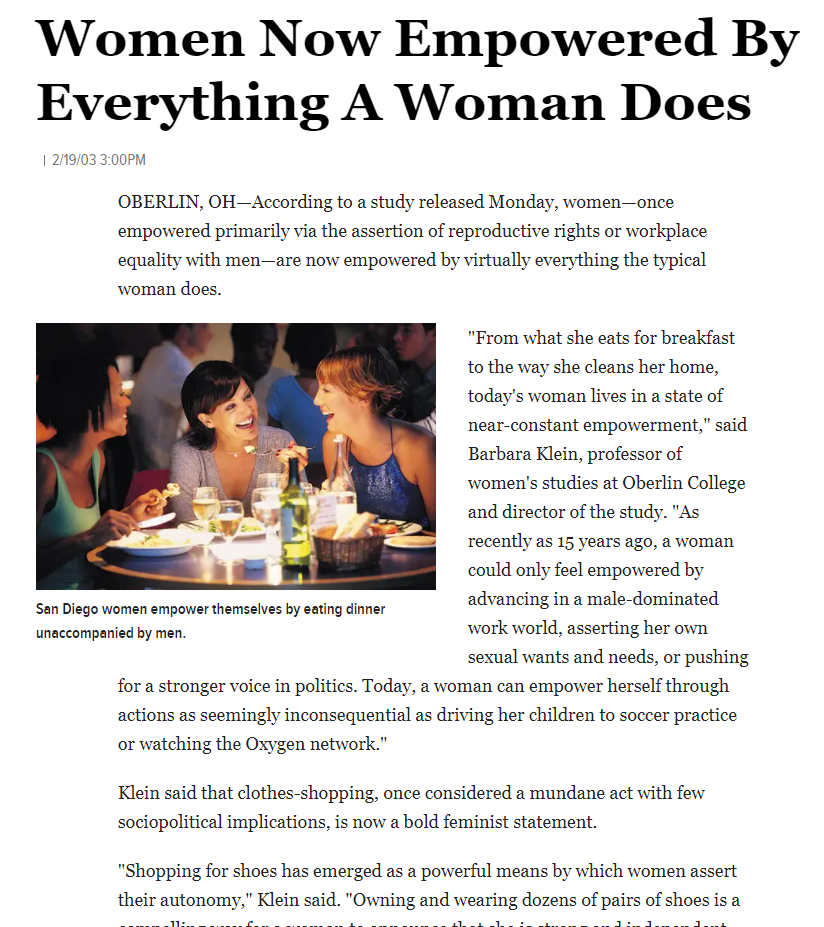
Misogyny is supposedly rampant in modern society, but where, exactly, does it lurk? For decades, researchers have hunted for evidence of overt discrimination against women as well as subtler varieties, like “systemic sexism” or “implicit bias”. But instead of detecting misogyny, they keep spotting something else.
[…]
If you haven’t heard of this evidence, it’s because of the well-documented misandrist bias in the public discussion of gender issues. Scholars, journalists, politicians, and activists will lavish attention on a small, badly flawed study if it purports to find bias against women, but they’ll ignore — or work to suppress — the wealth of solid research showing the opposite. Three decades ago, psychologists identified the “women-are-wonderful effect”, based on research showing that both sexes tended to rate women more positively than men. This effect has been confirmed repeatedly — women get higher ratings than men for intelligence as well as competence — and it’s obvious in popular culture.
“Toxic masculinity” and “testosterone poisoning” are widely blamed for many problems, but you don’t hear much about “toxic femininity” or “estrogen poisoning”. Who criticizes “femsplaining” or pretends to “believe all men”? If the patriarchy really did rule our society, the stock father character in television sitcoms would not be a “doofus dad” like Homer Simpson, and commercials wouldn’t keep showing wives outsmarting their husbands. (When’s the last time you saw a TV husband get something right?) Smug misandry has been box-office gold for Barbie, which delights in writing off men as hapless romantic partners, leering jerks, violent buffoons, and dimwitted tyrants who ought to let women run the world.
Numerous studies have shown that both sexes care more about harms to women than to men. Men get punished more severely than women for the same crime, and crimes against women are punished more severely than crimes against men. Institutions openly discriminate against men in hiring and promotion policies — and a majority of men as well as women favor affirmative-action programs for women.
The education establishment has obsessed for decades about the shortage of women in some science and tech disciplines, but few worry about males badly trailing by just about every other academic measure from kindergarten through graduate school. By the time boys finish high school (if they do), they’re so far behind that many colleges lower admissions standards for males — a rare instance of pro-male discrimination, though it’s not motivated by a desire to help men. Admissions directors do it because many women are loath to attend a college if the gender ratio is too skewed.
Gender disparities generally matter only if they work against women. In computing its Global Gender Gap, the much-quoted annual report, the World Economic Forum has explicitly ignored male disadvantages: if men fare worse on a particular dimension, a country still gets a perfect score for equality on that measure. Prodded by the federal Title IX law banning sexual discrimination in schools, educators have concentrated on eliminating disparities in athletics but not in other extracurricular programs, which mostly skew female. The fact that there are now three female college students for every two males is of no concern to the White House Gender Policy Council. Its “National Strategy on Gender Equity and Equality” doesn’t even mention boys’ struggles in school, instead focusing exclusively on new ways to help female students get further ahead.
September 4, 2023
The temptations of envy
Rob Henderson discusses the phenomenon of envy in the modern world:
A couple of sample items in the social comparison scale are “I often compare myself with others with respect to what I have accomplished in life” and “I often compare how I am doing socially (social skills, popularity) with other people.”
Social comparison, by definition, is relative. Here is a question often used in these kinds of scales.
Suppose you are presented with two options:
A. You get 2 weeks of vacation; your coworkers get 1 week
B. You get 4 weeks of vacation; your coworkers get 8 weeks
A sensible, rational, objective person should choose B. One week of vacation versus 4 weeks is a no-brainer. But a surprisingly high number of people will choose A over B.
Consider the reality of working in an environment in which you know everyone gets twice as much vacation time as you. It’s unfair. And as we’ve discussed before, our preoccupation with the idea of fairness is in part rooted in concerns about status.
So what are some of the traits associated with social comparison orientation?
Unsurprisingly, social comparison orientation is associated with the Dark Triad personality traits (psychopathy, narcissism, Machiavellianism), fear of failure, interest in exhibiting status, FoMo (Fear of Missing Out), utilitarian moral preferences, malicious envy, and benign envy. We’ll discuss the difference between these two forms of envy later.
The utilitarian finding is interesting. When you present trolley problems to people high on social comparison orientation, they are more likely to report that they would flip the switch to kill one person or push the fat man off the bridge in order to save five people. They seem to favor cold calculations for decision-making, which may be why they tend to score highly on psychopathy.
Narcissism is unsurprising. People who compare themselves with others are more likely to be preoccupied with their social image and want others to admire them and think highly of them.
This is of course related to fear of failure. Failure means that you come off looking comparatively worse than others. Social comparers are interested in status displays, that’s not a surprise given the link with narcissism.
In fact, some researchers have found that narcissistically-oriented people often report intense reactions to the perception of others’ envy. They experience a hidden sadistic satisfaction in causing a sense of inferiority and painful feelings in others.
Social comparers report greater levels of Fear of Missing Out, because if they are left out or excluded, this reflects poorly on them. Most people want to be a part of the excitement, but social comparers have an especially intense desire to be among those who are seen.
And this brings us to envy.
What is envy? Plainly, it is the emotional consequence of upward social comparison. Envy is an emotion that regulates the navigation of status hierarchies.
It is a painful emotion. People might say they will occasionally feel pride, or greed, or lust, but seldom do people confess to feelings of envy. To confess to envy is to acknowledge that you believe someone else has more status than you. Few people are eager to intentionally lower themselves in this way.
Envy is an unpleasant feeling, as many of your emotions are. But negative emotions are evolutionarily adaptive. Envy alerts you when you might be falling too low on the status ladder. It is a kind of status leveling mechanism.
Here’s how some psychologists have described it:
At its core, envy is born out of the perceived danger to lose respect and social influence in the eyes of others … envy’s function may be to foster the motivations to re-gain status or harm the superior position of others.
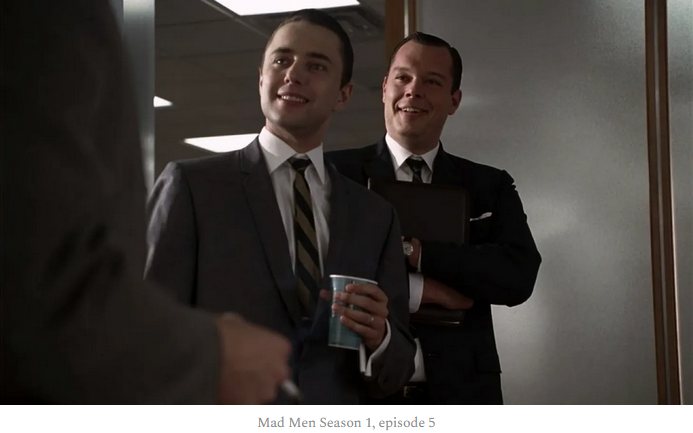
What does envy look like? Here’s a still from season 1 of the superb television series Mad Men.
Here, two advertising executives, Peter Campbell and Paul Kinsey, are reacting to their colleague Ken Cosgrove, who has just told them one of his stories was published in a prestigious magazine. Ken’s colleagues are smiling and congratulating him, but you can observe a bit of surprise, a bit of skepticism, and an attempt to show Ken that they are happy for him but also surprised that he had this talent for writing. It’s a way of being cordial while also communicating that Ken shouldn’t get too full of himself. This kind of contorted smile might be a uniquely American expression, because Americans are culturally conditioned to suppress envy and be happy for one another’s success. This is a good cultural practice, in my view.
There’s a term used in New Zealand and Australia called “Tall Poppy Syndrome”. The idea is that tall poppies, or people who rise too far up beyond others, get cut down because the smaller poppies are envious. Bids for status can incur envy in other people. If you try to achieve something, others might attack you or resent you or cut you down in some way. Some of you may be familiar with the crabs in the bucket metaphor, and this is similar to that idea of crabs at the bottom of the bucket pulling down the crabs higher in the bucket. People are often intuitively aware of this, which is why people conceal their desire for wealth or status or power.
September 3, 2023
QotD: The obesity epidemic – a possible explanation
When I was growing up as a white supremacist, embedded in a neighborhood of white privilege, before all our communities were broken by forced immigration and vulture capitalism, we all, despite our relative wealth, ate the dullest food you can imagine. Simple, basic, and not a lot of it: fish sticks, hamburgers, a hunk of roast beef or lamb once in a while, canned vegetables, ice cream once a week, no pop, like ever. Mac and cheese. Spaghetti and meatballs. Roast chicken. That’s it. No Japanese, Chinese, French, Italian, fusion, Korean, Mexican. Out for dinner once a month. Maybe. Abstemious.
Add to this, the entire culture was Stoic. Suck it up buttercup was pretty much the solution to everything. Life was not fair. Your duty was to make it more fair. That’s was it. That is the entire ethic of white supremacy. You didn’t eat a lot because that was not good for a) you or b) your tribe on whom your survival was based. It meant you were cheating, taking more of scarce common resources. That was not OK. This wasn’t stated or even conscious, but it was hard-wired.
My ever so privileged tribe left the Levant around 30,000 years ago, hived off to the Mongol Steppes, then migrated north to Scandinavia, thence to northern Scotland, and then to Ireland. Pretty much starved all the way. For 30,000 years. Constant famines. Dying by the side of the trail, absorbed into the peat moss. Etc. Like that. Around 500 BC they moved to the Midlands and bred out those who were lactose intolerant. To this day I can live on milk and cheese and meat. Wild greens. Salt. Bread. Their diet.
Then, after 1500 years of breeding and starving in the Midlands, a strike of lightning: the Industrial Revolution leading inevitably to industrial food and abundance. For 300 years afterwards there wasn’t famine for us, but there was pioneering and starving to the point of having to eat squirrel and tree bark, wars and rationing. Then, for the first time, EVER, the massive cohort of boomers got into the job market, started to make money, fall in love, date and party, food got spectacular.
And everyone got fat. Genes taught to horde any excess bloomed into layers and layers of fat around every torso and butt. This is not a moral issue. This is genetic. For every “race” or ethnic grouping.
That’s it. The end. Period. Every one of us has this history embedded in our genetic structure, one way or another. It is a bitch. It means a constant war against your appetite and genetic history which is shrieking EAT EAT! It’s only the left that makes it into a crime. We are hardwired to see fat as dangerous to collective survival, and deep down, we know it’s just not healthy. Near everyone is fat and everyone worries about it.
My white privileged clan developed stoicism as the primary survival tool because it worked. For 30,000 years, it made it possible to survive anything. Today, white culture or rather, the dominant culture filled with people of every race and color still uses stoicism to succeed in every profession or activity. There is no escaping it. Indulge the weakest part of you and you are doomed to failure.
It’s only the left that has made emotional blackmail the determinant survival tool.
Elizabeth Nickson, “The Woke Marxist Agenda to Destabilize Kids’ Health”, Welcome to Absurdistan, 2023-06-01.
August 29, 2023
The Souls of Black Folk by W.E.B. Du Bois “runs so fantastically counter to the entire ideology of ‘decolonise'”
In Spiked, Brendan O’Neill finds himself surprised at the inclusion of a very unusual book on a list demanded by those pushing for “decolonization” of university curricula:
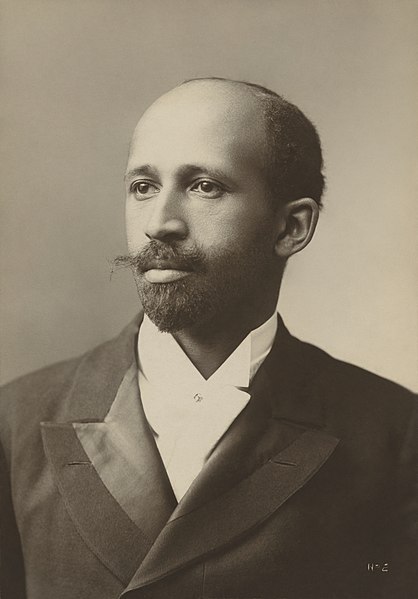
W.E.B. Du Bois by James E. Purdy, 1907, gelatin silver print, from the National Portrait Gallery which has explicitly released this digital image under the CC0 license.
Wikimedia Commons.
“Decolonise the curriculum” is a movement that wants university courses to focus less on dead white European males and more on writers of colour. Its argument is that black students need texts that speak directly to them. They need books by authors who look like them. They need books about experiences and ideas they can more readily relate to than they can the stuff written about in “high white culture”. Black students must be able to recognise themselves in what they study, we’re told, or else they’ll feel cheated and demeaned.
I was surprised to find that one of the leading decolonise movements, at the University of Edinburgh, was arguing for WEB Du Bois’ 1903 book, The Souls of Black Folk, to be included on the English curriculum. The activists said it was unreasonable to expect black students to engage with so many white authors. They also need to engage with people like Du Bois, in whose work they might “recognise themselves”. I was surprised, not because I think The Souls of Black Folk shouldn’t be on more university courses – absolutely it should. No, it’s because The Souls of Black Folk runs so fantastically counter to the entire ideology of “decolonise”. It made me wonder if these activists have even read it. Du Bois’ book contains some of the finest arguments you will ever read against the idea that high culture is a white thing that others cannot connect with.
One of my favourite passages in the book, from the chapter on what kind of education black men are fit for, touches on this very question. Here Du Bois makes his critique of those in his own time who were arguing that blacks only require basic education and industrial training. He describes his own experience of higher learning, writing:
I sit with Shakespeare and he winces not. Across the colour line I move arm in arm with Balzac and Dumas … From out the caves of evening that swing between the strong-limbed earth and the tracery of the stars, I summon Aristotle and Aurelius and they come all graciously with no scorn or condescension.
That passage, Du Bois’ moving belief that Shakespeare does not wince at him, captures a central thread of his writing: universalism. Du Bois agitates against accommodating to segregation or low expectations, and argues for the rights of “black folk” to assimilate into the spoils of civilisation; to become, as he puts it, “co-workers in the kingdom of culture”. To those in the late 1800s and early 1900s who argued that black people needed a targeted form of culture, one specific to their needs and capacities, Du Bois said: “We daily hear that an education that encourages aspiration, that sets the loftiest of ideals and seeks as an end culture and character rather than breadwinning, is the privilege of white men, and the danger and delusion of black men.”
Du Bois insisted that it is only through assimilation into the “kingdom of culture” that self-knowledge and self-improvement can truly occur. As he wrote: “Wed with Truth, I dwell above the veil.” The veil he’s referring to is the veil of colour, the one that separated blacks from whites in post-slavery America. For Du Bois, that veil was best lifted via assimilation into the American republic’s political universe and its realm of culture.
Du Bois’ critique of the notion that high culture was for white men, and would prove mystifying to black men, has sadly been superseded by an “anti-racism” with an entirely different outlook. Now, the supposedly radical stance is to believe that high culture is disorientating for black people, and possibly even damaging to their self-esteem, and therefore they require something more targeted. In short, they need release from the kingdom of culture. That, in essence, is what the decolonise movement desires: the “liberation” of non-white peoples from the cultural gains of Western civilisation. Behold the crisis of universalist belief.
August 22, 2023
Societal norms breaking down even among music fans at concerts
Ted Gioia on the increasing number of performing artists on stage who are being physically attacked by their own fans at live concerts:
Consider these recent events:
- During a Pink concert in London, a fan tossed a bag of human ashes on stage. Pink was totally chill, and on the video of the incident can be heard asking: “Is this your mom?”
- A fan threw a cellphone at Drake during a Chicago performance — and the singer almost caught it, but it hit his hand instead.
- Pop singer Bebe Rexha wasn’t so fortunate, and a hurled phone sent her to the hospital in June.
- Harry Styles has been repeatedly struck with objects while performing — taking on everything from a flying Chicken McNugget to a water bottle in the groin.
- Country star Kelsea Ballerini was struck by a flying bracelet thrown by a fan in Boise, Idaho. Jewelry is a lovely gift, but in this instance the impact caused the singer to flinch, and stop playing her guitar. A few minutes later she had to leave the stage.
- An assailant actually jumped on stage during an Ava Max performance in Los Angeles, and slapped the singer, scratching her eye in the process — before a security guard restrained him. The singer somehow managed to finish the song.
- Rapper Latto got hit with a flying object during a concert in Germany. She responded by telling the perpetrator “I’ma beat your ass.”
It’s a curious coincidence that, during this same period, activists have started throwing things at famous works of art. You wouldn’t normally think of museums and concert halls as epicenters of paintball-esque outbursts. But in the year 2023, they are hot spots for all the worst tendencies.
Of course, there’s a long history of fans throwing things on stage. But until recently, they were usually nice things. Only in the rarest instance — for example, a vaudeville show of embarrassingly low quality — were tomatoes tossed at a performer.
[…]
Our culture has changed, and not for the better. I have come to believe — as I’ve explained elsewhere — that US society shifts between cycles of hot and cool. We are currently approaching the peak of the hot cycle, and this is always accompanied by anger, conflict, and violence.
When I first started to say this, more than 15 years ago, people were skeptical. But who will deny it after everything we’ve seen in the intervening years?
You may think that violence plays out on the battlefield, not at a pop concert. But music has always been a cultural indicator. In some ways, it is our most revealing source of information on society. Sometimes the future shows up in our music even before it gets covered in the newspapers.
So even if I am saddened by the craziness at music concerts, I can’t say I’m surprised There’s something ugly simmering in our society, and it has finally arrived at the pricey front row seats of concerts. All of sudden, fans have decided that an expensive ticket gives them the right to do something abusive to their favorite pop star.
It makes no sense, but it’s definitely part of the zeitgeist. And it will almost certainly get worse before it gets better.
But these cycles eventually turn. There’s a law of reflexivity at work. People do burn out on anger, sooner or later. I’m hoping it will be sooner in this instance.

August 21, 2023
Baby Boomers – “a marketing category is not an age group”
Sarah Hoyt (who’s a few years younger than me) tackles the generational conflict that always seems to flare up on social media, if not so much in real life:
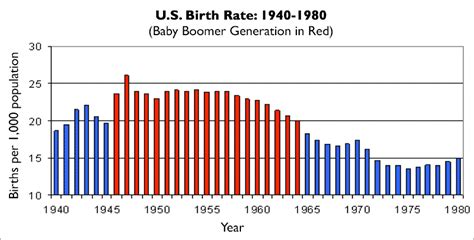
I’m going to write about boomers, why a lot of us blame them for … almost everything, why my generation (roughly 55 to 64) not only are not boomers, but tend to be the most vociferous in “D*mn it, I’m not a boomer.” Why I’m vaguely amused that millennials call everyone older than them “boomer”. And why I find it bizarre that my kids both hate millennials and identify as millennials, though they both are d*mn close to z and closer to z in attitudes. (And the younger one in date of birth, I think.) And why all this is unfair, because a marketing category is not an age group, and yet, perfectly fair in aggregate, because demographics is not destiny, but it sure as heck is economy. And economics shapes your life in a way you probably can’t think about too deeply without becoming enraged.
So, yeah, friends, in-betweeners, X, millenials and Zers, lend me your ears. I come not to bury the boomers and not to praise them, but to explain to everyone, including the sane boomers in the audience why the fractiousness exists, and to give — under the heading of giving perspective on the lives of others that we normally keep quiet about — an idea of how my non-generation (We certainly are not Jones. We don’t jones for anything that the boomers had. We just aren’t them) has gone through. Without blaming the boomers, because an accident of birth is not their fault.
First of all, and taking in account that I’m the one who says the population is not booming out of control, let me dismiss the idea the baby boom wasn’t real. That’s goofy. (To put it mildly.) You can argue the causes, but for about ten years — no, not the twenty five claimed. Marketing generations are not demographic generations — after World War II, families grew. Blame it on prosperity, which allowed one parent to stay home and raise the sprogs. Blame it on tax credits (it has been argued if the comparable applied today, people would have families of five or six too.) Sure, blame it on the move rural to city, which was tied to prosperity too, and the fact that the newly independent nuclear families didn’t have to put up with grandma’s critique of their child bearing or raising. Or blame it on the men having been away and the relief of the long war being over.
Blame it on whatever you want, but even without looking at the numbers, just by looking at family histories, families of five or six weren’t rare. And three was about average, I think. Four not anything to remark on.
But, you’ll say, that’s fairly normal for the past period. Sure. My mom, who was almost a boomer comes from a family of five (should be six, one lost in infancy) and dad from a family of four. And I’m almost sixty, and both dad and I were very late children. So, yeah “But that was normal before.”
Yes, it was, but now throw in prosperity, moves to the cities and … It’s not the babies who were born, you see, it’s the ones who survived. Even mom who was raised, for brevity of explanation, in a slum where going to your playfriend’s funeral, or more likely his infant sibling’s funeral was absolutely normal, had more of her friends survive than was normal for her parent’s generation.
To put it another way. Up until the late 19th century, women routinely bore 10 children and didn’t get to raise a single one to adulthood.
Even in the nineteenth century, women at the upper class level Jane Austen wrote about, routinely made two or three baby shrouds as part of their trousseau. Because that many deaths were expected. By my parent’s time that had improved — no, not medicine, sanitation. Better drains, a weekly bath, and washing your clothes more than twice a year — to the point that you would regularly raise about half of what you bore. (My family, having steel constitutions rarely lost a child. To compensate, we were always relatively low fertility.)
The improvement brought on by rudimentary sanitation and washing up was such that in the nineteenth century Europe burst at the seams with kids, which led to rapid invention, expansion, and yes, the adoption of a lot of half baked ideas. Because that’s the result of a lot of kids suddenly in a society. Baby busts … well, most of the Middle Ages, lead to slow innovation, a tendency to ossify the social structures, laws and regulations increasingly made by old men, for a world they only imagine exists. Stop me when this sounds familiar.
The baby boom happened at the intersection of the discovery of antibiotics and their popularization and also inoculation of school aged kids, both of which meant an unexpected number of children surviving childhood and surviving it in good health. And people having about the number of children their parents had. BUT — and this is very important — those children grew to adulthood and did so without any significant physical impairment.
What it caused was the same effect as if everyone alive had decided to have double or more the number of children. It was a massive demographic elephant moving through the societal snake.
August 20, 2023
QotD: Fear of death
[…]
As pretty much every Victorian anthropologist remarked, “savages” all seem deliriously happy — when life is a constant struggle, your every moment is filled with deep meaning, high purpose. So, too, with men at war — Robert Graves or someone like that once said that his time in the trenches were the greatest moments of his life, because everything other than the now disappeared. I can’t speak from personal experience, but I’d lay good money that no combat veteran completely re-enters the civilian world, largely for this reason.
Those are reasonable fears of death. We all accept, intellectually, that we could go at any time, and we will inevitably go eventually, but unless you’ve had a brush with death — a moment where you know, with perfect clarity, that there’s a significant chance you’re going now — you can’t really appreciate it, emotionally.
Severian, “Communal Salvation”, Rotten Chestnuts, 2020-11-19.
August 14, 2023
The WEIRDos – Western, Educated, Industrialized, Rich and Democratic societies
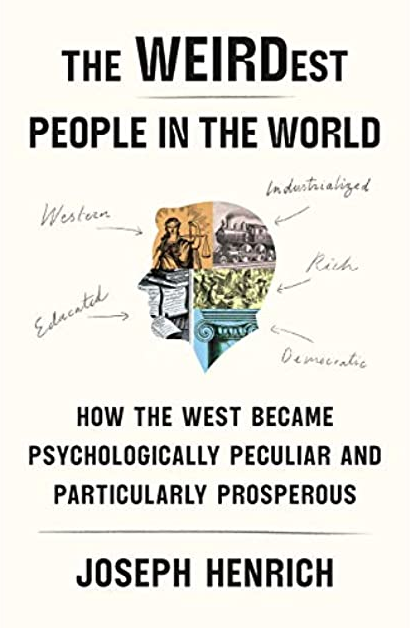
Another anonymous book review at Scott Alexander’s Astral Codex Ten considers The Weirdest People in the World: How the West Became Psychologically Peculiar and Particularly Prosperous by Joseph Henrich:
Coming as he does from the scientific side of the aisle, Henrich isn’t just going to tell a story. He has a hypothesis about an empirical puzzle. The puzzle is the most important question, the big one, the one that once you think about it’s hard to think about anything else, the economists’ Holy Grail since Adam Smith: why are some countries rich and others poor?
His hypothesis comes from cross-cultural psychology. The West got rich because Westerners are different. People from Western, Educated, Industrialized, Rich and Democratic societies are WEIRD – the acronym comes from a previous article of his. In particular, compared to everyone else in the world and in history, modern Westerners:
- Are individualist, not collectivist or conformist
- Feel more guilt and less shame
- Explain people’s actions by their innate dispositions, not their social role
- Reason analytically not holistically
- Follow more universal norms and less relationship-specific norms
- Are more patient
- Trust strangers more and are more honest.
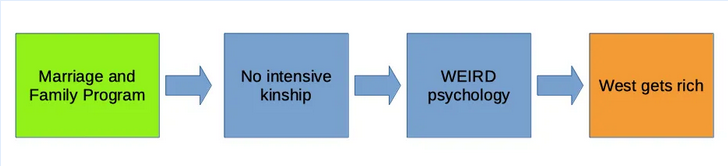
This psychology might make societies richer, for fairly well-known and plausible reasons. The Weirdest People in the World (henceforth just WEIRD) sets out a causal chain from cultural change to psychological change to modern economic growth. The start of that chain is surprising: an obscure set of rules pushed by the medieval Catholic church, which banned marriage between cousins. The most important argument of the book is that these rules created WEIRD psychology.
How it worked: these marriage regulations served to dismantle intensive kin networks, which are the social cement of society almost everywhere else in the world. For most people in history, family hasn’t just been the place where children grow up and couples spend time together. Family has been the basic human group, and there have been extensive and precise rules dictating who counts as family (or clan) and how each person should act with respect to different relatives. The Church’s regulations, the Marriage and Family Programme (MFP), aimed to replace intensive kinship, and over many centuries it was more or less successful in doing that. We’ll come back shortly to why it wanted to.
So, the causal chain looks like this:1
WEIRD‘s key evidence is the link between the places where the Church promulgated the MFP and a set of psychological and social outcomes: the level of cousin marriage, the psychology of people living in those places today, social capital and economic growth. This is the scientific story of European history, and Henrich’s answer to the most important question in the world.
These maps from one of the scientific articles behind WEIRD show the basic causal claim: the medieval church reduced the intensity of kinship institutions.
He tells it with an extraordinary mastery of a very wide range of sources from anthropology, psychology, behavioural economics, economic history, and historical narrative. This book is for everyone, but the connoisseur will enjoy the bibliography: if you think it’s important and relevant, it’s probably in there, and there was also plenty of work which I did not know, and now feel I should. It takes a very smart person to keep this many balls in the air. Being at Harvard probably doesn’t hurt either – that’s the “collective brain” of the human network, which makes an appearance later on in the book.
So this book really sets down a marker: the anthropologists are returning from the Amazon, the Sudan and Polynesia, and coming for Western history and economics. It will be interesting to see how those target disciplines react.
Is it true?
Economists and historians think about Western history very differently.
Historians love irony and contingency. They enjoy byways. Triumphalist, linear narratives of progress are distrusted as “Whig history”. Growth economists, by contrast, are all about the linear bigness. They have a relentless focus on the one question of how the West got rich, and if you call that triumphalist, they will take out a chart of South Sudanese child mortality and laugh at you.
Both historians and historical economists — a more appropriate name than “economic historians” nowadays — are interested in causality. But economists have a crunchier, more “scientific” standard for what counts as proof of causality. You’ve got to have a treatment and a control group, and by default if you claim there are no confounds, they won’t believe you. You need you some plausible exogeneity. A random river where Napoleon’s armies stopped. The distance from Wittemberg where Luther nailed up his theses. And then, how does that affect something that matters today (if it doesn’t, then who cares?) Of course, the longer ago the exogenous treatment, the more impressive the result.
You can see the incentives that these disciplinary demands might set up, and that might worry you. At worst, you might get a kind of “underground river” concept of history, where
- X happened long ago
- [underpants gnomes whispering]
- Y is correlated with X today
Indeed this does seem to skip all the interesting, contingent bits:
On the other hand, if you want to explain an all-important outcome like the take-off into modern economic growth, then you can’t just mumble “one damn thing after another” or “irony and contingency”. That a hundred things randomly conspired to make the West Educated, Industrialized, Rich and Democratic is not a satisfying story. Why would the die rolls keep favouring this one place? (And you can’t invoke the law of large numbers. There are only five continents in the world, and modern economic growth did not have to happen anywhere at all.)
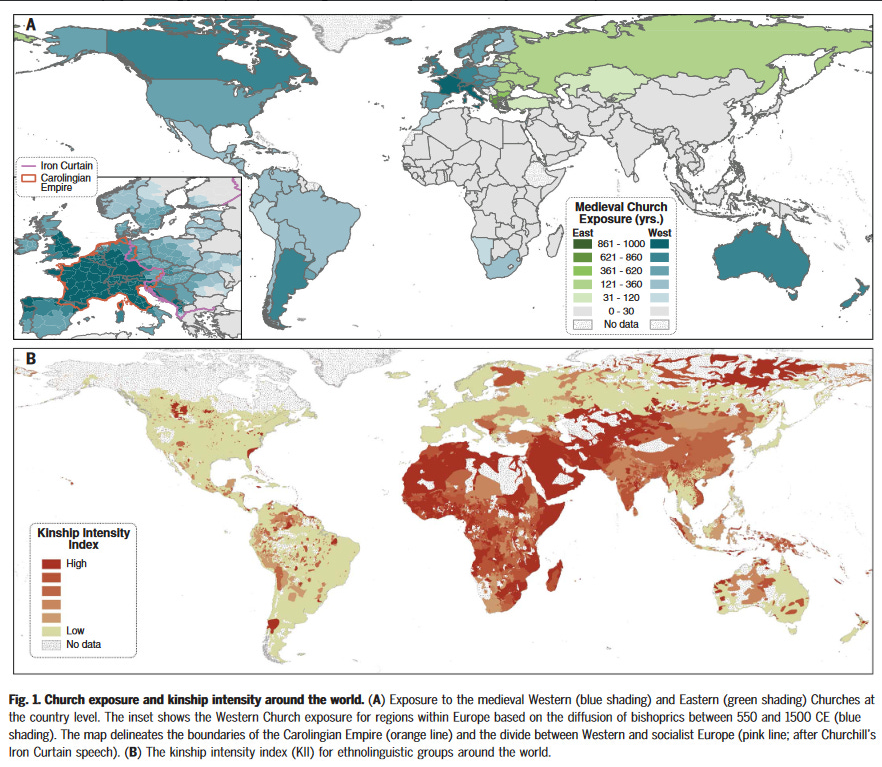
1. It’s a bit more complex than that. In particular, the end of intensive kinship directly helps economic growth because it clears the way for voluntary associations to thrive. But the psychology angle is what’s really unique to WEIRD – in particular, Francis Fukuyama has previously argued that kin institutions might be a problem for higher-level cooperation.
QotD: The US Army in the Korean War
The Army needed legions, but society didn’t want them. It wanted citizen-soldiers.
But the sociologists are right — absolutely right — in demanding that the centurion view of life not be imposed upon America. In a holy, patriotic war — like that fought by the French in 1793, or as a general war against Communism will be — America can get a lot more mileage out of citizen-soldiers than it can from legions.
No one has suggested that perhaps there should be two sets of rules, one for the professional Army, which may have to fight in far places, without the declaration of war, and without intrinsic belief in the value of its dying, for reasons of policy, chessmen on the checkerboard of diplomacy; and one for the high-minded, enthusiastic, and idealistic young men who come aboard only when the ship is sinking.
The other answer is to give up Korea-type wars, and to surrender great-power status, and a resultant hope of order — our own decent order — in the world. But America is rich and fat and very, very noticeable in this world.
It is a forlorn hope that we should be left alone.
In the first six months America suffered a near debacle because her Regular Army fighting men were the stuff of legions, but they had not been made into legionaries.
America was not more soft or more decadent than it had been twenty years earlier. It was confused, badly, on its attitudes toward war. It was still bringing up its youth to think there were no tigers, and it was still reluctant to forge them guns to shoot tigers.
Many of America’s youth, in the Army, faced horror badly because they had never been told they would have to face horror, or that horror is very normal in our unsane world. It had not been ground into them that they would have to obey their officers, even if the orders got them killed.
It has been a long, long time since American citizens have been able to take down the musket from the mantelpiece and go tiger hunting. But they still cling to the belief that they can do so, and do it well, without training.
This is the error that leads some men to cry out that Americans are decadent.
If Americans in 1950 were decadent, so were the rabble who streamed miserably into Valley Forge, where von Steuben made soldiers out of them. If American society had no will to defend itself, neither did it in 1861, at First Manassas, or later at Shiloh, when whole regiments of Americans turned tail and ran.
The men who lay warm and happy in their blankets at Kasserine, as the panzers rolled toward them in the dawn, were decadent, by this reasoning.
The problem is not that Americans are soft but that they simply will not face what war is all about until they have had their teeth kicked in. They will not face the fact that the military professionals, while some have ideas about society in general that are distorted and must be watched, still know better than anyone else how a war is won.
Free society cannot be oriented toward the battlefield — Sparta knew that trap — but some adjustments must be made, as the squabbling Athenians learned to their sorrow.
The sociologists and psychologists of Vienna had no answer to the Nazi bayonets, when they crashed against their doors. The soldiers of the democratic world did.
More than once, as at Valley Forge, after Bull Run, and Kasserine, the world has seen an American army rise from its own ashes, reorient itself, grow hard and bitter, knowledgeable and disciplined and tough.
In 1951, after six months of being battered, the Eighth Army in Korea rose from its own ashes of despair. No man who was there still believes Americans in the main are decadent, just as no man who saw Lieutenant General Matt Ridgway in operation doubts the sometime greatness of men.
T.R. Fehrenbach, This Kind of War: A Study in Unpreparedness, 1963.
August 1, 2023
QotD: US Army culture before the Korean War
A sergeant, by shouting at some sensitive yardbird, could get his captain into a lot of trouble. For the real effect of the Doolittle recommendations was psychological. Officers had not been made wholly powerless — but they felt that they had been slapped in the teeth. The officer corps, by 1946 again wholly professional, did not know how to live with the newer code.
One important thing was forgotten by the citizenry: by 1946 all the intellectual and sensitive types had said goodbye to the Army — they hoped for good. The new men coming in now were the kind of men who join armies the world over, blank-faced, unmolded — and they needed shaping. They got it; but it wasn’t the kind of shaping they needed.
Now an N.C.O. greeted new arrivals with a smile. Where once he would have told them they made him sick to his stomach, didn’t look tough enough to make a go of his outfit, he now led them meekly to his company commander. And this clean-cut young man, who once would have sat remote at the right hand of God in his orderly room, issuing orders that crackled like thunder, now smiled too. “Welcome aboard, gentlemen. I am your company commander; I’m here to help you. I’ll try to make your stay both pleasant and profitable.”
This was all very democratic and pleasant — but it is the nature of young men to get away with anything they can, and soon these young men found they could get away with plenty.
A soldier could tell a sergeant to blow it. In the old Army he might have been bashed, and found immediately what the rules were going to be. In the Canadian Army — which oddly enough no American liberals have found fascistic or bestial — he would have been marched in front of his company commander, had his pay reduced, perhaps even been confined for thirty days, with no damaging mark on his record. He would have learned, instantly, that orders are to be obeyed.
But in the new American Army, the sergeant reported such a case to his C.O. But the C.O. couldn’t do anything drastic or educational to the man; for any real action, he had to pass the case up higher. And nobody wanted to court-martial the man, to put a permanent damaging mark on his record. The most likely outcome was for the man to be chided for being rude, and requested to do better in the future.
Some privates, behind their smirks, liked it fine.
Pretty soon, the sergeants, realizing the score, started to fraternize with the men. Perhaps, through popularity, they could get something done. The junior officers, with no sergeants to knock heads, decided that the better part of valor was never to give an unpopular order.
The new legions carried the old names, displayed the old, proud colors, with their gallant battle streamers. The regimental mottoes still said things like “Can Do”. In their neat, fitted uniforms and new shiny boots — there was money for these — the troops looked good. Their appearance made the generals smile.
What they lacked couldn’t be seen, not until the guns sounded.
T.R. Fehrenbach, This Kind of War: A Study in Unpreparedness, 1963.
July 31, 2023
QotD: Stranger in a Strange Land at 50
Sexual mores changed but not, for most, in that direction. Living in southern California in the eighties, the view that seemed most common among young adults — many of those I associated with would have been people I met through the SCA,1 a subculture that had noticeable overlap with both science fiction fandom and hippiedom — was very different. The ideal pattern was stable monogamy but who could be so lucky? Insofar as it had been replaced it was mostly by the increasing acceptability and practice of casual sex.
There has been some development since Stranger was published, in practice and theory, along the lines of group marriage of a somewhat different sort. Polyamory is more self-conscious and, at least in theory, more structured than what we see in Stranger. Partners are classified as primary or secondary and a good deal of attention paid to what those terms mean and what behavior they imply. The result is in theory closer to the Oneida Commune of the 19th century, on a much smaller scale, than to the nest described in Stranger.2
This fits not only what happened in the real world but what happened in Heinlein’s fictional worlds. Consider a more sophisticated version of group marriage, the line marriage in The Moon is a Harsh Mistress. It is highly organized, with new members brought in at the low age end on a regular pattern of alternating gender. There is extensive search/courtship. And the protagonist offers a plausible explanation of its social role, why the institutions developed and what purposes it served.
Finally, consider Friday, a later novel. The protagonist, surprisingly naive given her profession — secret agent — joins a group marriage, makes a substantial commitment to it and is booted out, her share of the assets stolen, when it is discovered that she is an artificial person, the superior product of genetic engineering. Her much later commitment to a second group marriage follows more careful research.
David D. Friedman, “Odds and Ends”, David Friedman’s Substack, 2023-04-29.
1. The Society for Creative Anachronism, a historical recreation organization I have been active in for a very long time.
2. The practice sometimes ends up as open marriage, monogamous for purposes of producing and rearing children but with no obligation to sexual exclusivity — an option made possible by reliable contraception.
July 30, 2023
“Give me Andrea Dworkin’s anti-fella fury over this matrician tripe any day of the week”
Brendan O’Neill clearly doesn’t think Caitlin Moran’s new book What About Men? is worth reading:
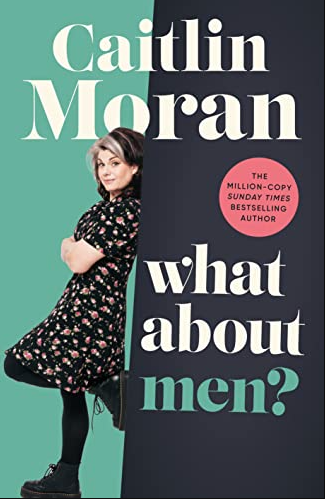
Men, I have bad news: Caitlin Moran is coming for us. She comes not to man-bash, not to holler: “All men are rapists!” It’s worse than that. She feels sorry for us. “I’m violently opposed to the branches of feminism that are permanently angry with men”, she writes at the very start of her very bad book. Instead she pities us. She frets over our toxic stoicism, our inability to be vulnerable, our unwillingness to be open about our fat bodies and small cocks. She wants to save us from all the “rules” about “what a man should be”. From all that “swagger” and “the stiff upper lip”. By the end I found myself pining for some good ol’ angry feminism. Give me Andrea Dworkin’s anti-fella fury over this matrician tripe any day of the week.
What About Men? is, I’m going to be blunt, rubbish. I knew it would be from the very first page where Moran says that “when it comes to the vag-based problems, I have the bantz”. Imagine using the word bantz unironically in 2023. What she means is that she’s done all the vagina stuff. She’s completed feminism. She’s known as “the Woman Woman”, she says, in an arrogant timbre that puts to shame those cocksure blokes who stalk her nightmares. She wrote the bestselling pop-feminist tome, How To Be a Woman (2011), which contained such gems of wisdom as “don’t shave your vagina” because it’s better to have a “big, hairy minge”, a “lovely furry moof”, “a marmoset sitting in [your] lap”, than a bald cooch. (Emmeline Pankhurst, I’m so sorry.) So now, naturally, she’s turning her attention to men. She’s discovered there is “a lot to say” about “men in the 21st-century”. Lucky us.
What she says about us is almost too daft for words. You realise by about page 22 that she’s never met a bloke from outside the media-luvvie, ageing rock-chick, “Glasto”-loving circle she famously inhabits. (I almost died of second-hand embarrassment when she said in How To Be a Woman that she lives an edgy existence, “like it’s 1969 all over again and my entire life is made of cheesecloth, sitars and hash”. Maam, you write a celebrity column for hundreds of thousands of pounds for The Times.)
Even her cultural references in What About Men? are off, as befits a woman who is essentially a square person’s idea of a cool person. She laments that young men are in “the grip of a fad” for super-skinny jeans. Jeans so tight they look “sprayed-on”. Jeans so tight that the poor lad’s balls end up “crushed against the crotch seam, in vivid detail”. Really? It’s not 2006. Bloc Party aren’t in the charts. I’m no follower of fashion but even I know most young men haven’t been wearing bollock-squashing jeans for a few years now. My nephews wear baggy jeans, à la Madchester. Pretty much the only time you see unyielding denim these days is on the portly thigh of a mid-life-crisis middle-class dad. The kind of men, dare I say it, that Ms Moran mixes with.
Her commentary on t-shirts is a dead giveaway, too. The only fashion flare the tragic male sex is allowed to enjoy is the tee, she says. Especially past the age of 40. You’ll see fortysomething fellas in “band t-shirts, slogan t-shirts, t-shirts with swearing on”, she says. Will you? Where? Again, only in the knowingly dishevelled privileged set Moran exists in. Every man in his forties I know always manages to put a shirt on. So desperate are emotionally repressed men to express themselves, says Moran, that some even buy t-shirts “from the back pages of Viz” that say things like “Breast Inspector” or “Fart Loading: Please Wait”. Not once in my life have I seen a man in a Viz tee. The problem here isn’t men – it’s Moran’s man-friends. She could have saved herself the trouble of this entire book by befriending some normal blokes.
That Moran’s pool of men is shallow is clear from the fact that all the men she talks to for the book seem to be as steeped as she is in chattering-class orthodoxy. She includes a transcript of long chats with male acquaintances and, honestly, reading it feels like being stuck in a lift with craft-beer wankers who do IT for the Guardian. At one point she informs her readers that her male friends are mostly “middle-aged, middle-class dads who know about wine, recycle, have views on thoughtful novels” and would probably “cry if they saw a dog struggling with a slight limp”. Writing a book about men from the perspective of men like that is like writing a book about women from the perspective of Princess Anne.
July 20, 2023
Three phases of a cultural cycle
Chris Bray visits an art museum and shares some thoughts provoked by his experiences:
There’s a moment, in a museum supported by a deep permanent collection, when you transition from glowing oil paint depictions of Lord Major Fluffington P. Farnsworth-Hadenwallace, Seventh Earl of Wherever, Ninth Duke of Someotherplace, posing in his lordly estate with a bowl of fruit and his array of status decorations, to the shocking emergence of late-19th century innovations in painting, and you find yourself thinking that huh, this Renoir dude really knew his stuff, like you’re the first person to ever notice.
Good eye, Sterling
These explosive moments of creativity were usually social: artists gathering, talking, seeing the work of other artists and thinking about new ways of seeing and showing. Individual acts of artistic liberation appeared in the context of an emerging cultural freedom. Renoir and Monet hung out together.
You can see the tide coming in and going out. You can watch enormous waves of joyful innovation, or — respectful nod to the German Expressionists — anxious and anguished innovation. It’s on the wall: here’s the moment when people experienced unusual freedom of vision. You can see artists pursuing beauty with disciplined attention, in a cultural atmosphere that allows the pursuit.
And it’s just so abundantly clear that something opened in the world, somewhere between 1870 and … 1950? Or so? And then it began to close, and the closure recently began picking up force. There are periods of general creativity and periods of general stultification and retrenchment; there was one Italian Renaissance, one Scottish Enlightenment, and so on. Weimar Germany, sick as it was, fired more brilliant art into the world in twenty years than many cultures produce in a period of centuries, though a certain teenager who lives in my house would like you to know that Fritz Lang sucks and please stop with those boring movies and I’ll be in my room.
So it seems to me that the first part of the cultural cycle is the making phase, the period of astonishing innovation; then comes the consolidation and appreciation, the moment the heirs to sewing machine fortunes show up and notice how good everything is; then comes the phase when a few monk-equivalents try to keep the record of accomplishment alive in the context of a hostile or indifferent culture, while most institutions reject innovation and turn to scolding, wrecking, and cannibalization. The fifth Indiana Jones movie. She-Hulk. Like that. I just spent twenty minutes in a Barnes and Noble, and the “new fiction” section may still be making me feel tired next week.
We’re living through a decline in fertility — in literal fertility, in rates of people being married and making babies and hanging around to raise children — at the moment when cultural fertility also seems to be going into freefall. Your results may vary, but I’m finding the moment manageable, largely with piles of earlier books and the occasional sprint to a place like the Clark. Fecundity and sterility appear in cycles, but you can time travel. You can reach back. Mary McCarthy got me through June, and Willa Cather is helping with July. Evelyn Waugh covered roughly February through May.
If you’re near the Berkshires, a worthwhile Edvard Munch exhibit is around until mid-October.
It’s very strange to be in the river and then to suddenly notice that it isn’t running — you’ve hit a long stretch of dead water, so still it starts to stink. I assume it will pass. But until then …