
… Socialists are all about equality, and if everyone ends up equally broke, hungry, and dead, well, fair’s fair. Igor Shafarevich flat out declared that Socialism is a suicide cult. Take your pick — Socialism simply is Nihilism.
That seems bizarrely wrong, considering how much effort Socialists put into saving the world. But look at it objectively, comrade (heh heh), and you’ll see that Save-the-World-ism, of whatever flavor, always boils down to Destroy-the-World-ism. Always. It doesn’t matter how the world gets “saved;” it always gets blown up in the process. You still can’t find a better primer on chiliastic psychology than Norman Cohn’s The Pursuit of the Millennium. The specifics of each loony doctrine changed, but the underlying presumption was always the same: Kill everyone, destroy everything, and then Jesus comes.
This is true even of millennialists whose doctrines don’t obviously entail killing everyone. Calvinists, for example. I spent decades trying to explain Calvinism to undergrads, and never once succeeded. The gulf between their words and their actions is too vast for the adolescent mind. There are only two logical responses to the doctrine of “double predestination”: quietism, or hedonism. They knew it, too, which is why they started burning people at the stake the minute they got any real power. Look at what they did, not what they said, and you’ll see nihilism plain as day. Calvin’s Geneva was the nearest thing to a police state that could be achieved with 16th century technology. The ideal Calvinist would say nothing, do nothing, think nothing, as he sat in the plain pews of his unadorned chapel, waiting for death and the Final Judgment. Calvinists wanted to grind the world to a halt, not blow it up, but once again the mass extinction of the human race is a feature, not a bug.
Take Jesus out of the equation, and you end up at pure shit-flinging nihilism in less than three steps. Marxism is perhaps the most exquisitely pointless doctrine ever devised. It’s more pleasant to have than to have not, I suppose, but no matter how much everyone has, we’re still just naked apes, living the brief days of our vain lives under an utterly indifferent sky. Marxists are a special kind of stupid, so they don’t realize it, but … they won. Modern Western “poor” people keel over from heart disease while fiddling with their smartphones in front of 50″ plasma tvs. While wearing $200 sneakers. We’re so far from being “alienated” from the fruits of our labor that “labor” is an all-but-meaningless concept for lots of us — and the further down the social scale you go, the more meaningless it gets. The modern ghetto dweller simply is Marx’s ideal proletarian. Does he look self-actualized to you? Ecce homeboy.
I assure you, the SJWs know this. Calvinists to the core, they know better than anyone the utter futility of all human effort. So they do what the original Calvinists did: Displace, displace, displace. Don’t take it from me, take it from a card-carrying Marxist. The end result is the same: Whether you’re a Puritan or an SJW, the only way to escape the crushing meaninglessness of your condition is to spend every moment of every day contemplating your pwecious widdle self.
Throw in the transitive property of equality, and you’ve got people like Hillary Clinton. If Socialism is Nihilism, then Nihilism is Socialism. Far from arguing against the idea … that Hillary et al are motivated solely by hatred, I’m 100% behind it. In fact, I’d argue that the Nihilism comes first — people who have convinced themselves that life is pointless always, always, embrace the biggest and most all-encompassing form of collectivism on offer. What could be crueler, than to be given all this for nothing? It’s not even a sick joke, since a joke implies a joker.
How can you not hate this world, then, and everything in it? More to the point: how can you not hate yourself, for seeing the world as it really is? Ignorance is bliss … but how can you not hate them, too, those poor deluded motherfuckers who still think stuff like God and love and family and the designated hitter might somehow mean something? Vanity, vanity, all is vanity … and if I have to face the existential horror of it all, then fuck it, so do you. “Capitalism,” the “free market,” “representative government” — call it what you will, it’s all just vanity, just another way for the sheeple to keep deluding themselves. Fuck it, and fuck them. Burn it down. Burn it allllll down.
Severian, “A Tyranny of Nihilism”, Rotten Chestnuts, 2019-10-22.
November 21, 2022
November 20, 2022
A Conspiracy to kill America’s President? – WW2 – 221 – November 19, 1943
World War Two
Published 19 Nov 2022A torpedo attack against the President; a Marine invasion in the central Pacific that turns very bloody in a hurry; German counterattacks in the Soviet Union; a bombing raid in Italy against a secret weapons site — all of that this week.
(more…)
Tank Chat #158 Spartan and Stormer | The Tank Museum
The Tank Museum
Published 22 Jul 2022David Fletcher is back with the next Tank Chat instalment! This week he chats about not one but two vehicles, Spartan and Stormer.
(more…)
QotD: The Maginot Line worked
As an aside, the purpose of the Maginot Line was to channel any attack at France through the Low Countries where it could be met head on with the flanks of the French defense anchored on the line to the right and the channel to the left. At this purpose, it succeeded; the failure was that the French army proceeded to lose the battle in the field. It was not the fixed fortifications, but the maneuvering field army which failed in its mission. One can argue that the French under-invested in that field army (though I’d argue the problem was as much doctrine than investment), but you can’t argue that the Maginot Line didn’t accomplish its goals – the problem is that those goals didn’t lead to victory.
Bret Devereaux, “Collections: Fortification, Part III: Castling”, A Collection of Unmitigated Pedantry, 2021-12-10.
November 19, 2022
American political parties from 1865 down to the Crazy Years we’re living through now
Severian responds to a comment about the Democrats and Republicans and how they have morphed over the years to the point neither party would recognize itself:
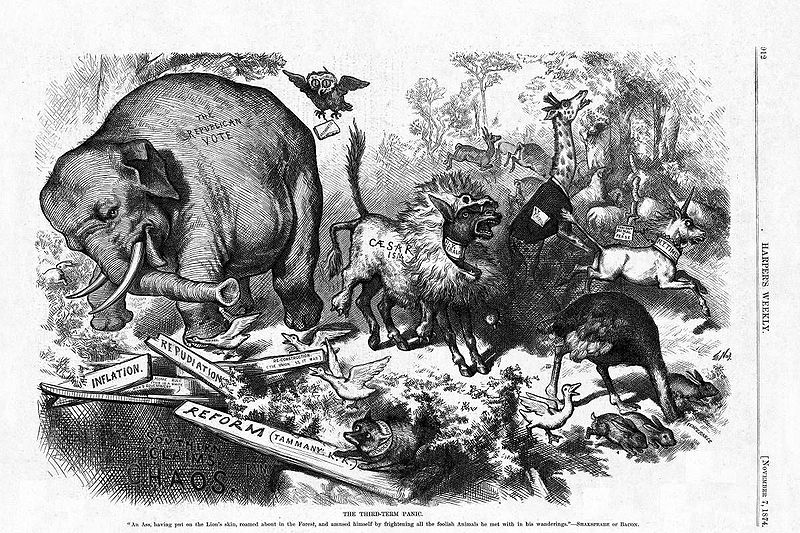
“The Third-Term Panic”, by Thomas Nast, originally published in Harper’s Magazine on 7 November 1874.
A braying ass, in a lion’s coat, and “N.Y. Herald” collar, frightening animals in the forest: a giraffe (“N. Y. Tribune”), a unicorn (“N. Y. Times”), and an owl (“N. Y. World”); an ostrich, its head buried, represents “Temperance”. An elephant, “The Republican Vote”, stands near broken planks (Inflation, Repudiation, Home Rule, and Re-construction). Under the elephant, a pit labeled “Southern Claims. Chaos. Rum.” A fox (“Democratic Party”) has its forepaws on the plank “Reform. (Tammany. K.K.)” The title refers to U.S. Grant’s possible bid for a third presidential term. This possibility was criticized by New York Herald owner and editor James Gordon Bennett, Jr.
Image and caption via Wikimedia Commons.
I find this extremely useful. I’d add that the postbellum parties do shift ideologies fairly regularly, as PR notes, such that even though they’re still called by the same names, they’re nowhere near the same parties, 1865-present.
I’d add some distinguishing tags for ease of reference, like so:DEMOCRATS:
The Redeemers of the “Solid South”, 1865-1882, when their main issue was ending Reconstruction and establishing Jim Crow.
The Grover Cleveland years, 1882-1896: Still primarily an opposition party, their main goal was reining in the ridiculous excesses of the Gilded Age Republicans. As one of about 100 people worldwide who have strong opinions on Grover Cleveland, I should probably recuse myself here, so let me just say this: Union Army veterans were to the Gilded Age GOP what the Ukraine is to the Uniparty now. They simply couldn’t shovel money at them fast enough, and the guys who orchestrate those ridiculous flag-sucking “thank you for your service” celebrations before pro sporting events would tell them to tone it way, way down. Cleveland spent most of his presidency slapping the worst of this down.
[How bad was it? So bad that not only did they pass ridiculous giveaways like the Arrears of Pension Act and the Dependent Pension Act — think “Build Back Brandon” on steroids, times two, plus a bunch of lesser boondoggles — but they got together every Friday night when Congress was in session to pass “private” pension bills. These are exactly what they sound like: Federal pensions to one specific individual, put up by his Congressman. Grover Cleveland used to burn the midnight oil vetoing these ridiculous fucking things, which makes him a true American hero as far as I’m concerned].
The Populist Party years, 1896-1912: They were more or less absorbed by the Populist Party — William Jennings Bryan ran as a “Democrat” in 1896, but he was really a Populist; that election hinged entirely on economic issues. They still had the “Solid South”, but the Democrats of those years were basically Grangers.
The Progressive Years, 1912-1968: They picked up all the disaffected “Bull Moose” Republicans who split the ticket and handed the Presidency to Woodrow Wilson in 1912, becoming the pretty much openly Fascist entity they’d remain until 1968.
The Radical Party, 1968-1992: The fight between the Old and New Left, or Marxism vs. Maoism.
The Boomer Triumphalist Party, 1992-2000. It’s an Alanis-level irony that Bill Clinton was the most “conservative” president in my lifetime, if the metric for “conservatism” is “what self-proclaimed conservatives say they want”. This was our Holiday From History, in which “wonks” reigned supreme, tweaking the commas in the tax code while occasionally making some noises about silly lifestyle shit.
The Batshit Insane Party, 2000-Present. The years of the Great Inversion. Today’s Democrats only know one thing: Whatever is, is wrong.
REPUBLICANS:
The Radical Party, 1864-1876: Determined to impose utopia at bayonet point in the conquered South, they started asking themselves why they couldn’t simply impose utopia at bayonet point everywhere. They never did figure it out, and we owe those awful, awful racists in the Democratic Party our undying thanks for that. This is the closest America ever came to a theocracy until The Current Year. Morphed into
The party of flabbergastingly ludicrous robber baron excess, 1876-1896. In these years, J.P. Morgan personally bailed out the United States Treasury. Think about that. FTX, meet Credit Mobilier. You guys are pikers, and note that was 1872. William McKinley deserves a lot more credit than he gets in pretty much everything, but he might’ve been the most fiscally sane American president. Only Calvin Coolidge is even in the ballpark.
The Progressive Party, 1900-1912. For all the Left loves to call Republicans “fascists”, for a time they were … or close enough, Fascism not being invented quite yet. But the Democrats coopted it under Wilson, leading to
The Party of (Relative) Sanity, 1912-1968. Before Warren G. and Nate Dogg, there were Warren G. Harding and Calvin Coolidge, the only two contestants in the “American politicians with their heads screwed on straight” competition, 20th century division. Alas, superseded by the
Anti-Left Party, 1968-2000. Want to punch a hippie? Vote for Richard Nixon. Or Gerald Ford. Or, yes, the Gipper.
The Invade-the-World, Invite-the-World Branch of the Uniparty, 2000-Present. Wouldn’t it be nice if Bill Clinton could keep it in his pants, and wasn’t a walking toothache like Al Gore? That was the essence of W’s pitch in 2000. Our Holiday From History was supposed to continue, but alas, 9/11. Some very special people at the State Department got their chance to finally settle their centuries-long grudge with the Cossacks, and, well … here we are.
By my count, the longest periods of ideological consistency ran about 50 years … and I’m not sure if that really tells us much, because it makes sense to view 1914-1945, if not 1914-1991, as THE World War, which put some serious constraints on the ideology of both sides.
Trend-wise, what I see is one side going nuts with some huge moral crusade, while the other side frantically tries to slam on the brakes (while getting their beaks good and wet, of course). Antebellum, it was the proslavery side leading the charge, but if they’d been slightly less excitable in the late 1840s, the abolitionist lunatics would’ve done the job for them by the late 1860s. If you know anything about the Gilded Age, you know that they somehow presented the truly ridiculous excesses of the Robber Barons as some kind of moral triumph; this was, after all, Horatio Alger‘s America. Progressivism, of either the Marxist or the John Dewey variety, is just moralizing gussied with The Science™, and so forth.
The big difference between then and now, of course, is that the grand moral crusade of The Current Year is open, shit-flinging nihilism. The “opposition”, such as it is, is also full of shit-flinging nihilists; they just don’t want to go before they’ve squeezed every possible penny out of the Suicide of the West. So … yeah. We’re overdue for a big ideological change. And we shall get it, never fear; we can only hope that we won’t have to see it by the light of radioactive fires.
Prelude to Victory: Burma, 1942
Army University Press
Published 11 Feb 2022In late 1941 and early 1942 the Imperial Japanese Army swept through the Asia-Pacific region like a wildfire. The Allies appeared powerless to stop them. With the British Army in Asia reeling, and pushed back to the frontier of India, something had to be done to stem the tide. “Prelude to Victory: Burma, 1942” provides context for Field Marshal William J. Slim and the 14th Army’s struggle to retake Burma from the Japanese.
QotD: Canada from the American Revolution to the Riel Rebellion
Unfortunately, as the Revolutionary and Napoleonic wars unfolded, the British could not resist the temptation to employ their mastery of the high seas to impose blockades and harass the shipping of neutral powers. The young United States did not have the military force to deter such treatment, and in 1812 those countries went to war. Canada was the blameless focal point of most of the fighting. Canada with the continuing solidarity of the French-Canadians, was able to mount a very solid defense. The many thousands of recently arrived Americans did not support the United States and the generous policy of enticing settlement from the United States was completely vindicated. There were pressures to expel them, monitor them, disqualify them from holding local offices and positions. But it was soon agreed that they could become citizens after eight years of residency. This affected about 40 percent of English-Canadians and this must count as another very successful chapter in Canada’s early record of respect for civil and human rights.
As reasonably successful wars do, considerable national sentiment was created and encouraged by the successful joint struggle to avoid American occupation. Out of these experiences came increased ambitions for democratic self-rule in domestic matters as the British and Americans enjoyed, instead of autocratic rule by British governors. Canada’s position was complicated by the fact that it could not agitate for home rule too energetically or the British would lose patience and sell Canada to the United States for cash or other territory or for a comprehensive alliance. Outright rebellion was not an option for Canada as it had been for the Americans, as the United States would seize Canada if it were not under British protection.
The Canadian solution for agitating but not completely exasperating Great Britain was the Gilbert and Sullivan rebellions of 1837 led by William Lyon Mackenzie in Ontario and Louis-Joseph Papineau in Québec. The Ontario uprising was just a rowdy group of malcontents who became disorderly and were easily chased off, and the French-Canadian group were essentially pamphleteers, though there were some exchanges of fire and small rebel and military units marched to and fro in poor winter weather. A total of about 300 people died, there were 14 executions and 92 people were transported as prisoners to Australia. The rebel leaders fled but were eventually pardoned and returned.
There was enough commotion to get Britain’s attention, but the loyalty of most of the population gratified the British, and they determined to put things right. London sent the well-known reformer Lord Durham to Canada in 1840 to make recommendations. After a year of research by a couple of biased examiners, Durham came to the insane conclusion that the source of Canadian discontent was that the French-Canadians wanted to be relieved of the intolerable burden of being French. Durham proposed uniting Upper and Lower Canada and assumed that the slight resulting English majority would assimilate the French in about 10 years. Of course, this was precisely what the French feared, and the English-Canadians had no desire for it either. But after several years of rearguard action by British governors, the movement for autonomous government succeeded, after the 25-year-old Queen Victoria sent Lord Elgin to Canada as governor to give the Canadians what they wanted. Elgin and Robert Baldwin and Louis-Hippolyte LaFontaine achieved this and secularized a great deal of territory owned by the principal churches so that they could be more easily settled and made the principal universities officially nondenominational. These were again great and non-violent steps in the civil rights of Canadians who now numbered over two million people.
All of North America was now walking on eggshells over the immense problem of American slavery. Slavery was abolished throughout the British Empire in 1834. In practice, there had not ever been more than a couple of hundred slaves in Canada, apart from the natives enslaving each other. Slaves had been imported to the southern states because of their efficiency at harvesting tropical crops such as cotton, so Canada was effectively spared that horrible institution, because of its climate more than its virtue. Canada consistently had a fine record in accepting about 40,000 fugitive slaves that reached the Canadian border in the thirty years before the U.S. Civil War. The leading American anti-slavery advocates Harriet Tubman and John Brown, and Josiah Henson, the model for the chief character in Harriet Beecher Stowe’s novel Uncle Tom’s Cabin, which sold an unheard-of two million copies in the 1850s, all lived in Canada for years. There were at least 11 black Canadian doctors who were fugitive slaves or sons of fugitive slaves who served in the Union Army in the Civil War, and the white Canadian anti-slavery activist, Dr. Alexander Ross, at the request of President Lincoln, assisted in breaking up a Confederate spy ring in Montréal. Escaped slave Joseph Taper, of St. Catharine’s, wrote this letter back to his former and still putative owner in 1839: “I now take this opportunity to inform you that I’m in a land of liberty, in good health … In the Queen’s dominions, man is as God intended he should be; all are born free and equal, not like the southern laws, which put man on a level with brutes. All the coloured population is supplied with schools. My boy Edward, who will be six years next January, is now reading and I intend keeping him at school until he becomes a good scholar. My wife and self are sitting by a good comfortable fire, happy, knowing that there are none to molest us or make us afraid. God save Queen Victoria.”
As many as 40,000 Canadian volunteers served in the Union Army in the Civil War and Canada was thanked on several occasions by President Lincoln for infiltrating Confederate exile organizations. This was an issue in which all Canadians were united and is a legitimate matter of national pride.
The next major civil rights challenge that Canada had to face was that of the Métis — the mixed white and indigenous people on the Great Plains of Canada. The territory of the natives had been steadily reduced by white settlement and the nutritious content of their diet had been reduced by the heavy depletion of the herds of plains Buffalo. There were also many other grievances and undoubtedly a number of violations of the Indian treaties and of the Indian Act and a flamboyant Metis lawyer, Louis Riel, led an uprising on the western plains in 1878. This was eventually suppressed with little violence, as Prime Minister John A. Macdonald dispatched an adequate military force under Field Marshal Garnet Wolseley, Gilbert and Sullivan’s “very model of the modern major general”. Riel fled to the U.S. and the Canadian government made a number of useful concessions to the aggrieved natives. But in 1885, Riel returned and led a rebellion in northwest Saskatchewan. At the same time, the Canadian Pacific Railway ran out of money and was about to flounder into bankruptcy. Macdonald brilliantly sent Canadian forces West on the railway and they surprised and defeated the insurgents and captured Riel. By emphasizing the railway’s role in saving the country (as Riel was making both annexationist and secessionist noises), Macdonald won passage of a bill to finance completion of the railway. Macdonald also gave the natives the right to vote and rewarded his allies among the native leaders. However, he created a lasting grievance by allowing the execution of Riel. Although 15 people died in the uprising, he should have commuted the sentence for insanity — Louis Riel was delusional.
Conrad Black, “Canada’s excellent history of civil and human rights”, New English Review, 2022-08-18.
November 18, 2022
“WOLLT IHR DEN TOTALEN TWEET?“
When German public TV is willing to invoke literal Nazi imagery, you know the Twitter situation has gotten out of hand:
After Germany’s “first” public television network, ARD, compared Elon Musk reducing Twitter censorship to “letting rats out of their holes”, Germany’s “second” public television network, ZDF, has now compared Musk to Nazi Propaganda Minister Joseph Goebbels! (The network’s name Zweites Deutsches Fernsehen literally means “Second German Television”.)
Thus, last Friday, ZDF’s would-be comedy program, the “Heute Show”, posted the below tweet and photoshop.
The Tweet reads: “Thanks to Elon Musk, you’re allowed to say anything again on Twitter! Total freedom of speech! #heuteshow.” The caption, whose color scheme and font invoke Nazi-era propaganda, reads “Do you want total tweet?” It is an allusion to Goebbels’s 1943 speech at the Berlin Sportspalast, in which the Nazi Minister of Propaganda famously shouted, “Do you want total war?” – in response to which audience members leapt to their feet shouting “Yes!” and raising their arms in the Hitler-salute.
The background image appears to show a Nazi Party rally with the swastikas replaced by the Twitter bird logo. Two smaller swastikas are still visible in the lower left-hand corner of the full-size image.
Leaving aside the extreme mental contortionism required to associate freedom of speech with Nazi Germany, if ever there was a don’t-throw-stones-in-glass-houses moment, this was it. For, as so happens, during the Second World War, the founding director of ZDF, Karl Holzamer, himself served in one of the propaganda units that none other than Goebbels’s Ministry of Propaganda embedded with the different divisions of the Germany military.
Holzamer served in a propaganda unit of the Luftwaffe or German air force. As noted in a 2012 article titled “Goebbels’s Soldiers” in the German daily Die Frankfurter Rundschau, Holzamer was embedded with the Luftwaffe during its April 1941 bombing of Belgrade and was “the first” to report on the German subjugation of the Yugoslav capital.

Baltic Peoples Join the SS – War Against Humanity 087
World War Two
Published 17 Nov 2022Hitler forces Himmler to betray his promise of independence for the Baltic states, despite giving the Waffen-SS 40,000 of their young men. Ion Antonescu of Romania decides to save the remaining Romanian Jews to save his own ass.
(more…)
The Model SS41 – A Czech Bullpup Anti-Tank Rifle for the SS
Forgotten Weapons
Published 23 Jun 2017The SS41 was a bullpup, bolt-action antitank rifle manufactured in small numbers by CZ for the SS. Contrary to common assumption, the SS were not a part of the standard German military arms procurement system, and were forced to scrounge for their weapons from other sources. Czech factories were one of the more popular sources, as smaller production lines could escape being integrated into Wehrmacht oversight and were able to contract privately with groups like the SS (the ZK383 as used by the SS is another example of this).
The Model 41 had been in development by the Czech military when the Germans occupied, and it was adapted to the German Patrone 318 cartridge for this production run. That cartridge was also used in the PzB-39, and fired a 220 grain tungsten-cored bullet at 4000 fps — although even this extremely high velocity only allowed it to defeat 30mm of vertical armor at 100m. As with the other antitank rifles of WW2, it would obsolete almost as soon as it was introduced, although it did remain useful for attacking emplaced positions and light armored vehicles (much like the Soviet PTRD and PTRS rifles).
Only a few thousand of the SS41 were manufactured, and they served primarily on the Eastern Front. As a result very few exist in American collections, and this is a particularly excellent example. Thanks to the Institute of Military Technology for allowing me to have access to this very cool AT rifle and bring it to you! Check them out at:
November 17, 2022
The Pornstars of World War Two – Pin-Ups – On the Homefront 017
World War Two
Published 16 Nov 2022How do you motivate men to leave home and go fight in a foreign land? Send them packing with Betty Grable, Rita Hayworth, and Irene Manning, of course! It helps if you include an Esquire magazine and girlie cartoons from the infamous Alberto Vargas.
(more…)
A History of Tacos
Tasting History with Max Miller
Published 5 Jul 2022
(more…)
QotD: The Dummies’ Guide to Meditations by Marcus Aurelius
Who: Marcus Aurelius, Roman Emperor in the mid-late 2nd century AD. The last of the “Five Good Emperors”, Marcus spent much of his time dealing with barbarian incursions and plague. There are some good biographies of the man, but Wiki covers the high points.
What: Because of the above, the Meditations were something like Marcus’s private self-help manual. He’s reminding himself to remain literally Stoic in the face of serious, seemingly unsolvable problems.
When: Late 2nd century AD. Greco-Roman philosophy was well-developed at this point; Stoicism was part of the classical tradition.
Where: In general, the European part of the Roman Empire. Specifically, on campaign against the barbarians – Marcus wrote a lot of the Meditations at the front.
Why: Because this man was the richest, most powerful individual in his world … and hated it. As a Stoic, he believed that virtue was its own — and, indeed, the only — reward, but as Roman Emperor he was forced to do un-virtuous things all day every day. It’s good instruction for how to live with yourself — how to be a man in a world that so often forces you to act like a snake.
Essential Background: Not much beyond the above.
Nice to have: The basics of Stoic doctrine. Specifically, their belief that “living virtuously” and “living according to nature” were basically synonymous, and that they were the only way to true happiness. A little Stoic epistemology, too — as their way of life depends on seeing the true nature of things, their standards for knowledge (what we’d call “justified true belief”) are extremely high. A statement like “pain is indifferent” is clear, and useful, on its own, but knowing the Stoic view of knowledge helps one appreciate just how prevalent the “indifferents” are, and how tough being truly indifferent is. Also nice to know: The wholesale adoption of Marcus by medieval Christians. There’s a very strong Stoic streak in Christianity’s first 1500 years; Marcus is always up there with the very best of the “virtuous pagans”.
None of these are necessary, though — you could lightly edit the Meditations (taking out the “thank you’s” at the start of Book One, explaining a few allusions) — and publish it today as a self-help manual. Also not necessary: Any real background in ancient philosophy. Back then, “philosophy” meant “a way of living”, not “a system for investigating the world”. Since Marcus is convinced of Stoicism’s truth, he doesn’t spend any time engaging the doctrines of other schools.
Severian, “Reading the Classics: An Illustration”, Rotten Chestnuts, 2020-02-14.
November 16, 2022
The Real Reason for Hitler’s War – WW2 Specials
World War Two
Published 15 Nov 2022The murder of the Jews of Europe is not simply conducted alongside the military and political war aims of the Third Reich. For Hitler and the Nazis, the murder of the Jews of Europe is the military-political aim of the war. It confounds all logic, but in the twisted worldview of Nazi ideology, it makes perfect sense. This is a war on the Jewry.
(more…)
QotD: Did Sparta actually aspire to supremacy in Greece?
Given Sparta’s inherent resources, the goal was not unrealistic: Sparta was by land area, if not by population, the largest polis in Greece. But Spartan hegemony lasted less than a decade, primarily because of the ineptness of Spartan diplomacy. While victory over Athens in 404 BC made Sparta the preeminent Greek state, the mistakes started almost immediately: the occupation/collaboration government (the “Thirty Tyrants”) in Athens was so cruel and unpopular that Sparta was forced to acquiesce to its removal after just eight months. Meanwhile, Spartan imperiousness – including a refusal to share the spoils of victory, as well as military activity against little Elis and big Persia unsanctioned by the Peloponnesian League – turned Sparta’s allies against them. Sparta’s efforts to restore their alliance militarily led to the Corinthian War in 395, which would prove that while Sparta was still strong, it was not strong enough to enforce its alliances by force of arms. If any of the Spartans ever aimed for hegemony or preeminence among the Greeks, it is safe to say they failed.
Bret Devereaux, “Collections: This. Isn’t. Sparta. Part VII: Spartan Ends”, A Collection of Unmitigated Pedantry, 2019-09-27.


