
Flight Dojo
Published 16 Jun 2022I think most of us, at some point, have had someone say to us “You know, we went to the moon with less computing power than your iPhone” or something to that effect. What you may not know, though, is that less than a century ago, a 2000-piece mechanical computer that lacked a single transistor or chip was the most closely guarded military secret of the Allied war effort. Or, at least, the second most.
Before being overshadowed by the Manhattan Project, the U.S. Navy spent billions helping Carl Norden develop a mechanical computer with one job and one job only: to determine the point at which a level-flying bomber would need to drop its bombs to achieve “pinpoint accuracy” on an intended target.
When it was completed, Mr. Norden famously claimed that the sight was so accurate that it was capable of putting a bomb inside a pickle barrel. And if it could, then war would be revolutionized, or so the powers-at-be thought. The idea was simple: fly your bombers above the enemy’s air defenses, above the reach of their flak batteries, faster than their fighters could fly, and drop your bombs, with pinpoint accuracy, on crucial industrial sites, robbing the enemy of their ability to manufacture the equipment they need to wage a war in the first place.
The only problem was that everything about the Norden Bombsight turned out to be a myth. Not just the obviously mythical bits, like the fact that the crosshairs in the site itself were actually webs from a Black Widow, or that, instead, the reticle was made from the strands of hair of a young Midwestern girl, but everything, the accuracy, the secrecy, and even the fact that it was the only bombsight used in the war.
So how can this be? Until two weeks ago, I believed that the Norden Bombsight was an ingenious piece of equipment that more than any other singular device, changed the tides of WWII in favor of the allies. So why do we still believe in the Norden Bombsight?
Because, as it turns out, myths are useful, not just to the Army Air Corps, the Carl Norden Company, and Hollywood, but to us, the public. As it turns out, they can help us swallow hard truths about the war we’d prefer to avoid.
(more…)
November 27, 2022
The Biggest Lie of WWII? The Myth of the Norden Bombsight
November 26, 2022
Why so Deadly? – Battle of Okinawa 1945
Real Time History
Published 25 Nov 2022The American invasion of Okinawa was the last big island operation on the Pacific Front. It took the US Marines and Army troops several months to defeat the last Japanese resistance on the island in one of the costliest American victories of the 2nd World War — but in the end not even Japanese Kamikaze attacks and using the civilian population could avert the outcome.
(more…)
The Volcanic: Smith & Wesson’s First Pistol
Forgotten Weapons
Published 18 Aug 2017The deep beginnings of the Volcanic go back to Walter Hunt’s Volitional Repeater, which became the Jennings repeating rifle, which then became the Smith-Jennings repeating rifle when Horace Smith was brought in to improve it. Smith was able to make it more commercially viable than the Jennings had been, but he recognized that the system needed significant changes to really become successful. He had met a fellow gun designer who had similar ideas, by the name of Daniel Wesson, and the two would spend a couple years developing and refining the system. In 1854 they thought it was ready for production, and formed the Smith & Wesson Company.
Included in the original company was a man named Courtland Palmer, who owned the patent rights to the Jennings system. Smith & Wesson’s system would probably have been deemed an infringement of Palmer’s patents, and by bringing him into the company they avoided legal trouble. The fact that he was a relatively wealthy financier of the new company certainly didn’t hurt!
The pistol that S&W started producing was a manually repeating one with a tubular magazine under the barrel holding either 6 or 10 rounds. It was available in the .41 caliber Navy model (note: not actually adopted by the Navy) and the .31 caliber pocket version. In this first iteration, both used iron frames, which were all engraved lightly. The prices were pretty steep, and the guns suffered from some reliability problems and a fundamental problem of underpowered ammunition (the .41 caliber had a muzzle velocity of just 260 fps / 79 m/s). However, they did offer a much greater level of rapid repeating firepower than the muzzle loading revolvers of the period, and gained some loyal fans. In total, just 1700 of the guns were produced before the company went bankrupt, about a year after forming.
To recover from that setback, they reformed the company into the new Volcanic Repeating Arms Company, and sold stock in the new company to generate a new supply of capital. This allowed them to get back into production, and the Volcanic company would make another 3000 pistols, all .41 caliber Navy types, before also running out of money 19 months later in 1856.
At this point, Smith and Wesson decide to move in another direction, and one of the main creditors of the Volcanic company was able to acquire all of its assets and put the guns into production a third time. The name of this creditor? None other than Oliver Winchester. Winchester puts a new infusion of his own money into the company under the name New Haven Arms Company. This company produces another 3300 guns, both large and small frame by 1861. The New Haven company comes very near to bankruptcy itself before finally changing the design to create the Henry repeating rifle. The Henry’s rimfire ammunition finally solved the reliability and power problems of the Volcanic, and became the starting point for Winchester to become one of the predominant American arms making companies.
(more…)
November 25, 2022
The Secret Radio in Auschwitz – War Against Humanity 088
World War Two
Published 24 Nov 2022In Auschwitz the inmates gathering evidence of Nazi crimes score two successes, while the RAF score a direct hit on Goebbels as they set Berlin aflame. In the Pacific the accidental sinking of the SS Suez Maru triggers a Japanese war crime.
(more…)
Our old, comfortable geopolitical certainties are becoming less comfortable and less certain
In The Line, Matt Gurney discusses a few of the things he heard at the recent Halifax International Security Forum:

First, though, I wanted to explore that grim feeling that swept over me as Forum president Peter Van Praagh stepped up to the lectern and opened the formal proceedings with a review of the geopolitical situation, and how we got here.
From his prepared remarks (slightly trimmed):
Last year … we marked the 20th anniversary of 9/11. It was not an auspicious anniversary. Just months earlier, the United States and its allies withdrew their troops from Afghanistan and discarded the hopes and dreams of so many Afghans … [it] was a low point for Afghanistan and indeed, for all of us. … It was the culmination of 20 years of good intentions. And bad results:
The decisions made in the immediate aftermath of 9/11, North Korea going nuclear, Russia’s invasion of Georgia, the Great Recession, Iran, the Arab Spring and the Syrian civil war, the surge of refugees — more than at any time in human history, the successful rise of populist politics, the higher than necessary death toll from coronavirus, Hong Kong losing its freedoms, January 6 and its wake, climate-change disasters, and our withdrawal from Afghanistan …
It was a tragic end to a 20-year tragic era.
That’s a pretty depressing list. Right?
As a student of history, I always strive to avoid too much recency bias. Most of the things you hear described as “unprecedented” aren’t anything remotely close to that. The general public has a memory of a few years — maybe a generation. We definitely do face some novel challenges today, but we are still better off than most generations in human history, and it’s not even close.
Still. Van Praagh offered a bleak if concise catalogue of tragedy and struggle. And there are some notable absences. The Iraq War, for instance, is probably worth noting as a specific event, not just part of the Sept. 11th fallout. Perhaps the Libyan intervention as well. Some of China’s more aggressive actions, especially at home, also come to mind.
But as I mulled over that terse version of early-21st-century history, something else jumped out at me: most of those threats were things that happened far away and to other people.
I mentioned recency bias above, so it’s only fair to note a different bias: “far away” and “other people” depends on the vantage point, doesn’t it? Every event listed above was a direct and local tragedy for the people caught in the middle of it, who don’t have the luxury of viewing these events at a comfortable remove, the way the West generally has.
The pandemic, of course, did not spare the West. Nor did the Great Recession, the toll of a changing climate and the populist upheavals roiling the democracies. Those are local problems for us all.
The military challenges, though, are getting more and more local, aren’t they? North Korea seemed far away once; today it’s using the Pacific Ocean’s vital sealanes for target practice and providing some of the munitions being used against civilians in Europe. Libya, Syria and the other migration crises posed real societal and political challenges for Europe, but nothing like what the continent has been bracing for in the event of either crippling energy shortages or an outright escalation into a military conflict, potentially nuclear conflict, with Russia. China’s growing ambitions and willingness to use force pose direct challenges to the West and its prosperity; American financier Ken Griffin recently made the headlines when he observed that if Chinese military action were to cut off or disrupt American access to Taiwanese semiconductor chips, the immediate impact on the U.S. economy would be between five and 10 per cent of GDP. That would be a Great Depression-sized bodyblow, and it could happen almost instantly and without much warning.
Pondering Van Praagh’s list later on, it occurred to me that the more remote threats to core Western security and economic interests were also more remote in time. The closer Van Praagh’s summation of crises came to the present, the more immediate and near to us they became.
Canada’s all-purpose VTOL transport that could have changed everything; the Canadair CL-84 Dynavert
Polyus Studios
Published 14 Jul 2018The program that developed the CL-84 lasted for almost 20 years and produced one of the most successful VTOL aircraft ever, as far as performance. Canadair produced four Dynavert’s over those 20 years and two of them crashed. In fact one crashed twice. The story of the great CL-84 is one of perseverance and missed potential.
(more…)
November 24, 2022
Pavlov’s House, codenamed “Lighthouse” in Stalingrad
In The Critic, Jonathan Boff reviews The Lighthouse of Stalingrad: The Hidden Truth at the Centre of WWII’s Greatest Battle by Iain MacGregor:
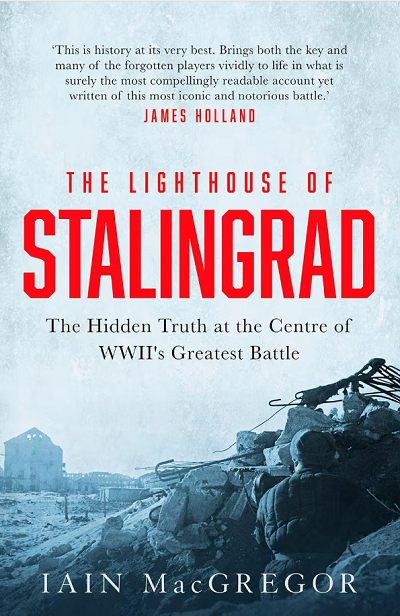
In the summer of 1942, with the German army deep inside the Soviet Union, Adolf Hitler launched Operation Blue, an attack from around Kharkiv in south-east Ukraine across hundreds of miles of steppe towards the oil fields of the Caucasus. Part of the plan required the German Sixth Army under General Paulus to secure the flank by seizing the industrial city of Stalingrad on the banks of the Volga.
By the middle of September Paulus’s troops were fighting their way, street by street, building by building, and sometimes room by room, through a city reduced to ruins by artillery shelling and the bombs of the Luftwaffe. The fighting was ferocious. Although by November most of Stalingrad was in German hands, several pockets of resistance still held out. Meanwhile, the Red Army was secretly massing for a counter-attack in the open terrain on either side of the city.
On 19 November 1942, General Zhukov unleashed a giant pincer attack which quickly overran the Romanian, Hungarian and Italian forces protecting Paulus’s flanks. Within days the German Sixth Army found itself trapped in a giant pocket, cut off from the rest of the German army. Here, in the depths of a Russian winter, nearly 300,000 surrounded men tried to hold out as their supplies of food, fuel, ammunition and medicine dwindled away.
By the end of January 1943, all hope of relief was gone. To Hitler’s disgust, Paulus ordered the remnants of his army to lay down their weapons. Of the 91,000 German soldiers sent into captivity in Siberia, only 5,000 would survive to ever see their homes again. Immense and terrible as the battle was — we will never know exactly how many troops took part, nor how many died, but it is probable that the total of dead, wounded and captured on both sides reached two million — Stalingrad was not the biggest battle of the war, nor even the bloodiest. Nonetheless, it remains, alongside Dunkirk and D-Day, among the touchstones of the Second World War, largely because it encapsulates three linked but distinct stories. Iain MacGregor does a fine job of covering each in his rich study.
First, Stalingrad was one of the most important battles of the war. It marked the high-water mark of the Nazi invasion of the USSR and an end to Hitler’s genocidal dreams of destroying the Soviet Union. Before Stalingrad, and the other crushing defeats the Axis suffered at around the same time in Tunisia and the Solomon Islands, the initiative had always lain with Germany and Japan. Afterwards, the Allies decided where, when and how the war would be fought.
MacGregor establishes this context neatly. He explains with just the right amount of detail why Operation Blue was launched and what it hoped to achieve. He offers a clear discussion of the decisions taken, and mistakes made, on both sides; and he hints at the logistical weaknesses that probably damned the Germans to disappointment from the start.
The strongest point of this book, however, is its description of the street-fighting in the heart of the city around a building known as “Pavlov’s House” (codename Lighthouse: hence the title of the book). Here the German 71st and Soviet 13th Guards rifle divisions fought for months. By focusing on this small area and these two formations, MacGregor is able to dig deep enough into the tactical detail to give us a clear sense of the difficulty, violence and terror of urban warfare, without swamping us with repetitive detail. His descriptions of fighting have a cinematic quality, swooping smoothly from panoramic tracking shots of the initial German charge down towards the waters of the Volga into close-ups of bullet-riddled mannequins fought over in the ruins of a department store.
A History of Ketchup
Tasting History with Max Miller
Published 12 Jul 2022
(more…)
QotD: Roman legionary fortified camps
The degree to which we should understand the Roman habit of constructing fortified marching camps every night as exceptional is actually itself an interesting question. Our sources disagree on the origins of the Roman fortified camp; Frontinus (Front. Strat 4.1.15) says that the Romans learned it from the Macedonians by way of Pyrrhus of Epirus but Plutarch (Plut. Pyrrhus 16.4) represents it the other way around; Livy, more reliable than either agrees with Frontinus that Pyrrhus is the origin point (Liv. 35.14.8) but also has Philip V, a capable Macedonian commander, stand in awe of Roman camps (Liv. 31.34.8). It’s clear there was something exceptional about the Roman camps because so many of our sources treat it as such (Liv. 31.34.8; Plb. 18.24; Josephus BJ 3.70-98). Certainly the Macedonians regularly fortified their camps (e.g. Plb. 18.24; Liv 32.5.11-13; Arr. Alex. 3.9.1, 4.29.1-3; Curtius 4.12.2-24, 5.5.1) though Carthaginian armies seem to have done this less often (e.g. Plb. 6.42.1-2 encamping on open ground is treated as a bold new strategy).
It is probably not the camps themselves, but their structure which was exceptional. Polybius claims Greeks “shirk the labor of entrenching” (Plb. 6.42.1-2) and notes that the stakes the Romans used to construct the wooden palisade wall of the camp are more densely placed and harder to remove (Plb. 18.18.5-18). The other clear difference Polybius notes is the order of Roman camps, that the Romans lay out their camp the same way wherever it is, whereas Greek and Macedonian practice was to conform the camp to the terrain (Plb. 6.42); the archaeology of Roman camps bears out the former whereas analysis of likely battlefield sites (like the Battle of the Aous) seem to bear out the latter.
In any case, the mostly standard layout of Roman marching camps (which in the event the Romans lay siege, become siege camps) enables us to talk about the Roman marching camp because as far as we can tell they were all quite similar (not merely because Polybius says this, but because the basic features of these camps really do seem to stay more or less constant.
The basic outline of the camp is a large rectangle with the corners rounded off, which has given the camps (and later forts derived from them) their nickname: “playing card” forts. The size and proportions of a fortified camp would depend on the number of legions, allies and auxiliaries present, from nearly square to having one side substantially longer than the other. This isn’t the place to get into the internal configuration of the camp, except to note that these camps seemed to have been standardized so that the layout was familiar to any soldier wherever they went, which must have aided in both building the camp (since issues of layout would become habit quickly) and packing it up again.
Now a fortified camp does not have the same defensive purpose as a walled city: the latter is intended to resist a siege, while a fortified camp is mostly intended to prevent an army from being surprised and to allow it the opportunity to either form for battle or safely refuse battle. That means the defenses are mostly about preventing stealthy approach, slowing down attackers and providing a modest advantage to defenders with a relative economy of cost and effort.
In the Roman case, for a completed defense, the outermost defense was the fossa or ditch; sources differ on the normal width and depth of the ditch (it must have differed based on local security conditions) but as a rule they were at least 3′ and 5′ wide and often significantly more than this (actual measured Roman defensive fossae are generally rather wider, typically with a 2:1 ratio of width to depth, as noted by Kate Gilliver. The earth excavated to make the fossa was then piled inside of it to make a raised earthwork rampart the Romans called the agger. Finally, on top of the agger, the Romans would place the valli (“stakes”) they carried to make the vallum. Vallum gives us our English word “wall” but more nearly means “palisade” or “rampart” (the Latin word for a stone wall is more often murus).
Polybius (18.18) notes that Greek camps often used stakes that hadn’t had the side branches removed and spaced them out a bit (perhaps a foot or so; too closely set for anyone to slip through); this sort of spaced out palisade is a common sort of anti-ambush defense and we know of similar village fortifications in pre- and early post-contact North America on the East coast, used to discourage raids. Obviously the downside is that when such stakes are spaced out, it only takes the removal of a few to generate a breach. The Roman vallum, by contrast, set the valli fixed close together with the branches interlaced and with the tips sharpened, making them difficult to climb or remove quickly.
The gateway obviously could not have the ditch cut across the entryway, so instead a second ditch, the titulum, was dug 60ft or so in front of the gate to prevent direct approach; the gate might also be reinforced with a secondary arc of earthworks, either internally or externally, called the clavicula; the goal of all of this extra protection was again not to prevent a determined attacker from reaching the gates, but rather to slow a surprise attack down to give the defender time to form up and respond.
And that’s what I want to highlight about the nature of the fortified Roman camp: this isn’t a defense meant to outlast a siege, but – as I hinted at last time – a defense meant to withstand a raid. At most a camp might need to withstand the enemy for a day or two, providing the army inside the opportunity to retreat during the night.
We actually have some evidence of similar sort of stake-wall protections in use on the East Coast of Native North America in the 16th century, which featured a circular stake wall with a “baffle gate” that prevented a direct approach and entrance. The warfare style of the region was heavily focused on raids rather than battles or sieges (though the former did happen) in what is sometimes termed the “cutting off way of war” (on this see W. Lee, “The Military Revolution of Native North America” in Empires and Indigines, ed. W. Lee (2011)). Interestingly, this form of Native American fortification seems to have been substantially disrupted by the arrival of steel axes for presumably exactly the reasons that Polybius discusses when thinking about Greek vs. Roman stake walls: pulling up a well-made (read: Roman) stake wall was quite difficult. However, with steel axes (imported from European traders), Native American raiding forces could quickly cut through a basic palisade. Interestingly, in the period that follows, Lee (op. cit.) notes a drift towards some of the same methods of fortification the Romans used: fortifications begin to square off, often combined a ditch with the palisade and eventually incorporated corner bastions projecting out of the wall (a feature Roman camps do not have, but later Roman forts eventually will, as we’ll see).
Roman field camps could be more elaborate than what I’ve described; camps often featured, for instance, observation towers. These would have been made of wood and seem to have chiefly been elevated posts for lookouts rather than firing positions, given that they sit behind the vallum rather than projecting out of it (meaning that it would be very difficult to shoot any enemy who actually made it to the vallum from the tower).
When a Roman army laid siege to a fortified settlement, the camp formed the “base” from which siege works were constructed (particularly circumvallation – making a wall around the enemy’s city to keep them in – and contravallation – making a wall around your siege position to keep other enemies out. We’ll discuss these terms in more depth a little later). Some of the most elaborate such works we have described are Caesar’s fortifications at the Siege of Alesia (52 BC; Caes. B.G. 7.72). There the Roman line consisted of an initial trench well beyond bow-shot range from his planned works in order to prevent the enemy from disrupting his soldiers with sudden attacks, then an agger and vallum constructed with a parapet to allow firing positions from atop the vallum, with observation towers every 80 feet and two ditches directly in front of the agger, making for three defensive ditches in total (be still Roel Konijnendijk‘s heart! – but seriously, the point he makes on those Insider “Expert Rates” videos about the importance of ditches are, as you can tell already, entirely accurate), which were reinforced with sharpened stakes faced outward. As Caesar expressly notes, these weren’t meant to be prohibitive defenses that would withstand any attack – wooden walls can be chopped or burned, after all – but rather to give him time to respond to any effort by the defenders to break out or by attackers to break in (he also contravallates, reproducing all of these defenses facing outward, as well).
Bret Devereaux, “Collections: Fortification, Part II: Romans Playing Cards”, A Collection of Unmitigated Pedantry, 2021-11-12.
November 23, 2022
Morris – A Minor Documentary
mglmedia
Published 28 Feb 2014The Morris Minor is a classic British car which has been given another lease of life by a new generation of young drivers. Join us on a journey from its humble beginnings to its current adventures on British roads with interviews with Mike Barson (Madness) Zac Ware (Charles Ware & The Proclaimers) Martin Wainwright (Author/Journalist) and a host of Morris Minor owners.
November 22, 2022
The real story of the First Thanksgiving
Tasting History with Max Miller
Published 15 Nov 2022
(more…)
Our modern abundance of cloth is something to remember at Thanksgiving
Virginia Postrel wrote this originally for USA Today in 2020:
Our closets and drawers bulge with clothing in every imaginable color. Thanks to incremental improvements over the past few decades, our clothes resist stains and wrinkles in ways that would thrill the past’s laundry-weary housewives. T-shirts wick sweat, and raincoats shed water. Sweaters snap back into shape, and pants stretch with our bellies — a handy feature come Thanksgiving dinner.
Today’s textile cornucopia overflows with more than clothes. It includes the damask tablecloth beneath the Thanksgiving feast, the soft microfiber blanket in front of the fire, the potholders pulling dinner from the oven, the dish towels drying the heirloom china. Textiles upholster the dining room chairs and the football fans’ sofa cushions. They bandage the careless carver’s fingers. They furnish burlap wreaths and felt garlands, and, for those who prefer an autumnal escape to nature, backpacks, sleeping bags, and tents.
If, as Arthur C. Clarke famously observed, any sufficiently advanced technology is indistinguishable from magic, the reverse is also true. Any sufficiently familiar technology is indistinguishable from nature. We no more imagine a world without cloth than one without sunlight or rain. Textiles are just there.
Except, until fairly recently, they weren’t.
“Bring good store of clothes, and bedding with you,” an early Plymouth arrival advised a prospective colonist in 1621. Textiles weren’t easily procured in the wilds of Massachusetts. It is only in the past century, and especially in the past generation, that most Americans could forget where cloth comes from. Once so valuable they were stolen from clothes lines and passed down in wills, textile products now occupy only a tiny fraction of household budgets.
Cloth was precious because it took so much effort to make. Throughout history, and around the globe, women spent their days spinning. Yet yarn was always in short supply. In 1656, Massachusetts even passed a law requiring every family with “idle hands” — women and children who weren’t otherwise employed — to spin a minimum amount of yarn, with fines levied on those who didn’t make their quotas.
“The spinners never stand still for want of work; they always have it if they please; but weavers sometimes are idle for want of yarn,” wrote the 18th-century agronomist and travel author Arthur Young, reporting on a tour of northern England. It took about 20 spinners to keep a single weaver supplied with yarn.
A few decades after Young wrote, spinning machines broke the bottleneck and sparked the Industrial Revolution. Abundant yarn improved nearly every aspect of life. From clothing to sails, bed linens to flour sacks, essential items were suddenly much cheaper, more varied, and more easily obtained. It was the beginning of what economic historian Deirdre McCloskey calls “the Great Enrichment,” the economic takeoff that over the next two centuries lifted global living standards by 3000%.

W+F Bern P43: A Swiss Take on the Browning High Power
Forgotten Weapons
Published 22 Jul 2017In 1940, Switzerland began a series of trials to replace their Luger service pistols with something equally high quality, but more economical. They had squeezed as much simplification out of the Luger as they could in 1929, and by this time the guns just needed to be replaced. The first 1940 trial had only two entrants (a Petter prototype from SIG and an Astra 900), but a second trial in 1941 included a large assortment of modern handguns, including a French 1935A, a Polish Vis-35, and prototypes from both SIG and W+F Bern.
One of the most tenacious competitors (aside form the winning SIG/Petter design) was the Bern factory’s series of Browning High Power copies. In this video, we will be looking at three progressive versions of this gun as they were modified through the course of the trials (which would last until 1949). While they are all mechanically very similar to the High Power, they will get progressively less visually similar as the trials progressed. In addition, we will see features like the slide lock, manual safety, and magazine release evolve and change.
(more…)
November 21, 2022
City Minutes: Colonial America
Overly Sarcastic Productions
Published 22 Jul 2022Colonial-era North America was a busy place, so let’s take a quick look through some of the major players from the perspective of the lands & cities they inhabited.
SOURCES & Further Reading: Lectures from The Great Courses: “1759 Quebec – Battle For North America” from The Decisive Battles of World History by Gregory Aldrete, “The American Revolution” from Foundations of Western Civilization II by Robert Bucholz, “North American Peoples and Tribes” from Big History of Civilizations by Craig Benjamin, “The Iroquois and Algonquians Before Contact” from Ancient Civilizations of North America by Edwin Barnhart, “Iroquoia and Wendake in the 1600s”, “Indian-European Encounters 1700-1750”, “The Seven Years War in Indian Country” and “The American Revolution Through Native Eyes” from Native Peoples of North America by Daniel M. Cobb, Britannica articles “New York” & “Boston” https://www.britannica.com/place/New-… & https://www.britannica.com/place/Bost…
(more…)
QotD: Socialism is nihilism
That seems bizarrely wrong, considering how much effort Socialists put into saving the world. But look at it objectively, comrade (heh heh), and you’ll see that Save-the-World-ism, of whatever flavor, always boils down to Destroy-the-World-ism. Always. It doesn’t matter how the world gets “saved;” it always gets blown up in the process. You still can’t find a better primer on chiliastic psychology than Norman Cohn’s The Pursuit of the Millennium. The specifics of each loony doctrine changed, but the underlying presumption was always the same: Kill everyone, destroy everything, and then Jesus comes.
This is true even of millennialists whose doctrines don’t obviously entail killing everyone. Calvinists, for example. I spent decades trying to explain Calvinism to undergrads, and never once succeeded. The gulf between their words and their actions is too vast for the adolescent mind. There are only two logical responses to the doctrine of “double predestination”: quietism, or hedonism. They knew it, too, which is why they started burning people at the stake the minute they got any real power. Look at what they did, not what they said, and you’ll see nihilism plain as day. Calvin’s Geneva was the nearest thing to a police state that could be achieved with 16th century technology. The ideal Calvinist would say nothing, do nothing, think nothing, as he sat in the plain pews of his unadorned chapel, waiting for death and the Final Judgment. Calvinists wanted to grind the world to a halt, not blow it up, but once again the mass extinction of the human race is a feature, not a bug.
Take Jesus out of the equation, and you end up at pure shit-flinging nihilism in less than three steps. Marxism is perhaps the most exquisitely pointless doctrine ever devised. It’s more pleasant to have than to have not, I suppose, but no matter how much everyone has, we’re still just naked apes, living the brief days of our vain lives under an utterly indifferent sky. Marxists are a special kind of stupid, so they don’t realize it, but … they won. Modern Western “poor” people keel over from heart disease while fiddling with their smartphones in front of 50″ plasma tvs. While wearing $200 sneakers. We’re so far from being “alienated” from the fruits of our labor that “labor” is an all-but-meaningless concept for lots of us — and the further down the social scale you go, the more meaningless it gets. The modern ghetto dweller simply is Marx’s ideal proletarian. Does he look self-actualized to you? Ecce homeboy.
I assure you, the SJWs know this. Calvinists to the core, they know better than anyone the utter futility of all human effort. So they do what the original Calvinists did: Displace, displace, displace. Don’t take it from me, take it from a card-carrying Marxist. The end result is the same: Whether you’re a Puritan or an SJW, the only way to escape the crushing meaninglessness of your condition is to spend every moment of every day contemplating your pwecious widdle self.
Throw in the transitive property of equality, and you’ve got people like Hillary Clinton. If Socialism is Nihilism, then Nihilism is Socialism. Far from arguing against the idea … that Hillary et al are motivated solely by hatred, I’m 100% behind it. In fact, I’d argue that the Nihilism comes first — people who have convinced themselves that life is pointless always, always, embrace the biggest and most all-encompassing form of collectivism on offer. What could be crueler, than to be given all this for nothing? It’s not even a sick joke, since a joke implies a joker.
How can you not hate this world, then, and everything in it? More to the point: how can you not hate yourself, for seeing the world as it really is? Ignorance is bliss … but how can you not hate them, too, those poor deluded motherfuckers who still think stuff like God and love and family and the designated hitter might somehow mean something? Vanity, vanity, all is vanity … and if I have to face the existential horror of it all, then fuck it, so do you. “Capitalism,” the “free market,” “representative government” — call it what you will, it’s all just vanity, just another way for the sheeple to keep deluding themselves. Fuck it, and fuck them. Burn it down. Burn it allllll down.
Severian, “A Tyranny of Nihilism”, Rotten Chestnuts, 2019-10-22.


