
World War Two
Published 30 Nov 2022Colonel Reinhard Gehlen is head of German military intelligence in the East. He likes to think he’s a master of his craft. But all along he’s been a victim of the NKVD and a man named Max. Gehlen thinks he can hold off the Red Army. But as things go from bad to worse his thoughts will start to turn to the possibility of a new world …
(more…)
December 1, 2022
Medieval Table Manners
Tasting History with Max Miller
Published 19 Jul 2022
(more…)
Comments Off on Medieval Table Manners
QotD: Movie swordfighting
I was reminded, earlier today, that one of the interesting side effects of knowing something about hand-to-hand and contact-weapons-based martial arts makes a big difference in how you see movies.
Most people don’t have that knowledge. So today I’m going to write about the quality of sword choreography in movies, and how that has changed over time, from the point of view of someone who is an experienced multi-style martial artist in both sword and empty hand. I think this illuminates a larger story about the place of martial arts in popular Western culture.
The first thing to know is this: with only rare exceptions, any Western swordfighting you see in older movies is going to be seriously anachronistic. It’s almost all derived from French high-line fencing, which is also the basis for Olympic sport fencing. French high-line is a very late style, not actually fully developed until early 1800s, that is adapted for very light thrusting weapons. These are not at all typical of the swords in use over most of recorded history.
In particular, the real-life inspirations for the Three Musketeers, in the 1620s, didn’t fight anything like their movie versions. They used rapiers – thrusting swords – all right, but their weapons were quite a bit longer and heavier than a 19th-century smallsword. Correspondingly, the tempo of a fight had to be slower, with more pauses as the fighters watched for an opening (a weakness in stance or balance, or a momentary loss of concentration). Normal guard position was lower and covered more of center line, not the point-it-straight-at-you of high line. You find all this out pretty quickly if you actually train with these weapons.
The thing is, real Three Musketeers fencing is less flashy and dramatic-looking than French high-line. So for decades there was never any real incentive for moviemakers to do the authentic thing. Even if there had been, audiences conditioned by those decades of of high-line would have thought it looked wrong!
Eric S. Raymond, “A martial artist looks at swordfighting in the movies”, Armed and Dangerous, 2019-01-13.
Comments Off on QotD: Movie swordfighting
November 30, 2022
Victorious Italians, Swedish Turnips, and Battlefield Songs – OOTF 29
World War Two
Published 29 Nov 2022Rommel disliked Italian officers, but how bad were the troops during the North Africa Campaign? DID German pilots use skip-bombing in the Atlantic? AND what kind of wartime songs did soldiers sing? Find out in this episode of Out of the Foxholes!
(more…)
Comments Off on Victorious Italians, Swedish Turnips, and Battlefield Songs – OOTF 29
James Gillray
In The Critic, James Stephens Curl reviews a new biography of the cartoonist and satirist James Gillray (1756-1815), who took great delight in skewering the political leaders of the day and pretty much any other target he fancied from before the French Revolution through the Napoleonic wars:
During the 1780s Gillray emerged as a caricaturist, despite the fact that this was regarded as a dangerous activity, rendering an artist more feared than esteemed, and frequently landing practitioners into trouble with the law. Gillray began to excel in invention, parody, satire, fantasy, burlesque, and even occasional forays into pornography. His targets were the great and good, not excepting royalty. But his vision is often dark, his wit frequently cruel and even shockingly bawdy: some of his own contemporaries found his work repellent. He went for politicians: the Whigs Charles James Fox (1749-1806), Edmund Burke (1729-97), and Richard Brinsley Butler Sheridan (1751-1816) on the one hand, and William Pitt (1759-1806) on the other. Fox was a devious demagogue (“Black Charlie” to Gillray); Burke a bespectacled Jesuit; and Sheridan a red-nosed sot. But Gillray reserved much of his venom for “Pitt the Bottomless”, “an excrescence … a fungus … a toadstool on a dunghill”, and frequently alluded to a lack of masculinity in the statesman, who preferred to company of young men to any intimacies with women, although the caricaturist’s attitude softened to some extent as the wars with the French went on.
As the son of a soldier who had been partly disabled fighting the French, Gillray’s depictions of the excesses of the Revolution were ferocious: one, A Representation of the horrid Barbarities practised upon the Nuns by the Fish-women, on breaking into the Nunneries in France (1792), was intended as a warning to “the FAIR SEX of GREAT BRITAIN” as to what might befall them if the nation succumbed to revolutionary blandishments. The drawing featured many roseate bottoms that had been energetically birched by the fishwives. He also found much to lampoon in his depictions of the Corsican upstart, Napoléon.
[…]
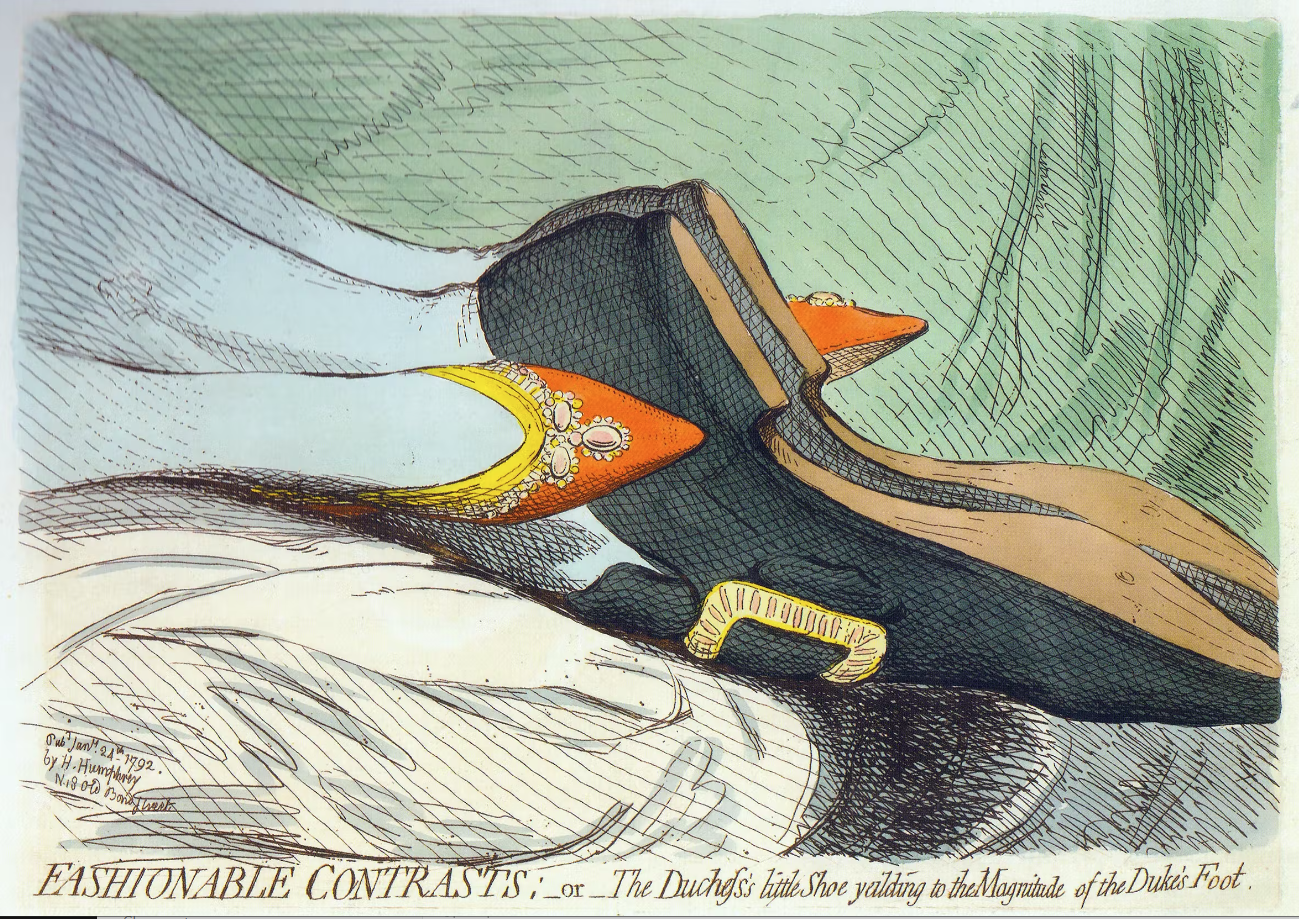
Some of Gillray’s works would pass most people by today, thanks to the much-trumpeted “world-class edication” which is nothing of the sort: one of my own favourites is his FASHIONABLE CONTRASTS;—or—The Duchefs’s little Shoe yeilding to the Magnitude of the Duke’s Foot (1792), which refers to the remarkably small hooves of Princess Frederica Charlotte Ulrica Catherina of Prussia (1767-1820), who married Frederick, Duke of York and Albany (1763-1827) in 1791: their supposed marital consummation is suggested by Gillray’s slightly indelicate rendering, in which the Duke’s very large footwear dwarfs the delicate slippers of the Duchess.
“In 1791 and 1792, there was no one who received more attention in the British press than Frederica Charlotte, the oldest daughter of the King of Prussia, whose marriage to the second (and favorite) son of King George and Queen Charlotte, Prince Frederick, the Duke of York set off a media frenzy that can only be compared to that of Princess Diana in our own day.”
Description from james-gillray.org/fashionable.htmlAll that said, this is a fine book, beautifully and pithily written, scholarly, well-observed, and superbly illustrated, much in colour. However, it is a very large tome (290 x 248 mm), and extremely heavy, so can only be read with comfort on a table or lectern. The captions give the bare minimum of information, and it would have been far better to have had extended descriptive captions under each illustration, rather than having to root about in the text, mellifluous though that undoubtedly is.
What is perhaps the most important aspect of the book is to reveal Gillray’s significance as a propagandist in time of war, for the images he produced concerning the excesses of what had occurred in France helped to stiffen national resolve to resist the revolutionaries and defeat them and their successor, Napoléon, whose own model for a new Europe was in itself profoundly revolutionary. What he would have made of the present gang of British politicians must remain agreeable speculation.
Comments Off on James Gillray
The St Etienne Mle 1907: France’s Domestic Heavy Machine Gun
Forgotten Weapons
Published 19 Oct 2017When the French first began testing machine guns in the late 1890s, they were one of the few countries that did not purchase quantities of Maxim guns. One of the reasons was that in France’s North African colonies, transporting water for guns was considered an unnecessary liability. Instead, France purchased a number of air-cooled Hotchkiss machine guns for its colonial forces. For the French Metropolitan Army, it wanted a gun designed and produced by its own arsenal system. And so, the Puteaux Arsenal developed the Modele 1905 gun.
This was a gas-trap style of action, pulling an operating rod forward with each shot. The gun was adopted and put into service, and as with every other military user of gas trap guns, the French quickly found the system to be seriously flawed. The St Etienne Arsenal set about improving it, and came up with the Modele 1907, which retained the forward-moving operating rod but used a gas piston instead of a gas trap. This would be the machine gun which France would enter World War One with, and more than 40,000 would be manufactured by 1917.
The Modele 1907 St Etienne gun is a magnificently Victorian machine gun, with a downright Swiss-like rack-and-pinion system running its action. It would have been truly at home on a Napoleonic battlefield — but not a World War One battlefield. The gun was not well-suited to the muddy hell of trench warfare, despite its beautiful machining and quality. Looking for both a lot more guns and also a more field-reliable system, the French began buying a great many Modele 1914 Hotchkiss machine guns, and they would replace the Modele 1907 by the end of the war.
One cannot fault the French for this change, and yet it still seems sad to see such a gorgeous piece of metal fabrication be sidelined — complete with its hydraulically adjustable rate of fire, its fine toothed feed spool, its sights with the spring and lever system to accommodate heat-induced change of aim and its magnificently extravagant flash hider.
(more…)
Comments Off on The St Etienne Mle 1907: France’s Domestic Heavy Machine Gun
QotD: The rise of liberalism
In sum, as one of the Levellers in the English Civil War of the 1640s, Richard Rumbold, said from the scaffold in 1685, “there was no man born marked of God above another, for none comes into the world with a saddle on his back, neither any booted and spurred to ride him.” It was a shocking thought in a hierarchical society. In 1685 the crowd gathered to see Rumbold hanged surely laughed at such a sentiment. By 1885 it was a solemn cliché.
Dierdre McCloskey, “How Growth Happens: Liberalism, Innovism, and the Great Enrichment (Preliminary version)” [PDF], 2018-11-29.
Comments Off on QotD: The rise of liberalism
November 29, 2022
Near Peer: Russia
Army University Press
Published 25 Nov 2022AUP’s Near Peer film series continues with a timely discussion of Russia and its military. Subject matter experts discuss Russian history, current affairs, and military doctrine. Putin’s declarations, advances in military technology, and Russia’s remembrance of the Great Patriotic War are also addressed. “Near Peer: Russia” is the second film in a four-part series exploring America’s global competitors.
Comments Off on Near Peer: Russia
Tank Chat #159 | Warrior | The Tank Museum
The Tank Museum
Published 29 Jul 2022Join David Willey for a new Tank Chat on Warrior.
(more…)
Comments Off on Tank Chat #159 | Warrior | The Tank Museum
November 28, 2022
Near Peer: China (Understanding the Chinese Military)
Army University Press
Published 29 Jul 2022This film examines the Chinese military. Subject matter experts discuss Chinese history, current affairs, and military doctrine. Topics range from Mao, to the PLA, to current advances in military technologies. “Near Peer: China” is the first film in a four-part series exploring America’s global competitors.
(more…)
Comments Off on Near Peer: China (Understanding the Chinese Military)
Mulberry Harbours – Rhinos, Whales, Beetles, Phoenixs and Spuds against the Axis
Drachinifel
Published 13 Jul 2022Today we take a look at the artificial harbours designed, built and then installed on the Normandy beaches in 1944.
Many thanks to @Think Defence for finding and collating so many images and letting me use them! Follow them on Twitter or on their website for more interesting articles!
(more…)
Comments Off on Mulberry Harbours – Rhinos, Whales, Beetles, Phoenixs and Spuds against the Axis
QotD: The Carolingian army
But below that in the Carolingian system, you have the select levy, relatively undistinguished (read: not noble, but often reasonably well-to-do) men recruited from the smaller farmers and townsfolk. This system itself seems to have derived from an earlier social understanding that all free men (or all free property owning men) held an obligation for military service; Halsall notes in the eighth century the term arimannus (Med. Lat.: army-man) or exercitalis (same meaning) as a term used to denote the class of free landowners on whom the obligation of military service fell in Lombard and later Frankish Northern Italy (the Roman Republic of some ten centuries prior had the same concept, the term for it was assidui). This was, on the continent at least, a part of the system that was in decline by the time of Charlemagne and especially after as the mounted retinues of the great magnates became progressively more important.
We get an interesting picture of this system in Charlemagne’s efforts in the first decades of the 800s to standardize it. Under Charlemagne’s system, productive land was assessed in units of value called mansi and (to simplify a complicated system) every four mansi ought to furnish one soldier for the army (the law makes provisions for holders of even half a mansus, to give a sense of how large a unit it was – evidently some families lived on fractions of a mansus). Families with smaller holdings than four mansi – which must have been most of them – were brigaded together to create a group large enough to be able to equip and furnish one man for the army. These fellows were expected to equip themselves quite well – shield, spear, sword, a helmet and some armor – but not to bring a horse. We should probably also imagine that villages and towns choosing who to send were likely to try to send young men in good shape for the purpose (or at least they were supposed to). Thus this was a draw-up of some fairly high quality infantry with good equipment. That gives it its modern-usage name, the select levy, because it was selected out of the larger free populace.
And I should note what makes these fellows different from the infantry who might often be found in the retinues of later medieval aristocrats is just that – these fellows don’t seem to have been in the retinues of the Carolingian aristocracy. Or at least, Charlemagne doesn’t seem to have imagined them as such. While he expected his local aristocrats to organize this process, he also sent out his royal officials, the missi to oversee the process. This worked poorly, as it turned out – the system never quite ran right (in part, it seems, because no one could decide who was in charge of it, the missi or the local aristocrats) and the decades that followed would see Carolingian and post-Carolingian rulers more and more dependent on their lords and their retinues, while putting fewer and fewer resources into any kind of levy. But Charlemagne’s last-gaps effort is interesting for our purpose because it illustrates how the system was supposed to run, and thus how it might have run (in a very general sense) in the more distant past. In particular, he seems to have imagined the select levy as a force belonging to the king, to be administered by royal officials (as the nation-in-arms infantry armies of the centuries before had been), rather than as an infantry force splintered into various retinues. In practice, the fragmentation of Charlemagne’s empire under his heirs was fatal for any hopes of a centralized army, infantry or otherwise, and probably hastened the demise of the system.
Beneath the select levy there was also the expectation that, should danger reach a given region, all free men would be called upon to defend the local redoubts and fortified settlements. This group is sometimes called the general levy. As you might imagine, the general levy would be of lower average quality and cohesion. It might include the very young and very old – folks who ought not to be picked out for the select levy for that reason – and have a much lower standard of equipment. After all, unlike select levymen, who were being equipped at the expense, potentially, of many households, general levymen were individual farmers, grabbing whatever they could. In practice, the general levy might be expected to defend walls and little else – it was not a field force, but an emergency local defense militia, which might either enhance the select levy (and the retinues of the magnates) or at least hold out until that field army could arrive.
Bret Devereaux, “Collections: The Battle oF Helm’s Deep, Part IV: Men of Rohan”, A Collection of Unmitigated Pedantry, 2020-05-22.
Comments Off on QotD: The Carolingian army
November 27, 2022
The Costliest Day in US Marine History – WW2 – 222 – November 26, 1943
World War Two
Published 26 Nov 2022The Americans attack the Gilbert Islands this week, and though they successfully take Tarawa and Makin Atolls, it is VERY costly in lives, and show that the Japanese are not going to be defeated easily. They also have a naval battle in the Solomons. Fighting continues in the Soviet Union and Italy, and an Allied conference takes place in Cairo, a prelude for a major one in Teheran next week.
(more…)
Comments Off on The Costliest Day in US Marine History – WW2 – 222 – November 26, 1943
Aleksandr Solzhenitsyn and One Day in the Life of Ivan Denisovich
In Quillette, Robin Ashenden discusses the life experiences of Aleksandr Slozhenitsyn that informed the novel that made him famous:

The book was published less than 10 years after the death of Joseph Stalin, the dictator who had frozen his country in fear for nearly three decades and subjected his people to widespread deportation, imprisonment, and death. His successor Nikita Khrushchev — a man who, by his own admission, came to the job “elbow deep in blood” — had set out on a redemptive mission to liberalise the country. The Gulags had been opened and a swathe of prisoners freed; Khrushchev had denounced his predecessor publicly as a tyrant and a criminal and, at the 22nd Party Congress in October 1961, a full programme of de-Stalinisation had been announced. As for the Arts, previously neutered by the Kremlin’s policy of “Socialist Realism” — in which the values of Communism had to be resoundingly affirmed — they too were changing. Now, a new openness and a new realism was called for by Khrushchev’s supporters: books must tell the truth, even the uncomfortable truth about Communist reality … up to a point. That this point advanced or retreated as Khrushchev’s power ebbed and flowed was something no writer or publisher could afford to miss.
Solzhenitsyn’s book told the story of a single day in the 10-year prison-camp sentence of a Gulag inmate (or zek) named Ivan Denisovich Shukhov. Following decades of silence about Stalin’s prison-camp system and the innocent citizens languishing within it, the book’s appearance seemed to make the ground shake and fissure beneath people’s feet. “My face was smothered in tears,” one woman wrote to the author after she read it. “I didn’t wipe them away or feel ashamed because all this, packed into a small number of pages … was mine, intimately mine, mine for every day of the fifteen years I spent in the camps.” Another compared his book to an “atomic bomb”. For such a slender volume — about 180 pages — the seismic wave it created was a freak event.
As was the story of its publication. By the time it came out, there was virtually no trauma its author — a 44-year-old married maths teacher working in the provincial city of Ryazan — had not survived. After a youth spent in Rostov during the High Terror of Stalin’s 1930s, Solzhenitsyn had gone on to serve eagerly in the Red Army at the East Prussian front, before disaster struck in 1945. Arrested for some ill-considered words about Stalin in a letter to a friend, he was handed an eight-year Gulag sentence. In 1953, he was sent into Central Asian exile, only to be diagnosed with cancer and given three weeks to live. After a miraculous recovery, he vowed to dedicate this “second life” to a higher purpose. His writing, honed in the camps, now took on the ruthless character of a holy mission. In this, he was fortified by the Russian Orthodox faith he’d rediscovered during his sentence, and which had replaced his once-beloved, now abandoned Marxism.
Solzhenitsyn had, since his youth, wanted to make his mark as a Russian writer. In the Gulag, he’d written cantos of poetry in his head, memorized with the help of matchsticks and rosary beads to hide it from the authorities. During his Uzbekistan exile, he’d follow a full day’s work with hours of secret nocturnal writing about the darker realities of Soviet life, burying his tightly rolled manuscripts in a champagne bottle in the garden. Later, reunited with the wife he’d married before the war, he warned her to expect no more than an hour of his company a day — “I must not swerve from my purpose.” No friendships — especially close ones — were allowed to develop with his fellow Ryazan teachers, lest they take up valuable writing time, discover his perilous obsession, or blow his cover. Subterfuge became second nature: “The pig that keeps its head down grubs up the tastiest root.” Yet throughout it all, he was sceptical that his work would ever be available to the general public: “Publication in my lifetime I must put out of my mind.”
After the 22nd Party Congress, however, Solzhenitsyn recognised that the circumstances were at last propitious, if all too fleeting. “I read and reread those speeches,” he wrote later, “and the walls of my secret world swayed like curtains in the theatre … had it arrived, then, the long-awaited moment of terrible joy, the moment when my head must break water?” It seemed that it had. He got out one of his eccentric-looking manuscripts — double-sided, typed without margins, and showing all the signs of its concealment — and sent it to the literary journal of his choice. That publication was the widely read, epoch-making Novy Mir (“New World”), a magazine whose progressive staff hoped to drag society away from Stalinism. They had kept up a steady backwards-forwards dance with the Khrushchev regime throughout the 1950s, invigorated by the thought that each new issue might be their last.
Comments Off on Aleksandr Solzhenitsyn and One Day in the Life of Ivan Denisovich
The Biggest Lie of WWII? The Myth of the Norden Bombsight
Flight Dojo
Published 16 Jun 2022I think most of us, at some point, have had someone say to us “You know, we went to the moon with less computing power than your iPhone” or something to that effect. What you may not know, though, is that less than a century ago, a 2000-piece mechanical computer that lacked a single transistor or chip was the most closely guarded military secret of the Allied war effort. Or, at least, the second most.
Before being overshadowed by the Manhattan Project, the U.S. Navy spent billions helping Carl Norden develop a mechanical computer with one job and one job only: to determine the point at which a level-flying bomber would need to drop its bombs to achieve “pinpoint accuracy” on an intended target.
When it was completed, Mr. Norden famously claimed that the sight was so accurate that it was capable of putting a bomb inside a pickle barrel. And if it could, then war would be revolutionized, or so the powers-at-be thought. The idea was simple: fly your bombers above the enemy’s air defenses, above the reach of their flak batteries, faster than their fighters could fly, and drop your bombs, with pinpoint accuracy, on crucial industrial sites, robbing the enemy of their ability to manufacture the equipment they need to wage a war in the first place.
The only problem was that everything about the Norden Bombsight turned out to be a myth. Not just the obviously mythical bits, like the fact that the crosshairs in the site itself were actually webs from a Black Widow, or that, instead, the reticle was made from the strands of hair of a young Midwestern girl, but everything, the accuracy, the secrecy, and even the fact that it was the only bombsight used in the war.
So how can this be? Until two weeks ago, I believed that the Norden Bombsight was an ingenious piece of equipment that more than any other singular device, changed the tides of WWII in favor of the allies. So why do we still believe in the Norden Bombsight?
Because, as it turns out, myths are useful, not just to the Army Air Corps, the Carl Norden Company, and Hollywood, but to us, the public. As it turns out, they can help us swallow hard truths about the war we’d prefer to avoid.
(more…)
Comments Off on The Biggest Lie of WWII? The Myth of the Norden Bombsight


