Finally, a real intelligence failure on the NVA‘s part contributed to the US failure. The main reason US analysts were sure the North Vietnamese lacked the forces was because the NVA did, in fact, lack the forces. They called Tet the “general uprising”, and they were counting on widespread popular support — including, it seems, entire ARVN units defecting. That’s the only way they’d have sufficient force to knock ARVN out of the war …
… and it didn’t happen, because they, the North Vietnamese, had faulty intel.
The Americans suffered from the “intel to order” problem too, of course, which we in the civilian world call “telling the boss what he wants to hear”. But the NVA had it much worse, since that’s a much greater structural problem among Commies. Indeed, the Americans got at least one high-level defector during Tet — a lieutenant colonel I think — who only defected because the units he was supposed to command in the “general uprising” didn’t exist. They were purely paper fantasies, straight out of some commissar’s head.
And that’s what made [US Army military analyst Joseph] Hovey’s report so easy to dismiss. Hovey himself said it — it looks like they’re planning to do X, Y, and Z, but that would only make sense if they’re making a big mistake about the balance of forces. The US had pretty good intel on the ARVN and the political mood of South Vietnam. But they for some reason assumed that the NVA had basically the same information, so all of the NVA’s calls for a general uprising — which the NVA absolutely meant, and indeed were counting on — were easy for US analysts to dismiss as mere propaganda.
Severian, “Book Rec: Tet, Intelligence Failure”, Founding Questions, 2022-06-30.
May 8, 2026
July 8, 2025
QotD: Sixty years of intelligence service operations going sideways
There’s also another version of the Historian’s Fallacy in play with Intelligence work:
The historian’s fallacy is an informal fallacy that occurs when one assumes that decision makers of the past viewed events from the same perspective and having the same information as those subsequently analyzing the decision. It is not to be confused with presentism, a similar but distinct mode of historical analysis in which present-day ideas (such as moral standards) are projected into the past. The idea was first articulated by British literary critic Matthew Arnold in 1880 and later named and defined by American historian David Hackett Fischer in 1970.
Things that seem obvious in retrospect weren’t at the time. That’s the “formal” Historian’s Fallacy, if you like. But there’s another one, that we could call the “Narrative Fallacy” or the “Assumed Rationality Fallacy” or something (I stink at titles). Historians are, or at least should be, acutely sensitive to the danger of seeing patterns that aren’t really there (in a very real sense, “conspiracy theorists” e.g. McGowan are just Historians manqué. Coincidences are coincidental, and without training and practice and — crucially — an experienced hand to smack you upside the head for going farther than the available sources allow, it’s easy to run wild with them. So-and-So knew Joe Blow … yes, but that does not automatically mean that So-and-So conspired with Joe Blow).
Compounding it further: It’s indeed rational to assume rationality on your enemies’ part, so some catastrophic intelligence “failures” have come because analysts were unwilling to acknowledge that the enemy was, in fact, making a mistake. It’s a bit pricey, but I highly recommend James Wirtz’s The Tet Offensive: Intelligence Failure in War (here’s a preview page of a review at JSTOR, which points to a trade journal, American Intelligence Journal. Wirtz is a professor at the Naval Postgraduate School; I bet his book rattled a lot of cages that needed rattling). Breaking it out a bit further, and these categories are mine, not Wirtz’s:
In the case of Tet, there was top-level structural “failure” that hardly deserves the term “failure” — the NVA’s intelligence boys were no fools; they were bright guys doing their damnedest to put one over on the American intelligence crew, and they had some success at it. That’s only “failure” in the sense that in binary system, a win for them is a loss for you — you “failed” to win the game against a highly skilled, highly motivated opponent. The Americans didn’t fail to recognize that The Enemy Gets a Vote; they just didn’t realize how he’d voted.
But there was what I’ll call “Narrative” failure, and that’s all on the Americans. They seem to have decided that the North Vietnamese were not only losing the war, but knew themselves to be losing the war. So what the North Vietnamese saw as merely “the next phase of the plan”, the Americans saw as “increasing desperation”. Which led to other Narrative Failures. I might be misremembering the details, so check me on this, but I believe that the Americans were correct despite themselves about the attack on the big Marine base at Khe Sanh — it was indeed a diversion. But the Americans somehow concluded that it was a diversionary attack, specifically a “spoiling attack”, on something the NVA shouldn’t have known about in the first place — a top secret operation called “Muscle Shoals” (in Wiki under Operation Igloo White).
In reality, the Khe Sanh attack was a diversion against the main Tet operation, and it worked so well that it took a week or more, IIRC, for Westmoreland to come around. He insisted on interpreting the Tet “uprising” as yet a further diversion — a diversion in support of what he assumed was the main NVA operation, the attack on Khe Sanh!
Those are Narrative Failures. Twitter didn’t exist then, but we could nowadays profitably call them “Twitter Failures”. Whatcha gonna believe, your own lying eyes or the blue checkmarks in the Pocket Moloch?
All of which was aided and abetted by the third kind of failure, that “Assumed Rationality” failure. One CIA analyst, Joseph Hovey, not only predicted the Tet Offensive, but got large parts of it exactly right. But Hovey had a hard time believing his own analysis, because its central assumption was that the North Vietnamese were, in fact, making a mistake. The North Vietnamese did not, in fact, have the forces in place to do what they wanted to do. They were suffering a catastrophic Narrative Failure of their own, one endemic (it seems reasonable to say) to Communist regimes — since political officers are highly encouraged to submit exaggerated reports of unit strength and morale (and often lethally discouraged from reporting the opposite), the NVA thought they had far more, and far better prepared, forces than they actually did.
In an Alanis-level irony, US military intelligence had a better idea of the NVA’s strength than the boys in Hanoi did. (They confirmed this, in fact, when they nabbed a high-level NVA defector, who only “rallied” because the formation he was sent south to lead didn’t actually exist!). When faced with the possible conclusion that the Enemy is about to make a big mistake, it’s only rational to assume that something else is going on. Hovey knew that, of course, and that’s one of the main reasons his analysis went nowhere — being a conscientious professional, he noted at the outset that his analysis was premised on the NVA setting up to make a big mistake, which seemed extremely unlikely.
Given all that, if I had to guess, I’d bet that the KGB had a similar record, if the truth is ever known, because they had similar problems. They had a different, more systematic kind of Narrative Failure, I’d imagine — “Marxism-Leninism” vs. “bow-tied Ivy Leaguers running around cosplaying Lawrence of Indochina” — but it probably all washed out in the end. It’d be extremely interesting to hear about the Vietnam War from the KGB’s side …
Severian, “Friday Mailbag”, Founding Questions, 2023-04-15.
December 1, 2022
August 12, 2021
QotD: Ignoring the warnings
Let’s jump forward a few decades: in 1973, Israeli military intelligence was fully aware of a huge build-up of men and weapons on its borders with Syria and Egypt. The mobilizations were impossible to hide — tens of thousands of troops, tanks, artillery, the whole apparatus of modern warfare was lining up across Israel’s borders. But Israel’s top military intelligence officer concluded that the build-up was intended to apply political pressure ahead of negotiations, not actually to prepare for an assault. Israel was militarily superior, after all, and had handily defeated the combined Arab armies before, including just six years prior. The Arabs simply wouldn’t dare try again. Right?
Wrong. They dared, Israel was caught totally by surprise, and the Jewish state came shockingly close to defeat and likely destruction.
Ideally, these kinds of mistakes — mistakes of preparedness, mistakes of erroneous conclusion — are studied, learned from and then never repeated. In the real world, of course, we tend to make the same mistakes over and over.
Matt Gurney, “How the COVID crisis broke our leaders’ minds”, The Line, 2021-04-23.
July 21, 2021
August 8, 2018
Doing military intelligence … backwards
Ted Campbell on what he sees as a big problem with western military command structures and particularly the way military intelligence is being over-centralized away from the fighting troops and pushed high up the chain of command:
Intelligence is vital in modern combat operations … just as it was when Alexander set about conquering the known world. But, as Alexander knew, real intelligence is gathered by the troops in direct contact with the enemy and is augmented by e.g. spies who read the enemies mail (our modern, very effective SigInt services, for example, and drones and so on). There is a now well established ~ and I think wrong headed ~ system which aims to collect ALL intelligence at the highest possible level and then disseminate it down … that’s exactly backwards! Combat intelligence is gathered, in the main, by troops in contact with the enemy, by privates and troopers and corporals and then it is passed up the chain to be collated with reports from other troops in contact and then a refined picture is passed back down … where it is promptly corrected by the troops in contact. Intelligence staffs in HQs almost never know much of anything of real utility but they have convinced commanders that if there can only be more and more highly ranked intelligence officers with more clerks and more drones and more computers and so on, that they will, somehow, get ahead of the enemy. It’s a siren song that has, already, run more than one combat commander up on to the rocks of operational failure. The only people who have a good feel for what the enemy is up to are the people who have them in their sights. Don’t get me wrong: I am a HUGE fan of SigInt and drones and UWB radio devices that can see through walls and so on … I want the micro drones and the cyber bugs to be in the hands of the corporals in the rifle sections who are making their way house-to-house and floor-by-floor.
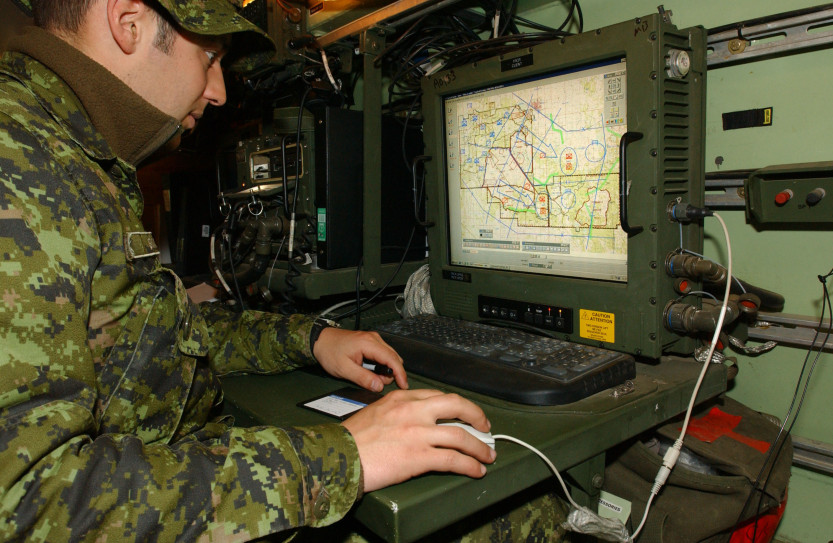
But the bigger threat, by far, is a brigade command post that looks like this …
… than like this:
April 18, 2003, Wainwright, Alberta
Captain Jeremy Small, the Signals Officer with the First Battalion of the Royal Canadian Regiment (1 RCR)(Petawawa, Ontario), works on the Athene Tactical System (ATS) in the Command Post (CP). The ATS is a new battlefield information system being tested by 2 Canadian Mechanized Brigade Group (2CMBG) Headquarters and the 1 RCR. The digital information can be shared in a more timely fashion than the old method, which needed to be drawn by hand. The 1 RCR are part of the is part of the approximately 4,600 Canadian Forces members who are participating in the first major army training exercise of the 21st Century, from April 7 to May 2, 2003 in Wainwright, Alta. After two years of planning, co-operation, strategic resource management, and with assistance from the Air Force, the Army has created Exercise RESOLUTE WARRIOR. Fourteen combat and support units are training together in a multi-element combat environment in preparation for potential and upcoming high readiness tasks at home and abroad. This exercise is the confirmation of the skills and cohesion of the units involved and will be similar to an actual deployment.
Photo: MCpl Paul MacGregor, Canadian Forces Combat CameraThe urban battle of the future, like those of the past will be fought by rifle sections of eight to 12 soldiers, directed by platoon commanders (young, 20-something, lieutenants) overseen and supports by company and battalion commanders. The lessons that my Regiment learned at Ortona, during the Christmas season of 1943, (and which were drummed into my head by ‘old sweats‘ 20 years later) will still apply. Generals and brigadiers and colonels may plan and guide the battle but it will be fought by captains and corporals and privates … hand-to-hand, house-by-house, street-by-street … whether it is a small city or a giant metropolis. Yes, that young soldier would love to have a little drone to see around the corner before he throws the grenade and he might even be interested in knowing that SigInt says that enemy is running low on ammo and food, but at the moment he, like all combat soldiers, must trust, mainly, in his own judgment of the situation as he, and only he, can see it.
But while the privates and corporals are fighting the battle and gathering the real intelligence about the enemy, the legal officer will be wanting to know exactly what (s)he (the rifle section commander) sees and (s)he, the legal officer, will want to advise the brigade commander (who commands 6,500 soldiers) to interfere directly with the the command decisions of the most junior leaders (section (10 soldiers) and platoon (35 soldiers) commanders) and with the control decisions being made by company (125 soldiers) and battalion (900 soldiers) commanders. Good brigade commanders will resist that pressure and they will, equally, close their ears to the urgent warnings of the Public Affairs officer who will say something like “if this goes wrong the Minister will be embarrassed and that will cost you your next star.”