
World War Two
Published 24 Feb 2024This week the Battle of Iwo Jima begins and American forces raise the Stars and Stripes on Mount Suribachi. Elsewhere, the Allies fight the stiff Japanese defences in Manila. The Red Army continues fighting through East Prussia and Pomerania as Stalin plans the next stage of the advance on the Reich. There are Allied advances in Western Europe and Italy too.
00:01 Intro
00:54 Recap
01:16 Iwo Jima Begins
06:32 The war in the Philippines
07:56 The Battle of Manila
11:12 Fighting in Burma
12:14 Operation Grenade
13:46 Operation Encore
14:38 Soviet plans for new offensives
21:28 Moscow Commission Meets
(more…)
February 25, 2024
Iwo Jima! – WW2 – Week 287 – February 24, 1945
Comments Off on Iwo Jima! – WW2 – Week 287 – February 24, 1945
Battleships – Ruling the Waves Across the 7 Seas – Sabaton History 124 [Official]
Sabaton History
Published Nov 16, 2023They were as much symbols of national pride as they were mighty weapons of war, but they were indeed MIGHTY. Dreadnoughts, battleships, super battleships — Sabaton has covered them in songs more than once, and today we dive into the battleship craze of the early 20th century: the Age of the Battleship!
(more…)
Comments Off on Battleships – Ruling the Waves Across the 7 Seas – Sabaton History 124 [Official]
QotD: From the M1903 Springfield to the M1 Garand
The M1 Garand is correctly considered the best battle rifle of World War II. It was the only semi-automatic rifle — meaning that it fired each time the operator pulled the trigger — to be the standard issue infantry rifle of any army during the war. Other forces were equipped with bolt-action rifles — the British Lee Enfield, Soviet Mosin Nagant, Japanese Type 99, German K98k, etc. — that required the operator to manually pull back a bolt to eject the [expended cartridge], and then push it forward again to insert a fresh cartridge into the chamber. The most obvious advantage was an increased rate of fire: a semiautomatic rifleman with an M1 had an official aimed rate of fire of 24 shots per minute.1 Compare this to the 15 aimed shots that British soldiers were expected to pop off with a bolt-action Lee Enfield in a “mad minute” drill. And the Lee Enfield was one of the fastest bolt-action rifles ever produced! In a pinch, a GI could blast out a clip in a few seconds, approximating a burst from an automatic weapon.2 Furthermore, with semi-automatic fire, the shooter could stay focused on his target, whereas working the bolt generally forced the shooter off target, requiring time to reacquire a proper sight picture.
Lt. General George Patton famously called the M1 Garand “the greatest battle implement ever devised“, a quote often repeated reverently in the context of World War II nostalgia. The US Government after the war gave away millions of M1 Garands, making it a popular civilian rifle for hunting and competitive shooting.
But nostalgia aside, it is also possible to view, from the high perch of hindsight, the M1 Garand as a missed opportunity. The most advanced battle rifle of World War II ultimately looked back too much to the past rather than pointing the way to the future. During its development, senior military officials applied the perceived lessons of the Spanish American War to a rifle designed to solve the problems of the Great War. This intervention prevented the M1 Garand from becoming something closer to a modern assault rifle, with an intermediate power cartridge and higher magazine capacity. The army was in no hurry to ditch the rifle that had won World War II, meaning that the United States did not field its first true assault rifle until two decades after the concept had been invented by the Germans in 1943 and soon successfully adapted by the Soviets in 1947. The first American assault rifle, the M16, would not debut until 1965.
First a necessary caveat: rifles were not the decisive weapon in World War II. For the most part the small arms deployed by the United States had been designed to fight World War I: the Browning Automatic Rifle (1918), the M1919 Browning Medium Machine Gun (as the date implies, first fielded in 1919) and the M2 Browning heavy machine gun, designed in 1918 and so good it is still used over a century later. In contrast, German machine guns were somewhat more recent in design: the MG 34 (as the name implies, first fielded 1934) and the MG 42. During the war, the Germans invented the first true assault rifle, the StG 44.
The secret sauce of the US Army by 1944-45 had little to do with firearms at all: it was a combination of ready mobility through motorization combined with deadly artillery and close air support, enabled by an unmatched communication system that allowed forward observers to direct and adjust fires to lethal effect. The American way of war was rooted in fleets of trucks and jeeps, networks of radios and heaps of shells. Having a nice semi-automatic rifle was ancillary to a conflict like World War II. But the M1 Garand is a useful window into the vagaries of military procurement and technological innovation, which require developers to at once predict the operational environment of the future and analyze the lessons of the past.
Throughout the 1920s, officers at the Infantry School in Fort Benning experimented with new tactics that they hoped would again allow for mobile infantry combat and avoid the trench stalemate of World War I. The basic solution was some form of “fire and maneuver”, in which one section of a unit (say a squad or platoon) would lay down a sufficient base of small arms fire to suppress the enemy so as to facilitate the other section’s advance. By alternating suppression and assault the element might leapfrog its way forward, even against entrenched enemy machine guns.
For such a tactic to work, infantry platoons needed a lot of firepower. Some might come from light machine guns, like the Browning Automatic Rifle, which was issued to individual infantry squads. But it was generally realized that individual infantrymen needed to be capable of a far higher rate of fire than could be provided by the standard issue rifle, the bolt-action M1903 Springfield, fed from a five round magazine. To this end, the US government set about developing a semi-automatic rifle.
The charge was taken up by John C. Garand, a Canadian-born, self taught firearms designer who worked for the Springfield Armory in Massachusetts. Garand’s solution to make the rifle self-loading was to insert a piston beneath the barrel. When the gunpowder exploded in the cartridge, the gas produced in the explosion propelled the bullet out the barrel. But some gas was bled off into a cylinder below the barrel (which gives the M1 its peculiar appearance of seeming to have two barrels); the pressure of the gas in the cylinder drove a piston.3 This piston attached to an operating rod which pushed the bolt of the rifle back, ejecting the spent casing, and allowing a spring in the internal magazine to insert another cartridge into the chamber before a separate spring pushed the operating rod forward and closed the bolt for the next shot, all in a fraction of a second.
Garand had initially worked on a rifle chambering the standard .30-06 cartridge used by the M1903 Springfield rifle (the .30 indicates that the bullet had a diameter of .30 inches, while the 06 indicates that the cartridge had been adopted in 1906; the round is often pronounced “thirty-ought-six”. But when a rival designer named John Pedersen, also affiliated with Springfield Armory, developed a semi-automatic design that chambered a lighter .276 (7mm) round, Garand retooled his project for the lighter round as well, producing a prototype known as the T3, with subsequent refinements labeled the T3E1 and T3E2. The smaller round meant that the internal magazine of the T3E1/2 could accept clips of 10 bullets, doubling the magazine capacity of the M1903 Springfield.
Army officials were very interested in the new round, but wanted proof that a lighter bullet would be sufficiently lethal in combat. A series of grisly ballistic tests were therefore ordered, pitting the .276 round against the traditional .30-06. In 1928, anesthetized pigs were shot through with both rounds. To the surprise and consternation of traditionalists, the .276 did far more damage in the so-called “Pig Board”. This is not paradoxical: the lighter round was more likely to “tumble”, precisely because it was lighter and so more likely to have its trajectory disrupted by bone and tissue; the tumble meant that more of the kinetic energy was expended inside the target, causing far more damage. The .30-06, meanwhile, as a more powerful round, was more likely to punch clean through, retaining its kinetic energy to keep moving forward after passing through the target. Eventually, tests of this sort would be used to sell the army on the lethality of the 5.56mm round used by the M16/M4, which has an even greater tumble, and causes even more grievous injuries. Out of concern that the fat bodies of pigs did not accurately replicate the human teenagers that the new round was designed to kill, a new test was inflicted upon goats, seen as more appropriately lean and therefore better analogs. The result was the same in favor of the .276 (a lighter .256 performed even better). With two rounds of tests vindicating the .276, the Army demanded that its new rifle chamber the .30-06. The final decision was made by Douglas MacArthur himself.
The .30-06 round itself had been the product of a painful lesson learned during the Spanish American War. Here, American troops, armed with Krag M1892 rifles, had found themselves badly out-ranged by Spanish troops armed with Mausers; the famous charge up San Juan Hill occurred after US troops had advanced for some distance under a hail of unanswered rifle fire. Given the importance of sharp shooting to the American military mythos, getting handily outranged and outshot by Spanish forces was a painful embarrassment. The first order of business had been to adopt the Mauser design: the M1903 Springfield was essentially a modified Mauser, as the US government had licensed a number of Mauser’s patents. By upgrading the M1903 to take the heavy .30-06 round, the Army ensured that soldiers could engage targets over a kilometer away. Beyond the deeply ingrained “lessons learned” from the Spanish American War, the mythos of the deadly American sharpshooter was strongly entrenched. Even as disruptors at Benning developed new infantry tactics that stressed volume of fire over accuracy, the phantoms of buck skinned frontiersmen sniping at British redcoats from a thousand paces still occupied the headspace of military leaders; they wanted a rifle with long distance accuracy. The sights on the M1 Garand adjust out to 1200 yards.
But MacArthur’s reasoning seems to have been primarily motivated by administrative and logistical concerns, as he cited the generic difficulties of fielding a lighter round. Some of these challenges may have been related to production and distribution of a sufficient stockpile of new caliber ammunition. There may have also been a concern with the new round complicating the logistics of line companies. The army also used .30-06 for the BAR and Browning medium machine gun, and having all of these shoot the same round in theory simplified the supply of line companies, and allowed for cross-leveling between weapons systems. Similar concerns have the US Army maintaining a policy of only having 5.56mm weapons at the squad level (thus the M4 and M249 Squad Automatic Weapon both shoot 5.56, and the SAW can shoot from M4 magazines).4 Still, MacArthur’s concerns seem unfounded in hindsight. The United States was about to produce billions of bullets during World War II. American troops were about to be so lavishly supplied that distributing two types of bullets would have been readily feasible given the soon to be proven quality of American logistics.5
With MacArthur’s edict, Garand retooled his rifle back to the .30-06 caliber, and his design was finally accepted in 1936. But the larger and more powerful round required a design change: the internal magazine now took clips of eight bullets instead of ten. Two rounds may not sound like much, but every bullet can be precious in a firefight, and this represented a 20% reduction in magazine capacity. Spread over a company sized element, the reduced clip capacity represented over two-thousand fewer rounds that a company commander could expect to fire and maneuver with. Indeed, the M1’s volume of fire proved generally insufficient to suppress the enemy on its own during the war, evidenced by the habit of equipping rifle squads with two Browning Automatic Rifles, instead of one. Marine divisions by the end of the war often deployed three BARs per squad.6
Michael Taylor, “Michael Taylor on The Development of the M1 Garand and its Implications”, A Collection of Unmitigated Pedantry, 2023-09-08.
1. TM 9-1005-222-12.
2. Thus George Wilson, a platoon leader and later company commander in the Fourth Infantry Division, describing a platoon scout stumbling upon the enemy: “The second scout emptied the eight round clip in his M-1 so fast it seemed like a machine gun … the rest of us moved very cautiously and found three dead enemy soldiers in the road.” (G. Wilson. If You Survive. Ivy, 1987).
3. John Garand’s initial design, and early production M1s, had a gas trap inserted over the muzzle to catch the gas after the bullet had exited; when this proved prone to fouling, a design modification drilled a small hole in the barrel just before the muzzle to allow the gas to bleed into the cylinder, most M1 Garands had this “gas port” system.
4. In 2023, US Army infantry will begin transition to the M7 carbine and M250 Squad Automatic weapon, which will both use a 6.8mm bullet, out of concerns that the 5.56 NATO is insufficient to penetrate body armor.
5. Editor’s Note: I agree with Michael here in principle: US logistics could have managed this. But I would also note that part of the reason American logistics were so good is that they applied MacArthur’s reasoning to everything, reusing vehicle chassis, limiting the number of different ammunition calibers and demanding interchangeable parts across the whole range of military equipment. Take one of those decisions away and the whole still functions. Take all of them away and one ends up with the mess that was German production and logistics.
6. Editor’s Note: BAR goes BARRRRRRRRRRR.
Comments Off on QotD: From the M1903 Springfield to the M1 Garand
February 24, 2024
Feeding Napoleon – Chicken Marengo
Tasting History with Max Miller
Published Nov 21, 2023
(more…)
Comments Off on Feeding Napoleon – Chicken Marengo
February 23, 2024
The Gun Science Says Can’t Work – Madsen LMG Mechanics
Forgotten Weapons
Published 21 Nov 2023The Madsen LMG is generally considered an extremely complex and confusing system — but is it really? Today we are taking one apart to see just how it actually works. Because in fact, it’s a very unusual system, but not really any more complicated than any other easy self-loading action.
(more…)
Comments Off on The Gun Science Says Can’t Work – Madsen LMG Mechanics
February 22, 2024
Allied War Crimes, Latin American Troops, and Top-Secret Proximity Fuzes – WW2 – OOTF 033
World War Two
Published 21 Feb 2024Did the Western Allies commit war crimes? What did Latin American troops do during the war? And, how did the top-secret proximity fuze change the face of warfare? Find out in this episode of Out of the Foxholes.
(more…)
Comments Off on Allied War Crimes, Latin American Troops, and Top-Secret Proximity Fuzes – WW2 – OOTF 033
The Malayan Emergency – Britain’s Jungle War v Communists
The History Chap
Published Nov 16, 2023Britain’s Victorious Jungle War Against the Communists
Get My FREE Weekly Newsletter
https://www.thehistorychap.com
Comments Off on The Malayan Emergency – Britain’s Jungle War v Communists
February 21, 2024
“College attendance is our society’s only meaningful initiation ritual, and it thus assumes an existential importance that renders it near-impossible to replace until an alternative is found”
Johann Kurtz believes the modern university’s survival despite its increasingly irrational and counterproductive actions can be explained as the last modern example of an initiation ritual:

Harvard University Memorial Church.
Photo by Crimson400 via Wikimedia Commons.
Our understanding of the college system is incomplete. Until we correct this, we won’t be able to fix or replace the system.
First, consider a paradox: college attendance remains near all-time highs [Link], yet the majority of Americans no longer believe it is worth the cost [Link].
The college system seems irrationally resistant to declining value. We must therefore ask: is there an important non-rational reason for college attendance which we have failed to acknowledge?
I believe the answer is “Yes”. College attendance is our society’s only meaningful initiation ritual, and it thus assumes an existential importance that renders it near-impossible to replace until an alternative is found.
Our culture is historically anomalous in lacking explicit initiation rituals.
Mircea Eliade, the great religious historian of the 20th-century, defined initiation rituals as “a body of rites and oral teachings whose purpose is to produce a decisive alteration in the religious and social status of the person to be initiated“.
In philosophical terms, initiation is equivalent to a basic change in existential condition; the novice emerges from his ordeal endowed with a totally different being from that which he possessed before his initiation; he has become another.
— Mircea Eliade, Rites and Symbols of Initiation: The Mysteries of Birth and Rebirth
In Europe, fully expressed initiation rituals were common until the end of the Middle Ages, and in the wider world, until the end of the First World War. Now, they only persist in the West in the sacramental practices of devout Christians (baptism, confirmation, and so forth).
Once, however, these practices were of tremendous importance to us, as Eliade makes clear:
To gain the right to be admitted among adults, the adolescent has to pass through a series of initiatory ordeals: it is by virtue of these rites, and of the revelations that they entail, that he will be recognized as a responsible member of the society. Initiation introduces the candidate into the human community and into the world of spiritual and cultural values. He learns not only the behavior patterns, the techniques, and the institutions of adults but also the sacred myths and traditions of the tribe, the names of the gods and the history of their works …
In the absence of local community rituals, the universities are a natural site for their replacement. These have always been religious sites, although the nature and expression of this religion has transmuted over time.
H/T to Bruce Gudmundsson at Extra Muros for the link and his additional comments:
This hypothesis accords with the argument, made often in this blog, that education and schooling are two very different things. At the same time, it suggests that one of the definitive purposes of Extra Muros, the encouragement of young people to eschew the conventional college experience in favor of a combination of practical pursuits and systematic self-tuition, may be a fool’s errand. After all, if four (or five or six) years of drinking second-rate beer from red plastic cups does for the office-bound folk of North America what fear-filled rites of passage do for members of the bone-in-the-nose set, then I might well be sailing against the wind.
Upon second thought, I find hope in the possibility that the parasite (or, to be more precise, the cancer) promoted by d’Angelo, Kendi, and company will soon deal the coup de grâce to its mortally-wounded host.
The coming-of-age ordeals of warrior tribes demand that boys who would be men prove possession of such martial virtues as courage and self-command. The rites-of-passage of the modern middle classes, however, require that postulants demonstrate a mixture of conformity, conscientiousness, and, to a diminishing degree, intelligence. (Readers familiar with the oeuvre of economist Bryan Caplan will recognize the source of this troika. However, it is worth noting that, while Professor Caplan will occasionally tip his hat in the direction of the campus-based building of basic brain-power, he devotes far more attention to the collegiate cultivation of the two components of Sitzfleisch.)1
The cult of Marx, Mao, and Marcuse demands complete compliance, not only with its basic tenets, but also with any changes in the party line that, from time to time, may occur. (I am old enough to remember the days when campus commies of the caucasian persuasion could don dashikis without facing charges of “cultural appropriation”.) Thus, those who sit at the feet of the acolytes of critical theory learn an art of great value to people who wish to thrive in a large organization, that of discarding the old hat, and putting on the new one, at just the right time. (Think, if you will, of the mid-level employees of the McDonalds Corporation, who, over the course of the last four decades, were obliged to alter their opinion of the McRib sandwich more often than they changed the oil in their cars.)
1. Bryan Caplan, The Case Against Education: Why the Education System is a Waste of Time and Money (Princeton: Princeton University Press, 2018), pages 9-21.
Comments Off on “College attendance is our society’s only meaningful initiation ritual, and it thus assumes an existential importance that renders it near-impossible to replace until an alternative is found”
Greek History and Civilisation, Part 3 – The Ancient Greeks: Rising Tensions with Persia
seangabb
Published Feb 18, 2024This third lecture in the course deals with the rise of the Persian Empire, and the growing tensions between the Persians and the Greeks, culminating in an account of the Battle of Marathon in 490 BC.
(more…)
Comments Off on Greek History and Civilisation, Part 3 – The Ancient Greeks: Rising Tensions with Persia
“There’s a moral imperative to go dig out that villa … It could be the greatest archaeological treasure on earth”
In City Journal, Nicholas Wade discusses the technical side of the ongoing attempts to read one of the Herculaneum scrolls:
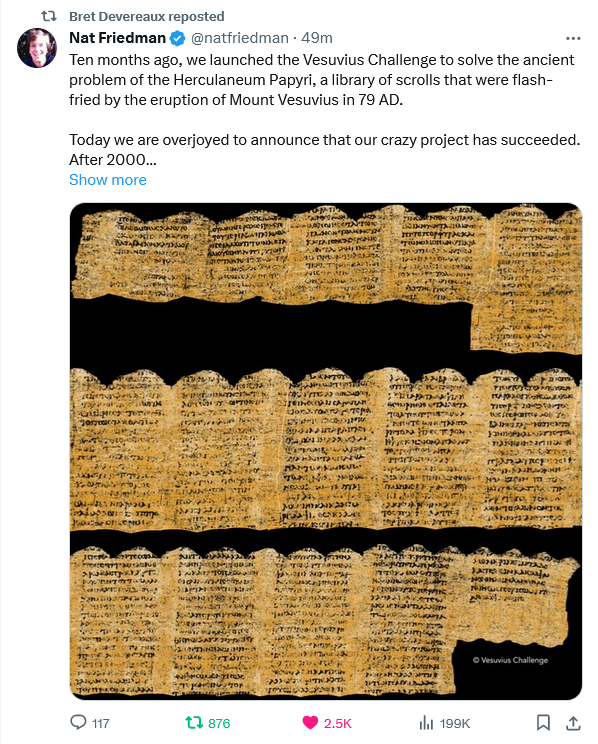
A computer scientist has labored for 21 years to read carbonized ancient scrolls that are too brittle to open. His efforts stand at last on the brink of unlocking a vast new vista into the world of ancient Greece and Rome.
Brent Seales, of the University of Kentucky, has developed methods for scanning scrolls with computer tomography, unwrapping them virtually with computer software, and visualizing the ink with artificial intelligence. Building on his methods, contestants recently vied for a $700,000 prize to generate readable sections of a scroll from Herculaneum, the Roman town buried in hot volcanic mud from the eruption of Vesuvius in 79 A.D.
The last 15 columns — about 5 percent—of the unwrapped scroll can now be read and are being translated by a team of classical scholars. Their work is hard, as many words are missing and many letters are too faint to be read. “I have a translation but I’m not happy with it,” says a member of the team, Richard Janko of the University of Michigan. The scholars recently spent a session debating whether a letter in the ancient Greek manuscript was an omicron or a pi.
[…]
Seales has had to overcome daunting obstacles to reach this point, not all of them technical. The Italian authorities declined to make any of the scrolls available, especially to a lone computer scientist with no standing in the field. Seales realized that he had to build a coalition of papyrologists and conservationists to acquire the necessary standing to gain access to the scrolls. He was eventually able to x-ray a Herculaneum scroll in Paris, one of six that had been given to Napoleon. To find an x-ray source powerful enough to image the scroll without heating it, he had to buy time on the Diamond particle accelerator at Harwell, England.
In 2009, his x-rays showed for the first time the internal structure of a scroll, a daunting topography of a once-flat surface tugged and twisted in every direction. Then came the task of writing software that would trace the crumpled spiral of the scroll, follow its warped path around the central axis, assign each segment to its right position on the papyrus strip, and virtually flatten the entire surface. But this prodigious labor only brought to light a more formidable problem: no letters were visible on the x-rayed surface.
Seales and his colleagues achieved their first notable success in 2016, not with Napoleon’s Herculaneum scroll but with a small, charred fragment from a synagogue at the En-Gedi excavation site on the shore of the Dead Sea. Virtually unwrapped by the Seales software, the En-Gedi scroll turned out to contain the first two chapters of Leviticus. The text was identical to that of the Masoretic text, the authoritative version of the Hebrew Bible — and, at nearly 2,000 years old, its earliest instance.
The ink used by the Hebrew scribes was presumably laden with metal, and the letters stood out clearly against their parchment background. But the Herculaneum scroll was proving far harder to read. Its ink is carbon-based and almost impossible for x-rays to distinguish from the carbonized papyrus on which it is written. The Seales team developed machine-learning programs — a type of artificial intelligence — that scanned the unrolled surface looking for patterns that might relate to letters. It was here that Seales found use for the fragments from scrolls that earlier scholars had destroyed in trying to open them. The machine-learning programs were trained to compare a fragment holding written text with an x-ray scan of the same fragment, so that from the statistical properties of the papyrus fibers they could estimate the probability of the presence of ink.
Comments Off on “There’s a moral imperative to go dig out that villa … It could be the greatest archaeological treasure on earth”
Can you make a tank disappear? The Evolution of Tank Camouflage
The Tank Museum
Published Nov 17, 2023It’s not easy to hide a tank. But over the years, military commanders have developed ways to disguise, cover and conceal the presence of their tanks from the enemy. This video is about the “art of deception” – and how, since World War One, through World War Two and into the present day, the science of tank camouflage has evolved to meet the conditions and threats of the contemporary battlefield.
00:00 | Intro
01:38 | WWI
06:26 | WW2
13:42 | Post War
19:40 | Conclusion
(more…)
Comments Off on Can you make a tank disappear? The Evolution of Tank Camouflage
February 20, 2024
Rome: Part 3 – The Expansion of Roman Power
seangabb
Published Feb 18, 2024This course provides an exploration of Rome’s formative years, its rise to power in the Mediterranean, and the exceptional challenges it faced during the wars with Carthage.
Lecture 3: The Expansion of Roman Power
• The Conquest of Central Italy
• The Gallic Sack of 390 BC
• The Conquest of the Greek Cities
• Relations with Carthage
(more…)
Comments Off on Rome: Part 3 – The Expansion of Roman Power
Belt-fed Madsen LMG: When the Weird Get Weirder
Forgotten Weapons
Published Nov 15, 2023First produced in 1902, the Madsen was one of the first practical light machine guns, and it remained in production for nearly 5 decades. The Madsen system is a rather unusual recoil-operated mechanism with a tilting bolt and a remarkably short receiver. The most unusual variation on the system was the belt-fed, high rate-of-fire pattern developed for aircraft use. This program was initiated by the Danish Air Force in the mid 1920s, and several different patterns were built by the time World War Two erupted.
The model here was actually a pattern that was under production for Hungary when German forces occupied Denmark. Taking over the factory, they continued the production and the guns went to the Luftwaffe for airfield defensive use.
In order to use disintegrating links instead of box magazines, some very odd modifications had to be made to the Madsen. One set of feed packs are actually built into the belt box itself, and the gun cannot function without the box attached. The only feasible path for empty link ejection is directly upwards, and so a horseshoe-shaped link chute was attached to the top cover, guiding links up over the gun and dropping them out the right side of the receiver. Very weird!
While several thousand of these were made under German occupation, very few survive today and they are extremely rare on the US registry.
(more…)
Comments Off on Belt-fed Madsen LMG: When the Weird Get Weirder
February 19, 2024
The CIA’s covert operations … as inspired by Vladimir Lenin
Along with most people who’ve been paying attention to history since the start of the Cold War, I hold the CIA in dubious regard. They seem to have been involved in so many underhanded escapades in countries around the world — certainly by reputation, if not in reality — that they stand almost in direct opposition to how most Americans liked to think of their country. Jon Miltimore thinks that among their inspirations was the founder of the Soviet Union himself:

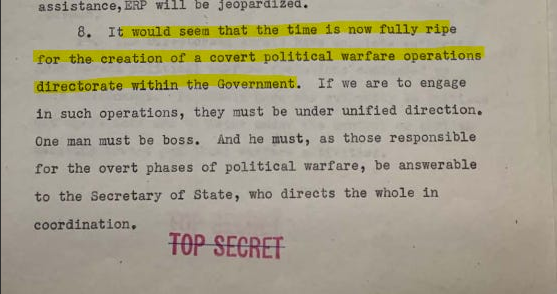
I bring all of this up because I recently came across an old document of some significance that I’d never heard of before titled, “The Inauguration of Organized Political Warfare“.
It was authored by George Kennan, the State Department Policy Planning Director who’d go on to be a successful US diplomat, for the National Security Council (which governed the CIA), and the document explained how the US government had to mobilize national resources “for covert political warfare” to combat the Soviet Union.
Kennan was not, in my opinion, a bad man. He had good instincts and sound motives, at least compared to others in the US intelligence apparatus. He was an early opponent of the Vietnam War and later was one of the first diplomatic leaders to warn against the US policy of expanding NATO up to Russia’s doorstep, something he predicted would be “the most fateful error of American policy in the entire post-cold-war era”.
That said, it’s clear that Kennan was not appalled by the Soviet Union’s use of covert political warfare. He was impressed by it.
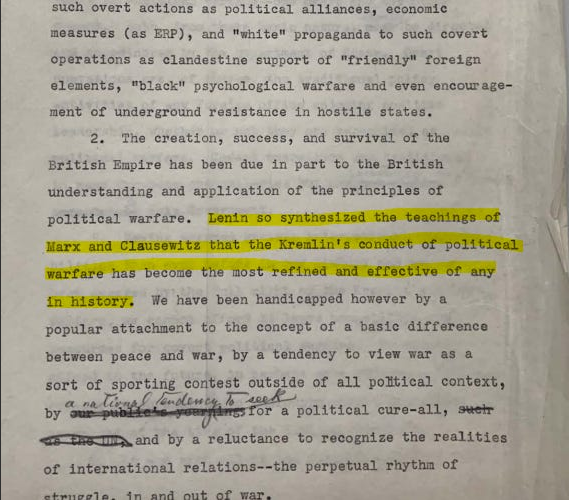
“Lenin so synthesized the teachings of Marx and Clausewitz that the Kremlin’s conduct of political warfare has become the most refined and effective of any in history,” Kennan wrote in the document.
We have been handicapped however by a popular attachment to the concept of a basic difference between peace and war, by a tendency to view war as a sort of sporting context outside of all political context, by a national tendency to seek for a political cure-all, and by a reluctance to recognize the realities of international relations — the perpetual rhythm of [struggle, in and out of war].
The document is fascinating because it appears to mark the genesis of the US government’s first formal steps into the world of political warfare — a well-documented history that includes toppling governments, assassinating world leaders, tipping elections, and torturing enemies.
All of these efforts, of course, initially targeted external parties and countries to serve “the national interest”.
This is no longer the case. The CIA, NSA, and other intelligence agencies no longer restrict their covert political warfare to foreign states, and I’m not talking about just Operation Mockingbird and other domestic propaganda efforts.
The CIA is clearly putting its thumb on the scales of US elections in ways that should terrify all Americans.
Comments Off on The CIA’s covert operations … as inspired by Vladimir Lenin
QotD: Cleopatra VII Philopator
Cleopatra, of course, has all of that reception layered on too. In antiquity and indeed until the modern era, she was one of the great villains of history, the licentious, wicked foreign queen of Octavian’s propaganda. More recently there has been an effort to reinvent her as an icon of modern values, perhaps most visible lately in Netflix’ recent (quite poorly received) documentary series. A lot of both efforts rely on reading into gaps in the source material. What I want to do here instead is to try to strip some of that away, to de-mystify Cleopatra and set out some of what we know and what we don’t know about her, with particular reference to the question I find most interesting: was Cleopatra actually a good or capable ruler?
Now a lot of the debate sparked by that Netflix series focused on what I find the rather uninteresting (but quite complicated) question of Cleopatra’s heritage or parentage or – heaven help us – her “race”. But I want to address this problem too, not because I care about the result but because I am deeply bothered by how confidently the result gets asserted by all sides and how swiftly those confident assertions are mobilized into categories that just aren’t very meaningful for understanding Cleopatra. To be frank, Cleopatra’s heritage should be a niche question debated in the pages of the Journal of Juristic Papyrology by scholars squinting at inscriptions and papyri, looking to make minor alterations in the prosopography of the Ptolemaic dynasty, both because it is highly technical and uncertain, but also because it isn’t an issue of central importance. So we’ll get that out of the way first in this essay and then get to my main point, which is this:
Cleopatra was, I’d argue, at best a mediocre ruler, whose ambitious and self-interested gambles mostly failed, to the ruin of herself and her kingdom. This is not to say Cleopatra was a weak or ineffective person; she was very obviously highly intelligent, learned, a virtuoso linguist, and a famously effective speaker. But one can be all of those things and not be a wise or skillful ruler, and I tend to view Cleopatra in that light.
Now I want to note the spirit in which I offer this essay. This is not a take-down of the Netflix Queen Cleopatra documentary (though it well deserves one and has received several; it is quite bad) nor a take-down of other scholars’ work on Cleopatra. This is simply my “take” on her reign. There’s enough we don’t know or barely know that another scholar, viewing from another angle, might well come away with a different conclusion, viewing Cleopatra in a more positive light. This is, to a degree, a response to some of the more recent public hagiography on Cleopatra, which I think air-brushes her failures and sometimes tries a bit too hard to read virtues into gaps in the evidence. But they are generally gaps in the evidence and in a situation where we are all to a degree making informed guesses, I am hardly going to trash someone who makes a perfectly plausible but somewhat differently informed guess. In history there are often situations where there is no right answer – meaning no answer we know to be true – but many wrong answers – answers we know to be false. I don’t claim to have the right answer, but I am frustrated by seeing so many very certain wrong answers floating around the public.
Before we dive in briefly to the boring question of Cleopatra’s parentage before the much more interesting question of her conduct as a ruler, we need to be clear about the difficult nature of the sources for Cleopatra and her reign. Fundamentally we may divide these sources into two groups: there are inscriptions, coins and papyrus records from Egypt which mention Cleopatra (and one she wrote on!) but, as such evidence is wont to be, [they] are often incomplete or provided only limited information. And then there are the literary sources, which are uniformly without exception hostile to Cleopatra. And I mean extremely hostile to Cleopatra, filled with wrath and invective. At no point, anywhere in the literary sources does Cleopatra get within a country mile of a fair shake and I am saying that as someone who thinks she wasn’t very good at her job.
The problem here is that Cleopatra was the target of Octavian’s PR campaign, as it were, in the run up to his war with Marcus Antonius (Marc Antony; I’m going to call him Marcus Antonius here), because as a foreign queen – an intersecting triad of concepts (foreignness, monarchy and women in power) which all offended Roman sensibilities – she was effectively the perfect target for a campaign aimed at winning over the populace of Italy, which was, it turns out, the most valuable military resource in the Mediterranean.3 That picture – the foreign queen corrupting the morals of good Romans with her decadence – rightly or wrongly ends up coloring all of the subsequent accounts. Of course that in turn effects the reliability of all of our literary sources and thus we must tread carefully.
Bret Devereaux, “Collections: On the Reign of Cleopatra”, A Collection of Unmitigated Pedantry, 2023-05-26.
1. Or even just the seventh!
2. This is not to diminish the value of reception studies that trace the meaning a figure – or the memory of a figure – had over time. That’s a valuable but different lens of study.
3. It’s not all Octavian, mind. Cicero’s impression of Cleopatra was also sharply negative, for many of the same reasons: Cicero was hardly likely to be affable to a foreign queen who was an ally of Julius Caesar.
Comments Off on QotD: Cleopatra VII Philopator


