
World War Two
Published 17 Feb 2024The Germans finally launch a counterattack into the Soviet flanks, but it does not go as well as was as hoped. The Siege of Budapest comes to an end, also not well for the Germans. The Soviets have now also surrounded Breslau. In Burma, the Allies cross the Irrawaddy River, in the Philippines the fight for Manila continues, and in the Pacific preparations are underway for an American invasion of Iwo Jima Island.
01:50 The fight for East Prussia
04:08 German counterattack in Poland
07:00 Breslau Surrounded
07:57 The Siege of Budapest
09:14 Operation 4th Term in Italy
10:07 Operation Veritable Continues
11:36 Allies cross the Irrawaddy
14:43 The Fight in the Philippines
17:52 Preparations for Iwo Jima
(more…)
February 18, 2024
German Counterattack in Pomerania – WW2 – Week 286 – February 17, 1945
Does the Chieftain Fit Into … a Ford Model T
The Chieftain
Published Nov 19, 2023Filmed during a down-moment on a maintenance day at the Ontario Regiment Museum. The Model T is small and so old that I have to ask someone else at the end of the video how to drive it.
(more…)
QotD: British meals – sauces
Here also we may mention the special sauces which are so regularly served with each kind of roast meat as to be almost an integral part of the dish. Hot roast beef is almost invariably served with horseradish sauce, a very hot, rather sweet sauce made of grated horseradish, sugar, vinegar and cream. With roast pork goes apple sauce, which is made of apples stewed with sugar and beaten up into a froth. With mutton or lamb there usually goes mint sauce, which is made of chopped mint, sugar and vinegar. Mutton is frequently eaten with redcurrant jelly, which is also served with hare and with venison. A roast fowl is always accompanied by bread sauce, which is made of the crumb of white bread and milk flavoured with onions, and is always served hot. It will be seen that British sauces have the tendency to be sweet, and some of the pickles that are eaten with cold meat are almost as sweet as jam. The British are great eaters of pickles, partly because the predilection for large joints means that in a British household there is a good deal of cold meat to finish up. In using up scraps of food they are not so imaginative as the peoples of some other countries, and British stews and “made-up dishes” – rissoles and the like – are not particularly distinguished. There are, however, two or three kinds of pie or meat-pudding which are peculiar to Britain and are good enough to be worth mentioning. One is steak-and-kidney pudding, which is made of chopped beef-steak and sheep’s kidney, encased in suet crust and steamed in a basin. Another is toad-in-the-hole, which is made of sausage embedded in a batter of milk, flour and eggs basked in the oven. There is also the humble cottage pie, which is simply minced beef or mutton, flavoured with onions, covered with a layer of mashed potatoes and baked until the potatoes are a nice brown. And finally there is the famous Scottish haggis, in which liver, oatmeal, onions and other ingredients are minced up and cooked inside the stomach of a sheep.
George Orwell, “British Cookery”, 1946. (Originally commissioned by the British Council, but refused by them and later published in abbreviated form.)
February 17, 2024
Hitler speaking – not the raging, raving maniac we all think he was
Colby Cosh on a major German academic effort to provide an authoritative digital record of Adolf Hitler’s actual speeches, rather than the highly selective snippets we in the English speaking world have seen or the “official” transcripts that were published in Nazi propaganda organs:
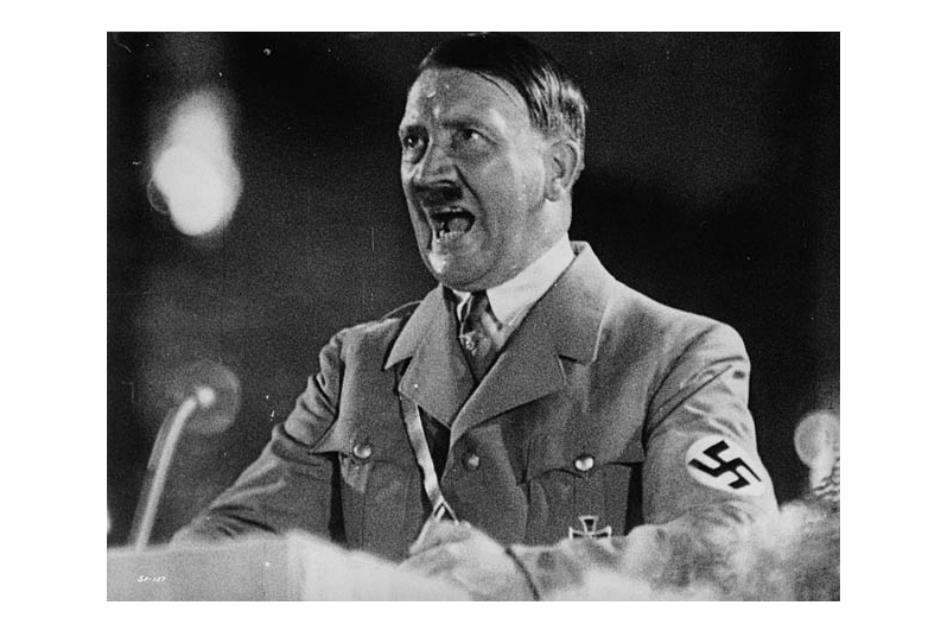
Adolf Hitler making a speech sometime between 1933 and 1940.
Library and Archives Canada item number 3191955.
You may have seen reports that a consortium of German research institutions has set out on a seven-year project to compile, annotate and digitize every speech Adolf Hitler gave as chancellor of Germany. The effort is being led by the Institute of Contemporary History (Institut fuer Zeitgeschichte, or IfZ), a Munich-based German government research consortium founded in 1947 to preserve the various records of Germany’s experience under National Socialism. Since that time, there has been a whole lot more zeitgeschichte in Germany, of course, so the IfZ also does a lot of work on communism, the Cold War and German reunification. It helps run important museums and historical sites, such as Hitler’s mountain retreat on the slopes of the Obersalzberg.
[…]
The co-head of the new project is Magnus Brechtken, deputy director of the IfZ and author of a landmark 2017 biography of Hitler’s pet architect and economic manager, Albert Speer. In January, Brechtken gave an absorbing German-language interview explaining the need for a contemporary, digital Hitler edition. Run that puppy through Google Translate and you’ll see that it commences amusingly with the question, “So do you have Adolf Hitler’s voice running through your head all the time?”
(This probably wouldn’t be as hellish as it sounds. Hitler didn’t really bellow like a rabid animal at his audiences for hours on end, contrary to the image of him that you and I have in our heads, and he spoke with a low, musical Austrian accent that German speakers like Brechtken seem to appreciate.)
Brechtken observes that in writing his Speer book, he spurned Domarus and went to the Sisyphean trouble of running down primary versions of relevant Hitler speeches himself. Hundreds of audio recordings of Hitler have survived in the German Broadcasting Archive in Frankfurt, and the project team has computer scientists and even linguists on board to help integrate text, sound and historians’ notes on persons, events and the context of the speeches.
No doubt the finished product will be consumed by the uglier parts of today’s German political right, and its reaction is fully predictable. Some will say, “At last, the real Hitler!”; and an equal number will say, “This whole project is a parcel of falsehoods — it’s fake Hitler!”
Breda 37: Italy’s Forgotten Heavy Machine Gun
Forgotten Weapons
Published Nov 11, 2023The Breda Model 37 was Italy’s standard heavy machine gun (which meant a rifle-caliber gun fired only from a tripod) during World War Two. It was chambered for the 8x59mm cartridge, as Italy used a two-cartridge system at the time, with 6.5mm for rifles and the heavier 8mm for machine guns to exploit their longer effective range. Production began in 1937 and continued until the end of the war, with a batch being made for German use after the Italian armistice in 1943. Pre-war it was also sold to Portugal as the m/938. It remained in Italian use after the war as well, eventually replaced by the MG42/59.
The Breda 37 is a durable, reliable, and overall very good design. It uses 20-round feed strips, with the quite unusual feature of placing fired cases back into the strips rather than ejecting them out of the gun. It is a relatively unknown gun today, but this is not because of any inferiority on its part.
(more…)
QotD: Lessons for today from the decline of the Western Roman Empire
Luttwak has a charmingly racist bit about how some client states have the IQ and sophistication to understand the true nature of the arrangement, while others are too dumb or barbaric to remember who’s boss without having their faces regularly rubbed in it. In the Roman case, the former camp contained the various Hellenistic kingdoms in Asia Minor and the Levant, who didn’t need legionaries standing around and supervising them, because they could imagine the existence of those legionaries and what they would do to them if provoked. The latter camp included many of the Germanic tribes, who tended to forget their place if the legions weren’t garrisoned within eyeshot, and even then would rise up in fruitless rebellion every couple of generations. We can make this marginally less racist by positing something more like a spectrum of how tolerable the client arrangement was, and consequently a spectrum of how coercive it had to be. The Greeks were relatively compatible culturally with the Romans, and the warrior spirit of their ancestors had been sufficiently sanded down that they didn’t mind being told what to do. The Germans were more foreign, and also retained the barbarian’s yearning for freedom, so a careful eye had to be kept on them.
A true cynic might think that there was something similar going on with America’s imperial dependencies … sorry, with America’s “allies”. There are no American garrisons in Canada, because the Canadians are culturally-compatible, and also because they’ve been thoroughly cowed and do not dream of an independent national destiny. But look overseas, for instance at some of our Middle Eastern “allies”, and you will see a situation more analogous to the Germanic tribes. What a coincidence that these same “allies” host a much heavier American military presence! Even here, however, the situation isn’t strictly coercive, and insofar as it is, the coercion is mostly outsourced to local elites. Those elites, in turn, can mostly be handled with carrots: the imperial power subsidizes their trade and security arrangements, not to mention keeps them in charge of their respective countries! The Romans commonly rewarded loyal clients with citizenship and a cushy sinecure for a job well done. It would be rude of us to do otherwise.
Maybe this was already obvious to everyone else, but reading the “rules-based international order”1 as a concealed hegemon/client system feels a bit like having the skeleton key to understanding current events. Like why do European countries so often act in ways contrary to their own economic or geopolitical self-interest, but consonant with America’s interest? How do the political and business elites of these countries maintain such an impressive unified front in the face of popular discontent? Why do the rulers of all these very different countries have seemingly identical tastes, worldviews, and mannerisms? What is the meaning of “populism,” and why do people treat it like it’s a single, consistent thing, despite the fact that “populist” parties in different countries often seek diametrically opposite policies?
Just pretend, imagine with me, that these European “allies” are client kingdoms. They are permitted a certain amount of latitude, but when the chips are down they do not have an independent foreign policy. Their ruling classes are client rulers that administer certain territories, and there is tacit agreement with the imperial overlord on what they may and may not do. Over time, the client rulers identify less and less with their countrymen, more and more with their counterparts in other client states, and most of all with the distant metropole, whose social approval they desperately desire. The “populists” are simply the anti-imperial party, in whatever country. The thing the “populists” have in common is a desire to be free of the suffocating imperial embrace,2 but they all have a thousand different stupid ideas about what to do with that freedom. This includes the “populists” in the United States itself, by the way. The American Empire is called that because it started here, but it has long-since burst free of the host in which it incubated, and the rot of our own political institutions can be understood as our transformation into the biggest client kingdom of them all.
None of what I’ve said above is meant to be a value judgment. I think many people resist the notion that America is an empire because empires are “bad” and we’re obviously the good guys. But others, including myself not too long ago, resist it because we have an overly-simplistic notion of what an empire looks like, especially what it looks like from the inside. Empires exist on a spectrum — America’s subjects certainly have more ability to act independently than Rome’s did. But many empires also go to some lengths to conceal their true nature. Around the time of the birth of Christ, the official story in many of the lands ruled by Rome was that Rome was merely their largest trading partner and a staunch military ally. Some of them might even have believed it.
John Psmith, “REVIEW: The Grand Strategy of the Roman Empire by Edward Luttwak”, Mr. and Mrs. Psmith’s Bookshelf, 2023-11-13.
1. The rules-based international order which has no rules, isn’t based, and opposes order.
2. They may also have in common the payments made to their bank accounts by the empire’s enemies.
February 16, 2024
Regional Power: North Korea
Army University Press
Published Feb 13, 2024This film examines the current political and military situation in North Korea. Subject matter experts discuss Korean history, DPRK current affairs, and KPA military doctrine. Topics include the rise of the Kim family to political leadership of the DPRK, its influence in the region, and how the U.S. works in partnership with the Republic of Korea.
What remains of the “first” steam powered passenger railway line?
Bee Here Now
Published 23 Oct 2023The Stockton-Darlington Railway wasn’t the first time steam locomotives had been used to pull people, but it was the first time they had been used to pull passengers over any distance worth talking about. In 1825 that day came when a line running all the way from the coal pits in the hills around County Durham to the River Tees at Stockton was opened officially. This was an experiment, a practice, a great endeavour by local businessmen and engineers, such as the famous George Stephenson, who astounded crowds of onlookers with the introduction of Locomotion 1 halfway along the line, which began pulling people towards Darlington and then the docks at Stockton.
This was a day that would not only transform human transportation forever, but accelerate the industrial revolution to a blistering pace.
In this video I want to look at what remains of that line — not the bit still in use between the two towns, but the bit out in the coalfields. And I want to see how those early trailblazers tackled the rolling hills, with horses and stationary steam engines to create a true amalgamation of old-world and new-world technologies.
(more…)
February 15, 2024
Israel as an “Eschatological Garrison State”
Big Serge outlines why Israel was compelled by its geostrategic position to react as strongly as possible to the October 7th atrocities along the southern border with Gaza:
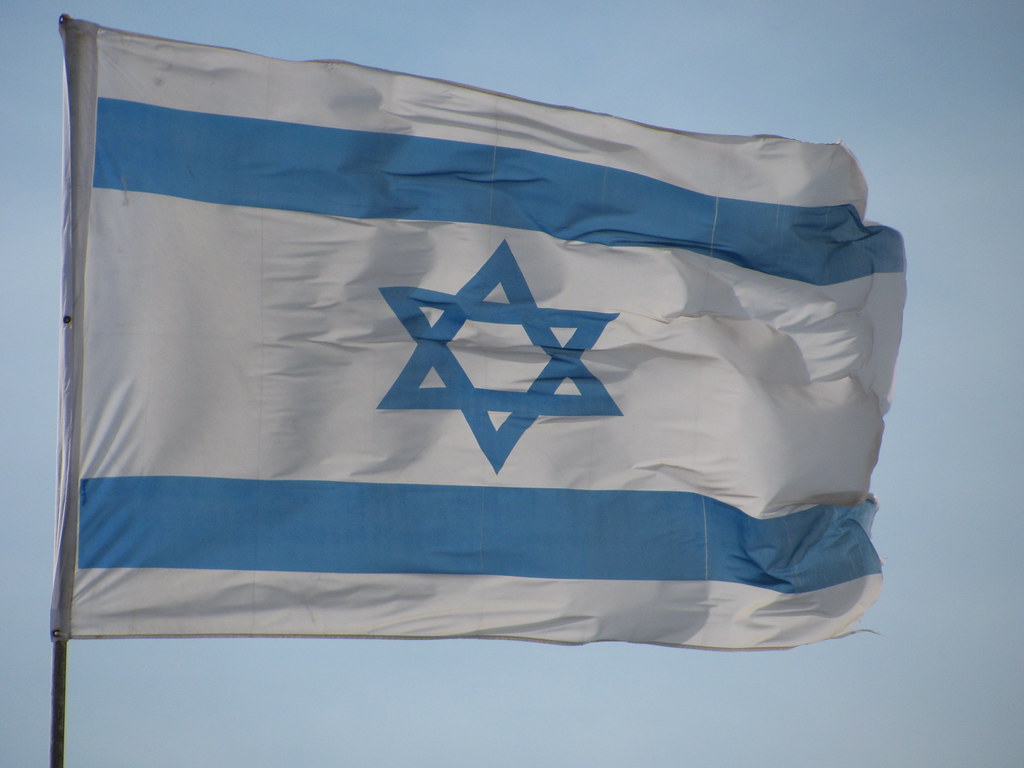
“Israeli flag, Tel Aviv, Star of David” by Tim Pearce, Los Gatos is licensed under CC BY 2.0 
 .
.
It is almost impossible to find a dispassionate analysis of the Israeli-Arab conflict, simply because it sits directly upon a concatenation of ethno-religious fault lines. Palestinians are the object of concern for many of the world’s nearly two billion Muslims, particularly in the Arab world, who tend to view Gaza’s suffering and humiliation as their own. Israel, on the other hand, is a subject of rare agreement between American evangelicals (who believe that the nation state of Israel has relevance to Armageddon and the fate of Christianity) and the more secular American governing blob, which treats Israel as an American outpost in the Levant. To this, we can add the emerging religion of anti-colonialism, which views Palestine as something like the next great liberation project, akin to ending apartheid in South Africa or Gandhi’s campaign for Indian independence.
My goal is not to convince any of the aforementioned people that their views are wrong, per se. Instead, I would like to argue that, despite these many powerful emotional-religious currents, much of the Israeli-Arab conflict can be understood in fairly mundane geopolitical terms. Despite the enormous psychological stakes that billions of people have in the subject matter, it still unfolds itself to a relatively dispassionate analysis.
The root of the problems lay in the peculiar nature of the Israeli state. Israel is not a normal country. By this, I mean neither that it is a special, providential country (as an American evangelical might say), nor that it is a uniquely wicked root of all evil. Rather, it is extraordinary in two important ways that relate to its function and geopolitical calculus, rather than its moral content.
First, Israel is an Eschatological Garrison State. This is a particular form of state which perceives itself as a sort of redoubt against the end of all things, and accordingly becomes highly militarized and highly willing to dispense military force. Israel is not the only such state to have existed in history, but it is the only obvious one extant today.
A historical comparison may help explain. In 1453, when the Ottoman Empire at last overran Constantinople and brought an end to the millennia-old Roman imperium, early medieval Russia found itself in a unique position. With the fall of the Byzantines (and the previous schism with western papal Christianity), Russia was now the only Orthodox Christian power remaining in the world. This fact created a sense of world-historic religious siege. Surrounded on all sides by Islam, Roman Catholicism, and Turko-Mongol Khanates, Russia became a prototypical Eschatological Garrison State, with a high degree of cooperation between Church and State and an extraordinary level of military mobilization. The character of the Russian state was indelibly formed by this sense of being besieged, of being the last redoubt of authentic Christianity, and the consequent need to extract a high volume of manpower and taxes to defend the garrison state.
Israel is much the same, though its sense of eschatological terror is of a more ethno-religious sort. Israel is the only Jewish state in the world, founded in the shadow of Auschwitz, besieged on all sides by states with which it has fought several wars. Whether this justifies the kinetic aspects of Israeli foreign policy is not the point. The simple fact is that this is Israel’s innate self conception. It is an eschatological redoubt for a Jewish population that sees itself as having nowhere else to go. If one refuses to acknowledge the central Israeli geopolitical premise — that they would do anything to avoid a return to Auschwitz — one will never make sense of their actions.
Artillery! A WW2 Special
World War Two
Published 14 Feb 2024The modern artillery of the Great War was responsible for the vast majority of military deaths in that conflict, but how has artillery developed from that war to this one? Today we take a look at some of the artillery of WW2.
(more…)
The Big Picture – NATO: Partners in Peace (1954)
Army University Press
Published Nov 13, 2023NATO: Partners in Peace follows the creation and impact of the North Atlantic Treaty Organization (NATO). Created in April 1949 with twelve founding members, this organization’s goal was to protect the inherent rights of individual states through collective defense. In this episode from The Big Picture series, General Dwight D. Eisenhower offers a speech before he deploys to Europe to become the first Supreme Allied Commander Europe (SACEUR). This is followed with footage of the buildup and training of European forces. Once Eisenhower leaves NATO to campaign for the presidency, General Matthew Ridgway replaces him as NATO commander. One significant problem NATO forces faced was the fact that each nation had its own weapon systems and ammunition, an issue the U.S. wanted to address with the standardization of the 7.62mm cartridge. Perhaps as a deterrent to the Soviet Union, NATO: Partners in Peace depicts new weapons that could be used against a large enemy force such as remote-controlled missiles, napalm bombs, and the massive atomic cannon.
February 14, 2024
Soviet World War Two Swords? The M1927 Shashka
Cossack forces have long been a key cavalry element of the Russian military, and this did not change during the Soviet era. The Cossacks had their own rather distinctive style of sword, the shashka, and the Red Army maintained the tradition of issuing them to Cossack cavalry troopers. In 1927, a new pattern was adopted, and it was produced and issued from 1928 until 1946. The shashka has a slightly curved, single-edged blade and no handguard. The model 1927 military type was initially made with a rather decorative pommel, but this was simplified to just a plain 5-pointed star as German advances into Russia really stressed Soviet industrial production. However, production and issue of the shashka continued uninterrupted throughout the war.
Originally there were separate trooper and officer versions of the model 1927, with the trooper version including the ability to stow the trooper’s Mosin-Nagant rifle bayonet on the side of the shaskha scabbard. As cavalry, the Cossacks were not expected to carry their rifles with bayonets fixed, and this served in lieu of a bayonet sheath. By 1944 this feature was omitted, as the M91/30 was replaced by the M38 and M44 carbines and submachine guns, which did not use bayonets.
The decorations returned to the M1927 shashka in 1945, with a series made for the Victory Day parade celebrating the defeat of Germany. Today’s example is one of these, and in beautiful condition.
QotD: Judging historical figures’ actions
You can’t judge people on actions they didn’t know were wrong, or on things that were hidden from them, which only time has revealed. Or rather, you can, but it’s deranged. What you are holding people guilty of is not being psychic. Not being able to foretell the future. Well, none of us can. Not with any accuracy, and never about things we want to. (Yeah, sometimes I get something like glimpses, but seriously? Do you see me among the lottery winners? No? That’s because I can’t see the future in a significant way.) Go ahead and despise people for that failing, but be aware you’re being deranged.
Also, unlike the people on the left, most of us are aware we, ourselves, are not infallible, and our time is not the pinnacle of knowledge and morality. Things that seem right to us now — or at least not markedly wrong — can and will be reviled by future lovers of liberty.
Sarah Hoyt, “In Their Time”, According to Hoyt, 2023-11-07.
February 13, 2024
“I am a proud member of the Airfix generation”
I didn’t realize that Peter Caddick-Adams is the same age as me, but it does seem that our interests pretty much ran parallel for a while:
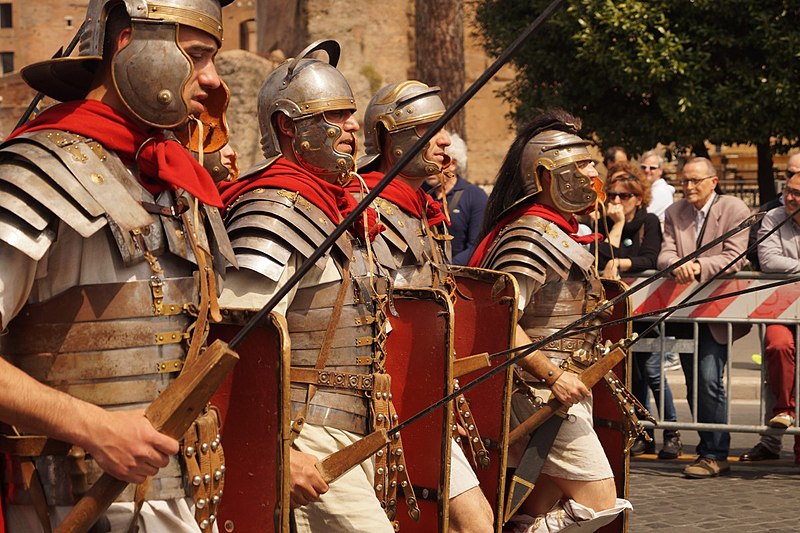
Re-enactors in Roman legionary gear, 19 May, 2021.
Original photo from https://pxhere.com/en/photo/883133 via Wikimedia Commons.
I am a proud member of the Airfix generation. The desire (less so the ability) to assemble and paint plastic model kits of aircraft, tanks and ships hit me squarely between the eyes on my tenth birthday in 1970. Several aunts and uncles had arrived at the same solution to bring out my inner Spitfire on the same day. Who needed the high of polystyrene cement and Humbrol enamel when you could refight D-Day across your bedroom floor with kits costing as little as 1/6d? Although Airfix was the premium producer of scale kits, other competing brands included Frog, Tamiya, Monogram, Hasegawa and Revell. I wish I knew what I did with them all, but many of the aircraft I recall casting out of upstairs windows, set on fire by match and candle. Looking back, I can see how it sewed the seeds of my becoming a professional military historian decades later. From little acorns, eh?
Two years later, I discovered I was interested in anything historical when my parents packed us into a train (great excitement in itself) for a trip to London. Although long past the days of steam, I can remember my father walking me down to thank the engine driver for getting us safely into Euston and then the true adventure began. The arrival at the British Museum to see the Tutankhamun Exhibition, which ran from March to December 1972. When it ended, besides the young Caddick-Adams, 1.6 million visitors had passed through the exhibition doors, making it the most popular attraction in the museum’s history. My favourite art class activity thereafter altered from drawing Spitfires and Messerschmitts chasing each other across every page to depicting ghostly, golden burial masks. Ever since, I have held an unbelievably soft spot for the old BM, always remembering that due to its vastness, it is best to go there to see something specific, rather than wander hither and thither, lost in its many treasures.
Then in 1977, when studying Ancient History for “A” Level, it was the turn of the Royal Academy in Piccadilly to capture my imagination with its Pompeii AD 79 exhibition. Mosaics, personal possessions, wall paintings and plaster casts of Romans and their animals caught in the moment of death as toxic gases, ashes, molten rock and pulverized pumice froze them forever, like insects in amber, likewise left a profound mark on my understanding of the bigger wheels of history.
The other day I was more than happy to be reunited with my old friend, the British Museum, this time hosting another Roman exhibition, which promises to be every bit as impactful as the Tutankhamun and Pompeii antecedents. Just unveiled, Legion: Life in the Roman Army is an inspired portrayal of an institution which numbered around 450,000 at its peak in AD 211 (33 legions and c. 400 auxiliary regiments), although numbers always fluctuated. The first amazing realisation is how little archaeological evidence remains of this vast organisation that endured for many centuries. The second is how well the scanty remnants in this exhibition have been preserved and interpreted.
Here, the British Museum has assembled the best surviving examples of arms, armour and personal possessions from collections around the world, in over 200 artefacts from 28 lenders. Though we view gleaming bronze helmets, swords long-rusted into scabbards, a pile of near-fossilised chainmail, it is incredible to think that there is only one intact example remaining of all those hundreds of thousands of rectangular and curved legionary shields (called a scutum), still bearing its decoration and crimson dye. This one comes from Syria.
There are some fine funerary carvings of Roman officers from around the empire, then we encounter some of the battlefield detritus including breastplate armour found near Kalkriese, in the Teutoburgerwald of Lower Saxony. This is where a coalition of Germanic tribes led by a rebel chieftain called Arminius ambushed 3 legions led by Publius Quinctilius Varus in 9 AD. The story of discovering this battle terrain was as dramatic as the assault itself. It was the result of a meticulous British soldier who combed an area north of his base at Osnabrück with a metal detector in 1987. Major Tony Clunn recorded each discovery of Roman coins and sling shot, making it possible to reconstruct the route taken by Roman legionaries under Varus and determine where they were ambushed and massacred.
Greek History and Civilisation, Part 2 – Sparta and Athens: Contrasting Societies
seangabb
Published Feb 11, 2024This second lecture in the course contrasts Athens and Sparta, the two leading societies in Greece — one a commercial society with high levels of personal freedom and citizen participation, the other a militarised oligarchy.
[NR: Some additional information to supplement Dr. Gabb’s lecture:
– “Citizenship” in the ancient and clasical world
– Sparta had Lycurgus, while Athens had Solon … who at least actually existed
– The Constitution of Athens
– The Constitution of the Spartans
– The Myth of Spartan Equality
– Relative wealth among the Spartiates
– Sparta’s military reputation as “the best warriors in all of Greece”
– Sparta – the North Korea of the Classical era
– Spartan glossary]
(more…)


