
Adrian Goldsworthy. Historian and Novelist
Published 15 Apr 2026Today we return to a familiar theme — the Punic Wars between Rome and Carthage. This video is meant as an overview of all three wars, rather than just the Second Punic War which is the most famous and involved Hannibal and Scipio and the like. We think about the context of the wars and also how they played out. A particular focus is the significance of big battles, whether on land or on sea. Clearly these mattered, but how much did the matter and how common were they?
September 28, 2026
The Punic Wars – An Overview
July 27, 2026
The Total Erasure of Carthage | Part Four
The Rest Is History
Published 12 Feb 2026Three decades after the defeat of Hannibal, how had the Roman Empire managed to conquer vast swathes of the known world? Why did the predatory eyes of this terrifying behemoth turn once more to Carthage? And, could this mighty city defy the odds and repel Rome one last time …?
Join Tom and Dominic as they reach the climactic, final phase of the Punic Wars; the greatest military struggle of all ancient history.
(more…)
Comments Off on The Total Erasure of Carthage | Part Four
July 19, 2026
Rome’s Greatest Enemy: Bloodbath in Africa | EP 3
The Rest Is History
Published 9 Feb 2026Would the Roman general Publius Cornelius Scipio successfully march on Africa? What happened when Hannibal and Scipio — the greatest commanders of their age — came head to head at the Battle of Zama, in the ultimate showdown? And, what would be the fate of these two titans of the ancient world?
Join Tom and Dominic, as they discuss the Roman Republic’s audacious invasion of North Africa under the leadership of the dashing Scipio, and his clash with Hannibal.
00:00 Scipio’s night attack in Numidia
02:16 Hannibal as a commander
08:07 The rise of Scipio Africanus
13:05 The Roman invasion of Africa begins
21:56 The Battle of the Great Plains
25:29 Hannibal recalled from Italy
28:18 Preparing for the final showdown
33:02 The Battle of Zama begins
36:03 Could Hannibal have won?
40:25 Hannibal urges acceptance of defeat
42:40 Hannibal as a civilian reformer
44:22 Scipio after the war
46:45 Cato’s rise and the conservative backlash
49:29 Rome turns east after victory
52:32 The Hellenistic world after Alexander
56:45 Hannibal and Scipio compare great generals
58:31 Rome defeats Antiochus
1:00:18 Hannibal’s final flight and death
1:01:40 Scipio’s death and exile
(more…)
Comments Off on Rome’s Greatest Enemy: Bloodbath in Africa | EP 3
July 12, 2026
How Rome’s Survival Came Down To One 25-Year-Old General – The Second Punic War | EP 2
The Rest Is History
Published 5 Feb 2026What happened at the Battle of Ibera, a totemic though overlooked battle of the Punic Wars? With the forces of Carthage closing in on a depleted Rome, would a young Roman, Publius Cornelius Scipio resurrect the fortunes of the Republic? And, could he destroy Carthage’s most crucial power base in Europe?
Join Tom and Dominic, as they discuss this next phase of the Carthaginian Wars.
00:00 Intro: Rome’s “darkest hour” + Scipio teased as the Republic’s saviour
02:26 206 BC, Atlantic coast of Iberia
04:26 What’s “up” with Scipio?
12:05 Spain as hostile “sci-fi planet”
15:30 New Carthage (Cartagena)
18:09 215 BC crisis: Hasdrubal tries to march north
19:14 Battle of the Ebro
21:25 “Two rival pairs of brothers”
24:48 Rome’s commander problem
30:36 Scipio’s bold plan
31:37 New Carthage targeted
34:57 Sack of New Carthage
39:01 Hasdrubal crosses the Alps with elephants
39:59 Italy’s crisis for Rome
44:05 Battle by the Metaurus
47:23 Ilipa (206): Scipio crushes Mago and breaks Carthage’s Spanish power
49:52 Mago’s last throws
52:14 Scipio returns to Rome as a superstar
53:05 Senate authorises Africa invasion
(more…)
Comments Off on How Rome’s Survival Came Down To One 25-Year-Old General – The Second Punic War | EP 2
July 7, 2026
Carthage at the Gates – The Second Punic War | EP 1
The Rest Is History
Published 2 Feb 2026Our whole series on Rome vs Carthage can be found here: • Rome Vs Carthage
[NR: Last year’s animated episode on Cannae is here — The Bloody Battle of Cannae]
Did Hannibal march on Rome after his legendary victory at the Battle of Cannae in 216 BC? How could Rome fight on after losing so many men? And, where would their next cataclysmic clash take place …?
Join Tom and Dominic, as they discuss the beginning of the end for the once mighty city of Carthage, and her masterful general, Hannibal Barca.
00:00 Cold open
02:02 After Cannae
05:20 Carthage vs Rome: the long backstory
12:44 The Barcid dynasty
15:37 Hannibal’s invasion route
18:37 Why Hannibal doesn’t march on Rome
21:30 Roman morale collapse (and recovery)
25:01 Rome’s “Lord Halifax moment” that never happens
28:00 Fabius Maximus takes control
31:06 Early heroes and hard choices
33:39 The Fabian strategy returns
34:26 Italy fractures
36:10 The Capua turning point
37:07 “Hannibal at the gates”
39:40 The war becomes a stalemate
43:08 Syracuse at its peak
50:14 Archimedes’ war machines
51:15 Syracuse switches sides
52:06 Marcellus besieges Syracuse
56:20 The fall of Syracuse
57:25 Death of Archimedes
58:40 What Syracuse means for the wider war
(more…)
Comments Off on Carthage at the Gates – The Second Punic War | EP 1
June 26, 2025
A Basic Explanation Of The First Punic War
MoAn Inc.
Published 8 Jan 2025GEOGRAPHY NOTES
Messina is the modern name for Messana. Both are correct.
Acragas / Akragas was renamed as Agrigentum by the Romans. Most videos on YouTube use the name Agrigentum for convenience purposes … so again, both are correct.
Panormus is modern day Palermo.
Drepana / Drepanum is modern day Trapani.
Lilybaeum is modern day Marsala.!READ THE SOURCES FOR FREE!
Livy: https://www.perseus.tufts.edu/hopper/…
Polybius: https://www.perseus.tufts.edu/hopper/…
Cassius Dio: https://www.perseus.tufts.edu/hopper/…
(more…)
Comments Off on A Basic Explanation Of The First Punic War
January 10, 2025
Rome – Part 6, The Second Punic War, 218-201 BC
seangabb
Published 22 Aug 2024This course provides an exploration of Rome’s formative years, its rise to power in the Mediterranean, and the exceptional challenges it faced during the wars with Carthage.
Lecture 6: The Second Punic War (218-201 BC)
• Carthaginian Expansion into Spain
• Hannibal Takes Over in Spain – War Declared
• Hannibal and the Invasion of Italy
• The Three Shattering Defeats
• Roman Strategy for Victory
• Compete and Overwhelming Roman Victory
• Rome Emerges as the Mediterranean Superpower
(more…)
Comments Off on Rome – Part 6, The Second Punic War, 218-201 BC
December 11, 2024
Rome: Part 5 – Between Two Wars, 241-218 BC
seangabb
Published Jul 21, 2024This course provides an exploration of Rome’s formative years, its rise to power in the Mediterranean, and the exceptional challenges it faced during the wars with Carthage.
Lecture 5: Between Two Wars (241-218 BC)
• Carthage after the First Punic War
• Carthaginian Expansion into Spain
• Rome and the East
• Rome and the Gauls
• The Emergence of Hannibal
• The Outbreak of the Second Punic War
(more…)
Comments Off on Rome: Part 5 – Between Two Wars, 241-218 BC
July 17, 2024
Re:View – The First Punic War
Invicta
Published Apr 4, 2024A parody Re:View episode from @RedLetterMedia on the First Punic War! Mike and Rich react to watching the events of Rome and Carthage’s great wars for the first time.
This video was a work of love which pays homage to some of my favorite RLM quotes from the following episodes:
Best of the Worst: Hawk Jones, Winterbeast, and ROAR
Best of the Worst: Twin Dragon Encounter, American Rickshaw, and Infested
Half in the Bag Episode 43: The Hobbit: An Unexpected Journey
Half in the Bag Episode 63: The Hobbit: The Desolation of Smaug
Half in the Bag Episode 81: The Hobbit: The Battle of the Five Armies
Half in the Bag: Indiana Jones and the Dial of Destiny
Half in the Bag: Rogue One
Half in the Bag: The 70-Minute Rise of Skywalker Review
Star Trek Discovery (Pilot Episodes) – re:View
Star Trek Discovery Season 1 – re:View
Star Trek Discovery Season 2 – re:View
Star Trek: Galaxy – re:View
Star Trek: Picard Episodes 4 and 5 – re:View
Star Trek: Picard Episodes 6, 7 and 8 – re:View
Starship Troopers – re:View
The Good, The Bad and the Ugly – re:ViewTimestamps:
00:00 Intro
03:05 Backstory
08:13 Outbreak of War
10:53 War at Sea
13:45 Battle of Ecnomus
15:42 Invasion of Africa
17:31 Climax
20:35 Outro
(more…)
Comments Off on Re:View – The First Punic War
July 6, 2024
QotD: The Roman Republic at war … many wars … many simultaneous wars
With the end of the Third Samnite War in 290 and the Pyrrhic War in 275, Rome’s dominance of Italy and the alliance system it constructed was effectively complete. This was terribly important because the century that would follow, stretching from the start of the First Punic War in 264 to the end of the Third Macedonian War in 168 (one could argue perhaps even to the fall of Numantia in 133) put the Roman military system and the alliance that underpinned it to a long series of sore tests. This isn’t the place for a detailed recounting of the wars of this period, but in brief, Rome would fight major wars with three of the four other Mediterranean great powers: Carthage (264-241, 218-201, 149-146), Antigonid Macedon (214-205, 200-196, 172-168, 150-148) and the Seleucid Empire (192-188), while at the same time engaged in a long series of often quite serious wars against non-state peoples in Cisalpine Gaul (modern north Italy) and Spain, among others. It was a century of iron and blood that tested the Roman system to the breaking point.
It certainly cannot be said of this period that the Romans always won the battles (though they won more than their fair share, they also lost some very major ones quite badly) or that they always had the best generals (though, again, they tended to fare better than average in this department). Things did not always go their way; whole armies were lost in disastrous battles, whole fleets dashed apart in storms. Rome came very close at points to defeat; in 242, the Roman treasury was bankrupt and their last fleet financed privately for lack of funds (Plb. 1.59.6-7). During the Second Punic War, at one point the Roman censors checked the census records of every Roman citizen liable for conscription and found only 2,000 men of prime military age (out of perhaps 200,000 or so; Taylor (2020), 27-41 has a discussion of the various reconstructions of Roman census figures here) who hadn’t served in just the previous four years (Liv. 24.18.8-9). In essence the Romans had drafted everyone who could be drafted (and the 2,000 remainders were stripped of citizenship on the almost certainly correct assumption that the only way to not have been drafted in those four years but also not have a recorded exemption was intentional draft-dodging).
And the military demands made on Roman armies and resources were exceptional. Roman forces operated as far east as Anatolia and as far west as Spain at the same time. Livy, who records the disposition of Roman forces on a year-for-year basis during much of this period (we are uncommonly well informed about the back half of the period because those books of Livy mostly survive), presents some truly preposterous Roman dispositions. Brunt (Italian Manpower (1971), 422) figures that the Romans must have had something like 225,000 men under arms (Romans and socii) each year between 214 and 212, immediately following a series of three crushing defeats in which the Romans probably lost close to 80,000 men. I want to put that figure in perspective for a moment: Alexander the Great invaded the entire Persian Empire with an army of 43,000 infantry and 5,500 cavalry. The Romans, having lost close to Alexander’s entire invasion force twice over, immediately raised more than four times as many men and kept fighting.
These armies were split between a bewildering array of fronts (e.g. Liv 24.10 or 25.3): multiple armies in southern Italy (against Hannibal and rebellious socii now supporting him), northern Italy (against the Cisalpine Gauls, who also backed Hannibal) and Sicily (where Syracuse threatened revolt) and Spain (a Carthaginian possession) and Illyria (fighting the Antigonids) and with fleets active in both the Adriatic and Tyrrhenian Sea supporting those operations. And of course a force defending Rome itself because did I mention Hannibal was in Italy?
If you will pardon me embellishing a Babylon 5 quote, “Only an idiot fights a war on two fronts. Only the heir to the throne of the kingdom of idiots would fight a war on twelve fronts.” And apparently, only the Romans would then win that war anyway.
(I should note that, for those interested in reading up on this, the state-of-the-art account of Rome’s ability to marshal these truly incredible amounts of resources and especially men is the aforementioned, M. Taylor, Soldiers & Silver (2020), which presents the consensus position of scholars better than anything else out there. I’d be remiss if I didn’t note that my own book project takes aim at this consensus and hopes to overturn parts of it, but seeing as how my book isn’t done, for now Taylor holds the field (also it’s a good book which is why I recommended it)).
Bret Devereaux, “Collections: The Queen’s Latin or Who Were the Romans, Part II: Citizens and Allies”, A Collection of Unmitigated Pedantry, 2021-06-25.
Comments Off on QotD: The Roman Republic at war … many wars … many simultaneous wars
March 5, 2024
The 1st Punic War – Corvus, Rams and Drachma
Drachinifel
Published Sep 13, 2023Today we take a look at the strategy and shipping of the 1st Punic War with expert Bret Devereaux!
(more…)
Comments Off on The 1st Punic War – Corvus, Rams and Drachma
February 26, 2024
Rome: Part 4 – The First Punic War 264-241 BC
seangabb
Published Feb 25, 2024This course provides an exploration of Rome’s formative years, its rise to power in the Mediterranean, and the exceptional challenges it faced during the wars with Carthage.
• Growth of Tensions between Rival Powers
• Differences of Civilisation
• The Outbreak of War
• The Course of War
• Growth of Roman Sea Power
• The End and Significance of the War
(more…)
Comments Off on Rome: Part 4 – The First Punic War 264-241 BC
January 12, 2024
QotD: Rome’s Italic “allies”
The simple (and perhaps now increasingly dated) way I explain this to my students is that Rome follows the Goku Model of Imperialism: I beat you, therefore we are now friends. Defeated communities in Italy (the system is different outside of Italy) are made to join Rome’s alliance network as socii (“allies”), do not have tribute imposed on them, but must supply their soldiers to fight with Rome when Rome is at war, which is always.
It actually doesn’t matter for us how this expansion was accomplished; rather we’re interested in the sort of order the Romans set up when they did expand. The basic blueprint for how Rome interacted with the Italians may have emerged as early as 493 with the Foedus Cassianum, a peace treaty which ended a war between Rome and [the] Latin League (an alliance of ethnically Latin cities in Latium). To simplify quite a lot, the Roman “deal” with the communities of Italy which one by one came under Roman power went as follows:
- All subject communities in Italy became socii (“allies”). This was true if Rome actually intervened to help you as your ally, or if Rome intervened against you and conquered your community.
- The socii retained substantial internal autonomy (they kept their own laws, religions, language and customs), but could have no foreign policy except their alliance with Rome.
- Whenever Rome went to war, the socii were required to send soldiers to assist Rome’s armies; the number of socii in Rome’s armies ranged from around half to perhaps as much as two thirds at some points (though the socii outnumbered the Romans in Italy about 3-to-1 in 225, so the Romans made more strenuous manpower demands on themselves than their allies).
- Rome didn’t impose tribute on the socii, though the socii bore the cost of raising and paying their detachments of troops in war (except for food, which the Romans paid for, Plb. 6.39.14).
- Rome goes to war every year.
- No, seriously. Every. Year. From 509 to 31BC, the only exception was 241-235. That’s it. Six years of peace in 478 years of republic. The socii do not seem to have minded very much; they seem to have generally been as bellicose as the Romans and anyway …
- The spoils of Roman victory were split between Rome and the socii. Consequently, as one scholar memorably put it, the Roman alliance was akin to, “a criminal operation which compensates its victims by enrolling them in the gang and inviting them to share to proceeds of future robberies” (T. Cornell, The Beginnings of Rome (1995)).
- The alliance system included a ladder of potential relationships with Rome which the Romans might offer to loyal allies.
Now this isn’t a place for a long discussion of the Roman alliance system in Italy (that place is in the book I am writing), so I want us to focus more narrowly on the bolded points here and how they add up to significant changes in who counted as “Roman” over time. But I should note here that while I am calling this a Roman “alliance system” (because the Romans call these fellows socii, allies) this was by no means an equal arrangement: Rome declared the wars, commanded the armies and set the quotas for military service. The “allies” were thus allies in name only, but in practice subjects; nevertheless the Roman insistence on calling them allies and retaining the polite fiction that they were junior partners rather than subject communities, by doing things like sharing the loot and glory of victory, was a major contributor to Roman success (as we’ll see).
First, the Roman alliance system was split into what were essentially tiers of status. At the top were Roman citizens optimo iure (“full rights”, literally “with the best right”) often referred to on a community basis as civitas cum suffragio (“citizenship with the vote”). These were folks with the full benefits of Roman citizenship and the innermost core of the Roman polity, who could vote and (in theory, though for people of modest means, only in theory) run for office. Next were citizens non optimo iure, often referred to as having civitas sine suffragio (“citizenship without the vote”); they had all of the rights of Roman citizens except for political participation in Rome. This was almost always because they lived in communities well outside the city of Rome with their own local government (where they could vote); we’ll talk about how you get those communities in a second. That said, citizens without the vote still had the right to hold property in Roman territory and conduct business with the full protection of a Roman citizen (ius commercii) and the right to contract legal marriages with Roman citizens (ius conubii). They could do everything except for vote or run for offices in Rome itself.
Next down on the list were socii (allies) of Latin status (note this is a legal status and is entirely disconnected from Latin ethnicity; by the end of this post, Rome is going to be block-granting Latin status to Gauls in Cisalpine Gaul, for instance). Allies of Latin status got the benefits of the ius commercii, as well as the ability to move from one community with Latin status to another without losing their status. Unlike the citizens without the vote, they didn’t automatically get the right to contract legal marriages with Roman citizens, but in some cases the Romans granted that right to either individuals or entire communities (scholars differ on exactly how frequently those with Latin status would have conubium with Roman citizens; the traditional view is that this was a standard perk of Latin status, but see Roselaar, op. cit.). That said, the advantages of this status were considerable – particularly the ability to conduct business under Roman law rather than what the Romans called the “ius gentium” (“law of peoples”) which governed relations with foreigners (peregrini in Roman legal terms) and were less favorable (although free foreigners in Rome had somewhat better protections, on the whole, than free foreigners – like metics – in a Greek polis).
Finally, you had the socii who lacked these bells and whistles. That said, because their communities were allies of Rome in Italy (this system is not exported overseas), they were immune to tribute, Roman magistrates couldn’t make war on them and Roman armies would protect them in war – so they were still better off than a community that was purely of peregrini (or a community within one of Rome’s provinces; Italy was not a province, to be clear).
The key to this system is that socii who stayed loyal to Rome and dutifully supplied troops could be “upgraded” for their service, though in at least some cases, we know that socii opted not to accept Roman citizenship but instead chose to keep their status as their own community (the famous example of this were the allied soldiers of Praenesti, who refused Roman citizenship in 211, Liv. 23.20.2). Consequently, whole communities might inch closer to becoming Romans as a consequence of long service as Rome’s “allies” (most of whom, we must stress, were at one point or another, Rome’s Italian enemies who had been defeated and incorporated into Rome’s Italian alliance system).
But I mentioned spoils and everyone loves loot. When Rome beat you, in the moment after you lost, but before the Goku Model of Imperialism kicked in and you became friends, the Romans took your stuff. This might mean they very literally sacked your town and carried off objects of value, but it also – and for us more importantly – meant that the Romans seized land. That land would be added to the ager Romanus (the body of land in Italy held by Rome directly rather than belonging to one of Rome’s allies). But of course that land might be very far away from Rome which posed a problem – Rome was, after all, effectively a city-state; the whole point of having the socii-system is that Rome lacked both the means and the desire to directly govern far away communities. But the Romans didn’t want this land to stay vacant – they need the land to be full of farmers liable for conscription into Rome’s armies (there was a minimum property requirement for military service because you needed to be able to buy your own weapons so they had to be freeholding farmers, not enslaved workers). By the by, you can actually understand most of Rome’s decisions inside Italy if you just assume that the main objective of Roman aristocrats is to get bigger armies so they can win bigger battles and so burnish their political credentials back in Rome – that, and not general altruism (of which the Romans had fairly little), was the reason for Rome’s relatively generous alliance system.
The solution was for Rome to essentially plant little Mini-Me versions of itself on that newly taken land. This had some major advantages: first, it put farmers on that land who would be liable for conscription (typically placing them in carefully measured farming plots through a process known as centuriation), either as socii or as Roman citizens (typically without the vote). Second, it planted a loyal community in recently conquered territory which could act as a position of Roman control; notably, no Latin colony of this sort rebelled against Rome during the Second Punic War when Hannibal tried to get as many of the socii to cast off the Romans as he could.
What is important for what we are doing here is to note that the socii seem to have been permitted to contribute to the initial groups settling in these colonies and that these colonies were much more tightly tied to Rome, often having conubium – that right of intermarriage again – with Roman citizens. The consequence of this is that, by the late third century (when Rome is going to fight Carthage) the ager Romanus – the territory of Rome itself – comprises a big chunk of central Italy […] but the people who lived there as Roman citizens (with and without the vote) were not simply descendants of that initial Roman citizen body, but also a mix of people descended from communities of socii throughout Italy.
Bret Devereaux, “Collections: The Queen’s Latin or Who Were the Romans, Part II: Citizens and Allies”, A Collection of Unmitigated Pedantry, 2021-06-25.
Comments Off on QotD: Rome’s Italic “allies”
February 16, 2022
Roman Republic to Empire 02 The Carthaginian Curse
seangabb
Published 5 Feb 2021[Update 2023-03-02 – Dr. Gabb took down the original posts and re-uploaded them.]
Here is the second lecture, which describes the vindictive treatment of Hannibal and Carthage, and explains this in terms of how the Second Punic War destabilised both Italy and the Roman Constutition. Between January and March 2021, Sean Gabb explored this transformation with his students. Here is one of his lectures. All student contributions have been removed.
(more…)
Comments Off on Roman Republic to Empire 02 The Carthaginian Curse
August 10, 2020
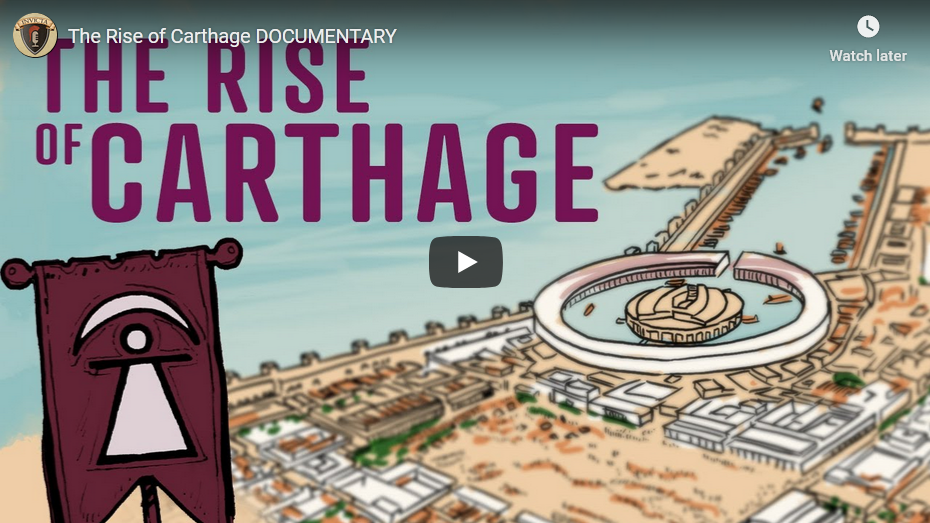
The Rise of Carthage
Invicta
Published 13 Mar 2020Support the channel by downloading Rise of Kingdoms: http://patron.me/Invicta, New users can use the code
seyfpw6fxuand claim these prizes: GEM 200, Silver Key x2, 50000 Food x2, 50000 Wood x2Today Carthage is remembered only in the context of its dramatic fall at the end of the Punic Wars between Rome and Carthage. We all know about Hannibal and the Battle of Cannae but how about the daily life of Carthage. There is much more to this ancient civilization than the dust and ashes left to us by history. Today we will be exploring the Rise of Carthage and dive into the fascinating details of their civilization.
The history documentary begins by covering the ancient Phoenicians who planted colonies across the Mediterranean. Carthage emerged from this trade network to become the leader of the Phoenicians in the west and eventually come to forge an empire when its mother colony Tyre declined. The history documentary then turns to cover the government, economy, culture, and military of ancient Carthage.
Sources and Suggested Reading:
Carthage: A History by Serge Lancel
The Carthaginians by Dexter Hoyos
Carthage’s Other Wars by Dexter Hoyos
Carthage Must be Destroyed by Richard Miles#History
#Documentary
#Carthage
Comments Off on The Rise of Carthage


