
Forgotten Weapons
Published Nov 29, 2023The Maxim Gun was the first successful true machine gun, and it became extremely popular worldwide. Maxim sent his first two working models to Enfield for testing in 1887, and by 1889 he had what he termed the “World Standard” model. No two contracts were quite identical, as the gun was constantly being tweaked and improved, but the 200 guns sold to Argentina in 1895 (50), 1898 (130) and 1902 (20) are a great time capsule into the configuration of the early Maxim guns in military service.
The Argentine Maxims had gorgeous brass jackets, along with ball grips, triggers, feed blocks, and fusee spring covers. The have the early 1889 pattern lock, complete with a walnut roller to assist belt feeding into the action. These guns were in Argentine military service until 1929 (which included a retrofit at DWM in 1909 to use the new Spitzer 7.65mm Mauser cartridge). They then passed into police use until 1956, and 91 were sold to Sam Cummings of InterArms in 1960. Of those, 8 were exported out of the US, 28 went to government agencies and museums, and the remaining 55 were sold onto the US collector market. They are the single largest group of early Maxims in the country today, and make fantastic collectors’ pieces.
(more…)
March 3, 2024
Argentine Brass Maxim: A Machine Gun of the Steampunk Age
March 2, 2024
Brian Mulroney, RIP
In a guest post at Paul Wells’ Substack, Ian Brodie describes former Prime Minister Brian Mulroney’s role in ending the Cold War:
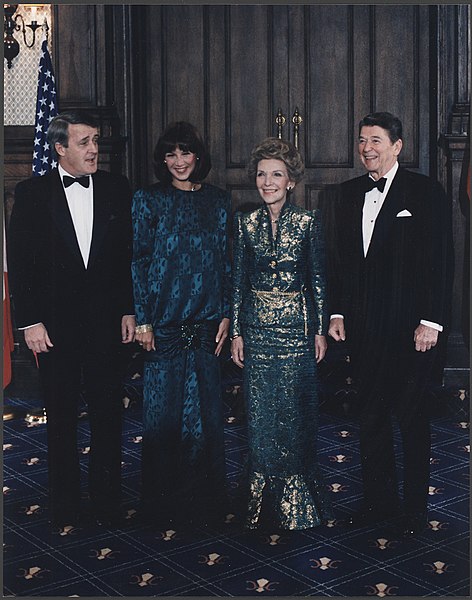
Prime Minister Brian Mulroney, Mila Mulroney, Nancy Reagan, and President Ronald Reagan at the “Shamrock Summit”, 18 March, 1985.
Photo from the Ronald Reagan Presidential Library via Wikimedia Commons.
Mulroney’s role has long been poo-poohed by intellectuals on the Canadian left. He was said to have an unhealthy obsession with pleasing the Americans. As a young boy, his fine voice won him an opportunity to entertain visiting American executives with a song. Amateur psychologists diagnosed a disturbing link between Mulroney’s having grown up in a company town, under the shadow of a US owned mill, and his reinvigoration of St. Laurent’s post-war grand strategy.
Mulroney never automatically fell in with US positions on the global issues of the day. His opposition to the apartheid regime in South Africa ran counter to the positions of both Reagan and Thatcher. But he drove the effort to link the American and Canadian economies through the free trade agreement. He backed our allies in the strategic competition with the Soviet bloc. And in helping to create the International Democratic Union, he helped put the west’s centre-right parties on the side of international political cooperation on the side of democracy, liberty, and the rule of law. The contrast with an earlier prime minister who could not bring himself to condemn the declaration of martial law in Poland a few years earlier was clear.
His personal relationships with a generation of American leaders gave substance to the transactional successes. As the Soviet Union came apart, he secured a spot for Canada as the first NATO country to recognize Ukraine’s independence and bolstered the independence movements of the Baltic republics. When Iraq tried to establish a precedent that, following the Cold War, large, powerful countries could invade their neighbours with impunity, Mulroney backed the US led coalition to liberate Kuwait with all the diplomatic and military power he had on hand.
And along the way, he so closely befriended both Reagan and the first Bush that he was given a privileged platform at two US state funerals, an honour never extended to a Canadian leader before and unlikely to be extended to one again soon.
Mulroney deserves to be remembered along with St. Laurent as Canada’s grand strategist of the 20th century. A trusted confidant of world leaders.
Crossing the Irrawaddy
Dr. Robert Lyman is on a visit to the site of a very significant event in the battle for Burma in 1945:
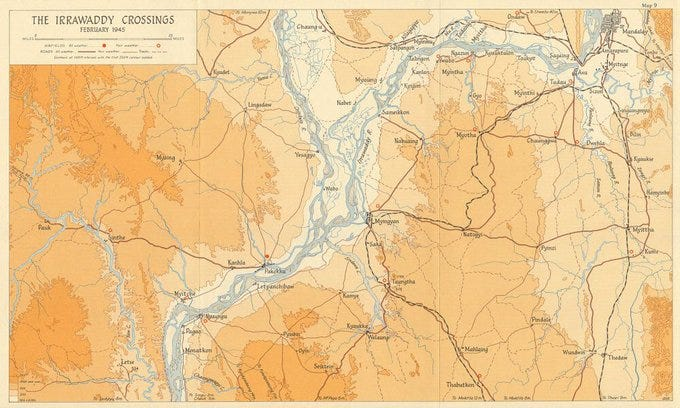
On 13-14 February 1945, 79-years ago this month the 7th Indian Division commanded by Major General Geoffrey Evans secured crossings over the Irrawaddy at Pakkoku and Nyaung-U/Bagan. The northern crossing (Pakkoku) was designed to allow Punch Cowan’s 17th Indian Division, and the Sherman tanks of 255 Indian Tank Brigade, to race across country to seize Meiktila. The southern ones, at Nyaung-U and Bagan (a few miles to the south still), were designed to prevent the enemy from interfering with the operations against Meiktila, and to make him believe that securing the Irrawaddy as a route to Rangoon — and not Meiktila — was Slim’s primary objective. In 2005, for the 60th anniversary of the Irrawaddy crossings, I was privileged to walk the battlefield with three veterans of these crossings, John Chiles (Probyn’s Horse), Manny Curtis (South Lancashire Regiment) and Bert Wilkins (RA, in support of the South Lancs). During that trip we travelled along the Irrawaddy from Bagan, anxiously scouring the maps in the South Lancs’ War Diary searching for B4 beach, where on the early morning of 14 February 1945 two hundred men of 2nd Battalion South Lancashire Regiment had rowed silently across the river to form the vanguard of the 7th Indian Division beachhead. I remember vividly the excitement as we found B4 — it was much easier than I had thought — disembarked from the boat and climbed to the top of the cliffs to find old trenches from the battle. It was an emotional event for the veterans as they recalled the battle and found trenches left by the defenders decades before.
At Nyaung-U the first wave of a company of the 2nd Bn South Lancs (including Manny Curtis) managed to seize the high ground above B4 in the early morning of 14 February. It was the longest opposed river crossing in any theatre of the Second World War. The beaches had been recced by a Sea Reconnaissance Unit and a Special Boat Section. However, subsequent waves of troops from the remainder of the South Lancs, the 4th Battalion 14th Punjab Regiment and the 4th Battalion 1st Gurkha Rifles were mauled by enemy machine gun fire as the leaky canvas boats and temperamental outboard motors failed to cope with the distance they had to cover and the strength of the river’s flow. The enemy? Pagan and Nyaungu were defended not by the Japanese but by three battalions of the Indian National Army’s 4th Guerrilla Regiment, some 2,000 men in well-sited positions overlooking the Irrawaddy. This was the only major engagement of the war when troops of the Indian Army fought in direct combat against the INA. To subdue the enemy positions causing casualties on the water, Sherman tanks of the Gordon Highlanders sniped the enemy positions, and an artillery bombardment by 25-pdrs and a Hurribomber strike pummelled the east bank of the river. Together these actions succeeded in forcing the INA to surrender. Further to the west, at Pagan, the INA’s 9th Battalion took a heavy toll of the assaulting 1/11th Sikh Regiment, before they withdrew to Mount Popa to the rear. River crossing are dangerous, especially for troops with little training in boatmanship, across one of the world’s greatest rivers. But this time the 7th Indian Division succeeded with little training or preparation. By the end of the day the east bank was in its hands. Amazingly, a cinematographic unit were available to film some of the crossings at Nyaung-U. An 8-minute reel of the landings can be seen in the IWM on JFU35.
Today I was able to revisit B4. Not much had changed in nearly 20-years. The size of the Irrawaddy even in the dry season is astonishing, the task given to the men of 33 Brigade enormous. In 2005 we climbed the cliffs that Manny and his friends had raced up in 1945. Looking at them again today, I realised just how Gallipoli-like was the terrain. In the hands of of better trained enemy, 33 Brigade should never have managed to get off the beachhead. Rippling rows of gullies flow behind the initial landing site: if these had all been defended, a position of great depth and near impregnability could have been achieved. These photos look down on B4 and across to the position up which the men of 2nd South Lancs scrambled.
The Hindenburg Disaster – Dining on the Zeppelin
Tasting History with Max Miller
Published Nov 28, 2023Decadent vanilla rice pudding with poached pears, chocolate sauce, and candied fruit
City/Region: France
Time Period: 1903Everything about this dish exudes fanciness, and it comes as no surprise. A ride across the Atlantic on the Hindenburg cost around $9,000 in today’s money, and the whole experience was meant to be luxurious. The head chef on the Hindenburg, Xaver Maier, had worked at the Ritz Hotel in Paris, which was still cooking from the recipes of Auguste Escoffier.
The Escoffier recipe for pears condé seems simple enough, until you realize he references about 5 other recipes in total in order to make the dish. It’s a lot of work, but it’s so good. The rice pudding has such an intense vanilla flavor that really elevates it and is the perfect base for the poached pears. Don’t get too much of the rich chocolate sauce or it will overwhelm the other flavors.
Really you could make just the rice pudding and have that be a fancy dessert all on its own if you don’t want to go to all the fuss.
Poires Condé:
Very small pears which are carefully peeled and shaped are most suitable for this preparation. Those of medium size should be cut in half. Cook them in vanilla-flavored syrup then proceed as for Abricots Condé, recipe 4510.
Abricots Condé:
On a round dish prepare a border of vanilla-flavored Prepared Rice for sweet dishes (recipe 4470)— Auguste Escoffier, 1903
QotD: Early siege warfare
Now the besieger’s side of the equation may seem like an odd place to start a primer on fortifications, but it actually makes a fair bit of sense, because the capabilities of a potential attacker is where most thinking about fortification begins. Siegecraft, both offensive and defensive, is a case of “antagonistic co-evolution“, a form of evolution through opposition where each side of the relationship evolves new features in response to the other: neither offensive siege techniques nor fortifications evolve in isolation but rather in response to each other.
In many ways the choice of where to begin following that process of evolution is arbitrary. We could in theory start anywhere from the very distant past or only very recently, but in this case I think it makes sense to begin with the early Near Eastern iron age because of the nature of our evidence. While it is clear that siege warfare must have been an important part of not only bronze age warfare but even pre-bronze age warfare, sources for the details of its practice in that era are sparse (in part because, as we’ll see, siege warfare was a sort of job done by lower status soldiers who often didn’t figure much into artwork focused on royal self-representation and legitimacy-building).
But as we move into the iron age, the dominant power that emerges in the Near East is the (Neo-)Assyrian Empire, the rulers of which make a point of foregrounding their siegecraft as part of a broader program of discouraging revolt by stressing the fearsome abilities of the Assyrian army (which in turn had much of its strength in its professional infantry). Consequently, we have some very useful artistic depictions of the Assyrian army doing siege work and at the same time some incomplete but still very useful information about the structure of the army itself. Moreover, it is just as the Assyrian Empire’s day is coming to a close (collapse in 609) that the surviving source base begins to grow markedly more robust (particularly, but not exclusively, in Greece), giving us dense descriptions of siege work (and even some manuals concerning it) in the following centuries, which we can in turn bring to the Assyrian evidence to better understand it. So this is a good place to start because it is the earliest point where we are really on firm ground in terms of understanding siegecraft in some detail. This does mean we are starting in medias res, with sophisticated states already using complex armies to assault fairly complex, sophisticated fortifications, which is worth keeping in mind.
That said, it should be noted that this is hardly beginning at the beginning. The earliest fortifications in most regions of the world were wooden and probably very simple (often just a palisade with perhaps an elevated watch-post), but by the late 8th century, well-defended sites (like walled cities) already sported sophisticated systems of stone walls and towers for defense. That caveat is in turn necessary because siegecraft didn’t evolve the same way everywhere: precisely because this is a system of antagonistic co-evolution it means that in places where either offensive or defensive methods (or technologies) took a different turn, one can end up with very different results down the line (something we’ll see especially with gunpowder).
Bret Devereaux, “Collections: Fortification, Part I: The Besieger’s Playbook”, A Collection of Unmitigated Pedantry, 2021-10-29.
March 1, 2024
Was JUNO BEACH The Deadliest On D Day? | Canadian Army | Normandy WW2
The History Explorer
Published Oct 27, 2023During the invasion of Fortress Europe the casualty figures sustained on Omaha beach were terrifying; approximately 2,500 US casualties were sustained of which around 800 were killed, depending on which source you use. The ratio was said to be 1 in 19 soldiers would become a casualty.
But it was at Juno beach where the fighting Canadians landed that the casualties were 1 in 18. The fighting on Juno beach resembled modern urban warfare – silencing fortified residential houses, clearing rooms and bunker busting. So was this the more deadly beach? This is the story, of Juno beach and the brave sons of Canada.
On June 6th, 1944, the 3rd Canadian Infantry Division and the 2nd Armoured Brigade were tasked with establishing a bridgehead on the beach codenamed “Juno”. This was an eight-kilometre long stretch of beach between Sword beach to the East and Gold beach to the West.
Come with me as we walk the beaches and take a look at what made this beach so well defended.
(more…)
February 29, 2024
Hotchkiss Portative: Clunky But Durable
Forgotten Weapons
Published Nov 27, 2023The Portative was an attempt by the Hotchkiss company to make a light machine gun companion to their heavy model (which had found significant commercial success). The Portative used the same feed strips, albeit loaded upside down, and the same gas piston operation, but a very different locking system. Instead of a tilting locking block the Portative had a “fermeture nut” that rotated to lock onto the bolt with three sets of interrupted thread locking lugs. In addition, many of the traditionally internal parts were mounted externally on the Portative, and it was quite the awkward gun to use.
The Portative was adopted by the American Army as the Model 1909 Benet-Mercié, and by the British early in World War One as a cavalry and tank-mounted gun. The remainder of Portative contracts were relatively small from second-tier military forces, including several South American countries.
(more…)
February 28, 2024
V-2: Hitler’s Wunderwaffe
World War Two
Published 27 Feb 2024Hitler hopes that the V-2 rocket will turn the tide of the war. It’s cutting edge technology and impossible to intercept. Right now, the first long-range ballistic missile is raining death on London and Antwerp. But is it too little, too late? Find out the backstory to this powerful weapon.
(more…)
Accusations aplenty, but still no clear evidence
Michelle Stirling outlines the establishment of the North West Mounted Police (today’s Royal Canadian Mounted Police) and their role in driving out American whiskey traders and criminal gangs who had invaded the Canadian west, and the initial role of Sir John A. Macdonald in setting up the first residential schools for First Nations children:
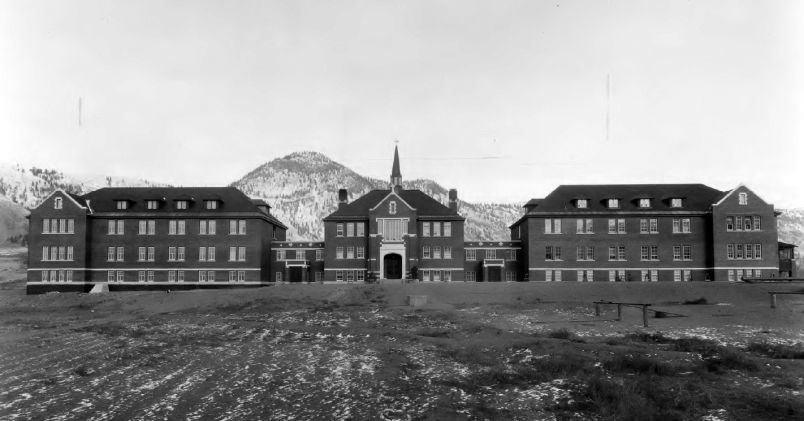
Kamloops Indian Residential School, 1930.
Photo from Archives Deschâtelets-NDC, Richelieu via Wikimedia Commons.
It is clear that the claim of “mass graves” of children allegedly found by Ground Penetrating Radar (GPR) at the former Kamloops Indian Residential School is false. The main reason is that there is no list of names of missing persons — over the course of 113 years of Indian Residential Schools, which saw 150,000 students go through the system, some staying for a year, most for an average of 4.5 years, some staying for a decade or more and graduating, and some orphans being taken in to the school as children, then remaining to work as Indigenous staff — these many thousands of children passed through Indian Residential Schools, their parents enrolling and re-enrolling them year after year.
And there is no list of names of missing persons.
There are many claims of missing persons.
Some of these claims are quite fatuous — with one person claiming that in their Band, every family had four or five children who went missing at that school. Another person claimed that their grandfather had ten siblings disappear in that school.
If that were true, the Band would have ceased to exist.
Despite these claims, there are no missing persons records.
And every student who went to that school is documented on the Band’s Treaty rolls, in documents of the Indian Agent, in the enrollment forms at the Department of Indian Affairs, along with the student’s medical certificate for entry, and in the quarterly reports of the department.
In fact, the Indigenous population of Canada grew from about 102,358 in 1871 to now 1.8 million.
It seems that the claim of a “mass grave” on the former Kamloops Indian Residential School site was timed to “nudge” the approval of the United Nations Declaration of the Rights of Indigenous People through parliament — which it did! The bill had been “stuck” as six provinces had requested delay and clarity on key issues. Once the claim of “mass graves” surfaced — boom!
Less than a month after the “mass graves” news shot round the world, shocking the global community that Canadians — once known as international peacemakers, were actually hideous murderers of Indigenous children — UNDRIP swept through the Canadian Parliament with no objection.
A day later, China accused Canada of genocide, citing the Kamloops “mass graves” find as proof. For those of you following the concerns about China’s alleged interference in elections in Canada, this rather convenient timing might set off some alarm bells.
If anything, the RCMP should be investigating this matter on grounds of false pretences or fraud. But the RCMP appear to have transferred the investigation of the Kamloops “mass grave” to the people who claimed to have found them! Ground Penetrating Radar (GPR) can only identify “disturbances” under ground, not bodies or coffins. In fact, based on previous land use records, most likely the GPR found 215 clay tiles of an old septic trench.
Why Germany Lost the First World War
The Great War
Published Nov 10, 2023Germany’s defeat in the First World War has been blamed on all kinds of factors or has even been denied outright as part of the “stab in the back” myth. But why did Germany actually lose?
(more…)
February 27, 2024
Greek History and Civilisation, Part 4 – The Ancient Greeks: The Great Invasion
seangabb
Published Feb 18, 2024This fourth lecture in the course deals with the Persian invasion of Greece in 480 BC, ending with the glory of Thermopylae and the burning of Athens.
(more…)
The Company that Broke Canada
BobbyBroccoli
Published Nov 4, 2023For a brief moment, Nortel Networks was on top of the world. Let’s enjoy that moment while we can. Part 1 of 2.
00:00 This is John Roth
02:04 The Elephant and the Mouse
12:47 Pa without Ma
26:27 Made in Amerada
42:15 Right Turns are Hard
57:43 Silicon Valley North
1:07:37 The Toronto Stock Explosion
(more…)
February 26, 2024
Rome: Part 4 – The First Punic War 264-241 BC
seangabb
Published Feb 25, 2024This course provides an exploration of Rome’s formative years, its rise to power in the Mediterranean, and the exceptional challenges it faced during the wars with Carthage.
• Growth of Tensions between Rival Powers
• Differences of Civilisation
• The Outbreak of War
• The Course of War
• Growth of Roman Sea Power
• The End and Significance of the War
(more…)
FN Model 30: The First Belgian BAR
Forgotten Weapons
Published Nov 22, 2023FN played a role in the production of Polish wz.28 BARs, and in the process obtained a copy of the technical package for the weapon, and converted it to metric measurements. Under the supervision of Dieudonne Saive, this was used as the basis for FN’s own BAR production, called the Modelé 30. Production was done with a license from Colt, who owned the rights to Browning’s patents on the BAR.
The Model 30 was basically a Colt R75 (Model 1925), but incorporated a few improvements. Most significantly, the male and female parts of the gas system were swapped, which prevented carbon from building up and eventually jamming the gas piston. In addition, the bolt removal latch was improved from the US pattern, and the Polish wz.28-style rear sight was used. Lastly, a rate-reduction mechanism on the fire control group gave the gun “slow” and “fast” settings, of roughly 350rpm and 600rpm instead of the traditional semi and full auto settings.
Production began in 7.65mm, and the Belgian Army adopted the weapon, taking deliveries from 1930 until occupation in 1940. The Model 30 was also made in 8mm Mauser, and exported to China and Ethiopia. The design was fairly quickly supplanted in 1932 by the FN Modelé D, which added a quick-change barrel mechanism to the design, and this pattern sold more widely.
(more…)
February 25, 2024
Who Killed Canadian History?
I was not aware that it has been a full twenty-five years since J.L. Granatstein published his polemical Who Killed Canadian History?:
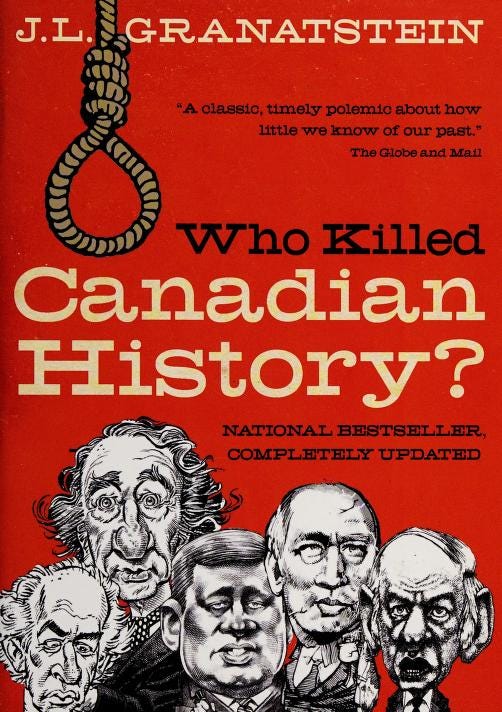
In that work, Granatstein asserts that the rationale for the history taught in Canadian schools was political, not historical. And sexism and racism were being taught, not history.
In the postmodern era, the priority of vast areas of history teaching and historiography, and Granatstein is far from the only academic who noticed this, transitioned from evidence and facts, to morals and emotions. Western oppression became the source of historiographical obsession. And the practice, which has shaped Western historiography since at least the turn of the twentieth century, of injecting moral judgements adjacent to facts and timelines, became entrenched.
This has happened because important areas of historiography, and historical pedagogy, have been subsumed into social sciences. My 9 and 11 year old children do not have a history class. What they learn about history, which isn’t much, is in a class called “social studies”. My son, who is in grade 6, and who was never previously taught anything about the Holocaust, is learning about Nazis Germany’s persecution of the Jews in the most obscure way. His introduction to the Holocaust included a lesson pertaining to the MS St. Louis, a passenger ship carrying 907 Jewish refugees fleeing Nazi persecution that was refused entry into Canada in 1939.
The ship’s Jewish passengers were safely returned to four European countries, but tragically 254 were later killed in the Holocaust. A terrible outcome. Indeed, one of the rare dark stains on Canada’s otherwise quite exemplary record of offering sanctuary to refugees. But if Canadians at the time had known that refusing entry to the MS St. Louis would result in the cold-blooded murder of 254 innocent people, would they have allowed entry? A question not raised in my son’s class.
As well, what Canadians knew or didn’t know about the genocidal ambitions of the Nazis did not come up in my son’s classroom discussions. Indeed, that would be too complex and nuanced for 12 year old’s. They also did not discuss conditions in Canada at the time that may have played a role in the consequential decision to turn away the MS St. Louis. Nor did they mention the Evian Conference, which occurred the year prior to the MS St. Louis‘ ill-fated arrival to Canada.
The Evian Conference of 1938 was held in the French resort town of Évian-les-Bains. There were 32 participating nations, including Canada, who were “to seek, by international agreement, avenues for an orderly resettlement of (Jewish) refugees from Germany and Austria”. Shockingly, at the close of the talks, none of the nations involved had offered to accept any Jewish refugees.
From the London Spectator (1938):
If the Conference has not been a complete failure, it has achieved little to boast about, all the States sympathizing and none desiring to admit refugees. Even the United States, as prime mover, offers no more than the quota.
My son did not come away from his class with an impression that Canada was not alone in its reluctance to accept refugees. This, and other such lessons, seem as if they are designed to implant a sense of revulsion over Canada’s past failures, instead of patriotism over its achievements and victories. What a disservice to young Canadian learners.
This cherry-picked event from history, which doesn’t really deal with the Holocaust, but assumes kids will appreciate related events that occurred over the backdrop of the Holocaust, is doubly misleading in that it presents Canada as a racist country hostile to refugees, before establishing that the opposite was (and is) overwhelmingly true throughout the arc of Canadian history up to the present.
It’s not even clear if my son took away from the lesson that Hitler was the far bigger villain, compared to his “racist colonial” country of Canada.
Clearly, Canada eventually let in Jewish people, and people from all ethnicities. We became the world’s first multiculturalism, and our large cities are among the most cosmopolitan and multicultural places in the world. This needs to be established first for young learners of Canada’s story. Clearly established, before one starts teaching the exceptions to the rule. But my son is getting some weird blend of oddities presented as introductory material to larger subjects which hold historical conclusions opposite to the ones the cherry-picked exceptions portray. It only makes sense that these exceptional events are selected deliberately for political, not educational, reasons.
Twenty-five years ago, Granatstein wrote of Canadian schools,
The material taught stressed the existence of anti-Aboriginal, anti-Metis, and anti-Asian racism, as well as male sexism and discrimination against women, as if these issues were and always had been the primary identifying characteristics of Canada … The history taught is that of the grievers among us, the present-day crusaders against public policy or discrimination. The history omitted is that of the Canadian nation and people.
Who Killed Canadian History? also criticized the teacher-curated practice whereby early exposure to Canadian history is random and discontinuous concerning time periods and individuals, and “without much regard for chronology”. Exactly what I have been experiencing with my kids, decades after Granatstein identified the problem.


