
Like many a kiddy growing up in the 1960s, the release of a new James Bond film was a thrilling event. My cohort were too young to know about sex proper but the saucy suggestiveness of the Sean Connery films was the nearest we got to it. Once, a rumour went around our school that there was a kissing stand-in man employed on Bond films in order to get the lighting right rather than keep bothering the star with snogging various starlets; the careers officer became quite exasperated with the 16-year-old school-leavers he dealt with that year.
Julie Burchill, “How James Bond became the prisoner of woke”, Spiked, 2021-10-14.
January 25, 2022
QotD: James Bond’s stand-in
Comments Off on QotD: James Bond’s stand-in
January 24, 2022
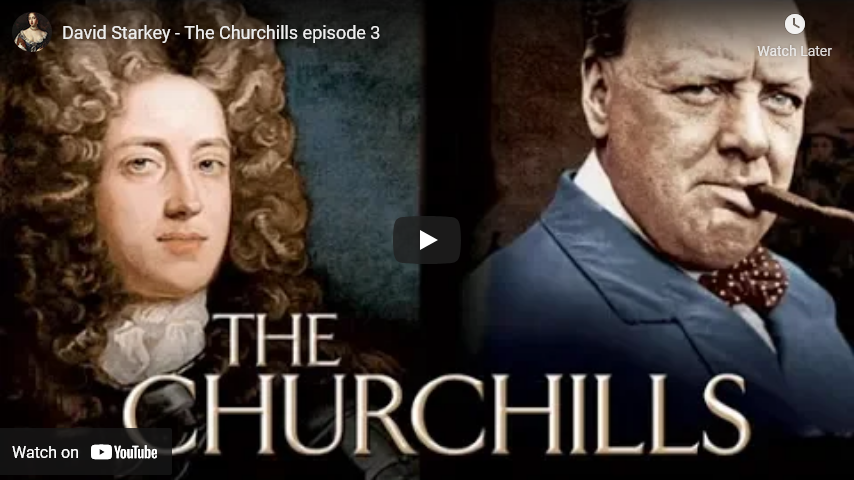
David Starkey – The Churchills episode 3
Whitehall Moll History Clips
Published 29 May 2019How did Winston Churchill draw on the lessons of his ancestor John Churchill to fight World War II? The Duke of Marlborough’s influence is apparent as Dr David Starkey explains
Comments Off on David Starkey – The Churchills episode 3
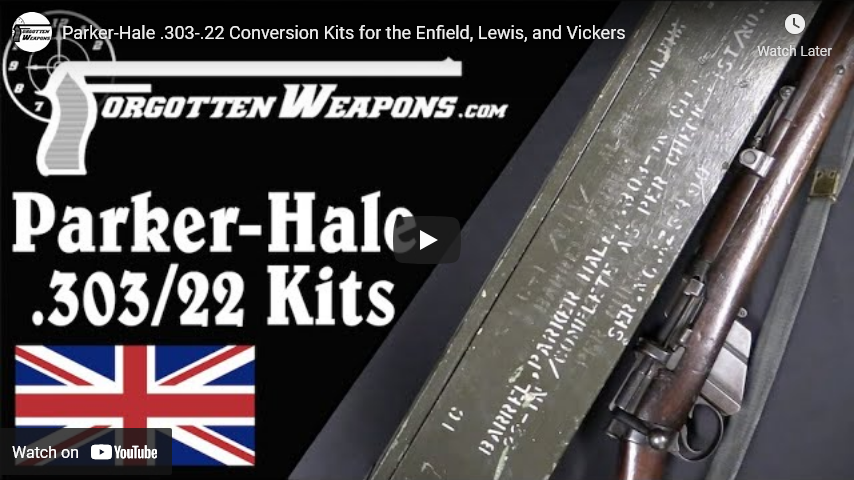
Parker-Hale .303-.22 Conversion Kits for the Enfield, Lewis, and Vickers
Forgotten Weapons
Published 14 Sep 2021http://www.patreon.com/ForgottenWeapons
https://www.floatplane.com/channel/Fo…
Cool Forgotten Weapons merch! http://shop.forgottenweapons.com
In July of 1918, the British military formally adopted a Parker-Hale system of adapting .303-caliber arms to .22 rimfire for short range training. The system involved lining standard barrels with .22 caliber blanks that were machined with full size .303 chambers. Special cartridge inserts were used which had the external dimensions of .303 cartridges, but held .22LR cartridges inside. This allowed the weapon to use the same feeding system as it normally would, and to duplicate the handling and trigger mechanism of a standard .303 caliber gun while only firing a small rimfire cartridge.
Parker-Hale built kits of this type for the Lee Enfield rifle, the Lewis LMG, and the Vickers HMG, and all were used by the British military. In the Lewis and Vickers, there was no accommodation made to actually cycle the guns; this sort of .22 practice drill was done by manually cycling the actions after each shot. Still, it was a good way to practice basic drill (loading, unloading, etc) as well as basic marksmanship without the noise of full power cartridges and without the need for a full-power-rated backstop.
The system for the Lee Enfield was replaced in 1920 (after only about 2 years of use) with the No2 MkIV* rifle, a dedicated .22 conversion of an SMLE. Parker-Hale kept the system in their commercial catalog into the 1930s, however.
Contact:
Forgotten Weapons
6281 N. Oracle 36270
Tucson, AZ 85740
Comments Off on Parker-Hale .303-.22 Conversion Kits for the Enfield, Lewis, and Vickers
QotD: The Punk-Prog War of 1977
The Sex Pistols were angry young men — sois-dissant situationists who hated the dreamy Jung men with their Hipgnosis gatefold album art, their endless concept albums and “song-cycles”, and their am-dram dressing-up box shenanigans. The progs were pretentious and effete and disdained, not only for being able to read music, but for littering their lyrics with symbols from the collective unconscious. It all came from doing too much prep — they were the decadent ancien regime to punk’s snotty sans culottes.
Whether there was any truth to all this didn’t matter much. As mediated by their friends at the NME, the punks despised prog — a genre they regarded as anything but progressive. And Genesis were among the original sinners. True, it was a Pink Floyd t-shirt onto which Johnny Rotten had scrawled “I hate”, an alteration which amounted to all the wit he needed back then to get hired by Malcolm McLaren. But Genesis were the Druidic Lords of the iddly-diddly — the eye-wash and the whimsy that the bin-bag and safety-pin boys and girls found so contemptible.
The Pistols drew as much of their energy from the desire to make overfed rock dinosaurs like Genesis extinct, as they did from making music themselves. They wanted to see the carcasses of these privately educated fops littering the impact crater of punk rock, exposed for the cold blooded, lumbering, vegetative grotesques that they were. The nimble-witted likes of Rotten and Co. pogoed jubilantly on the wreckage of shattered Melotrons and twin-necked Gibsons and their long-overdue graves. Their hour — 1977, year zero — had surely arrived.
Simon Evans, “Rocker Crocked. Pistol Shot.”, Quillette, 2021-10-04.
Comments Off on QotD: The Punk-Prog War of 1977
January 23, 2022
Hitler’s Interference is losing the war – WW2 – 178 – January 22, 1943
World War Two
Published 22 Jan 2022This is a rough week for the Germans — their trapped garrison at Velikie Luki is liquidated, and their trapped army at Stalingrad is … well, it isn’t going well for them. In fact, it isn’t going well for the Axis anywhere this week, being pushed back or retreating in New Guinea, the Caucasus, North Africa, and on Guadalcanal. Berlin is even bombed this week as well.
(more…)
Comments Off on Hitler’s Interference is losing the war – WW2 – 178 – January 22, 1943
The Abandoned Hill With Two Members Of Parliament
Tom Scott
Published 6 Jul 2020Old Sarum, in Wiltshire, is a now-desolate hillfort run by English Heritage. But it was once one of the most important sites in southern England: so important that it had two members of Parliament. Then, it became a “rotten borough”: and a warning about power.
Thanks to English Heritage: more information and how to visit: https://www.english-heritage.org.uk/v…
Research and script assistance from Jess Jewell
Drone camera by Jamie Bellinger
Edited by Michelle Martin: https://twitter.com/mrsmmartin
Audio mix by Graham Haerther: https://haerther.netFilmed safely, following all local and national guidance: https://www.tomscott.com/safe/
SOURCES:
Corfield, P. (2000). Power and the professions in Britain 1700-1850. London: Routledge.Dodsworth, W. (1814). An historical description of the cathedral church of Salisbury: including an account of the monuments, chiefly extracted from Gough’s “Sepulchral Monuments,” and other authentic documents: also, biographical memoirs of the Bishops of Salisbury, from the earliest period by W. Dodsworth, verger of the Cathedral
English Heritage’s own research page: https://www.english-heritage.org.uk/v…
http://www.historyhome.co.uk/c-eight/…
I’m at https://tomscott.com
on Twitter at https://twitter.com/tomscott
and on Instagram as tomscottgo

Comments Off on The Abandoned Hill With Two Members Of Parliament
QotD: The British governments of the 1930s
In spite of the campaigns of a few thousand left-wingers, it is fairly certain that the bulk of the English people were behind Chamberlain’s foreign policy. More, it is fairly certain that the same struggle was going on in Chamberlain’s mind as in the minds of ordinary people. His opponents professed to see in him a dark and wily schemer, plotting to sell England to Hitler, but it is far likelier that he was merely a stupid old man doing his best according to his very dim lights. It is difficult otherwise to explain the contradictions of his policy, his failure to grasp any of the courses that were open to him. Like the mass of the people, he did not want to pay the price either of peace or of war. And public opinion was behind him all the while, in policies that were completely incompatible with one another. It was behind him when he went to Munich, when he tried to come to an understanding with Russia, when he gave the guarantee to Poland, when he honoured it, and when he prosecuted the war half-heartedly. Only when the results of his policy became apparent did it turn against him; which is to say that it turned against its own lethargy of the past seven years. Thereupon the people picked a leader nearer to their mood, Churchill, who was at any rate able to grasp that wars are not won without fighting. Later, perhaps, they will pick another leader who can grasp that only Socialist nations can fight effectively.
George Orwell, “The Lion And The Unicorn: Socialism and the English Genius”, 1941-02-19.
Comments Off on QotD: The British governments of the 1930s
January 22, 2022
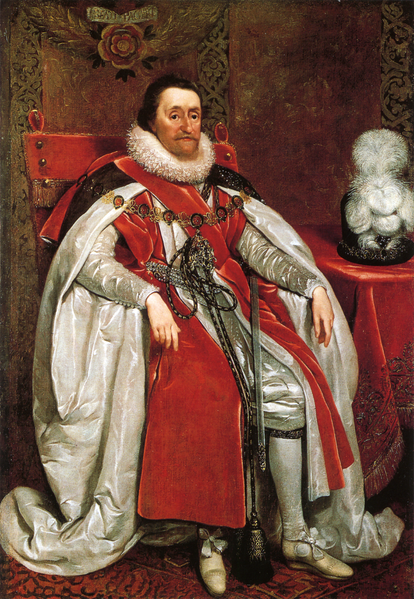
James I and his experiment with “personal rule”
In the latest Age of Invention newsletter, Anton Howes explains why King James I grew frustrated in his dealings with Parliament and decided to avoid calling that body into session and ruling the kingdom directly:
King James I (of England) and VI (of Scotland)
Portrait by Daniel Myrtens, 1621 from the National Portrait Gallery via Wikimedia Commons.
By the end of 1610, James’s disillusionment with the House of Commons was complete — it was, he said, after six years of fruitlessly wrangling for parliamentary taxes, like a “House of Hell”.
So, despite failing to reach a permanent financial settlement, James decided to try to rule without it. His debts were huge, and his deficit substantial. But after the failure of 1610 he would do everything he could to never have to summon a Parliament again. Although he couldn’t actually afford it, he decided to try ruling as an absolutist monarch anyway — to embark on “personal rule”.
This extraordinary decision, to be an absolutist ruler without adequate financial support, would have dramatic consequences for England’s foreign policy, and perhaps on the whole balance of Europe too. James had already tried to reduce the costs of war when he came to the throne in 1603, by immediately concluding a peace with the vast Spanish Empire. Yet peace now became a necessity — if he couldn’t even plug the deficit during peacetime, he could not possibly pay for a war. Recognising this, Spain intervened freely in the affairs of the Protestant German states, confident that England would not be able to come to their aid.
To make matters worse, James’s financial woes made him especially susceptible to foreign influence. A poor king could be bought. Some of the smaller but wealthier European dynasties began to offer James large sums for his children’s hands in marriage. In 1611, the duke of Savoy offered a vast dowry of £210,000 for his daughter to marry James’s eldest son and heir, Prince Henry. The notoriously wealthy grand duke of Tuscany even put in a bid for £300,000. France then offered £240,000 — not as high, but it had the greater status as a kingdom. Any of these amounts would have plugged the deficit for a few years, even if they were nowhere near to eliminating James’s debt. Yet Henry died in 1612 at the age of eighteen, before any match was agreed, and James’s new heir Charles was much younger and sickly. There was now no rush, so the bidding war ceased. Indeed, by 1616 Charles had given England’s rivals yet another way to influence its king. The Spanish Hapsburgs dangled the prospect of a gigantic dowry of £600,000, but dragged their feet in negotiations, keeping James focused for as long as they could on trying to keep them sweet.
In the meantime, with Henry’s death denying him an immediate windfall, James in 1613 turned [to] Ireland. The Irish Parliament had not been summoned for over a quarter of a century, but it could be a way to reduce the costs of the occupation of Ireland and even raise some funds. The Parliament was initially a disaster. James had flagrantly gerrymandered a Protestant majority by chartering dozens of new towns, particularly in the English plantations in Ulster. Each new town was a borough constituency able to choose its own MPs, and James could even select their initial members — especially in cases where the towns were actually only tiny villages. In protest, the Catholic MPs refused to even recognise the new borough MPs, so each side elected their own Speaker. The Catholic Speaker was only forced out of the chair when the Protestant Speaker was hoisted onto his lap. Nonetheless, although James was legally entitled to create as many new boroughs as he liked, he soon compromised and in 1615 the Irish Parliament ended up voting him some cash.
But the delays forced James’s hand, and in 1614 he briefly suspended his foray into personal rule by summoning the English Parliament again. He needn’t have bothered. Having embarked on personal rule, James had doubled down on legally dubious ways of raising cash, like imposing new customs duties without parliamentary approval — measures that had already been deeply unpopular with MPs in 1610. This time, the Parliament lasted just two months and two days before James dissolved it in a rage — the House of Hell had proved even more impudent than before. One of the veteran opposition leaders, Sir Edwin Sandys, went so far as to explicitly compare James’s impositions on trade to tyranny, before reminding the Commons that tyrants often met a bloody end. When the Parliament was dissolved, the king had MPs’ notes on impositions burned, and a few of the ringleaders were even briefly imprisoned. But with the dissolution of Parliament, which had not voted him any cash, he was still none the richer.
Comments Off on James I and his experiment with “personal rule”
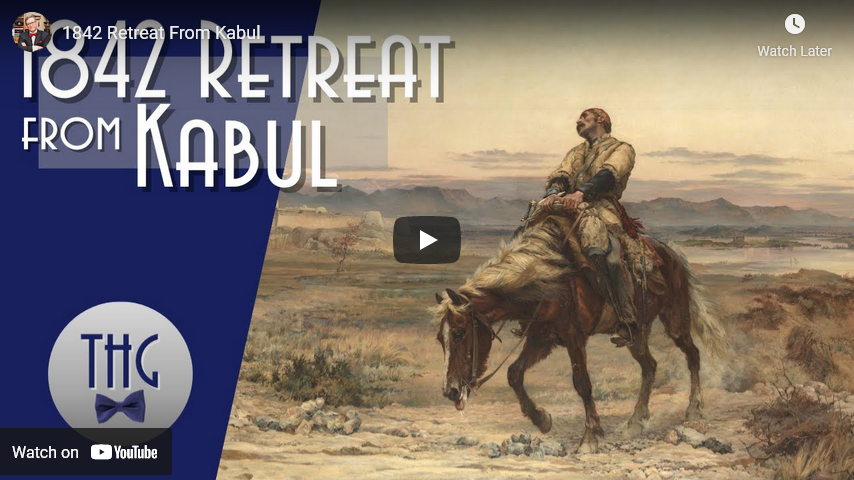
1842 Retreat From Kabul
The History Guy: History Deserves to Be Remembered
Published 22 Sep 2021On January 13, 1842, a single man on horseback approached the British garrison at Jalalabad, where soldiers were waiting for a retreating army of several thousand. Exhausted, the man had part of his skull shaved off by a sword and his horse was so exhausted that it would soon perish. As he was brought into the walls of the city the lone man was asked where the rest of the army was. “I am the army,” he replied. Thus ended a disastrous retreat from Kabul, where a British force of some 4,500 soldiers and thousands of civilians was almost entirely destroyed.
This is original content based on research by The History Guy. Images in the Public Domain are carefully selected and provide illustration. As very few images of the actual event are available in the Public Domain, images of similar objects and events are used for illustration.
You can purchase the bow tie worn in this episode at The Tie Bar:
https://www.thetiebar.com/?utm_campai…All events are portrayed in historical context and for educational purposes. No images or content are primarily intended to shock and disgust. Those who do not learn from history are doomed to repeat it. Non censuram.
Find The History Guy at:
Patreon: https://www.patreon.com/TheHistoryGuy
Please send suggestions for future episodes: Suggestions@TheHistoryGuy.netThe History Guy: History Deserves to Be Remembered is the place to find short snippets of forgotten history from five to fifteen minutes long. If you like history too, this is the channel for you.
Awesome The History Guy merchandise is available at:
https://teespring.com/stores/the-hist…Script by JCG
#history #thehistoryguy #Afghanistan
Comments Off on 1842 Retreat From Kabul
January 21, 2022
Boris is in trouble, threaten the BBC to take the heat off him!
In Spiked, Gareth Roberts wonders why Britons should continue to pay an annual license fee to support a media conglomerate that demonstrably hates them and their country:

Culture secretary Nadine Dorries, the most ardent of Boris Johnson stans, obligingly threw the deadest of cats on to the table at the weekend to distract from the woes of her beleaguered boss. She announced a two-year freeze on the BBC licence fee and dangled the prospect of scrapping it entirely.
Dorries must be well aware that any threat to the BBC always results in a Furies’ chorus of anger, horror and prophecies of woe, coming from precisely those people the Tory grassroots are likely to detest. And up they obligingly popped – Polly Toynbee, Nish Kumar, Gary Lineker, all present and correct. This wasn’t so much political theatre as a pantomime with stock phrases and responses. She’s behind you!
Behind all this repetitive call and response, there is something different this time around, on both sides. Dorries was noticeably blatant and direct when she tweeted that this licence-fee consultation “will be the last” (though she seemed less so in the Commons a couple of days later). And her detractors seemed more at a loss, struggling to find the counter examples of BBC excellence that used to come quickly and easily to hand. Citizen Khan creator Adil Ray tweeted a BBC promotional video asking “What has the BBC ever done for us?” that was made 36 years ago. Comedian Simon Day provided a list of great BBC comedies going back to the 1950s, which contained only one show commissioned in the last 15 years.
Canada’s CBC has a similar attitude toward Canadian culture and (ugh!) Canadians that the BBC displays, but the CBC gets direct government subsidies rather than a formal TV license required of all British TV owners. It’s quite reasonable to wonder what benefit Canadian taxpayers and British license-holders derive from all this financial support of increasingly unwatched TV and online propaganda that mocks and belittles them:
What this seems to show is that the BBC is now in a fix. In a way, the BBC hasn’t changed all that much. It is doing now what it has always done, reflecting and embodying a certain section of the middle class. When that section was sane, or at least fairly sane, that could be irritating on occasion, but we all forgave it because it had its heart in the right place. But in the past decade, the nominally “liberal” middle class has, to put it politely, gone both doolally and totalitarian.
To consume the BBC since about 2012 is to be never more than 10 minutes away from being scolded or berated, usually based on some spurious identity-politics talking point imported from the sick vortex of American academia. (On Radio 4 this happens much more frequently, about every 35 seconds.) It is unbearable, like paying £159 a year, on pain of imprisonment, to be told off by a particularly irritating polytechnic lecturer.
BBC News gets a lot of stick for this, understandably, but the Beeb’s drama, comedy and documentary output is now infested with it, too. It’s the same crushingly banal suite of opinions across everything.
Life before Blair was a grey, damp horror, a cultural wasteland of prejudice where Oswald Mosley had huge amounts of support (strangely enough, insinuating that people’s grandparents were all fascists doesn’t endear them to you). Working-class whites are bigots who can’t be trusted with basic information in case they start a race war. Fiona Bruce has kittens live on air when a doctor states the simple fact that it’s impossible to change sex. The BBC’s younger journalists have to be told that people have different opinions. If upper-class or working-class people can’t be shamed or blamed for something, the BBC just isn’t interested. It is stultifyingly bourgeois.
The BBC is often valued, and often trumpets itself, as a thing that brings the nation together. I think it has transmogrified into doing the opposite, with a superior sneer that treats Britain like something it’s found on its shoe.
Comments Off on Boris is in trouble, threaten the BBC to take the heat off him!
Conservatives versus the “Blob”
Sam Ashworth-Hayes is writing here about the British Conservative party, but just swap out the names and it’s equally applicable to the Canadian equivalent, and very likely true for the rest of the western world:
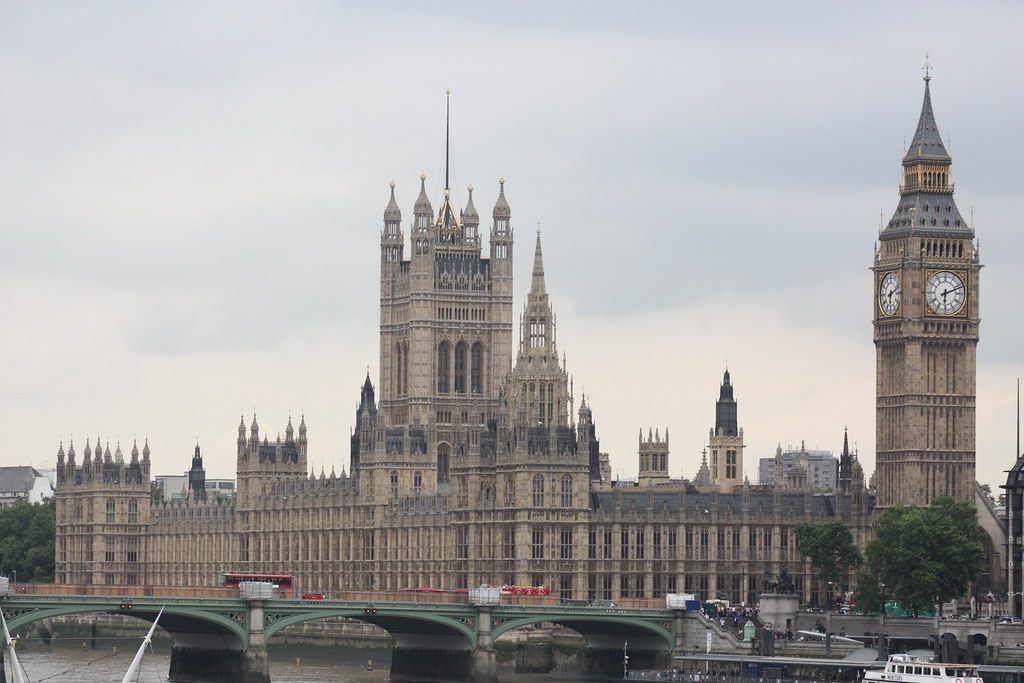
“Palace of Westminster”by michaelhenley is licensed under CC BY-NC-SA 2.0


The Conservative party is trapped in a nightmare of its own making. Number 10 is rocked by scandals, support in the polls is plummeting, the Northern Ireland Protocol (Chekhov’s car bomb) waits patiently for its return to the newscycle. As with every good nightmare, there is the sense of unease that something remains undone.
That something would be “conserving”. Set aside economic policy, where the Conservatives and Labour are still just about separable — although the new interest in higher taxes, spending and regulation is rapidly eroding this gap — and judge the period on the social axis: same-sex marriage, net migration at record highs, the march of progressive ideas through academia, business and press and into government speeches. You could be forgiven for thinking that Labour won the 2010 election, and every bout subsequent.
Why is that the Conservative party governs in such a fundamentally unconservative way? Part of the issue is that the average Conservative MP is, on social issues, basically indistinguishable from the average Labour voter, while the average Labour MP is to the left even of this. The centre of gravity in Parliament is well to the left of the general population.
A second part of the answer — and a partial cause of the first — is that the infrastructure of British politics is not designed for the right. When Michael Gove and his then-Special Advisor Dominic Cummings attempted to shake up the English education system in 2014, they found themselves publicly at war with what they termed “the Blob”: an amorphous conglomerate of civil servants, academics and unions that acted to gum up change and ensure stasis in the interests of its members. Rightwards reform is received as violent revolution, whilst the constant leftwards drift goes unremarked and unchallenged.
When Cummings made his way to Number 10, so did the concept of the Blob, expanded to include the BBC, various quangos, much of Whitehall and what is sometimes called “civil society”. The example of hate crime policy is illustrative of the general idea. The concept is not dissimilar to Curtis Yarvin’s “Cathedral”, or the Trumpian “deep state”. Critics of such accusations point out, not unreasonably, that coordinating so many constituent parts would be almost impossible — but this misses the point entirely. The purpose of a system is what it does, and individual elements responding to an ecosystem of incentives that produce given results can act in a remarkably coordinated way, when those incentives point in the same direction.
Comments Off on Conservatives versus the “Blob”
A Rare Navy Stopgap: the CLLE MkI Naval Enfield
Forgotten Weapons
Published 6 Sep 2021http://www.patreon.com/ForgottenWeapons
https://www.floatplane.com/channel/Fo…
Cool Forgotten Weapons merch! http://shop.forgottenweapons.com
The British Royal Navy tended to accumulate some of the obsolescent patterns of Enfield rifles around the turn of the 19th century, as the Army had higher priority for the new types of rifle. This resulted in a rather odd and poorly-documented pattern, the Charger-Loading Lee Enfield (CLLE) MkI Naval.
Produced around 1910-1912, these guns began as original production Long Lee (or Metford) rifles. In 1910, the new MkVII high velocity Spitzer ammunition was adopted, and it was largely issued on charger clips for use in the new SMLE rifles. The Royal Navy decided that it wanted to be able to use this ammunition, and so it converted some (exact numbers are unclear) of the old Long Lees with a mishmash of updates.
The rear sights were recalibrated for MkVII ammunition, but not changed in style. So, no windage adjustment was possible on either the front or rear.
A charger bridge was added, including a channel cut to allow a sight picture on the old-style sights. This also involved removing the early pattern dust covers on the bolts.
The resulting guns were marked “HV” for “high velocity” in front of their rear sights. The right side of the receiver socket retained the original production markings, and “CLLE MkI” was added to the left side of the sockets.
Contact:
Forgotten Weapons
6281 N. Oracle 36270
Tucson, AZ 85740
Comments Off on A Rare Navy Stopgap: the CLLE MkI Naval Enfield
January 20, 2022
David Starkey — The Churchills episode 2
Whitehall Moll History Clips
Published 11 Feb 2019Dr David Starkey reveals how Winston Churchill’s biography of his ancestor John Churchill marked out Winston as the only politician who truly understood war — just as WWII loomed.
Comments Off on David Starkey — The Churchills episode 2
Discovery ’70 — “A Tale of Two Forts” — Fort Niagara & Fort George, War of 1812
PeriscopeFilm
Published 19 Oct 2021Want to support this channel and help us preserve old films? Visit https://www.patreon.com/PeriscopeFilm
Visit our website www.PeriscopeFilm.comThis episode of the television show Discovery ’70 is hosted by Virginia Gibson. “A Tale of Two Forts” focuses on two important historic forts from the War of 1812, Fort Niagara and Fort George, which are located between the United States and Canada on the Niagara River. The episode contains re-enactments of the activities at the forts, a bitter battle for control of the Niagara River valley, and the Battle of Queenston Heights — the first major battle of the war. Fort Niagara was an important American post near the outlet of the Niagara River into Lake Ontario. During the early days of the war, it launched artillery fire against the British at Fort George on the other side of the river. On 27 May 1813, the Americans won the Battle of Fort George, and held the enemy fortification. Later that same year, after the burning of Newark and with American forces in disarray, the British advanced on Fort George, forcing the American garrison to abandon it. The artillery could not be withdrawn from Fort George and was thrown into the ditch surrounding the fort. The American garrison at Fort Niagara was then taken by surprise in a night assault by a select force of British regular infantry. Fort Niagara remained in British possession until the end of the war, until they relinquished it under the terms of the Treaty of Ghent. The War of 1812 was won by the British, and was the last military conflict between the two countries.
In 1812, the U.S. Army’s Fort Niagara stood near the British Army’s Fort George in Canada. The introduction of the film begins with a re-enactment of U.S. soldiers in Revolutionary era dress advancing by canoe on the river at :12. British Redcoat soldiers and cannons at Fort George. Main title. At 1:16 the film shows small vessels near Lake Ontario, which was Indian land in 1812. At 1:27 a cannon. At 1:43 the American Fort Niagara, made of stone and brick. At 2:17 the French “stone house” is shown. This was actually a disguised fort with cannon positions. Defenses and the outside of the fort at 2:52. At 4:08, to show the seizure of the fort by the British, a Redcoat is shown triumphantly walking past the fort. The fort served as a refuge for English loyalists at 4:55. At 5:57 an American drummer, and Continental type soldiers. At 6:59 a woman and her daughter go to the well to fetch water. A type of oven is shown that heated cannonballs, so that they could not be re-used by the enemy. At 8:07 an overhead view of Fort George. Houses, log stockades, ladders, saws. British soldiers on parade and marching. At 11:20 British soldiers firing, and the Union Jack being raised. At 12:20 English and American officers dine together. The generals of both Fort George and Fort Niagara are shown in the re-enactment — Major-General Sir Isaac Brock for the British and American General Stephen Van Rensselaer. A Redcoat rides a horse toward the house where the dinner takes place, bearing news that the U.S. has declared war on the British. U.S. soldiers canoe past the island at 14:34, attempting to establish a foothold on the Canadian side of the Niagara River. The American assault on October 13, known as the Battle of Queenston Heights — the first major battle in the War of 1812 — takes place. American soldiers attempting plant “Old Glory” at 15:58. At 16:48 at Fort George, General Brock writes dispatches requesting reinforcements, then leads his men into battle as part of the counter attack. General Brock is fatally hit by sniper fire 17:51. The forts firing cannons at each other 18:13. At 19:17 British soldiers firing at American soldiers, the British prevail. At 19:49 the Americans retreating in defeat. At 20:07 The British salute their fallen general. The Americans salute Brock as well. The film ends at 21:04.
We encourage viewers to add comments and, especially, to provide additional information about our videos by adding a comment! See something interesting? Tell people what it is and what they can see by writing something for example: “01:00:12:00 — President Roosevelt is seen meeting with Winston Churchill at the Quebec Conference.”
This film is part of the Periscope Film LLC archive, one of the largest historic military, transportation, and aviation stock footage collections in the USA. Entirely film backed, this material is available for licensing in 24p HD, 2k and 4k. For more information visit http://www.PeriscopeFilm.com
Comments Off on Discovery ’70 — “A Tale of Two Forts” — Fort Niagara & Fort George, War of 1812
January 19, 2022
Neville Chamberlain, the “great appeaser”
Alexander Larman considers an attempt to paint British Prime Minister Neville Chamberlain in a much more positive light than his popular image after appeasement failed:
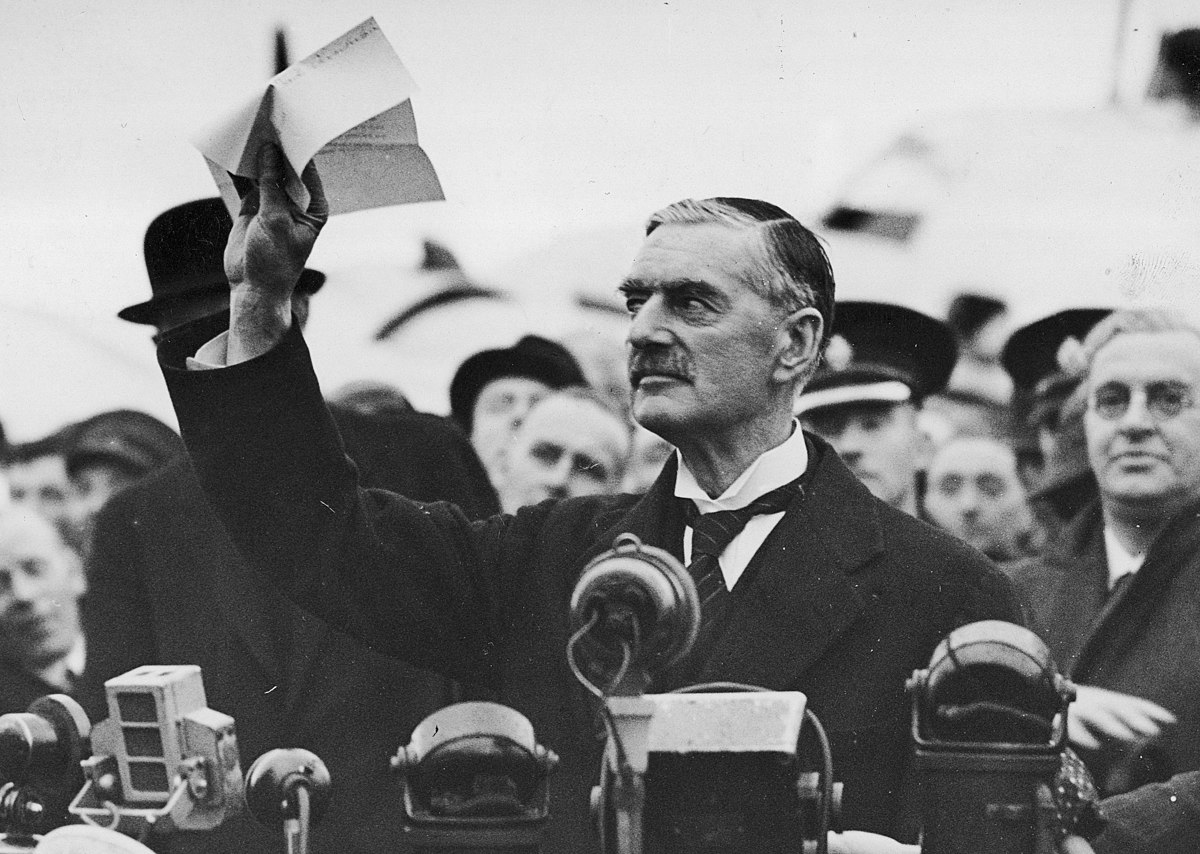
Prime Minister Neville Chamberlain at Heston Aerodrome, holding up a copy of the Anglo-German Declaration he had negotiated with Adolf Hitler, 30 September, 1938.
Narodowe Archiwum Cyfrowe via Wikimedia Commons.
On 30 September 1938, the Prime Minister Neville Chamberlain waved a piece of paper in his hand and declared “My good friends, for the second time in our history, a British Prime Minister has returned from Germany bringing peace with honour. I believe it is peace for our time.” He was, of course, incorrect. Less than a year later, Britain was at war with Germany, and the piece of paper was rendered meaningless.
Posterity has been hard on Chamberlain, regarding him as one of the least effective British premiers, and he has been entirely overshadowed by his more charismatic and successful replacement, Winston Churchill. Yet the bestselling author Robert Harris took a more sympathetic view of Chamberlain, and suggested in his 2017 novel Munich that, far from the Prime Minister being a hapless blunderer, he was in fact a canny tactician who bought his country an invaluable extra year to prepare for the coming conflict. This novel has now been filmed by Netflix, and has attracted particular attention for Jeremy Irons’ sympathetic and warm portrayal of Chamberlain.
Harris has even suggested that “I could perhaps show him as a tragic hero rather than merely the gullible old fool of popular myth … it is a mark of maturity to be able to hold two competing views in one’s head at the same time: that Churchill was vital to the defeat of Germany, and so, in a different way, was Neville Chamberlain.” Does he have a point, or is this just the canny spin of a novelist who has found a new and profitable angle to bring a well-worn story to life?
For my forthcoming book The Windsors at War, dealing with the royals in WWII and their relationships with the politicians of the day, I researched many letters and documents written by Chamberlain, members of the Royal Family and those around him in Downing Street. Several things came to light. There was residual antipathy between Chamberlain, who was an instinctive appeaser, and Churchill, who was not, and the Prime Minister privately derided the other politician as “a bandit” and “a pirate”. He also despised Attlee’s Labour party, calling them experts in “sob-stuff” sentimentality. He can undeniably be accused of high-handedness and complacency. Yet the charge of incompetence is a more deadly one.
Chamberlain himself came from a distinguished political family. His father Joseph was a ruthless Liberal parliamentarian who was said to have originated the phrase “you cannot teach old dogs new tricks”, and his elder brother Austen, one-time Chancellor of the Exchequer and leader of the Conservative Party, demonstrated a confidence in his intellectual abilities that his sibling did his best to emulate. He was not universally popular with his own side – the Conservative MP and diarist Harold Nicolson called him “a bourgeois shit” – but he generally had the support of his party in pursuing his policy of appeasement towards Hitler and Germany, believing – correctly – that Britain could not win the conflict outright.
Comments Off on Neville Chamberlain, the “great appeaser”


