Quotulatiousness

November 10, 2021

The organizational priorities of Canadian universities make for interesting reading

Filed under: Bureaucracy, Cancon, Education, Politics — Tags: , , , , — Nicholas @ 05:00

In Quillette, Jonathan Kay examines the 89-page agenda from a Universities Canada meeting, comparing the issues most people would identify as likely being of high urgency for a gathering of Canadian university administrators with the actual issues the organization considers urgent and important:

University College, University of Toronto, 31 July, 2008.
Photo by “SurlyDuff” via Wikimedia Commons.

Last week, 53 top Canadian academic administrators convened in Ottawa for a biannual membership meeting of Universities Canada, a group dedicated to “providing university presidents with a unified voice for higher education.” The 89-page meeting agenda, which was leaked to me after the event, makes for an interesting read.

The pandemic has been a challenging period for Canadian universities, as the adoption of virtual classrooms has caused some families to wonder whether the traditional bricks-and-mortar education model is worth the price. Many Canadian schools are financially dependent on foreign students, an income source that’s now in flux thanks to COVID. In April, Laurentian University in Ontario declared itself insolvent, cut dozens of programs, and laid off about 100 professors — an unprecedented development.

And yet none of these issues is listed on the October 27th Universities Canada meeting agenda. Laurentian University isn’t mentioned at all, in fact. And the only substantive reference to the COVID pandemic consists of an aside to the effect that “women are disproportionately being impacted negatively during the pandemic”. Instead, all of the agenda’s main action items are dedicated to social justice.

The first item updates attendees on Universities Canada’s multi-year effort to draft a statement on “Social Impact Principles”. A subsequent action item details the “Scarborough National Charter”, a document aimed at “mov[ing] from rhetoric to meaningful concrete action to address anti-Black racism and to promote Black inclusion.” There’s also a related item titled “Equity, Diversity, and Inclusion,” under which members were asked, by formal motion, to affirm their commitment to an affirmative-action doctrine known as “Inclusive Excellence”.

Later in the document, there appears an action item relating to “Principles of Indigenous Education”, detailing the by-now year-and-a-half-long consultation process aimed at renewing Universities Canada’s original Indigenous Education manifesto (which itself was announced with much fanfare in 2015 after a year of work). Among the proposed editing refinements are that language be added “recognizing [the] intersectionality of Indigenous identities”; and that a new preamble be added “acknowledging that Universities Canada and its member universities are located on Indigenous lands across Turtle Island.” The final version, it’s predicted, will be ready by April 2022.

But the agenda’s real centrepiece is a 46-page standalone report commissioned by Universities Canada, called Building a Race-Conscious Institution: A Guide and Toolkit for University Leaders Enacting Anti-Racist Organizational Change.

The report’s main theme is that university leaders must decisively reject the idea of “colour-blindness” (which the author asserts should properly be termed “colour evasion”) in favour of becoming “race-conscious individuals” who “explicitly reflect on their ethno-racial identity and group membership.” The author also exhorts university presidents to “actively examine their personally mediated racial biases, consider their individual experiences with respect to racism, and acknowledge their relative race-related marginalization or privilege in the larger society.” To persist in colour evasion, the author warns, is to erect “discursive barriers to antiracist organizational change.”

And colour evasion is just one of 10 listed “dominant ideologies and pervasive narratives [that] undermine efforts to counteract racism.” Among the other “barriers” listed by the author are “equal opportunity”, “tradition”, and “tolerance”. The report also contains tangents on “white fragility”, “allyship”, and the “ethics of care” prescribed by “critical feminist and antiracist scholars” — as well as instructions regarding the use of certain words and phrases. For instance: “Representation gaps among students, scholars, and staff in higher education are not ‘achievement’ gaps, but rather ‘opportunity’ gaps.”

November 7, 2021

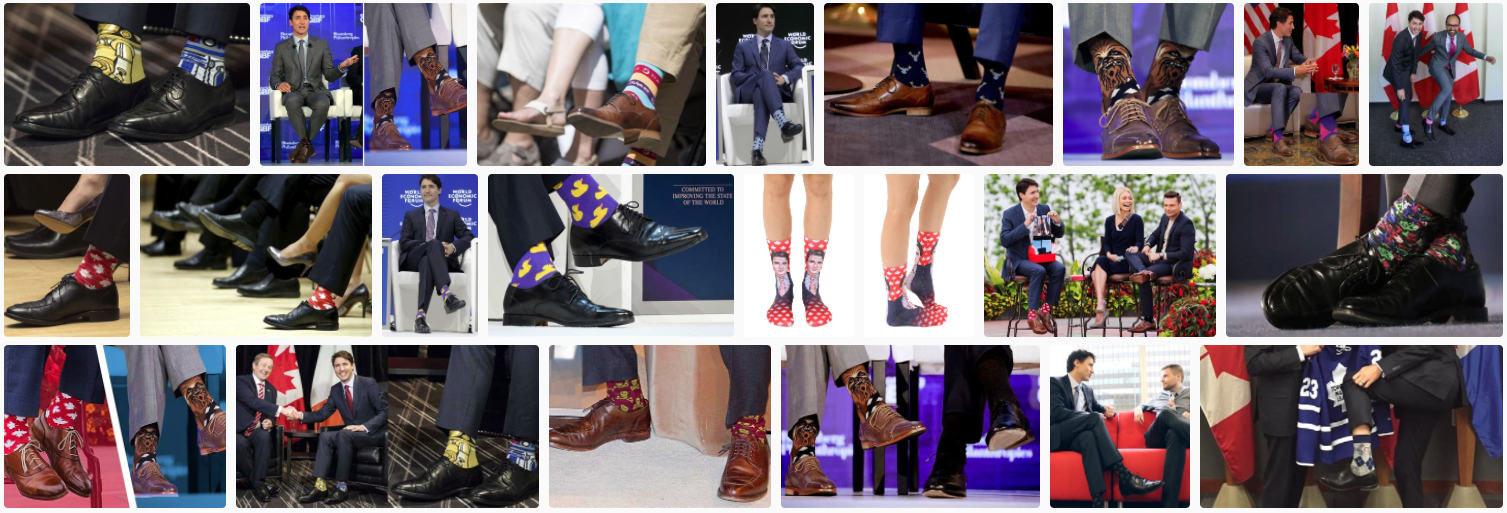
Prime Minister Look-at-my-socks loves the limelight at COP26

Jen Gerson on Canada’s fundamentally unserious Prime Minister Photo-Op grandstanding at the climate love-in in Glasgow:

In a rare moment of unity, both Alberta Premier Jason Kenney and NDP opposition leader Rachel Notley objected to Trudeau’s announcements.

“I don’t know why they would make an announcement like this without consulting with the province that actually owns the overwhelming majority of Canada’s oil and gas reserve,” said Kenney.

I mean, yeah. He’s right.

When asked for actual details about this brave new plan at COP26, Environment Minister Steven Guilbeault didn’t have much to share … because the plan doesn’t exist yet. It’s a plan to make a plan.

“We will need to be developing this, and that’s exactly what we will be doing in the coming months,” Guilbeault said, according to the CBC. Both he and Natural Resources Minister Jonathan Wilkinson have asked the net-zero advisory board to help them come up with a plan. “Specifically, we seek your advice on key guiding principles to inform the development of quantitative five-year targets,” they said in a letter sent on Monday.

There’s no path, here. There’s been no discussion; no consultation, nothing. There’s not even a draft of an idea.

So why is Trudeau getting on a stage in front of the world’s leaders half-cocked with ambitious promises for an emissions cap before he’s worked out the details at home?

To quote Line co-founder Matt Gurney during our weekly meeting: “To ask that question is to answer it.”

Trudeau is signalling what he cares about and what he doesn’t. He’s more concerned with how the audience abroad perceives him than he is about the finer points of governing. It’s about getting back-pats by the Davos set, not actually running our embarrassing, open-pit G7 backwater.

It was hard to avoid the sense during the last election that Trudeau didn’t have his heart in the fight; that he’s more invested in acting the part of prime minister than being it.

I put little stock in rumours that the Liberal leader will soon leave his role — if you’re going to act a part, after all, there are few better. And what a great platform it provides for a launch to better things. But I do wonder: If someone offered him a ranking job at the UN or the WEF or something else with a suitably impressive acronym and a travel expense account, how long would he stick around?

November 6, 2021

Canadian flag shenanigans still not resolved, kinda

Filed under: Cancon, Government, History, Politics — Tags: , , — Nicholas @ 05:00

For non-Canadian readers (which last time I bothered to check were the absolute majority of readers), it’s perhaps not clear why flying of the Canadian national flag is an ongoing issue here in the dysfunctional Dominion. In short, Prime Minister Trudeau ordered the flag to be flown at half-staff at federal government and military sites after the publicization of unmarked graves of First Nations children who died during their stay at various residential schools across the country. (I must note that this wasn’t actually unknown beforehand … it just got enough media attention that PM Look-at-my-socks Photo-op decided it was a good idea to ostentatiously pretend that this was previously unknown and (to some) provided further evidence of the “ongoing genocide” of Canada’s problematic relations with First Nations people. The flag-lowering was ordered in May and no end date was specified to the observance. Like ritualistic “land acknowledgements” this did absolutely nothing to actually improve the living conditions of any members of First Nations bands, but was balm to the soul of virtue-signallers across the country. In Friday’s NP Platformed newsletter, Colby Cosh updates us on the state of play:

This morning the Assembly of First Nations (AFN) made its much-anticipated move in the chess game that has developed over the display of the Canadian flag on federal government buildings. As you will recall, the flags on all these buildings, including those abroad, were lowered to half-mast in May, when unmarked graves were discovered on the site of a former residential school in Kamloops, B.C., and have stayed there ever since. The prime minister said then that, although the lowering of the flags is his exclusive responsibility, he wouldn’t allow them to be flown normally again until “Indigenous communities and leadership” agreed that they could go back up.

Was this elliptical, confounding phrase intended to refer to the AFN? We wondered at the time who was capable of giving the necessary permission, if not the AFN: it appears, quite naturally, to have accepted the position, which is bound to be controversial if made explicit, that it is the exclusive political instrument for Indigenous communities.

In any case the AFN announced its solution to the stalemate this morning. Its executive committee, after consulting with elders, suggests raising the Maple Leaf on Sunday alongside an orange “Every Child Matters” banner. Both flags would go to half-mast on Monday, Nov. 8, this being Indigenous Veterans Day. The flags then go back up, and the Canadian one comes down again on Nov. 11, according to the usual tradition. From then on, both flags fly until “all of our children are recovered, named and symbolically or physically returned to their homelands with proper ceremony.”

There are Canadians who have no use for a national flag; some, no doubt, dream of carrying national self-abnegation to the point of having a fully transparent flag. But even these progressives would have to admit that it is hard to imagine a sequence of events allowing some future prime minister and some future AFN executive to get together and say, “Great job, everybody, the orange one can come down now.” This is a proposed permanent adoption of two national flags (and who is to say it won’t catch on among private citizens?). Yet it could still be argued that the AFN is letting the prime minister off the hook lightly, in exchange for a symbolic political victory of its own.

With the approach of Remembrance Day, the flag flying at half-mast was becoming a symbol, not of Canadian remorse, but of one politician’s daft impulsiveness and inability to act with even the immediate future in mind. As much as some approved of the original gesture, the prime minister should never have been allowed to treat the flag as personal property or as a subject for political negotiation.

In what other country would this be contemplated? Where else could a head of government do something like this without being warned or grimaced at or, outside the pages of the National Post, castigated very much? Indeed, how was this particular power of jerking the flag up and down on government buildings ever assigned to a prime minister in the first place? It is a little anomalous that this file doesn’t belong to the Governor General, who wrangles other flag-like symbols like medals and heraldry.

November 1, 2021

Britain’s Last Ditch: Wartime Changes to No4 Lee Enfield

Filed under: Britain, Cancon, History, Military, USA, Weapons, WW2 — Tags: , , , — Nicholas @ 02:00

Forgotten Weapons
Published 14 Jul 2021

http://www.patreon.com/ForgottenWeapons

https://www.floatplane.com/channel/Fo…

Cool Forgotten Weapons merch! http://shop.forgottenweapons.com

When we think of “last-ditch” rifles, we normally think of 1945 and the very end of World War Two. For the British, however, the lowest ebb of the war was in 1941 and 42, and it is during that period that the Lee Enfield was at its crudest. British ordnance instituted a number of simplifications to maximize weapons production. In particular:

– Walnut replaced with kiln-dried birch and beech for furniture
– Two-groove barrels replacing five-groove ones
– A vastly simplified 2-position flip sight in place of the original fine micrometer style
– Simplified bolt release, designated the No4 MkI* (which was only produced in the US and Canada)
– Aluminum buttplates
– Much reduced standards of fit and finish, leading to really ugly machine marks and haphazard markings.

Most of these changes would be walked back later in the war as Britain’s footing became more solid, but they make a very interesting period of changes for the collector to study.

Contact:
Forgotten Weapons
6281 N. Oracle 36270
Tucson, AZ 85740

October 30, 2021

“Pretendians” … members of the Wannabe tribe … people who fake First Nations ancestry for personal gain

Filed under: Cancon, Education, Government, Health, Politics — Tags: , , , , , — Nicholas @ 03:00

I missed Thursday’s NP Platformed newsletter when it first came out, where Colby Cosh praised a CBC “longread” which dug into the oft-trumpeted heritage of a prominent Saskatchewan university official and did a thorough job of demolishing her claims to First Nations ancestry. This might have seemed unwarranted cruelty, except that those false claims had materially aided her rise to her current position with the university and the federal government:

Carrie Bourassa with media.
Lead photo in Geoff Leo’s article for the CBC – https://www.cbc.ca/newsinteractives/features/carrie-bourassa-indigenous

The result is not only astonishingly well-written and funny — it’s unanswerable. Bourassa has been caught telling utterly insupportable stories about her own past, making lurid claims of racial abuse and colonial trauma in a fanciful Indigenous household bearing no resemblance to the wealthy white one in which she actually grew up. When she got wind that the CBC was working on a story, Bourassa used the resources of the institute to organize a PR defence and arrange for an “open letter”, whose signatories are surprised and offended to find their names attached.

And if the story’s soundness is doubted, one need only refer to the rebuttal that Bourassa published yesterday. Read it and hear the scratching of ticked-off boxes. “I refuse to be victimized by this man who calls himself a journalist. This entire smear campaign stems from lateral violence … nothing less than tabloid journalism … it is apparent that I must adhere to western ideologies.”

But Bourassa’s response, while slinging the jargon generously, does nothing to refute Leo’s reporting. The Saskatchewan scholar lashes herself to the mast of a late-life Métis adoption, which does nothing to explain her tales of making mukluks and beadwork with her “half-breed” “gramps” at age seven.

No prior news item about Aboriginal stolen identity has ever been as strong and complete as this one — and that is why it is worthy of our attention, and of the resources dedicated to it. Bourassa has earned fantastic sums as a researcher and administrator of public funds. Most of this would have been utterly unavailable to her as an ordinary white social worker from the vodka-drinking parts of Saskatchewan. She is in a paramount position of importance in a national bureaucracy dedicated to Indigenous well-being and cultural preservation: her endless nose-stretchers about Aboriginal identity make her position completely untenable.

So will anything be done about it? If the federal government and the University of Saskatchewan are willing to overlook the case made here by the CBC, they will overlook absolutely anything. Falsely claiming Aboriginal descent is one sinful thing; lying floridly and repeatedly to audiences about your personal history of suffering racist treatment is another. (Can one “adopt” experiences? We suppose one can, with a little imagination!) Bourassa seems determined to fight, and to exploit her position to do it. So the institutions to which she has attached herself may have to act — or suffer a disastrous blow to their credibility among First Nations and settlers alike.

October 27, 2021

Alouette and The Ionospheric Satellites; A Beginners Guide To The Early Canadian Space Program

Filed under: Cancon, History, Space, Technology, USA — Tags: , , , , — Nicholas @ 02:00

Polyus Studios
Published 22 Aug 2109

Don’t forget to like the video and subscribe to my channel!
Support me on Patreon – https://www.patreon.com/polyusstudios

In the early 1960s Canada was among the early pioneers of space technology and research. Scientists and engineers took advantage of then cutting edge technologies like the transistor and solar panels, to produce the Alouette and ISIS series of satellites. It was an immense engineering challenge that represented the high water mark of a tradition of ionospheric research that began back before the establishment of Canada as a nation. The Alouette and ISIS series of satellites produced more than 1200 research papers exploring all aspects of the Earth’s ionosphere, the aurora, and other phenomena. They also demonstrated to the world that Canada was a world leader in peaceful space technology.

0:00 Intro
0:29 Arctic exploration and early magnetic field research
2:40 New technologies promote new questions
5:35 Birth of the Canadian Space Program
9:25 Testing and Launch of Alouette
13:04 ISIS series of satellites
17:12 Legacy and Conclusion

Music:
“Denmark” – Portland Cello Project

Research sources:
https://nssdc.gsfc.nasa.gov/nmc/space…
https://space.skyrocket.de/doc_sdat/i…
http://www.friendsofcrc.ca/Projects/I…
https://www.ieee.ca/millennium/alouet…
https://www.ieee.ca/millennium/isis/i…
http://www.asc-csa.gc.ca/eng/satellit…
http://friendsofcrc.ca/Projects/ISIS/…
https://nssdc.gsfc.nasa.gov/nmc/space…
http://acuriousguy.blogspot.com/2017/…
https://photostories.ca/explore/photo…
http://www.ieee.dreamhosters.com/digl…
https://www.ieee.ca/millennium/alouet…

#Spacecraft #PolyusStudios #CanadianAerospace

October 23, 2021

Flower class corvettes – Guide 124

Filed under: Britain, Cancon, History, Military, WW2 — Tags: , , , , , — Nicholas @ 02:00

Drachinifel
Published 25 May 2019

The Flower class, ASW corvettes of the Royal Navy, are today’s subject.

Want to support the channel? – https://www.patreon.com/Drachinifel

Want to talk about ships? https://discord.gg/TYu88mt

Want to get some books? www.amazon.co.uk/shop/drachinifel

October 21, 2021

If Quebec is the model for universal childcare services, then voters will be waiting a long, long time for that promise to be fulfilled

Filed under: Business, Cancon, Government — Tags: , , , , — Nicholas @ 03:00

In The Line, Andrea Mrozek talks about the promises (mostly still unfulfilled) of Quebec’s “universal” childcare service model:

Since last month’s election, many have been asking which promises the Liberals made will prove the most difficult to keep. Put child care at the top of the list: The federal government’s five-year, $30 billion Canada-wide child-care plan is rife with complicating factors. When government officials point to Quebec as the model for the rest of Canada, what that means is a system plagued by lack of access, inequality and poor quality.

When Quebec introduced its low-user fee “universal” system in 1997, the goal was to create a centre-based, publicly-funded system for all children. Fees started at $5 a day, briefly shifting to a fee structure based on income, before settling in at the current daily rate of $8.50.

The rapid reduction in fees in only one part of the child-care sector disrupted the care options parents were using in Quebec. Private providers, who were not to be included in Quebec’s system, “understandably crumbled” after the system began. Unfortunately, the public system never picked up the slack. So the Quebec government then coaxed them back into the business of child-care provision through a system of tax credits.

Consider this: We are told publicly funded child care offered at a fixed low price for parents is the way to go across Canada. Consider further that we are told Quebec is the model for said child-care system. Then consider that between 2003 and 2021, in Quebec, public (“Centres de la petite enfance” or CPE spaces) increased by about 55 per cent, or 35,000 spaces. In the same time period, private, unsubsidized spaces increased by about 4,200 per cent or 68,500 spaces. This growth in private provision is not at all what architects of public child-care provision desire. It has, however, proved unavoidable in Quebec, precisely because provision of public spaces has been so slow. Whether it’s lack of funds, political will or some other combination of factors, Quebec has been unable over two decades to build the system of CPE’s envisioned in the mid 1990s.

None of this is a secret: The Quebec auditor general reported last fall there are “not enough spaces available in subsidized child care to meet the needs of families in Quebec.” There are 98,014 spaces in CPEs but 46,000 on a waiting list for a CPE space, as per the auditor general. Does this sound like a policy success?

Further, the waitlists are now themselves a source of inequity. The same auditor-general report highlights that in Montreal in particular, “the children of low-income families are underrepresented in (CPEs).” Previous studies showed this to be a problem across Quebec. Sociologist Rod Beaujot wrote this in a 2013 paper: “In Quebec, day care is used less by children in vulnerable environments, and the services they use are of lower quality (Giguère and Desrosiers 2011). In contrast, the higher the mother’s education, and the higher the family income, the greater the usage of child-care in the Quebec program (Audet and Gingras 2011.) While the program has provisions for disadvantaged families, it would appear that other provinces are more successful in tailoring programs to families with lower incomes.”

So, it’s another “universal” program that disproportionally benefits the wealthy and well-connected (who tend to be Liberal Party supporters and voters)? Tabarnak! Who could ever have possibly seen this coming? Oh, and the Quebec model the rest of the country is supposedly eager to adopt has literally the worst ratios of adult caregivers to children, and 81% of Quebec parents say “Finding quality child care is a way bigger hassle than it should be for parents today”, which is a higher percentage than it is in any other province.

October 20, 2021

Alberta and Quebec, the dark twins of Confederation

Filed under: Cancon, Government, Politics — Tags: , , , — Nicholas @ 03:00

In The Line, Jen Gerson explains why the Alberta government is consciously taking some of its strategies for dealing with the feds and other provinces from the generations-long success that has been Quebec’s planbook:

Quebec — as the single largest recipient of equalization cash — is often a target of anger in these parts, but I’d encourage any readers from thereabouts not to read too much into this fact. Both Alberta and Quebec suffer from a culture of political grievance that feed off one another. Alberta resents the fiscal balances, often casting Quebec as an ungrateful recipient of the very oil wealth that the latter regards with contempt. And I can only imagine how Quebec must read this; as a signal of its own isolation from Anglo culture more broadly. On both sides, I see politicians who have made a generational art of milking these respective grievances.

So sometimes it’s worthwhile to point this out.

Alberta doesn’t hate Quebec.

The provinces exist on flip sides of the very same coin; they are each others’ dark twins, and Alberta seeks mostly to emulate its French sibling.

Kenney made this point entirely explicitly in the days leading up to the referendum.

“We’re using this to get leverage to basically take a page out of Quebec’s playbook in having successfully dominated the political attention of the federation for the last 40 or 50 years.”

What playbook was he referencing, here?

The answer is obvious; the separation referenda of 1980 and 1995. In fact, the whole logic of Alberta’s referenda last night was predicated on a novel reading of the Quebec Secession Reference, in which a clear majority on a clear question must force the federal government to the negotiating table in good faith. The fact that this reference spoke to a secession question — and not a longstanding quibble over an item within the constitution — is a material difference from a legal point of view, but not a psychological one.

The hope is that this referenda will give us somethin akin to the “leverage” Quebec has enjoyed vs. Ottawa since its failed separation referenda; and the disproportionate financial and cultural incentives that followed in the following decades. Essentially, Alberta is asking for the leverage of a true separatist movement without suffering the risk of actually separating. We are play-acting a little Potemkin secession referendum, here. If it falls to me to point out the show is a little childish and even a touch pathetic, well, so be it.

October 17, 2021

Just about the least likely 2021 issue … protesting a school principal for her musical taste

Filed under: Cancon, Education, Media — Tags: , , , , — Nicholas @ 03:00

In Friday’s NP Platformed newsletter, Colby Cosh reports on some St. Catharines, Ontario parents who apparently just woke up from a 40-year long stasis pod:

Adrian Humphreys has a short item in today’s Post about an attempt to petition against a St. Catharines, Ont., public school principal because of her off-hours fondness for Britain’s ancient heavy-metal act Iron Maiden. NP Platformed can only applaud the success of what is clearly a disguised ploy for global publicity: Maiden, now 46 years into a busy life of recording and touring, released its first new studio LP in six years last month.

Then again, it is vaguely possible that the petition was started out of genuine concern by the “parents”, who claimed to have authored it, none of whom have stepped forward to own their objections to principal Sharon Burns. (She is, perhaps wisely, not giving interviews herself.)

If you’re about Burns’s age, you can only marvel at the operations of Father Time. When we and Burns and Iron Maiden’s (mostly intact) classic lineup were all still young, the band was one whose symbols you might draw on a Duo-Tang to annoy and disquiet a prissy teacher. How the tables have turned, as tables will.

Burns’s Instagram account contained photos of her going to concerts and wearing Iron Maiden merchandise of the sort that has made the group incalculable fortunes. Her gear included some references to 1982’s The Number of the Beast, which critical consensus considers to still be the finest of the group’s studio albums.

This was seen by the anonymous petitioners as signalling an allegiance to Satanism, and perhaps it’s natural for a very sheltered parent to have become upset. (The school, as Humphreys explains, has a distant background as a Mennonite Bible school.) But getting angry at Iron Maiden in 2021 feels a little like getting angry at McDonald’s. Even on a surface level, Maiden, a “new wave” metal group that did its most innovative work in the 1970s and ’80s, has been succeeded by several generations of metal groups and entire subcultures that take the violence, noise, crudity and obscenity into realms we old farts never dreamt of.

October 16, 2021

Alberta’s Equalization referendum is “political theatre, and it’s poorly timed political theatre at that”

Filed under: Cancon, Economics, Government — Tags: , , , , — Nicholas @ 03:00

The province of Alberta is unhappy with the current federal-provincial equalization arrangement. This is not new … it’s been the case off-and-on for most of my life, but this year the province is undertaking a formal referendum on the issue, as Jen Gerson explains in The Line:

Let’s start with all the usual but necessary rigmarole about the Alberta referendum on equalization: a “yes” vote won’t peel equalization from the constitution; even a resounding victory may not actually force the federal government to sit with the province of Alberta to discuss the matter. I mean, it might: this was Ted Morton’s idea, and his argument. That Alberta can force Ottawa and the provinces to engage in some kind of open-hearted exchange by piggybacking on the Quebec Secession Reference is not totally impossible, I guess.

As this Fraser Institute bulletin by Rainer Knopff points out, that reference is specific to questions of, well, secession and probably can’t be re-applied willy nilly to any old provincial grievance. However, Knopff goes on to note that the referendum is necessary to create a provincial legislative resolution on the matter, which would allegedly trigger some kind of duty to negotiate — although certainly no duty to come to an agreement that Alberta would find acceptable.

Most credible individuals begin to handwave furiously when asked to nail the technical legal details about how we’re going to make Ottawa cede a damn thing. Even Morton had to point out that the referendum’s greatest power lies in granting Alberta “moral force” on the question.

In other words, it’s political theatre, and it’s poorly timed political theatre at that.

Equalization is a perennial complaint in Alberta, and not one totally without merit. Although the province doesn’t cut Ottawa some kind of novelty-sized equalization cheque at tax time, we are a comparatively wealthy province, which means the province traditionally sends more money to the federal government through its income and business tax remittances than it receives in rebates and services. There is a sense of injustice, here, which notes that equalization-receiving provinces offer services like cheap daycare, and are now racking up rainy day funds as Alberta falls ever deeper into debt. Meanwhile, we can’t seem to get a pipeline built to transport the very product that provides so much of this national bounty and wealth because other provinces oppose them.

October 15, 2021

Alphonso Davies is “CONCACAF’s best player — which is to say, the continent’s best player”

Filed under: Americas, Cancon, Soccer — Tags: , — Nicholas @ 05:00

I had been a follower of the Canadian national soccer teams back when I was coaching my son and his friends in U-4 through U-16 house league soccer, but while the women’s team is among the world’s best, the men’s team has always lagged a long way behind. In Thursday’s NP Platformed newsletter, Colby Cosh shows that there’s a very big spark of hope in the person of Alphonso Davies of Edmonton:

Alphonso Davies playing for FC Bayern Munich, 28 April, 2019.
Photo by Granada via Wikimedia Commons.

Reaching the [2022 FIFA World Cup] tournament involves finishing in the top four in an eight-country “octagonal” round-robin tournament that include the best sides from our continental soccer federation, CONCACAF. Last night, Canada faced a critical home match in Toronto against a traditional close rival, Panama, who stood just ahead of us in the octagonal table after a shock 1-0 home win against the United States.

This game wasn’t a very big deal even in dedicated sports media, but if you were paying close attention, you knew this was a crucial match for our World Cup hopes, which have quietly begun to build in the last year or two. Panama has a strong side, strong enough to have qualified for the 2018 World Cup finals ahead of us. But some awesome young Canadian talent is coming into full flower, and our country now possesses, by common consensus, CONCACAF’s best player — which is to say, the continent’s best player.

If anyone doubted the credentials of 20-year-old Edmontonian Alphonso Davies before last night, they have been silenced, if not entombed. Canada fell behind one-nil to Panama early in the match, then equalized shortly before half-time. Panama was lucky, at that point, to stand even, and their players knew it.

That’s when Davies, who had already filled a highlight reel with unstoppable dribbles in the first 45 minutes, put Canada ahead with the most astonishing goal ever scored by any man wearing the national colours. [Twitter link] Let us emphasize: you don’t need to be a soccer fan to appreciate this one. Phonzie’s pursuit and robbery of Panama’s Harold Cummings, who had a 35- or 45-metre head start to a harmless ball on the touchline, resembles nothing so much as the targeting and evisceration of an antelope by a cheetah. Davies then humiliated a second defender and wrong-footed Panama keeper Luis Mejia, who certainly would have made a better effort if his soul hadn’t already departed his body.

The match ended 4-1 in Canada’s favour, with Panama visibly discouraged at the failure of brutal rugby tactics facilitated by a typically inept CONCACAF referee. Davies plays his professional football at Euro-giant club Bayern Munich, and his galactico ability is no secret across the pond. Over here, he has already won (half of) a Lou Marsh Trophy as Canadian sportsman of the year. But one doubts, talking to people who don’t follow soccer, that he has the appropriate degree of fame in Canada yet. He is probably not as famous as Penny Oleksiak, or Bianca Andreescu, or whomever’s the seventh defenceman on the Montreal Canadians depth chart.

Two years ago, the possibility that Davies might one day help drag Canada to a World Cup final or two was a foggy hypothetical for the future. Last night he took a giant step, or several hundred of them, toward doing exactly that. Canada still has to follow through in the remaining half of the octagonal, but the outlook is now good. (Many Canadian national sides might have wilted against Panama after falling behind and being presented with rapacious unpenalized violence, but our manager John Herdman has achieved a deserved new level of respect in the past year, too.)

Nazis “Restore” Law and Order – WAH 044 – October 1942, Pt. 1

World War Two
Published 14 Oct 2021

Resistance against occupation starts rising in the Autumn of 1942. It faces opposition not only from the occupiers, but also from collaborators killing their own countrymen.
(more…)

“… a preliminary Conservative estimate is that the PPC rise cost them between four and nine seats”

Filed under: Cancon, Media, Politics — Tags: , , , , — Nicholas @ 03:00

Matt Gurney looks at the federal Conservatives’ efforts in the September election and tries to assess how much the rise of the People’s Party of Canada impacted Conservative fortunes:

O’Toole planned to shift the CPC slightly toward the moderate centre on the assumption that the party’s traditionally lopsided wins in western Canada meant that it could lose a little on the right to flip some close seats in the east. This didn’t work. The Tories did shed support on the right, which might explain some measure of the PPC’s rise, but the CPC didn’t make up enough ground in eastern ridings to flip seats.

However, the election-night results are somewhat deceiving. O’Toole’s strategy was more effective than the final outcome suggests. In Ontario, in particular, the Conservatives materially cut into the Liberals’ advantage in the popular vote, effectively halving it, relative to 2019. This meant that the Liberals were extremely reliant on vote efficiency: a one-per cent swing of voters from the LPC to the CPC could have flipped dozens of seats, setting up a scenario where O’Toole could have been prime minister today. (These flips would not have come from the Greater Toronto Area, interestingly, where the Liberals continue to run up some lopsided victories of their own, but from other parts of Ontario and random seats all across the country. The election was closer than people realize.)

But back to the PPC. Did giving them room to grow on the right end up costing the CPC seats? If so, while that wouldn’t necessarily discredit the notion of moving the CPC toward the centre, it absolutely complicates it. If the Conservatives can’t take their right flank for granted, their lives get a lot more difficult. In a recent feature in the Toronto Star, Althia Raj, who apparently spoke to every insider on the planet, wrote that a preliminary Conservative estimate is that the PPC rise cost them between four and nine seats.

That sounds about right, and it doesn’t sound like much. Indeed, if anything, there’s reason to believe that that is overly generous to the PPC.

[…]

In aggregate terms, the author found that while you could conclude that a handful of ridings were possibly but not certainly lost due to a PPC surge, you couldn’t definitively conclude that any were lost because the Conservatives gave up ground on the right. This gets us to the low-end figure cited by Raj, but looking at this report, I don’t know where the rest could possibly have come from.

Every additional seat would have been good news for O’Toole. And the rise in the PPC vote share is worth studying on its own merits — The Line continues to work with John Wright to firm up our understanding of the PPC, both as a political and social movement.

But as an electoral force that hurt O’Toole in the last election, while we can certainly say it didn’t help, it also didn’t seem to hurt much.

Having met dozens of eager PPC supporters over the last two election campaigns, I have to believe that at most one third of them are former Tory voters … a lot of the people I met were not habitual voters for any party before the PPC came along. At one meeting I attended in 2019, there were more former Libertarian voters than Conservative voters around the table, but neither group was a majority. A lot of them were fans of Maxime Bernier personally — and note that this meeting was literally in the heart of Erin O’Toole’s own riding, a couple of blocks away from his constituency office.

October 14, 2021

Canada’s carrier-borne fighters onboard HMCS Bonaventure; the story of the McDonnell F2H-3 Banshee

Filed under: Britain, Cancon, History, Military, USA — Tags: , , , , , — Nicholas @ 04:00

Polyus Studios
Published 2 Apr 2021

Don’t forget to like the video and subscribe to my channel!
Support me on Patreon – https://www.patreon.com/polyusstudios

Up until the late 1960s the Canadian Navy operated a modern aircraft carrier. It had an angled flight deck, steam catapults, and fighter jets. The jets were comparable to land-based aircraft like the CF-100 but could pack a vicious air-to-air punch with their Sidewinder missiles. They saw a brief service aboard HMCS Bonaventure before being retired without replacement. It was the McDonnell F2H Banshee, Canada’s premiere sea-based jet fighter.

0:00 Introduction
0:29 Canadian Navy aircraft carriers 1945 to 1957
2:13 New Fighter Selection
3:34 Specifications
5:07 Comparison to the CF-100
5:50 Operational Service
8:23 Accidents and Retirement

Music:
Denmark – Portland Cello Project

Research Sources:
CASM-Aircraft Histories – HMCS Bonaventure CVL-22 by Robert T. Murray
McDonnell Banshee – Royal Canadian Air Force – http://www.rcaf-arc.forces.gc.ca/en/a…
Magnificent Moments by Vintage Wings of Canada – http://www.vintagewings.ca/VintageNew…
McDonnell Banshee – Shearwater Aviation Museum – http://www.shearwateraviationmuseum.n…
HMCS Bonaventure: Canada’s Last Aircraft Carrier by Kevin Patterson – http://www.sevenyearproject.com/canad…

Footage Sources:
HMCS Magnificent (CVL 21) – Majestic Class Light Aircraft Carrier – Camildoc – https://youtu.be/_Zvnz06-MRc
HMCS Bonaventure (CVL 22) – Majestic Class Aircraft Carrier – Camildoc – https://youtu.be/QmFD5bijrok

#Banshee #CanadianAerospace #PolyusStudios

« Newer PostsOlder Posts »

Powered by WordPress