
Annesi Bindings
Published 14 Mar 2021This video walks you through the process of repairing a damaged paperback and rebinding it as a hardcover book. It is intended for complete beginners and shows you how to take the book apart, repair torn pages, re-glue it using the double fan method, insert cords into the spine, rebind it as a hardcover book, and reattach the original covers.
(more…)
June 2, 2025
How to Repair & Rebind a Damaged Paperback as a Hardcover Book
Comments Off on How to Repair & Rebind a Damaged Paperback as a Hardcover Book
June 1, 2025
QotD: Robert E. Howard was more accurate with Conan than the historians of his day
This is one of my favorite facts of history that makes me laugh maniacally when I think about it. In some respects, Robert E. Howard’s “Hyborian Age” fantasies of Conan the Barbarian described the late Neolithic and early Bronze Age more accurately than archaeologists and historians managed to during most of the century after the fantasies were published.
(I’m not the first to point this out. Credit goes to Greg Cochran, co-author of “The 10,000 Year Explosion”, on his blog West Hunter.)
How did this happen? Scholars, reacting against 19th century Romanticism (and especially the weird polyp of it that turned into Nazi racial theory) adopted a sort of meta-model of prehistoric civilizations in which they usually evolved peacefully in place, with large-scale migration and warfare being exceptional.
It was only the advent of paleogenetics that shattered this cozy image. We now know that the Cimmerians (the Yamnaya ancestors of modern Europeans) did in fact come storming off the steppes to kill every male in sight and take all the women as sex slaves. We can read the traces of this catastrophe in our chromosomes.
ESR, Twitter, 2025-02-10.
Comments Off on QotD: Robert E. Howard was more accurate with Conan than the historians of his day
May 27, 2025
QotD: Refuting the “state of nature” argument in Leviathan
Alas, Hobbes’s method is so seductively useful, and his “state of nature” so seemingly correct (if you don’t think about it too hard, which is easy to do, as Hobbes’s prose is entrancing), that in their haste to reject his conclusions, later thinkers like Locke didn’t stop to question whether or not the premises behind the method are actually true. It helped, too, that Locke (born 1632) came of age as the civil wars were winding down (his father was briefly a Parliamentary cavalry commander); he made his philosophical bones with the Restoration (1660). […]
It’s easy to get too far into the weeds with this stuff, but I trust everyone takes my point: Because Hobbes presented such a seductive vision, and because he took such sustained criticism by such high-level guys as Locke even as they were adopting his premises and methods, we — later generations of thinkers, almost without exception — behave as if Hobbes really had done what he said he did, which was to naturalize political philosophy. Political science, he would’ve said, and unlike the pretentious dweebs who staff those departments in modern universities, he wasn’t kidding — he really thought the arguments in Leviathan were as unassailable and compelling as geometry proofs.
But they weren’t, and even he knew it. Hobbes is a fascinating personality, but he’s a hard man to like, not least because he’s so irascible. I sympathize, Tommy, I really do, I’m no mean curmudgeon myself, but dude, you were wrong. Recall the fundamental premise of the “state of nature” thought experiment: All men are functionally equal.
That’s not just wrong, it’s arrant nonsense. It’s hard to think of a statement this side of Karl Marx that’s so backasswards as that one. Far from naturalizing political philosophy, Hobbes made it totally artificial, completely mechanical. His social contract requires a bunch of armed-to-the-teeth free agents, of sound mind and body, all ready and willing to defend themselves to the hilt at all times. Women have no place in Hobbes’s world. Nor do children, or the weak, or the halt, the sick, the old …
In short, although Hobbes is a brilliant observer of human nature, full of acute insight into man and his works, the most famous passage of Leviathan, the one to which all modern political philosophy is mere footnotes, has nothing at all of Man in it. It’s baloney, and therefore, everything derived from it is also, on some deep philosophical level, horseshit.
Severian, “Range Finding III: Natural Law”, Founding Questions, 2021-11-23.
Comments Off on QotD: Refuting the “state of nature” argument in Leviathan
May 21, 2025
AI hallucinations capture the Chicago Sun-Times summer reading list
Good luck finding some of the highly recommended books on the Chicago Sun-Times list of summer reading … they don’t actually exist (yet):
Critics aren’t perfect.
Sometimes they get facts wrong. Sometimes their judgment is faulty. Sometimes they dangle their modifiers or split their infinitives with everybody watching.
I’ve been there. And it’s awkward.
But I’ve never seen anything as embarrassing as the “Summer Reading List for 2025” in the Chicago Sun-Times.
It gave glowing reviews to books that don’t exist. And I bet you can guess why.
Yes, the newspaper relied on AI to write the article.
The article starts with a recommendation for Tidewater Dreams by Isabel Allende. This is Allende’s “first climate fiction novel” where “magical realism meets environmental activism”.
It’s a shame that Allende never wrote this book. Nor did anyone else — the book simply doesn’t exist.
(I’ll predict, however, that an AI-generated book with this title will show up on Amazon within a few days. When you live in a world of AI hallucinations, this is how the business model plays out.)
The next book on the Sun-Times list is The Last Algorithm by Andy Weir. This novel is also non-existent. But the storyline — about rogue AI that gains consciousness — makes me think that the bots are now mocking us.
It doesn’t get better. The first 10 books on the summer reading list are entirely hallucinated.
As the story of the fake reviews spread on social media, the Sun-Times got into damage control mode. It issued a public statement denying responsibility.
But that just makes matters worse.
Why are they publishing garbage without vetting it? And the denial is also implausible.
Somebody at the newspaper must have given the okay to this. The printing presses don’t run themselves (although maybe that will be the next stage of the AI business model).
How is this happening?
We are now several years into the AI revolution. I’m constantly hearing about new, improved bots that are smarter than super-geniuses, and can replace lowly humans.
But the bizarre lapses are getting worse — and more dangerous.
AI is routinely making stupid, nonsensical mistakes that even the most incompetent employee would never make. I’ve met some incompetent journalists over the years, but none would make a boneheaded move of this magnitude.
And this is after a trillion dollars has been sunk into AI by the most powerful corporations in the world. This is after they have soaked up much of the energy grid. This is after all the training and vetting and upgrading.
We’re not talking about beta testing or first generation AI. Silicon Valley is actually bragging about this tech — but it’s stupider than the worst journalist in the country.

Comments Off on AI hallucinations capture the Chicago Sun-Times summer reading list
May 16, 2025
Those scary “Brexity books”
Andrew Doyle on the sudden interest British police seem to be taking about what kind of books you may have on your shelves at home:
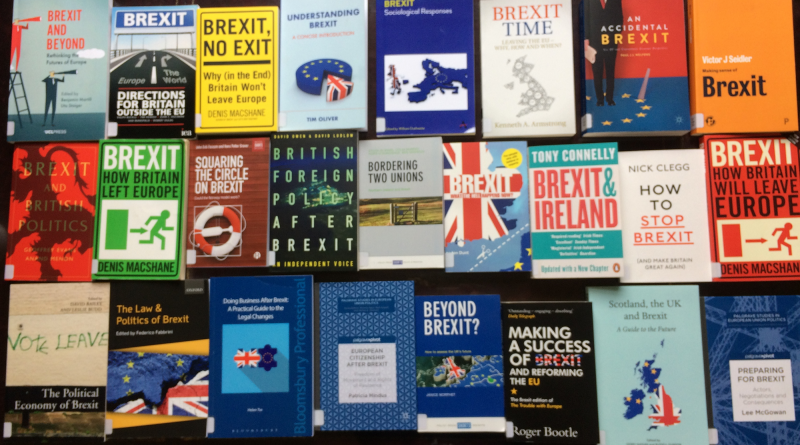
If the British police saw this collection, you’d be lucky to get out of prison in fifty years!
The UK police certainly seem to believe in that old aphorism that that “You can tell everything you need to know about a person from their bookshelf”. There has been much press coverage this week of the case of Julian Foulkes, a former policeman who was arrested at his home in Gillingham for tweetcrime. It took six officers to handcuff the pensioner and take him to a cell, and bodycam footage from the arrest shows them assessing the contents of his bookshelves. One was seen singling out The War on the West by Douglas Murray and another remarked that there were “very Brexity things”.
I have a fair few “Brexity” books on my shelf too. I have just as many “anti-Brexity” books, as it happens. It seems to have escaped the attention of these officers that it is possible to read multiple points of view without necessarily subscribing to any of them. They have also apparently forgotten that “Brexity” views are fairly commonplace, enough so to win the largest democratic mandate the country has ever seen. If it’s a majority view, is it really all that controversial?
I recall during the lockdown I was scheduled for a television interview and, having set up the webcam, I suddenly realised that the two volumes of Ian Kershaw’s excellent biography of Hitler were not only visible, but prominent. The design of the books’ spines is such that the word “HITLER” is displayed in huge letters. Very dramatic and marketable, but not so helpful if you’re about to appear on live television. I must confess that I repositioned my chair to ensure that the books were obscured.
But why? It isn’t as though any sensible person could possibly believe that my interest in the history of tyranny implies an endorsement of it. I could just as easily have a copy of Mein Kampf on the shelf and still retain my wholehearted opposition to its author and everything he stood for. If I owned a copy of the Koran, would that make me a Muslim? If I owned a copy of Jilly Cooper’s Riders, would that make me prone to passionate romps in stables? As a chronic hay fever sufferer, this hardly seems likely.
The assumption that the books we choose to read are a mirror-image of our private thoughts, or that we are so malleable that any opinion we encounter will automatically be assimilated, is very much a core tenet of faith in today’s woke mindset, one that has quite palpably infected the justice system. Those who are currently serving prison time for offensive tweets will be aware that the unevidenced belief that the public act on cue to the language they read has some very authoritarian consequences.
Comments Off on Those scary “Brexity books”
QotD: Marxist and socialist revolutions
The collapse of communist regimes in Eastern Europe, which he is happy to call revolutionary, also does not support his rough schema. It is not that the communist regime refused to reform, it is that it was incapable of reform for the same reason that a woman can’t be a little bit pregnant. If a regime makes the kind of claims for itself that the communist regime made, even if the leaders had themselves long since ceased to believe them, namely that it is the ineluctable denouement of all history, if not that of the universe itself, it cannot retreat, all the more so because its crimes, which one could and would have been claimed as a step in the march of history, would thereafter be seen for what they were: the choices of fanatical psychopaths avid for total power.
Professor Chirot seems to have a slight soft spot (admittedly only implicit) for socialism, that is to say for something more than mere social democracy. In his discussion of the case of Angola, in which a revolutionary movement emerged triumphant, but whose post-revolutionary regime was a pure kleptocracy under cover of Marxist rhetoric, he says: “Much more could have been done through either a market-friendly or a genuinely more socialist approach to economic development”.
This surely implies that somewhere, at some time, there was a socialist regime that would have handled Angola’s oil bonanza better, in which case one would have liked an example that it might have followed. Norway, perhaps? But Norway is not socialist, it is social democratic. Besides, Norwegians and Angolans are scarcely the same in a very large number of ways. I would have thought that the chances of Angola following the Norwegian model were, and are, approximately, and perhaps even exactly, zero.
Theodore Dalrymple, “Longing for Revolution”, New English Review, 2020-05-13.
Comments Off on QotD: Marxist and socialist revolutions
May 13, 2025
For boys, sometimes a touch of competition is all that’s required
Jon Miltimore was concerned when a report from his son’s school indicated that his son was lagging behind in reading compared to his classmates:
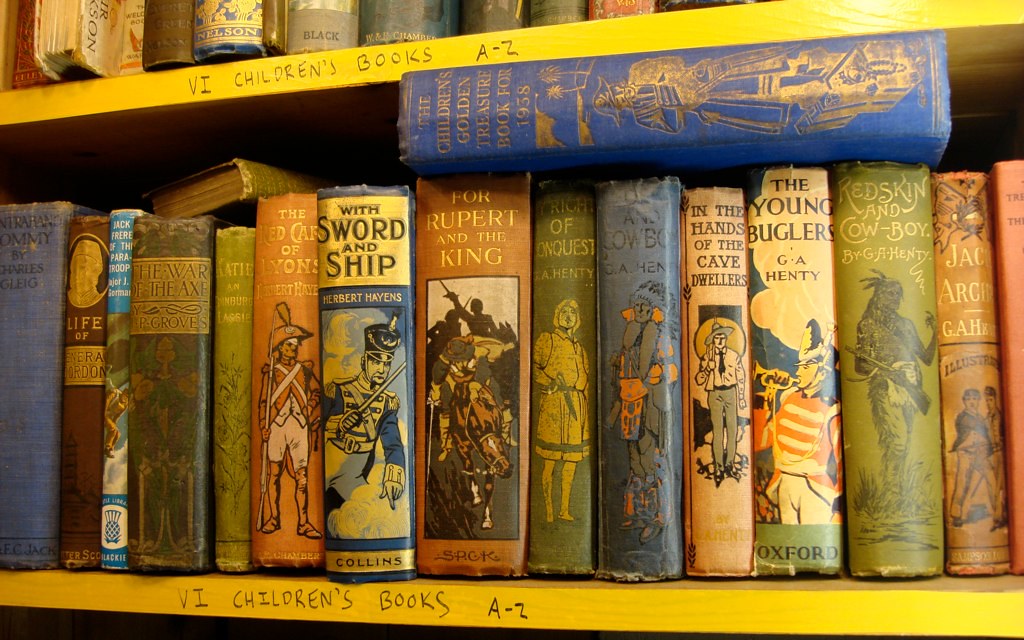
“Old Victorian Childrens’ Books” by pettifoggist is licensed under CC BY-SA 2.0 

 .
.
So the fact that my own son — who is quite bright and scores extremely high in math — was struggling hit me a little, but it was not a surprise. Like many children, he had fallen behind in reading during the pandemic, and our efforts to get him caught up at home were pretty ineffective. Part of the problem was that as parents we did not do a good enough job of finding the right books to naturally kindle his interest and curiosity, but another issue was that at some point he began to feel self-conscious about this reading, which created an aversion to books.
[…]
A few months later, I had just finished reading a story to my 6-year-old son, who shares a bedroom with his older brother. I went to flick the light off when my older son said something I’d never heard before.
“Can I read for just ten more minutes,” he pleaded, showing me his book on pro football players.
I quickly gave my approval, then went downstairs to tell my wife. She was not as surprised as I was.
“They’re doing a reading competition at school. It’s boys against girls,” she said. “Every minute he reads is now added to their score. So now he wants to read — because it’s a competition.”
My wife did not say this disapprovingly, but she said it in a way that said of course he wants to read now. (My son is competitive.)
Over the next several weeks I watched as my son made a point of reading every night. Oftentimes he’d ask — just like on that first night — if he could read just 10 more minutes. Many nights he’d fall asleep with a book on his chest.
I have to admit that at first I found this strategy a tad cynical, but then I got the results. Over the span of seven weeks, my son leapt nearly two reading levels. He’s reading comfortably at the third-grade level and we’re now focusing more on reading comprehension than reciting sentences. He’s asking for books on World War I, World War II, and Vietnam for Christmas.
“His fluency has improved so much! I am so proud of him,” his teacher later told me.
Competition as a Virtue
I don’t doubt that some will look on this strategy with disdain.
We’re taught today that competition is crass, even harmful. George Soros, in a highly read piece from the 1990s published in The Atlantic, could have been speaking for many when he wrote that competition can “cause intolerable inequities and instability”. For many, competition is a dirty word, a sinister force to be suppressed and controlled.
This is nonsense, of course. Competition isn’t just innate to humans; it brings out the best in us.
It’s the force that drove Roger Bannister to break the four-minute mile. It’s given us the achievements of Michael Phelps and Michael Jordan. Socially, competition is what prompted the Brooklyn Dodgers to do the unthinkable and sign Jackie Robinson, breaking the color barrier and forever changing sports and America.
Comments Off on For boys, sometimes a touch of competition is all that’s required
May 12, 2025
Is modern fiction in any way intended to be read by a male audience?
I belong to several genre-specific groups on various social media platforms, most of which appear to be disproportionally female in membership, and I read very little new fiction of any sort these days, partly for diminished interest and largely from diminished disposable income. I’ve often seen the assertion that men no longer read much fiction, but is it actually true?
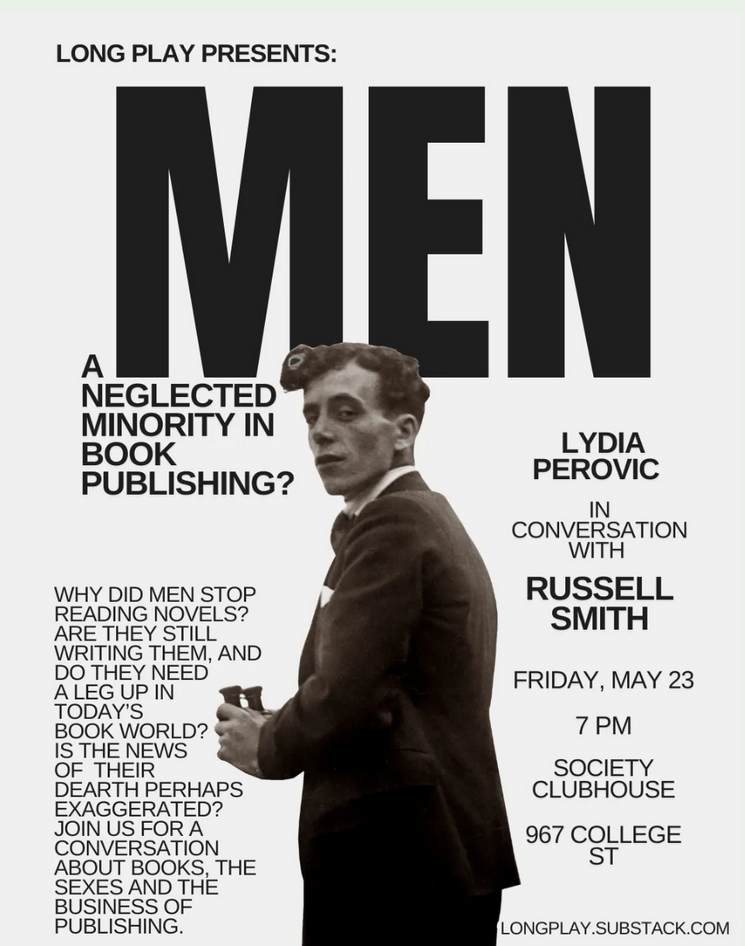
You can see here some of the challenges involved in measuring reading habits. Are we talking reading books or purchasing books? Does buying correlate to reading or are women better gift givers? What about those hugely popular 20-part, 60-page-per-instalment romance series that might ratchet up purchases by women — anything like that in the fiction market for men? Should we base assumptions about readership of literary fiction on data about readership of general fiction, as many of the articles I’ve read do?
All we can safely say is that it does seem men read somewhat less fiction than women; they also read fewer books of any kind. As a person in the book industry, I wish that weren’t so, but it may not be a cultural calamity.
The most interesting article I came across in last night’s binge was published in 2009 by the University of Saskatchewan’s Virginia Wilson in Evidence Based Library and Information Practice. She undertook a small study of boys aged four through twelve, interviewing them about their reading habits. Her theoretical perspective was that if anyone was ever going to understand the reading habits of boys, they needed to recognize that the experts were the boys themselves. She quizzed forty-three of them about their book collections, what they liked and didn’t like, and their motives for reading.
Each of the boys had a personal collection of books. These ranged from eight to 398 volumes, with a median of 98. All but one of the boys had fiction in his collection. The most prominent genres were fantasy, science fiction, sports stories, and humour. The boys had no time for love stories, books about groups of girls, and such classic children’s fiction as The Adventures of Robin Hood.
Asked about their favourite books, most of the boys pointed to a non-fiction title: joke books, magic books, sports books, survival guides, science books, references, atlases, dinosaur books.
The boys also read a good deal of non-book material: comics, manga, magazines, sticker books, puzzle books, and catalogues. A number mentioned reading video game manuals, both to learn more about the games, but also to heighten their enjoyment of the narratives within the games.
The manuals were part of a bent toward pragmatic reading, something they found useful as much as pleasurable. The boys often read to support another hobby — Pokémon, for instance. They also appreciated non-linear texts and plenty of illustrations.
Interestingly, many of the boys tended to discount their own reading. They often described the informational stuff they liked—those video game manuals or computer guides or research materials for science projects—as “not really being reading”. Serious reading, in their minds, involved novels and conventional non-fiction books.
Wilson’s conclusion was that at least part of the “boys and reading problem” might come down to what counts as reading. Informational nonfiction, comic books, computer magazines, graphic novels, and role-playing game manuals were “not necessarily privileged by libraries, schools, or even by the boys themselves”.
Of course, as Wilson notes, one shouldn’t generalize too much from a small qualitative study involving forty-three boys. There’s nothing definitive to be learned here about Trump or contemporary masculinity (although I’ve read several lengthy screeds based on less).
Wilson’s paper simply reminds us that reading is complicated, and most of the available research on reading habits isn’t. Survey respondents are typically asked if they read books for leisure, or if they’ve read a book in the last year. There are many reasons to read other than for leisure. There are many things to read other than books. And not all books are equal.
I haven’t seen a study that tracks if men spend more minutes per day reading sentences than women. Or one that drills down to find who reads the most newspapers, magazines, websites, newsletters, contracts, annual reports, research papers, instruction manuals, catalogues, and cereal boxes. Each of those formats is as potentially edifying (if not as much fun) as Morning Glory Milking Farm: A Monster Bait Romance, with its 47,570 enthusiastic ratings on Goodreads.
I read so many concerns for and condemnations of contemporary males last night that it came as a surprise to learn that our most reliable measure of reading competence, the Program for the International Assessment of Adult Competencies, finds no real difference in literacy of men and women aged 16 to 64 in the US or Canada. We should all revisit that baseline before assigning responsibility for the state of civilization to whoever is or isn’t reading or buying contemporary fiction. (PIAAC did find that while Canadian literacy scores have been stable, US scores have slipped 5 percent since Trump was first elected. Make of that what you will.)
Does the men-and-fiction problem exist? I think yes, and my sense is that it’s one of both supply (what’s getting published) and demand (what men will read). I thought I’d have more than that to say. This is my kind of issue — the whole point of SHuSH is ill-considered opinion drawn from shaky evidence on a weekly timetable — but I can’t compete with what I’m reading, so I’m backing off for now.
I certainly find myself reading almost nothing that has been published recently with a few exceptions for well-researched and well-written histories and military histories. My preferred genre reading got taken over by the “jam the narrative into every story” crowd a few decades back, so I stopped buying SF and fantasy titles except those from authors I’d already read.
Comments Off on Is modern fiction in any way intended to be read by a male audience?
May 8, 2025
Aftermath
I’ve read a few books on what happened in Europe after the surrender of Nazi Germany in May of 1945, but there is always more to learn about a continent-wide struggle to recover from a disaster of the magnitude of World War Two:
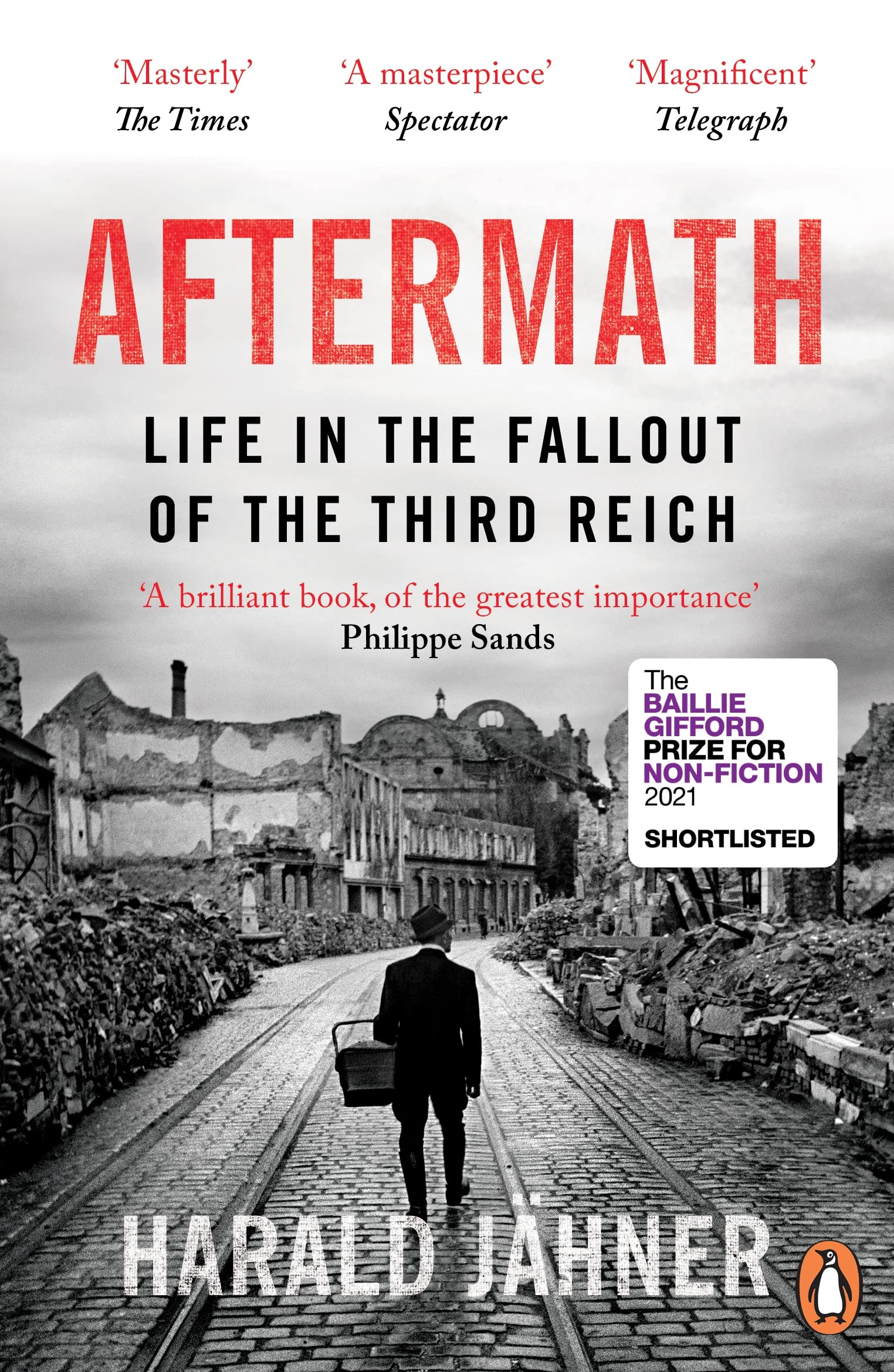
On a train journey earlier this year between Cologne and Berlin, I began to read Harald Jähner’s Aftermath, a fascinating account of the years when Germany emerged from the destruction and shame of the Third Reich.
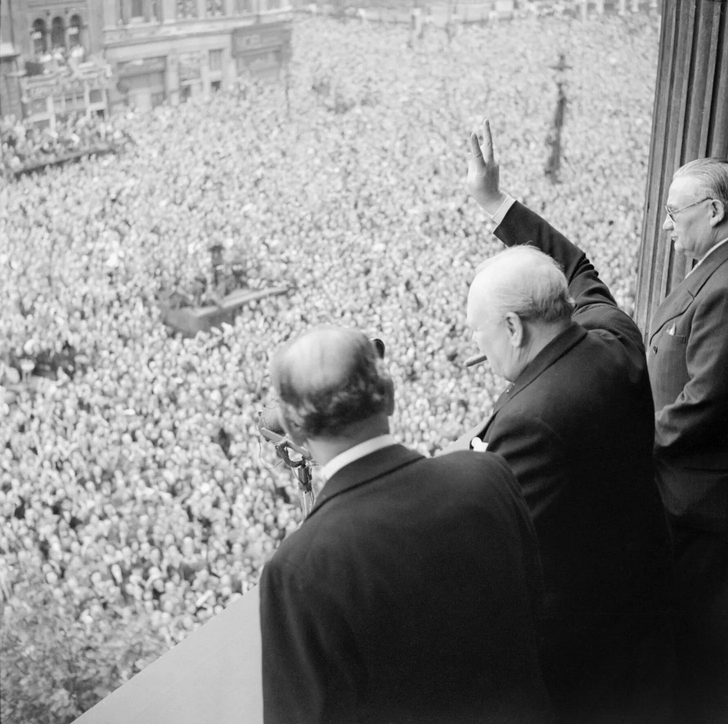
The war ended 80 years ago today, and in the defeated nation the scenes were primeval and apocalyptic. In Berlin, journalist Ruth Andreas-Friedrich, along with a doctor, actor and musical conductor, discovered a white ox wandering through the streets and, after finding a Russian soldier to shoot it, found themselves suddenly surrounded by a ravenous mob. She recalled: “Suddenly, as if the underworld had been spying on them, a noisy crowd gathered around the dead ox. They crept from a hundred basements. Women, men, children. Were they lured by the smell of blood? Within minutes they were scrambling for meat.” The bourgeois of Middle Europe reduced to an animal state.
Germany was a pile of rubble; the ruins in the Reich‘s capital amounted to 55 million cubic metres, enough for a wall 30 metres wide and 5 metres high stretching all the way to Cologne. In West Berlin, for the next 22 years, up to 800 lorries a day unloaded so much rubble on the former Factory of Armaments Technology that it became known as Teufelsberg, or Devil’s Mountain. The last “rubble brigade” in Dresden only finished work in 1977.
Although Nazi party members were made to clear rubble as a punishment, the Germans hardly needed encouragement; on 23 April, the war not yet over, the municipal building of Mannheim had already declared WE ARE REBUILDING.
The communal process of clearing away seemed to serve a psychological function for a hungry, defeated people, and was encouraged by the new authorities — all the “heroic cinematic rhetoric” employed by the UFA film company of the Nazi regime now used to get the country clearing up. There was even a cinema genre called Trümmerfilm, rubble films, one — And The Heavens Above Us — ending with the Lord’s Prayer being recited among the ruins of Germany.
German POWs, “dispirited, disciplined and dutiful to the point of submissiveness”, made life easy for occupying soldiers while their former victims were far more troublesome. (Russian POWs in France caused such anarchy that they called in a Soviet liaison officer who selected ten at random and shot them, bringing the mob under control.) This led to a bizarre alliance between Allied and German law enforcement working hand-in-hand from the early days of the occupation, with joint raids and weapons searches on displaced persons from Poland and the Soviet Union, which the Poles and Russians “of course saw as an intolerable provocation”.
London cheered on May 8, 1945. In Berlin they searched for food and cleared rubble
In a strange irony, there was now a large-scale migration of Jews from Poland to Germany, fleeing fresh persecution despite the horror they had endured. Even here in a camp system under Allied control, there were anti-Semitic attacks from other survivors, so that Jews were eventually separated altogether following the conclusions of the Harrison Report. The Americans, in a likely first in European history, now made Jews an explicitly privileged group, with superior camp conditions.
The Polish Jews set up their own camp in the Munich district of Bogenhausen where locals were confused and disorientated by the new arrivals. These eastern Jews actually looked like the alien caricatures Nazi propaganda had bombarded them with, dressed in oriental clothes from the shtetl, totally unlike the assimilated German Jews they had grown up with. One local complained that “the Jews from the old days were really, how can I put it, very intelligent, polite and unusually friendly and elegant people. And of course the ones who turned up after the war included all sorts.” The Jews “from the old days” were “the good Jews”, he lamented.
Holocaust guilt was in the distant future for most, and newly re-established newspapers weren’t remotely shy about publishing anti-Semitic content. One printed a resident’s complaint about Polish Jews that “these were not people who had been persecuted” but “the sputum, the yeast and the scum of elements who were never deported but, to avoid regular work, came here from the eastern states, in many cases completely illegally, and are now spreading themselves raggedly about the place.”
Comments Off on Aftermath
Ted Gioia is apparently “the guy you consult about the total collapse of everything“
I’ve been reading Ted Gioia‘s work for a few years now, but I somehow failed to pick up on the fact that he’s some kind of Bond supervillain:
Many articles have been written about me over the years. But I’ve never been hit with an opening sentence like the one published on Monday by The Atlantic.
Last year, I visited the music historian Ted Gioia to talk about the death of civilization.
Whoa! That makes me feel like a Bond villain.
I need some henchmen — any volunteers?
Ted appears to like the classic goon uniforms for his to-be-recruited legion of minions.
What an unexpected turnabout! For many years, I was known as an expert on music, especially jazz and blues.
But now I’ve taken on a new guise. I’m the guy you consult about the total collapse of everything.
I don’t sing the blues. I don’t write about the blues. I now deliver the blues.
I originally declined the interview request from The Atlantic. But their staff writer Spencer Kornhaber pushed back, insisting that I was an essential source for his article.
The subject was, he explained, a “pervasive suspicion that we’re in an era of cultural decline, especially in arts and entertainment”.
He said that I needed to be part of the story — because everybody saw me as the decline-of-culture guy.
This caught me surprise. But I thought it over. maybe this is why I don’t get invited to many parties anymore.
Dammit, Ted, we’re trying to have some fun here — and you keep droning on about the collapse of the Roman empire.
I eventually agreed to a phone conversation with Spencer, and that went well. And this led to him getting on a plane, and visiting me at home here in Austin.
To help him in his research, I laid out more than 40 books on a countertop in my library — these were essential works, I explained, for anyone studying social or cultural decline.
[At a future date, I will provide more details about these books, and share a reading list on — to quote The Atlantic — the “death of civilization”.]
But this begs the question: Is our culture really collapsing?
I spoke with Spencer for many hours about this subject. But only a few of my comments found their way into the finished article.
So today I’ll offer a fuller diagnosis for your benefit.


Comments Off on Ted Gioia is apparently “the guy you consult about the total collapse of everything“
May 6, 2025
Online tools for the curious autodidact
Like many people, I was generally not a good student and in primary and middle school, I was notorious for reading the “wrong” parts of books because they were closer to my interests than the assigned readings, but I generally was able to scrape together enough marks to pass the tests on the stuff I skimmed or ignored. This is hardly the way to make an academic career — not that I would ever have done so, unless they just let me study what I wanted to learn about. A useful Substack for my fellow autodidacts [Wiki] is a side project of military historian Bruce Ivar Gudmundsson called Extra Muros, and his latest post provides some information on tools for online research that you may find helpful:
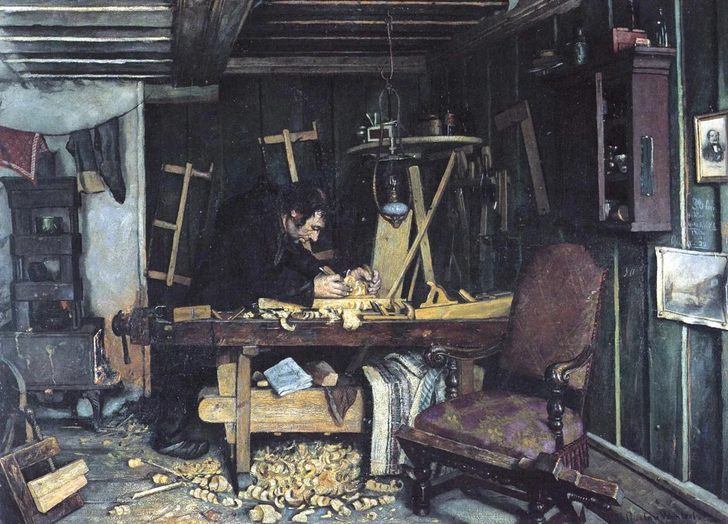
Gustav Wenzel – “A Carpenter’s Workshop” (1881)
The “advanced search” page of the Internet Archive allows you to …
- download copies, in various electronic formats, of
– books and magazines published before 1929
– works (such as those created by the US Federal Government) that have always belonged to the public domain
– relatively recent works uploaded by people in countries (such as India) with less restrictive copyright laws
- examine books that you might want to acquire for enjoyment the old-fashioned way
- find higher-quality copies of items that you found on Google Books
- obtain an overview of the works (to include foreign language translations)
– of a particular author
– on a particular subject
The “advanced search” page on the website of the Hathi Trust allows you to do many of the things you might otherwise do on the Internet Archive. Alas (and, indeed, alack), the interface restricts the direct download of complete volumes to “participating institutions”. As a result, mere mortals must either seek the PDF in question on Google Books (to which Hathi provides a direct link) or use a bit of freeware called Hathi Download Helper.
The Hathi Trust search engine also makes it easy for you to search within books for specific words and phrases, as well as the mention of particular places and personalities. Doing the former turns the Hathi Trust database into a kind of dictionary, a way of discovering ways that people in various climes and times have used the expression. Doing the latter converts that cornucopia into an encyclopedia.
The NGram Viewer performs a similar service. However, as it sits atop a smaller collection and suffers from a number of irritating defects, it has proved less useful to me than the website of the Hathi Trust.
Comments Off on Online tools for the curious autodidact
May 5, 2025
Post-election Bullshit Bulletin from The Line
Last week’s federal election has left us in the weird, unresolved situation of being not significantly different than the situation before the writ dropped. We still have a Liberal minority government, probably supported by the rump of the NDP caucus (minus Jagmeet Singh) and a reliable vote from the Green MP, which is enough to pass at least an initial confidence vote in the Commons. Before The Line‘s editors put the Bullshit Bulletin back into mothballs, we get a useful wrap-up post:

Pierre and Ana Poilievre at a Conservative leadership rally, 21 April, 2022.
Photo by Wikipageedittor099 via Wikimedia Commons.
We want to now offer some advice to Pierre Poilievre: grow up.
Seriously. Because not calling your opponent to congratulate him is bullshit.
We don’t mean Mark Carney! We do think Poilievre should call Carney and offer congratulations and also test the waters to see what extent, if any, there is room for cooperation. We aren’t naive idealists. We know neither man is going to want to hop into the sack — politically speaking — with the other. But there are still norms in a democracy, and they should be observed. Poilievre did congratulate Carney in his remarks on election night, and did so with professionalism and grace, and that’s good.
But we’re actually talking about Bruce Fanjoy, the newly elected Liberal MP for Carleton, the riding that had been held for many years by … Pierre Poilievre. Fanjoy defeated Poilievre on Monday, and by a decisive margin. In an interview with NewsTalk 1010 in Toronto, Fanjoy said that he hadn’t received a call from Poilievre to congratulate him. Calls to the winners of a riding race by the opponents in that riding are routine. Fanjoy doesn’t seem much fazed by the lack of a call, but still. It’s not a great look.
Indeed, we might go so far as to say that not making a call will be seen as confirmation in the eyes of some voters of what they already thought about Poilievre. We aren’t the first to note that the Conservative leader is polarizing and has high “negatives” — Canadians tell pollsters that they dislike him. We understand that congratulating the guy that beat you must be like pulling your own teeth out. We also think we have a good enough read on Poilievre’s personality to know why this is particularly difficult for him.
Too bad. A would-be national leader is expected to sometimes do unpleasant things. And we’re calling about a two-minute phone call here, not making a decision to send troops into battle (some of whom will die) or a decision that will alter the trajectory of our national history.
Make the call, offer congratulations, wish him well, offer any cooperation you can, and get it over with. And if you don’t, Canadians will be right to call bullshit on that.
In the latest SHuSH newsletter, Ken Whyte notes the oddly incurious attitude of the Canadian mainstream media toward the man who became Trudeau’s successor as PM and leader of the Liberal Party:

Then-Governor of the Bank of Canada Mark Carney at the 2012 Annual Meeting of the World Economic Forum in Davos, Switzerland.
WEF photo via Wikimedia Commons.
Mark Carney became prime minister of Canada in March without our media delivering a single meaningful profile of him.
There was a time, only recently ended, when every party leader and most prospective party leaders (and most senior cabinet ministers and chiefs of staff) were subjected to scrutiny the moment they were deemed serious players. A reporter, usually a high-ranking feature artist, would be assigned by Maclean’s, Saturday Night, Report on Business, The Walrus, The Globe & Mail, The National Post, a CBC documentary desk, or any number of other outlets, to dig into the person’s past, read everything on the record, speak to friends and enemies and knowledgeable observers, weigh all the evidence and craft a narrative to give readers (or audiences) a sense of what made the person tick, and some idea of how to think about him or her in relation to public office. At their best, these profiles would provide a welcome counterpoint to how political actors chose to define themselves and how they were defined by their opponents. They were an arbiter of sorts, a first draft of history depended upon by participants in the political process, other media, and the informed public.
No one bothered to profile Carney, even though his advent in our politics had been rumoured for years. It was as though the press gallery in Ottawa assumed he was a known quantity because he’d shown up at the Politics & The Pen Gala for several years in his capacity as governor of the Bank of Canada.
Carney was not only sworn in as prime minister without sustained scrutiny, he made it all the way to the last week of a national campaign before the Globe landed what read like a well-intentioned but hastily assembled and not terribly revealing profile of him. Also in the last week, The Logic, a very good upstart business news site, produced a better one, but for a relatively tiny audience behind an expensive paywall.
Thinking and reporting in depth about the careers and characters of our leaders is perhaps the most important thing that journalists do. Yet Carney’s experience is not unique. If you want to know anything about our last two prime ministers, Stephen Harper and Justin Trudeau, you won’t find much in newspapers, magazines, or documentaries. You’ll need to read the books about them: Stephen Harper by John Ibbitson, Right Side Up and The Longer I’m Prime Minister by Paul Wells, Party of One by Michael Harris; Trudeau by John Ivison, Promise and Peril by Aaron Wherry, The Prince by Stephen Maher, Justin Trudeau on the Ropes by Paul Wells. There is a whole other shelf of aggressively critical takes on the two leaders which offer valuable insights amid their axe-grinding: Tom McMillan’s Not My Party (Harper), Mel Hurtig’s The Arrogant Autocrat (Harper), Brooke Jeffrey’s Dismantling Canada (Harper), Mark Bourrie’s Kill The Messengers (Harper), Yves Engler’s The Ugly Canadian (Harper), Ezra Levant’s Libranos (Trudeau), Candice Malcolm’s Losing True North (Trudeau). Additionally, there are books by the leaders themselves, Harper’s Right Here, Right Now, and Trudeau’s Common Ground, and a range of others written about particular issues or by other participants in their governments.
The past year has brought a wealth of books on our political leadership. Justin Trudeau on the Ropes (Sutherland House) and The Prince (Simon & Schuster) chronicled the last days of Trudeau’s prime ministership. Catherine Tsalikis’s Chrystia (House of Anansi) profiled the woman who ultimately brought him down. Andrew Lawton’s Pierre Poilievre (Sutherland House) and Mark Bourrie’s Ripper (Biblioasis) treated the Conservative leader who sought to replace him. Carney, seemingly intent on dominating the conversation about himself, was ready with another book this spring. The election delayed it until summer.
Comments Off on Post-election Bullshit Bulletin from The Line
QotD: English intelligentsia and the Soviet Union
I am well acquainted with all the arguments against freedom of thought and speech — the arguments which claim that it cannot exist, and the arguments which claim that it ought not to. I answer simply that they don’t convince me and that our civilization over a period of 400 years has been founded on the opposite notice. For quite a decade past I have believed that the existing Russian regime is a mainly evil thing, and I claim the right to say so, in spite of the fact that we are allies with the U.S.S.R. in a war which I want to see won. If I had to choose a text to justify myself, I should choose the line from Milton:
“By the known rules of ancient liberty.”The word ancient emphasizes the fact that intellectual freedom is a deep‐rooted tradition without which our characteristic Western culture could only doubtfully exist. From that tradition many of our intellectuals are visibly turning away. They have accepted the principle that a book should be published or suppressed, praised or damned, not on its merits but according to political expediency.
And others who do not actually hold this view assent to it from sheer cowardice. An example of this is the failure of the numerous and vocal English pacifists to raise their voices against the prevalent worship of Russian militarism. According to these pacifists, all violence is evil, and they have urged us at every stage of the war to give in or at least to make a compromise peace. But how many of them have ever suggested that war is also evil when it is waged by the Red Army? Apparently the Russians have a right to defend themselves, whereas for us to do so is a deadly sin. One can explain this contradiction in only one way — that is, by a cowardly desire to keep in with the bulk of the intelligentsia, whose patriotism is directed toward the U.S.S.R. rather than toward Britain.
I know that the English intelligentsia have plenty of reason for their timidity and dishonesty; indeed, I know by heart the arguments by which they justify themselves. But at least let us have no more nonsense about defending liberty against fascism. If liberty means anything at all, it means the right to tell people what they do not want to hear. The common people still vaguely subscribe to that doctrine and act on it. In our country — it is not the same in all countries: it was not so in Republican France, and it is not so in the United States today — it is the liberals who fear liberty and the intellectuals who want to do dirt on the intellect: it is to draw attention to that fact I have written this preface.
George Orwell “The Freedom of the Press”, 1945 (written as the preface to Animal Farm, but not published in Orwell’s lifetime).
Comments Off on QotD: English intelligentsia and the Soviet Union
May 4, 2025
One Fine Day in the British Empire 100 years ago
Nigel Biggar discusses One Fine Day by Matthew Parker, which looks at the state of the British Empire in the mid-1920s with a moderately jaundiced eye (as you’d expect for a modern popular history about the empire):
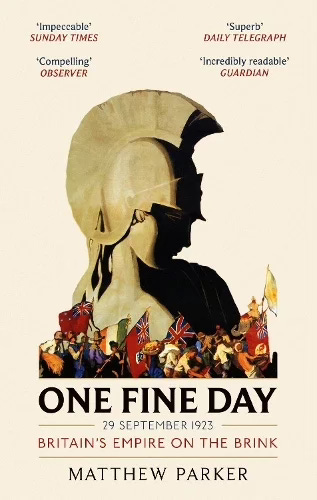
The approach is imaginative: to present a snapshot of the British Empire a century ago, five years after its victory in the First World War, when its territory was most extensive and at what must have seemed its zenith. The result is a display of the Empire in all its ad hoc variety, from the white-majority settler “dominion” of Australia to the non-settler “protectorate” of Uganda. The reader meets colonial officials who were sympathetic and conscientious in their dealings with those they ruled, as well as some who were brutally arrogant and dismissive. He also hears from native people who appreciated the benefits of imperial rule, as well as those who felt humiliated by Western dominance. And he learns that, if the British were late in introducing democracy to India, they were the very first to do so, for its like had never been seen before. To its great credit, no one can read this book and conclude that the British Empire was a morally simple thing.
However, it seems that our snap-shooter was fascinated mainly by the Empire in the east and grew tired as he travelled westward. Of the thirty-seven chapters, he devotes twenty-two to Australasia, the Pacific, South-East Asia, and India. There is very little mention of the Empire in South Africa, almost nothing on the Middle East (Egypt, Palestine, and Iraq) and hardly a reference to Canada. In addition, the publisher appears to have become alarmed at the length, since readers wanting to consult the notes or bibliography are directed to the author’s website.
What is more, the synchronic approach suffers from myopia, relegating major imperial achievements to walk-on parts. We do hear about the Empire’s humanitarian suppression of slavery, but only incidentally. The reader is not told that Britain (along with France and Denmark) was among the first states in the history of the world to repudiate slave-trading and slavery in the early 1800s and that it used its imperial power throughout the second half of its life to abolish slavery from Brazil across Africa to India and New Zealand. And in ending his book by reporting the 1923 cession of Rwanda to Belgium and Jubaland to Italy as tokens of imminent imperial dissolution — “Very soon, of course, the trickle became a flood” is the very last sentence — the author allows the reader to overlook the extraordinary, heroic contribution that the British Empire went on to make in the Second World War, when, between the Fall of France in May 1940 and the German invasion of Russia in June 1941, it offered the only military resistance to the massively murderous, racist regime in Nazi Berlin, with the sole exception of Greece.
While our imperial tourist is a generally an honest reporter, presenting the good as well as the bad elements of the Empire, his account is not innocent of unfairly negative bias.
The problem first manifests itself in the decision to open his account with the story of the mining ruination of a tiny Pacific territory by the British Phosphate Company. He then returns to this in the book’s closing pages, where describes it as a tale of “extractive colonialism at its most literal”. While an attentive reader of the pages in between will notice that the Empire sometimes brought native people economic opportunities and benefits, the lasting impression given by this bookending is that it was — as neo-Marxists have always claimed — basically exploitative. And yet Rudolf von Albertini, whose work was based “on exhaustive examination of the literature on most parts of the colonial world to 1940” (according to the eminent imperial economic historian, David Fieldhouse) judged “that colonial economics cannot be understood through concepts such as plunder economics and exploitation”.1
Parker’s negative bias appears most strongly in his crude, unreflective understanding of the racial attitudes of the imperial British. While he does bring onto the stage colonial Britons who express a range of views of other peoples, including sympathy and benevolence (albeit usually “paternalistic”), he nevertheless tells us that “ideas of white supremacy remained a guiding structural principle of the empire. This racist ideology was a coping stone of empire” (p. 8). What he has in mind is specifically the idea of a fixed “hierarchy of races”, with whites permanently established at the top — “what we would now call white supremacism” (p. 65). Such a view could claim the authority of natural science, since at the turn of the twentieth century “European scientists all still agreed that human beings were naturally unequal … and that there was a hierarchy of races” (p. 138).
1. D.K. Fieldhouse, The West and the Third World (Oxford: Blackwell, 1999), p. 168; R. von Albertini with Albert Wirz, European Colonial Rule, 1880–1940: The Impact of the West on India, Southeast Asia, and Africa, trans. John G. Williamson (Oxford: Clio, 1982), p. 507.
Comments Off on One Fine Day in the British Empire 100 years ago
April 29, 2025
1984 and the Politicizing of Language
Feral Historian
Published 16 Aug 2024A dive into 1984 in relation to modern politics can’t be done without pissin’ in everyone’s Froot-Loops, so grab a tall glass of Victory Gin and let’s talk about how The Party functions, how doublethink makes us crazy, and how it’s not just those nutters on the other side that do it.
I take a few jabs at current sacred cows of the Left and Right here. Hopefully the comments won’t look like Hate Week.
00:00 Intro
01:46 Thoughtcrime and Doublethink
12:27 War is Peace
17:46 Oligarchal Collectivism
22:12 MiniTruePost-release edit: It’s been pointed out that I grossly oversimplified the military analysis later in the video, which is true. Man-portable air defense systems and maneuver warfare are a lot more complicated than this video implies. As for that one particular doublethink example mentioned so very briefly, some of the counterpoints have been … impressive contortions of language in their own right. But not interesting enough to discuss the matter further.
Comments Off on 1984 and the Politicizing of Language


