
One reason Hobbes’s “state of nature” thought experiment is so seductive is because, though the premise is glaringly false, the conclusions are true. Every Dissident should memorize this, it’s the most important passage in modern philosophy (if not the whole of philosophy, from Socrates on):
I put for a general inclination of all mankind a perpetual and restless desire of Power after power, that ceaseth only in Death. And the cause of this is not always that a man hopes for a more intensive delight than he has already attained to, or that he cannot be content with a moderate power: but because he cannot assure the power and means to live well, which he hath present, without the acquisition of more.
Or, if you prefer it in slightly more modern English:
Now I will tell you the answer to my question. It is this. The Party seeks power entirely for its own sake. We are not interested in the good of others; we are interested solely in power. Not wealth or luxury or long life or happiness: only power, pure power … Power is not a means, it is an end. One does not establish a dictatorship in order to safeguard a revolution; one makes the revolution in order to establish the dictatorship. The object of persecution is persecution. The object of torture is torture. The object of power is power. Now do you begin to understand me?
That’s the bedrock of human existence, right there: Power. Everything that isn’t Power is nothing, until Power requires it; when it’s no longer useful to Power, it becomes nothing again. Nietzsche would’ve understood O’Brien perfectly.
But please note: Human existence.
Human — animals aren’t like that. They can’t be. They’re not mere automata, as Descartes would have it, but they’re obviously not self-conscious, either. All that Green hooey about animals living in harmony with their environment is, nonetheless, true. They can’t do any other, because they’re animals. Only humans can see that extra step ahead, all the potential dangers that will never let him rest content with the power he has.
And existence – not life, existence. The world Hobbes and O’Brien describe with such terrifying eloquence isn’t life, it’s mere existence. O’Brien couldn’t see where his philosophy led, but Hobbes could:
Whatsoever therefore is consequent to a time of War, where every man is Enemy to every man; the same is consequent to the time, wherein men live without other security, than what their own strength, and their own invention shall furnish them withal. In such condition, there is no place for Industry; because the fruit thereof is uncertain; and consequently no Culture of the Earth; no Navigation, nor use of the commodities that may be imported by Sea; no commodious Building; no Instruments of moving, and removing such things as require much force; no Knowledge of the face of the Earth; no account of Time; no Arts; no Letters; no Society; and which is worst of all, continual fear, and danger of violent death; And the life of man, solitary, poor, nasty, brutish, and short.
This is the end of power-for-power’s-sake. O’Brien was wrong about that boot stomping on a human face, forever. The “state of nature” doesn’t actually exist IN nature, but Big Brother’s Party created it artificially.
But for such a creation to continue, as O’Brien shows, it must be completely static … and that’s impossible. The opposite of Power is Entropy, and Entropy always wins in the end.
Severian, “Salute the Hat”, Founding Questions, 2021-12-07.
July 14, 2025
QotD: The inevitable endgame of power-for-power’s-sake
July 12, 2025
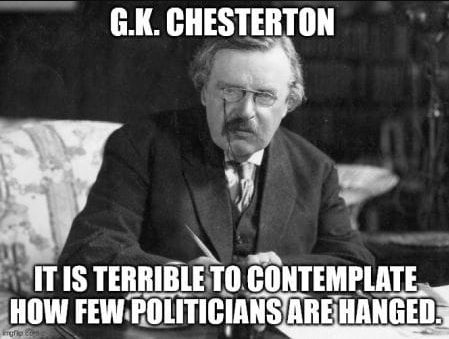
G.K. Chesterton on the dangers of cultural surrender
Andrew Doyle on Chesterton’s novel The Flying Inn (1914) which warned against the risks of unfettered immigration and what came to be known as “multiculturalism”:
The creed of multiculturalism has made it difficult to discuss the impact of unfettered immigration. The far right have always opposed it on the basis of racial prejudice and ethno-jingoism. Yet there are authentically liberal concerns to be raised about the problem of political Islam and how all discussions are stifled through accusations of “Islamophobia”. What happens when an essentially anti-democratic ideology is allowed to flourish within a society that otherwise depends upon democratic norms?
To help illuminate the troubles of our time, and in particular the perverted form of liberalism that ensures its own undoing, we might return to G. K. Chesterton’s The Flying Inn (1914), a whimsical novel about a future Islamic England. With today’s proliferation of sharia courts and the government’s determination to criminalise blasphemy against Islam by legislative stealth, one might call Chesterton’s novel prescient.
The key figure is Lord Ivywood, a politician who becomes enamoured of Misysra Ammon, an Islamic cleric who styles himself as the “Prophet of the Moon”. Ivywood is an exemplar of the zealotry of the progressive reformer, a prototype of the virtue-signaller, one who “did not care for dogs” but “cared for the Cause of Dogs”. He first introduces Ammon at a private event at the “Society of Simple Souls”, where he is able to preach his creed to the gullible bons vivants of the upper middle-class. The collective thrill of the crowd is pure orientalism, and they are easily mesmerised by Ivywood’s panegyrics.
Inevitably, Ivywood’s submission to Islam is framed in syncretic terms; not so much surrender as a beautiful fusion. “The East and the West are one”, Ivywood says. “The East is no longer East nor the West West; for a small isthmus has been broken, and the Atlantic and Pacific are a single sea.” Islam, he claims, is the “religion of progress”, a phrase that anticipates today’s oft-echoed slogan of Islam as the “religion of peace”.
This kind of doublespeak is ubiquitous among those activists who routinely strive to force the square peg of Islamic doctrine into the round hole of woke politics. This is exemplified by articles such as “Prophet Muhammed was an intersectional feminist” in Muslim Girl magazine, a piece that includes the inane claim that the founder of the religion “wanted to generate as much inclusivity as possible”. In similarly convoluted terms, Ammon in The Flying Inn argues that there is nothing more feminist than a harem. “What is the common objection our worthy enemies make against our polygamy?” he asks. “That it is disdainful of the womanhood. But how can this be so, my friends, when it allows the womanhood to be present in so large numbers?”
Today’s readers will recognise Chesterton’s depiction of the tendency of liberal politicians to kowtow to the demands of Islamic clerics in a bid to avoid causing offence. At one point, Ivywood explains that he has tabled the “Ballot Paper Amendment Act” in parliament to allow citizens to vote with a mark resembling a crescent rather than the traditional cross.
If we are to give Moslem Britain representative government, we must not make the mistake we made about the Hindoos and military organization — which led to the Mutiny. We must not ask them to make a cross on their ballot papers; for though it seems a small thing, it may offend them. So I brought in a little bill to make it optional between the old-fashioned cross and an upward curved mark that might stand for a crescent — and as it’s rather easier to make, I believe it will be generally adopted.
The main plot of The Flying Inn revolves around the innkeeper Humphrey Pump and the Irish sailor Captain Patrick Dalroy, who take it upon themselves to sell alcohol in spite of the new Islamic prohibitions in England. They find a loophole in the law that permits them to conduct their business so long as they first erect an official inn sign. And so we follow the pair as they dash from location to location, with their barrel of rum and a wheel of cheese on a donkey’s back, planting their portable sign wherever refreshment is needed.
July 11, 2025
William F. Buckley
In Quillette, Ronald Radosh reviews the long-awaited biography of arch-conservative William F. Buckley by his friend Sam Tanenhaus, Buckley: The Life and the Revolution That Changed America:
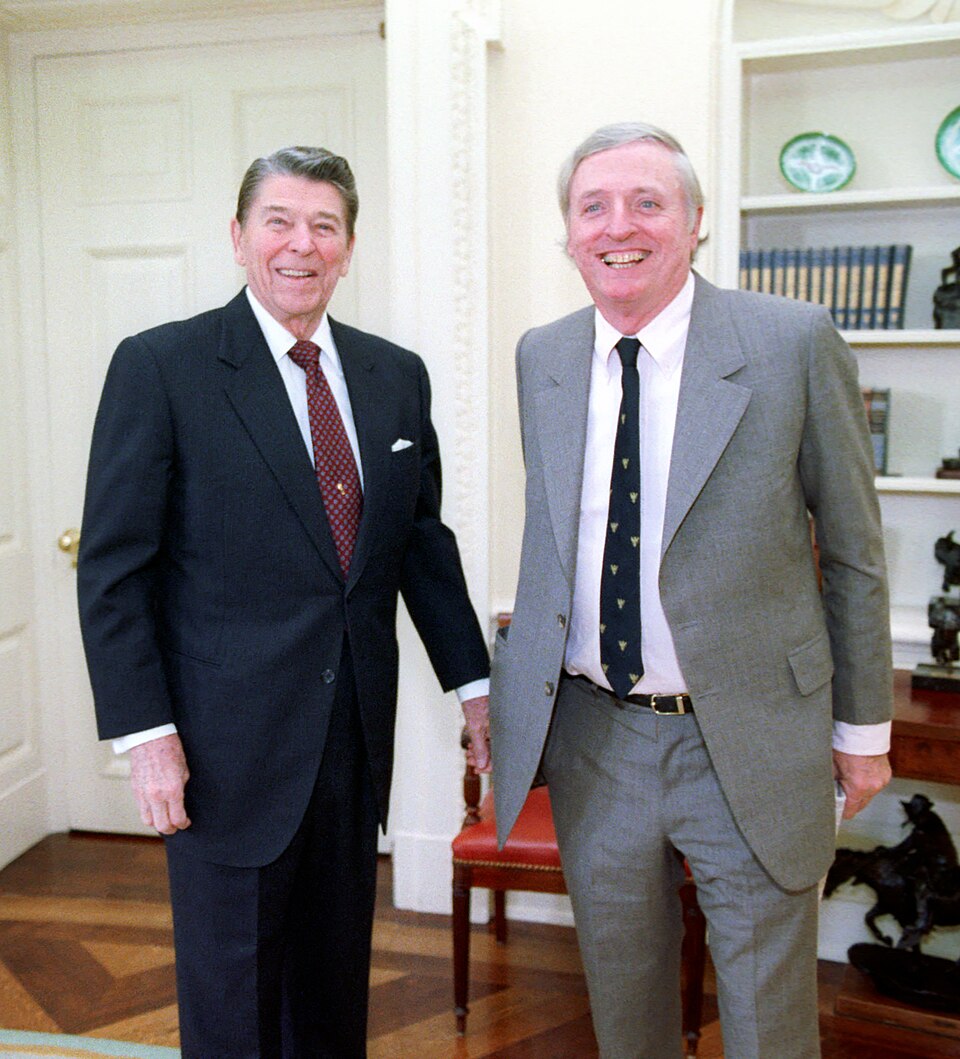
President Reagan meeting with William F. Buckley in the White House, 21 January, 1988.
Photo from the White House Photographic Collection via Wikimedia Commons.
William F. Buckley Jr. was a polymath of unusual erudition. The author of scores of books (including nearly two dozen novels), Buckley was an ardent apostle of conservatism at a moment when American liberalism was ascendant. But he was also an accomplished musician who played the harpsichord, a sailor who entered competitions and spent most summers on the sea, and an avid skier who spent his winters on the slopes of Gstaad after a morning of writing. Most Americans knew him as the host of a weekly television talk show called Firing Line, in which he interviewed and debated a wide range of politicians and intellectuals, most of whom he vehemently but politely disagreed with. (Many of these episodes are now available to view on YouTube.)
Television allowed Buckley to display his not inconsiderable wit and charm. He interviewed prominent socialists like both Norman Thomas and Michael Harrington, but he invited fellow conservatives onto his show as well. He had fellow conservatives on his show too, but he particularly relished debates with ideological opponents like Julian Bond (the young black leader of the Student Nonviolent Coordinating Committee), author Norman Mailer, journalist Christopher Hitchens, Ramparts editor Robert Scheer, and leaders of the Black Panther Party. The only people he would refuse to debate, he told the TV network, were communists lest he lend them legitimacy. Agents of the Soviet Union, he maintained, were not worth engaging with.
Buckley’s other major accomplishment was founding and editing America’s first nationwide conservative magazine. The bi-weekly National Review was the conservative counterpart of the influential liberal publications of the day, including the New Republic, The Nation, The Reporter, and the New Leader. Those liberal magazines all had rather small circulations but they also had the field to themselves until Buckley’s NR came along. Buckley hired a roster of old-style conservatives and ex-communists, including the former Trotskyist James Burnham, the former Communist agent (and accuser of Alger Hiss) Whittaker Chambers, Willi Schlamm, and Frank Meyer. As time went by, he added prominent young conservatives to the magazine’s masthead, many of whom would go on to become political leaders in the new American conservative movement. His prize protégé may have been Gary Wills, who eventually left NR‘s ranks and, much to Buckley’s disappointment, became an influential American liberal. Other NR contributors went on to become important American essayists and authors in their own right, like Joan Didion, George Will, and John Leonard, who edited the New York Times Book Review during the 1970s.
Buckley was the scion of a wealthy Connecticut family with a great estate in Sharon, Connecticut, that his father William F. Buckley Sr. named “Great Elm”. However, Buckley Sr. was also a Texan who identified closely with the American South, and after he made his fortune speculating in oil in Mexico and Venezuela, he purchased a mansion in Camden, South Carolina, for use during the cold Eastern winters. He named it Kamchatka, and the neighbouring residents, Tanenhaus writes, embraced the family “as Southerners who had come home”. Kamchatka had previously been the home of a Confederate general and senator who left office when Lincoln was elected President in 1860, but Camden would play an important role in the civil-rights movement.
By the 1950s through the ’60s, Tanenhaus writes, “the institution of Jim Crow — the legacy of slavery, the Civil War and Reconstruction — was being shaken at its foundations”. In the ’50s, the nation learned about the brutal murder of fourteen-year-old Emmet Till and massive protests by the black population began to appear across the South. The liberal magazines of the day covered the rise of the civil-rights movement and did what they could to mobilise Northerners in support of Southern blacks. In the deep South, activist efforts culminated in the famous Freedom Summer movement for black-voter registration in 1964. Camden, too, became the centre of a massive resistance movement.
Yet all this political and social upheaval never received a word of positive coverage in the pages of National Review. The reason for this was not complicated. Buckley’s family believed that “race was a settled question” and that racial separation was justified “as a matter of law as well as custom”. The Buckley family, of course, hired black help for their Camden mansion, whom they treated with respect and support. But members of the “Negro” race, as blacks were then called, had to know their place. So, Buckley wrote a number of unsigned editorials in February 1956 defending the South’s “deeply rooted folkways and mores”. The South, he argued, “believes that segregation is the answer to a complex situation not fully understandable except to those who live with it”, just as his own parents and siblings did. He vigorously objected to the Supreme Court’s verdict in 1954 outlawing segregated schools in Brown v. Board of Education, and he wrote editorials arguing that the Court’s decision was not an interpretation of the Constitution but rather “a venture in social legislation.”
In Camden, meanwhile, the Buckley family started and financed a newspaper called the News, which was meant to be a vehicle for the white South’s racist population and their “Citizens’ Councils”. Instead of burning crosses and lynching, the Councils preferred to use “legal threats, economic harassment, and public denunciation” in defence of segregation. In one case, a business owned by a black protestor was destroyed and his family harassed by the Council, after the owner tried to register to vote. As the violence in Camden became more extensive and widely reported, Buckley responded with an unsigned NR editorial on 10 January 1957 in which he argued that “the Northern ideologists are responsible for the outbreak of violence”. He did also condemn the “debasing brutality” of the white population’s behaviour, and for years, that remark remained his strongest condemnation of white violence. He continued to ignore the support provided to the Councils by South Carolina authorities.
One of Tanenhaus’s most stunning revelations is that, in 1956, Buckley dispatched an NR contributor to report on the National States’ Rights Conference in Memphis. The man he sent was one Revilo Oliver, whom Tanenhaus correctly describes as “a fanatical racist and anti-Semite”. The following year, NR published Buckley’s most infamous editorial, titled “Why the South Must Prevail”. The white community, he wrote, had a right to defend segregation because “for the time being, it is the advanced race”. The white South, he wrote, “perceives important qualitative differences between its culture and the Negroes’; and intends to assert its own”. And since NR “believes the South’s premises are correct”, the black population could justifiably have its interests thwarted by “undemocratic” but “enlightened” means. That editorial, Tanenhaus rightly notes, “haunts [Buckley’s] legacy, and the conservative movement he led”. Buckley also believed that if suppression of the black vote violated the terms of the Fourteenth Amendment, then that and the Fifteenth Amendment should be considered unconstitutional — “inorganic accretions to the original document, grafted upon it by victors-at-war by force”.
July 8, 2025
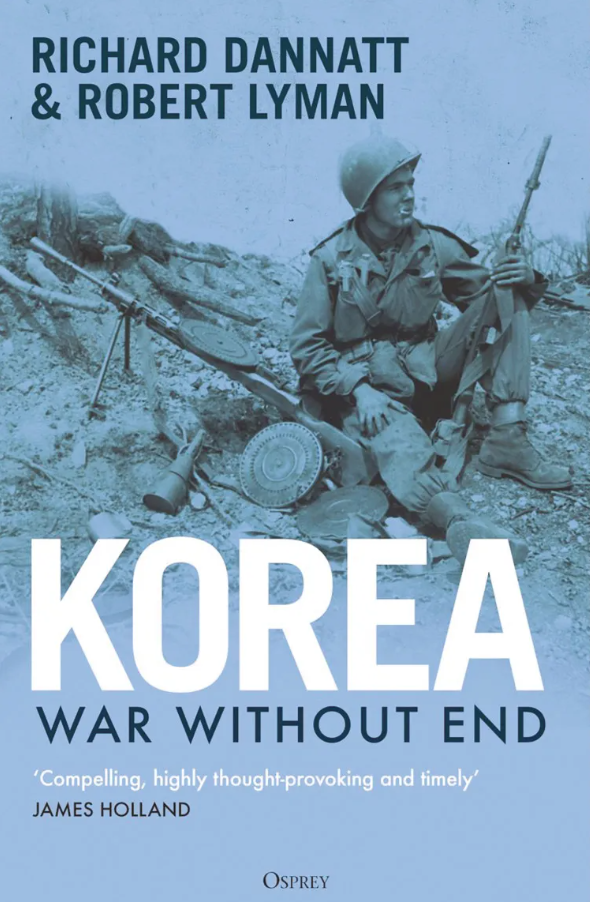
Korea: War Without End by Richard Dannatt and Robert Lyman
Taylor Downing reviews the latest co-operative work between former British Chief of the General Staff Lord Dannatt and Dr. Robert Lyman:
Their book has three premises. First, that the conflict in Korea is a forgotten one that very much deserves retelling. Second, that the war is very topical today partly because it shows how to fight (or not to fight) a conventional war in a nuclear age, and partly because it shows how politics must always take precedence over military ambition. And, third, the authors argue that the war was not a single conflict but was in fact two wars, quite separate but consecutive.
The “first” war is the story of the surprise invasion of South Korea by the North Korean People’s Army (NKPA), or the In Mun Gun, in June 1950 as their leader Kim Il Sung sought to reunite the Korean peninsula under Communist control without having any sense of the political response he would unleash. What followed was a rapid advance towards the southern city of Pusan in a form of Blitzkrieg that had not been seen since World War II.
This early phase covers the establishment of a US-led United Nations force for the first time in its history – only formed because the Soviet Union was boycotting the Security Council at the time. US troops finally slowed the NKPA advance and then, in a brilliant counterstroke masterminded by General Douglas MacArthur, an amphibious troop landing took place behind enemy lines at Inchon. This resulted in a complete reversal in the fortunes of the North Koreans and their retreat to pretty well their starting lines on the 38th Parallel that had divided the peninsula since 1945.
This, the authors argue, is where the war should have ended. The UN had achieved its aim of liberating the south from a Communist takeover. But instead a “second” war unfolded in which General MacArthur, convinced that he was fighting a crusade against world Communism, advanced rapidly through North Korea towards the Yalu River and the border with Communist or (as he called it) “Red” China. For him, victory had to include total defeat of the enemy. In scenes of remarkable hubris, MacArthur was convinced he had the war wrapped up and his troops would be home by Christmas. Instead, he provoked an attack by the Chinese People’s Volunteers on a massive scale, leading to the humiliating rout of US troops and a midwinter retreat back into southern Korea.
This “second” war had as its next phase the final standstill along lines roughly similar to the 38th Parallel and two years of stalemate, before an armistice was signed. The breakdown of the war into two separate conflicts is a fine way of interpreting the remarkable see-saw events of the first year of fighting. Seoul was captured and recaptured four times in nine months. Pyongyang was captured and lost, becoming the only Communist capital to have been taken in battle during the entire Cold War.
In the first stages of the conflict, UN troops, largely Americans who had been sent in from keeping the peace in Japan and who were entirely untrained and unprepared for combat, were thrown back so rapidly that many simply threw down their weapons and retreated. The NKPA, using the tactics the Japanese had used in their invasions of Malaya and Burma, completely outclassed the unprepared US forces.
Then, a few months later, the US-led advance made the Americans feel completely unstoppable as they headed north, only to be turned once more by the Chinese. Again, tactically outclassed and totally unprepared for mountain warfare in midwinter, where conditions were brutal, the UN forces collapsed. It is a remarkable story that very much merits the retelling.
“One of the problems with being a writer is that all of your idiocies are still in print somewhere”
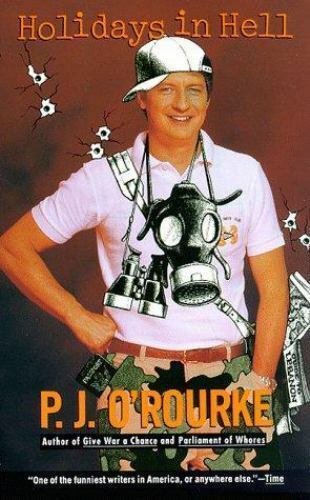
At the Foundation for Economic Education, Itxu Díaz considers the work of P.J. O’Rourke:
Though P.J. O’Rourke passed away three years ago, his sharp wit and defense of freedom continue to resonate in a world still tempted by interventionist solutions. Reclaiming his work is more vital now than ever. What he told us through laughs and jabs in recent decades has proven to be one of the sharpest diagnoses of the dangers of postmodern left-wing ideology — and one of the most inspired reflections on why we must root our societies in individual liberty, private property, the free market, and the Judeo-Christian values that shaped the West for centuries.
Progressives want bigger government, and often conservatives don’t want it as small as we ought to like. O’Rourke knew all too well that the larger the state grows, the smaller individuals become. He devoted much of his work to explaining this in a way anyone could understand — even those not particularly interested in politics. His words resonate today in a new light, and fortunately, they remain easy to access: the Internet is full of O’Rourke’s articles, and all his books are still in print. The ideas, the jokes — the profound, the outdated, and even the ones that haven’t aged all that well — are still out there, waiting to be discovered by any digital wanderer with a sense of humor and a thirst for sharp thinking. It’s almost frightening to realize that some of O’Rourke’s tech-related jokes would go completely over a Millennial or Zoomer’s head today. And it’s even more pitiful to think that some of his old comments would be cancelled in today’s dull, hypersensitive postmodern world. Perhaps it’s because, as he once said, “One of the problems with being a writer is that all of your idiocies are still in print somewhere”. Incidentally, that’s where O’Rourke found his only point of agreement with environmentalists: “I strongly support paper recycling”.
The hippie student he was in the ’60s lost his enthusiasm for leftist ideas the following decade, as soon as he got his first paycheck from National Lampoon: a $300 check that filled him with joy — until he was told $140 would be deducted for taxes, health insurance, and Social Security. That day, he got mad at the government, and the grudge never faded. Before that, while still sporting what he called “a bad haircut” — think John Lennon’s worst style — he’d decided to tell his Republican grandmother he’d become a communist. Her response threw him off: “Well, at least you’re not a Democrat”.
O’Rourke was never one to romanticize his drug-fueled college days. “Oh God, the ’60s are back,” he wrote. “Good thing I’ve got a double-barreled 12-gauge with a chamber for three-inch magnum shells. And speaking strictly as a retired hippie and former beatnik, if the ’60s come my way, they won’t make it past the porch steps. They’ll be history. Which, for God’s sake, is what they’re supposed to be.”
From his time as editor-in-chief of National Lampoon in the ’70s, we got his account in The Hollywood Reporter, “How I Killed National Lampoon“. The job was a blast, but the environment was hell: “Having a bunch of humorists in one place is like having a bunch of cats in a sack”. As a satirical war correspondent covering every late-century conflict, O’Rourke filled countless pages describing the struggle to find a damn glass of whiskey in the burning countries at the “end of history”. His last dangerous assignment was in Iraq. “I’d been writing about overseas troubles of one kind or another for twenty-one years, in forty-some countries, none of them the nice ones. I had a happy marriage and cute kids. There wasn’t much happy or cute about Iraq,” he wrote in Holidays in Heck.
July 7, 2025
Augustus: Visionary Statesman or Destroyer Of The Republic?
The Rest Is History
Published 27 Jan 2025The Roman historian Suetonius’ The Lives of the Caesars, written during the early imperial period of the Roman Empire, is a seminal biography covering the biographies of the early emperors of Rome, during two spectacular centuries of Roman history. Delving deep into the personal lives of the Caesars and sparing no detail, no matter how prurient, pungent, explicit or salacious, it vividly captures Rome at the peak of her power, and those colourful individuals at the heart of everything. It is an unsettling yet fascinating portrait of the alien and the intimate, that sees some of history’s most famous characters revealed as almost modern men, plotting a delicate line between private and public, respectability and suspicion. From the showmanship of Augustus, the first Caesar, and his convoluted family melodramas, to Tiberius, a monster in the historical record famed for his sexual misdeeds, to Caligula, who delighted in voyeuristic moral degeneracy, and the looming shadow of Nero; all will be revealed …
00:00 A humble plug from Tom
02:55 The most spectacular two centuries in Roman history
05:25 The value of Suetonius as a biographer
08:43 Suetonius’ interest in the love lives of the Caesars
12:58 Suetonius’ influence on popular culture
16:15 Augustus: Rome’s greatest actor
21:25 Roman politics as spectacle
21:55 Augustus as the model of a good emperor
24:30 What kind of monarchy was this?
28:00 The life of Suetonius
35:52 How did Roman histories work?
39:04 Why Romans had no idea of privacy
40:05 Did Roman emperors sexual misdemeanours matter
42:08 How we see sexual relations different to the Romans
(more…)
June 25, 2025
Experts – “The shorter, the better”. Audiences – “Gimme more long-form, stat!”
At The Honest Broker, Ted Gioia notes that the experts are all-in on shorter videos, but actual audiences are clearly now more interested in much longer-form treatments:
When I saw the numbers, I couldn’t believe them.
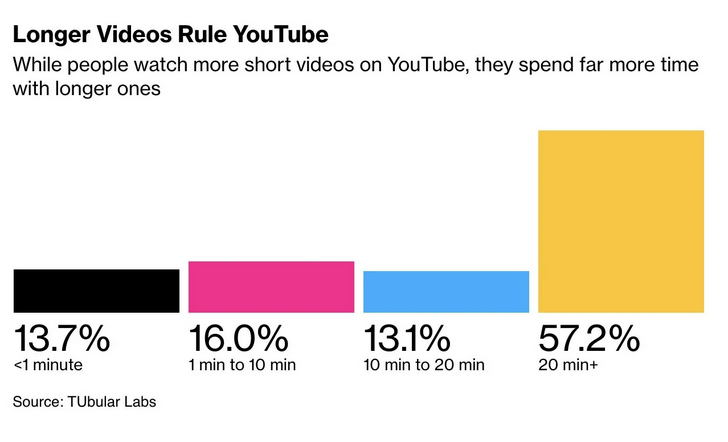
Every digital platform is flooding the market with short videos, but the audience is now spending more time with longform video — and by a huge margin.
Source: Tubular Labs
Some video creators have already figured this out. That’s why the number of videos longer than 20 minutes uploaded on YouTube grew from 1.3 million to 8.5 million in just two years.
That’s a staggering six-fold increase. But even short videos are now getting longer. Social media consultants call this the “long short” format. Sometimes they are used as teasers to draw viewers to still longer media (often on another platform).
Movies are also getting longer. At first glance, that makes no sense — more people are watching films at home on small digital devices, where Hollywood fare has to compete with bite-sized junk from TikTok and Instagram.
You might think that filmmakers would feel forced to compress their storytelling, but the opposite is true. They are learning that audiences crave something longer and more immersive than a TikTok.
At first, Hollywood insiders tried to imitate the ultra-short aesthetic, but they failed — sometimes in colossal fashion. (Does anyone remember the Quibi fiasco?)
Now they not only embrace long films, but happily release sprawling mega-movies longer than the Boston Marathon. Dune Two ran for 166 minutes — not even Eliud Kipchoge does that. Oppenheimer clocked in at 180 minutes. Scorsese’s Killers of the Flower Moon lasted a mind-boggling 206 minutes.
The studios would have vetoed these excesses just a few years ago. Not anymore.
Songs are also getting longer. The top ten hits on Billboard actually increased twenty seconds in duration last year. Five top ten hits ran for more than five minutes.
Two of those long hit songs came from Taylor Swift — who has been a champion of longer immersive musical experiences, most notably in her insanely successful Eras tour. She set the record for the biggest money-generating roadshow in music history, and did it with a performance twice as long as a Mahler symphony.
These Swift concerts run for three-and-a-half hours (just like Scorsese at his most maniacal), and include more than 40 songs. They’re grouped in ten separate acts, each built around a different era in her career.
Ten acts? Really?
Even Wagner stopped short of that. But the Eras tour generated more than $2 billion in revenues. And all this happened while experts were touting 15-second songs on TikTok as the future of music.
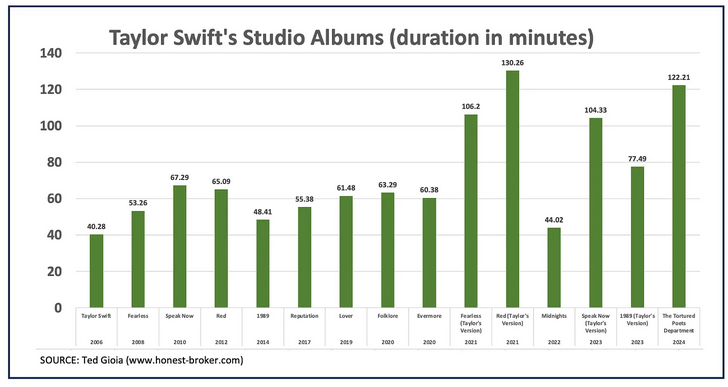
I’ve charted the duration of Swift’s studio albums over the last two decades, and it tells the same story. She has gradually learned that her audience prefers longer musical experiences.
The New York Times complained about the length of her most recent album — calling it “sprawling and often self-indulgent.” It mocked her for believing that “more is more.”
It summed up her whole worldview with a dismissive claim that she has fallen in love with “abundance”. In fact, the Times opened its article with that accusation.
But I note that a year after the Times laughed at Swiftian abundance, the hottest topic in the culture is a book with that same word as its title. (Full disclosure: I’ll be doing a live Substack conversation with its co-author Derek Thompson in a few days.)
Abundance has dominated the New York Times non-fiction bestseller list for the last several months. Even more to the point, the word seems to tap into the public’s hunger for something bigger, deeper, and more expansive than it’s been getting.
H.G. Wells’ Things To Come: Through The Eyes of its Time
Feral Historian
Published 10 Jan 2025H.G. Wells’ Things To Come played much differently in 1936 than it does today. So much so that it offers us an insight into the politics of the period if we can step back from our post-WWII understanding and look at it on its own terms.
Link to the Coupland essay.
http://digamoo.free.fr/coupland2000.pdf00:00 Intro
02:08 Revolution Envy
05:15 The Gulf of Time
06:32 Wells and the BUF
08:02 Empire and Establishment
12:11 The World State
15:18 To Understand the Past …
June 24, 2025
Fandom Has Always Been UNHINGED
Jill Bearup
Published 23 Jun 2025Listen, nobody asked for a history of fanfiction but here we are regardless. From Helen of Troy fix-it fic to Holmes fans unsubscribing en masse when the detective was killed in The Final Problem, fandom has always been this chaotic, and fanfiction has always been with us. In one form or another.
00:00 Did you ask for this? Nah.
01:20 Ancient authors ripping off other ancient authors
03:06 Virgil was a Homer fanboy
04:10 Dante was a Virgil fanboy
05:18 Don Quixote and the Case of the Unauthorised Sequel
08:01 The Statute of Anne
12:35 Gulliver’s Travels NSFW fanart
14:40 Geniuses and Originality
16:51 The Berne Convention
17:20 Character Vibes are not Copyrightable
20:46 The First Modern Fandoms (were Genuinely Unhinged)Link to Der Spiegel article on copyright and innovation: https://www.spiegel.de/international/…
June 22, 2025
Delaying Mark Carney’s next book
In the latest SHuSH newsletter, Ken Whyte outlines the various oddities of Mark Carney’s next book to market:

Three years ago, long before he declared himself a politician, Mark Carney published Value(s), his attempt at solving some of the world’s biggest problems: income inequality, climate change, systemic racism, etc. The book was reasonably well received. It sold well. A sequel was in order.
Announced last year, The Hinge: Time to Build an Even Better Canada was ostensibly Carney’s attempt to address Canada’s biggest issues, and perhaps to position himself as our future leader. The book was set for release in May 2025. Events interceded and Carney was elected prime minister on a far tighter timeline than anyone, including his publisher, could have imagined. Publication of The Hinge was delayed. An anonymous source told the Toronto Star Carney was too busy politicking to finish the final edits on the book. I heard the delay had more to do with campaign finance rules that would consider a book publicized or released in election season as political advertising. Anyway, a new release date was set for July 1. Amazon now has The Hinge coming next January.
Carney’s political opponents have been enjoying the delay. Critics both left and right have attributed it to the difficulty of squaring positions taken by Carney a year or two ago with positions he espoused during the campaign and, more recently, as prime minister.
I don’t doubt that Carney’s politics have moved over the last six months. And I wouldn’t be surprised if his second book is being rewritten in whole or in part. I don’t have a problem with that. Much has happened, both in Canada and south of the border. We’ve all been reconsidering our positions.
My problem with Carney’s conduct is not that he’s revising his manuscript, if he is, but that he’s not revising his publishing contract.
The Hinge is set to be published by Signal. Signal is a division of McClelland & Stewart. M&S is a division of Penguin Random House Canada. PRHC is a division of Penguin Random House LLC, corporate headquarters at 1745 Broadway, 3rd Floor, New York, New York, 10019.
Penguin Random House LLC is owned by Bertelsmann, a media conglomerate in Gütersloh, Germany, but legally and operationally, it is a US company. Its executive leadership, including CEO Nihar Malaviya, works out of the above address. Strategy and publishing priorities are set in New York, and profits in PRH’s many far-flung international divisions flow to New York. So the prime minister of Canada is publishing his book with the Canadian branch plant of a US company.
Other recent prime ministers have done the same. Justin Trudeau published Common Ground with HarperCollins. Steven Harper published Right Here, Right Now with Signal, and his forthcoming memoir sits there, too. Jean Chretien released My Stories, My Time with Random House Canada. Most of our politicians have published with branch plants of American firms.
I should add that many of our best writers publish at these same branch plants, if not directly with US publishers. (Even middling scribblers like me have published directly in the US.)
But, again, the world has changed. To quote no less an authority than Mark Carney, Canada’s old relationship with the US, “based on deepening integration of our economies and tight security and military cooperation, is over”. We need to “fundamentally reimagine our economy”, “retool” our industry, and enhance our self-sufficiency.
He sees our cultural relationship with the US as part of this project. From the Liberal platform: “In this time of crisis, protecting Canada means protecting our culture, our journalism, our perspectives. The Americans have threatened our sovereignty and issued inflammatory statements about our economy; we need to be able to tell a story that fights back.”
Right under the cultural section of the platform was a “Buy Canadian” plank. “At a time when our economy is under threat, consumers want to do their part as patriotic Canadians, buying things that are truly made here.” Team Carney promised to make it easier to determine what is and isn’t a Canadian product and prioritize made-in-Canada suppliers in every sector of the economy, limiting bidders from foreign suppliers, and so on.
So it’s “eLbOwS uP!” for the voters, but carry on publishing your next book through a US-owned subsidiary, eh? You have to admit they wear their hypocrisy proudly.
June 19, 2025
The Guns of the South: Checkmate, Alt-Hist Plausibility Sticklers
Feral Historian
Published 24 Jan 2025Harry Turtledove’s The Guns of the South gives us a look at a victorious Confederate States as they grapple with the consequences of slavery, war, and the challenges of building a new nation. It also skewers a favorite activity of alt-history readers, the nitpicking of plausibility in the points of divergence, by dropping South African time travelers with AKs into the middle of the Civil War.
00:00 Intro
02:08 America Will Break
04:49 Right and Left
05:36 CSA at odds with AWB
08:08 Forrest
10:16 Technology
13:16 “Why then …”
June 15, 2025
QotD: Four stages of revolutions
Professor Chirot writes extremely well and is never less than clear. He uses no jargon and he has a gift for condensing complex historical events into a short compass without resort to procrustean simplification. I would imagine that he is an excellent teacher.
He does not claim to have found a universal law of history that applies at all times and in all places, but he says that large-scale revolutions in the modern world have had a tendency to go through four discernible stages. First, an outmoded governing power refuses to accept that change is necessary and consequently refuses to make the necessary concessions to save itself. This leads to overthrow by relatively moderate leaders who would once have accepted compromise but see that change can only come about by revolution. Second, there is a counter-revolutionary reaction by those who do not accept their loss of power and who provoke a civil war or call for foreign intervention, or both. As a result, much more radical revolutionary leaders come to the fore and defend the revolution by increasing repression of enemies or supposed enemies. Third, the radical leaders, because they hold extreme views and are imbued with unrealistic notions of the complete redemption of mankind from all its earthly ills, impose experimentation on the population which is economically and socially disastrous. Fourth, in the case of its evident failure, the revolutionary regime loses its ideological ardour, and settles down to a kind of routine and less violent authoritarianism accompanied by large-scale corruption and cronyism.
Theodore Dalrymple, “Longing for Revolution”, Law & Liberty, 2020-05-13.
June 12, 2025
QotD: Napoleon Bonaparte, arch-meritocrat
Jane: But Napoleon was a meritocrat, in the strictest and most literal sense. He made himself emperor through sheer excellence, and the men he elevated were the same. I mean, let’s look at his first set of marshals: Augereau is the son of a fruit-seller, Ney’s father was a cooper, Masséna’s father was a shopkeeper, and Bessières’ was a doctor (in an era when that was a lot less prestigious than it is today). Bernadotte starts out the son of a provincial prosecutor and ends up king of Sweden. Only Davout had an aristocratic background. Obviously this was sort of inevitable, because the previous elite had been literally decapitated and a new one had to come from somewhere. Maybe it’s just what happens when you have a particularly profound disruption: people end up in power because they’re better than anyone else at making war to get the power in the first place. Just like you can’t follow the lineage of any European aristocrat back farther than the Germanic conquerors of the early Middle Ages. (The Psmiths, as is well attested, trace descent from the Viking Psmiðr who came to Normandy with Rollo in the 8th century.) But I think it’s more than that. Napoleon set up all kinds of meritocratic institutions outside the military: he had his competitive examination lycées, he was constantly promoting the talented young auditeurs he ran across in the Conseil … (Can you tell I liked the civil administration chapters better than the battle chapters? #thetwogenders)
So what is the difference between Napoleonic meritocracy and our present sort? I think the real difference is that in his case there was someone doing the choosing. This is important for a couple of reasons: first, because it takes a certain amount of talent to recognize excellence. You can get away with being a Salieri, but you need to have something. I think we’ve all seen institutions whose HR departments were so packed with drones that they couldn’t have recognized a genius if one fell into their laps, let alone wanted to work for them. And it’s way, way harder to keep around an institution full of competent intelligent people with correctly aligned incentives than it is to just … be good at identifying talent, personally. Second, a person exercising judgment can take a way more holistic view than any standardized metric. This is what college admissions claims to be trying to do when they’re not just using it as an excuse to keep out Asians. But a well-functioning meritocracy — or an emperor picking his men — should be searching for excellence. Studying hard and doing well on a test not only fails to reliably indicate excellence, it actually encourages and cultivates habits of mind that undermine excellence.
But the biggest reason this is important, I think, brings us back to Napoleon again, and might be the key to what you described as the strange inconsistency between his loving concern for his men and his willingness to send them to a hideous death. Because I don’t actually think it’s an inconsistency at all! And it has to do with mission. What’s the deal with our current meritocratic system? “We want to have the smartest people in power”. Okay but why? “So they can be effective”. Effective at what?
No one ever had to ask Napoleon “effective at what”.
He was willing to throw himself, and his closest friends, and the meanest infantryman whose boots he nevertheless obsessed over, into some of the most hellish experiences yet devised by men1 in service of something greater. And you can be snide and say the something greater was “Napoleon”, and that’s sort of true, but to him and to France “Napoleon” had come to stand for law and knowledge and liberty and order and greatness itself. Napoleon’s meritocracy worked because it had a telos. Our meritocracy is the idiot fluting of a blind inhuman blob.
Jane and John Psmith, “JOINT REVIEW: Napoleon the Great, by Andrew Roberts”, Mr. and Mrs. Psmith’s Bookshelf, 2023-01-21.
1. Another book recommendation! The Face of Battle.
June 10, 2025
The limits of female empathy
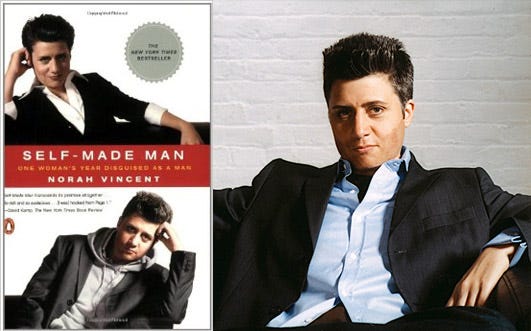
Janice Fiamengo discusses the 2006 book Self-Made Man: One Woman’s Year Disguised As A Man by journalist Norah Vincent. Intended as a kind of exposé of male privilege, her investigations turned into something rather different than she originally intended:
Many men are lonely. Many don’t like the work they do. Many are unhappily married. They struggle with an at-times overwhelming sex drive. Their encounters with women, romantic or otherwise, often involve rejection and contradictory tests of their masculinity. They are the objects of blame and bigotry in their societies, yet are expected to remain stoic and put women’s needs first.
It’s a strange world in which the above observations — by a woman — are seen as outstanding insights, but it’s the one we’re in.
In 2006, American journalist Norah Vincent published Self-Made Man: One Woman’s Year Disguised As A Man, an under-cover adventure in which the author, a mannish lesbian with big feet, spent close to 18 months periodically disguised as a man named Ned, notching up about 150 episodes in drag.
With breasts flattened, fake stubble on her chin, and a stuffed jock strap in her pants, having hired a tutor to teach her how to pitch her voice low and move like a man, she set out to “infiltrate exclusive all-male environments and if possible learn their secrets” (p. 18). She joined a bowling league, went on dates, did sales calls, spent some weeks at a monastery, and attended a Robert Bly-influenced men’s wilderness retreat.
Expecting to learn something about male power, she found instead “the hidden pain of masculinity and my own sex’s symbiotic role in it” (p. 254). The planned exposé became a feminist mea culpa.
The book got a lot of attention when it was published, and many men expressed gratitude and appreciation for the empathy and insight in Vincent’s work.
Reading the many accolades, I felt sadness, tenderness, and amazement. Wasn’t this a bit much? Was it really so remarkable that a woman could develop sympathy for the opposite sex?
Most men are so unaccustomed to any empathy from a woman, even when it’s mixed with patronizing descriptions and questionable conclusions, that they respond as if to heroism. The woman who cares, even within circumscribed limits, is catapulted into the company of the saints.
Imagine the reaction if a man had masqueraded as a woman for a year or more, and then pretended to understand women (even sympathetically) using a shop-worn ideological framework? Imagine a white person putting on blackface in order to become an expert, even a well-intentioned one, on the need for black self-improvement? There would be howls of outrage and indignant rebuttals, especially by members of the impersonated group.
Not in Vincent’s case. So rare is a woman’s attempt to understand male experiences that she doesn’t need to be consistently sympathetic or accurate.
Even when someone goes beyond temporary male drag, there is a palpable surprise that mens’ lives are not a well-watered garden of male privilege:
Today, of course, there is still always a reason to look away from men’s pain. Feminist-inclined men and women routinely “bathe in male tears“. They claim that discussing men’s issues is misogynistic, and ask “Can White Men Finally Stop Complaining?” No wonder it seems that the only time men can be heard is when women speak for them.
Notably, women who “transition” to male through hormone treatments and surgery are often shocked by the indifference and unkindness they encounter in public, where men are not eager to help and women expect deference. Zander Keig wrote as a trans man in “Crossing the Divide” of a pronounced sense of aloneness: “No one, outside of family and close friends, is paying any attention to my well-being”.
June 3, 2025
QotD: Heinlein’s opinions on the right to bear arms
Between 1942 and 1966 Heinlein’s politics evolved from New Deal left-liberalism towards what after 1971 would come to be called libertarianism. But that way of putting it is actually misleading, because Heinlein did not merely approach libertarianism, he played a significant part in defining it. His 1966 novel The Moon Is A Harsh Mistress was formative of the movement, with the “rational anarchist” Bernardo de la Paz becoming a role model for later libertarians. By 1978, we have direct evidence (from an interview in Samuel Edward Konkin’s New Libertarian magazine, among other sources) that Heinlein self-identified as a libertarian and regretted his earlier statism.
But if Heinlein’s overall politics changed considerably and wandered down some odd byways during his lifetime, his uncompromising support of civilian firearms rights was a constant on display throughout his life. Brin observes that was already true in 1942, but attempts to attribute this position to John W. Campbell. Multiple lines of evidence refute this claim.
[…]
Heinlein, on the other hand, was a vocal and consistent advocate of civilian weapons ownership both during and after his association with Campbell. This is perhaps clearest in his 1949 novel Red Planet, written after their parting of the ways. In that novel, the bearing of personal weapons is explicitly connected to the assumption of adult responsibilities.
Red Planet is also interesting because, although we might consider the views of Heinlein’s characters an unreliable guide to Heinlein’s own, Heinlein’s letters about the novel reveal much more. His editor at Scribner attempted to delete the section of argument in which weapons-bearing is connected to adult responsibility; Heinlein rejected this, objecting that it eviscerated the book’s ethical core and making very clear that the views of the pro-gun mentor figures in the novel were his own.
Heinlein was to reiterate similar views not only in his later fiction but in the posthumous nonfiction collection Grumbles From The Grave – by which time they were no surprise to any Heinlein fan. And it would be difficult to overstate the influence they had on firearms-rights activists during the dark years between the Gun Control Act of 1968 and our vindication in the 2008 District of Columbia v. Heller ruling.
Heinlein’s gift to firearms-rights activism during that bleak four decades was to be able to draw on the principled case for civilian firearms going back to the framers of the U.S. Constitution and English Republican sources and restate it in language appealing to the brightest children of post-WWII America. But he did more than that, because in Red Planet and elsewhere firearms rights were presented as an inextricable part of a philosophical whole, with the personal firearm both as instrument and defining symbol of personal liberty and responsibility.
Eric S. Raymond, “Brin on Heinlein on guns is dead wrong”, Armed and Dangerous, 2011-07-18.


