
History Hit
Published 12 Sept 2024Historian Dr Kate Lister removes Bridgerton‘s rose-tinted glasses, unlaces the corsets and unbuttons the breaches of the Georgians. Join Kate as she investigates how s*x and the world of celebrity were a big thing long before the 20th century.
The fabulous wealthy elite of Bridgerton look perfectly preened, their teeth, hair, make up, even their sex scenes are all filled with opulent glamour! But in reality a lot of people in Georgian society, including the wealthy, were dealing with a myriad of issues, from syphilis, teeth decay and scandals to laudanum and gin addictions. All of this would have been rife and incredibly visible on the big city streets during the booming industrial revolution.
Kate uncovers what went on betwixt the Georgian sheets: who’s doing what, where, how and with whom. Along the way she’ll explore extraordinary guides to s*x work in London and Edinburgh and unwrap the world of 18th century condoms, syphilis and even high profile and hidden sex clubs. All of this will help to unearth the real lives of the people stomping the streets, pubs and back alleys of these lavish Georgian cities. No stone is left unturned in the quest to reveal the real lives of Georgian society!
(more…)
April 25, 2025
What Were Georgian Attitudes Towards Sex? | Georgian Pleasures
April 22, 2025
Douglas Murray’s On Democracies and Death Cults
James Pew reviews Douglas Murray’s latest book, On Democracies and Death Cults: Israel and the Future of Civilization (I was first made aware of the book by the sudden uptick in antisemitic posts on social media that directly attacked Murray and his work).
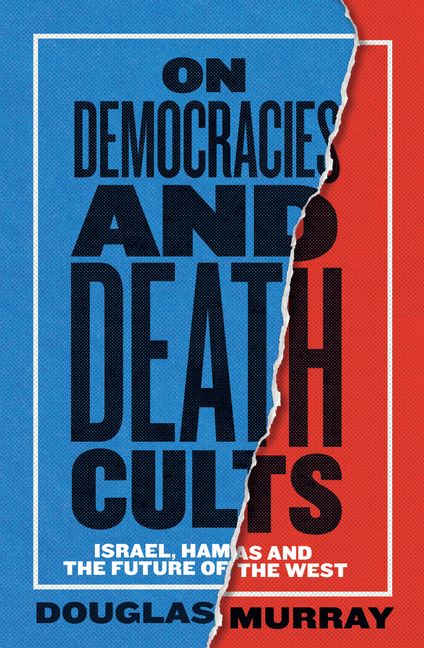
The opening words of On Democracies and Death Cults by Douglas Murray contains a disturbing fact about the situation Israel, and the entire Western world, were thrust into immediately following the barbaric terrorist attacks of October 7, 2023:
Sometimes a flare goes up and you get to see exactly where everyone is standing.
Indeed. Out of all the conflicts occurring all over the world, many of which are more devastating by orders of magnitude and in terms of the scale of humanitarian catastrophe than the IDF’s Gaza campaign, why would Westerners care so much about it? Why do Canadians and Americans take to the streets and occupy college campuses over it? These and many other vital questions are asked by Douglas Murray in On Democracies and Death Cults.
So why should this particular October 7th event, and the IDF’s subsequent military response, which is taking place halfway around the world, be the one that reveals “exactly where everyone is standing”? Murray knows the answer, as do his readers and most clear thinking people who do not harbour secret loathing’s for the Jewish people. The reason is clear and plain as day: the Jews are defending themselves and their homeland from a terroristic death cult bent on their destruction, but for some reason hoards of people from all political stripes from virtually all corners of the world, believe this to be a wholly unacceptable thing for the Jews to do.
The shame I felt for Canada, or more correctly, for things that had been allowed to take place in Canada following the October 7th massacre in Israel, was immediately apparent in the introduction when Murray wrote:
In Canada alone, after October 7, synagogues were firebombed and shot at, Jewish schools were shot at, Jewish shops were fire-bombed, and Jewish-owned bookshops were vandalized.
Future generations will need to contend with the fact that in the immediate aftermath of the worst crisis to strike the Jewish people since the Holocaust, anti-Semitism erupted throughout the West. An inexplicable “shapeshifting” hatred that “locks Jews in an unresolvable set of challenges.” Murray writes:
Jews were once hated because of their religion. Then sometime after the Enlightenment it became hard to hate people because of their religion. At that point the Jews were hated because of their race. Then, after the twentieth century it became unacceptable to hate people because of their race. So, in the twenty-first century, when civilized people cannot hate the Jews for their religion or their race, Jews can be hated for having a state–and for defending it.
Murray’s head is constantly in two places: 1) Israel, including the war zone in Gaza 2) The West. The question of why Israel seems always to be the object of relentless and obsessive international scrutiny, is top of Murrays mind. But as well, the infiltration of radical Islamic ideologies into the Western institutional edifice is not lost on him. Indeed, this knowledge leads him to such observations as the following:
While there were certainly plenty of non-Muslim politicians in the West who decided to attack Israel from the moment the conflict started, it should also be noted that elected Muslim politicians across the West seemed to have a special beef with the Israelis and supported the Palestinian side …
Canada has no shortage of the exact political personage Murray is referring to. The signs of Islamic infiltration and subversion into Canadian society are everywhere. The recent adoption by the Toronto District School Board of policies concerning Anti-Palestinian Racism, is but one example of the phenomenon.
Early in the book Murray mentions the Iron Dome – the Israeli missile defense system. One thing I never considered was the economics involved with the constant rocket attacks on Israel from Gaza. Whereas the cost of a rocket shot from Gaza is estimated at around $300 US, the cost of one of the defense missiles deployed to eliminate Hamas’ rockets is around $100,000 US, and sometimes two defense missiles are required to shoot down one $300 dollar terrorist rocket. The vast amount of economic resources eaten up by the asymmetrical terrorist warfare waged by Hamas is astounding, when one considers the years over which these rocket assaults have taken place.
April 21, 2025
QotD: Thomas Hobbes’ view of the “state of nature” in Leviathan
By Hobbes’s day, then — the last, nastiest phase of the Period of the Wars of Religion, of which the English Civil Wars were a sideshow — it was clear that conversion by the sword wasn’t on the cards. But so long as political legitimacy remained tied, however tenuously, to God’s approval, malcontents would have a legitimate reason to oppose, and if possible depose, their prince. That’s the context in which Hobbes advanced his famous “state of nature” thought experiment.
The idea of “natural rights” was nothing new, of course. It goes back to at least Aristotle; Thomism and the whole medieval Scholastic schmear is incomprehensible without it. But Aristotle lived in a pre-Christian world, and Aquinas in a monolithically Catholic one. Both would find the idea of two sets of believers going to the hilt at each other over different versions of the same god incomprehensible. But that was the reality in Hobbes’s day, and it was real enough to reduce parts of Germany to cannibalism — the best modern estimates put casualties from the Thirty Years’ War at World War I levels proportional to population. That simply couldn’t go on, especially with the infidel Turk hammering at the gates.
Thus Hobbes decided to write God out of the picture. There’s lots of debate over Hobbes’s personal religious beliefs, if any; ranging from “he was a sincere, if somewhat unorthodox, Anglican” to “he was a raging atheist”. It doesn’t matter for our purposes. All we need to know is: because appeal to Scripture couldn’t end in anything but more bloodshed, perforce political legitimacy must be secularized, and the old concept of “natural rights” seemed to be the answer. Do we have rights just by virtue of being human, and if so, what are they?
Thus the “state of nature”. Hobbes was always quite clear that this was a thought experiment, not a statement about historical anthropology. His employer, the Cavendish family, the Earls (later Dukes) of Devonshire, were investors in the Virginia Company, and we believe Hobbes acted on their behalf in some capacity with the Company. So he knew better than anyone that the North American Indians weren’t in the state of nature (as he semi-jokingly suggested in Leviathan). Only semi-jokingly, though, because […] it was a real question back in the 1500s just what authority, if any, the conquistadores had to overthrow the native regimes in New Spain. Cortes and the boys might’ve laughed when the Requirimiento was read out, but they nonetheless felt compelled to do it, to legally cover their monarchs’ asses.
From the perspective of post-Hobbes political philosophy, it’s an easy answer. Montezuma was legitimately ruler of the Aztecs, as they, the Aztecs, had gotten out of the state of nature the way everyone else does: Via the “social contract” (recall that Hobbes himself doesn’t use this term). But since international relations remain in the state of nature, by definition, that’s all the justification the Spaniards would’ve needed. That Fernando and Isabella would’ve cheerfully burnt Hobbes at the stake is ironic, Alanis-level at least, but they were practical people; they’d be happy to use his arguments
Severian, “Range Finding III: Natural Law”, Founding Questions, 2021-11-23.
April 18, 2025
QotD: Literature in (and after) the late Western Roman Empire
Well, no.
Here I think the problem is the baseline we assess this period against. Most people are generally aware that the Greeks and Romans wrote a lot of things and that we have relatively few of them. Even if we confine ourselves only to very successful, famous Greek and Roman literature, we still only have perhaps a low single-digit percentage of it, possibly only a fraction of a percent of it. In our post-printing-press and now post-internet world, famous works of literature do not simply vanish, generally and it is intuitive to assume that all of these lost works must have been the result of some catastrophe or intentional sabotage.
I am regularly, for instance, asked how I feel about the burning of the Library of Alexandria. The answer is … not very much. The library burned more than once and by the time it did it was no longer the epicenter of learning in the Mediterranean world. Instead, the library slowly declined as it became less unique because other libraries amassed considerable collections. There was no great, tragic moment where countless works were all lost in an instant. That’s not how the chain of transmission breaks. Because a break in the chain of transmission requires no catastrophe – it merely requires neglect.
The literature of the Greeks and Romans (and the rest of the ancient iron age Mediterranean) were largely written on papyrus paper, arranged into scrolls. The problem here is that papyrus is quite vulnerable to moisture and decay; in the prevailing conditions in much of Europe papyrus might only last a few decades. Ancient papyri really only survive to the present in areas of hard desert (like Egypt, conveniently), but even in antiquity, books written on papyrus would have been constantly wearing out and needing to be replaced.
Consequently, it didn’t require anyone going out and destroying books to cause a break in the chain of transmission: all that needed to happen was for the copying to stop, even fairly briefly. Fortunately for everyone, Late Antiquity was bringing with it a new writing material, parchment, and a new way of putting it together, the codex or book. The transition from papyrus to parchment begins in the fourth century, but some books are still being produced in papyrus in the 7th century, particularly in the Eastern Mediterranean. Whereas papyrus is a paper made of papyrus stalks pressed together, parchment is essentially a form of leather, cleaned, soaked in calcium lye and scraped very thin. The good news is that as a result, parchment lasts – I have read without difficulty from 1200 year old books written on parchment (via microfilm) and paged through 600 year old books with my own hands. Because making it requires animal hide, parchment was extremely expensive (and still is) but its durability is a huge boon to us because it means that works that got copied onto parchment during the early middle ages often survive on that parchment down to the present.
But of course that means that the moment of technological transition from short-lived papyrus to long-lasting parchment was always going to be the moment of loss in transition: works that made it to parchment would largely survive to the present, while works that were not copied in that fairly narrow window (occupying Late Antiquity and the Early Middle Ages) would be permanently lost. And that copying was no simple thing: it was expensive and slow. The materials were expensive, but producing a book also required highly trained scribes (often these were monks) who would hand copy, letter by letter, the text for hundreds of pages. And, for reasons we’ll talk about later in this series, the resources available for this kind of copying would hit an all-time-low during the period from the fifth to the seventh centuries – this was expensive work for poor societies to engage in.
And here it is worth thus stopping to note how exceptional a moment of preservation this period is. The literary tradition of Mediterranean antiquity represents the oldest literary tradition to survive in an unbroken line of transmission to the present (alongside Chinese literature). The literary traditions of the Bronze Age (c. 3000-1200 BC and the period directly before antiquity broadly construed) were all lost and had to be rediscovered, with stone and clay tablets recovered archaeologically and written languages reconstructed. The Greeks and Romans certainly made little effort to preserve the literature of those who went before them!
In that context, what is actually historically remarkable here is not that the people of Late Antiquity and the Early Middle Ages lost some books – books had always been being lost, since writing began – but that they saved some books. Never before had a literary tradition been saved in this way. Of course these early copyists didn’t always copy what we might like. Unsurprisingly, Christian monks copying books tended to copy a lot more religious texts (both scriptures but also patristic texts). Moreover, works that were seen as important for teaching good Latin (Cicero, Vergil, etc.) tended to get copied more as well, though this is nothing new; the role of the Iliad and the Odyssey in teaching Greek is probably why their manuscript traditions are so incredibly robust. In any event, far from destroying the literature of classical antiquity, it was the medieval Church itself that was the single institution most engaged in the preservation of it.
At the same time, writers in the fifth, sixth and seventh centuries did not stop writing (or stop reading). Much of the literature of this period was religious in nature, but that is no reason to dismiss it (far more of the literature of the Classical world was religious in nature than you likely think, by the by). St. Augustine of Hippo was writing during the fifth century; indeed his The City of God, one of the foundational works of Christian literature, was written in response to the news of the sack of Rome in 410. Isidore of Seville (560-636) was famous for his Etymologies, an encyclopedia of sorts which would form the foundation for much of medieval learning and which in its summaries preserves for us quite a lot of classical bits and bobs which would have otherwise been lost; he also invented the period, comma and colon. Pope Gregory I (540-604) was also a prolific writer, writing hundreds of letters, a collection of four books of dialogues, a life of St. Benedict, a book on the role of bishops, a commentary on the Book of Job and so on. The Rule of St. Benedict, since we’ve brought the fellow up, written in 516 established the foundation for western monasticism.
And while we’ve mostly left the East off for this post, we should also note that writing hardly stopped there. Near to my heart, the emperor Maurice (r. 582-602) wrote the Strategikon, an important and quite informative manual of war which presents, among other things, a fairly sophisticated vision of combined arms warfare. Roman law also survived in tremendous quantities; the emperor Theodosius II (r. 402-450) commissioned the creation of a streamlined law code compiling all of the disparate Roman laws into the Codex Theodosianus, issued in 439. Interestingly, Alaric II (r. 457-507), king of the Visigoths in much of post-Roman Spain would reissue the code as past of the law for his own kingdom in 506 as part of the Breviary of Alaric. Meanwhile, back at Constantinople, Justinian I (r. 527-565) commissioned an even more massive collection of laws, the Corpus Iuris Civilis, issued from 529 to 534 in four parts; a colossal achievement in legal scholarship, it is almost impossible to overstate how important the Corpus Iuris Civilis is for our knowledge of Roman law.
And it is not hard again to see how these sorts of literary projects represented a continuing legacy of Roman culture too (particularly the Roman culture of the third and fourth century), concerned with Roman law, Roman learning and the Roman religion, Christianity. And so when it comes to culture and literature, it seems that the change-and-continuity knight holds the field – there is quite a lot of evidence for the survival of elements of Roman culture in post-Roman western Europe, from language, to religion, to artwork and literature. Now we haven’t talked about social and economic structures (that’s part III), so one might argue we haven’t quite covered all of “culture” just yet, and it is necessary to note that this continuity was sometimes uneven. Nevertheless, the fall of Rome can hardly be said to have been the end of Roman culture.
Bret Devereaux, “Collections: Rome: Decline and Fall? Part I: Words”, A Collection of Unmitigated Pedantry, 2022-01-14.
April 7, 2025
Those brave, rare contrarians willing to risk everything by … criticizing Trump?
Chris Bray is deeply concerned that a free society seems unable to produce even a mild array of differing political opinions these days:
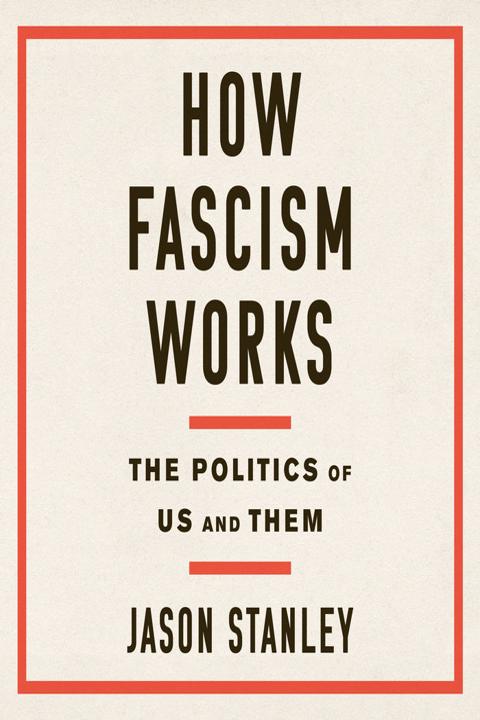
I was at a small independent bookstore today, the exact kind of place that’s supposed to curate a culture of argument and criticism. The prominently displayed books about politics and current events were Timothy Snyder’s book about the terrifying rise of American fascism under that monster Trump, Jason Stanley’s book about the terrifying rise of American fascism under that monster Trump, Anne Applebaum’s book about the terrifying rise of American fascism under that monster Trump, and a bunch of other books by prominent journalists and professors about … okay, try to guess.
On the other side of that exchange, the books by public intellectuals offering a favorable or even neutral view of Trump and the Trump era were … not there? Maybe I just missed them. So every prominent figure moving to the cultural foreground from academia and “mainstream” journalism — every brave contrarian, every freethinking intellectual warrior rising against the prevailing fascist sentiment of the age to speak in his own voice as a free person — thinks and says the same things, the same ways, with the same evidence and the same framing and the same tone and in the same state of mind. They’re so free and brave and iconoclastic that they’re essentially identical, chanting in intellectual unison.
Forget Trump for a moment and answer this question in general: If you’re living through an era in which every prominent journalist and academic and artist says exactly the same fucking thing all the time, what kind of moment are you living in? Would you call people who all chant in unison the resistance?
Any engagement with these books reveals their emptiness. Snyder, Stanley, Applebaum, whatever: pick a book, then pick a page. See if it makes sense. Here, I spent a few nauseating minutes today with brave Jason Stanley’s book How Fascism Works: The Politics of Us and Them. Here’s a paragraph from the introduction to the paperback edition:
ICE is novel: It was created after 9/11, by the same law that created a bureau tasked with border protection: a “special force, created in an anti-democratic moment”.
I can’t calibrate the degree to which this person is a fool or a liar, but let’s go with both. The Border Patrol was created in 1924, and was itself the successor agency to a different organization that was created in 1904. You can read that history here. The post-9/11 organization that supposedly created this novel American institution merely reorganized a century-old American institution, making it not the least bit novel. Before ICE, we had INS. Yes, we had a border before 2003, and we policed it. This isn’t a novel concept at all, as it has operated in any form of practice.
You can go through that single amazing paragraph sentence by sentence and tear every last bit of it apart, at the lowest, simplest factual level. The argument isn’t wrong: all of it is wrong, every layer of fact and interpretation. This man is an absolutely enormous jackass. And he’s … important. An important public intellectual, you see.

Confessions of a book-hoarder
In the latest SHuSH newsletter, confessed book-hoarder Ken Whyte has a confession to make:
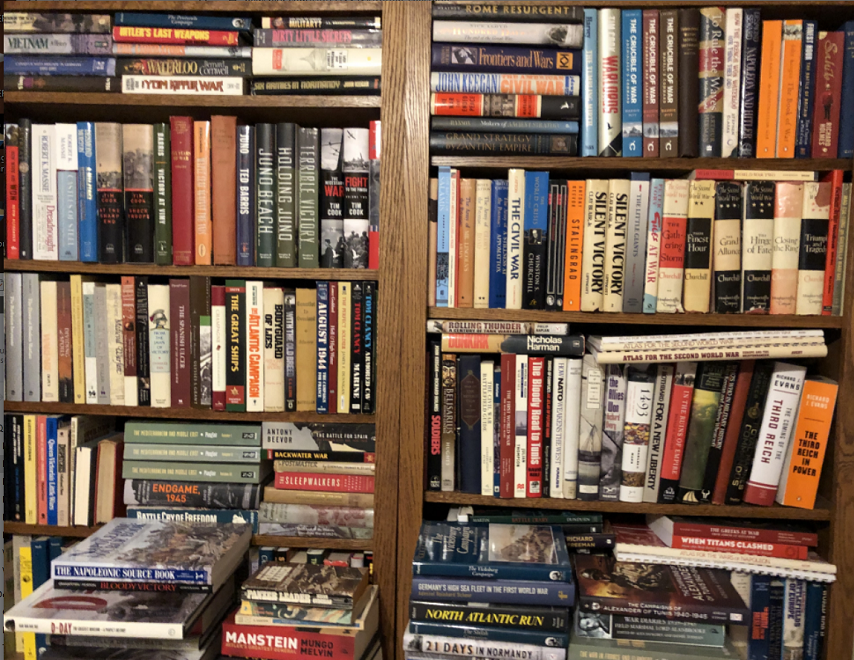
A small portion of my own book hoard. These shelves at least have a bit of commonality to them, unlike a lot of other shelves I could share.
I’ve been trying to reduce my hoard of books in recent months and it’s not going well.
And let’s be clear, it is a hoard, not a collection. A collection implies the books were selected with deliberation; that they are organized around subjects, themes, authors; that they are displayed with care. In a word, curated.
My books have been accumulated over time, some for work, some for pleasure. More were acquired impulsively than purposefully. Most people would not discern any organizational principles on my shelves. The fiction tends to be separate from the nonfiction, and books I’ve used to write books of my own tend to be grouped together, but not always. Hardbacks are mixed with paperbacks. I have some first editions that may be moderately valuable, although I’m not positive about that and I’ve never checked.
The hoard has been culled on occasion, usually in response to domestic complaints. The last major cull was a decade ago and since then I’ve been on a book diet, meaning that I can’t bring a new book home without getting rid of one already there.
I cheat on my diet all the time.
This part of the post could just as easily have been written by me … except that my sudden ejection from working life ten years back put me on an involuntary book-buying hiatus. From my peak buying years where I’d be accumulating multiple volumes per week, I was down to less than half a dozen new (or new-to-me) books through all of 2024.
That I’ve enjoyed a surplus of space for most of the last six years — the Sutherland House office is just two blocks from home — has abetted the cheating. The first week I took possession of the office, I lined it with solid metal shelves in optimistic anticipation of Sutherland House books to come. A good number of those shelves soon filled with boxes of personal books I could no longer keep at home and couldn’t bring myself to dump (along with a rather impressive archive of materials related to the founding of the National Post relocated from home to office for similar reasons).
Now Sutherland House is producing more books in one year than we produced in total over our first three years, and there are more of us in the office. Space is getting tight. I’ve been telling myself every weekend since before Christmas that I need to reduce the hoard.
It should not be difficult to jettison a quarter, a third, or even half of an impulsively amassed, haphazardly organized pile of books. You just face the shelf and pull out the ones you least want to keep. First to go are the never-cracked: anything that’s been sitting on the shelf for more than a decade without an attempt at reading. Next, books you’ve read and you know you’ll never want to read again. Then the yellowest paperbacks. Those three rules alone ought to get rid of half.
On a Saturday afternoon in mid-March. I faced a bookcase of eight shelves with about forty books per shelf. I challenged myself to get rid of one book for every book I kept. An hour later, I had half the books on the floor. Hurrah.
The next step was to put the unwanted books in boxes and haul them away.
They’re still sitting on the floor.
[Raises hand sheepishly] Yeah, I’ve got a few piles of books in various rooms of the house that failed the initial culling, yet somehow never made their way to the next stage of leaving the house.
I walk past them regularly and doubt my choices. I ask myself what harm would come from putting them all back on the shelves — makes more sense than leaving them on the floor. I wonder if a better solution to my storage problems wouldn’t be more shelves, or a storage locker.
I’ve read all the reasons why it’s difficult to get rid of books (or records, or art, or collections or hoards of any variety). The individual objects are companions, the scaffolding of your intellectual and emotional life, tokens of time, experience, identity, aspirations. Psychologists talk of loss aversion, the endowment effect that makes things feel more valuable simply because you own them, and the sunk-cost fallacy that leads you to hold onto and keep investing in things because you’ve already invested in them.
None of that makes me feel any better about my hoard (or the more than 10,000 photos and 30,000 emails I have on my laptop). The psychological explanations are just embarrassing.
When I’m levelling with myself, I can admit there are less than a hundred books I own where it genuinely matters to me to keep my particular copy. The rest are fungible. I freely admit that if I were to later miss any individual title I discarded, I could chase down a replacement in a day (in a minute electronically) at modest expense.
It used to matter to me to be surrounded by books in my living space. Now that I’m surrounded by books in my work space, not so much. For every instance when I spot a title on a shelf at home and think I really want to read that one someday, there are many more instances when I look at a whole shelf and think I’m never going to read any of these—they’re just taking up space. And I have a dust allergy, for christ sake.
Yet I can’t seem to do anything about it.
April 6, 2025
“[U]pwards of 86 percent of Americans thought he was too old to serve another term. And no one did anything about it“
Andrew Sullivan reacts to some new books on the Biden administration just hitting the bookstores recently:

By April of last year, the health of the president had clearly declined. As with many older men in their eighties, this didn’t happen in a slow, predictable glide-path down — but in swift, turbulent declines. Suddenly he took a while to get out of his limo, and then would emerge “with a blank look in his face”, according to the new campaign book, Fight, by Jonathan Allen and Amie Parnes. By early summer, Biden was suddenly freezing up in public, staring motionless into the air. At a fundraiser in Los Angeles, Obama had to jump in to answer some questions, and then had to guide Biden off the stage by hand. We had already seen Joe wander weirdly off the set of MSNBC and during a Medal of Honor ceremony. His memory lapses mounted.
Everyone around him saw this. Everyone close to him had seen it for over a year by then. Everyone in his campaign knew that upwards of 86 percent of Americans thought he was too old to serve another term. And no one did anything about it.
Sometimes human folly is just human folly. Sometimes, even at the pinnacle of the world, you find flawed people struggling with familiar human problems, like how to tell a beloved but fast-aging man that he needs to leave the stage before he falls off it. Just because she was First Lady did not prevent Jill Biden from putting family before country; and just because he was president didn’t mean that Biden reacted to his own decline with denial, anger, pig-headedness, and arrogance.
Do we learn anything new in this book and another one, Uncharted, by Chris Whipple out next week? Not really. We know, in fact, that everything I guessed happened did actually happen. Among the unsurprising confirmations: Obama was so aloof he didn’t even watch the fateful June debate live; he and Pelosi then wanted an open primary and did all they could to get one. (“He goes. She goes” was their mantra.) Hillary Clinton defended Biden — not because she knew his health was fine, but because her health had once been questioned by the press too. Biden’s closest advisers were his wife and, yes, his son Hunter, and they routinely put their clan’s interests well before the country’s. His inner circle — Mike Donilon especially — were so blindly loyal and informationally siloed they couldn’t absorb what was staring them in the face.
The Democrats, even as late as July, could have found a fresh candidate capable of taking on what they said was a vital moment for democracy’s survival. We might have avoided our current abyss:
“It would have been very cheap. It would have been quick. A rocket ship for your career and no loss,” said one Democratic former governor. “If this had been a year earlier, twenty people would have gotten in,” said one governor who had kicked the tires on a 2024 bid.
Why didn’t they? That is a question that will reverberate through history. Wokeness was a factor. The only reason the embarrassingly mid Harris was made veep in the first place was to fill a slot Biden had already marked for a woman, and, in the wake of the Floyd murder, a black woman seemed the only option. Everyone, particularly Pelosi and Obama, knew Harris was a disaster about to happen, and her vice-presidency had the lowest approval ratings in history. Obama told friends directly that he thought she couldn’t win. The night after the epic debate, Pelosi gritted her teeth: “Oh my God. It’s going to be her.”
So yes, identity before merit was a principle the Dems clung to even at the expense of marching off an electoral cliff. “If you want to break the Democratic coalition, try to skip over the first African-American vice president,” Michigan Senator Elissa Slotkin argued at one point. “I watched the black-white stuff start on Thursday night [after the debate],” said another lawmaker. Donna Brazile assembled a team of black women operatives who called themselves “the colored girls” to ensure Harris became the nominee. Jim Clyburn was also a critical supporter: “I’m going all in with Kamala. I don’t want to look back and y’all ain’t there,” he told the DNC.
The open primary therefore never happened. Harris became the nominee for one core reason in the end. Biden, who had previously used the awfulness of Kamala as a way to dissuade anyone from pushing him out, decided to endorse her after she pleaded with him the day he decided to quit. One source “close to both men” explained: “It was a fuck-you to Obama’s plan. At that moment, you have very few things you control, and that’s one thing he had control over, and he chose to stick it to Obama.” So much for putting the survival of democracy first.
And yes, they lied. Jill Biden was one of the worst offenders. She insisted in January 2024, “I see his vigor, I see his energy, I see his passion every single day. I say his age is an asset.” Before the June debate, Joe had been drained by grueling international travel, was catching a cold and couldn’t last more than 45 minutes in the practice debates. But the First Lady went out and told the world: “The president’s feeling great. He’s ready. We’re going to win this thing.” The woman who had covered up her husband’s decline for the previous two years now set expectations that were, of course, utterly ruinous.
April 5, 2025
QotD: Arguments against publishing Animal Farm
You could, indeed, publish anti‐Russian books, but to do so was to make sure of being ignored or misrepresented by nearly the whole of the highbrow press. Both publicly and privately you were warned that it was “not done”. What you said might possibly be true, but it was “inopportune” and “played into the hands of” this or that reactionary interest. This attitude was usually defended on the ground that the international situation, and the urgent need for an Anglo‐Russian alliance, demanded it: but it was clear that this was a rationalization. The English intelligentsia, or a great part of it, had developed nationalistic loyalty toward the U.S.S.R., and in their hearts they felt that to cast any doubt on the wisdom of Stalin was a kind of blasphemy. Events in Russia and events elsewhere were to be judged by different standards. The endless executions in the purges of 1936–8 were applauded by life‐long opponents of capital punishment, and it was considered equally proper to publicize famines when they happened in India and to conceal them when they happened in the Ukraine. And if this was true before the war, the intellectual atmosphere is certainly no better now.
But now to come back to this book of mine. The reaction toward it of most English intellectuals will be quite simple: “It oughtn’t to have been published”. Naturally, those reviewers who under stand the art of denigration will not attack it on political grounds but on literary ones. They will say that it is a dull, silly book and a disgraceful waste of paper. This may well be true, but it is obviously not the whole of the story. One does not say that a book “ought not to have been published” merely because it is a bad book. After all, acres of rubbish are printed daily and no one bothers. The English intelligentsia, or most of them, will object to this book because it traduces their Leader and (as they see it) does harm to the cause of progress. If it did the opposite they would have nothing to say against it, even if its literary faults were ten times as glaring as they are. The success of, for instance, the Left Book Club over a period of four or five years shows how willing they are to tolerate both scurrility and slipshod writing, provided that it tells them what they want to hear.
The issue involved here is quite a simple one: Is every opinion, however unpopular — however foolish, even — entitled to a hearing? Put it in that form and nearly any English intellectual will feel that he ought to say “Yes”. But give it a concrete shape, and ask, “How about an attack on Stalin? Is that entitled to a hearing?”, and the answer more often than not will be “No”. In that case, the current orthodoxy happens to be challenged, and so the principle of free speech lapses. Now, when one demands liberty of speech and of the press, one is not demanding absolute liberty. There always must be, or at any rate there always will be, some degree of censorship, so long as organized societies endure. But freedom, as Rosa Luxemburg said, is “freedom for the other fellow”. The same principle is contained in the famous words of Voltaire: “I detest what you say; I will defend to the death your right to say it”. If the intellectual liberty which without a doubt has been one of the distinguishing marks of Western civilization means anything at all, it means that everyone shall have the right to say and to print what he believes to be the truth, provided only that it does not harm the rest of the community in some quite unmistakeable way. Both capitalist democracy and the Western versions of Socialism have till recently taken that principle for granted. Our Government, as I have already pointed out, still makes some show of respecting it. The ordinary people in the street — partly, perhaps, because they are not sufficiently interested in ideas to he intolerant about them — still vaguely hold that “I suppose everyone’s got a right to their own opinion”. It is only, or at any rate it is chiefly, the literary and scientific intelligentsia, the very people who ought to be the guardians of liberty, who are beginning to despise it, in theory as well as in practice.
George Orwell, “The Freedom of the Press”, 1945 (written as the introduction to Animal Farm, but not published in Orwell’s lifetime).
April 4, 2025
Wine, Urine, Paperclips: America’s Secret Weapons of WWII
World War Two
Published 3 Apr 2025Today Astrid and Anna explore the Simple Sabotage Field Manual, a top-secret WWII guide that taught ordinary people how to disrupt the Nazi war machine. From factory slowdowns to derailed trains, they show how small acts of sabotage targeted Hitler’s regime, and how resistance often came from unexpected places.
(more…)
March 31, 2025
Remaking Robert Heinlein’s Starship Troopers, but without the mocking satirical mis-interpretation
Heinlein is still my favourite science fiction author, and Starship Troopers was one of the first of his books that I read when I was in Grade 5. I still love the book and re-read it every few years … unlike a lot of authors’ works, Heinlein’s writing holds up well decades after being published. John Carter is also a fan of Starship Troopers, but not the movie adaptation (which I managed to avoid seeing). He starts out this post with an updated treatment of the opening scenes of the book for an honest screenplay, which I think would work very well:
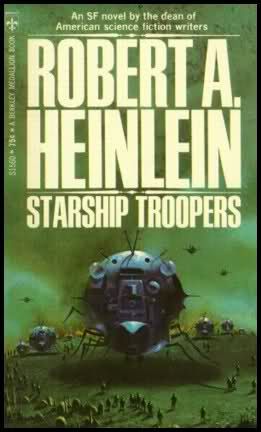
And that is how the cinematic adaptation of Robert A. Heinlein’s seminal military-SF masterpiece Starship Troopers should have started: with all of the pathos, action, and emotional intensity of the novel’s famous first chapter. I’ve taken extensive liberties with the source material, but in my head, this is what the first ten minutes or so of the movie would look like. If it had been a good movie.
But it was not.
Instead, director Paul Verhoeven served up Saved By the Bugs, a cheesy 90’s high-school drama cum college movie which felt more like Beverly Hills 90210 than Full Metal Jacket, liberally slathered with unnecessary sexual drama and drenched in hamfisted satire of the source material, with all of the coolest elements – the powered armour, the orbital drops, the backpack nukes – conspicuously stripped out.
I’ve read that Verhoeven claimed the powered armour was left out for budgetary reasons, but this has always struck me as a weak excuse. The budget had enough for CGI bugs and CGI spaceships, so CGI powered armour wouldn’t have stretched the budget at all. That’s like Blizzard saying that after they animated the Zerg, they didn’t have enough left over for the Terrans. Utterly absurd.
That’s to say nothing of the gaudy high-tech training facility the film set the boot camp scenes in, which was an utterly superfluous waste of money. In the novel, the boot camp was deliberately low-tech: some tents out in the middle of a grassy field a hundred miles from nowhere. The recruits didn’t learn how to use high-tech weapons until they’d learned to make their entire body, their entire being, into weapons; that’s the origin of the famous scene in the movie in which Sergeant Zim chucks a knife through Ace’s hand (in the book, Zim merely describes the possibility of doing this as an example of how a warrior armed with a low-tech weapon can disable someone with a high-tech weapon: can’t use the high-tech weapon if you can’t use your hand. Zim doesn’t actually stab one of his own troops). Graduation includes a fun exercise where they’re dropped naked and alone in the middle of the Rockies, with the objective of making it back to civilization alive; recruits were expected to hunt their own food and make their own shelter, using whatever tools they could improvise from the natural environment. They were expected to be just as dangerous as cavemen as they were wearing powered armour. That’s one of the many scenes from the novel which is sadly missing from Verhoeven’s movie.
You may be getting the idea that I am not a big fan of Verhoeven’s execrable adaptation, and you would be correct. Some of you may be surprised by this. I expect many readers have only seen the movie, and of those who have read the book, the younger readers probably saw the movie first, and have a nostalgic attachment to it.
Look, you might say this is personal for me.
I was ecstatic when I found out Starship Troopers was being brought to the silver screen. This was, by far, my favourite science-fiction novel of all time. Not only was it the pioneering archetype for the military science-fiction subgenre, but it introduced at least three novel concepts that have since become tropes: powered armour, which went on to inspire half of Japanese anime, along with Ironman, the Adeptus Astartes of Warhammer 40K, the Terran faction in Starcraft, Halo‘s Spartans, the Battletech games, and by now makes an appearance in practically every science-fiction universe you can name; the orbital drop, in which armoured space marines are fired down to the surface in drop capsules like living bullets, which also appears in 40K and Halo, and plays a prominent role in Pierce Brown’s Red Rising series by way of the planet-breaking Iron Rain tactic; and the insectoid alien hive mind, seen also in 40K‘s Tyrannids, Starcraft‘s Zerg, and numerous lesser-known works. As if this creative efflorescence was not enough, Heinlein’s novel grappled with the weighty issue of the moral philosophy of organized violence and its relationship to human politics in a deeply serious way, using the coming-of-age story of a young man turned soldier during an existential war for the survival of the human species as the dramatic frame for the philosophical exposition. Heinlein did all of this in just over 80,000 words – a short, fun read accessible to a bright ten-year-old.
The travesty that confronted me therefore filled me with a hot rage.
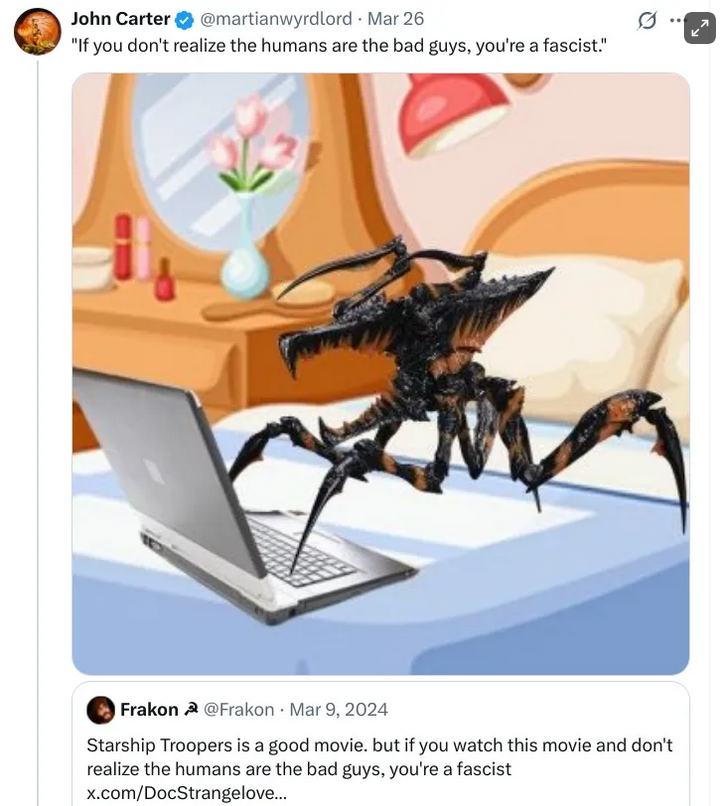
The reason Verhoeven left out the powered armour is quite simple: it was too cool, and his intention was not to make the Mobile Infantry look cool. His intention was to ridicule the philosophical position that Heinlein put forward in the book: that violence is at the heart of the political, and cultures – or species – who forget this, get rolled by the ones who don’t.
Liberals have been appalled by Starship Troopers since it was published, considering it a work of warmongering crypto-fascist apologetics, with very light emphasis on the “crypto”. They’ve been somewhat baffled by it, as well: how could the man who wrote the hippie free love bible Stranger in a Strange Land, or the libertarian anti-state manifesto The Moon is a Harsh Mistress, argue so compellingly for a society in which “service guarantees citizenship”, thereby ensuring that political power forever remains firmly in the hands of the military (or, rather, veterans of the military)? What sort of right-wing maniac gleefully smashes the beloved idol of “violence never solves anything” to replace it with the dictum that nothing in history has solved so many issues so decisively as violence; insists that communism isn’t only a bad thing but wholly unsuited to human beings (although very well-suited to insectoid hive-mind aliens); and insinuates that letting the scientists run society “rationally” according to the principles of managerial technocracy would bring about its ruin?
Verhoeven, as a good liberal, therefore set out to make the novel’s arguments look ridiculous.
March 30, 2025
Dies the Fire and the Founder Effect
Feral Historian
Published 15 Nov 2024The first book in S.M. Stirling’s Emberverse series, Dies The Fire yanks modern technology out of the world and sets the stage for a multi-faceted exploration of how distinct cultures emerge from small isolated groups and the profound effect individuals can have the societies that coalesce around them.
00:00 Intro
01:28 Founders
03:37 Desperation
04:51 Flawed Assumptions
07:05 Composites and Rhymes
(more…)
March 29, 2025
The Life of Plutarch
MoAn Inc.
Published 19 Sept 2024#AncientHistory #AncientGreece #Plutarch
Donate Here: https://www.ko-fi.com/moaninc
March 27, 2025
QotD: Did humans domesticate plants, or was it the other way around?
Of course, the cultivation of crops enabled human beings to produce far more calories per unit of territory than foraging ever could. And this enabled the human population to expand exponentially, thus putting even more pressure on the food supply, thus necessitating an even greater emphasis on agriculture. Alongside this deepening spiral there were other unintended consequences as well. As Harari puts it: “Nor did the farmers foresee that in good years their bulging granaries would tempt thieves and enemies, compelling them to start building walls and doing guard duty”.
Giles Fraser, “The Magnificent Seven is a post-liberal idyll”, UnHerd, 2020-04-01.
March 20, 2025
QotD: “[T]here is no such thing as a secular society, every country has a state religion, and you won’t get very far opposing it”
Obviously I had to physically restrain myself from laughing at her. Assuming for the sake of argument that such differences exist and are easily measurable, only somebody totally autistic would think that mere scientific evidence for them would cause them to be acknowledged.2 Just look at all the ridiculous “sky is green” type beliefs that society already successfully forces everybody to internalize. You mentioned biological and cognitive differences between men and women, which are far more obvious and noticeable than those between populations, but which we successfully force everybody to pretend do not exist. And that’s far from the silliest thing everybody pretends to believe, in our society or in others.
Put it another way: there is no such thing as a secular society, every country has a state religion, and you won’t get very far opposing it. Were there people in Tenochtitlan who secretly believed that blood pouring down the sides of the great step pyramid day and night wasn’t actually necessary to placate the gods? Yeah probably, but if any of them had tried to point that out, they would have been laughed at (and sacrificed). Were there people in the Soviet Union who privately doubted whether dialectical materialism was the true engine of history? Probably, yes, but everybody besides Leonid Kantorovich was smart enough not to mention it.
What are the religious precepts on which our society is founded? There are a few, but a belief in absolute racial equality is clearly one of them, and that view is now enshrined in the “real” constitution (civil rights caselaw and its downstream effects on corporate HR). Anything which contradicts that precept is just a total nonstarter. If a few nerds somewhere found irrefutable evidence of important differences between groups, they would quietly hide it, and if some among them were like Reich too autistic or principled to do that, they would be ignored, shouted down, or persecuted. Possibly this would even be a good thing — every society needs its orthodoxies, and sometimes those who corrupt the youth need to drink the hemlock.
We’ve gotten far afield, though. As an inveterate shape-rotator, my favorite part of the book was Reich’s description of the statistical and mathematical techniques that can be used to determine when population bottlenecks occurred, how recently two populations shared a common ancestor, and when various mixing events occurred.
Jane Psmith and John Psmith, “JOINT REVIEW: Who We Are and How We Got Here, by David Reich”, Mr. and Mrs. Psmith’s Bookshelf, 2023-05-29.
1. Not to get all “Dems are the real racists”, but anecdotally this view does seem slightly more prevalent among my left-wing friends than my right-wing friends, though that seems to currently be changing.
2. Somebody totally autistic or somebody who had already drunk the kool-aid on literally every other ridiculous official viewpoint imposed by our society. In her case it was probably the latter. As I said she was a leftist, and women in general are much less likely to be autistic but much more likely to value social conformity.
March 16, 2025
QotD: The “Social Contract”
Hobbes didn’t actually use the phrase “social contract” in Leviathan, but that’s where his famous “state of nature” argument ends. In the state of nature, Hobbes says, the only “law” is self defense. Every man hath the right to every thing, because nothing is off limits when it comes to self preservation; thus disputes can only be adjudicated by force. And this state of nature will prevail indefinitely, Hobbes says, because even though some men are stronger than others, and some are quicker, cleverer, etc. than others, chance is what it is, and everybody has to sleep sometime — in other words, no man is so secure in so many advantages that he can impose his will on all possible rivals, all the time. We won’t be dragged out of the state of nature by a strongman.
The only way out of the state of nature, Hobbes argues, is for all of us, collectively, to lay down at least some of our rights to a corporate person, the so-called “Leviathan”, who then enforces those rights for us. So far, so familiar, I’m sure, but even if you got all this in a civics class in high school (for the real old fogeys) or a Western Civ class in college (for the rest of us), they probably didn’t go over a few important caveats, to wit:
The phrase corporate person means something very different from what even intelligent modern people think it does, to say nothing of douchebag Leftists. In the highly Latinate English of Hobbes’s day, “to incorporate” meant “to make into a body”, and they used it literally. In Hobbes’s day, you could say that God “incorporated” (or simply “corporated”) Adam from the dust, and nobody would bat an eye. I honestly have no idea what Leftists think the term “corporate person” means — and to be fair, I guess, they seem to have no idea either — but for us, we hear “corporation” and we think in terms of business concerns. Which means we tend to attribute to Hobbes the view that the Leviathan, the corporate person, is an actual flesh and blood person — specifically, the reigning monarch.
That’s wrong. Hobbes was quite clear that the Leviathan could be a senate or something. He thought that was a bad idea, of course — the historical development of English isn’t the only reason we think Hobbes means “the person of the king” when he writes about the Leviathan — but it could be. So long as it’s the ultimate authority, it’s the Leviathan. For convenience, let’s call it “the Leviathan State”, although I hope it’s obvious why Hobbes would consider that redundant.
Second caveat, and the main reason (I suppose) it never occurred to Hobbes to call it a social contract: It can’t be broken. By anyone. Ever. It can be overtaken by events (third caveat, below), but no one can opt out on his own authority. The reason for this is simple: If you don’t permanently lay down your right to self defense (except in limited, Rittenhouse-esque situations that aren’t germane here), then what’s the point? A contract that can be broken at any time, just because you feel like it, is no contract at all. And consider the logical consequences of doing that, from the standpoint of Hobbes’s initial argument: If one of us reverts to the state of nature, then we all do, and the war of all against all begins again.
Third caveat: The Leviathan can be defeated. Hobbes considers international relations a version of the state of nature, one there’s no getting out of. If pressed, he’d probably try to attribute Charles I’s defeat in the English Civil War to outside causes. Indeed at one point he comes perilously close to arguing something very like that New Donatist / “Mandate of Heaven” thing we discussed below, but however it happened, it is unquestionably the case that Charles I’s government is no more. Hobbes bowed to reality — he saw that Parliament actually held the power in England, whatever the theoretical rights and wrongs of it, so even though the physical person of Charles II was there with him in Paris, Hobbes took the Engagement and sailed home.
Severian, “True Conclusions from False Premises”, Founding Questions, 2021-11-22.


