
There are really only three management books anyone ever needs to read (soon forthcoming, the fourth, my own precis of those three!) and we can use all of them in explaining this.
The Peter Principle tells us that everyone gets promoted to their own level of incompetence. So, that explains why the people actually running HR departments are incompetent. The second is Parkinson’s Law, which everyone usually takes to be about work expanding to fill the time available etc. In reality the book as a whole is about how bureaucracy will eat an organisation from the inside. Like one of those parasitic wasps where the pupae eat the spider from the inside out. The lesson of this is that proper management of any organisation is a constant battle against the growth of the bureaucracy. Proper managers should — must — spend significant amounts of their time turning a blowtorch on that internal bureaucracy. Real slash and burn, proper Carthaginian Solution on their arses.
The third has the most direct and exact relevance here. Up the Organisation. In which we are told that the personnel department (what we had before Human Resources) should be the secretary of the line manager. Someone wants to hire someone? Sure. The person who decides who to hire is the person doing the hiring. He needs an assistant only in so far as someone should phone up the local rag to put the job ad in.
Now, it is necessary to have someone making sure the details for the paycheque are right, that they enrolled in the company equity scheme, health care is sorted. But that’s some beancounter preferably hundreds of miles away from any actual influence upon anything.
All of which — from that distillation of the finest ponderings upon corporate management civilisation has so far achieved — tells us what to do with Human Resources.
Turn the blowtorches on the power skirts. Possibly even the full Carthaginian. Tho’ who we’ll find to buy as drabs and doxies the usual inhabitants of HR is another matter. Dunno, might be worth ploughing them into the fields and selling the salt instead.
Tim Worstall, “The Invasion Of The Power Skirts”, It’s all obvious or trivial except …, 2024-12-06.
March 9, 2025
QotD: HR metastasized
March 5, 2025
QotD: British and French Enlightenments
By the time she wrote, a number of historians had accepted that the Enlightenment, once characterized as the “Age of Reason”, came in two versions, the radical and the skeptical. The former was identified with France, the latter with Scotland. Historians of the period also acknowledged that the anti-clericalism that obsessed the French philosophes was not reciprocated in Britain or America. Indeed, in both the latter countries many Enlightenment concepts — human rights, liberty, equality, tolerance, science, progress — complemented rather than opposed church thinking.
Himmelfarb joined this revisionist process and accelerated its pace dramatically. She argued that, central though many Scots were to the movement, there were also so many original English contributors that a more accurate name than the “Scottish Enlightenment” would be the “British Enlightenment”.
Moreover, unlike the French who elevated reason to a primary role in human affairs, British thinkers gave reason a secondary, instrumental role. In Britain it was virtue that trumped all other qualities. This was not personal virtue but the “social virtues” — compassion, benevolence, sympathy — which British philosophers believed naturally, instinctively, and habitually bound people to one another. This amounted to a moral reformation.
In making her case, Himmelfarb included people in the British Enlightenment who until then had been assumed to be part of the Counter-Enlightenment, especially John Wesley and Edmund Burke. She assigned prominent roles to the social movements of Methodism and Evangelical philanthropy. Despite the fact that the American colonists rebelled from Britain to found a republic, Himmelfarb demonstrated how very close they were to the British Enlightenment and how distant from French republicans.
In France, the ideology of reason challenged not only religion and the church, but also all the institutions dependent upon them. Reason was inherently subversive. But British moral philosophy was reformist rather than radical, respectful of both the past and present, even while looking forward to a more enlightened future. It was optimistic and had no quarrel with religion, which was why in both Britain and the United States, the church itself could become a principal source for the spread of enlightened ideas.
In Britain, the elevation of the social virtues derived from both academic philosophy and religious practice. In the eighteenth century, Adam Smith, the professor of moral philosophy at Glasgow University, was more celebrated for his Theory of Moral Sentiments (1759) than for his later thesis about the wealth of nations. He argued that sympathy and benevolence were moral virtues that sprang directly from the human condition. In being virtuous, especially towards those who could not help themselves, man rewarded himself by fulfilling his human nature.
Edmund Burke began public life as a disciple of Smith. He wrote an early pamphlet on scarcity which endorsed Smith’s laissez-faire approach as the best way to serve not only economic activity in general but the lower orders in particular. His Counter-Enlightenment status is usually assigned for his critique of the French Revolution, but Burke was at the same time a supporter of American independence. While his own government was pursuing its military campaign in America, Burke was urging it to respect the liberty of both Americans and Englishmen.
Some historians have been led by this apparent paradox to claim that at different stages of his life there were two different Edmund Burkes, one liberal and the other conservative. Himmelfarb disagreed. She argued that his views were always consistent with the ideas about moral virtue that permeated the whole of the British Enlightenment. Indeed, Burke took this philosophy a step further by making the “sentiments, manners, and moral opinion” of the people the basis not only of social relations but also of politics.
Keith Windschuttle, “Gertrude Himmelfarb and the Enlightenment”, New Criterion, 2020-02.
February 26, 2025
Colonialism was so bad … that we have to make shit up about how evil it supposedly was
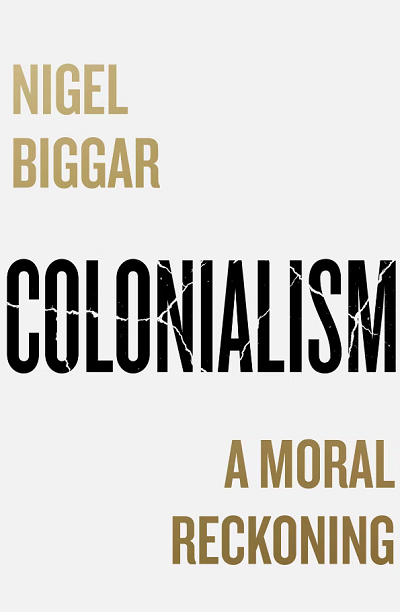
In the National Post, Nigel Biggar recounts some of the most egregious virtue signalling by western elites over the claimed evils of colonialism … even to the point of inventing sins to confess and obsess over:
Meanwhile, in Australia, there’s the extraordinary career of Bruce Pascoe’s 2014 book, Dark Emu. This argues that Aborigines, far from being primitive nomads, developed the first egalitarian society, invented democracy, and were sophisticated agriculturalists. Such was the morally superior civilization that white colonizers trashed in their racist greed. Named Book of the Year, Dark Emu has sold more than 360,000 copies and was made the subject of an Australian Broadcasting Company documentary.
Yet, it has been widely criticized for being factually untrue. Author Peter O’Brien has forensically dismantled it in Bitter Harvest: The Illusion of Aboriginal Agriculture in Bruce Pascoe’s Dark Emu (2020). And in Farmers or Hunter Gatherers: The Dark Emu Debate (2021) — described by reviewers as “rigorously researched”, “masterful”, and “measured” — eminent anthropologist Peter Sutton and archaeologist Keryn Walshe dismiss Pascoe’s claims.
Which bring us to Canada. The May 2021 claim by the Tk’emlúps te Secwépemc First Nation to have discovered the “remains of 215 children” of an Indian Residential School was quickly sexed up by the media into a story about a “mass grave”, with all its connotation of murderous atrocity. The Globe and Mail published an article under the title, “The discovery of a mass gravesite at a former residential school in Kamloops is just the tip of the iceberg,” in which a professor of law at UBC wrote: “It is horrific … a too-common unearthing of the legacy, and enduring reality, of colonialism in Canada”. Prime Minister Justin Trudeau ordered Canadian flags to be flown at half-mast on all federal buildings to honour the allegedly murdered children. Because the Kamloops school had been run by Roman Catholics, some zealous citizens took to burning and vandalizing churches, 112 of them to date. The dreadful tale was eagerly broadcast worldwide by Al Jazeera.
Yet, almost four years later, not a single set of remains of a murdered Indigenous child in an unmarked grave has been found anywhere in Canada. Judging by the evidence collected by Chris Champion and Tom Flanagan in their best-selling 2023 book, Grave Error: How the Media Misled us (and the Truth about the Residential Schools), it looks increasingly probable that the whole, incendiary story is a myth.
So, prime ministers, archbishops, academics, editors, and public broadcasters are all in the business of exaggerating the colonial sins of their own countries — from London to Sydney to Toronto. Why?
An obvious reason is the well-meaning desire to raise respect for indigenous cultures with a view to “healing” race relations. But that doesn’t explain the aggressive brushing aside of concerns about evidence and truth in the eager rush to irrational self-criticism.
February 25, 2025
QotD: Identity politics as a secular religion
But the problem with identity politics as a secular religion is precisely its failure to allow for absolution. The faith that Saad espouses is utterly bleak, even cloaked as it is in words of love. It utterly fails to allow for redemption, and its most direct religious antecedent is found in Calvinist predestination.
Under this doctrine, God has predetermined whether you are damned or elect. From the second that the right sperm hit it lucky with the most fecund egg, your place in the woke hierarchy was decided. In the modern progressive world, informed by intersectional feminists, it does not matter what you say or do, the only defining factor in your state of grace is your skin, gender and sexuality.
This is a profoundly depressing outlook for three main reasons. The first is the essential nihilism in the creed. Your intent? Irrelevant. Your deeds? Likewise. The sum of your experience, desires, longings, beliefs? Your humanity itself? Nah, not relevant.
The second dispiriting message is that the problems its aims to address are insoluble. White people are racist by their nature, and inherently incapable of seeing their own racism or addressing it. Men are misogynists, by default, witting or unwitting bulwarks of the patriarchy. If they don’t believe they are individually at fault they are in denial. And if they try to say, actually, I’m not sure the patriarchy exists, they are mansplaining misogynist bastards. This is the politics of perpetual antagonism, of a kind of bleak acceptance that all relationships between different categories of human are necessarily fractious.
[…]
The third problem with Puritan wokeness is that it [has] sinister echoes in the history of predestination. When the creed reached its zenith in the seventeenth century, the logical hole at its centre became insanely obvious. If it does not matter to God how you behave, because your salvation was pre-determined at birth, why not behave however the hell you want to?
Antonia Senior, “Identity politics is Christianity without the redemption”, UnHerd, 2020-01-20.
February 20, 2025
QotD: Those memorable quotes from history
I still don’t know how those people felt, but let me do the Robot Historians of 2334 a solid. In this particular case, guys: It feels stupid. Really, really stupid. Any sane person, watching this, can only marvel at how fucking fake and gay it all is. I wish I could say something more quotable about it (that’s a dirty trick of the History biz, by the way — often the quotes you see are quoted just because some crank had a good turn of phrase. The other sadly common reason is “because the quoted person’s letters are the only ones with handwriting you can read”). But I can’t, so … there it is.
Severian, “We Hold Erection For King!”, Founding Questions, 2024-11-05.
February 16, 2025
QotD: Why we’re stagnating
Their explanation for our doldrums is simple: we’re more risk averse, and we don’t care as much about the future. Risk aversion means stagnation, because any attempt to make things better involves risk: it could also make things worse, or it could fail and turn out to be a waste of time and money. Trying to invent a crazy new technology is risky, going into consulting or finance is safe. Investing in unproven startups or speculative bets is risky, investing in index funds is safe. Trying to overturn the scientific consensus is risky, keeping your head down and publishing papers that don’t say anything is safe. Producing challenging new art is risky, spewing an endless stream of Marvel superhero capeshit is safe. Even if, in every case, the safe option is the “rational” choice for an individual actor in maximin expected value terms, the sum total of these individually rational choices is a catastrophe for society.
So far this is a lame, almost tautological, explanation. Even if it’s all true, we still haven’t explained why people are so much more fearful of failure than they used to be. In fact, we would naively assume the opposite — society is much richer now, social safety nets much more robust, and in the industrialized world even the very poor needn’t fear starvation. In a very real sense, it’s never been safer to take risks. Failing as a startup founder or academic means you experience slightly lower lifetime earnings,1 while, in the great speculative excursions of the past, failure (and sometimes even success) meant death, scurvy, amputations, destitution, children sold into slavery or raised in poorhouses — basically unbounded personal catastrophe. And yet we do it less and less. Why?
Well, for starters, we aren’t the same people. Biologically, that is. We’re old, and old people tend to be more risk-averse in every way. Old people have more to lose. Old people also have less testosterone in their bloodstream. The population structure of our society has shifted drastically older because we aren’t having any children. This not only increases the relative number (and hence relative power) of older people, it also has direct effects on risk-aversion and future-orientation. People with fewer children have all their eggs in fewer baskets. They counsel those kids to go into safe professions and train them from birth to be organization kids. People with no children at all are disconnected from the far future, reinforcing the natural tendency of the elderly to favor consumption in the here and now over investment in a future they may never get to enjoy.
Old age isn’t the only thing that reduces testosterone levels. So does just living in the 21st century. The declines are broad-based, severe, and mysterious. Very plausibly they are downstream of microplastics and other endocrine-disrupting chemicals. The same chemicals may have feminizing effects beyond declines in serum testosterone. They could also be affecting the birth rate, one of many ways that these explanations all swirl around and flow into one another. Or maybe we don’t even need to invoke old age and microplastics to explain the decline in average testosterone of decisionmakers in our society. Many more of those decisionmakers are women, and women are vastly more risk-averse on average.2
John Psmith, “REVIEW: Boom, by Byrne Hobart and Tobias Huber”, Mr. and Mrs. Psmith’s Bookshelf, 2024-11-11.
1. And given the logarithmic hedonic utility of additional money and fame, that hurts even less than it sounds like it would.
2. If you’re too lazy to read Jane’s review of Bronze Age Mindset but just want the evidence that women are more cautious and consensus-seeking than men on average, try this and this and this for starters.
February 13, 2025
Australia’s most toxic export (so far) – “Settler-colonial ideology”
Helen Dale explains how a lunatic fringe Australian notion has grown to be a major ideology in most of the Anglosphere and even as far afield as Israel:

Despite a great efflorescence of literature and especially film about the mafia, it’s a truism to say that it isn’t very good for Sicily. It also hasn’t been very good when exported to other countries, either, spreading violence, corruption, and lawlessness. Well, Australia is to settler-colonial ideology as Sicily is to mafia, and our poisonous gift to the world is, like Sicily’s mafia, one of those things about us that really isn’t for export.
“Settler-colonial ideology” seems a mouthful, but if I describe bits of it to you, you’ll recognise it. Heard Australia Day called “Invasion Day”? You’ve encountered settler-colonial ideology. Been called racist for voting NO in the 2023 Voice Referendum? You’ve encountered settler-colonial ideology. Noticed Aboriginal academics get hired with obviously inadequate qualifications? You’ve encountered settler-colonial ideology.
Many Australians — including me — first encountered settler-colonial ideology at university. Back then, it was a theoretical and foreign concern, and largely in languages other than English (mainly French and Arabic). I do remember one of the “post-colonial literatures” (note the s, the s is important) obsessives trying to convince me that Alan Paton’s Cry the Beloved Country wasn’t a “legitimate book” because its author was white, but back then, this was still a niche view.
Like other Australians confronted with daft academic ideas, I blamed the US or France and ignored my own country’s contribution. Australians aren’t noted for their theoretical acumen, which made this easier. Critical race theory and affirmative action are all-American, while US academics have often executed hostile takeovers of French nonsense like postmodernism or queer theory early on in proceedings. It gets easy to blame America and France.
Easy, but unfair.
I realised how mistaken I’d been when, in October last year, I returned to Australia for a stint. While I was there, I read Adam Kirsch’s On Settler Colonialism: Ideology, Violence and Justice. I did so in part because October 2024 was the one-year anniversary of two important events. Both concerned what Kirsch calls “the ideology of settler-colonialism”.
Kirsch documents a process whereby the French- and Arabic-speaking theorists of post WWII decolonial conflicts — particularly Frantz Fanon — had their ideas grafted (very, very awkwardly) onto dissimilar Australian history and conditions by Australian intellectuals. These were then exported throughout the English-speaking world, likely through academic conferences. This explains how cringeworthy Australian nonsense like land acknowledgments managed to spread first to Canada and then the US in a reversal of the usual process whereby America sneezes and so gives its Hat a cold.
Fanon was a Marxist and a Freudian. His writing seethes with angry bloodthirstiness and pseudoscientific psychodrama, but he was responding to a vicious war of independence and incipient civil conflict. Kirsch notices a pattern where Australian scholars borrow bits of Fanon to give a sanguinary rhetorical garnish to their writing. “Fanon’s praise of violence is a large part of his appeal for Western intellectuals,” he notes. “Many of the sentiments expressed in The Wretched of the Earth, coming from a European or American writer, would immediately be identified as fascistic.”
Australia’s intervention changed the ideology, in some ways making it more destructive. Fanon is shorn of most of his Marxism, for example (can’t have that, won’t be able to recruit rich minorities to the boss class otherwise). The key Australian shift coalesces around an oft-quoted aphorism from historian Patrick Wolfe: “invasion is a structure, not an event”. That is, colonisation trauma is constantly renewed because “settler” is a heritable identity. “Every inhabitant of a settler colonial society who is not descended from the original indigenous population,” Kirsch points out, “is, and always will be, a settler”.
“Settler” here includes people transported to both America and Australia in chains — slaves and convicts. Once it became acceptable to construe one group of people conveyed against their will across thousands of miles of ocean in dreadful conditions as providentially lucky (and genocidal) settlers, it became possible to extend the reasoning to other, similar groups. After all, the only difference between a convict and a slave is the presence or absence of a criminal conviction.
Kirsch’s attempt to explain how Australia was analogised with Fanon’s Algeria and then how Israel was analogised with Wolfe’s Australia is heroic, in part because the casuistry he seeks to unpick is so convoluted. Filtering Fanon through Australian academia and its claim that “settler” is a heritable identity did have the effect of making Jewish Israelis look more like non-indigenous Australians or Americans, however, especially when attention was focussed on European Jewish immigrants to Israel.

February 9, 2025
A “certain niche Canadian’s” prophetic look at Western demography
Mark Steyn reminds us that it’s twenty years since he published America Alone: The End of the World as We Know It, which has become more and more accurate every year:
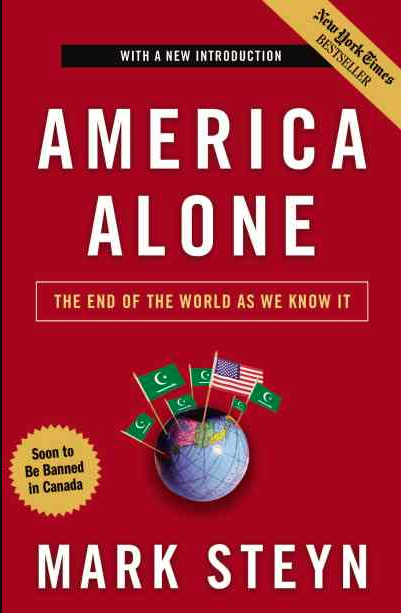
~As some readers may be aware, next year marks the twentieth anniversary of a certain “niche Canadian”‘s boffo international bestseller on demography. So the other day I was musing on whether it was too soon to mark the occasion — only to find I’d been beaten to the punch by the Nigerian media bigfoot Azu Ishiekwene:
It’s nearly 20 years since Mark Steyn wrote a non-fiction book, America Alone: The End of the World as We Know It.
Steyn, a Canadian newspaper columnist, could not have known that the kicker of this book title, which extolled America as the last bastion of civilisation as we know it, would become the metaphor for a wrecking ball.
Steyn thought demographic shifts, cultural decline, and Islam would ruin Western civilisation. The only redeeming grace was American exceptionalism. Nineteen years after his book, America Alone is remembered not for the threats Steyn feared or the grace of American exceptionalism but for an erratic president almost alone in his insanity.
The joke is on Steyn.
Oh, well. It was good while it lasted — which wasn’t as long as it should have, thanks to the dirty stinkin’ rotten corrupt American “justice” system (see below).
~But I thank Mr Ishiekwene for reminding me of the twin theses of my book: on the one hand, “demographic shifts, cultural decline, and Islam” and, on the other, “American exceptionalism”. The first half is undeniable: At one point last year, there were no Anglo-Celtic heads of government anywhere in the British Isles except for Northern Ireland. Nobody even talks about “demographic shifts”, with even “conservative” politicians preferring to focus on “British values” or “French values” or “[Your Country Here] values”, even as those “values”, not least freedom of speech, are remorselessly surrendered. The UK’s “Deputy Prime Minister”, Angela Rayner, is proposing as the state’s reaction to the Southport stabbings, about which the most intemperate Tweeters were less inaccurate than the state propaganda, to restrict free expression even further. Islam? In Britain, Germany, France, the Netherlands, we would rather our children be stabbed and gang-raped than do anything about it, especially if it risks being damned as “Islamophobic”. The delightful Ms Rayner, who once boasted about flashing her soi-disant “ginger growler” across the Commons to Boris Johnson at Question Time, will be keeping it under wraps in the years ahead.
~As for the second part of my book’s arguments — “American exceptionalism” — well, it’s been a rough twenty years. But, to cast Azu Mr Ishiekwene’s contempt for an “an erratic president almost alone in his insanity” in a more generous light, the last three weeks have been a useful reminder that America is still different — or, at any rate, retains the capacity to be different. In his first days in office Trump 47 yanked the US from the World “Health” Organisation and the Paris “climate” accord and the UN “Human Rights” Council. If I have been insufficient in my praise for this energy, it is only because I held out hopes that a man “alone in his insanity” might have simply nuked the WHO. But, such disappointments aside, in Britain (and in the EU it has yet to leave in any meaningful sense), no such decisive acts in the here-and-now can even be contemplated.
And just because I’ve been including a fair bit of USAID-related stuff this week, he comments on Elon Musk’s epic sidequests investigations into US government waste and corruption:

~That’s the good news — and it’s very heartening. The bad news is that almost everything the national government (it is no longer really “federal”) of the United States touches is a racket.
The United States Agency for International Development is so-called in order that gullible rubes who listen to NPR think that it’s something to do with helping starving children in Africa. The cynical rubes who follow Conservative Inc think it’s something to do with helping African dictators’ Swiss bank accounts and endlessly regurgitate the old line about “international aid” taking money from poor people in rich countries to give to rich people in poor countries. But this is the cynicism of the terminally naïve and does a great injustice to the average blood-drenched Somali warlord. As Elon Musk has pointed out, ninety per cent of USAid funds are disbursed in the Washington, DC area. Opponents of that line say, ah, yes, but that’s misleading because some of it then gets passed on outside the Beltway eventually to reach some emaciated Congolese laddie.
Well, I would doubt it. There is no legitimate reason for Bill Kristol and Mona Charen to be receiving any funds from an agency for “international development” — and they surely know it. The least we should expect from them is that they come by their Never Trumpery honestly.
But I wouldn’t be surprised to learn that that 90-10 ratio is pretty standard. The US armed forces account for forty per cent of the planet’s total military spending. Does ninety per cent of that also get disbursed in the District of Columbia? On Thoroughly Modern Milley’s ribbon budget? It’s as good an explanation as any for the failure to win anything since VJ Day. The rube right’s antipathy to foreigners shouldn’t blind us to the fact that the overwhelming majority of the corruption is domestic — and it’s a very bipartisan sewer.
So I wish Trump, Musk et al the best of luck. But, notwithstanding that every rinky-dink District Court judge seems to be labouring under the misapprehension that he’s head of the executive branch of government, Trump has spent the last three weeks doing things. There is no sign that that is even possible in the rest of the west, where the Dutch model seems to prevail: Geert Wilders wins the election, but then gets neutered.
So, in a sense, Azu Ishiekwene is right. There is a yawning chasm between Trump and the poseur attitude-flaunting rest of the west. And yet Mr Ishiekwene is wrong on this: an erratic president is not almost alone in his insanity. In case you haven’t noticed, Panama won’t be renewing its Chinese deal on the Belt & Road Initiative, and El Salvador is happy to gaol anybody Trump sends them. It turns out that the quickest way to solve any international dispute is to threaten the recalcitrant with twenty-five per cent tariffs starting at midnight. If the forty-seventh president doesn’t seem interested in “winning hearts and minds”, it’s because he’s found something more effective.
January 31, 2025
“… and 10% for the Big Guy”
In the New English Review, Bruce Bawer reviews Miranda Devine’s new book, The Big Guy: How a President and His Son Sold Out America:

Even now, roughly half of Americans seem to believe that all the attention that’s been paid to Hunter Biden and his laptop has to do with his love of prostitutes and drugs rather than with high crimes and misdemeanors committed by him on behalf of his dad and other members of the clan. Even now, many Americans seem to be blithely unaware of the mountains of evidence showing that Hunter has long been fleecing foreign firms on Daddy’s behalf. For some reason those clueless Americans, even if capable of accepting that Hunter was up to no good, simply can’t believe that his pop – good old Lunchpail Joe – has ever been guilty of anything. (These same people, of course, are convinced that Donald Trump is the most corrupt politician ever to come down the pike.)
This blindness to facts – or stubborn refusal to pay attention to them – is immensely frustrating. And it must be especially frustrating for Miranda Devine, the Australian-American New York Post journalist who, in Laptop from Hell: Hunter Biden, Big Tech, and the Dirty Secrets the President Tried to Hide (2021), detailed the contents (by turns sordid and criminal) of Hunter’s celebrated computer, the story of which her newspaper broke 20 days before the 2020 presidential election, and who in her new book, The Big Guy: How a President and His Son Sold Out America, focuses on the cover-up.
To say that Devine tells her story in impressive detail would be an understatement. Like War and Peace, The Big Guy opens with a long list of the main players, just in case you lose track of who’s who. And you will. Reading this book isn’t just like reading War and Peace – it’s like reading War and Peace at the same time as One Hundred Years of Solitude. You have to remember a slew of foreign-sounding names, many of which sound very much alike, all the while following an exceedingly labyrinthine narrative.
To be sure, this tale also involves plenty of Americans, some of them public officials who, when they scented the heady whiff of corruption in the Biden circle, actually did their jobs by digging into the facts and gathering evidence. Others, alas, are people who also held positions of authority but who did their damnedest to put up “roadblocks” or “obstructions” or “delays” or “logjams” – to use some of the many synonyms that Devine uses to describe efforts to keep the public in the dark.
And boy, was there a lot to cover up. Among the expenses that Hunter tried to write off on his taxes – not that he was quick to pay them, mind you – were disbursements to prostitutes and drug dealers and memberships in sex clubs. During one “crack and hooker bender” in 2018, he spent $8,000 on a single sex worker, $140,000 on a stay in Las Vegas, and $34,000 on a sojourn at the Chateau Marmont in L.A. The Chateau Marmont is legendary for playing host to celebrities on drug binges, but Hunter caused so much damage to his room that he was banned from the place thereafter, which even he suspected was a first.
Part of the reason why Hunter was able to go through a small fortune so quickly was that he had a “sugar daddy” by the name of Kevin Morris, who for reasons that still remain a mystery chose to give him millions of dollars over the years to save him from financial crises (such as the ones posed by the relatively modest monetary demands of Hunter’s baby mama in Arkansas). A 2019 book contract with Simon & Schuster also netted Hunter a $750,000 advance, even though the book (surprise!) ended up selling so few copies that it made back only a tiny fraction of that sum. Then there were his paintings, which brought in at least $1.5 million. People laughed when Hunter first revealed his artworks to the world in 2020, but I didn’t: they’re no worse than a hell of a lot of contemporary art – and, after all, the art market these days is as much about laundering money than it is about aesthetics.
But Hunter’s main sources of mazuma were foreign companies. One of them was Barisma in Ukraine. Another, in Russia, was run by a man named Zlochevsky who said that Hunter, whom Joe Biden had called the smartest man he knew, was in fact stupider than Zlochevsky’s dog. A third was the Chinese energy company CEFC, a leading promoter of China’s Belt and Road Initiative. CEFC put Hunter on its board – and paid him millions – in exchange for his promise to use his father’s name to “open … doors around the world” for the firm.
Collecting loot from all these sources and funneling some of it to family members involved a complex network of bank accounts and shell companies that was designed to make the moolah tough to trace. To illustrate the process, Devine follows the path of a single $5 million payment by a CEFC affiliate to one of Hunter’s firms, HWIII. Over time, Hunter transferred most of that $5 million to another firm of his, Owasco; in addition, he wired some of it to his uncle Jim’s company, after which Jim’s wife, Sara, withdrew a fraction of that sum and deposited it in the couple’s personal account and dispatched a $40,000 check to Joe Biden.
January 28, 2025
Dining at the Wild Parties of Regency England
Tasting History with Max Miller
Published 24 Sep 2024Drop biscuit-style cakes with dried currants
City/Region: London, England
Time Period: 1806In the 18th and 19th centuries, members of the aristocracy threw wild parties called routs. These parties, which sound akin to a modern frat party, eventually devolved to rooms stuffed with way too many people, so that attendance consisted of jostling from room to room before leaving. If you were lucky, you could grab a rout cake to help sustain you while you party hopped.
These cakes are dense and dry, but not unpleasantly so. While they are delicious, because of the dryness I recommend enjoying them with a cup of coffee, tea, or party beverage of your choice. They’re just sweet enough, and the flavors of the brandy and the flower waters shine through.
Rout Drop Cakes
Mix two pounds of flour, one ditto butter, one ditto sugar, one ditto currants, clean and dry; then wet into a stiff paste, with two eggs, a large spoon of orange-flower water, ditto rose-water, ditto sweet wine, ditto brandy, drop on a tin-plate floured; a very short time bakes them.
— A New System of Domestic Cookery by A Lady (Maria Rundell), 1806.
QotD: Was Einstein a science-denier?
Even if there were absolutely no light deflection, no perihelion motion and no redshift, the gravitational equations would still be convincing because they avoid the inertial system … It is really quite strange that humans are usually deaf towards the strongest arguments, while they are constantly inclined to overestimate the accuracy of measurement.
In a few short sentences Einstein completely repudiates the empiricist spirit which has ostensibly guided scientific inquiry since Francis Bacon. He doesn’t care what the data says. If the experiment hadn’t been run, he would still believe the theory. Moreover, should the data have disconfirmed his theory, who cares? Data are often wrong.
This is not, to put it mildly, the official story of how science gets made. In the version most of us were taught, the process starts with somebody noticing patterns or regularities in experimental data. Scientists then hypothesize laws, principles, and causal mechanisms that abstract and explain the observed patterns. Finally, these hypotheses are put to the test by new experiments and discarded if they contradict their results. Simple, straightforward, and respectful of official pieties. The Schoolhouse Rock of science. Or as Einstein once described it:
The simplest idea about the development of science is that it follows the inductive method. Individual facts are chosen and grouped in such a way that the law, which connects them, becomes evident. By grouping these laws more general ones can be derived until a more or less homogeneous system would have been created for this set of individual facts.
See? It’s as easy as that. But then, Einstein finishes that thought with: “[t]he truly great advances in our understanding of nature originated in a manner almost diametrically opposed to induction”.
Was Einstein a science-denier? I’m obviously kidding, but this is still pretty jarring stuff to read. How did he get this way? Einstein’s Unification is the story of the evolution of Einstein’s philosophical views, disguised as a story about his discovery of general relativity and his quixotic attempts at a unified field theory. It’s a gripping tale about how Einstein tried to do science “correctly”, experienced years of frustration, almost had priority for his discoveries snatched away from him, then committed some Bad Rationalist Sins at which point things immediately began to work. This experience changed him profoundly, and maybe it should change us too.
John Psmith, “REVIEW: Einstein’s Unification, by Jeroen van Dongen”, Mr. and Mrs. Psmith’s Bookshelf, 2024-05-27.
January 20, 2025
QotD: Brainwashing
Like Robert Jay Lifton’s Thought Reform and the Psychology of Totalism (another must-read), I read Meerloo years ago, so my recall of the details is fuzzy, but the upshot is obvious: The techniques of “brainwashing” have been known since at least the Middle Ages, and they’re still the same. Suspected witches in the Early Modern period, for instance, got Der Prozess, and though the witch hunters also had recourse to the rack and thumbscrews and all the rest, none of it was really necessary — isolation, starvation, and sleep deprivation work even better, provided you hit that sweet spot when they’re just starting to go insane …
I’m being deliberately flip about a horrible thing, comrades, because as no doubt distasteful as that is to read, the fact is, we’re doing it to ourselves, everywhere, all the time. Not the starvation part, obviously, but we eat such horribly unnatural diets that our minds are indeed grossly affected. Want proof? Go hardcore keto for a week and watch what happens. Or if that’s too much, you can simulate the experience by going cold turkey off caffeine. I promise you, by the end of day two you’d give the NKVD the worst dirt on your own mother if they sat a steaming hot cup of java in front of you.
Severian, “Kickin’ It Old Skool”, Founding Questions, 2021-10-04.
January 18, 2025
QotD: On Auguste Rodin’s Fallen Caryatid
“For three thousand years architects designed buildings with columns shaped as female figures. At last Rodin pointed out that this was work too heavy for a girl. He didn’t say, ‘Look, you jerks, if you must do this, make it a brawny male figure’. No, he showed it. This poor little caryatid has fallen under the load. She’s a good girl — look at her face. Serious, unhappy at her failure, not blaming anyone, not even the gods … and still trying to shoulder her load, after she’s crumpled under it.
“But she’s more than good art denouncing bad art; she’s a symbol for every woman who ever shouldered a load too heavy. But not alone women — this symbol means every man and woman who ever sweated out life in uncomplaining fortitude, until they crumpled under their loads. It’s courage, […] and victory.”
“‘Victory’?”
“Victory in defeat; there is none higher. She didn’t give up […] she’s still trying to lift that stone after it has crushed her. She’s a father working while cancer eats away his insides, to bring home one more pay check. She’s a twelve-year old trying to mother her brothers and sisters because Mama had to go to Heaven. She’s a switchboard operator sticking to her post while smoke chokes her and fire cuts off her escape. She’s all the unsung heroes who couldn’t make it but never quit.
Robert A. Heinlein, Stranger in a Strange Land, 1961.
January 14, 2025
Baking the Original Brownie – The History of Brownies
Tasting History with Max Miller
Published 3 Sept 2024Fudgy brownies with walnuts
City/Region: Chicago, Illinois
Time Period: 1904I love a gooey, chocolatey brownie, so I opted not to make the first recipe for something called brownies from 1896, because it had no chocolate and instead used molasses. Certainly not the brownies of my heart.
There are a couple of origin stories about brownies, but the one for Bangor brownies goes that a housewife forgot to put baking powder into her chocolate cake. While I question the validity of this story, we do see a lot of recipes for Bangor brownies during the early 20th century that closely resemble brownies today.
While these may not rival my favorite modern ones, they’re very good. They come out fudgy and dense without being heavy and have a surprising amount of chocolate flavor for the amount of chocolate in the recipe. No matter their origin, brownies haven’t changed all that much in the last 120 years.
Bangor Brownies
Cream one-half cup of butter, one cup sugar. Add two squares (one-quarter cake) Baker’s chocolate, melted, two eggs. One half-cup pastry flour and one-half cup chopped walnuts. Spread on baking tins and bake fifteen minutes in a moderate oven.— Service Club Cook Book, 1904
January 13, 2025
The “Thucydides Trap”
At History Does You, Secretary of Defense Rock provides a handy explanation of the term “the Thucydides Trap”:
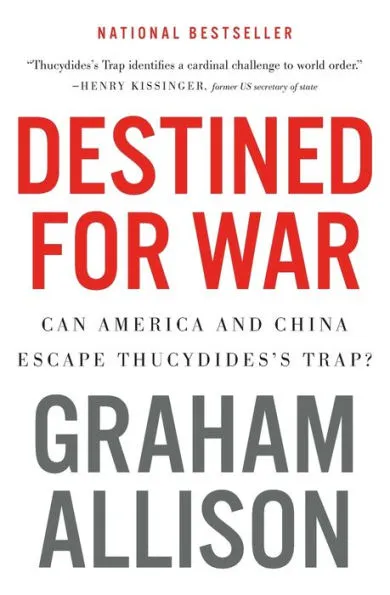
In the world of international relations, few concepts have captured as much attention — and sparked as much debate — as the “Thucydides Trap”. Brought to prominence by Harvard political scientist Graham Allison, the term suggests that conflict is almost inevitable when a rising power threatens to displace an established one, a dynamic often invoked to frame the strategic rivalry between the United States and China. Lauded as a National Bestseller and praised by figures like Henry Kissinger and Joe Biden, Allison’s Destined for War: Can America and China Escape Thucydides’s Trap? has become a staple of policy discussions and academic syllabi. Yet beneath the widespread acclaim lies a deeply flawed analysis, one that risks oversimplifying history and perpetuating a fatalistic narrative that could shape policy in dangerous ways. Far from an inescapable destiny, the lessons of history and the nuances of modern geopolitics suggest that the so-called “trap” may be more myth than inevitability.
The term “Thucydides Trap” is derived from a passage in the ancient Greek historian Thucydides’ work History of the Peloponnesian War, where he explained the causes of the conflict between Athens (the rising power) and Sparta (the ruling power) in the 4th century BC. Thucydides famously wrote
It was the rise of Athens and the fear that this instilled in Sparta that made war inevitable.
Allison defines the “Thucydides Trap” as “the severe structural stress caused when a rising power threatens to upend a ruling one”.1 More articles by Allison using this term previously appeared in Foreign Policy and The Atlantic. The book, published in 2017, was a huge hit, being named a notable book of the year by the New York Times and Financial Times while also receiving widespread bipartisan acclaim from current and past policymakers. Historian Niall Ferguson described it as a “must-read in Washington and Beijing”.2 Senator Sam Nunn wrote, “If any book can stop a World War, it is this one”.3 A brief search on Google Scholar reveals the term “Thucydides Trap” has been cited or used nearly 19,000 times. In 2015, Australian Prime Minister Malcolm Turnbull even publicly urged President Xi and Chinese Premier Li Keqiang to avoid “falling into the Thucydides Trap”.4 One analyst observed that the term had become the “new cachet as a sage of U.S.-China relations”.5 The term has become so prominent that it is almost guaranteed to appear in any introductory international politics course when discussing U.S.-China relations.
Allison wrote in his essay “The Thucydides Trap: Are the U.S. and China Headed for War?” in The Atlantic published in 2015, “On the current trajectory, war between the United States and China in the decades ahead is not just possible, but much more likely than recognized at the moment” forewarning, “judging by the historical record, war is more likely than not”.6 A straightforward analysis of the 16 cases in the book and previous essays might indicate that, based on historical precedent, there is approximately a 75 percent likelihood of the United States and China engaging in war within the next several decades. Adding the additional cases from the Thucydides Trap Website would still leave a 66 percent chance, more likely than not, that two nuclear-armed superpowers will go to war with one another, a horrifying and unprecedented proposition.7
With such alarm, it’s no surprise that the concept gained such widespread attention. The term is simple to understand and in under 300 pages, Allison delivers a sweeping historical narrative, drawing striking parallels between events from ancient Greece to the present day.8 International Relations as a field often struggles to break through in the public discourse, but Destined for War broke through, making a broad impact on academic and popular discourse.
1. Graham Allison, Destined For War: Can America and China Escape Thucydides’s Trap? (Boston: Houghton Mifflin Harcourt, 2017), 29.
2. Ibid., iii.
3. Ibid., vi.
4. Quoted by Alan Greeley Misenheimer, Thucydides’ Other “Traps”: The United States, China, and the Prospect of “Inevitable” War (Washington: National Defense University, 2019), 8.
5. Misenheiemer, 1.
6. “Thucydides’s Trap Case File” Belfer Center for Science and International Affairs, Harvard Kennedy School, accessed December 31, 2024
7. Graham Allison, “The Thucydides Trap: Are the U.S. and China Headed for War?” The Atlantic, September 24, 2015.
8. Misenheimer details what Thucydides actually said about the origins of the Peloponnesian War, 10-17.


