
The opening of Demons tries to fool you into thinking it’s a comedy of manners about liberal, cosmopolitan Russian aristocrats in the 1840s. The vibe is that of a Jane Austen novel, but hidden within the comforting shell of a society tale, there’s something dark and spiky. Dostoevsky pokes fun at his characters in ways that translate alarming well into 2020s America. Everybody wants to #DefundTheOkhrana and free the serfs, but is terrified that the serfs might move in next door. Characters move to Brookl … I mean to St. Petersburg to start a left-wing magazine and promptly get canceled by other leftists for it. Academics endlessly posture as the #resistance to a tyrannical sovereign (who is unaware of their existence), and try to get exiled so they can cash in on that sweet exile clout. There are polycules.1
As the book unfolds, the satire gets more and more brutal. The real Dostoevsky knew this scene well — remember he spent his early years as a St. Petersburg hipster literary magazine guy himself — and he roasts it with exquisite savagery. As a friend who read the book with me put it: the men are fatuous, deluded about their importance, lazy, their liberal politics a mere extension of their narcissism. The woman are bitchy, incurious about the world except as far as it’s relevant to their status-chasing, viewing everyone and everything instrumentally. Nobody has any actual beliefs, and everybody is motivated solely by pretension and by the desire to sneer at their country.
But this is no conservative apologia for the system these people are rebelling against either, Dostoevsky’s poison pen is omnidirectional. Many right-wing satirists are good at showing us the debased preening and backbiting, like crabs in a bucket, that surplus elites fall into when there’s a vacuum of authority. But Dostoevsky admits what too many conservatives won’t, that the libs can only do this stuff because the society they despise is actually everything that they say it is: rotting from the inside, unjust, corrupt, and worst of all ridiculous. Thus he introduces representatives of the old order, like the conceited and slow-witted general who constantly misses the point and gets offended by imagined slights. Or like the governor of the podunk town where the action takes place, who instead of addressing the various looming disasters, sublimates his anxiety over them into constructing little cardboard models.2 If there’s a vacuum of authority, it’s because men like these are undeserving of it, failing to exercise it, allowing it to slip through their fingers.
All of this is very fun,3 and yet not exactly what I expect from a Dostoevsky novel. It’s a little … frivolous? Where are the agonizingly complex psychological portraits, the weighty metaphysical debates, the surreal stroboscopic fever-dreams culminating in murder, the 3am vodka-fueled conversations about damnation? Don’t worry, it’s coming, he’s just lulling you into a false sense of security. After a few hundred pages a thunderbolt falls, the book takes a screaming swerve into darkness, and you realize that the whole first third of this novel is like the scenes at the beginning of a horror movie where everybody is walking around in the daylight, acting like stuff is normal and ignoring the ever-growing threat around them.
John Psmith, “REVIEW: Demons, by Fyodor Dostoevsky”, Mr. and Mrs. Psmith’s Bookshelf, 2023-07-17.
1. In an incredible bit of translation-enabled nominative determinism, the main cuckold is a character named Virginsky. I kept waiting for a “Chadsky” to show up, but alas he never did.
2. Look, the fact that he’s sitting there painting minis while the world burns makes the guy undeniably relatable. If you transported him to the present day he would obviously be an autistic gamer, and some of my best friends, etc., etc. Nevertheless, though, he should not be the governor.
3. For some reason, there are people who are surprised that Demons is funny. I don’t know why they’re surprised, Dostoevsky is frequently funny. The Brothers Karamazov is hilarious!
December 31, 2024
QotD: Pre-revolution Russia satirized by Dostoevsky
December 30, 2024
Ted Gioia on 2025’s most likely trends
Peeking out from behind the paywall, the latest installment of Ted Gioia‘s arts & culture briefing includes some good news for those of us who still remember when book stores actually sold books (unlike the last time I visited an Indigo store to find that the books were even more of an afterthought than ever):

“Barnes & Noble Book Store” by JeepersMedia is licensed under CC BY 2.0 
 .
.
The Barnes & Noble turnaround is really happening — and everybody in the culture business should learn from it.
More than a year ago, I celebrated the arrival of a new boss at Barnes & Noble who actually loves books.
This led him to do all sorts of brave things. He stopped promoting new titles based on kickbacks from publishers, and instead showcased books that people might actually enjoy reading.
This was an example of stealth culture mentioned above. Shoppers had no idea that the promoted books at the front of the store were chosen on the basis of financial incentives, not quality. And new boss Jamie Daunt shook the entire publishing business by turning down the cash.
He also empowered employees in the store, giving them freedom to feature books that they loved. He told his local booksellers to remove every title from every shelf, and “weed out the rubbish”. He wanted the staff to be excited about the books they sold.
I now have a happy update to my previous report.
Barnes & Noble has more than 60 new locations opening this year, and store foot traffic is improving steadily.
In an especially inspiring move, the company recently reopened a huge retail space in DC it had abandoned in 2013. After more than a decade, it returned to the same location and opened a flagship store.
When he took over, Daunt saw that the stores were “crucifyingly boring”. But now the excitement is back. Some visitors even compare Barnes & Noble nowadays to a theme park for books.
Kendra Keeter-Gray, a BookTok content creator with over 100,000 followers, told CNN that she and her friends could spend anywhere between 30 minutes to a few hours inside a Barnes & Noble, usually in the BookTok section where they trade recommendations and flip through currently trending novels.
“When you go to Barnes, it’s like an excursion almost. I would equate it to when I was little and my parents would take me to Six Flags,” she said.
Meanwhile here’s a completely different strategy for the book business …
In Japan, writers can rent out their own shelf at a local bookstore.
The new trend in Japanese bookstores is to sublease the shelves to outsiders. The result is the exact opposite of algorithm-chosen books. Every shelf is filled with surprises.
According to the South China Morning Post:
“Here, you find books which make you wonder who on earth would buy them,” laughs Shogo Imamura, 40, who opened one such store in Tokyo’s bookstore district of Kanda Jimbocho in April.
“Regular bookstores sell books that are popular based on sales statistics while excluding books that don’t sell well,” says Imamura … “We ignore such principles”.
December 29, 2024
QotD: Churchill as author and Prime Minister
The words were those of Winston Churchill, the 150th anniversary of whose birthday, 30 November 1874, falls this year. In addition to submitting canvases to the Royal Academy of Arts under the pseudonym David Winter — which resulted in his election as Honorary Academician in 1948 — and twice being Prime Minister for a total of eight years and 240 days, he has merited far more biographies than all his predecessors and successors put together. This summer I completed one more volume to add to the vast collection. My purpose here is less to blow my own trumpet than to ponder why Churchill remains so popular as a subject and survey what is new in print for this anniversary year.
It is tempting to see his career through many different lenses, for his achievements during a ninety-year lifespan spanning six monarchs encompassed so much more than politics, including that of painter. The only British premier to take part in a cavalry charge under fire, at Omdurman on 2 September 1898, he was also the first to possess an atomic weapon, when a test device was detonated in Western Australia on 3 October 1952. Besides being known as an animal breeder, aristocrat, aviator, big-game hunter, bon viveur, bricklayer, broadcaster, connoisseur of cigars and fine fines (his preferred Martini recipe included Plymouth gin and ice, “supplemented with a nod toward France”), essayist, gambler, global traveller, horseman, journalist, landscape gardener, lepidopterist, monarchist, newspaper editor, Nobel Prize-winner, novelist, orchid-collector, parliamentarian, polo player, prison escapee, public schools fencing champion, rose-grower, sailor, soldier, speechmaker, statesman, war correspondent, war hero, warlord and wit, one of his many lives was that of writer-historian.
Most of his long life revolved around words and his use of them. Hansard recorded 29,232 contributions made by Churchill in the Commons; he penned one novel, thirty non-fiction books, and published twenty-seven volumes of speeches in his lifetime, in addition to thousands of newspaper despatches, book chapters and magazine articles. Historically, much understanding of his time is framed around the words he wrote about himself. “Not only did Mr. Churchill both get his war and run it: he also got in the first account of it” was the verdict of one writer, which might be the wish of many successive public figures. Acknowledging his rhetorical powers, which set him apart from all other twentieth century politicians, his patronymic has gravitated into the English language: Churchillian resonates far beyond adherence to a set of policies, which is the narrow lot of most adjectival political surnames.
“I have frequently been forced to eat my words. I have always found them a most nourishing diet”, Churchill once quipped at a dinner party, and on another occasion, “history will be kind to me for I intend to write it”. Yet “Winston” and “Churchill” are the words of a conjuror, that immediately convey a romance, a spell, and wonder that one man could have achieved so much. It is an enduring magic, and difficult to penetrate. In 2002, by way of example, he was ranked first in a BBC poll of the 100 Greatest Britons of All Time — amongst many similar accolades. A less well-known survey of modern politics and history academics conducted by MORI and the University of Leeds in November 2004 placed Attlee above Churchill as the 20th Century’s most successful prime minister in legislative terms — but he was still in second place of the twenty-one PMs from Salisbury to Blair.
Peter Caddick-Adams, “Reading Winston Churchill”, The Critic, 2024-09-22.
December 19, 2024
QotD: Replacing the outdated “left” and “right” with more accurate terms
It was guys like Haldane who caused Stove to write a great essay about “The Ishmael Effect”. He said something like (from memory) it’s a striking fact about powerful minds, that even though they know better than everyone else some fact about the physical world — the conservation of energy, say — their powerful minds cause them to get caught up in all the fascinating implications of their pet theory, such that they fail to see their pet theory requires energy not to be conserved. Thus (said Stove), a guy like Kant: After telling us that no human mind can access the Thing-in-Itself, he gives us four hundred pages of extremely detailed information about the Thing-in-Itself. Or Karl Marx, who was able to soar so far above his own economic class situation as to tell us, with oracular certainty, that no one is able to transcend the cognitive limits of his economic class situation. I don’t think it’s much of an exaggeration to say that “the Ishmael Effect” pretty much IS 19th century philosophy … and thanks to entropy, 20th century politics, and now 21st century culture.
Such are the Theory People who, however many raw IQ points they have, will really see five lights if The Party tells them to, because The Party controls the Theory and the Theory is never wrong, facts be damned. Call them Rubashovs if you like (and are feeling literary), but let’s move on to the Reality People. If Rubashov is the ultimate Theory Person — marching willingly off to his destiny in the dreaded Lubyanka, because The Party requires it and The Party is never wrong — so the ultimate Reality Person is Niccolo Machiavelli.
Much hooey has been written about The Prince, that it’s ACK-shully a biting satire (you could call the Rubashovs’ junior varsity the ACK-shully kids), but Ol’ Nick meant every fucking word. Politics was a contact sport in his day — he picked the wrong side of a political dispute, and got the strappado for it. He knew exactly what he was talking about, and had the disjointed shoulders to prove it.
Machiavelli is often called a cynic, but just as everything in Clown World always turns out faker and gayer than the most jaded can imagine, so even the hardest-bitten cynic can’t touch Ol’ Nick. The Prince is beautifully written, but it’s one of the toughest reads you’ll ever have, because surely he can’t mean what he just wrote … he just can’t. But he does, and it’s true — that for example a man will more quickly get over the murder of his father than the loss of his patrimony. And you know it’s true, if only in the darkest watches of the night when you toss and turn in the coldest of cold sweats. There aren’t more than a handful of sentences in The Prince that won’t give you insomnia, if you really start thinking them through …
But just as (one hopes) even Rubashov would balk at shooting his children on The Party’s orders, so even Machiavelli marvels at the truth that no one is thoroughly, consciously evil, even when it’s in his obvious best interest to be. A man will always convince himself he’s doing good, even when he’s obviously, objectively doing the most heinous evil, and that — Nick implies — is the way to manage a tyrant. Even when doing X is the obviously advantageous thing to do, and doing Y is obviously disadvantageous, you can convince someone to do Y by changing the moral frame.
There’s obviously a spectrum here, which like all human behavior bends in on itself at the extremes. One imagines Rubashov, for instance, going through an “if only Comrade Stalin knew!” type thought process if The Party ordered him to shoot his infant children. Yes, The Party is never wrong … but even though Comrade Stalin IS The Party, The Party is, finally, the historical manifestation of a metaphysical necessity, and therefore, in the light of the Highest Truth, Comrade Stalin — though never wrong!! — is perhaps misinformed in this case … Just as Francesco Sforza or whomever balks at murdering those infants in their cribs, though it’s clearly the very best course of action, politically.
Rubashov vs. Machiavelli. That’s the best I can do.
Severian, “Mail / Grab Bag”, Rotten Chestnuts, 2021-09-10.
December 16, 2024
The Price of Victory by N.A.M. Rodger
In The Critic, Phil Weir reviews the final volume in N.A.M. Rodger’s three-book study of the history of the Royal Navy:
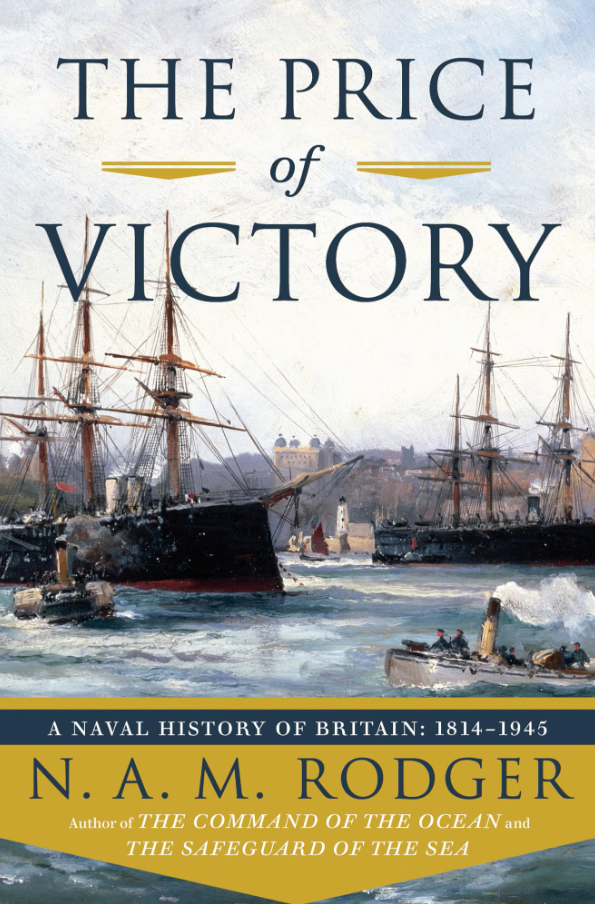
This October a major scholarly achievement was realised with the publication of The Price of Victory, the third and final instalment of N.A.M. Rodger’s great trilogy on the naval history of Britain from 660 AD to 1945. It has been an odyssey, albeit one that to complete took more than three times longer than Homer’s hero took to journey home.
The first volume, Safeguard of the Sea, was published back in 1997, some six years after Rodger had left his job as Assistant Keeper of the Public Records at the then Public Records Office to join the National Maritime Museum. Having moved to Exeter University, he completed the second volume, Command of the Ocean, covering the period from 1649 to 1815, in 2004.
Mindful of the fates of others who have attempted grand, multi-volume naval histories of Britain, Nicholas Rodger, now aged 74, was known to quip that one of his key aims was to become the first historian to live to see it completed. What he describes as “an exciting episode of brain surgery” delayed the completion of the final volume for several years, and left achieving this a closer-run thing than was — one suspects — entirely comfortable.
To the immense relief of all, Rodger recovered to complete his great work, and it has, emphatically, been well worth the wait. The Price of Victory is, like its predecessors, a most substantial work in both physical and scholarly senses.
At the outset of his task, Rodger aimed to create “not a self-contained ‘company history’ of the Royal Navy, but a survey of the contribution which naval warfare with all its associated activities has made to national history”. In doing so, he sought to link naval warfare “to political, social, economic, diplomatic, administrative, agricultural, medical, religious and other histories which will never be complete until the naval component of them is understood”.
He has succeeded handsomely, firmly entwining naval and naval-related matters into the core fabric of the history of the British Isles. The Price of Victory is a worthy conclusion to an epic series that will both stand in its own right and, as he hopes, serve as a baseline for future scholarly endeavours.
The vast, polyglot erudition underpinning Rodger’s prose wears no disguise. Yet, for all its great length and the density of knowledge each page imparts, The Price of Victory is, like its two preceding volumes, a lively read, leavened with the author’s dry wit.
The academic battle over the legacy of the British Empire
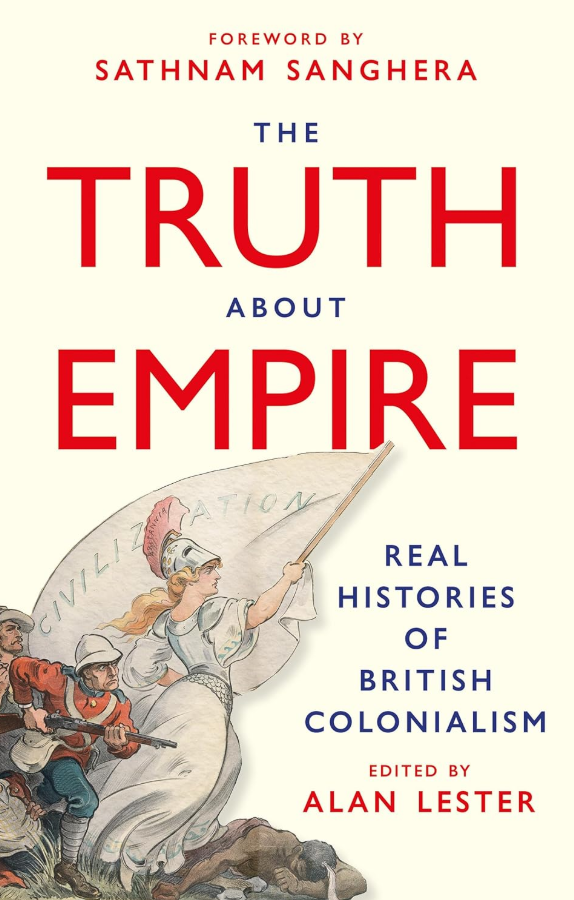
In the Washington Examiner, Yuan Yi Zhu reviews The Truth About Empire: Real histories of British Colonialism edited by Alan Lester:
… the story fitted awkwardly with the new dominant historical narrative in Britain, according to which the British Empire was an unequivocally evil institution whose lingering miasma still corrupts not only its former territories but also modern-day Britain.
When Kipling lamented, “What do they know of England, who only England know?” he was not being elegiac as much as describing a statistical fact. Contrary to modern caricatures, apart from episodic busts of enthusiasm, Britons were never very interested in their empire. At its Victorian peak, the great public controversies were more likely to be liturgical than imperial. In 1948, 51% of the British public could not name a single British colony; three years later, the figure had risen to 59%. Admittedly, this was after Indian independence, but it should not have been that hard. Proponents of the “imperial miasma” theory are right in saying that British people are woefully ignorant about their imperial past; but that was the case even when much of the world was colored red.
The Truth About Empire: Real Histories of British Colonialism is a collection of essays edited by Alan Lester, an academic at the University of Sussex who has been at the forefront of the cultural conflict over British imperialism on the “miasma” side — though, like all combatants, he denies being a participant. Indeed, one of the book’s declared aims is to show that its contributors are not engaged in cultural warring.
Their nemesis, whose name appears 376 times in this book (more often than the word “Britain”) is Nigel Biggar, a retired theologian and priest at the University of Oxford. In 2017, Biggar began a project to study the ethics of empire alongside John Darwin, a distinguished imperial historian. The now-familiar academic denunciations then came along, and Darwin, on the cusp of a quiet retirement, withdrew from the project.
Lester was not part of the initial assault on Biggar but has since then emerged as his most voluble critic. He disclaims any political aims, protesting that he and his colleagues are engaged in a purely scholarly enterprise, based on facts and the study of the evidence.
Yet some of Lester’s public interventions — he recently described a poll showing that British people are less proud of their history than before as an “encouraging sign” — are hard to square with this denial. Biggar, by contrast, is refreshingly honest that his aims are both intellectual and political. I must add that both men are serious scholars, which is perhaps why neither has been able to decisively bloody the other in their jousts.
[…]
“What about slavery?” asks Dubow’s Cambridge colleague Bronwen Everill. Unfortunately, her four pages, which read like a last-minute student essay, do not enlighten us. The most she can manage is to point to an 18th-century African monarch abolishing the slave trade as evidence that the British do not deserve any plaudits for their abolitionist efforts across the world, whose cost has been estimated at 1.8% of its gross domestic product over a period of 60 years.
Meanwhile, Abd al Qadir Kane, Everill’s abolitionist monarch, only objected to the enslavement of Muslims but not to slavery generally, his progressive reputation resting mainly on the misunderstandings of Thomas Clarkson, an overenthusiastic English abolitionist. (Either cleverly or lazily, Everill quotes Clarkson’s misleading account, thus avoiding the need to engage with the historiography on Islamic slavery in Africa.)
Everill’s central argument is that abolitionism allowed Britain to rove the world as a moral policeman and to overthrow rulers who refused to abolish slavery. It is never clear, however, why this was morally bad. If anything, Britain did not go far enough: Well into the 1960s, British representatives still manumitted slaves on an ad hoc basis in its Gulf protectorates, when the moral thing would have been to force their rulers to abolish slavery, at gunpoint if necessary.
December 14, 2024
QotD: The One Ring in Lord of the Rings
Unlike his friend C.S. Lewis, Tolkien was not fond of allegorical fiction. He had no time for the idea that the Ring — extremely dangerous but hard to get rid of — was an allegory of the atomic bomb. Rather, it was exactly what he said it was: an embodiment of power and the corrupting effects of power.
Tolkien shows us that the only people who can be trusted with great power are those who don’t really want it — or who do, but have the moral strength to reject it. Even then, it’s touch-and-go, the burden of responsibility taking a terrible toll on the reluctant bearer.
Numerous commentaries have been written on this aspect of the story — often summed up by the Lord Acton quote: “power tends to corrupt and absolute power corrupts absolutely”. Which is true enough. But Tolkien was onto a whole lot more than that …
Let’s begin at the beginning. The Ring was made at great cost to Sauron, its creator. He poured much of his own strength into an external object — one from which he could be separated, which in due course he was. So why take the risk? Sauron, though evil, was possessed of great cunning — why did he expose himself to such a vulnerability? Did old JRR just not think it through? Does the Ring actually represent a massive hole in the plot?
Not a bit of it. When you understand what Tolkien understood about the nature of power, it all makes perfect sense.
In a letter, he once wrote that the Ring was a “mythological way of presenting the truth that potency … if it is to be exercised, and produce results, has to be externalised and so as it were passed, to a greater or less degree, out of one’s direct control”. This is a crucial insight into the way Tolkien understood power to work.
Peter Franklin, “Tolkien’s guide to contemporary politics”, Unherd, 2019-12-24.
December 12, 2024
QotD: The “natural cycle” of empire
Arguably the evolution of the British Empire into a Commonwealth of 70-odd self-governing nations, many of them with stable democratic governments, who can all get together and play cricket and have Commonwealth Games (and impose sanctions and suspensions on undemocratic members): cannot be considered much of a “collapse” when compared to say the Inca or Aztec civilisations. Nor can post Medieval Europe be considered a “collapsed” version. Even Rome left a series of successor states across Europe – some successful and some not. (Though there was clearly a collapse of economics and general living standards in these successor states.) The fact that the Roman Empire survived in various forms both East – Byzantium – and west – Holy Roman Empire, Catholic Church, Christendom, etc – would also argue somewhat against total collapse. Still the idea has been popular with both publishers and readers.
Yet the “natural cycle” theory has been revisited recently by economic historians in such appalling works on “Imperialism and Collapse”, as The Rise and Fall of the Great Powers. [That’s the one where the Paul Kennedy explained how US power “has been declining relatively faster than Russia’s over the last few decades” (p.665) – just before the Berlin Wall came down.]
Nigel Davies, “The Empires of Britain and the United States – Toying with Historical Analogy”, rethinking history, 2009-01-10.
December 11, 2024
QotD: Simon Leys on George Orwell
What Leys wrote in 1984 in a short book about George Orwell might just as well have been written about him: “In contrast to certified specialists and senior academics, he saw the evidence in front of his eyes; in contrast to wily politicians and fashionable intellectuals, he was not afraid to give it a name; and in contrast to the sociologists and political scientists, he knew how to spell it out in understandable language.”
Leys drew a distinction between simplicity and simplification: Orwell had the first without indulgence in the second. Again, the same might be said of Leys — who, of course, like Orwell, had taken a pseudonym, and with whose work there were many parallels in his own.
But immense as was Leys’s achievement in destroying the ridiculous illusions of Western intellectuals, as Orwell had tried to do before him, it was a task thrust upon him by circumstance rather than one that he would have chosen for himself. He was by nature an aesthete and a man of letters, and I confess that great was my surprise (and pleasurable awe) when I discovered that he was, in addition to being a great sinologist, a great literary essayist.
Theodore Dalrymple, “Rare and Common Sense”, First Things, 2017-11.
December 10, 2024
Countering the “Managerial Revolution”
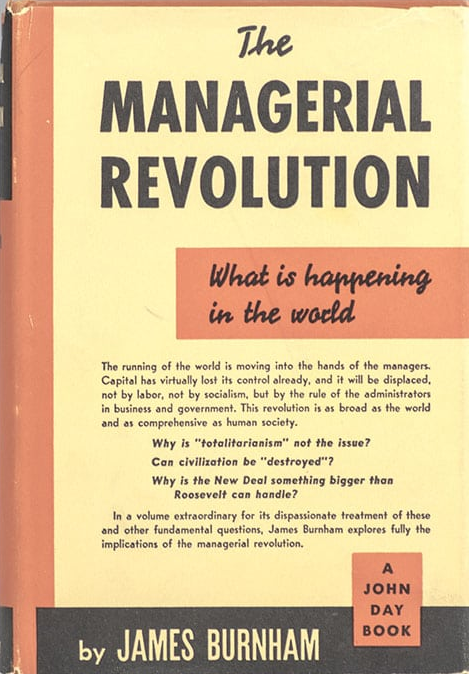
Tim Worstall discusses the rise of the managerial class — described in 1941’s Managerial Revolution by James Burnham — and how detrimental to individual enterprises and the wider economy managerialism has been:
This, rather joyously, explains a lot about the modern world. We could go back to the mid-1980s and the bloke who ran the ‘baccy company written up in Barbarians at the Gates. In which he, as CEO, had a fleet of private planes, the company paid for his 11 country club memberships and so on. His salary was decent, sure, but the corporation rented him all the trappings of a Gatsbyesque — and successful — capitalist. Until the actual capitalists — the barbarians — turned up at those gates and started demanding shareholder returns.
Or we can think of the bureaucratic classes in the UK in more recent decades. Moving effortlessly between this NGO, that quasi-governmental body and a little light sitting on the right government inquiry. All at £1500 a day and a damn good pension to follow.
Or, you know, adapt the base idea to taste. There really is a bureaucratic and managerial class that gains the incomes and power of the capitalists of the past without having to do anything quite so grubby as either risk their own money or, actually, do anything. They, umm, administer, and the entire class is wholly and absolutely convinced that everything must be administered and they’re the right people to be doing that.
You know, basically David Cameron. Met him once, when he was just down from uni. At a political meeting – drinkies for the Tory activists in a particular council ward, possibly a little wider than that. Hated him on sight which I agree has saved me much time over the decades. And I was right too. There is nothing to Cameroonism other than that the right sort of people should be administering — the managerial revolution.
Sure, sure, we used to have the aristocracy which assumed the same thing but we did used to insist that they could chop someone’s head off first — show they had the capability. Also, they didn’t complain nor demand a pension when we did that to them if they lost office.
But the bit that really strikes me. France — and thereby the European Union — seems to me to be where this Managerial Revolution has gone furthest. Get through the right training (the “enarques“) and you’re the right guy to be a Minister, run a political party, manage the oil company, sort out the railways etc. You don’t have to succeed or fail at any of them, you’re one of the gilded class that runs the place. Because, you know, everything needs to be run and one of this class should do so.
The divergence or even active conflict of interests between the owners and the non-owning managers is part of the larger Principal-Agent Problem.
Microsoft has launched a publishing arm called “8080 Books” – AI-generated books anyone?
Ted Gioia notices that Microsoft and other tech companies are moving into book publishing, likely as a way to generate some additional revenue from their vast investments in artificial intelligence ventures over the last several years:

I never expected Microsoft to enter the book business.
But on November 18, this huge tech company quietly announced that it is now a publisher. But there was an interesting twist.
Microsoft is “not currently accepting unsolicited manuscripts”.
Let’s be totally fair. Nobody at Microsoft claims that it plans to replace human writers with AI slop. But this company has invested a staggering $13 billion in AI — it’s their top priority as a corporation.
So what you do think their goals are in the book business?
If you’re looking for a clue, I note that Microsoft’s publishing arm is called 8080 Books. Yes, they named it after the 8080 microprocessor.
How charming!
And just a few hours after Microsoft announced this move, TikTok did the exact same thing.
According to The Bookseller:
ByteDance, the company behind the video-sharing platform TikTok, has announced that it will start selling print books in bookshops from early next year, published under its imprint, 8th Note Press. 8th Note Press will work in partnership with Zando to publish print editions and sell copies in physical bookstores starting early 2025.
Here, too, nobody is claiming that they will replace humans with bots. But why would a company that has built its empire with online social media have any interest in the slow and stodgy business of selling printed books on paper?
Oh, by the way, TikTok’s parent is investing huge sums in AI. The company has even found a way around export controls on Nvidia chips. Just a few weeks before entering the book business, ByteDance’s sourcing of AI tech from Huawei was leaked to the press.
And as if these coincidences weren’t enough to alarm you, another AI publishing development happened at this same time — but (here too) with very little coverage in the media.
Tech startup Spines raised $16 million in seed financing for an AI publishing business that aims to release 8,000 books per year.
Here, too, the company says that it wants to support human writers. Maybe it will run a new kind of vanity publishing business. But is that a sufficient lure to attract $16 million in seed financing?
It’d be a rearguard action, but it’d be nice to have a requirement that publishers disclose when published works are partly or wholly AI-extruded, wouldn’t it? It would certainly help me to avoid buying books or magazines where AI hallucinations may occur in key sections …
December 9, 2024
QotD: The downfall of Boeing
There’s a lot to love about an engineer-dominated corporate culture. For starters, it has a tendency to overengineer things, and when those things are metal coffins with hundreds of thousands of interacting components, filled with people and screaming through the air at hundreds of miles an hour, maybe overengineering isn’t so bad. These cultures also tend to be pretty innovative, and sure enough Boeing invented the modern jet airliner and then revolutionized it several times.
But there are also downsides. As any Googler will tell you, these companies usually have a lot of fat to trim. Some of what looks like economic inefficiency is actually vital seed corn for the innovations of the future, but some of it is also just inefficiency, because nobody looks at the books, because it isn’t that kind of company. Likewise, being highly deliberative about everything can lead to some really smart decision making and avoidance of group think, but it can also be a cover for laziness or for an odium theologicum that ensures nothing ever gets done. Smart managers steeped in this sort of culture can usually do a decent job of sorting the good from the bad, but only if they can last, because you see there’s a third problem, which is that almost everybody involved is a quokka.
Engineers, being a subspecies of nerds, are bad at politics. In 1996, Boeing did something very stupid and acquired a company that was good at politics. McDonnell Douglas, another airplane maker, wasn’t the best at making airplanes, but was very good at lobbying congress and at impressing Wall Street analysts. Boeing took over the company, but pretty much everybody agrees that when the dust had settled it was actually McDonnell Douglas that had taken over Boeing. One senior Boeing leader lamented that the McDonnell Douglas executives were like “hunter killer assassins”. No, sorry bro, I don’t think they were actually that scary, you were just a quokka.
Anyway, the hunter killer assassins ran amok: purging rivals, selling off assets, pushing through stock buybacks, and outsourcing or subcontracting everything that wasn’t nailed down. They had a fanaticism for capital efficiency that rose to the level of a monomania,1 which maybe wasn’t the best fit for an airplane manufacturer. And slowly but surely, everything went off the rails. Innovation stopped, the culture withered, and eventually planes started falling out of the sky. And now the big question, the question Robison just can’t figure out. Why?
John Psmith, “REVIEW: Flying Blind by Peter Robison”, Mr. and Mrs. Psmith’s Bookshelf, 2023-02-06.
1. This is how you know this story took place in an era of high interest rates!
December 8, 2024
QotD: Who invented the vending machine?
Richard Carlile was a shit-disturbing English bookseller. He insisted on selling Thomas Paine’s The Age of Reason despite it being seditious and blasphemous for its attacks on organized religion, particularly the Church of England. Impressively stubborn, Carlile was arrested in 1819, imprisoned, and fined a massive £1,500 for selling Paine’s work. While a guest of the state, his wife, Jane, and other associates kept selling The Age of Reason, leading to more arrests.
Sometime around his release in 1822, Carlile came up with the idea of automating sales. His device was crude, but effective. A person inserted coins and pulled a lever that opened a compartment from which a copy of The Age of Reason could be retrieved without human intervention. Police had no one to arrest for selling seditious material.
The book vending machine didn’t keep Carlisle out of jail — he would spend nine years locked up for acts of political rebellion. Nor was he able to patent his device. I admire the hell out of him, tho.
Jump ahead to the early twentieth century and vending machines were being used in France and Germany to sell newspapers, postcards, maps, as well as books. The idea crossed the English Channel in 1937. Allen Lane, who single-handedly invented the modern paperback and founded Penguin Books with his brothers in 1935, launched the Penguincubator two years later. Based on the German machines, it was described by the Times as “an unfamiliar contraption of metal and glass”. Lane installed it at 66 Charing Cross Road, outside Collet’s bookshop.
Lane’s contraption was no more successful than Carlile’s. It got wheeled out of Collet’s shop at closing time every night and wheeled back in every morning when the shop opened. Another Charing Cross bookseller recalled seeing letters shoved under the shop’s door each morning complaining of coins lost in the machine. Customers also learned that you only had to pound the side of the box in order for it to disgorge about a third of its inventory. The Bookseller reported that when this was pointed out to the manager of Collet’s, he “gave his incontinent robot a terrific thrashing. As a result of this all the rest of the Penguin’s promptly fell out.”
That perhaps explains why I couldn’t find a mention of the Penguincubator in Stuart Kells’ otherwise excellent book, Penguin and the Lane Brothers: The Untold Story of a Publishing Revolution.
Ken Whyte, “Have I got a business for you!”, SHuSH, 2024-09-06.
December 7, 2024
QotD: Game of Thrones as PoMo “deconstructionism”
Again, I guess I can forgive my colleagues, under-sexed little closet cases that they are, for being distracted by the boob cornucopia up on screen, but in the books, anyway, this comes through plain as day: Everyone in Westeros is either a psychopathic scumbag, or dead. In the very best PoMo style, the author is rubbing our faces in his belief that, since it’s extremely difficult to be heroic — or, all too often, merely decent — everyone who even thinks about trying is a fool, and deserves all the awful shit that happens to him. I’m told that back in the 18th century, a fun topic of debate at salons is whether a society of atheists could endure. Martin’s entire oeuvre seems dedicated to proving that life — mere, grubby, eating-shitting-sleeping existence — will continue in a society composed entirely of scumbags … but he has no idea why.
I have no idea why this idea (if that’s the right word) is so deeply appealing to academics, but evidently it is … and these are the people who are teaching your children.
Severian, “The One Pop Culture Thing”, Rotten Chestnuts, 2021-09-16.
December 5, 2024
QotD: Oscar Wilde
H.L. Mencken, “Portrait of a Tragic Comedian”, The Smart Set, 1916-09.


