I’ve written a lot here about how the most dangerous types in peacetime are the ones who juuuuust missed participating in some vast social upheaval. The Nazis are an obvious example. The Nazi-est Nazis of them all — Himmler, Heydrich, Eichmann, etc. — were old enough to have seen and understood the great national cataclysm that was World War I, but weren’t quite old enough to participate in it directly. Thus, when their turn came, they had to go double-or-nothing to prove to their older kin and classmates that they had what it takes. In America, guys like Teddy Roosevelt don’t make much sense until you realize that they grew up hearing their fathers and older brothers reminisce about the Civil War. And so on.
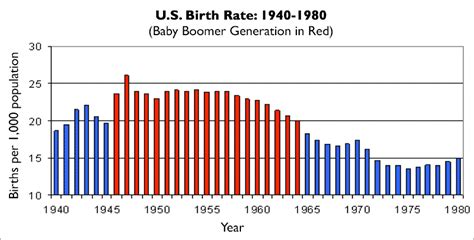
Now, I’m all for bashing the goddamn Boomers, but let’s be fair (since it matters for historical analysis). There’s a common misconception about the Baby Boom. Here, see if you can spot it:
Did you see it? Look closer, and you’ll see that while 1947(-ish) appears to be the peak year in terms of total births, the vast majority of what we call “Boomers” were born after 1950. Let’s do some simple math. The very oldest Boomers were born in 1946. The Summer of Love was 1967. Even if we assume the Summer of Love came out of nowhere — which is impossible, of course, any movement that large had antecedents going back years, probably decades, but let’s assume — that means that any “Boomers” participating were, at most, barely 22 years old. They were just barely 24 when Woodstock came around. Granted that the youngest are the dumbest, and thus can have outsize influence, they still can’t have been largely, let alone solely, responsible for the idiocy of the hippies.
That’s all on the older crowd, the so-called “Silent Generation” — the ones who were old enough to be aware of World War II, but unable to participate directly.
It’s easy to verify. The Port Huron Statement, the founding document of the New Left, was penned by coddled college kids in 1962 — meaning, by kids born, at latest, in about 1942 (its principal author, Tom Hayden, was born in 1939). Here are the Chicago Seven and their dates of birth: Abbie Hoffman (1936), Jerry Rubin (1938), David Dellinger (1915!), Hayden, Rennie Davis (1941),John Froines (1939), and Lee Weiner (1939).
Hoffman, especially, bears scrutiny. Though he’s best remembered as a Yippie — that is, the founder of an ostentatiously youth-oriented movement — he was 31 at its founding. Don’t trust anyone over thirty, right?
1936 to 1946 is only a decade, but it’s crucial. A kid born in 1936 would have vivid memories of World War II and its immediate aftermath — fathers, uncles, and older brothers (and, in more than a few cases, aunts and older sisters) coming home from the service. A kid born in 1946 would have a completely different experience — ask any combat veteran about the first year or two back in the world, versus being home for a decade. Those guys — the kids who saw firsthand the angry young strangers they were supposed to call “Dad” — were the ones who did the real damage in The Sixties(TM), just as it was the almost-but-not-quite frontsoldaten who did the real damage in the Third Reich.
With me? Now hang on to your hats, because here’s where it gets pretty meta: It was the “Silent Generation,” not the Boomers, who did the real damage in The Sixties(TM). That is, the guys who juuuust missed the giant social upheaval that was World War II. The Boomers have done all the damage since The Sixties(TM).
That — The Sixties(TM), which is why I’m using that obnoxious (TM) — is the great social upheaval they juuuust missed. [These people] aren’t old fossils from the flower power years, though many of those fossils are still alive and kicking (including four of the Chicago Seven: Hayden, Davis, Froines, and Weiner). Has anyone heard from Billy Ayers lately? How about Noam Chomsky (born 1928)? I’m sure they have plenty to say … but nobody cares.
It’s not retreads from The Sixties(TM) out there doing this stuff. It’s the people who wish they’d been around for the Summer of Love that are doing it. It’s the people who just know they would’ve ended the Vietnam War, if only they hadn’t been in junior high at the time. This is their Woodstock, not least because they only heard about the original when they arrived for freshman orientation in 1976.
Severian, “Talkin’ ’bout My Generation!”, Rotten Chestnuts, 2020-06-11.
September 23, 2020
QotD: Don’t blame the Boomers for the “Summer of Love” … most of ’em were too young to participate
September 20, 2020
QotD: The anti-slavery movement
What did Wilberforce “cure”? Two centuries ago, on March 25th 1807, one very persistent British backbencher secured the passage by Parliament of an Act for the Abolition of the Slave Trade throughout His Majesty’s realms and territories. It’s not that no one remembers the disease ever existed, but that we recall it as a kind of freak pandemic — a SARS or bird flu that flares up and whirrs round the world and is then eradicated. The American education system teaches it as such — as a kind of wicked perversion the Atlantic settlers had conjured out of their own ambition.
In reality, it was more like the common cold — a fact of life. The institution predates the word’s etymology, from the Slavs brought from eastern Europe to the glittering metropolis of Rome. It predates by some millennia the earliest laws, such as the Code of Hammurabi in Mesopotamia. The first legally recognized slave in the American colonies was owned by a black man who had himself arrived as an indentured servant. The first slave owners on the North American continent were hunter-gatherers. As Metaxas puts it, “Slavery was as accepted as birth and marriage and death, was so woven into the tapestry of human history that you could barely see its threads, much less pull them out. Everywhere on the globe, for 5,000 years, the idea of human civilization without slavery was unimaginable.”
Mark Steyn, The [Un]documented Mark Steyn, 2014.
September 8, 2020
2020 is a cracking year
And by “cracking” I don’t mean the old Victorian expression for “very good”. Sarah Hoyt explains the cracks at the Libertarian Enterprise:
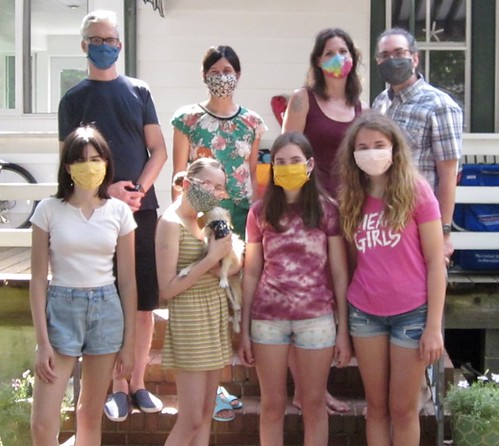
“Covid 19 Masks” by baldeaglebluff is licensed under CC BY-SA 2.0


It’s 2020 and we’re all cracking.
And no, by that I don’t mean that we’re cracking like crazy on our writing. Most of us are having trouble writing. A lot of us are having trouble reading. Though I’ve finally got out of the Pride and Prejudice fanfic jag.
I’ve seen people suddenly lose it and start crying over dirty dishes. Or the fact we ran out of peanut butter.
Okay, that was me. Yesterday. But I’ve been watching signs of just that much fragility in everyone I know.
Part of it is the lockdown. Man — and verily, woman — is a social animal. Not only is it not good for Man — do I need to say “and woman again?” — to be alone, it’s not good for us, when going out to be confronted with “truncated” human faces.
It is instinctive in humans to see human faces in everything. Don’t believe me? Look at a random pattern long enough, and you’ll find faces. Truncated human faces, the mouth gone, are deeply unsettling to the back of our brain. It is wrong, mutilated.
Suicides are through the roof. Mental health issues abound. The young are suffering particularly badly, because on top of all they believe they’re going to die. (The rest of us are already dead from the ice age, acid rain, fossil fuel depletion, alar, global warming, ozone depletion … I’m sure I’m forgetting some things. After so much death, one becomes resilient. Those of us forty and over won’t die. Even if they kill us.)
But the other part of it is that in a contentious political year there’s nowhere to escape.
Remember when you used to have friends that believed exactly the opposite of what you did, and you both knew it, but you were still friends? You couldn’t talk politics, but you could talk knitting, embroidery, kids, gardening, furniture refinishing, science fiction? You could sit down and have a cup of coffee with someone whose political views you considered despicable and not mention politics? Not even once?
But that was before the invasion of those for whom everything is political. Oh, cancel culture already existed. Before social media, I was terrified of saying the wrong word and revealing my real thoughts, and getting blacklisted by publishing houses.
But there were spaces you could draw a breath. Places where you didn’t have to talk and/or think about politics.
August 31, 2020
Why was Europe better with guns? – The History of Guns
History Clarified
Published 3 Dec 2018China invented gunpowder (combustible powder), so why was it the European nations that went out and conquered the world using firearms?
This video looks at some geographical factors to examine what allowed Europe to innovate while China and most of the world fell behind with gunpowder weapons.
This focuses heavily on Kenneth Chase’s Book, Firearms: A Global History to 1700. He tries to get away from just looking at drill, organization, and state production of firearms to see how geography helped create the necessary conditions for those other innovations.
Interested in your own copy? Check out the link below:
DISCLAIMER: This video description contains affiliate links, which means that if you click on one of the product links below, I’ll receive a small commission.
The map of Japan is under Creative Commons 4.0.

August 28, 2020
Britain’s National Trust decides to go in a radically different direction
If you’ve ever visited the UK, you’ll almost certainly have seen some National Trust historic properties in your travels. Despite the name, it’s not a government-affiliated organization, so the Trust has its mission set by its own leadership … and the current leadership are apparently turning their back on the tradional role of the Trust “due to the pandemic”:

From its establishment in 1895 by Octavia Hill, Sir Robert Hunter and Hardwick Rawnsley “to promote the permanent preservation for the benefit of the Nation of lands and tenements (including buildings) of beauty or historic interest”, it has become the pre-eminent haunt of the tasteful middle classes, and is as much part of national life as that other much-lauded institution, the NHS. I have fond memories from my own childhood, and beyond, of walking round grand houses and of playing in their lavish and beautifully appointed grounds. Even their names produce a kind of Proustian rush in me – Felbrigg, Blickling, Stourhead, Dyrham Park, Kingston Lacy. In an uncertain and constantly changing world, the National Trust seemed to be almost a secular church, a rather well-appointed and comfortable Rock of Ages in its own right.
Yet we live in a time when a grubby little pandemic has turned all certainties upside down, and so even the National Trust has had to rethink its plans for the future. Unfortunately, its method of so doing seems to be both destructive and ill-considered. Some might call it woke, if it weren’t for the fact that its actions do not seem to be dictated by panicked social change, but instead by the reported £200 million loss that the coronavirus outbreak has occasioned. Despite having an endowment of over a billion pounds, and still retaining the annual memberships of over five million people, elements within the organisation that long for disruption seem now to have grasped the initiative, with potentially disastrous consequences for both the Trust and the country at large.
An internal briefing document that was leaked to the Times by a no doubt furious insider represents a chilling account of a cull of both heritage and expertise. It describes the status quo as “an outdated mansion experience”, and one that exists only to serve “a loyal but dwindling audience.” It plans to deal with this old-fashioned situation by firing dozens of its curators, placing large amounts of art and antiquities in storage, and by closing most of the properties to the public, instead letting them be hired by corporate entities and the well-heeled for private events, or “new sources of experience-based income”. As the document put it, the Trust wishes to “flex our mansion offer to create more active, fun and useful experiences.” Flex. Mansion Offer. We are, it seems, at the end of days.
I briefly considered, before writing this article, attempting to hold a séance to try and obtain James Lees-Milne’s views from beyond the grave, but eventually decided against interrupting his eternal rest to inform him of the disappointing and frightening news. Yet this situation does not need the phantoms of long-dead architectural historians to fan the flames. There are plenty of living people who are equally, and vocally, appalled, ranging from those who cancelled their memberships to the Trust when the institutional ties were no longer available in their gift shops to the curators, historians and architectural consultants who stand to lose both income and professional standing if these ill-considered and short-sighted reforms are brought about.
The art historian and broadcaster Bendor Grosvenor has been especially exercised by the revelation of the Trust’s plans. He has described their restructuring ideas in The Art Newspaper as “one of the most damaging assaults on art historical expertise ever seen in the UK.” Grosvenor has since been assiduously passing scathing commentary on the various public statements, of varying degrees of disingenuity, made by various high-up executives at the National Trust, none of which have denied that historic properties will be “repurposed”, that the specialist curator posts will be “closed” and the expert curators fired, nor, perhaps most chillingly of all, that the Trust will be seeking to “dial down” its status as a “major national cultural institution”.
About thirty years ago, when we could afford to travel more often, we had a family membership in the National Trust even though we’d only get to visit National Trust properties for two-to-three weeks in a given year. I’m very disappointed to hear about this planned change to the organization, but the chances of me visiting the UK anytime in the next few years are quite low, so I may not have to worry about it personally.
August 25, 2020
QotD: Collective punishment
In times of peace, collective punishment may come in the form of social media dust-ups over sombrero hats or Chinese dresses. Gradual softening on the taboo of collective punishment does not bode well for the health of liberal democracies. Which is also why it is important for us all to remember that social-justice activists who complain about cultural appropriation only represent themselves, and not the minority groups to which they belong.
Claire Lehmann, “The Evils of Cultural Appropriation”, Tablet, 2018-06-11.
August 22, 2020
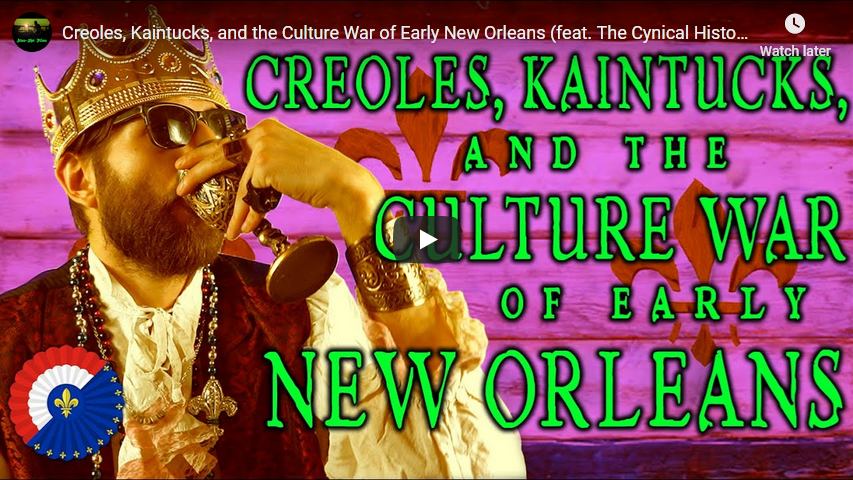
Creoles, Kaintucks, and the Culture War of Early New Orleans (feat. The Cynical Historian)
Atun-Shei Films
Published 21 Aug 2020For #ProjectFrance, I collaborated with @The Cynical Historian to teach y’all about the cosmopolitan cultural exchange between revolutionary France and a country called the United States of America in the late 18th and early 19th century. In this video, I discuss the contentious relationship between Anglo-Americans and French Creoles in New Orleans in the years after the Louisiana Purchase.
Support Atun-Shei Films on Patreon ► https://www.patreon.com/atunsheifilms
Leave a Tip via Paypal ► https://www.paypal.me/atunsheifilms (All donations made here will go toward the production of The Sudbury Devil, our historical feature film)
Buy Merch ► teespring.com/stores/atun-shei-films
#NewOrleans #History
Watch our film ALIEN, BABY! free with Prime ► http://a.co/d/3QjqOWv
Reddit ► https://www.reddit.com/r/atunsheifilms
Twitter ► https://twitter.com/atun_shei~REFERENCES~
[1] Lo Faber. “Anglo-Americans” (2018). 64Parishes https://64parishes.org/entry/anglo-am…
[2] Richard Campanella. Bienville’s Dilemma: A Historical Geography of New Orleans (2008). University of Louisiana at Lafayette, Page 170-171
[3] Peter J. Kastor. “Louisiana Purchase and Territorial Period” (2018). 64Parishes https://64parishes.org/entry/louisian…
[4] Daniel Rasmussen. American Uprising: The Untold Story of America’s Largest Slave Revolt (2011). Harper Perennial, Page 16
[5] Kimberly S. Hanger. Bounded Lives, Bounded Places: Free Black Society in Colonial New Orleans, 1769-1803 (1997). Duke University Press, Page 54-56
[6] Mary Gehman. The Free People of Color of New Orleans (2009). Sheridan Books, Page 49-51
[7] Rasmussen, Page 159-163
Debra Soh’s new book is “a cancel-culture grenade”
Jen Gerson knows that any positive mention of Debra Soh’s The End of Gender: Debunking Myths About Sex and Identity has a strong resemblance to square-dancing in a minefield. Cancellations may fall like raindrops on the career of anyone so unenlightened as to even acknowledge the existence of such a work:
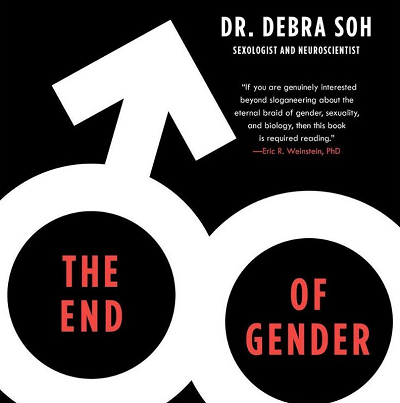
For that, at its heart, is what Soh’s book is: a lucid discussion of the best science we have to date on the nature of gender and sex, written for a lay audience. What gives the title its sizzle is not the content, but rather the cultural climate in which it is being published.
It maps the depth, scope and scale of current Culture War trenches in this particular theatre of battle. The End of Gender stomps on tripwires like the gender binary, whether transgender women are women, autogynephilia, Rapid Onset Gender Dysphoria, bathroom bans, and more.
It’s a cancel-culture grenade.
That’s not because these subjects ought to be contentious. Soh’s approach and tone are largely neutral. Rather, the controversy the book will inevitably incite is a reflection of a culture that has been warped into a state of existential terror by the very notion that these ideas can be responsibly discussed.
Soh begins by defining her terms.
So much of the debate around the most difficult topics of sex and gender stem from the simple fact that we are misusing the basic language. For example, sex and gender are not interchangeable concepts, even though they are often treated as such.
Sex is a term of biology. One’s sex, Soh argues, is determined by his or her gametes. With the exception of rare intersex disorders, 99 per cent of the population has a clearly defined biological sex that slots into one of two dimorphic categories: male or female.
Gender is more complicated. It’s now popular to state that there are more than two genders, but Soh disputes this. She argues that gender — or the set of characteristics that signal one’s sex to society — is also dimorphic. For 99 per cent of the population, gender correlates with sex. Further, even when expressions of gender are at odds with one’s biological sex, this, too, is mediated by biology. Whether one presents as gender typical or gender atypical is the result of prenatal testosterone exposure.
Soh notes that claiming to be gender non-binary, or gender fluid — or any one of a thousand variations that transcend the limiting concepts of male and female — is increasingly trendy, especially among teenagers and young adults. It seems to be the latest form of identity experimentation.
There are two reasons for this trend.
The first is that seeing the world through an intersectional framework encourages progressives to reverse the traditional hierarchies of race, sex and power. Therefore, claiming a marginalized identity — like genderqueer non-binary unicorn — accrues status within progressive peer circles.
The second is that the culture has undergone a massive awakening to transgender rights over the past decade. This has contributed expressive categories and vocabularies for people who otherwise might have struggled to find the language to explore their most authentic selves. As the cues, like cosmetics and dress, that we used to signal our gender are socially constructed, gender expression is limited only by our creativity.
August 21, 2020
QotD: Our overprotective culture
There’s a rule of thumb for dealing with elderly people in old age homes: Never do anything for anyone that they can do for themselves. It sounds cruel, but it’s not cruel.
This is one of the pathologies of our culture. A major pathology, and this is associated with a kind of immaturity and a kind of fear and this Oedipal mother problem, which is, “I don’t want you to suffer any distress right now.” Fine, but what about tomorrow and next week and next month? You might have to suffer a lot of distress right now so that you’re better next week and next month.
Jordan Peterson, “Christie Blatchford Sits Down With ‘Warrior For Common Sense’ Jordan Peterson”, National Post, 2018-02-07.
August 18, 2020
Political polarization, or why Liberals and Conservatives really don’t understand each other
John Miltimore discusses the findings of Jonathan Haidt on the differences in moral worldviews of conservative and liberal Americans which seem to explain why communication across the political “aisle” is so difficult:

Jonathan Haidt at the Miller Center of Public Affairs in Charlottesville, Virginia on 19 March, 2012.
Photo via Wikimedia Commons.
During a TED talk a number of years ago, Haidt shared his discovery that contrary to the idea that humans begin as a blank slate — “the worst idea in all psychology,” he says — humans are born with a “first draft” of moral knowledge. Essentially, Haidt argues, humans possess innate but malleable sets of values “organized in advance of experience.”
So if the slate is not blank, what’s on it?
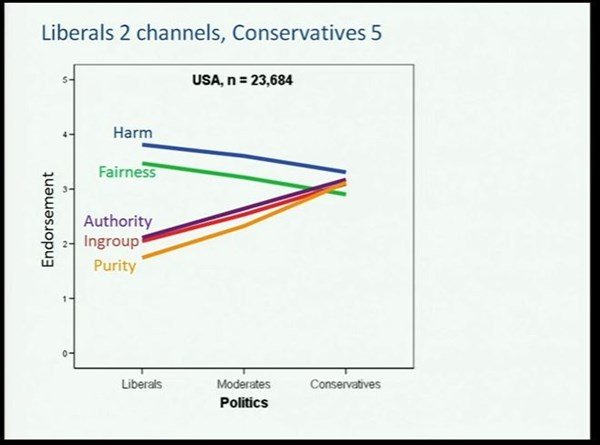
To find out, Haidt and a colleague read the most current literature on anthropology, cultural variations, and evolutionary psychology to identify cross-cultural matches. They found five primary categories that serve as our moral foundation:
- Care/harm: This foundation is related to our long evolution as mammals with attachment systems and an ability to feel (and dislike) the pain of others. It underlies virtues of kindness, gentleness, and nurturance.
- Fairness/reciprocity: This foundation is related to the evolutionary process of reciprocal altruism. It generates ideas of justice, rights, and autonomy. [Note: In our original conception, Fairness included concerns about equality, which are more strongly endorsed by political liberals. However, as we reformulated the theory in 2011 based on new data, we emphasize proportionality, which is endorsed by everyone, but is more strongly endorsed by conservatives.]
- Loyalty/betrayal: This foundation is related to our long history as tribal creatures able to form shifting coalitions. It underlies virtues of patriotism and self-sacrifice for the group. It is active anytime people feel that it’s “one for all, and all for one.”
- Authority/subversion: This foundation was shaped by our long primate history of hierarchical social interactions. It underlies virtues of leadership and followership, including deference to legitimate authority and respect for traditions.
- Sanctity/degradation: This foundation was shaped by the psychology of disgust and contamination. It underlies religious notions of striving to live in an elevated, less carnal, more noble way. It underlies the widespread idea that the body is a temple which can be desecrated by immoral activities and contaminants (an idea not unique to religious traditions).
[…]
What Haidt found is that both conservatives and liberals recognize the Harm/Care and Fairness/Reciprocity values. Liberal-minded people, however, tend to reject the three remaining foundational values — Loyalty/betrayal, Authority/subversion, and Sanctity/degradation — while conservatives accept them. It’s an extraordinary difference, and it helps explain why many liberals and conservatives in America think “the other side” is bonkers.
QotD: Stigma
But in fact there is almost a law of conservation of stigma that operates in human societies, such that if it does not attach to one thing, it will attach to another. No doubt there is more stigma in shame societies than in guilt societies, but even in the latter everyone, except perhaps the most psychopathic of psychopaths, is afraid of being shown up in some respect or another.
Stigma begins early in life and children are much guided or influenced in their conduct by the fear of it. A teacher told me the following story. A child of about seven or eight came crying to her one day because another child had called him names.
“What did he say?” she asked.
“He called me a virgin.”
“What is a virgin?” asked the teacher,
“I don’t know,” said the boy. “But I know it’s something horrible.”
Stigma is a kind of shorthand to indicate what we detest. Anyone who pretends that he never stigmatises is probably lying, or perhaps I should say not telling the truth, since not every untruth that emerges from the human mouth is a lie. There are people who can contradict themselves without disbelieving in the law of non-contradiction, and therefore people who can genuinely despise people who pass moral judgment on others.
What would living completely without stigma and stigmatisation mean? Surely that there was nothing that we or anyone else could do to make people think badly of us. One of the reasons — I don’t say the only one — that I don’t steal is that I don’t want to be stigmatised as a thief. One sin doesn’t define a person’s character, however, so that when we stigmatise we must be careful to be just and proportionate. If we called everyone a liar who had told a lie, then we should all be liars (quite apart from the fact that it is sometimes virtuous to tell a lie). We call a liar someone who habitually lies, so that untruthfulness is a central part of his character.
Stigma is one of those many things that is neither good nor bad in itself, and depends for its social beneficence or maleficence on what it attaches to and how strongly. In the company of rogues or scoundrels, one can be stigmatised for honesty. Many a cruel act has been performed to avoid the stigma of being too cowardly to be cruel.
Theodore Dalrymple, “The Situational Nature of Scorn and Stigma”, New English Review, 2020-04-28.
August 15, 2020
French President Emmanuel Macron – “We are a country that for decades is divided and in doubt”
Individuals in France may be chauvinistic, says Joseph de Weck, but the French as a whole are less chauvinistic and more self-critical than the British or the Germans:
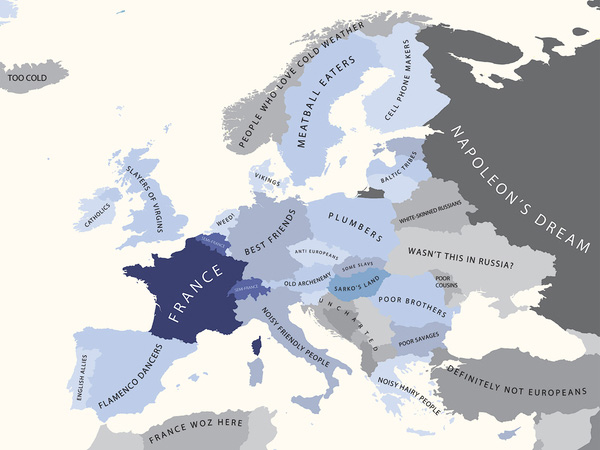
There is no doubt that the French are a self-sufficient bunch. After all, it was a Frenchman who once wrote, “Hell is other people.”
COVID-19 or not, the French rarely travel abroad for holidays. In terms of food, most French people think they have it best. And at housewarming parties in Paris, the music playlist is usually primarily made up of chansons and French rap classics.
And despite President Emmanuel Macron’s attempts to turn Europe into a global “balancing power,” what happens abroad doesn’t seem to spark much interest at home. The evening news on the public channel on average dedicates 16 percent of its coverage to European and foreign news. By comparison, that proportion rises to 50 percent in Germany. No surprise then that polls show the average French person knows little about the functioning of the EU.
But if this cliché about French aloofness is easily backed up with data points, another common trope about the Gauls doesn’t: that of French arrogance. At least when it comes to the present, the French are brutally self-critical.
In fact, France seem to be among the least chauvinistic countries in Europe. Asked whether they think their culture is superior to others, 36 percent of the French answered “yes” in a recent poll. This compares to 46 percent in the United Kingdom and 45 percent in Germany.
Or take the COVID-19 crisis: unlike other nations, the Republic’s citoyens won’t rally around the flag. Among Europeans, the French give their government the lowest grades for its handling of the pandemic. Never mind that four of France’s neighbors have significantly higher death-per-capita rates. Never mind either that France’s short-time work benefits are among the most generous, also explaining why consumption is almost back to pre-crisis levels.
Of course, one could explain the French’s dim view of the state’s COVID-19 response as being due to Macron’s unpopularity. But by French standards, the president is actually polling relatively well. At 39 percent, Macron’s approval ratings surpass his predecessors François Hollande (23 percent) and Nicolas Sarkozy (35 percent) at the same point in their terms.
The negative view the French have of their country goes far beyond the complaint du jour. As Macron put it, “We are a country that for decades is divided and in doubt.”
August 14, 2020
From protests to riots to …
In the Claremount Review of Books, Angelo M. Codevilla looks at historical patterns that may prefigure what is going on in major urban areas today:
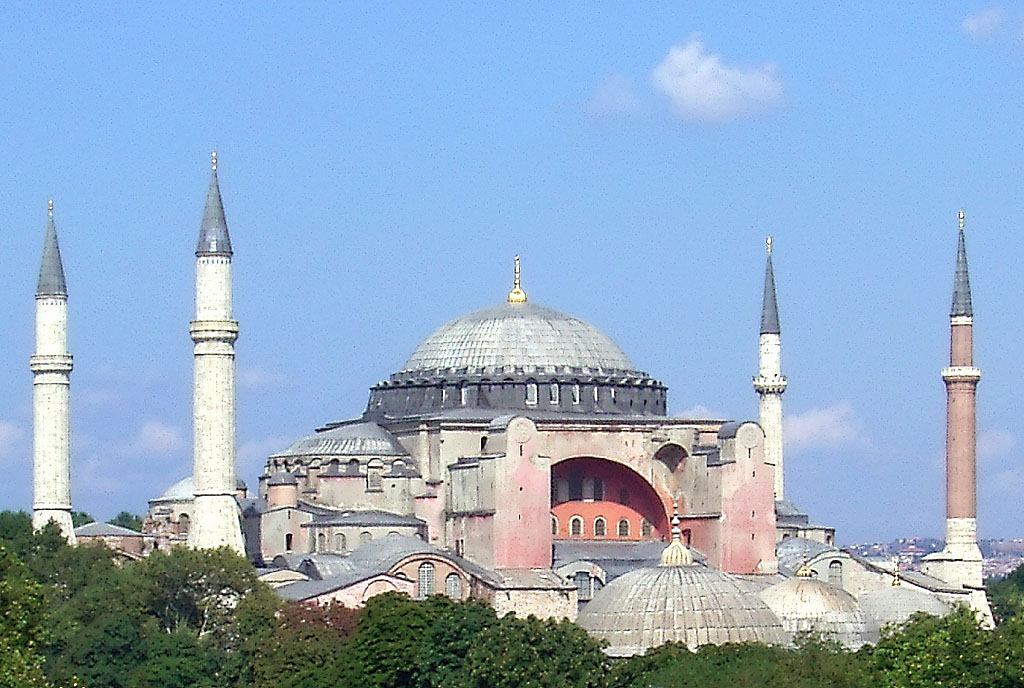
Hagia Sophia in the Faith district of Istanbul, 18 November 2004.
Photo by Robert Raderschatt via Wikimedia Commons.
The Americans who confess other people’s racism absolve themselves inexpensively by a moral mechanism common to humanity: the more I profess to hate evil, the more I showcase my own goodness. Such confessions, however, have a particular history of tragedy in Christian civilization. Again and again over the centuries, persons who have imagined themselves cleansed by ritual confessions have believed themselves elevated above the rest of humanity and, hence, entitled to oppress or even annihilate those around them. Today’s self-purifiers, arms outstretched in supine submission, who then countenance violence against persons, property, and cultural symbols, are mostly unwitting protagonists in yet another chapter of a hoary history.
Although Judeo-Christianity teaches that perfection is not of this world, nevertheless the Old Testament (see the Book of Daniel) and the New (Revelation, chapter 20) refer tangentially to a final state in human affairs in which all evil will have been defeated and the virtuous will have triumphed over their enemies. In the Book of Revelation, this final stage is to last for a thousand years. Jesus Christ’s warnings notwithstanding, people have hearkened periodically to “false prophets” who brandish the prospect of ultimate vengeance over evil. Between the 11th and 16th centuries, any number of movements of this sort used ritual confessions to cleanse themselves, and energized the mobs that waged Europe’s bloodiest wars of that age. Thereafter, though such movements secularized their terms, they fit into the same moral and intellectual categories. Now as ever, they are about destroying civilization in the name of altering the human condition.
But whereas revolutionary movements from the Middle Ages to roughly the middle of the 20th century opposed the ruling classes wholeheartedly and found no friends among them, this generation’s movements have intense, problematic relations with those classes, about which more below.
Today we see scenes of monuments which had stood for decades, now destroyed and defaced, as well as the forceful cancellation of names from circulation. Smashing others’ idols was, and remains, a staple of tribal warfare. The Old Testament recalls the divine command to destroy idols, and the clashes between Christian and Muslim armies always aimed as much at symbols as at people. The Song of Roland contains a lyrical account of Charlemagne’s iconoclasm in his campaign against the Saracens. In the 6th century, Emperor Justinian made Constantinople’s Hagia Sophia cathedral the Christian world’s biggest and most important church. The Muslims who added that city to the Ottoman Empire in 1453 killed its priests, toppled its statues, and made it into the principal mosque of the Muslim caliphate at war with Christendom. In 1923, Kemal Atatürk, Turkey’s modernizer, turned the building into a museum in order to end that war. But in July 2020 Turkey’s Islamist president Recep Erdogan, consistent with his hostility to Judeo-Christian civilization, turned it into a mosque again and began covering up what remain of the Christian frescoes on its walls. Destroying symbols, however, has had no place within Christian civilization. As the equivalent of torturing dead men, it has always been the work of cowards likelier to run from living enemies. On the other hand, war against statues, paintings, books, biographies, etc., has been a defining feature of civilization’s revolutionary enemies, consistent with their chosen identities as alien tribes.
What follows is a glance at the bloody history of this little-known flaw. It is a tale whose cautionary moral Aleksandr Solzhenitsyn best expressed: the line between good and evil runs not between persons — never mind between parties, classes, or races — but down the middle of every human heart. That is central to our civilization.
H/T to David Warren for the link.
August 11, 2020
QotD: Our culture shapes what we can see
I have a little more insight into how culture shapes what’s possible to think, because I changed my culture as an adult. While this can be done (obviously) and immigrants should be encouraged to do it, (or go home), the acculturation is never complete. What happens is that you acquire a sort of cultural double vision. Depending on how far your acculturation goes, you’ll see the defects in thought or at least the unquestioned assumptions in one of the countries better, but also have a strong feeling of being outside enough to see some flaws in your dominant culture. In my case, for instance, I see the flaws in Portugal very clearly, like the obsession with speed over diligence or being decisive over being right, but I still see some in the US which is why sometimes I say “what people born and raised here don’t see.”
I have, of course, even more insight, due to being a conservative in the US, in a culture and profession (the arts/publishing) that is not only majority left, but majority extreme left. For many years, the only way to stay at least plausibly under cover was to see what they were seeing, and what they expected.
But without that, most people are blind to the … ah, unconscious or unthinking parts of their culture. Heck, even with what I’ve been through, I still tend to accept a lot of things unconsciously, unless I step back and go “Now wait a minute.”
Sarah Hoyt, “Slouching Into Shackles”, According to Hoyt, 2018-04-27.
August 10, 2020
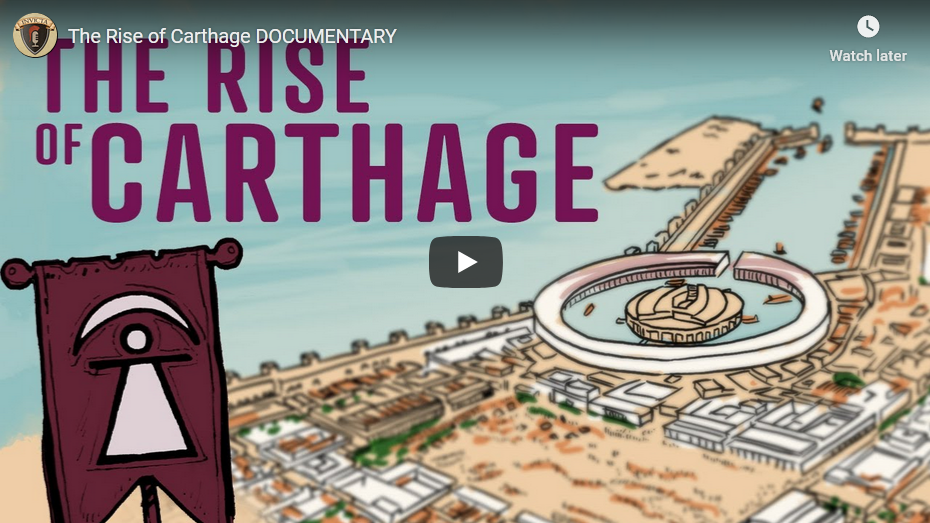
The Rise of Carthage
Invicta
Published 13 Mar 2020Support the channel by downloading Rise of Kingdoms: http://patron.me/Invicta, New users can use the code
seyfpw6fxuand claim these prizes: GEM 200, Silver Key x2, 50000 Food x2, 50000 Wood x2Today Carthage is remembered only in the context of its dramatic fall at the end of the Punic Wars between Rome and Carthage. We all know about Hannibal and the Battle of Cannae but how about the daily life of Carthage. There is much more to this ancient civilization than the dust and ashes left to us by history. Today we will be exploring the Rise of Carthage and dive into the fascinating details of their civilization.
The history documentary begins by covering the ancient Phoenicians who planted colonies across the Mediterranean. Carthage emerged from this trade network to become the leader of the Phoenicians in the west and eventually come to forge an empire when its mother colony Tyre declined. The history documentary then turns to cover the government, economy, culture, and military of ancient Carthage.
Sources and Suggested Reading:
Carthage: A History by Serge Lancel
The Carthaginians by Dexter Hoyos
Carthage’s Other Wars by Dexter Hoyos
Carthage Must be Destroyed by Richard Miles#History
#Documentary
#Carthage