
I believe it’s related to pensions, Medicare, and the whole Social Security scam. Boomers paid into these funds with the naive but innocent understanding that their money would be returned. Instead, the government spent it on other frivolities such as wars for Israel and keeping the Federal Reserve happy, so there’s no money left, and naturally the younger generations will have to pay. I believe that the elites want to get the younger generations so angry at the Boomers that they cut off what was promised to them — so angry, they dream of the day that Boomers get murdered in nursing homes.
OK, Zoomer. Two can play this game. Keep in mind that the little magic trick I’m about to perform here does not mean I’m blaming your generation for any of these things, because I’m not a Generational Astrologist. I’m merely taking what you do and flipping the script:
Yours is the generation of “woke culture” and Antifa. As much as you yabber about how the Boomers let the culture slide into liberalism, atheism, and degeneracy, your generation is far less religious than the Boomers. You lean heavily socialist and encourage “punishment” for Halloween costumes you deem “offensive”. While the world is burning, the Zoomers’ top three voting issues are emotionally laden trifles such as “mass shootings, racial equality, and … treatment of immigrants”. You are far more anti-racist, anti-“hate”, and pro-LGBT than any generation that preceded you. This is not my opinion — it’s a statistical fact supported by every survey and poll I’ve ever seen.
Therefore, every Zoomer is personally responsible for Drag Queen Story Time and the fact that there’s no wall on the border, because you just sat there and LET it happen. Three trillion dollars have been added to the national debt since Trump’s inauguration, and you Millennials and Zoomers just sat there and LET it happen. The tech giants are doing purges of people for thoughtcrimes, while your generation hides behind goofy fake names and clown avatars and LETS it happen.
That’s because every member of every generation is 100% responsible for what happens on its watch. Get down on your knees and APOLOGIZE!
And if you don’t repent immediately and bend to my shaming tactics, you fucking deserve all the righteous pain the generations after you will rain down on your selfish head.
See how stupid that sounds when it’s applied to you?
People hate to admit they’ve been brainwashed. But sorry — you’ve been brainwashed.
Politicians enjoy a little generational warfare if it suits their needs. They’ll even instigate it. And as far as I can tell, this sudden emergence of a generational identity-politics civil war is a divide-and-conquer tactic that has worked wonderfully.
Jom Goad, “The Myth of Boomer Privilege”, Taki’s Magazine, 2019-11-03.
April 18, 2024
QotD: The intergenerational blame game
April 17, 2024
QotD: The mid-life crisis, male and female versions
Which is why I’ve found the COVID overreaction so bizarre. Realizing your own mortality changes things. You can always tell, for instance, when it has happened to a younger person — when they come home, combat vets often act like middle-aged men going through a midlife crisis. Readjustment to civilian life is hard. Read the great war narratives, and it’s clear that none of them ever really “got over it”. Robert Graves and Ernst Junger, for instance, both lived to ripe old ages (90 and 103, respectively), and were titans in fields far removed from battle … and yet, the war WAS their lives, in some way we who haven’t been through it will never understand, and it comes through in every line they wrote.
If the Covidians were really freaking out about COVID, then, I’d expect one of two broad types of reaction: Either party-hearty midlife crisis mode, or a new determination to get on with whatever’s left of life. Obviously neither of those are true, and I just can’t grasp it — these might be your last few weeks on Earth, and that’s how you’re going to spend them? Sitting in your apartment like a sheep, wearing a mask and eating takeout, glued to a computer screen?
If you want a measure of just how feminized our society has become, there you go. Call this misogyny if you must, but it’s an easily observed fact of human nature — indeed, it has been observed, in every time, place, and culture of which we have knowledge — that post-menopausal women go a bit batty. Though a man might know for certain that he dies tomorrow, he can still keep plugging away today, because he’s programmed to find real meaning in his “work” — we are, after all, running our snazzy new mental software over kludgy old caveman hardware.
Women aren’t like that. They have one “job”, just one, and when they can’t do it anymore, they get weird. In much the same way high-end sports cars would cease to exist if middle aged men ceased to exist, so there are entire aspects of culture that don’t make sense in any other way except: These are channels for the energies of post-menopausal, and therefore surplus-to-requirements, women. You could go so far as to say that pretty much everything we call culture — traditions, history, customs — exist for that reason. Women go from being the bearers, to being the custodians, of the tribe’s future.
Severian, “Life’s Back Nine”, Rotten Chestnuts, 2021-05-11.
April 13, 2024
When there was an active counterculture
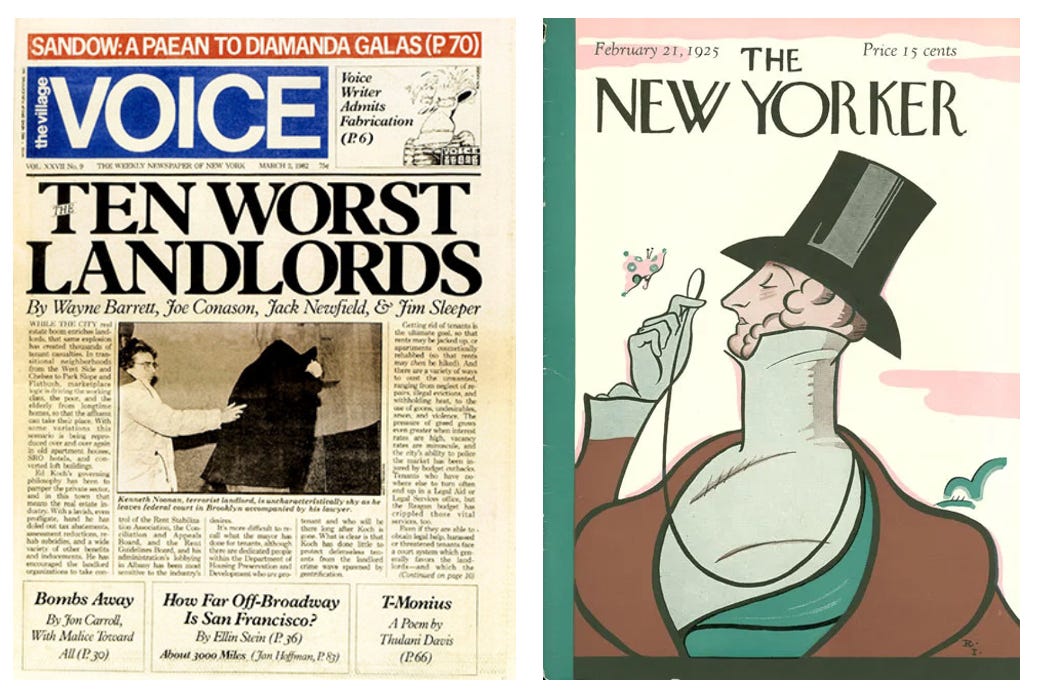
Ted Gioia on a recent oral history of the countercultural touchstone, The Village Voice:
At the start of her oral history of The Village Voice, author Tricia Romano provides a “cast of characters”. It goes on for 15 pages, and includes 216 people — each with some connection to the alternative newspaper.
Many people nowadays have never lived in a society with such a vibrant counterculture. In a time when official sources all seem part of a predictable Disney-fied monoculture, just reading this list of names and mini-bios can be a revelation.
Many of these individuals are now revered as historic figures who changed society. They had power and prestige. It’s easy to forget that most of them operated as outsiders.
That’s how they wanted it.
These renegades at The Village Voice knew that working outside the system — and typically against the system — was their superpower. They could criticize ruling institutions. They could speak harsh truths. They could go against the grain.
One thing is certain: They didn’t align their interests with globalist corporate CEOs, billionaire technocrats, the surveillance state, and establishment bureaucracies. They would have laughed at journalists who did that — believing, rightly, that honest media requires distance, or even an adversarial stance, vis-à-vis entrenched powers.
Because that’s what a counterculture does. That’s what it’s expected to do.
Romano captures the peculiar vibe in the title of her book The Freaks Came Out to Write. She makes clear that The Village Voice wasn’t The New York Times and it definitely wasn’t The New Yorker.
Nobody ever stepped into its madcap offices and said “Ah, the Gray Lady”. No reader ever picked up a copy and expected to see Eustace Tilley on the cover.
Can you tell the difference between culture and counterculture?
And The Voice was heard. Even establishment insiders knew they needed to listen to these “Freaks”. Sometimes they feared The Voice, sometimes they secretly agreed with it, but they always treated it as a force deserving respect.
Until recently that’s how it worked. The tension between insiders and outsiders was a source of creative energy in society. The upstarts provided alternative views and new ideas. They kept everybody accountable.
I’m pointing this out because this no longer happens. This is the world we’ve lost.
“One of the banes of the traditionalist and neoreactionary is ideology”
Theophilus Chilton urges conservatives to rebuild the crucial social structures that modern life has so signally undermined: churches, the männerbund, and militias (and no, I’d never heard of männerbund either).
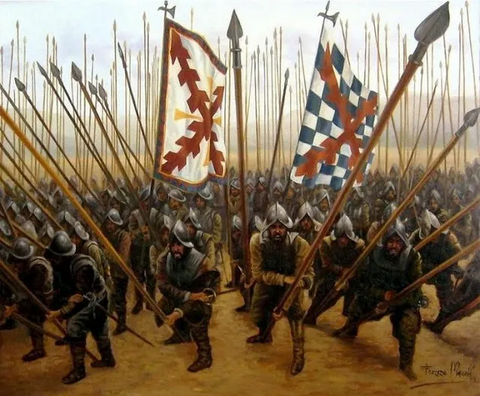
One of the banes of the traditionalist and neoreactionary is ideology. Now, any thinking person has a worldview, a comprehensive picture of how they view the world and interpret what they see around them that is based on their experiences, education, and background. However, this is not what is meant with the term “ideology.” Instead, an ideology is a set of beliefs – often unsubstantiated – which are held in a doctrinaire fashion, even in the face of any and all evidences that the beliefs are wrong. Moreover, ideologues will demand adherence to these beliefs, and will actively seek to ridicule and punish those who do not sufficiently fill out the list of checkboxes demanded by the ideology. In short, an ideology is a way for people to avoid having to think for themselves, to resist bringing their worldview into line with reality as it is manifested around them. The key to the concept here is not that of having a cohesive worldview, but the fact that this worldview is held in spite of any countervailing evidence. The ideologue refuses to consider any evidences or objections to his belief system, and will try to find ways (accusing his opponent of being racist, sexist, etc.) to get around having to deal with them.
One such ideology is modern American conservatism, along with its close relative by cousin marriage libertarianism. Just as much as modern neoliberalism demands a blind adherence to a rigidly held set of ideological positions which are increasingly out of step with human nature and reality, so also does modern conservatism. One of the most obvious examples of this is the conservative/libertarian idolisation of “rugged individualism” and “the sovereign individual”. Indeed, these folks have created an elaborate mythology which places the “rugged individual” at the centre of the American experience throughout our history. Like most beliefs built on a purely ideological foundation, this mythology is deeply held while being deeply out of touch with actual history and reality.
If I were to make this criticism on a typical conservative site such as Free Republic, it would be roundly met with automatic and unreasoning condemnation. How dare I suggest that Americans should be anything less than atomised individuals with no connexions or associations of community to each other! I must be the reincarnation of Josef By-George Stalin!
And yet, the whole history of America has been one of traditional communities acting in concert. The Revolution was driven by citizen associations formed in churches and taverns, who then fought as community militias. The settling of the West was not done by individuals, by and large, but by groups who traveled by wagon train for mutual support and self-defence. Even today, most local community matters are handled by citizens acting together. While the individuals in American history may have been rugged, they were not alone. America, like most other traditional Western societies from the classical period forward, was communitarian and group oriented.
In other words, there is ample evidence which suggests that our choices don’t have to be either Ayn Rand or Bernie Sanders. There is a third option, which is to recognise the organic bonds of community, society, and nation which bind men together.
This is important for us to keep in mind today because there are any number of influences due to the modernism of our world today which act to draw people away from community and the positive associative bonds we used to have with each other. One of these which I’ve discussed previously is the set of social phenomena surrounding the creation of suburbia after World War II. Our forms of popular entertainment work toward this end as well – instead of towns and villages coming together to celebrate births, marriages, and deaths with song, dance, and competitions, modern American man sits alone in front of his television or in a darkened movie theatre where he’s not allowed to talk to those sitting next to him. Modern American religion plays into this as well, with its selfish emphasis on “what church can do for me”, rather than the other way around, and where Americans “church hop” from assembly to assembly, never integrating into a body of believers, but always flitting about looking for the next new program for their kids.
I say that we ought to reject this modernism as inferior to what we once had. In place of the atomised individual of conservative and libertarian phantasies, those of us in tradition and neoreaction ought to seek to restore and then strengthen traditional social bonding institutions.
The three institutions which I’d like to discuss in particular here are churches, the männerbund, and militias. Each of these institutions play different, yet complementary, roles in communitarian society. Each also, I believe, appeals particularly to one of the three complementary and interdependent tripartite divisions (spirit, soul, and body) of the holistic makeup of man.
April 11, 2024
QotD: North America will never be a “bicycle” culture
I’m deliberately discounting bicycles as a means of locomotion, you’ll notice, because look: America is a car society. Our cities are designed for cars. Indeed, given the vast distances involved over here, cars are what make our lifestyle possible. Europeans who haven’t been here, or who only visit the big tourist pits like NYC and LA, don’t get this. Even if you’ve seen the maps, it doesn’t really register until you experience it. I’m just guessing here, for purposes of explanation, but it really does seem to be the case that if it were possible to hop in your car and drive two hours due east from downtown Paris, you’d pass through three or four countries. There are lots of American cities where, if it were possible to hop in your car and drive two hours straight from downtown, you’d still be in that same city. The continental US is just mind-bogglingly huge; only Russians and maybe Australians share our mental maps. When you’ve got daily commutes that run an hour, hour and a half on freeways, setting anything up with bicycles in mind is just ludicrous.
Severian, “Cars, Bikes, Motorcycles”, Rotten Chestnuts, 2021-07-25.
April 7, 2024
Instructions for American Servicemen in Britain (1942)
Henry Getley on the US War Department publication Instructions for American Servicemen in Britain produced for incoming GIs on arrival in Britain from early in 1942:
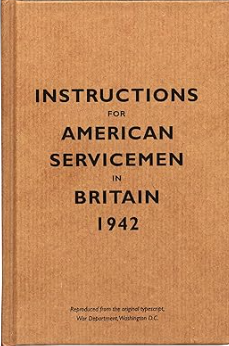
[W]ith their troops pouring into this country from 1942 onwards to prepare for D-Day, officials at the US War Department did their best to make the culture clash as trouble-free as possible. One of their main efforts was issuing GIs with a seven-page foolscap leaflet called Instructions for American Servicemen in Britain.
It’s available in reprint as a booklet and makes fascinating reading, not least for its straightforward, jargon-free writing style and its overriding message – telling the Yanks to use “plain common horse sense” in their dealings with the British.
In parts, it now seems clumsy and condescending. But its purpose was praiseworthy – to try to get American troops to damp down the impression that they were overpaid, oversexed and over here. Many GIs qualified in all three aspects, of course, but you couldn’t blame the top brass for trying.
The leaflet paints a sympathetic (some would say patronising) picture for the incoming Americans of a Britain – “a small crowded island of forty-five million people” – that had been at war for three years, having initially stood alone against Hitler and braved the Blitz. Hence this “cradle of democracy” was now a “shop-worn and grimy” land of rationing, the blackout, shortages and austerity. But beneath the shabbiness, there was steel.
The British are tough. Don’t be misled by the British tendency to be soft-spoken and polite. If need be, they can be plenty tough. The English language didn’t spread across the oceans and over the mountains and jungles and swamps of the world because these people were panty-waists.
There were helpful hints about cricket, football, darts, pounds, shillings and pence, warm beer and badly-made coffee. And because we are two nations divided by a common language, the Yanks were urged to listen to the BBC.
In England the “upper crust” speak pretty much alike. You will hear the newscaster for the BBC (British Broadcasting Corporation). He is a good example, because he has been trained to talk with the “cultured” accent. He will drop the letter “r” (as people do in some sections of our own country) and will say “hyah” instead of “here”. He will use the broad “a”, pronouncing all the a’s in “banana” like the “a” in father.
However funny you may think this is, you will be able to understand people who talk this way and they will be able to understand you. And you will soon get over thinking it’s funny. You will have more difficulty with some of the local accents. It may comfort you to know that a farmer or villager from Cornwall very often can’t understand a farmer or villager in Yorkshire or Lancashire.
The GIs were warned against bravado and bragging, being told that the British were reserved but not unfriendly. “They will welcome you as friends and allies, but remember that crossing the ocean doesn’t automatically make you a hero. There are housewives in aprons and youngsters in knee pants in Britain who have lived through more high explosives in air raids than many soldiers saw in first-class barrages during the last war.”
March 30, 2024
QotD: Multiculturalism, in theory and practice
Victor Davis Hanson, Ripples of Battle, 2003.
March 29, 2024
“Constitutional monarchy, such as we have, is a gift not to be ignored”
In The Line, Graeme Menzies makes a pitch for a renewed royal presence in Canadian affairs:
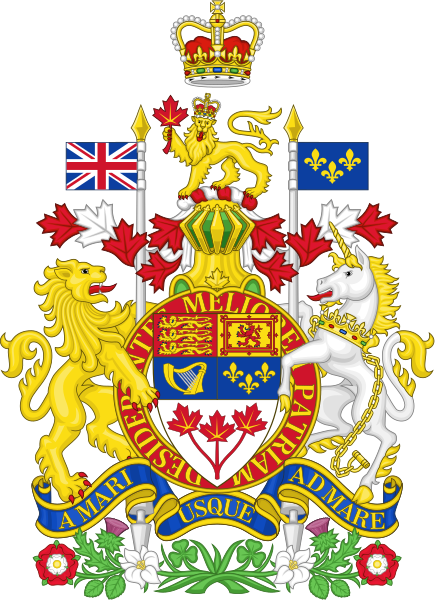
The role of the Crown in Canada has been given a particularly cold shoulder by Trudeau. He’s first in line at the funerals and wedding parties, and quick to boast of his lifelong friendship with members of the royal family, but of all Canada’s 23 prime ministers Justin Trudeau is the one who has done his best to erase them from Canadian cultural identity. His record appointing governors-General suggests he’s been actively doing his best to tarnish that office.
Trudeau was the first prime minister not to approve the traditional Jubilee Medal for her late majesty Queen Elizabeth II — Canada’s loyal and beloved monarch for over 70 years. Under his watch, the anticipated Canada 150 Medal was also quashed. Later, under pressure, he agreed at the very last minute that a medal should be issued to celebrate the Coronation of King Charles III; but other than a couple lines about it in a news release last May, nothing has come of it. Not a single medal has been produced or issued.
This is where a post-Trudeau government must really seize the day. The monarchy is a great gift to Canada. It’s probably the single most important thing that distinguishes Canada from the United States. Take it away and we’re just Puerto Rico — another American protectorate, waiting for the day it gains statehood and a star on the flag.
It is foolish to think any serving prime minister will ever command the respect and affection of the majority of citizens; but Queen Elizabeth often did and there’s no reason to think King Charles cannot do so as well. The past visits to Canada by William and Kate, the future King and Queen of Canada, have been nothing short of sensational.
But the next prime minister will have to act on this. Constitutional monarchy, such as we have, is a gift not to be ignored. It is to be embraced and folded fully into a forward-looking vision of a new, proud, strong nation. To begin with, the next prime minister should ask the King, or the Prince of Wales, to visit Canada annually. The presentation of Orders of Canada should be timed to coincide with these visits. I would even go so far as to suggest Canada reinstate knighthoods. If Ringo Starr and Paul McCartney can be knighted then why can we not have Sir Randy Bachman and Dame Joni Mitchell?
The King of Canada can also play an important and useful role toward Canada’s reconciliation efforts. Trudeau and his radicals have done much to make it seem the Crown and Indigenous peoples are incompatible but a closer review of history books would suggest otherwise. It wasn’t the King who came up with the Indian Act — our elected political leaders did that. The statue of Tecumseh in Windsor is marvellous, but there should be another in Ottawa and it should be unveiled by the King. Same for Chief Maquinna who, apart from a likeness chiselled into the exterior of the British Columbia Legislative Library Building, has no statue, and I’ll bet dollars to donuts he is virtually unknown to most Canadians. That should be changed.
Most Canadians would rather see the King unveil a statue like that than the current, or the next, prime minister. When a prime minister is involved, it’s political. When the monarch does it, we can all get behind it. It’s unifying.
March 27, 2024
As the kids will be taught, pre-Columbian culture was feminist, egalitarian, non-violent, etc.
The way history will be taught in future will distort historical facts to flatter modern sensibilities, especially with regard to First Nations history:

Linguistic groups of pre-contact North America.
Wikimedia Commons
In my previous missive of this series, I outlined the socio-economic problems facing Indigenous people in Canada and identified the official narrative, promoted by the federal government, Indigenous leaders, and their non-Indigenous allies. This narrative is basically that colonialism, racism, and oppression are the sole (or at least the major) causes of the long list of socio-economic difficulties so many Indigenous people are suffering from today. The narrative focuses on colonialism, oppression, as well as “intergenerational trauma” and “genocide”, neither of which claims stand up to the slightest bit of objective scrutiny and analysis. The genocide claim is particularly laughable in that the Indigenous population has increased from about 100 thousand in 1900 to nearly 2 million today, which is at least four times the pre-contact Indigenous population.
Pre-contact living conditions for Indigenous people
In order to blame all the problems on European settlers and their descendants, the narrative starts out by implying that life in pre-contact Canada was idyllic. Students are led to believe that this was a time of peace, cooperation, and prosperity based on teachings and knowledge systems that were superior to what we have now (the Western enlightenment-based ethos and the scientific method). Students are told that people lived well- sustainably, with little environmental impact, and with a respect for each other and the land, with which their relationship was one of stewardship and symbiotic coexistence.
This is presented in contrast to the purported European world view, which kids are told was, and still is, characterized by exploitation and a belief in European superiority. Europeans are described as ruthless and greedy people who just wanted to enrich themselves by maximally extracting any and all resources without regard for impacts on the environment or Indigenous people. It is presented as a case of good vs. evil.
But what was life really like for pre-contact Indigenous people? Certainly their stone age way of living combined with their small, scattered population was eco-friendly, but was their standard of living, on balance, better than that of modern Canada? Were they more moral, or wiser than modern non-Indigenous Canadians? An honest answer to these questions demands a hard look at the available evidence and a willingness to draw conclusions wherever that evidence may lead.
And that evidence shows that pre-contact indigenous people demonstrated the full range of behaviors we find in all stone age hunter gatherer/horticulturalist societies. While there is much to admire about these people, who were able to survive in a challenging environment with only the most rudimentary of wooden, stone, and bone tools, the evidence is clear that, compared to modern times
- life expectancy was very low
- child mortality was very high
- warfare was endemic
- slavery was a common practice
- violence of all kinds was common
- people suffered a great deal from simple health problems which would now be easily treatable with antibiotics and surgical techniques.
It should also be pointed out that while the allegation that Indigenous people were the victims of genocide at the hands of the government of Canada is ridiculous, it is a well-established (but rarely mentioned) fact that Indigenous people carried out genocides against one another on a regular basis, for example the genocide of the Hurons by the Iroquois.
March 25, 2024
One major change in sexual behaviour since the mid-20th century
David Friedman usually blogs about economics, medieval cooking, or politics. His latest post carefully avoids (almost) all of that:

I didn’t have a convenient graphic to use for this post … but I know not to Google something like this.
My picture of sexual behavior now and in the past is based on a variety of readily observable sources — free online porn for the present, writing, both pornography and non-pornographic but explicit, for the past. On that imperfect and perhaps misleading evidence the pattern of when oral sex was or was not common in our society in recent centuries is the opposite of what one would, on straightforward economic grounds, expect.
Casanova’s memoirs provide a fascinating picture of eighteenth century Europe, including its sexual behavior. He mentions incest, male homosexuality, lesbianism, which he regards as normal for unmarried girls:
Marton told Nanette that I could not possibly be ignorant of what takes place between young girls sleeping together.
“There is no doubt,” I said, “that everybody knows those trifles …
I do not believe he ever mentions either fellatio or cunnilingus. Neither does Fanny Hill, published in London in 1748, when Casanova was twenty-three.
Frank Harris, writing in the early 20th century, is familiar with cunnilingus, uses it as a routine part of his seduction tactics, but treats it as something sufficiently exotic so that he had to be talked into trying it by a woman unwilling to risk pregnancy. I do not think he ever mentions fellatio.
Modern online porn in contrast treats both fellatio and cunnilingus as normal parts of foreplay, what routinely comes between erotic kissing and vaginal intercourse.
One online article on the history of fellatio that I found dated the change in attitudes to after the 1976 Hite Report, which found a strongly negative attitude among women to performing it. In contrast:
Today, the act is something more like bread before dinner: noteworthy only if it’s absent. (Fifty Shades of Grey and How One Sex Act Went Mainstream)
And from another, present behavior:
Oral sex precedes and often replaces sexual intercourse because it’s perceived to be noncommittal, quick and safe. For some kids it’s a cool thing to do; for others it’s a cheap thrill. Raised in a culture in which speed is valued, kids, not surprisingly, seek instant gratification through oral sex (the girl by instantly pleasing the boy, the boy by sitting back and enjoying the ride). A seemingly facile command over the sexual landscape of one’s partner is achieved without the encumbrances of clothes, coitus and the rest of the messy business. The blow job is, in essence, the new joystick of teen sexuality. (Salon)
Contrasted with:
When I was a teenager, in the bad-taste, disco-fangled ’70s, fellatio was something you graduated into. Rooted in the great American sport of baseball, the sexual metaphors of my generation put fellatio somewhere after home base, way off in the distant plains of the outfield. In fact, skipping all the bases and going directly to fellatio was the sort of home run reserved only for racy, borderline delinquents, who enjoyed a host of licentious and forbidden activities that made them stars in the firmament of teen recklessness.
QotD: Generational politics
I’ve been making this point for years, but you’ve all been too busy projecting your guilt onto others and blaming them for all your problems to listen to me.
The reason I get fixated on certain topics is because they in some way powerfully reflect this theme of misplaced blame. This may burst quite a few of your bubbles, but the fact that I’ve focused on the endless bashing of whites for years is not a sign of how deeply in love I am with white people but rather a fascination with the fact they’re getting blamed for many things that demonstrably aren’t their fault. It’s the same reason I focus on the gender wars — men nearly aren’t as awful as they’re being depicted, and women are nowhere near as innocent as the current narrative says they are.
If you haven’t been paying attention, there’s been escalating intergenerational hostility across our fair land, and people are increasingly identifying with dumb, media-manufactured generational names — AKA Baby Boomers, Gen X, Millennials, and Gen Z — as if they were scientific categories that are predictive of human behavior rather than arbitrary designations along the lines of Virgo, Capricorn, Scorpio, and Leo.
It’s some weird new metastasized form of identity politics. And, since it comes with the turf, these groups are blaming each other for all that ails the world.
It’s dumber than astrology […] but this intensely stupid way of framing the world refuses to die.
Jom Goad, “The Myth of Boomer Privilege”, Taki’s Magazine, 2019-11-03.
March 23, 2024
Bhutan
Ned Donovan recounts his recent trip to Bhutan, situated in the Himalaya mountains between India and China:
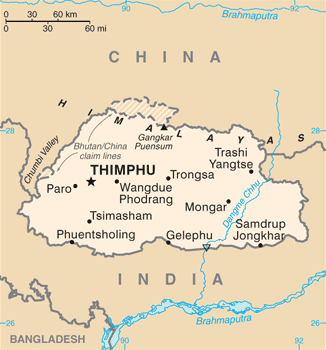
Bhutan map from the CIA World Factbook, 2010. Chinese-disputed border areas are marked with dashed lines and darker shading.
Wikimedia Commons.
Bhutan has long been a place I had wanted to visit, but it isn’t as simple as booking a ticket.
It would be remiss not to quickly situate Bhutan and its history for those unaware. It is a small kingdom east of Nepal and nestled between India and China. It has a population of around 750,000, almost all of whom are devout Buddhists. It was once a land of feuding Tibetan chieftans who were united in the 1630s by a remarkable warrior and Buddhist lama called Ngawang Namgyal. Namgyal died in 1651, but his death was kept a secret from the country for more than 50 years, with officials simply saying that the king was “on an extended retreat” and continued to keep Bhutan together by issuing decrees in his name.
While Namgyal was seen as the spiritual leader, he also established a temporal monarchy which in a slightly modified form still exists today under the leadership of the Wangchuk dynasty. The King of Bhutan’s title is the Druk Gyalpo, which literally translates to Dragon King. Over time Bhutan, being small but strategically located, faded in and out of the spheres of influence of the day from the Mughals to the British Raj. It would have been subsumed into the latter like other princely states, but in the 19th Century a British civil servant placed some files relating to Bhutan into a folder marked “External” instead of “Internal”, a small decision that ensured it remains an independent country today, albeit one “guided” on matters of defence and foreign affairs by a treaty with India.
The country only opened its borders to foreigners in 1974, to mark the coronation of the Fourth King, Jigme Singye Wangchuck. His Majesty saw the opportunity to take advantage of his accession to showcase Bhutan and its unique culture and traditions to the world, but was also aware that unrestricted tourism would put those at risk. Over time, this developed into a vision known as “High Quality, Low Volume” tourism. All visitors must have a guide and driver and also pay a daily fee — currently $100. In 1974, 287 foreigners visited Bhutan, and in 2019 more than 70,000 fee paying tourists came.
As a result of this policy, the trips are largely cultural. You take hikes in unimaginable scenery, watch local festivals where masked creatures tell villagers morality tales, and sit with locals to eat dishes made up mostly of chilis. For fun people relax with the national sport of archery, singing deliciously rude songs to put off their friends while they take shots. Tourists get to have a go but the target is brought closer and you get to use the same kind of bow young children do. Civil servants go to work in traditional dress and robe-clad monks pepper society. In the five days I spent there, much was spent talking to our compulsory guide who was a lovely man named Yarab, who had once been on the Bhutan national football team. One story Yarab told me was that of Bhutan’s transition to democracy.
The previously mentioned Fourth King oversaw Bhutan’s transition into the modern world – but with a catch. Bhutan’s development could not come at the cost of its people’s happiness. Thousands of kilometres of roads were built, free at point of use clinics quickly filled the country, and electricity and telephone hookups turned King Jigme Singye’s isolated kingdom where almost no one had access to healthcare or education into a remarkably healthy and literate little state in the space of just a few decades. Much of the money to make this possible came from selling hydroelectricity generated by dams that are powered by Himalayan glaciers. The Fourth King explained that: “water is to us what oil is to the Arabs”.
March 22, 2024
Rome conquered Greece … militarily, anyway
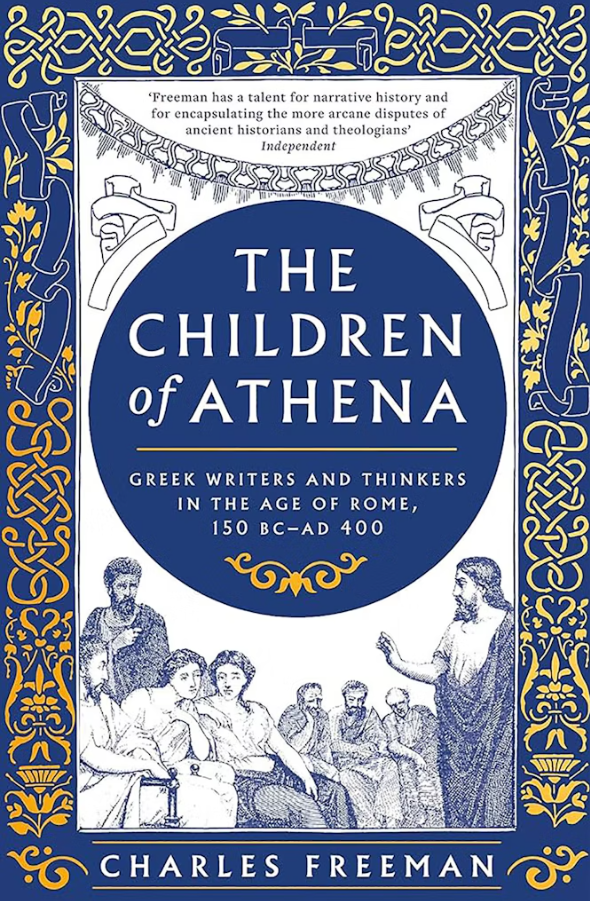
In The Critic, Gavin McCormick reviews Charles Freeman’s new book The Children of Athena: Greek writers and thinkers in the age of Rome, 150BC – 400AD:
“To a wise man,” said the first-century wonderworker Apollonius of Tyana, “everywhere is Greece.” That is to say, Greece is not a mere place, but a special state of mind. For Apollonius, on his extensive travels around the Greco-Roman world, the purported truth of this maxim is seldom open to doubt.
The author of Apollonius’s colourful biography, Philostratus, depicts his hero as not just a philosopher but also an impossibly accomplished champion of culture — a confounder of logic and expectations who could vanish in plain sight, now fascinating Roman emperors and foreign sages, now inspiring whole towns into acts of celebration and renewal. The guiding ideology that drove this hero is a heady mix of philosophy, religion, magic and political insouciance — or, to give it another name, Hellenism.
In the context of the third-century world, where Christianity was an increasingly noteworthy presence in the towns and cities of the Roman empire, pagans such as Philostratus were keen to highlight what their own tradition had to offer.
In fact, he seems almost to present his hero as a pagan rival to Jesus. And, in turn, Apollonius — in his successful renewal of the shrines and local cults of Hellas — seems to hint at what Philostratus would like to see happen in his own contemporary context.
Despite living under Rome, Apollonius (and Philostratus) wants to celebrate an emphatically Greek form of culture. The celebration of Greek culture in the Roman world was, of course, nothing new, and it was something the Romans themselves had long enjoyed.
Alongside their admiration for Greek literature, philosophy, art and architecture, there was the successful movement known as the “Second Sophistic” — whose parade of Greek-speaking intellectuals left a heavy imprint on the public life of the High Roman Empire.
But it is striking nonetheless that the virtues of Hellas — not Rome itself — were what many educated citizens of the empire turned to when they thought of cultural renewal. Indeed his was precisely the route taken later in the fourth century by the last pagan emperor of Rome, himself a champion of all things Greek, Julian the so-called Apostate.
Charles Freeman’s latest book, Children of Athena, is a highly readable tour through the lives and accomplishments of some of the great exponents of Greek culture under Rome. He introduces readers to a bracingly varied and energetic cast of characters — the geographers, doctors, polymaths, botanists, satirists, and orators are just part of the repertoire. In an early chapter, we meet the brilliant Greek historian Polybius, who wrote in the tradition of Herodotus and Thucydides, while training his sights on the rise of Rome in his own time.
March 18, 2024
Life among the WEIRD
Rob Henderson reviews The WEIRDest People in the World: How the West Became Psychologically Peculiar and Particularly Prosperous by Joseph Henrich:
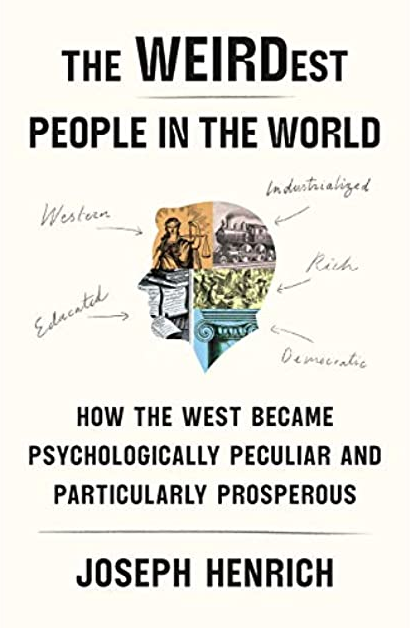
The word “WEIRD” stands for “Western, Educated, Industrialized, Rich, Democratic.” It is also a convenient way to communicate that people from such societies are psychologically different from most of the rest of the world and from most humans throughout history.
In short, the Western Church (Henrich’s term for the branch of Christianity that rose to power in medieval Europe) enacted a peculiar set of taboos, prohibitions, and prescriptions regarding marriage and family. This dissolved Europe’s kin-based institutions, and gave rise to a more individualistic psychology, which in turn spurred the creation of impersonal markets in which people grew used to interacting with and trusting unrelated strangers, and propelled the development of voluntary institutions, universally applicable laws, and innovation.
Characteristics of WEIRD people
WEIRD people are hyper-individualistic, self-obsessed, nonconformist, analytical, and value consistency. We try to be “ourselves” across social contexts and prize “authenticity”.
The book reviews research indicating that Americans rate those who show behavioral consistency during interactions in different contexts as more “socially skilled” and “likable” compared to those who are more behaviorally flexible. In contrast, non-WEIRD people view personal adjustments as reflecting social awareness and maturity.
In addition to valuing behavioral consistency, WEIRD people are more likely to feel guilt than shame. In contrast, non-WEIRD people are more likely to experience shame as opposed to guilt. Shame is the result of not living up to the expectations of one’s community. Guilt is a private emotion that results from falling short of our own expectations, rather than the community’s.
Relatedly, a recent study found that people can experience shame for being accused of actions they didn’t commit. The accusation alone was enough to elicit this powerful emotion. Shame is a reaction to others believing we did something bad rather than a reaction to actually doing something bad.
Delayed gratification also appears to be more prevalent in WEIRD societies. When researchers offered WEIRD people the choice between a smaller monetary payment up front, or a larger sum later, they tended to choose the larger sum. In contrast, most non-WEIRD people preferred the immediate, smaller, reward.
Interestingly Henrich relays data suggesting that greater patience is most strongly linked to positive economic outcomes in lower-income countries. Put differently, the tendency to defer gratification seems to be especially more important for economic prosperity in countries where formal institutions are less effective. This pattern holds within countries as well, such that patient people obtain higher incomes and more education. Patience is related to success after controlling for IQ and family income, and, even within the same families, more patient siblings obtain more education and higher earnings later in life.
Moreover, WEIRD people are more likely to adhere to rules even in the absence of external sanctions. The book reports that until 2002, U.N. diplomats from other countries were immune from having to pay parking tickets in New York City. Diplomats from the UK, Sweden, Canada, and other countries received a total of zero parking tickets. But diplomats from Bulgaria, Egypt, and Chad, among other non-WEIRD countries accumulated more than 100 tickets per member of their respective delegations. When diplomatic immunity was lifted, parking violations declined, but the gap between countries persisted.
But while they may be patient and rule-following, WEIRD people are more likely to be fair-weather friends. Relative to other populations, WEIRD people assign higher value to impartiality and show less favoritism toward friends, family members, and co-ethnics. We are more likely to abhor nepotism and believe in universally applicable principles.
March 15, 2024
Peter Turchin’s notion of the “overproduction of elites”
Severian is on a mini-vacation at the moment, but still managed to find time to share some thoughts about Turchin’s “overproduction of elites”:

University graduation – a large crowd of students at a graduation ceremony in Ottawa, Ontario. This was the thumbnail image used on the “Elite overproduction” Wikimedia page, which seemed quite appropriate.
Photo by Faustin Tuyambaze via Wikimedia Commons.
Let us consider “the overproduction of elites”. Those who love Peter Turchin’s work love this phrase, as it finally gives a name to a phenomenon we’ve all noticed: The creation, promotion, and indeed valorization of what would more properly be called social barnacles — they don’t move, can’t change, and eventually bring whatever they infest to a complete halt. Those who dislike his work often haven’t read it, so they object to the use of the word “elite” — again, these are social barnacles; what’s elite about them?
Which is precisely Turchin’s point — “elite” is a descriptor of their lifestyle, and most importantly their self-image; it is almost perfectly opposed to their actual utility. The modern Ed Biz is set up to do little else but produce these (pseudo) elites, and therefore a kind of Say’s Law takes hold. Say’s Law, you’ll recall, is vulgarly summarized as “Supply creates its own demand,” and that’s what we see with the (pseudo) elites churned out by every college in the land — they expect, indeed they demand, “jobs” commensurate with their “education”, and thus make-work “jobs” in the Apparat are brought into being.
They take out massive student loans to get the “jobs”; they “work” the “jobs” to service the debt, and so on.
But that’s true of most “white-collar” “jobs” these days. What separates the “elites”, in Turchin’s usage, from the rest of them is not their utility, or lack thereof — the economy, such as it is, would function just as well (or not) with far fewer lawyers, accountants, insurance adjusters, and so on. The difference, comrades, is what we must call Revolutionary Class Consciousness,
stealingnationalizingsocializingliberating a phrase from Lenin.An accountant, I’d wager, views his work as a technical specialty. They’re “rude mechanicals” (that’s Shakespeare, darlin’; evidently Mr. Ringo is an educated man). Maybe not so “rude” — accountants make good scratch; they’re middle to upper-middle class, economically — but basically technicians. Accounting is a highly-trained, well-compensated job, but that’s all it is: A job. Accounting is what an accountant does; it’s not what an accountant IS. Contrast that to the overproduced “elites”, in Turchin’s sense, and you see what Turchin’s sense really means: An “elite” really IS his job title.
Note the shift: His job title. As we all know, so many of the overproduced “elite” do no meaningful work. How could they? We could easily do this for most any “job” in the Apparat, but one example will suffice. Consider “Journalist”. Formerly called “Reporter”, and back then it required some actual productive output. Some “shoe leather”, as the phrase was. To find out what they were up to at City Hall, you actually had to physically go down to City Hall and follow the Mayor around. These days — the days when Reporters are now Journalists — it’s just stenography. And not even real stenography, Claudine Gay-style stenography — the Mayor’s press secretary (who probably went to college with you) emails you a press release; you change a word or two and then reprint it, basically verbatim, under your byline.
A monkey could be trained to do it. Hell, a chatbot could be trained to do it, and that’s probably a good quick-and-dirty definition of a Turchin-style overproduced “elite”: If whatever “work” he does could easily be replaced by a chatbot, with no appreciable drop-off in either productivity or quality. Because that’s the key to understanding these people: They know damn good and well, at some almost-but-not-quite conscious level, that they’re social barnacles. That is the “base” upon which the “superstructure” — again stealing terms from Onkel Karl — of their Revolutionary Class Consciousness is built.


