
Like many terrible ideas, postmodernism started with a question. The wreckage left over from the Second World War, the incomprehensible scale of the slaughter, the industrialised genocide, the atom bombs – all this brought about by the most advanced nations on earth, the ones that considered themselves civilised. How could the same cultures that brought us the Enlightenment, human rights, individual liberty and the scientific revolution also give us Auschwitz, slavery and the brutal repression of colonised people? As the second half of the century got underway, intellectuals were naturally inclined to question the West’s founding principles and what they saw as the illusion of progress. It was time to interrogate its assumptions, take apart its certainties, and puncture its claim to hold universal values.
Leading the way were the French intellectuals, who in the 1960s and 70s questioned the deepest of those assumptions, beginning with truth itself. Was there really such a thing as “objective truth”, or was it simply an invention of the powerful, something declared rather than discovered? Was “progress” a description of reality or just the story told by whoever won? These are serious questions from which they could make fair observations. They were right to point out that institutions serve their own interests, and grand narratives play a defining role in our understanding and interpretation of the world. The trouble is that the same intellectuals didn’t try to place the answers intelligibly within the larger story of our lives. Postmodernism made interrogating power the overriding intellectual move and the answer to its own question.
Postmodernism doesn’t lend itself to a simple explanation, which is appropriate, as we shall see. However, dig beneath the deliberately impenetrable jargon, and the core claims are as follows. There is no objective truth, only competing narratives. What we think of as “knowledge” is just something the powerful tell us is the case. Language doesn’t describe reality but constructs it. Science, reason, and universal liberalism are inventions of Western minds, specifically male ones, while the Enlightenment idea of the individual with supposed natural rights is just another concept made up by those most likely to benefit from it.
There’s an obvious paradox at the outset. In what sense is it true to say there’s no such thing as objective truth? The question is meaningless because the premise is nonsensical. As Roger Scruton put it, “A writer who says that there are no truths, or that all truth is ‘merely relative’, is asking you not to believe him. So don’t.”
Despite the obvious contradiction, it’s an idea that has been pushed aggressively by campus authoritarians for decades. No narrative deserves authority, they say, while demanding intellectual obedience to a narrative of their own.
Frederick Alexander, “Postmodernism: The Idea That Ate Itself”, The Gadfly, 2026-04-03.
August 14, 2026
QotD: Postmodernism’s origins
May 17, 2026
French contributions to the development of wokeness
Brivael Le Pogam offers an apology to the west for France being so significant in the philosophical and political effluvia of 1968 for setting the conditions in which wokeness was born:
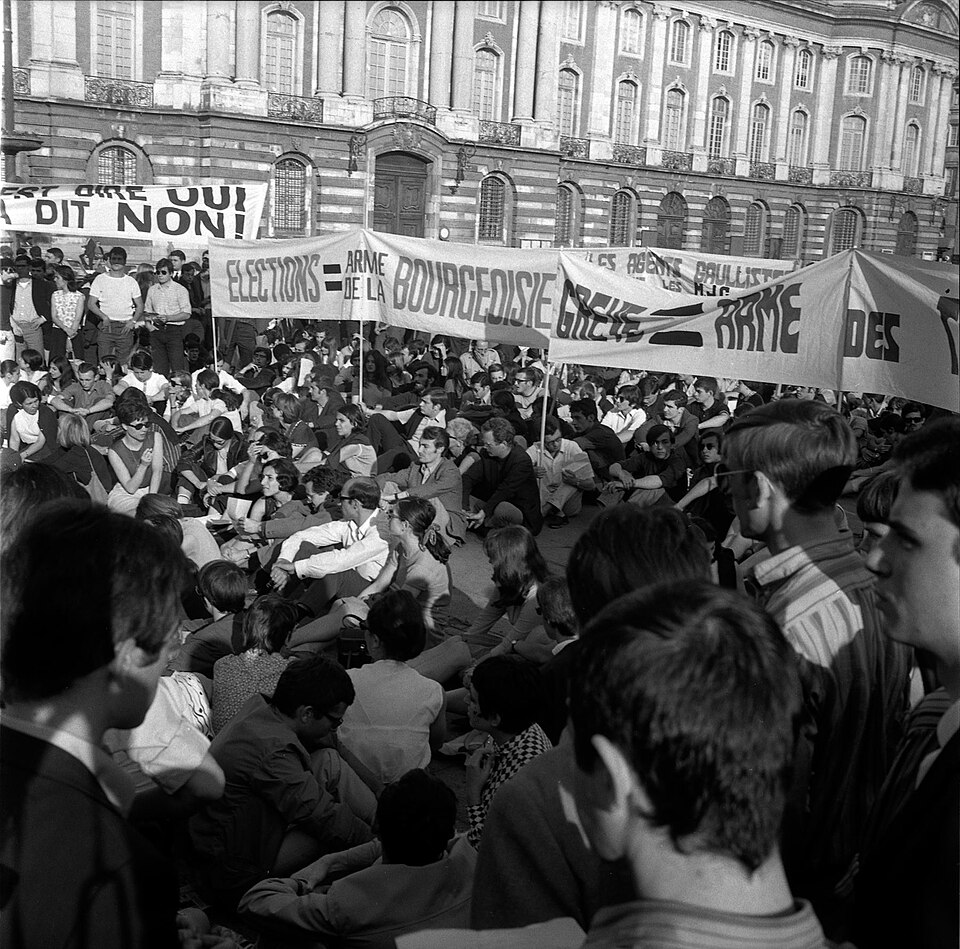
Protesters gathered in the Place du Capitole in Toulouse, 11 or 12 June, 1968.
Photo by André Cros (1926-2021) via Wikimedia Commons.
I want to offer my apologies, on behalf of the French, for giving birth to French Theory (which in turn gave birth to the worst of all ideological monstrosities: wokism).
We gave the world Descartes, Pascal, Tocqueville. And then, in the intellectual ruins of post-1968, we gave Foucault, Derrida, Deleuze. Three brilliant men who forged, in the elegance of our language, the ideological weapon that today paralyzes the West.
We must understand what they did. Foucault taught that truth does not exist, that there are only power relations disguised as knowledge. That science, reason, justice, the medical institution, the school, the prison, sexuality — everything is merely a staging of domination. Derrida taught that texts have no stable meaning, that every signifier slips away, that every reading is a betrayal, that the author is dead and the reader reigns supreme. Deleuze taught that we should prefer the rhizome to the tree, the nomad to the sedentary, desire to the law, becoming to being, difference to identity.
Taken individually, these are debatable theses. Combined, exported, and popularized, they form a system. And that system is a poison.
For here’s what happened. These texts, unreadable in France, crossed the Atlantic. The departments of Yale, Berkeley, and Columbia absorbed them in the 1980s. They found there a soil that did not exist among us: American Puritanism, its racial guilt, its obsession with identity. French Theory married this substratum, and the child of that union is called wokism.
Judith Butler reads Foucault and invents performative gender. Edward Said reads Foucault and invents academic postcolonialism. Kimberlé Crenshaw inherits the framework and invents intersectionality. At every step, the matrix is French: there is no truth, there is only power, so every hierarchy is suspect, every institution is oppressive, every norm is violence, every identity is constructed and thus negotiable, every majority is guilty.
That’s how three Parisian philosophers, who probably never imagined their practical consequences, provided the operating software to an entire generation of activists, university bureaucrats, HR managers, journalists, and legislators. That’s how we ended up with a civilization that no longer knows how to say whether a woman is a woman, whether its own history is worth defending, whether merit exists, whether truth can be distinguished from opinion.
It’s shit for one simple reason, and it must be stated calmly. A civilization stands on three pillars: the belief that there exists a truth accessible to reason, the belief that there exists a good distinct from evil, the belief that there exists a heritage to be transmitted. French Theory set out to dynamite all three. Not out of malice. Out of intellectual play, fascination with suspicion, hatred of the bourgeoisie that had nurtured them. But the result is there. An entire generation learned to deconstruct and never learned to build. An entire generation knows how to suspect and no longer knows how to admire. An entire generation sees power everywhere and beauty nowhere.
I apologize because we French bear a particular responsibility. It’s our language, our universities, our publishers, our prestige that gave this nihilism its chic packaging. Without the legitimacy of the Sorbonne and Vincennes, these ideas would never have crossed the ocean. We exported doubt the way others export weapons.
What is being built now, in Silicon Valley, in AI labs, in startups, in workshops, in all the places where people still make things instead of deconstructing them — that is the response. A civilization is rebuilt by builders, not by commentators. By those who believe that truth exists and is worth devoting oneself to. By those who embrace a hierarchy of the beautiful, the true, the good, and are not ashamed to transmit it.
So, forgive us. And back to work.
Auto-translated by the social media site formerly known as Twitter from the original French post.
October 25, 2025
QotD: Postmodernism is all about power
Cognitive dissonance isn’t a thing on the Left, obviously, but that’s a bridge too far. So they went all in on Postmodernism. It’s not a fact that Socialism ends in poverty and mountains of corpses everywhere it’s implemented, comrades, because there’s no such thing as a “fact”. Those peasants eating rats, shoes, and each other on their way to the Ultimate Collectivism? Mere social constructions. And so on.
The Postmodernists have done irreparable damage to every language they’ve written in, but that’s a feature, not a bug. And the reason for that is: If you translate their gibberish into plain language, they really only have one idea, and it’s horrifying: There is nothing in this world but Power.
If that sounds like cheap knockoff Nietzsche to you, comrades, that’s because it is. It’s also the sum total of Michel Foucault’s life work, and Foucault was such a cheap Nietzsche knockoff, he should’ve been made by slave labor in Shandong and sold on Amazon. Lenin reduced all politics to two questions — “Who?” “Whom?” — and Foucault expanded that reduction to cover all of human behavior. Your “life”, on Foucault’s reading, is nothing but the sum of your power relations. Subject / object; subjection / domination; there are a million ugly polysyllabic ways to say it, but it all boils down to power relations: Either you have power over someone, or they have power over you.
That’s it. All the stuff we’d call “humanity” — love, friendship, sorrow, joy, aesthetic experience of all sorts, to say nothing of religious experience — are all meaningless. Category errors. If we appear to experience these things, comrades, it’s just because we’re seduced by the surface of things. Give it a proper “unmasking” — another favorite bit of Foucauldian jargon — and you’ll see the power relations, the false consciousness. You don’t “love” your wife and children; you just enjoy the power you have over them, your ownership of their minds and bodies (“What is happiness?” Nietzsche famously asked. “The feeling that power is growing; that resistance is overcome”). Similarly, your boss at work feels no “duty”, to either you or the company. He enjoys his power over you, but grovels to the bigger bosses who have power over him.
Submission and domination. That’s it. That’s all there is to human existence. (I’m sure it’s just a coincidence that Foucault was really into rough gay sex, and died of AIDS in 1984. Nor is there any cosmic irony about the year of his death).
Severian, “Power”, Founding Questions, 2022-02-02.
June 22, 2024
QotD: The rise of post-modernism
Perhaps the present brand of postmodernism was born primarily in France as well. After the humiliating drive of the Panzers through the Ardennes in May, 1940, the collapse of Europe’s largest army in six weeks, and the rescue by the Americans and the British in August, 1944, theories were easier to accept than facts. For a few elite but stunned postwar Frenchmen, fiction was more palatable than reality, text and discourse a refuge from a truth as unacceptable as it was bothersome.
Victor Davis Hanson, Ripples of Battle, 2003.
February 3, 2024
QotD: The Postmodernist’s Dilemma
We could also call it “the PoMo’s Dilemma”, since this stuff originated in the ivory tower back in the Sixties, and finally broke containment in the late Seventies. Most intellectual fads quickly become caricatures of themselves, but in their haste to get to the next hot new thing the PoMos decided to cut to the chase. Postmodernism started as a self-parody. Put simply but not at all unfairly, PoMo is the assertion for a fact that there is no such thing as a fact. There is no Truth, just “truth”. No eternal verities, just perspective, just discourse; it’s all — say it with me now — “just a social construction”.
I suppose we must give the early PoMos credit for having — in a thoroughly Postmodern way – the courage of their convictions. When Alan Sokal invited the PoMos to try transgressing the Law of Gravity from his twenty-first floor apartment window, the goofs from Social Text published a “rebuttal” to Sokal, informing him, a working physicist, that they, the English Department, understood physics better than he did. He meant it as a joke, but he was really right all along about the so-called “law” of “gravity”.
That was 1996. At that point, any sane society would’ve had the editors of Social Text dragged out of the faculty lounge and shot in the middle of the quad, pour encourager les autres. But of course we chose not to. And why would we? Being close to three decades deep into the Great Inversion by then, we got much barmier stuff than anything Social Text published in freshman orientation. Stick it to The Man, we were told, and don’t trust anyone over thirty …
Severian, “Hoist on Their Own Petard”, Rotten Chestnuts, 2021-04-19.
September 15, 2023
QotD: Modernism into Post-Modernism
Gertrude Himmelfarb, On Looking into the Abyss, 1994.
April 16, 2023
Do Foucault and Derrida deserve the blame for PoMo excesses?
In Spiked, Patrick West says that it’s a misunderstanding of Foucault and Derrida to blame them for the rise of wokeness:
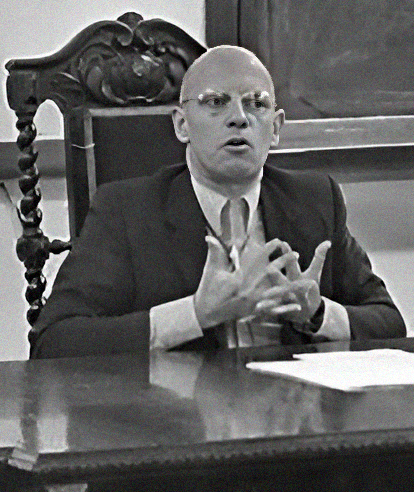
Michel Foucault speaking at the Hospital das Clínicas of the State University of Guanabara in Brazil, 1974.
Public domain image from the Arquivo Nacional Collection via Wikimedia Commons.
It has become common to blame wokeness on its supposed philosophical parent: postmodernism. As the standard narrative goes, postmodernism is the ideology that entrenched itself in Anglophone universities in the 1980s and 1990s. It talked of relativism, of the absence of objective truth, of the spectre of a pervasive, invisible power, and it was generally anti-Western. A whole generation of professors, writers, journalists and a fair few activists have subsequently been raised on this diet of postmodern thinking. And the result is a cultural elite that is wedded to wokeness.
[…]
For these critics of woke, Foucault’s influence, in particular, is seemingly everywhere. According to [Douglas] Murray [in The War on The West], it’s through the “anti-colonial” philosophy popularised by the Foucault-inspired scholar, Edward Said, that Foucault and therefore postmodernism have filtered down into woke philosophy, which holds that Western society is uniquely racist and to blame for all of today’s ills. Equally, right-wing critics of wokeness will claim that the trans movement has sprung from the postmodern contention that sexuality and gender are entirely socially constructed and therefore plastic and malleable.
If Foucault is regarded as the father of wokeness then 19th-century philosopher Friedrich Nietzsche tends to be regarded as the grandfather. After all, Foucault was profoundly influenced by Nietzsche and even proudly declared himself to be “Nietzchean”. Nietzsche, like Foucault, also saw all human behaviour stemming from the desire for power. And he conceived of morality – good and evil, right and wrong – as the mere manifestation of the will to power. As he wrote of the “origin of knowledge”, in The Joyous Science (1883): “Gradually, the human brain became full of such judgements and convictions, and a ferment, a struggle, and lust for power developed in this tangle. Not only utility and delight but every kind of impulse took sides in this fight about ‘truths’.” One can see this Nietzschean sentiment at work in Foucault’s Discipline and Punish (1975): “Power produces knowledge … power and knowledge directly imply one another.”
So, according to this largely right-wing narrative, wokeness is the product of a 20th-century philosophical assault on truth, objectivity and the West. And it was inspired by Nietzsche and led by several “cultural Marxist” thinkers.
There are several problems with this rather neat story. The first error is to use the phrase “cultural Marxism” to talk of postmodernism or wokeness. This term doesn’t really make sense. Marx himself conceived of his work as a historical materialism. It was focussed on class and the means of production, not on culture. Yes, in the 1940s and 1950s, some Frankfurt School thinkers, who sometimes presented themselves as Marxist, did focus on culture rather than class. But as Joanna Williams writes in How Woke Won (2022), their thinking “represented less a continuation of Marxism and more a break with Marx”.
Moreover, postmodern thinkers were broadly opposed to Marxism. Many may have been signed-up Communists in their youth (the French Communist Party dominated left-wing politics at the time), but by the 1960s they had become highly critical of Marxist politics. They rejected the idea that history was progressing “dialectically” towards a communist future, or “telos”. And they were often hostile to the scientific objectivity and “Enlightenment” values so central to Marxism. Foucault wrote that history was not the story of progress; it was but a series of non-linear discontinuities and contingencies. And Jean-François Lyotard (1924-1998), in his highly-influential The Postmodern Condition (1979), announced and celebrated the end of “grand narratives”, and with it the end of the Marxist “grand narrative” of progress. Lyotard’s writings from the 1970s onwards were violently antithetical to Marxism, especially its claims to objective truth.
As for wokeness itself, it has nothing to do with Marxism. With their myopic focus on race and gender, woke activists are utterly blind to the material, class-structure of society. Today, bizarrely, it’s often conservatives who are more attuned to the plight of the working class than woke “radicals”. As Williams writes, “critics who insist that woke is simply Marxism in disguise are wide of the mark”.
August 2, 2020
Words are verbal tools, but tools can be weaponized
In this week’s newsletter, Andrew Sullivan analyzes the roots of wokeness:
In the mid-2010s, a curious new vocabulary began to unspool itself in our media. A data site, storywrangling.org, which measures the frequency of words in news stories, revealed some remarkable shifts. Terms that had previously been almost entirely obscure suddenly became ubiquitous — and an analysis of the New York Times, using these tools, is a useful example. Looking at stories from 1970 to 2018, several terms came out of nowhere in the past few years to reach sudden new heights of repetition and frequency. Here’s a list of the most successful neologisms: non-binary, toxic masculinity, white supremacy, traumatizing, queer, transphobia, whiteness, mansplaining. And here are a few that were rising in frequency in the last decade but only took off in the last few years: triggering, hurtful, gender, stereotypes.
Language changes, and we shouldn’t worry about that. Maybe some of these terms will stick around. But the linguistic changes have occurred so rapidly, and touched so many topics, that it has all the appearance of a top-down re-ordering of language, rather than a slow, organic evolution from below. While the New York Times once had a reputation for being a bit stodgy on linguistic matters, pedantic, precise and slow-to-change, as any paper of record might be, in the last few years, its pages have been flushed with so many neologisms that a reader from, say, a decade ago would have a hard time understanding large swathes of it. And for many of us regular readers, we’ve just gotten used to brand new words popping up suddenly to re-describe something we thought we knew already. We notice a new word, make a brief mental check, and move on with our lives.
But we need to do more than that. We need to understand that all these words have one thing in common: they are products of an esoteric, academic discipline called critical theory, which has gained extraordinary popularity in elite education in the past few decades, and appears to have reached a cultural tipping point in the middle of the 2010s. Most normal people have never heard of this theory — or rather an interlocking web of theories — that is nonetheless changing the very words we speak and write and the very rationale of the institutions integral to liberal democracy.
What we have long needed is an intelligible, intelligent description of this theory which most people can grasp. And we’ve just gotten one: Cynical Theories: How Activist Scholarship Made Everything About Race, Gender and Identity, by former math prof James Lindsay and British academic, Helen Pluckrose. It’s as deep a dive into this often impenetrable philosophy as anyone would want to attempt. But it’s well worth grappling with.
What the book helps the layperson to understand is the evolution of postmodern thought since the 1960s until it became the doctrine of Social Justice today. Beginning as a critique of all grand theories of meaning — from Christianity to Marxism — postmodernism is a project to subvert the intellectual foundations of western culture. The entire concept of reason — whether the Enlightenment version or even the ancient Socratic understanding — is a myth designed to serve the interests of those in power, and therefore deserves to be undermined and “problematized” reason whenever possible. Postmodern theory does so mischievously and irreverently — even as it leaves nothing in reason’s place. The idea of objective truth — even if it is viewed as always somewhat beyond our reach — is abandoned. All we have are narratives, stories, whose meaning is entirely provisional, and can in turn be subverted or problematized.
During the 1980s and 1990s, this somewhat aimless critique of everything hardened into a plan for action. Analyzing how truth was a mere function of power, and then seeing that power used against distinct and oppressed identity groups, led to an understandable desire to do something about it, and to turn this critique into a form of activism. Lindsay and Pluckrose call this “applied postmodernism”, which, in turn, hardened into what we now know as Social Justice.
April 18, 2020
QotD: Distorting the history of science
The historian of science David Wootton has remarked on the mores of his own field: “In the years since Snow’s lecture the two-cultures problem has deepened; history of science, far from serving as a bridge between the arts and sciences, nowadays offers the scientists a picture of themselves that most of them cannot recognize.” That is because many historians of science consider it naïve to treat science as the pursuit of true explanations of the world. The result is like a report of a basketball game by a dance critic who is not allowed to say that the players are trying to throw the ball through the hoop.
Many scholars in “science studies” devote their careers to recondite analyses of how the whole institution is just a pretext for oppression. An example is a 2016 article on the world’s most pressing challenge, titled “Glaciers, Gender, and Science: A Feminist Glaciology Framework for Global Environmental Change Research,” which sought to generate a “robust analysis of gender, power, and epistemologies in dynamic social-ecological systems, thereby leading to more just and equitable science and human-ice interactions.”
More insidious than the ferreting out of ever more cryptic forms of racism and sexism is a demonization campaign that impugns science (together with the rest of the Enlightenment) for crimes that are as old as civilization, including racism, slavery, conquest, and genocide.
This was a major theme of the Critical Theory of the Frankfurt School, the quasi-Marxist movement originated by Theodor Adorno and Max Horkheimer, who proclaimed that “the fully enlightened earth radiates disaster triumphant.” It also figures in the works of postmodernist theorists such as Michel Foucault, who argued that the Holocaust was the inevitable culmination of a “bio-politics” that began with the Enlightenment, when science and rational governance exerted increasing power over people’s lives. In a similar vein, the sociologist Zygmunt Bauman blamed the Holocaust on the Enlightenment ideal to “remake the society, force it to conform to an overall, scientifically conceived plan.”
In this twisted narrative, the Nazis themselves are somehow let off the hook (“It’s modernity’s fault!”). Though Critical Theory and postmodernism avoid “scientistic” methods such as quantification and systematic chronology, the facts suggest that they have the history backwards. Genocide and autocracy were ubiquitous in premodern times, and they decreased, not increased, as science and liberal Enlightenment values became increasingly influential after World War II.
Steven Pinker, “The Intellectual War on Science”, Chronicle of Higher Education, 2018-02-13.
February 7, 2011
Postmodern Monday
A little postmodernism to lighten your Monday morning burdens:
Surrealism in the works of Rushdie
John N. Humphrey
Department of Sociolinguistics, University of Massachusetts, Amherst
1. Sontagist camp and capitalist theory
The main theme of the works of Rushdie is a self-justifying totality. The subject is interpolated into a capitalist theory that includes narrativity as a paradox.
It could be said that if Lyotardist narrative holds, we have to choose between Sontagist camp and the subcultural paradigm of narrative. Sontag suggests the use of surrealism to deconstruct class divisions.
Therefore, the subject is contextualised into a Sontagist camp that includes reality as a reality. Several sublimations concerning the role of the participant as observer may be discovered.
Thus, Porter[1] suggests that the works of Rushdie are postmodern. If constructive objectivism holds, we have to choose between capitalist theory and postdialectic narrative.
2. Rushdie and Sontagist camp
“Sexuality is part of the meaninglessness of language,” says Lacan. However, Sartre promotes the use of surrealism to analyse and read sexual identity. The subject is interpolated into a cultural rationalism that includes narrativity as a totality.
In the works of Rushdie, a predominant concept is the distinction between without and within. It could be said that Sontag uses the term ‘surrealism’ to denote a mythopoetical whole. Baudrillard suggests the use of neodeconstructivist desemioticism to challenge elitist perceptions of truth.
However, the subject is contextualised into a capitalist theory that includes art as a reality. A number of constructions concerning surrealism exist.
But the characteristic theme of Geoffrey’s[2] essay on materialist postcultural theory is the absurdity, and hence the paradigm, of capitalist class. The subject is interpolated into a capitalist theory that includes sexuality as a whole.
Thus, the example of surrealism prevalent in Rushdie’s Satanic Verses is also evident in Midnight’s Children, although in a more self-referential sense. Sontag promotes the use of Debordist image to analyse sexual identity.
However, the main theme of the works of Rushdie is not narrative, but subnarrative. Derrida uses the term ‘capitalist theory’ to denote the defining characteristic, and subsequent collapse, of neotextual art.
3. Consensuses of economy
If one examines the conceptualist paradigm of narrative, one is faced with a choice: either reject capitalist theory or conclude that consciousness is responsible for capitalism. Therefore, the characteristic theme of Parry’s[3] model of Lacanist obscurity is a posttextual paradox. Marx suggests the use of capitalist theory to deconstruct archaic perceptions of society.
However, Lacan uses the term ‘surrealism’ to denote not discourse, but subdiscourse. The primary theme of the works of Rushdie is the genre of capitalist class.
But Sartre uses the term ‘capitalist theory’ to denote a self-justifying totality. The subject is contextualised into a surrealism that includes truth as a reality.
4. Rushdie and Sontagist camp
The main theme of de Selby’s[4] analysis of surrealism is the role of the writer as participant. Thus, an abundance of theories concerning the common ground between sexual identity and class may be found. Derrida uses the term ‘Batailleist `powerful communication” to denote the role of the observer as participant.
In the works of Rushdie, a predominant concept is the concept of capitalist language. But the premise of surrealism implies that society, surprisingly, has significance, but only if truth is equal to reality; otherwise, Marx’s model of presemioticist narrative is one of “the textual paradigm of context”, and therefore part of the meaninglessness of narrativity. The characteristic theme of the works of Rushdie is the bridge between culture and sexual identity.
Thus, several desituationisms concerning Sontagist camp exist. Lyotard’s essay on capitalist theory states that reality is a product of the masses.
Therefore, Geoffrey[5] holds that we have to choose between surrealism and semantic theory. In The Moor’s Last Sigh, Rushdie reiterates capitalist theory; in The Ground Beneath Her Feet, although, he analyses Sontagist camp.
In a sense, Marx promotes the use of the neodialectic paradigm of narrative to modify and challenge language. Lacan uses the term ‘surrealism’ to denote the role of the artist as poet.
1. Porter, Z. ed. (1998) The Failure of Discourse: Surrealism in the works of Fellini. And/Or Press
2. Geoffrey, J. W. I. (1986) Sontagist camp and surrealism. Loompanics
3. Parry, J. K. ed. (1994) Reassessing Modernism: Surrealism in the works of Mapplethorpe. Cambridge University Press
4. de Selby, A. (1989) Nihilism, surrealism and neotextual libertarianism. University of California Press
5. Geoffrey, O. R. ed. (1974) Poststructural Narratives: Surrealism and Sontagist camp. Yale University Press
H/T to Andrew C. Bulhak and Josh Larios for the link.


