This poor woman has everything backward in her head. It makes it very difficult for me to believe that she can create any kind of sane or believable world. Why? Because she doesn’t understand the laws of supply and demand, which means she doesn’t understand reality.
It is clear that she comes from an academic background, since she thinks that shelves are allotted by order of “importance.”
This is a problem for me as a reader often because I run into a lot of writers like her. It’s less important in things like romance, though even there it can get weird, like when some authors assume that the best thing possible in the Regency would be being a duke AND a doctor. (Head>desk, repeat.) This is because they misunderstand the relative wealth and importance of earning a living in the professions.
But there are a ton of books in mystery that hit the wall. Those that require understanding of how the world worked. So the economics these writers write are what you expect from exquisitely maleducated people. They learned sociology and various grievance studies. So you know, factories are bad places where people are forced to work in terrible conditions — for the 21st century. None of these darlings has the slightest idea what actual conditions were like at farms in the Regency, say — and do not even get health care or counseling, and are probably totally deprived of free ice cream.
I have now walled mysteries, some romances and a few fantasies, because they assume people who build and run factories are “evil exploiters” and villains. (As opposed to you know not building anything and letting the peasants starve.)
I’ve walled even more of them when the villain becomes “reformed” and just gives his whole fortune away to people who probably drink it away within a week and, presumably, dies in a gutter shortly thereafter.
In science fiction and fantasy this is even more painful. You’ll have entire worlds getting paid for things, without it making any sense, since there is no galactic agreement on money, no universally agreed upon standard, nothing that makes whatever they hand you worth anything. We have entire worlds paid for things that make no sense to transport inter-world with the money existent at that time. You have “exploited” groups, that you can’t figure out why anyone would exploit or what sense it makes.
Then there is the soc jus in these worlds, which often consists of upending historic injustices by creating worse injustices and, oh, yeah, incidentally making it impossible for the economics to function and starving everyone in the world. If you’re going to do that call it Planet Venezuela already, okay?
And don’t get me started on the economics of worlds with magic, where monetizing magic is somehow either wrong or no one ever thought of doing it (because everyone in that world is born mentally impaired.)
Sarah Hoyt, “A Fundamental Misunderstanding of Supply and Demand”, According to Hoyt, 2019-11-06.
January 19, 2020
January 18, 2020
Paul Sellers’ Desktop Organiser | Episode 1
Paul Sellers
Published 17 Jan 2020Our Desktop Organiser series was originally released for free on Woodworking Masterclasses, to see Episode 2 straight away click here: https://woodworkingmasterclasses.com/…
Episode 2 will be released on YouTube on Friday 31st January.
Making smaller projects like this one can elevate the demand for precise handwork and the constant throughout this opening video is to establish accuracy first off.
Though this box is similar to one made in Paul’s foundational woodworking course, the design progresses to include all the tenets of drawer making and fitting. The box must be made to exacting tolerances, so Paul takes you one step at a time to show how he works to that end. You can choose any wood you like or have to hand, from Pine to Sapele and Oak to Spruce. If you are new to woodworking, you might prefer to practice some of the steps before you begin the whole box.
For a free PDF of the drawing and cutting list, click here: https://paulsellers.com/desktop-organ…
——————–Want to learn more about woodworking?
Go to Woodworking Masterclasses for weekly project episodes: http://bit.ly/2JeH3a9
Go to Common Woodworking for step-by-step beginner guides and courses: http://bit.ly/35VQV2o
http://bit.ly/2BXmuei for Paul’s latest ventures on his blog
——————–
Instagram: http://bit.ly/2oWpy7W
Twitter: http://bit.ly/33S7RFa
Pinterest: http://bit.ly/35X5uTf

Economic interventions during the Roman republic and empire
Even during the republican period, state intervention in the economy — usually to “fix” another problem already caused or exacerbated by previous interventions — often made the situation worse. Fortunately there’s a lot of ruin in a nation, but over a long enough run, you do reach the economic end-game:
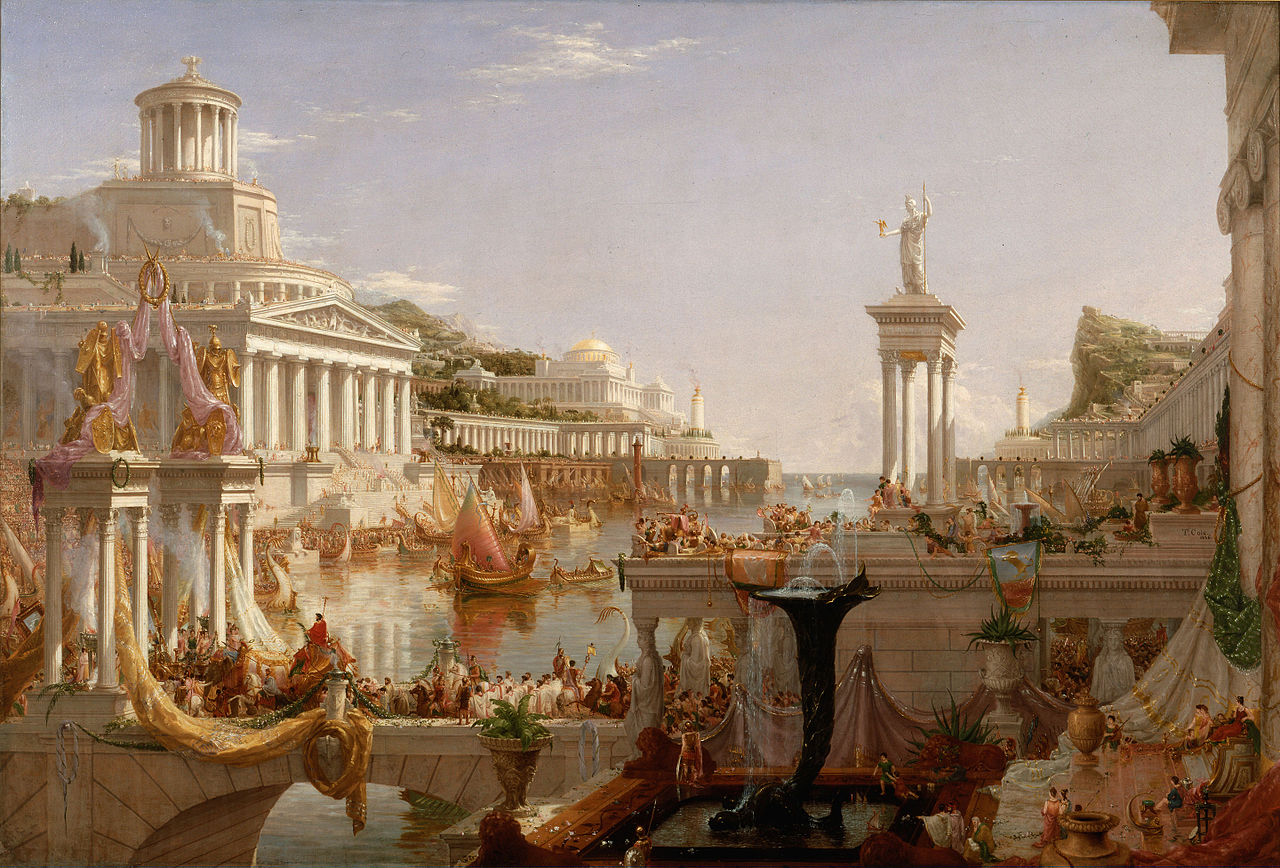
“The Course of Empire – The Consummation of Empire” by Thomas Cole, one of a series of five paintings created between 1833 and 1836.
Wikimedia Commons.
Debt forgiveness in ancient Rome was a contentious issue that was enacted multiple times. One of the earliest Roman populist reformers, the tribune Licinius Stolo, passed a bill that was essentially a moratorium on debt around 367 BC, a time of economic uncertainty. The legislation enabled debtors to subtract the interest paid from the principal owed if the remainder was paid off within a three-year window. By 352 BC, the financial situation in Rome was still bleak, and the state treasury paid many defaulted private debts owed to the unfortunate lenders. It was assumed that the debtors would eventually repay the state, but if you think they did, then you probably think Greece is a good credit risk today.
In 357 BC, the maximum permissible interest rate on loans was roughly 8 percent. Ten years later, this was considered insufficient, so Roman administrators lowered the cap to 4 percent. By 342, the successive reductions apparently failed to mollify the debtors or satisfactorily ease economic tensions, so interest on loans was abolished altogether. To no one’s surprise, creditors began to refuse to loan money. The law banning interest became completely ignored in time.
The original “dole” was implemented as part of the reforms of the Gracchi brothers, and quickly became a major part of government spending:
Gaius, incidentally, also passed Rome’s first subsidized food program, which provided discounted grain to many citizens. Initially, Romans dedicated to the ideal of self-reliance were shocked at the concept of mandated welfare, but before long, tens of thousands were receiving subsidized food, and not just the needy. Any Roman citizen who stood in the grain lines was entitled to assistance. One rich consul named Piso, who opposed the grain dole, was spotted waiting for the discounted food. He stated that if his wealth was going to be redistributed, then he intended on getting his share of grain.
By the third century AD, the food program had been amended multiple times. Discounted grain was replaced with entirely free grain, and at its peak, a third of Rome took advantage of the program. It became a hereditary privilege, passed down from parent to child. Other foodstuffs, including olive oil, pork, and salt, were regularly incorporated into the dole. The program ballooned until it was the second-largest expenditure in the imperial budget, behind the military. It failed to serve as a temporary safety net; like many government programs, it became perpetual assistance for a permanent constituency who felt entitled to its benefits.
In the imperial government, economic interventions were part and parcel of the role of the emperor:
In 33 AD, half a century after the collapse of the republic, Emperor Tiberius faced a panic in the banking industry. He responded by providing a massive bailout of interest-free loans to bankers in an attempt to stabilize the market. Over 80 years later, Emperor Hadrian unilaterally forgave 225 million denarii in back taxes for many Romans, fostering resentment among others who had painstakingly paid their tax burdens in full.
Emperor Trajan conquered Dacia (modern Romania) early in the second century AD, flooding state coffers with booty. With this treasure trove, he funded a social program, the alimenta, which competed with private banking institutions by providing low-interest loans to landowners while the interest benefited underprivileged children. Trajan’s successors continued this program until the devaluation of the denarius, the Roman currency, rendered the alimenta defunct.
By 301 AD, while Emperor Diocletian was restructuring the government, the military, and the economy, he issued the famous Edict of Maximum Prices. Rome had become a totalitarian state that blamed many of its economic woes on supposed greedy profiteers. The edict defined the maximum prices and wages for goods and services. Failure to obey was punishable by death. Again, to no one’s surprise, many vendors refused to sell their goods at the set prices, and within a few years, Romans were ignoring the edict.
Actually that last sentence rather understates the situation. The Wikipedia entry describes the outcome of the Edict:
The Edict was counterproductive and deepened the existing crisis, jeopardizing the Roman economy even further. Diocletian’s mass minting of coins of low metallic value continued to increase inflation, and the maximum prices in the Edict were apparently too low.
Merchants either stopped producing goods, sold their goods illegally, or used barter. The Edict tended to disrupt trade and commerce, especially among merchants. It is safe to assume that a black market economy evolved out of the edict at least between merchants.
Sometimes entire towns could no longer afford to produce trade goods. Because the Edict also set limits on wages, those who had fixed salaries (especially soldiers) found that their money was increasingly worthless as the artificial prices did not reflect actual costs.
History Summarized: Classical India
Overly Sarcastic Productions
Published 17 Jan 2020Classical and Medieval Indian History is a tale of constant flux — but in between the dozens and hundreds of states at play across the peninsula, there are clear trends that arise. Let’s take this chapter of history as an opportunity to dig into different types of sources, and try and wrap our heads around a story that doesn’t fit neatly into a single chronology.
FURTHER SOURCES: The Discovery of India by Jawaharlal Nehru, “A History of India” by Michael H. Fisher (lecture courtesy of The Great Courses).
Our content is intended for teenage audiences and up.
PATREON: https://www.Patreon.com/OSP
DISCORD: https://discord.gg/y7uUnzJ
MERCH LINKS: https://www.redbubble.com/people/OSPY…
OUR WEBSITE: https://www.OverlySarcasticProductions.com
Find us on Twitter https://www.Twitter.com/OSPYouTube
Find us on Reddit https://www.Reddit.com/r/OSP/

The innovative 1720s
In the latest Age of Invention newsletter, Anton Howes says the real Roaring Twenties were back in the eighteenth century:
Last week I called the 1720s an era of schemes. 1720 was the year of the South Sea Company’s crash, as well as the collapse of John Law’s Mississippi Company in France. But the decade saw some oft-neglected innovations too. As I never tire of saying, Britain’s extraordinary acceleration of innovation was about all industries, not just the famous ones of cotton, coal, iron, and steam — a point that the 1720s demonstrate perfectly.
For a start, it was the decade in which smallpox began to be systematically eradicated through inoculation. Lady Mary Wortley Montagu, having observed the procedure in the Ottoman Empire, had her daughter inoculated in London following an outbreak in 1721. The same epidemic prompted the trialling of inoculation in New England, and the reports of these successes provided the statistical evidence for it to be more widely spread. Soon, through Lady Montagu’s aristocratic connections, even the royal children were being inoculated. Inoculation was still dangerous — it was decades before non-deadly cowpox was discovered to also confer immunity to smallpox — but the 1720s marked the beginning of the end for one of humanity’s greatest killers.
[…]
Most famous, however, was the search for longitude. When at sea, it was relatively easy to tell how far north or south you were, but not how far east or west. The implications for navigation were immense. William Whiston, a protégé of Newton, was in 1714 instrumental in lobbying for the creation of a substantial government prize for a solution, and spent much of the following decades trying to win it. His earliest proposal, along with the mathematician Humphrey Ditton, was for ships anchored at fixed locations to essentially shoot fireworks at fixed intervals. By comparing the difference between seeing and hearing the flashes, you might calculate your longitude (it’s actually not that dissimilar to the principle that underlies GPS).
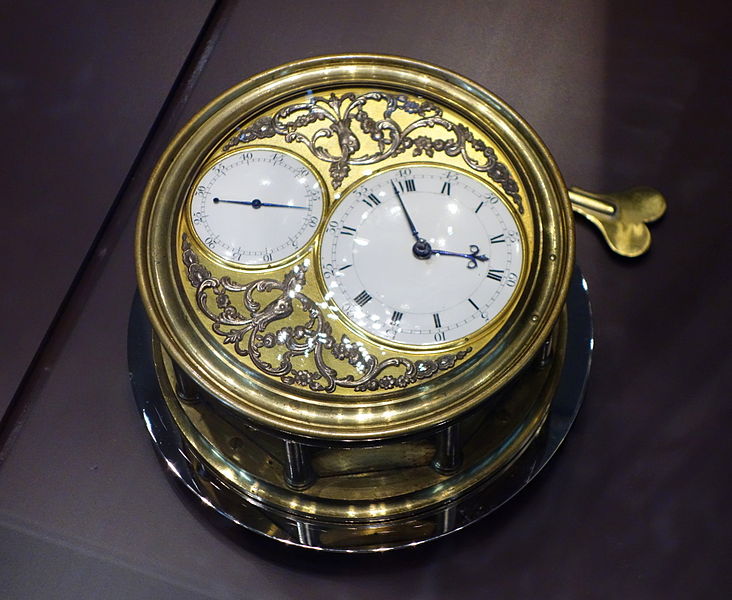
Marine chronometer “Copie No. 18″, Thomas Mudge, Jr., Robert Pennington, Richard Pendleton, et al, London, 1795 – Mathematisch-Physikalischer Salon, Dresden.
Photo by Daderot via Wikimedia Commons.But unlike with the medical advances, the poets were having none of it. As one of them rather crudely put it:
The longitude miss’d on
By wicked Will Whiston;
And not better hit on
By good master Ditton.
So Ditton and Whiston
May both be bepist on;
And Whiston and Ditton
May both be beshit on.Whiston and the other longitude-searchers also investigated using the earth’s magnetic variation — he produced perhaps the first map with isogonic lines, indicating where compass needles dipped — as well as solar eclipses. And as longitude could be found on land by looking at the eclipses of Jupiter’s moons, he tried to develop telescopes so that they could observe such events on the unsteady sea.
Nonetheless, the solution came from one of George Graham’s friends, the clockmaker John Harrison. Starting in the 1720s, Harrison developed a timekeeping device — the marine chronometer — that would keep its accuracy despite the rocking and rolling and atmospheric changes from being at sea. By comparing your local time with the time at Greenwich shown on the chronometer, you could calculate your longitude. (Though by the time his device came into use in the 1770s, another method had been discovered that involved observing the moon).
And of particular interest to woodworkers who also have historical interests:
While scientific minds sought the longitude, consumer items were also being transformed. In the 1720s, a ship’s carpenter to Jamaica, Robert Gillow, was among the first to import mahogany to Britain, creating a tradition of furniture-making in Lancaster that even the fashion-conscious French would come to regard jealously.
Tank Chats #59 Sherman Grizzly | The Tank Museum
The Tank Museum
Published 16 Nov 2018David Willey, Tank Museum Curator, presents a Tank Chat on the Sherman Grizzly.
This version of the Sherman was built in Canada from October 1943. After the fall of France, the Canadians began making their own vehicles, beginning with the Ram tank based on the M3 Lee chassis before moving on to a modified M4 Sherman. Only about 180 were produced.
This vehicle is currently on loan to the Heeresgeschichtliches Museum Wien.
Support the work of The Tank Museum on Patreon: ► https://www.patreon.com/tankmuseum
Visit The Tank Museum SHOP: ► https://tankmuseumshop.org/
Twitter: ► https://twitter.com/TankMuseum
Tiger Tank Blog: ► http://blog.tiger-tank.com/
Tank 100 First World War Centenary Blog: ► http://tank100.com/ #tankmuseum #tanks #tankchats

QotD: Men and talking
Also, because many women tend to over-analyze, they assign all sorts of deep meaning to trivial gestures and then demand explanations. Sometimes a rose is just a rose and five minutes of silence is just a man thinking about what he has to do at work tomorrow. You want to get a man to talk? It’s not hard. Ask him to explain what’s going on in a UFC fight or what his favorite sexual fantasy is and you’ll have trouble getting him to shut up.
John Hawkins, “5 Things Women Do That Secretly Annoy Men”, PJ Media, 2012-08-23.
January 17, 2020
Zionism, Arabism & Colonialism in the Middle East | BETWEEN 2 WARS I 1936 Part 1 of 3
TimeGhost History
Published 16 Jan 2020After more than twenty years of colonial management, promises made but few promises kept and ethnic & cultural clashes in the area, unrest in the Middle East erupts in violence. A series of movements originate in this time, with long lasting consequences.
Watch our episode about the Middle east in the 1920s here: https://youtu.be/y6tSvRbvh2s
Join us on Patreon: https://www.patreon.com/TimeGhostHistory
Hosted by: Indy Neidell
Written by: Joram Appel
Directed by: Spartacus Olsson and Astrid Deinhard
Executive Producers: Bodo Rittenauer, Astrid Deinhard, Indy Neidell, Spartacus Olsson
Creative Producer: Joram Appel
Post-Production Director: Wieke Kapteijns
Research by: Joram Appel
Fact-Checking by: Jonas Srouji
Edited by: Daniel Weiss
Sound design: Marek KaminskiSources:
Arab by LINECTOR from the Noun Project
Bomb by P Thanga Vignesh from the Noun ProjectColorizations by:
– Dememorabilia – https://www.instagram.com/dememorabilia/
– Adrien.Colorisation – https://instagram.com/adrien.colorisa…
– Norman StewartSoundtracks from Epidemic Sound:
– “Dawn Of Civilization” – Jo Wandrini
– “The Inspector 4” – Johannes Bornlöf
– “Easy Target” – Rannar Sillard
– “First Responders” – Skrya
– “Not Safe Yet” – Gunnar Johnsen
– “Deflection” – Reynard Seidel
– “The Charleston 3” – Håkan ErikssonA TimeGhost chronological documentary produced by OnLion Entertainment GmbH.
From the comments:
TimeGhost History
42 minutes ago (edited)
We have already covered “Carving up the Middle East” in one of our first Between Two Wars episodes (watch here: https://youtu.be/y6tSvRbvh2s), but we felt like we had to return to the area one more time as all that carving had quite some consequences. This means that a large part of this episode is about colonialism, Zionism, Arabism, race and ethnicity. I’m also aware of the complicated modern-day conflict in the area, many of which originate in [the events covered in] this episode. However, we would like the comment section to be reserved for debating the history. We’re not going to engage with people discussing modern-day issues and politics, and we’re going to be quite strict in monitoring any racist or otherwise hateful comments.Cheers,
Joram

Labour’s underlying problem
In UnHerd, James Bloodworth explains why the Labour Party will have to change to get back into power in Britain:

Jeremy Corbyn speaking at a Rally in Hayfield, Peak District, UK on 25th July 2018.
Photo by Sophie Brown via Wikimedia Commons.
George Orwell was famously contemptuous of much of the left intelligentsia. “England is perhaps the only great country where intellectuals are ashamed of their own nationality,” he wrote in his 1941 essay “England, Your England“. “In left-wing circles it is always felt that there is something slightly disgraceful in being an Englishman and that it is a duty to snigger at every English institution.”
Plus ça change, plus c’est la même chose.
There has always been a healthy suspicion of jingoism and flag-waving on the Left. However it wasn’t this that Orwell was referring to. Few wrote more damning screeds about the British empire than the former colonial policeman, who was always willing to give the “blimps” who ran Britain a good kicking. Rather, Orwell was referring to a more generalised contempt many on the Left felt towards Britain and — by extension — their fellow countrymen.
Socialism to Orwell meant bread and butter issues of higher wages and more freedom — freedom itself depending to a large extent on how much money one has. Yet the movement attracted its fair share of cranks. It was this penumbra of crankishness that prevented socialism from developing a mass following. A major hallmark of it was its anti-Britishness.
Jeremy Corbyn has been compared plenty of times over the past five years to the “vegetarian, fruit-juice drinking, Nature Cure quack, pacifist” oddballs Orwell wrote about in The Road to Wigan Pier. In Orwell’s time these types seemed to gravitate towards the socialist movement “like bluebottles to a dead cat”, as he put it. Since Corbyn became leader in 2015 something similar has occurred: the Labour Party has been flooded with conspiracy theorists, antisemites and various other subliterate fools. Uniting almost all of them is a profound contempt for Britain and in particular British foreign policy.
This is arguably a major reason Labour lost the recent election. “Such was the demonisation of Jeremy Corbyn,” wrote the Labour MP Liam Byrne, “that hundreds of voters I met thought Labour’s leader was a communist terrorist sympathiser who wouldn’t push the nuclear button or sing the national anthem.”
This isn’t so much the “demonisation of Jeremy Corbyn” as an accurate summation of the Labour leader’s views. Seumas Milne and Andrew Murray, two of Corbyn’s first appointments as advisers, are communists. Corbyn called members of Hamas and Hezbollah “honoured friends”. He fraternised with the IRA and argued for the abolition of Nato. He has obfuscated shamefully over acts of aggression directed against Britain, such as during the Skripal poisoning in Salisbury. It is not demonising someone to accurately list the things they have said and done.
SdKfz 2 Kettenkrad: Germany’s Halftrack Motorcycle
Forgotten Weapons
Published 16 Jan 2020http://www.patreon.com/ForgottenWeapons
https://www.floatplane.com/channel/Fo…
Cool Forgotten Weapons merch! http://shop.bbtv.com/collections/forg…
The Sd.Kfz. 2 Kettenkraftrad (aka Kettenrad) is a deliciously German sort of vehicle, a small utility tractor made with a pair of treads and motorcycle front wheel. It was powered by a 4 cylinder Opel automotive engine generating 36 horsepower, and had a 3-speed gearbox with high and low range transfer case. Top speed was 44 mph, and it could tow about 1,000 pounds of ammunition or other supplies in a small 2-wheeled trailer, or directly tow light artillery pieces.
The vehicle was developed in 1939, and in mass production in time to see substantial use in Operation Barbarossa; the German invasion of Russia. Although complex to maintain and expensive to produce, the Kettenkrad was quite well suited to the terrain and distances of the Eastern Front. As the war progressed and supplies became scarcer and artillery became heavier it was less universally useful, but remained in service until the very end of the war, tasked with jobs as mundane as towing aircraft at airfields. After the war, they were put into civilian agricultural service (much like the Jeep in the US).
This example is in the rental fleet at DriveTanks.com, available for instruction and driving to anyone. It is one of my very favorite vehicles from World War Two, and I really appreciate DriveTanks giving me the opportunity to do some driving on it and show it to you! See all their available rentals here:
Contact:
Forgotten Weapons
6281 N. Oracle #36270
Tucson, AZ 85740

The crying need for “regime change” … in Canadian newsrooms
Chris Selley discusses the amazingly tone-deaf “corrections” issued by CBC and CTV over their malicious misquoting of former Prime Minister Stephen Harper’s comments on the Iranian government:
Harper did not advocate military intervention in Iran, or indeed any particular intervention whatsoever. Despite describing Iran (accurately) as an “anti-Semitic state” premised on “religious fanaticism and regional imperialism” that is standing resolutely in the way of cooperation between other Middle Eastern nations, Harper didn’t even advocate “a complete change of government.”
Prime Minister Stephen Harper speaking at the Annual Meeting of the World Economic Forum in Davos, Switzerland, January 26, 2012.
World Economic Forum photo via Wikimedia Commons.“I do believe we need to see a change in Iran if we are going to see peace in the Middle East,” he said.
“Without a change in the nature of the government of Tehran,” he said, “the Middle East will continue to be in turmoil.”
He said he hoped the furious protests in Iran might nudge the country toward “a better trajectory.”
These are perfectly anodyne statements. Who doesn’t want the Iranian regime to alter its behaviour?
Clarification or correction? I would say this calls for something more like “colossal embarrassment necessitating deep introspection.”
The root problem, I think, is that so much of Canadian politics is purely for show. We are a sparsely populated, not very powerful nation where the differences between the two major federal parties are remarkably small — and thus so are the stakes. It requires special measures to keep people interested, as much for the media as for politicians.
[…]
That’s how the big outlets like CBC and CTV make the sausage of the day, and it’s understandable. They do great investigative work, but the beast needs feeding not just every day, but all day every day. During the campaign I would watch colleagues set up for live hits in various parking lots and back yards and sometimes even on the campaign bus, and imagine them speaking the truth: “I’m here in Delta, B.C. and there’s f–k-all to report. Back to you, Kent.” But the viewers must never know. They need drama, as weak as it might be. I can easily imagine how that principle transformed “a changed regime” into “regime change.”
The real problem with this reporting regime is when it’s applied to things that actually do matter. There are serious potential consequences to telling the world that Stephen Harper thinks, in essence, that we should declare war on Iran with an eye to bouncing the ayatollahs. Harper’s successor and his government are in the midst of an extremely delicate and frankly improbable operation to find out precisely what happened the morning of Jan. 8 in the skies above Tehran and seek justice for the victims and their families. Those families don’t deserve fake news about a warmongering former PM, and I’m sure our diplomats would prefer members of the unchanged Iranian regime didn’t come across it either.
This isn’t a Canadian federal election. It’s real life, and needs to be covered as such.

HK4: Heckler & Koch’s Multi-Caliber Pocket Pistol
Forgotten Weapons
Published on 28 Aug 2019RIA on YouTube: https://www.youtube.com/user/RockIsla…
RIA on Instagram: https://www.instagram.com/rockislanda…The H&K Model 4 was named for the fact that it was offered in four different calibers – .22LR, .25 ACP, .32 ACP, and .380 ACP. The gun came with a complete set of spare barrels and magazines to allow conversion between all of them, and interesting feature not offered by any other pistols like it at the time. The design was by Alex Seidel, one of the founding engineers of H&K. He had familiarity with the Mauser HSc from his time working at Mauser, and it was the rough basis fo the HK4.
The changes between centerfire calibers required nothing more than swapping barrels (and recoil springs, which were pinned to the barrels) and magazines. Differing spring strength for each caliber were enough to make the gun both safe and reliable in the different chamberings. To convert to .22LR rimfire, it was also necessary to unscrew the removable breech face and flip it around. The breech face had two firing pin holes (one centerfire and one rimfire), and the firing pin could pivot enough to use either one. When the breech face was removed, the firing pin could be positioned for whichever setting was desired.
The HK4 was interesting and reasonably successful, but never able to really compete with guns like the Walther PP and PPK. During a 16-year production run from 1968 until 1984 a total of 38,200 were made, including 12,400 for the German customs police.
http://www.patreon.com/ForgottenWeapons
Cool Forgotten Weapons merch! http://shop.bbtv.com/collections/forg…
Contact:
Forgotten Weapons
PO Box 87647
Tucson, AZ 85754

QotD: The Bible
In my former life, when I entertained grand schemes, I dreamt of publishing a multi-volume revision of that Variorum, with the latest scholarship, but attached to the same old, resonant King James text. (This project could as well have been mounted on the explicitly Roman, and similarly magnificent, Douay-Rheims.)
There are now, in print, more than one hundred alternative English translations of the Bible, and the reader who buys, say, the top twenty, to compare them, is wasting time. He could actually save time by mastering the original languages. I rather think it was the Devil’s idea, to undermine the simple Christian’s confidence in Scripture by means of multiple translations, and innumerable petty and irrelevant distractions.
The New English Bible‘s first volume, a translation into “modern idiom” of the New Testament, was published in 1961. It is dated now in a way the KJV will never be, and has in fact been succeeded by the many other “improved” — and desperately flawed — ever more “modern” editions, including those which intentionally misrepresent the original texts to keep up with the latest “gender” abominations. Yet even when it first appeared, T. S. Eliot could say that the new translation “astonishes in its combination of the vulgar, the trivial, and the pedantic.”
That criticism holds, so far as I can see, for every modern-language “update” of scripture and liturgy. The hard truth is that the medium of contemporary language is incapable of conveying the substance we require.
Remove not the ancient landmark which thy fathers have set.
David Warren, “A rant”, Essays in Idleness, 2017-12-13.
January 16, 2020
Make a router plane from a chisel
Rex Krueger
Published 15 Jan 2020Make a FREE router plane using a chisel and my easy construction method.
More video and exclusive content: http://www.patreon.com/rexkrueger
Get the plans: https://www.rexkrueger.com/store/plan…
Get the FREE Tip Sheet: https://www.rexkrueger.com/articles/2…
(more…)
“… he returned to settle in a 250-year-old farmhouse in Wiltshire which he named ‘Scrutopia'”
In Quillette, Barbara Kay remembers Sir Roger Scruton:
Scruton’s breadth of knowledge was astonishing. None of his enemies could dispute that. He wrote whole books with complete authority on religion, architecture, opera, the environment, Islam, philosophy. But running through them all was a guilt-free love for, and fidelity to his — our — cultural inheritance. He loved his own home, England, and he would not repudiate it for its disfiguring historical warts, which seemed to preoccupy almost everyone else. It was Scruton who gave us the word “oikophobia” — hatred of one’s home — which is the hallmark of progressivism. He was out of sync with the hey-hey-ho-ho-western-civ-has-got-to-go zeitgeist. It didn’t help that he was the son of a lowly schoolmaster and had gone to the Royal Grammar School High Wycombe, a selective public high school.
Sir Roger Scruton
Photo by Pete Helme via Wikimedia Commons.Feeling isolated, like Andrew Sullivan and Christopher Hitchens before him, Scruton drifted “across the pond” to breathe the friendlier air of the last western redoubt where conservative thought finds a welcoming hearth. From 1992 to 1995, he taught a philosophy course at Boston University, and he spent a second stint in America from 2004 to 2009. But the pull of his beloved England proved too great, and he returned to settle in a 250-year-old farmhouse in Wiltshire which he named “Scrutopia.”
[…]
Among those who expressed their gratitude to Scruton in his final year were the governments of Poland and Hungary, who garlanded him with honors for the role he’d played in overthrowing the Communist regimes that had blighted their countries before the fall of the Berlin Wall. This recognition followed his receipt of the Czech Medal of Merit (First Class), presented to him by Vaclav Havel in 1998. At great risk to himself, Scruton had smuggled banned books across the Iron Curtain and helped dissidents organize an underground university, even arranging for degrees to be awarded by the Cambridge theology department. Among his other achievements, he was on the right side of history.
I cherish the memory of a brief conversation I had with Scruton after his Ottawa talk, in which he had expanded on the idea of decency, a concept of great interest and importance for me, especially in retrospect, for Scruton was himself a supremely decent man, although that did not save him from the postmodern jackals. I remember he said decency was easy to regulate in small towns, because you can’t be happy in a small town without a willingness to conform to standards. But these standards aren’t written down. There is no need. Everyone knows what they are. You know you’ve transgressed them when you receive disapproving glances or are cold-shouldered.
Compelled conformity — not legislated, God forbid, but enforced by social pressure — looks stifling to progressives, but in its own way it can be a great comfort, knowing the rules of what is and isn’t decent, and, through them, belonging. We all want to belong, but healthy belonging is sensitive to scale. We’re not made for globalization. We’re made for homes and homelands. If people don’t have homes to keep them rooted, feeling they belong in a good way, they will find fake homes that are tethered to ideas and theories, and then they often belong in a bad way. These are Scrutonesque musings.
Conformity and its effects, good and bad, absorbed Scruton. He once described the entire trajectory of his life as a constant movement toward “that impossible thing: an original path to conformity.” Like so many other of his gnomic utterances, it forces one to stop and think, really think, about what it means. And you know it means something worth thinking about because Roger Scruton never thought or spoke or wrote bullshit. He left that to his critics.