Forgotten Weapons
Published 24 Sep 2017Get your copy on Amazon: http://amzn.to/2xwfDZ8
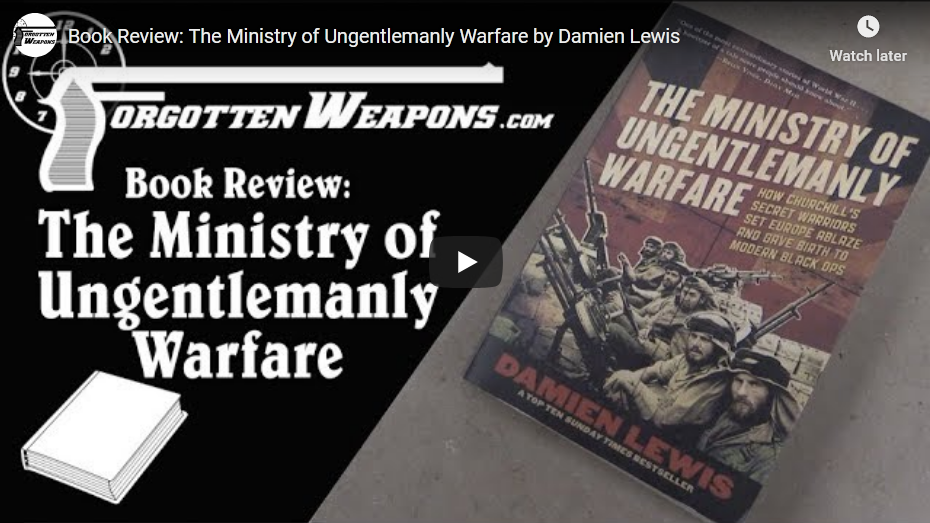
I ordered a copy of Damien Lewis’ book on the exploits of British SOE in WWII expecting to find an overview of, well, what SOE had done during the war. That’s not quite what this book is. Instead, Lewis has given us essentially a first-person view of SOE’s work through the eyes of Danish commando Anders Lassen (VC, MC with two bars). Don’t be fooled by the cover image; the North African LRDG is never mentioned. However, what Lassen was involved in was equally impressive and probably less well known.
Lassen was part of the crew for the first real SOE operation, the theft of a pair of German and Italian supply ships from the neutral Spanish port at Fernando Po. In an exploit that could be straight out of Hollywood, a band of commandoes sailed a pair of tugboats into the harbor at night while the ships’ officers were ashore at a raucous party. They blew the anchor chains with explosive charges, locked the crews below deck, and sailed the ships out to sea where they could be legally captured by a British destroyer. And they did it without a single death on either side.
The exploits only became bigger and bolder after that, with Lassen and his comrades making regular raids across the English Channel and running a freewheeling campaign of both hit-and-run raids and occupation of Greek islands in the Aegean. These were the quintessential independent Special Forces fighters, operating outside regular military command structures and supply chains, fighting as they saw fit. Lassen eventually became the commanding officer of a large group, and by the end of the war had been awarded the Military Cross three times. His last operation in Italy — where his men were hit with a shattering defeat when pushed into the role of spearheading a conventional offensive — would result in him posthumously receiving the Victoria Cross for his heroism.
I ended up reading the book almost entirely in a single sitting, and found it riveting and fascinating — far more so than the typical academic history. It offers a humbling and motivating example of what men can do when they are skilled and motivated. At the same time, it also left me a bit melancholy, as by the end we can see Lassen consumed by his combat experiences and slowly becoming removed from society. Nobody can say how Lassen would have coped had he survived the war, but one suspects he would have led a troubled life. Perhaps that is the price one must pay to become, as Churchill described, “a hand of steel which plucks the German sentries from their posts with growing efficiency.”
http://www.patreon.com/ForgottenWeapons
Cool Forgotten Weapons merchandise! http://shop.bbtv.com/collections/forg…
If you enjoy Forgotten Weapons, check out its sister channel, InRangeTV! http://www.youtube.com/InRangeTVShow
January 16, 2020
Book Review: The Ministry of Ungentlemanly Warfare by Damien Lewis
QotD: Progressive hatred
Something that has been noticeable for a long time now is that the Left is in a perpetual state of rage. The smallest things send them into spasms of anger. They hate Trump and they really hate his voters. They will go rummaging around in the social media history of people, looking for reasons to hate them. It’s not a general all-encompassing hate, like hating the fans of a rival sports team, but a very personal and cruel hate. They want the victim to suffer and they want to enjoy his suffering.
One reason for this, obviously, is that many people attracted to the Left are mentally unstable, so their politics are just a vehicle for their pathology. Many of the Antifa people, for example, have no coherent political thoughts. They just like being crazy on the streets and causing mayhem. This is the type of person who was attracted to the riots that used to follow the big economic summits. There was never any purpose to their rampages, other than the thrill of smashing things and causing mayhem.
Another more important reason for the rage is the nature of leftist politics in our post-national age. Being on the Left no longer means joining a group that has a tangible enemy, against whom the group throws themselves. The days of unionist, socialists and communists operating as collectives are gone. Even the post-modern movements like climate change and sexual politics is atomized. Much of it is backed by the sorts of people the Left used to oppose like rich people and business.
The Z Man, “It’s Personal”, The Z Blog, 2019-11-12.
January 15, 2020
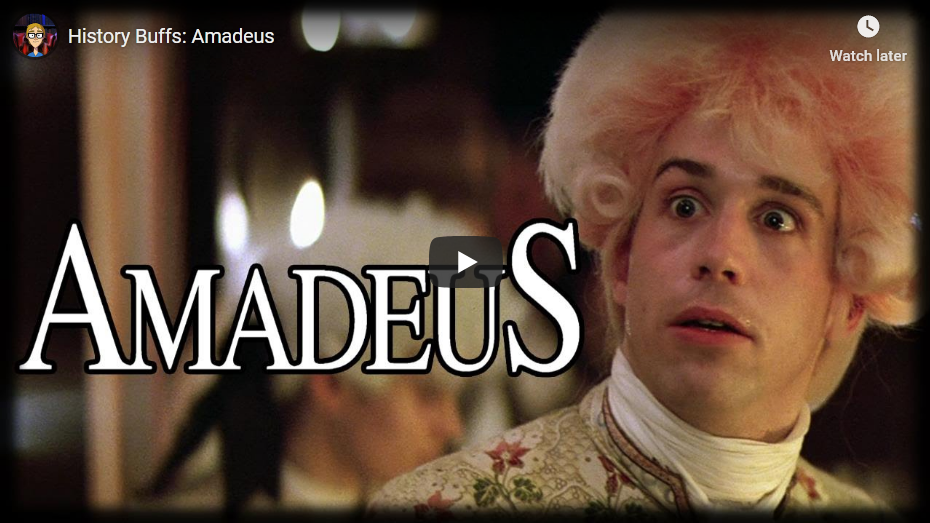
History Buffs: Amadeus
History Buffs
Published 3 Dec 2015In this episode we look at the original Rock n Roll bad boy, Wolfgang Amadeus Mozart! And who says this show isn’t classy and sophisticated đ
â Follow us on Twitter: https://twitter.com/HistoryBuffs_
________________________________________Â_________________________________
Amadeus is a 1984 American period drama film directed by MiloĆĄ Forman, written by Peter Shaffer, and adapted from Shaffer’s stage play Amadeus (1979). The story is set in Vienna, Austria, during the latter half of the 18th century.
The film was nominated for 53 awards and received 40, including eight Academy Awards (including Best Picture), four BAFTA Awards, four Golden Globes, and a Directors Guild of America (DGA) award. In 1998, the American Film Institute ranked Amadeus 53rd on its 100 Years… 100 Movies list.
The story begins in 1823 as the elderly Antonio Salieri (F. Murray Abraham) attempts suicide by slitting his throat while loudly begging forgiveness for having killed Wolfgang Amadeus Mozart (Tom Hulce) in 1791. Placed in a lunatic asylum for the act, Salieri is visited by Father Vogler (Richard Frank), a young priest who seeks to hear his confession. Salieri is sullen and uninterested but eventually warms to the priest and launches into a long “confession” about his relationship with Mozart.
“Subdivisions”
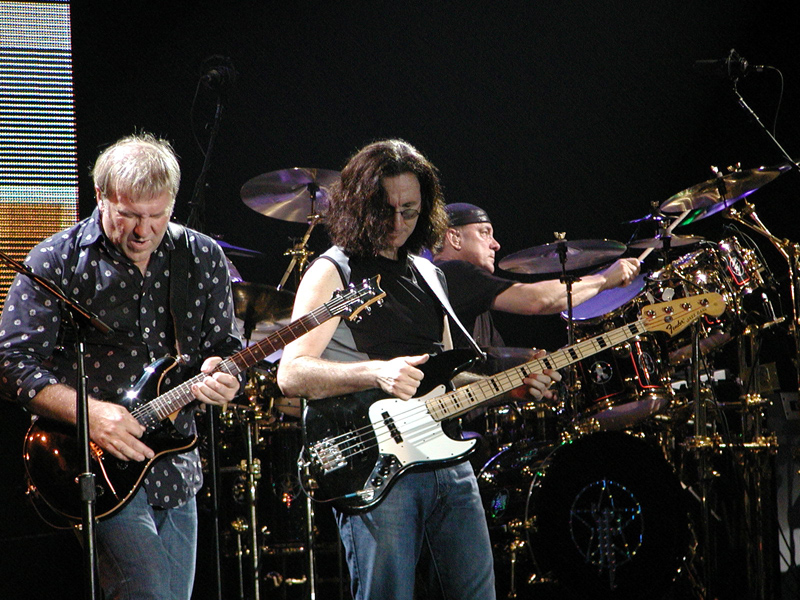
Colby Cosh on the way Rush responded to the “New Wave” on their 1982 album Signals:
Every Rush fan is presenting his own list of essential tracks this week: unexpectedly I found myself returning over and over again to “Subdivisions,” the opener from Signals (1982). No Rush song ever had a more portentous dividing effect: there are still fans who haven’t forgiven. Moving Pictures had come out in February of 1981, and its sales set up the band for life and beyond. But it was a consciously backward-looking record â the cover is a big clue â and a culmination of Rush’s original identity. Moving Pictures is an affectionate farewell to 11-minute track lengths and science-fiction song lyrics (mostly).
After just a few months came the first 51 seconds of “Subdivisions” â Rush’s own astonishing riposte to the New Wave. A lone synthesizer pulses (in 7/8) for a few seconds and then Neil comes in: no further description is possible or necessary. The passage would make a career calling card for any drummer, but what was novel was the upside-down structure of the song, with Alex Lifeson’s guitar showing up late and then carrying the rhythm (beautifully, if you take the trouble to pick him out) while the drums truly lead the way. This is rare, outside of a drum-solo setting, for any rock drummer not named Moon or Bonham.
It was as if Rush, until then a very loud group fuelled by metaphors of battle, had made a conscious decision to cool down and give the spotlight to its ultimate weapon. Very well, the start of Signals announced, this is the age of the synthesizer and we’re going along with it â but let’s see you S.O.B.s synthesize Neil Peart.
Not coincidentally, Peart’s lyrics for “Subdivisions” also took an artistic step: they shake free of the SF/fantasy tropes and the 1930s poetic conceits he had mostly hidden behind until then. Heard in 2020, the song drags the mind of the listener helplessly back to the moment when “Subdivisions” was on the radio, yet seems to have been written for us to hear now. “Some will sell their dreams for small desires,” Peart warned in a mood of cranky prophecy, “or lose the race to rats …”.
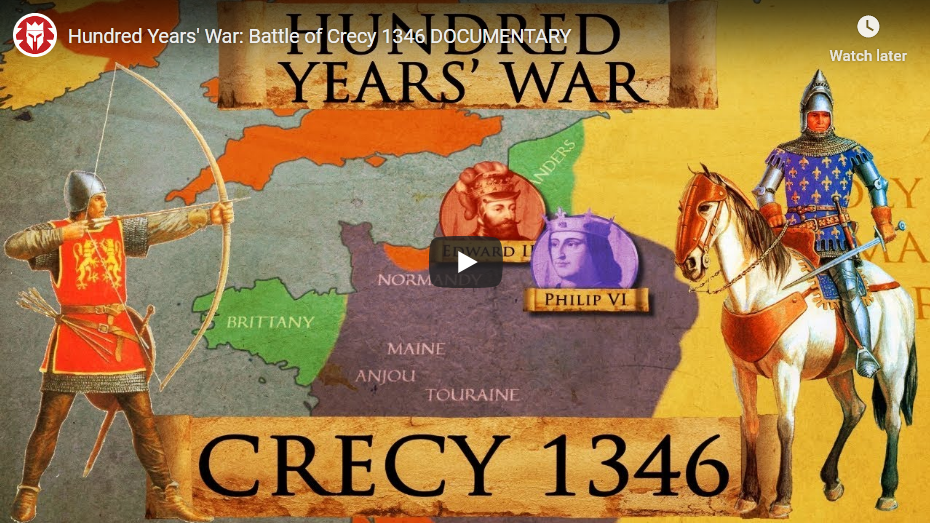
Hundred Years’ War: Battle of Crecy 1346
Kings and Generals
Published 7 December 2017The Hundred Years’ War of 1337-1453 between France and England is one of the most crucial conflicts in the history of Europe. It changed the social, political and cultural outlook of the countries involved, influenced the change in warfare, brought the end of feudalism closer. The first phase of this war is called the Edwardian War, and one of the most decisive engagements of this conflict was the battle of Crecy (1346). This series will have 5 videos, so don’t hesitate to like, subscribe and share. And if you want to support us, you can do it on Patreon: http://www.patreon.com/KingsandGenerals or Paypal: http://paypal.me/kingsandgenerals
We are grateful to our patrons, who made this video possible: Ibrahim Rahman, Koopinator, Daisho, Ćukasz Maliszewski, Nicolas Quinones, William Fluit, Juan Camilo Rodriguez, Murray Dubs, Dimitris Valurdos, FĂ©lix GagnĂ©-Dion, Fahri Dashwali, Kyle Hooton, Dan Mullen, Mohamed Thair, Pablo Aparicio MartĂnez, Iulian Margeloiu, Chet, Nick Nasad, Jeyares, Amir Eppel, Thomas Bloch, Uri Sternfeld, Juha MĂ€kelĂ€, Georgi Kirilov, Mohammad Mian, Daniel Yifrach, Brian Crane, Muramasa, Gerald Tnay, Hassan Ali, Richie Thierry, David O’Hare, Christopher Commins, Chris Glantzis, Mike, William Pugh, Stefan Dt, indy, Bashir Hammour, Mario Nickel, R.G. Ferrick, Moritz Pohlmann, Russell Breckenridge, Jared R. Parker, Kassem Omar Kassem, AmericanPatriot, Robert Arnaud, Christopher Issariotis, John Wang, Joakim Airas, Nathanial Eriksen and Joakim Airas.
This video was narrated by our good friend Officially Devin. Check out his channel for some kick-ass Let’s Plays. https://www.youtube.com/user/Official…
The Machinimas for this video is created by one more friend â Malay Archer. Check out his channel, he has some of the best Total War machinimas ever created: https://www.youtube.com/user/Mathemed…
Inspired by: BazBattles, Invicta (THFE), Epic History TV, Historia Civilis and Time Commanders
Machinimas made on the Total War: Attila engine using the great Medieval Kingdoms mod.
Production Music courtesy of Epidemic Sound: http://www.epidemicsound.com
QotD: Louis XIV and the first accurate maps of France
In our current age of apps, able to tell us exactly where we are in the world at any time, it’s hard to imagine an era in which most people would never have seen a map. The average English person of the mid-sixteenth century would have had little idea of the overall shape of their own country, let alone a foreign one. And even the merchants and elites who did have access to maps did not have an entirely accurate picture. Before the systematic adoption of trigonometric surveying, as well as the ability to accurately calculate longitude by observing Jupiter’s moons using telescopes, the process involved a lot of guesstimation. When the new techniques were introduced towards the end of the seventeenth century, the results could come as quite a shock. Louis XIV, when shown a revised map of his country, allegedly remarked that he had lost more land to his astronomers than to his enemies. France was a lot thinner than everyone had supposed.
Anton Howes, “The House of Trade”, Age of Invention, 2019-11-13.
January 14, 2020
The Desert Fox | Rommel’s FIRST Battle in the North African Campaign | BATTLESTORM
TIK
Published 17 May 2016Erwin Rommel faces the might of the British Empire. In 3D animation, we’ll see the units, the battlefield and the tactics The Desert Fox uses to overcome the British and Australian forces at Mersa Brega and throw them out of Italian Libya. Except for Tobruk of course! The video covers Erwin Rommel’s arrival in Italian Libya up to the beginning part of the Battle of Tobruk 1941.
This video is Part 2 of the Western Desert Campaign – Part 1 (Operation Compass) is in the link below
https://www.youtube.com/watch?v=b71kd…Bibliography
Battistelli, Pier Paolo. Erwin Rommel (Command). Osprey Publishing, 2010.
Beckett, Ian F. Rommel: A Reappraisal. Great Britain, 2013.
Beevor, Antony. The Second World War. Phoenix, 2014.
Bickers, Richard Townshend. The Desert Air War: 1939-1945. Endeavour Press Ltd, 2015.
Butler, Daniel Allen. Field Mashal: the Life and Death of Erwin Rommel. Casemate Publishers, 2015.
Dimbleby, Jonathan. Destiny in the Desert: The Road to El Alamein – the Battle that Turned the Tide. Great Britain, 2012.
Liddell Hart, B.H. A History of the Second World War. Pan Books, 2015.
Hastings, Max. All Hell Let Loose: The World at War 1939-1945. HarperPress, 2011.
Jorgensen, Christer. Afrika Korps: Rommelâs 1941 Offensive (Rapid Reads). Brown Bear Books, 2014.
LaFace, Major Jeffrey L. Tactical Victory Leading to Operational Failure: Rommel in North Africa. Pickle Partners Publishing, 2014.
Lyman R. The Longest Siege: Tobruk – The Battle That Saved North Africa. Pan Books, 2011.
Moorehead, Alan. The Desert War: the Classic Trilogy on the North Africa Campaign 1940-43. CPI Group, 2012.
Nash, N. Strafer Desert General: The Life and Killing of Lieutenant General WHE Gott. Pen and Sword Books Ltd, 2013.
Neillands, Robert. The Desert Rats: 7th Armoured Division 1940-45. UK, 2005.
Neillands, Robert. Eighth Army: From the Western Desert to the Alps, 1939-1945. John Murray Publishers, 2004.
Pitt, Barrie. The Crucible of War: Volume 1: Wavellâs Command. Cassell & Co, 2001.
Playfair, Major-General I.S.O. The Mediterranean and Middle East, Volume II, âThe Germans come to the help of their Allyâ (1941). The Naval & Military Press Ltd, 2004.
Raugh, H. Wavell in the Middle East 1939-1941: A Study in Generalship. USA, 2013.
Reuth, Ralf Georg. Rommel: The End of a Legend. Haus Publishing, 2005.
Thompson, Dennis H. Discarded Victory – North Africa, 1940-1941. Pickle Partners, 2014.
Williamson, Gordon. Afrikakorps 1941-43 (Elite). Osprey Publishing, 2009.
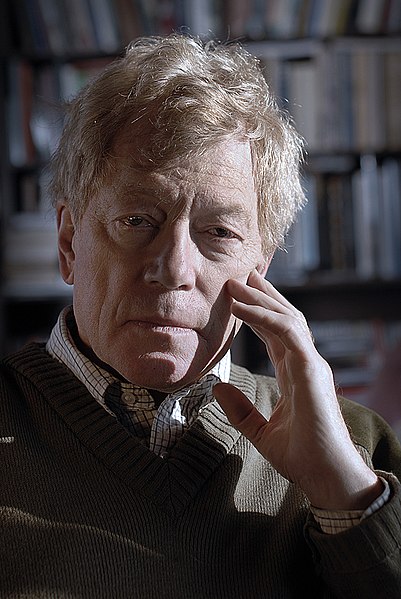
Sir Roger Scruton, RIP
Douglas Murray on the life and work of the British philosopher:
Doubtless there will be some talk in the coming days of “controversy”. Some score settling may even go on. So it is worth stressing that on the big questions of his time Roger Scruton was right. During the Cold War he faced an academic and cultural establishment that was either neutral or actively anti-Western on the big question of the day. Roger not only thought right, but acted right. Not many philosophers become men of action. But with the “underground university” that he and others set up, he did just that. During the ’70s and ’80s at considerable risk to himself he would go behind the Iron Curtain and teach philosophy to groups of knowledge-starved students. If Roger and his colleagues had been largely leftist thinkers infiltrating far-right regimes to teach Plato and Aristotle there have been multiple Hollywood movies about them by now. But none of that mattered. Public notice didn’t matter. All that mattered was to do the right thing and to keep the flame of philosophical truth burning in societies where officialdom was busily trying to snuff it out.
Having received numerous awards and accolades abroad, in 2016 he was finally given the recognition he deserved at home with the award of a Knighthood. Yet still there remained a sense that he was under-valued in his own country. It was a sense that you couldn’t help but get when you travelled abroad. I lost count of the number of countries where I might in passing mention the dire state of thought and politics in my country only to hear the response “But you have Roger Scruton”. As though that alone ought to be enough to right the tiller of any society. And in a way they were right of course. But the point did always highlight the strange disconnect between his reputation at home and abroad. Britain has never been very good with philosophers of course, a fact that Roger thought partly correct, but his own country’s treatment of him was often outrageous. As events of the last year reiterated, he might be invited onto a television or radio programme or invited to a print interview only for the interviewer to play the game of “expose the right-wing monster”. The last interview he did on the Today Programme was exactly such a moment. The BBC might have asked him about anything. They might have asked him about Immanuel Kant, or Hegel, or the correct attitude in which to approach questions of our day like the environment. But they didn’t. They wanted cheap gotchas. That is the shame of this country’s media and intellectual culture, not his.
But if there was a reason why such attempts at “gotchas” consistently failed it was because nobody could reveal a person that did not exist. course Roger could on occasion flash his ideological teeth, but he was also one of the kindest, most encouraging, thoughtful, and generous people you could ever have known. From the moment that we first met â as I was just starting out in my career â he was a constant guide as well as friend. And not just in the big things, but in the small things that often matter more when you’re setting out. Over the years I lost count of the number of people who I discovered that he had helped in a similar way without wanting anyone to notice and expecting no reward for himself.
Theodore Dalrymple describes him as “swimming always against the tide”:
He showed great moral courage throughout his career, swimming against the intellectual tide of his time regardless of the deprecation, insult, denunciation, and even hatred directed at him. For a long time, his very name among much of the British intelligentsia was a byword for political atavism or evil, as if he had been a radical advocate of tyranny and pogroms rather than a defender of freedom and civilized values. At the time of his coming to public notice, much of the intelligentsia refused to believe that a highly gifted and knowledgeable man could also be a conservative. Their own rejection of all that was traditional seemed so self-evidently right to them that they thought that the only possible explanation for someone who valued tradition was obtuseness, moral turpitude â or both.
Scruton’s work was so broad-ranging that the term Renaissance Man seems hardly inappropriate. He published books on Kant and Spinoza, on Wagner’s Tristan and Isolde, on the aesthetics of music and architecture, on animal rights, on wine, on hunting, on the importance of culture, on the nature of God, on man’s relations with animals, and on many other subjects. He wrote novels and short stories of distinction, and two operas. The words of Dr. Johnson’s epitaph for Oliver Goldsmith come to mind: he left scarcely any style of writing untouched, and touched nothing that he did not adorn.
This is not to say that many people, or indeed anyone, would agree with all that he wrote, scarcely to be expected in view of his immense output. He accepted disagreement with equanimity, as the natural and laudable condition and consequence of freedom. Unlike many of his detractors, who affixed labels to him and then believed in their veracity, he was fair-minded to those with whom he disagreed and whose ideas he believed had had a disastrous effect on Western society. In the two editions of his book about thinkers of the New Left, for example, he praised them generously for whatever he considered praiseworthy in them. He paid them the honor of reading their work with attention, trying hard to decipher what it meant (by no means easy, given their frequent resort to high-sounding, multisyllabic verbiage), and refuting what was sufficiently intelligible to be refutable.
Cursus honorum – Quaestors
Historia Civilis
Published 20 Dec 2014Patreon: https://www.patreon.com/HistoriaCivilis
Website: https://www.historiacivilis.com
Twitter: https://twitter.com/HistoriaCivilisMusic by audionautix.com
QotD: Drinking in Upper Canada
As in England, Canadian inns sprang up along coaching routes. Horses and passengers needed rest and refreshment, and before long there was no shortage of places offering such services. By the time the traveller up Yonge Street got to Holland Landing, he could be in quite a state. Given that tavern-keepers usually treated coach drivers to free drinks in return for bringing passengers their way, the driver might be in even worse shape.
Nor was the early Canadian drinker certain of what was in his drink. McBurney and Byers offer a few recipes of the day. Wisely they note: “These old recipes are presented for interest only; they should not be used.” I’ll say. Their recipe for port calls for 28 gallons of cider, 9 gallons of whiskey, 15 pounds of white sugar, as well as cinnamon, cloves, orange peel, ground cochineal, carbonate of potash, and — if necessary — two ounces of ground alum. I don’t think that’s the way they make it in Portugal. There are no grapes, for starters. I’m trying to imagine how I’d feel the next day. Now I’m trying to stop imagining how I’d feel the next day.
Nicholas Pashley, Notes on a Beermat: Drinking and Why It’s Necessary, 2001.
January 13, 2020
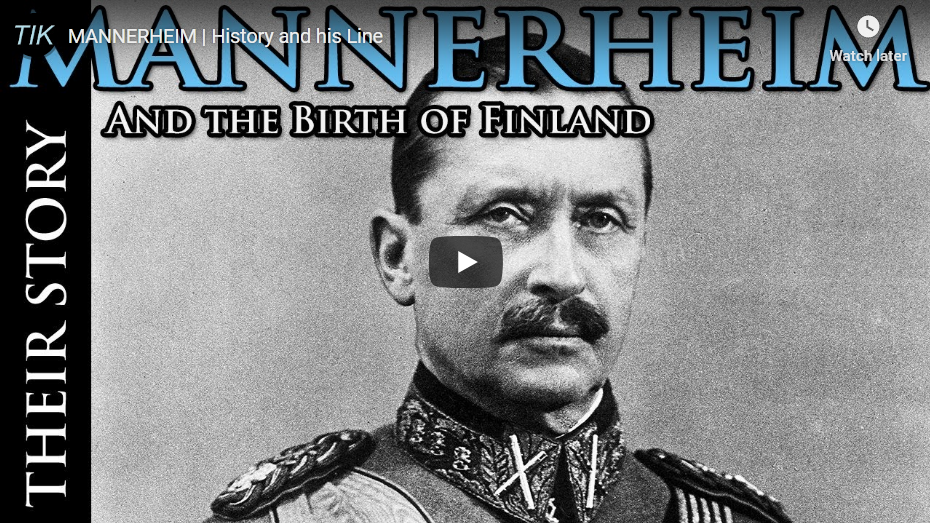
MANNERHEIM | History and his Line
TIK
Published 22 Jun 2017Carl Gustav Emil Mannerheim towers over all other characters of the Winter War, and of Finnish history in general. This video is a brief introduction to one of the great leaders of the 20th Century (and according to a TV poll in 2004, the greatest Finn of all time). Full script is available as captions/subtitles, and the source I used for this video is –
Trotter, W. The Winter War: The Russo-Finnish War of 1939-40. Aurum Press Ltd, 2003.
If you’d like to help me make these videos, consider supporting me on Patreon https://www.patreon.com/TIKhistory
The Nika riots in Constantinople (with bonus NASCAR analogies)
Not only does Tamara Keel provide interesting and informative gun information, she also has at least a vague interest in late Classical/early Medieval history:

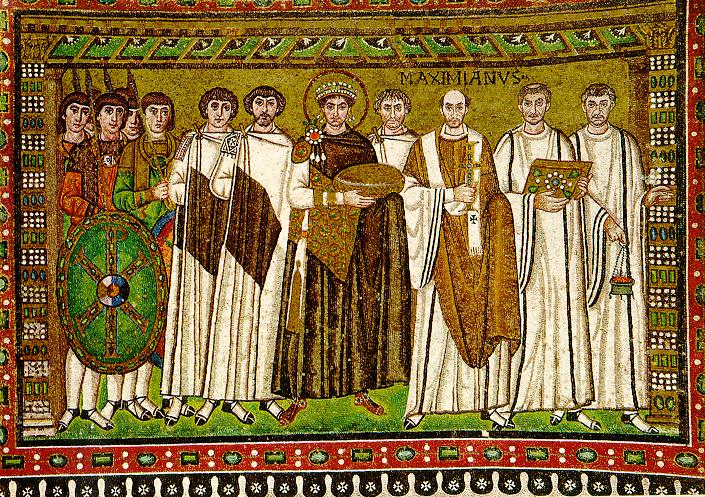
Court of Emperor Justinian with (right) archbishop Maximian and (left) court officials and Praetorian Guards; Basilica of San Vitale in Ravenna, Italy. The bearded man to Justinian’s right is believed to be Belisarius. (via Wikimedia)
The center of social life in Constantinople was the Hippodrome, a massive stadium where chariot races were held. Chariot racing was wildly popular with all strata of society, and everybody was a fan of one team or another; the Blues, the Greens, the Whites, and the Reds. Although as time went on, hardly anybody paid attention to anybody other than the Blues and the Greens. Kinda like Dale Jr. fans and Jeff Gordon fans and who cares about Kurt Busch anymore ’cause he’s a tool.
So, everybody who was anybody was a fan of the Blues or the Greens. You only hung out with fellow Dale fans, all the Jeff Gordon fans voted the same way, you beat the crap out of rival fans in bar fights when you could. Trouble really erupted, however, when some popular ringleaders from each faction were imprisoned on murder raps after a bit of friendly head-busting got out of hand after a contested race.
Dale fans and Jeff Gordon fans united and went wild in the streets, burning and looting and actually laying siege to the palace in a mob scene. The emperor Justinian (via someone expendable, no doubt) announced his willingness to accede to their demands, even to the point of agreeing to abdicate in favor of their choice for a new ruler. Fortunately for Justinian, his wife Theodora and a senior eunuch in the palace bureaucracy named Narses had the stones the emperor lacked. They put their heads together with Belisarius and Mundus, two great Byzantine generals, and hatched a plan.
As the tens of thousands of rioters thronged in the vast Hippodrome, waiting for the new emperor’s coronation, Belisarius and his bodyguard of no more than a couple hundred steppe archers took the passageway under the street from the palace to the imperial box in the stadium. With the crowd focused on the impending ceremony, nobody noticed the archers fanning out in the skybox until they started volleying into the crowd. Panic ensued and, leaving a litter of 24 flags and 88 mesh-back ball caps and shot-up, trampled bodies, the crowd stampeded for the big main gates off the racetrack.
Unfortunately, Mundus and his bodyguard were drawn up in ranks blocking the exit, and they opened fire into the front rows of the fleeing mob. Needless to say, when all was said and done, the backbone of the rioters was broken. Thousands had been shot, and many thousands more were crushed in the press. Justinian held onto his crown, no thanks to his own dithering.
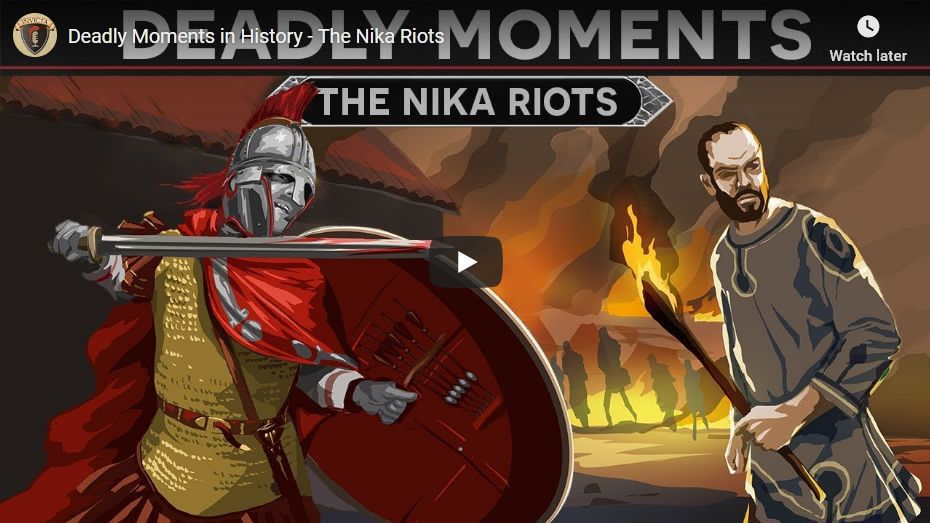
Deadly Moments in History – The Nika Riots
Invicta
Published 27 Feb 2018We relive the deadly Nika Riots which brought the Emperor Justinian to his knees and resulted in the death of 30,000 civilians. In our journey we will explore the history of chariot racing, the undercurrents of dissent, and the blow by blow unfolding of the riot.
Support future documentaries: https://www.patreon.com/InvictaHistory
Twitter: https://twitter.com/InvictaHistoryDocumentary Credits:
Research: Invicta and Luas McCahill
Script: Invicta
Artwork: Robbie McSweeney
Editing: Invicta
Music: Total War Soundtrack, Dreamnote, RecognitionLiterary Sources
–History of the Wars, I by Procopius
–Empress Theodora by J. A. S. Evans
–Justinian: The Last Roman Emperor by G. P. Baker
QotD: Early civilizations and the barbarians
The book [Against The Grain] ends with a chapter on “barbarians”. Scott reminds us that until about 1600, the majority of human population lived outside state control; histories that focus on states and forget barbarians are forgetting about most humans alive. In keeping with his thesis, Scott reviews some ancient sources that talk about barbarians in the context of people who did not farm or eat grain. Also in keeping with his thesis, he warns against thinking of barbarians as somehow worse or more primitive. Many barbarians were former state citizens who had escaped state control to a freer and happier lifestyle. Barbarian tribes could control vast trading empires, form complex confederations, and enter in various symbiotic relationships with the states around them. Scott wants us to think of these not as primitive people vs. advanced people, but as two different interacting lifestyles, of which the barbarian one was superior for most people up until a few centuries ago.
Scott Alexander, “Book Review: Against The Grain“, Slate Star Codex, 2019-10-15.
January 12, 2020
The shoot-down of Flight 752
Colby Cosh discusses the destruction of Ukraine International 752 in the historical context of the Vincennes incident (later on Friday, the Iranian official position appears to have shifted to accepting responsibility for an accidental missile launch):

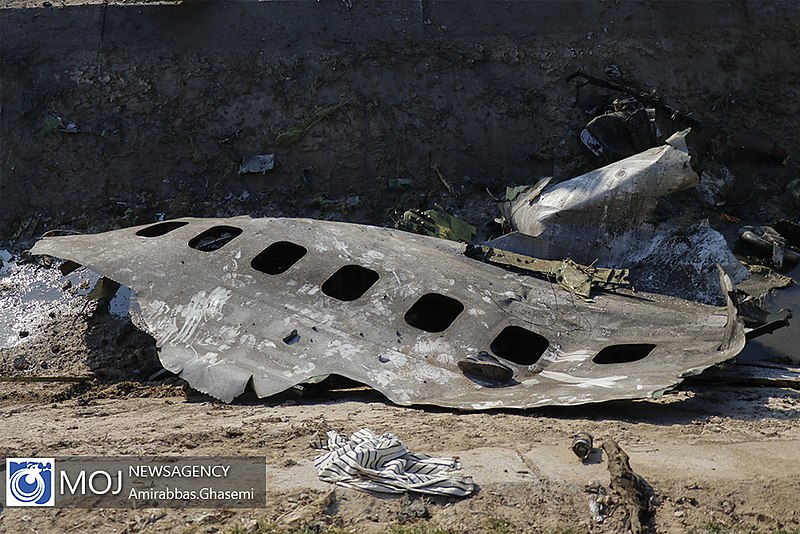
Some of the wreckage of Ukraine International flight 752 near Tehran, Iran.
Photo from MOJ Newsagency via Wikimedia Commons.
It has become fairly obvious, whatever the Iranian authorities may say now or later, that Ukraine International Airlines Flight 752 was shot down after departing Tehran. This was, in truth, overwhelmingly probable the moment the news broke, but there was still widespread shock and disbelief on Thursday when several Western heads of government announced signal-intelligence evidence of a missile strike. There are still “How could such a thing happen?” reactions pouring forth â mostly from people who are old enough, in theory, to recall the USS Vincennes accidentally shooting down an Iran Air Airbus A300 in 1988.
I say “in theory,” but the truth is that popular memory of the Vincennes incident has been much diminished â outside Iran â by later events in the region. This must qualify as one of the good Lord’s most sadistic jests. The United States wasn’t officially at war with anyone in the region at the moment when its best-trained sailors, equipped with scorchingly new and uncannily powerful missile and battlespace-mapping technology, blew up a commercial airliner full of religious pilgrims.
The Navy was in the Gulf not to fight or oppose anybody in particular, but to protect neutral shipping from the Iran-Iraq War. Up to the time of the accident, it was Iraq that demonstrably presented the greater danger to American warships. Ronald Reagan was still president. The First Gulf War wouldn’t kick off until 1990.
In other words: we forgot. The memory of Vincennes was overwritten by a generation of Middle East conflict, like an old computer file.
Which leaves a paradox. Liberals who regard recent U.S. history as one enormous, indistinguishable mass of bloodthirsty actions don’t seem especially aware of one of the most horrifying tactical blunders in American military history. What’s one jet plane more or less in the black ledger of imperialism? Conservatives, meanwhile, are racing to accuse Iran of “murder” in the case of Flight 752.
Blunders can be worse than crimes, according to one of the most famous of all military maxims. But if one points out that Iran’s “murder” of innocents is starting to look like a nightmarish replay of Vincennes, one risks being accused of postulating “moral equivalence” between the United States and Iran.