Quotulatiousness

January 12, 2020

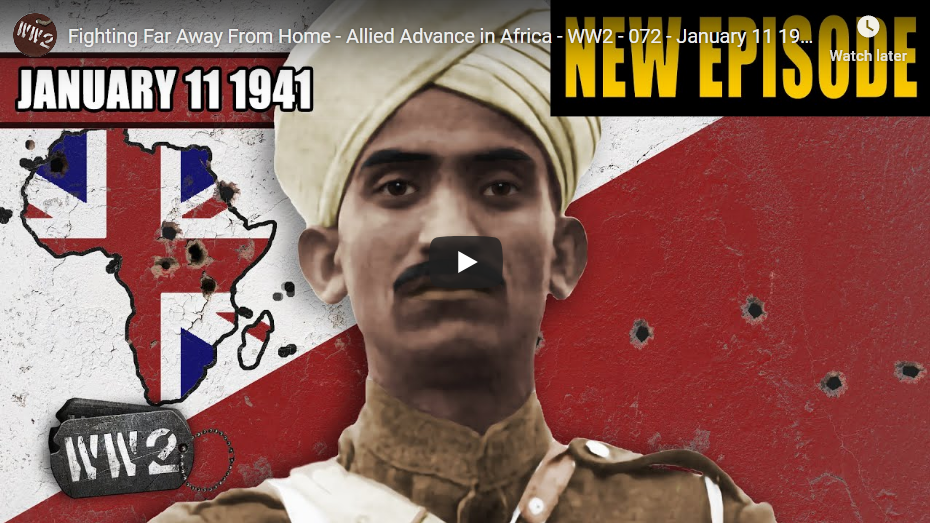
Fighting Far Away From Home – Allied Advance in Africa – WW2 – 072 – January 11 1941

Filed under: Africa, Britain, China, Europe, Greece, History, Italy, Military, WW2 — Tags: , , , , , — Nicholas @ 04:00

World War Two
Published 11 Jan 2020

Action in Albania. Action in North-Africa. Action in East-Africa. Action in China and action on the Mediterranean. It looks like every belligerent party is amping up its efforts to get a foothold wherever they are. And if your enemy is gaining ground? You just throw more material and men at them.

Join us on Patreon: https://www.patreon.com/TimeGhostHistory
Or join The TimeGhost Army directly at: https://timeghost.tv

Follow WW2 day by day on Instagram @World_war_two_realtime https://www.instagram.com/world_war_t…
Join our Discord Server: https://discord.gg/D6D2aYN.
Between 2 Wars: https://www.youtube.com/playlist?list…
Source list: http://bit.ly/WW2sources

Written and Hosted by: Indy Neidell
Produced and Directed by: Spartacus Olsson and Astrid Deinhard
Executive Producers: Bodo Rittenauer, Astrid Deinhard, Indy Neidell, Spartacus Olsson
Creative Producer: Joram Appel
Post-Production Director: Wieke Kapteijns
Research by: Indy Neidell
Edited by: Daniel Weiss
Map animations: Eastory (https://www.youtube.com/c/eastory)

Colorizations by:
– Dememorabilia – https://www.instagram.com/dememorabilia/
– Julius Jääskeläinen – https://www.facebook.com/JJcolorization/

Sources:
IWM (A 4161), (E 872), (A 4162), (A 9793), (A 13509).
Division Coat of Arms by Noclador
oil barrel by BomSymbols from the Noun Project
can by Anniken & Andreas from the Noun Project

Soundtracks from Epidemic Sound:
– “Arriving in Ancient Rome” – Kikoru
– “Easy Target” – Rannar Sillard
– “Split Decision” – Rannar Sillard
– “Road To Tibet 5” – Rannar Sillard
– “Death And Glory 1” – Johannes Bornlöf
– “The Inspector 4” – Johannes Bornlöf
– “Not Safe Yet” – Gunnar Johnsen

Archive by Screenocean/Reuters https://www.screenocean.com.

A TimeGhost chronological documentary produced by OnLion Entertainment GmbH.

From the comments:

World War Two
3 days ago (edited)
It looks like all fronts are heating up this week. And that the German reaction to the British offensive in North-Africa and the Greek progress in Albania is to move more German troops southward. This week already shows how that potentially threatens Britains position in the Mediterranean. Well, just like the British and Germans, we hope to increase our manpower in 1941. Do your part and expand our community of loyal supporters and history buffs by joining the TimeGhost Army on https://www.patreon.com/timeghosthistory and https://timeghost.tv. The war effort needs you!
Cheers, Joram

Neil Peart, RIP

Filed under: Cancon, Liberty, Media — Tags: , , , , , — Nicholas @ 03:00

I was very saddened to see the news, but it explains why the band retired:

Rush in concert, Milan 2004.
Photo by Enrico Frangi, via Wikimedia Commons

Neil Peart, the virtuoso drummer and lyricist for Rush, died Tuesday, January 7th, in Santa Monica, California, at age 67, according to Elliot Mintz, a family spokesperson. The cause was brain cancer, which Peart had been quietly battling for three-and-a-half years. A representative for the band confirmed the news to Rolling Stone.

Peart was one of rock’s greatest drummers, with a flamboyant yet precise style that paid homage to his hero, the Who’s Keith Moon, while expanding the technical and imaginative possibilities of his instrument. He joined singer-bassist Geddy Lee and guitarist Alex Lifeson in Rush in 1974, and his musicianship and literate, philosophical lyrics — which initially drew on Ayn Rand and science fiction, and later became more personal and emotive — helped make the trio one of the classic-rock era’s essential bands. His drum fills on songs like “Tom Sawyer” were pop hooks in their own right, each one an indelible mini-composition; his lengthy drum solos, carefully constructed and packed with drama, were highlights of every Rush concert.

In a statement released Friday afternoon, Lee and Lifeson called Peart their “friend, soul brother and bandmate over 45 years,” and said he had been “incredibly brave” in his battle with glioblastoma, an aggressive form of brain cancer. “We ask that friends, fans, and media alike understandably respect the family’s need for privacy and peace at this extremely painful and difficult time,” Lee and Lifeson wrote. “Those wishing to express their condolences can choose a cancer research group or charity of their choice and make a donation in Neil Peart’s name. Rest in peace, brother.”

A rigorous autodidact, Peart was also the author of numerous books, beginning with 1996’s The Masked Rider: Cycling in West Africa, which chronicled a 1988 bicycle tour in Cameroon — in that memoir, he recalled an impromptu hand-drum performance that drew an entire village to watch.

Peart never stopped believing in the possibilities of rock (“a gift beyond price,” he called it in Rush’s 1980 track “The Spirit of Radio”) and despised what he saw as over-commercialization of the music industry and dumbed-down artists he saw as “panderers.” “It’s about being your own hero,” he told Rolling Stone in 2015. “I set out to never betray the values that 16-year-old had, to never sell out, to never bow to the man. A compromise is what I can never accept.”

Update: At AIER Peter C. Earle pays tribute to Peart’s life and work.

The announcement of the death of Rush drummer Neil Peart came as a tremendous shock. Having only retired about four years ago, so many fans of Rush (myself included) had convinced ourselves that this was a temporary hiatus, and that in a year or two – eventually, at any rate – there would be an announcement of a new album, a short tour, or some other project. Surely musicians of their virtuosity and passion couldn’t stay away from the studio or stage for long. But now we know we were wrong, and we know why.

It was revealed that Neil had been battling a brain tumor for over three years. Characteristically, he, his family, and friends (among the closest of whom, Rush vocalist/bass player Geddy Lee and guitarist Alex Lifeson) upheld his desire for privacy. I haven’t done the math as to whether Neil’s illness was likely a causative factor in the decision to retire, or whether it seems to have come along not long after the decision to retire.

[…]

In his role as the lyricist of Rush, Peart took on such topics as pernicious nationalism (“Territories”), mass hysteria (“Witch Hunt”), the division between constructive and destructive belief (“Faithless”), the fall of Communism (“Heresy”), conflict and power (“The Trees”), the horrors of totalitarian rule (“2112,” “Red Sector A”) and many allusions to individual liberty (“Tom Sawyer,” “Anthem,” “The Analog Kid,” “Finding My Way,” “Caravan”). He did so via lyrics which artfully and passionately evinced those sentiments; sentiments which early on suggested Objectivist perspectives, but over time developed into what he called “Bleeding Heart” libertarianism:

    I call myself a bleeding heart libertarian. Because I do believe in the principles of Libertarianism as an ideal – because I’m an idealist. Paul Theroux’s definition of a cynic is a disappointed idealist. So as you go through past your twenties, your idealism is going to be disappointed many many times. And so, I’ve brought my view and also – I’ve just realized this – Libertarianism as I understood it was very good and pure and we’re all going to be successful and generous to the less fortunate and it was, to me, not dark or cynical. But then I soon saw, of course, the way that it gets twisted by the flaws of humanity. And that’s when I evolve now into … a bleeding heart Libertarian. That’ll do.

Neil, through his lyrics, managed to do what so many lyricists and writers – even, perhaps especially, so many libertarian intellectuals – fail to do: make liberty neither an alien fixture, a flat slogan, or a utopian slog. It is a way of thinking and living, and one which not only doesn’t ignore, but embraces the flaws and frailty of humanity, tempering realism with hope and optimism.

Three Variations of Party Leader PPK Pistols

Filed under: Germany, History, Weapons, WW2 — Tags: , , , — Nicholas @ 02:00

Forgotten Weapons
Published 25 Oct 2019

Note: I goofed on a detail here; “DRGM” is a trademark designation, not something related to the party. Sorry!

http://www.patreon.com/ForgottenWeapons

Cool Forgotten Weapons merch! http://shop.bbtv.com/collections/forg…

Today, courtesy of Tom from Legacy Collectibles, we are taking a look at “party leader” PPK pistols. There are three different versions of these, and we will look at all of them in sequence. They are highly valued in the collecting community, and also extremely easy to fake, making authentication quite difficult. I will give you as much information as I can to assist in this, and Tom is happy to help (free of charge) as well.

To see more about Legacy, check out their YouTube channel:

https://www.youtube.com/channel/UCesj…

Contact:
Forgotten Weapons
6281 N. Oracle #36270
Tucson, AZ 85704

QotD: Progressive snobbery is part of the kink

Filed under: Government, Media, Politics, Quotations, USA — Tags: , , , , , — Nicholas @ 01:00

Do they really hate ordinary people that much?

Yes, they do. For liberals, the distinction between the “dumb masses” and their enlightened selves renders life meaningful. Disdain for ordinary folks is not just an ancillary trait of liberalism. It is fundamental to the its nature.

At its heart, liberalism is a gnostic religion, and the essence of that religion is the believer’s faith that he possesses the means of changing the world for the better. The belief that the world must be changed requires there to be a mass of individuals whose lives are in need of change. Following this logic, it is the liberal, not those deplorables in need of change, who knows what must be changed. For liberals, there must be a mass of people in need of this knowledge for life to make sense.

Above all, liberalism is a hubristic faith. Its followers share the fatal flaw of pride in their own intellectual capacity. This is why liberalism appeals so strongly to those in the knowledge trades: teachers, journalists, writers, psychologists, and social workers. The sense of “knowing more than others” is its strongest attraction – particularly to the young, who otherwise know so little. Liberalism confers, or seems to confer, almost immediate power and authority to those who embrace it.

The left’s obsession with superior knowledge runs through its entire history. As Woodrow Wilson remarked, the “instrument” of political science “is insight. A nice understanding of subtle, unformulated conditions.” Lyndon B. Johnson thought “a president’s hardest task” is “to know what is right.” And the most hubristic of all is Obama’s “We are the ones we’ve been waiting for.” Yes, we are wonderfully bright, and we’ve been waiting eons for ourselves to appear.

Jeffrey Folks, “Leftists versus the People”, American Thinker, 2018-02-24.

January 11, 2020

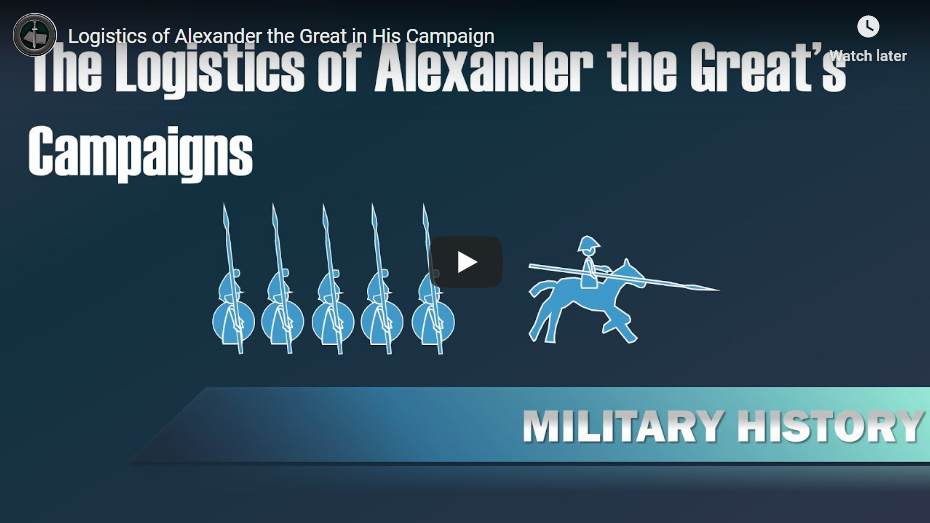
Logistics of Alexander the Great in His Campaign

Filed under: History, Middle East, Military — Tags: , , , , — Nicholas @ 06:00

Military History Visualized
Published 11 Jan 2016

Patreon: https://www.patreon.com/join/mhv

Alexander the Great is well known for his tactics on the battlefield. Some aspect that is often forgotten is that victory on the battlefield requires well supplied troops. This is especially true, because Alexander’s conquest covered a vast area.

See the YouTube description for a lengthy sources list.

What does a former royal do?

Filed under: Britain, Government, Media — Tags: — Nicholas @ 05:00

At UnHerd, Douglas Murray discusses membership in the (extended) royal family as a “predicament”:

The royal family at Buckingham Palace for the Trooping of the Colour 2010, 30 June, 2015.
Photo by Robert Payne via Wikimedia Commons.

There is a line in Alan Bennett’s play The Madness of George III which is so good that the makers of The Crown lifted it — without attribution — in their most recent season. The heir to the throne, waiting for Parliament to declare him regent, says that to be Prince of Wales is not a position: “It is a predicament.”

Whether or not that is the case for the current Prince of Wales, it is certainly true for the Sussexes, who have just announced that they are going to step back from public duties in order to become “financially independent”.

Even the most devout republican will recognise that there is something worse than the now-defunct Civil List; something undisguisably worse than members of the Royal Family receiving public subsidy. It is the predicament of Royal privilege.

Such is the cruelty of public life, that people born into a position of undeniable privilege are rewarded — or revenged — by being placed into an impossible situation. If a prince or princess is carrying out public duties, but also having the occasional moment of private enjoyment, they will be lambasted by the press for freeloading and gallivanting on the public’s dime. If they decide to relieve the strains on the public coffers by accepting the largesse of some wealthy individuals, then the same press will attack said royal for freeloading on someone else’s dime, and being caught up with sleazy or shallow celebrity characters.

There is a way out, of course, one demonstrated by Her Majesty the Queen throughout her public life, which has been to doggedly and dutifully carry out an unceasing round of obligations for so many years that in her tenth decade of service, no reasonable person could begrudge her the occasional day off.

But the head of the family is at an advantage. That role is well defined. It is the other royals — especially the “minor royals” — who find themselves in the worst situation. True, there are people — almost everybody else on earth if it comes to that — who are in a materially worse position. But in terms of being born into a difficult role, being born a non-monarch in the royal family must count as among the most impossible to carry out.

In the 1990s, when the Civil List was whittled down, we were given an inkling of how the Sussex situation might play out. Members of the Royal Family, such as the Michaels of Kent, were suddenly expected to strike out on their own; forced to sell their home while the press enjoyed ogling at their embarrassment. When the Michaels had an attic sale, they were attacked for cheapening themselves and the Royal Family by auctioning their possessions. They then attempted to make money through various forms of consultancy and authorship, but every way they turned they were accused of using their position to “cash in”. What else were they to do, though? What other commodity — other than royalty — did they have?

Card Scraper Sharpening | Paul Sellers

Filed under: Tools, Woodworking — Tags: , , — Nicholas @ 04:00

Paul Sellers
Published 9 Jan 2020

The card scraper is the least complex of all woodworking tools in that it comprises a single piece of plate steel with a highly refined cutting edge.

Throughout history, this tool has refined even the very wildest grain to the ultimate pinnacle of refinement levels. In this video, Paul demonstrates how to sharpen this incredibly versatile tool.
——————–

Want to learn more about woodworking?

Go to Woodworking Masterclasses for weekly project episodes: http://bit.ly/2JeH3a9

Go to Common Woodworking for step-by-step beginner guides and courses: http://bit.ly/35VQV2o

http://bit.ly/2BXmuei for Paul’s latest ventures on his blog

——————–

Instagram: http://bit.ly/2oWpy7W

Twitter- http://bit.ly/33S7RFa

Pinterest- http://bit.ly/35X5uTf

The bubbly 1720s

Filed under: Americas, Britain, Business, Economics, France, Government, History — Tags: , , , , , — Nicholas @ 03:00

In the latest Age of Invention newsletter, Anton Howes looks at Britain’s volatile financial scene in the 1720s:

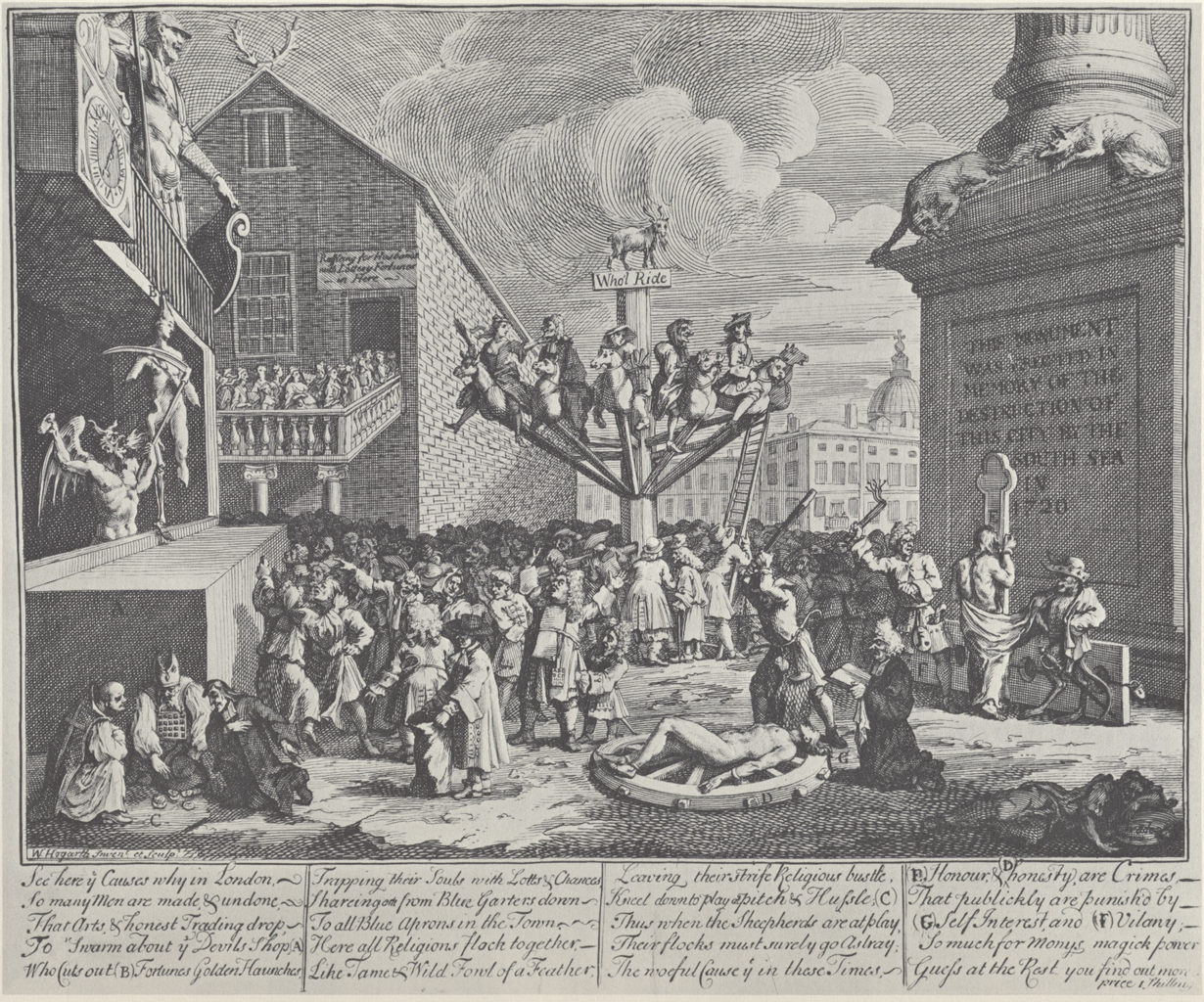
William Hogarth – The South Sea Scheme, 1721. In the bottom left corner are Protestant, Catholic, and Jewish figures gambling, while in the middle there is a huge machine, like a merry-go-round, which people are boarding. At the top is a goat, written below which is “Who’l Ride”. The people are scattered around the picture with a sense of disorder, while the progress of the well-dressed people towards the ride in the middle represents the foolishness of the crowd in buying stock in the South Sea Company, which spent more time issuing stock than anything else.
Scanned from The genius of William Hogarth or Hogarth’s Graphical Works via Wikimedia Commons.

Over in France, a Scottish banker named John Law had in the late 1710s overseen an ambitious scheme to reorganise the government’s finances. He ran the Mississippi Company, one of the many companies with monopolies on France’s international trade. His scheme was for the company to acquire all of the other similar monopolies, so that it could have a monopoly on all of the country’s intercontinental trade routes. By 1719, the Mississippi Company had swelled into a Company of the Indies, which in turn had purchased the right to collect French taxes, from which it took took its own cut. In exchange for acquiring these monopolies, Law’s new super-monopoly would buy up the French government’s accumulated war debts, allowing repayment on more generous terms. By allowing the state to borrow more cheaply, the scheme was to be a key plank in improving French military might.

Meanwhile, in Britain, a very similar project was afoot. Following the War of the Spanish Succession, one of the things Britain won from France was the asiento – the monopoly on supplying African slaves to Spain’s colonies in America. The asiento was given to the South Sea Company, which had the monopoly on British trade with South America, and which in 1720 began to follow a scheme similar to Law’s. Given developments in France, it would not do for the British state to be left behind in terms of its capacity to take on more debt for war. Thus, with political support, the South Sea Company began to buy up the government’s debt, persuading its creditors to exchange that debt for increasingly valuable company shares.

In 1720, both schemes came crashing down. In the case of Law’s scheme, he had printed paper currency with which people could buy his company’s shares, but in 1720 discovered he had printed too much. When he prudently tried to devalue the company’s shares to match the quantity of paper notes, the devaluation spun out of control. In the case of the South Sea Company, the causes of the crash were a little more mysterious, perhaps even verging on the mundane. One explanation is that too many wealthy investors simply tried to sell their shares so that they would have ready cash to spend on holidaying in Europe, precipitating a minor fall in the share price which then led to a more widespread panic. Regardless, it did not end well. The company itself continued for many years thereafter — it even got involved with whaling off the coast of Greenland — but the collapse of its share price ended its chance to restructure the government’s debts.

Feature History – Emu War

Filed under: Australia, History, Military — Tags: , , — Nicholas @ 02:00

Feature History
Published 25 Jan 2017

Hello and welcome to a Feature History special; featuring the Emu Wars, the incompetence of my own country, and my miserable attempt at doing the accent I should have.

Patreon
https://www.patreon.com/FeatureHistory
Twitter
https://twitter.com/Feature_History
———————————————————————————————————–
The credit for this video goes to Feature History’s employee of the month, me, for the art, animation, script, voice-over.
Music
Kevin MacLeod – “Drankin’ Song”
Kevin MacLeod – “Bama Country”

QotD: “Don’t ask, don’t tell”

Filed under: Government, History, Military, Politics, Quotations, USA — Tags: , , , , , , — Nicholas @ 01:00

As all right-thinking people know, Don’t Ask, Don’t Tell was a right-wing atrocity against gays, hatched in the pernicious seventy-two degree corners of the doubleplusungood and evilwickedbadnaughty Pentagon, fought against nearly to the death by progressives …

That’s not remotely what happened. Rather, the Uniform Code of Military Justice, as enacted by Congress, has long deemed Sodomy, which covered more than just homosexual conduct, as a criminal offense potentially carrying severe penalties. Moreover, the procedure for entering into service demanded that prospective recruits deny or admit to homosexual leanings, in writing, which admissions would usually bar the man or woman from service. Of course, back when the shame of being publicly homosexual was very great, people who wanted to join the armed forces simply lied about it and then, as a general rule, hid it while in service.

Liberal Democratic President Bill Clinton, acting in his capacity as Commander in Chief of the armed forces, simply ordered that prospective recruits were not to be asked if they were gay or had homosexual leanings, and were not to volunteer the information. That, young Millennial, is where DADT came from; it came from a liberal, liberally motivated, and pandering to his liberal base.

Did you know that? No? Well, then; ask yourself, WHY didn’t you know?

What the loss of history does to you, dear Millennial, is that it robs you of the ability to reason your way to cause and effect. Never mind the crappy to the point of idiotic decisions and programs this might lead you to support, consider what it does to you as a person. What, after all, is the effect of shielding people from contrary opinions by designating and maintaining, under color of law or regulation, “safe spaces” for this or that minority? Does it make them stronger? Better able to deal with a harsh world? Does it change that objective world to something less harsh? No and no and no; it does none of that. Do you gain grit in a safe space? Ha. Do you learn endurance in a safe space? Oh, please.

Tom Kratman, “It’s Up to You, Millennials. Deflect or Be Doomed”, Milo, 2017-12-06.

January 10, 2020

One more Scramble in Africa – The Second Italo-Abyssinian War | BETWEEN 2 WARS I 1935 Part 4 of 4

Filed under: Africa, Europe, History, Italy, Military — Tags: , , , , — Nicholas @ 06:00

TimeGhost History
Published 9 Jan 2020

After European Empires were done scrambling for Africa, not much of the African continent was left to be ruled by its native people, or to be colonised for other colony-hungry European powers. However, the Kingdom of Abyssinia is one of the countries that made it through the scramble alive. That is, until Benito Mussolini shifts the Italian focus to East-Africa once more.

Join us on Patreon: https://www.patreon.com/TimeGhostHistory

Hosted by: Indy Neidell
Written by: Joram Appel, Spartacus Olsson and Naman Habtom
Directed by: Spartacus Olsson and Astrid Deinhard
Executive Producers: Bodo Rittenauer, Astrid Deinhard, Indy Neidell, Spartacus Olsson
Creative Producer: Joram Appel
Post-Production Director: Wieke Kapteijns
Research by: Naman Habtom
Edited by: Daniel Weiss
Sound design: Marek Kaminski

Sources:
Diploma by Alena from the Noun Project
Teacher by b farias from the Noun Project
guns by Cards Against Humanity from the Noun Project
Curved path by Allie Tate from the Noun Project
Labor Day by H Alberto Gongora from the Noun Project
train tracks by Prasad from the Noun Project

Colorizations by:
– Dememorabilia – https://www.instagram.com/dememorabilia/
– Julius Jääskeläinen – https://www.facebook.com/JJcolorization/

A TimeGhost chronological documentary produced by OnLion Entertainment GmbH.

Brendan O’Neill on “Megxit”

Filed under: Britain, Media — Tags: , , , — Nicholas @ 05:00

He calls the Duchess a “woke Wallis Simpson”:

Prince Harry and Meghan Markle visit Titanic Belfast in March 2018.
Photo from the Northern Ireland Office via Wikimedia Commons.

So Harry and Meghan are stepping back. They’re resigning from The Firm. They’re ducking out of the Sovereign Grant and royal duties and going it alone. They’re going to split their time between the UK and North America – think of all the CO2! – and become more “independent”.

Why? Come on, we all know why. Forget the tripe about them fleeing the racism of the UK tabloids and the nonsense about the first DOC (duchess of colour) not being made to feel welcome in the stiff, white House of Windsor. No, H&M, the most right-on royals in history, are breaking off so that they can foist even more woke bollocks on the plebs without having to worry about receiving a tutting phone-call from Her Maj’s press secretary reminding them that they’re royalty and not virtue-signalling Hollywood celebs.

Megxit, as this royal bombshell is wittily being called, is a striking sign of the times. What Harry and Meghan are doing is virtually unprecedented in the history of the royals. They are jacking in their jobs (I say jobs) as senior royals and pursuing a more “financially independent” path that will allow them to earn, travel and – this is important – jabber on about their pet concerns and causes as much as they like.

Even leaving aside the fact that they won’t actually be financially independent – they’ll still get wads of cash from the Duchy of Cornwall and will still stay in that Frogmore Cottage us British taxpayers just splashed 2.4million quid on – still their move is a startling and concerning one.

What it fundamentally reveals is the incompatibility of the modern culture of narcissism with the values of duty, loyalty and self-negation traditionally associated with royal life. To someone like Meghan, who sprang from celebville, who sees herself as the embodiment of right-on goodness, and who loves nothing more than advertising her eco-virtue and performing her PC credentials, life in the British monarchy was never going to be a good fit.

Yes, the woke agenda Meghan expresses so well shares much in common with the old-world elitism of the monarchical system. Both obsess over inherited characteristics (the woke bang on about race and gender, the monarchy is all about bloodline). Both have a penchant for looking down their noses at the little people. And both have an instinctive loathing for modernity, from Charles’ longstanding conservationism to H&M’s humanity-bashing eco-hysteria.

“Light in the Black” – United Nations Peacekeeping – Sabaton History 049 [Official]

Filed under: Europe, History, Media, Military — Tags: , , , , , , — Nicholas @ 04:00

Sabaton History
Published 9 Jan 2020

The United Nations were created to avoid any future human suffering and all-out conflict. Numerous peacekeeping missions had the goal to deescalate and protect the innocent. However, the success and usefulness of the UN is still quite ambiguous. The Sabaton song “Light in the Black” is about the UN peacekeeping missions and we tell you about the history.

Support Sabaton History on Patreon: https://www.patreon.com/sabatonhistory

Listen to Attero Dominatus (where “Light in the Black” is featured):
CD: http://bit.ly/AtteroDominatusStore
Spotify: http://bit.ly/AtteroDominatusSpotify
Apple Music: http://bit.ly/AtteroDominatusAppleMusic
iTunes: http://bit.ly/AtteroDominatusiTunes
Amazon: http://bit.ly/AtteroDominatusAmzn
Google Play: http://bit.ly/AtteroDominatusGooglePlay

Listen to Sabaton on Spotify: http://smarturl.it/SabatonSpotify
Official Sabaton Merchandise Shop: http://bit.ly/SabatonOfficialShop

Hosted by: Indy Neidell
Written by: Markus Linke and Indy Neidell
Directed by: Astrid Deinhard and Wieke Kapteijns
Produced by: Pär Sundström, Astrid Deinhard and Spartacus Olsson
Creative Producer: Joram Appel
Executive Producers: Pär Sundström, Joakim Broden, Tomas Sunmo, Indy Neidell, Astrid Deinhard, and Spartacus Olsson
Production Intern: Rune Væver Hartvig
Post-Production Director: Wieke Kapteijns
Edited by: Iryna Dulka
Sound Editing by: Marek Kaminski and Karolina Dolega
Maps by: Eastory – https://www.youtube.com/c/eastory

Archive by: Reuters/Screenocean https://www.screenocean.com
Music by Sabaton.

Sources:
Rijksmuseum

An OnLion Entertainment GmbH and Raging Beaver Publishing AB co-Production.

© Raging Beaver Publishing AB, 2019 – all rights reserved.

Pierre Poilievre’s bid for federal Conservative leader

Chris Selley on the varying reactions to the notion of Pierre Poilievre as Andrew Scheer’s replacement:

Glee is spreading among Liberal partisans at the thought of Pierre Poilievre succeeding Andrew Scheer as Conservative leader. The theory is he is so pugnacious, so obnoxious, so poisonously, sneeringly partisan as to be literally unelectable.

Conservative MP Pierre Poilievre at a Manning Centre event, 1 March 2014.
Manning Centre photo via Wikimedia Commons.

It is true that the man longtime Conservative cabinet minister John Baird nicknamed “Skippy,” in tribute to his enthusiastic Question Period performances, does not suffer from an excess of gravitas — though Poilievre’s reported support for his leadership bid from Baird and Jenni Byrne, a former senior adviser to Stephen Harper, lend him some within party ranks. His candidacy hasn’t made any measurable dent thus far in public opinion polls. And the opposition war rooms would certainly have fun unpacking his baggage.

Never mind Poilievre questioning the value-for-money proposition of compensating residential school victims (for which he apologized), or his use of the term “tar baby” in the House of Commons (for which he did not, and nor should he have, because it was a perfectly apt and inoffensive analogy in the context he used it), or the dreaded Green Light from the Campaign Life Coalition. Having been Harper’s parliamentary secretary, Liberals will blame him for every supposed atrocity of the Harper era.

All that said, the notion that people widely viewed as pugnacious, obnoxious and partisan-to-a-fault can’t win in Canadian politics is belied by reality. A quick glance around the federation brings Jason Kenney, Doug Ford and Justin Trudeau immediately to mind.

That’s not to say they won because of those character traits: Kenney’s and Ford’s leadership opponents would likely have fared just as well. Trudeau hoodwinked many with his Sunny Ways fraud, but he might well have won as the classic born-to-rule Liberal he turned out to be. If his government continues venting credibility at the rate it established late in its first mandate, the next Conservative leader could well become prime minister no matter who he is.

After recounting the dismal tale of Sheer’s “leadership”, Selley recounts a favourite story about Boris Johnson which contrasts strongly with the Milk Dud’s occupancy of the job.

Again, that degree of swagger and eloquence is far too much to ask of Canadian politicians. But it shouldn’t be too much to ask a party leader to have enough confidence in his party, his members, his movement and his ideas to arouse him to at least some degree of annoyance when they’re unfairly deprecated. If Conservative members aren’t excited by the prospect of a Poilievre leadership, they shouldn’t be half as mortified as Liberals think they should be.

Tank Chats #58 Buffalo & Weasel | The Funnies | The Tank Museum

Filed under: Britain, History, Military, Pacific, WW2 — Tags: , , , — Nicholas @ 02:00

The Tank Museum
Published 28 Oct 2018

Another episode in the Tank Chats Funnies Specials, with David Fletcher looking at the weird and wonderful vehicles of 79th Armoured Division led by Major General Percy Hobart, known as “Hobart’s Funnies”.

The Buffalo, or Landing Vehicle Tracked IV (LVT), is a lightly armoured tracked amphibious carrier. British “Buffaloes” were used in Northern Italy during WW2 and were issued to the 79th Armoured Division in Northwest Europe where they played an important role in the crossing of the Rhine, in 1945. This particular Weasel is amphibious and was used in muddy and wet conditions, rather than directly in water.

Support the work of The Tank Museum on Patreon: ► https://www.patreon.com/tankmuseum

Visit The Tank Museum SHOP: ► https://tankmuseumshop.org/
Twitter: ► https://twitter.com/TankMuseum
Tiger Tank Blog: ► http://blog.tiger-tank.com/
Tank 100 First World War Centenary Blog: ► http://tank100.com/ #tankmuseum #tanks #tankchats

« Newer PostsOlder Posts »

Powered by WordPress