
Nebulous Media
Published 27 Dec 2022Allen Guelzo joins Douglas Murray on this episode to discuss George Washington. From his early childhood to his years as president, the two analyze the founding father’s legacy. Should the first president stay cancelled?
(more…)
July 17, 2023
Uncancelled History with Douglas Murray | EP. 06 George Washington
Comments Off on Uncancelled History with Douglas Murray | EP. 06 George Washington
July 16, 2023
Tricksy Tucker Carlson “tricked conservatives into accidentally thinking that they don’t like the former vice-president”
Chris Bray helps dispel the hypnotic trance so many American conservatives have been suffering under:

Tucker Carlson busy hypnotizing innocent conservatives to think they hate poor Mike Pence.
A stupid trend is emerging in the coverage of campaign discourse.
By now you’ve probably seen footage of Tucker Carlson interviewing Mike Pence in Iowa, a discussion that produced a memorable exchange regarding Ukraine. Politico would like you to know that it was a kind of hypnosis routine, a mental hijacking in which Carlson tricked conservatives into accidentally thinking that they don’t like the former vice-president.
The former Fox News host, reports the all-seeing Sally Goldenberg, “primarily used his perch to press candidates on issues of importance to him: namely, the United States’ role in the ongoing war in Ukraine.” As the United States sends cluster munitions to Ukraine and calls up thousands of reservists for “combat-ready” service in Eastern Europe, a journalist is asking political leaders about Ukraine only because it’s a quirky itch his ego needs to scratch — a selfish personal cause, pursued for whatever odd reason. Here’s Goldenberg’s eighth paragraph, and compare it to what you saw with your own eyes:
Carlson — a fierce Trump defender who later soured on the ex-president — challenged, interrupted and contradicted the soft-spoken Pence at nearly every turn. As a result, the devout Christian candidate faced hostility and jeers at a summit that would have once provided him with a friendly audience.
The hostility and jeers were inorganic and manufactured; they didn’t happen because the audience didn’t like Pence or his answers, but as a result of the performative maneuvering of an interviewer who challenged and contradicted him. It’s simply not possible that the audience actually didn’t like Pence or his answer; rather, journalism’s David Blaine pulled a “hey, do you wanna see some magic?” on them, whisking them away into a world of illusion. Tucker Carlson entered a thousand helpless brains and drove a Pence-loving audience away like a bus. The story goes on the say that “establishment Republicans expressed dismay,” accusing Carlson of “pro-Kremlin misinfo.” They don’t have to write these stories any more — they can just cut and paste from all the previous versions.
This is a template for all future campaign coverage: Voters were accidentally hypnotized today into wrongfully [fill in blank] after [select: Tucker Carlson / Donald Trump] challenged and contradicted more responsible leaders.
Comments Off on Tricksy Tucker Carlson “tricked conservatives into accidentally thinking that they don’t like the former vice-president”
Mass Suicide on Saipan – WW2 – Week 255 – July 15, 1944
World War Two
Published 15 Jul 2023Japanese troops and civilians commit mass suicide rather than surrender to the Americans in the Marianas; in Normandy, Caen has finally fallen to the Allies though the fight for St. Lo is not over; the Soviet offensives in the north take Vilnius and the fighting continues up in Finland, but the big eastern front news is the mighty new Soviet offensive in Western Ukraine. (more…)
Comments Off on Mass Suicide on Saipan – WW2 – Week 255 – July 15, 1944
“A school is a hole we fill with money”
One of the readers of Scott Alexander’s Astral Codex Ten has contributed a review of The Educated Mind: How Cognitive Tools Shape Our Understanding by Kieran Egan. This is one of a few dozen anonymous reviews that Scott publishes every year with the readers voting for the best review and the names of the contributors withheld until after the voting is finished:

I got a master’s degree in something like educational theory from a program whose name looked good on paper, and when I was there, one of the things that I could never quite make sense of was my professors’ and fellow students’ rock-solid assumption that schools are basically doing a good job.
Egan disagrees. He opens his book by laying that out:
Education is one of the greatest consumers of public money in the Western world, and it employs a larger workforce than almost any other social agency.
The goals of the education system – to enhance the competitiveness of nations and the self-fulfillment of citizens – are supposed to justify the immense investment of money and energy.
School – that business of sitting at a desk among thirty or so others, being talked at, mostly boringly, and doing exercises, tests, and worksheets, mostly boring, for years and years and years – is the instrument designed to deliver these expensive benefits.
Despite, or because, the vast expenditures of money and energy, finding anyone inside or outside the education system who is content with its performance is difficult.
Q: Oh, can it really be that bad?
Imagine a group of 100 American adults, chosen at random. They’ve sat through years of science lessons, so you decide to ask them some basic questions. What will they know?
Bryan Caplan, in his book Against Education, cites surveys of what Americans know about basic scientific concepts. Here’s what they find:
- of the hundred adults, 76 know that the center of the Earth is hot (this is good!)
- only 54 know that the Earth goes around the Sun
- only 50 know that not all radioactivity is man-made
- only 29 know that ordinary (as opposed to GMO) tomatoes have genes
Q: Well, those are facts, not understanding — and that’s just looking at American adults in general! Surely good schools are doing a better job educating than that?
Caplan cites a famous study by the educational psychologist Howard Gardner:
Researchers at Johns Hopkins, M.I.T., and other well-regarded universities have documented that students who receive honor grades in college-level physics courses are frequently unable to solve basic problems and questions encountered in a form slightly different from that on which they have been formally instructed and tested.
Q: Okay, but schools teach reading, writing, and math … right?
Basic literacy and numeracy: yes. Adult-level: no.
If you gave someone two editorials that clashed over interpreting economic evidence, what percent of American adults could compare the editorials? One U.S. Department of Education study that Caplan cites finds: just 13%.
And while 78% could “calculate the cost of a sandwich and a salad, using prices from a menu”, only 13% could “calculate an employee’s share of health insurance costs for a year, using a table that shows how the employee’s monthly cost varies with income and family size”.
Q: I’m afraid to ask about reasoning abilities.
Caplan quotes from a study that looked into how well college students were at applying academic learning to everyday life. The authors write:
The results were shocking. Of the several hundred students tested … the overwhelming majority of responses received a score of 0. Fewer than 1% obtained the score of 2 that corresponded to a “good scientific response”.
America isn’t so much of an outlier; numbers across the rest of the world are comparable. The 4.7 trillion-dollar question is why.
Comments Off on “A school is a hole we fill with money”
QotD: The girls’ locker room at school
One of the few skills I’ve retained from my teen years in the public school system of mid-Nineties America is the ability to get undressed in front of people without ever actually being naked. It is an art form particular to girls of a certain age, mastered in the locker room in the five minutes between gym class and the rest of the day: a sort of anti-strip tease in which you take off your sports bra while still wearing a T-shirt, always taking care not to expose so much as a millimetre of bare breast.
This method of bra removal was part of a larger, elaborate set of rules, unwritten but ironclad, whereby the locker room was a place to be naked as little as humanly possible. Being in your underwear was okay, but only if you were clearly making haste to put on more clothing. The bathing facilities, it was understood, were for decoration only and not to be used; people still talked about the time a few years back when a girl named Katie, a transfer student from some other country, or possibly another planet, actually took a shower after gym class one day — here you would lower your voice to a dramatic whisper — in the nude.
This cautionary tale of Katie revealed the true nature of our shared pathology: it wasn’t just that we didn’t want to be seen naked, or to see each other naked. It was that allowing yourself to be seen naked signified something sinister about you. You had to be some kind of pervert, an exhibitionist weirdo who lacked the good sense to be ashamed of your body — which was, of course, disgusting, and should be hidden at all costs.
Obviously, this was not a healthy way to be. Obviously, we all had eating disorders. Obviously, the kids were not, in this particular case, all right — or right at all. It’s strange, then, that in 2023, the neuroses of a bunch of 15-year-old girls trying to hide their developing bodies from each other in an upstate New York locker room seem to have somehow become the basis for a new Western paradigm. Nudity is now seen as invariably sexual, highly suspicious, and probably dangerous, particularly to children.
Kat Rosenfield, “The case for getting naked”, UnHerd, 2023-04-12.
Comments Off on QotD: The girls’ locker room at school
July 15, 2023
One heartbeat away
Joe Biden is old and his age is clearly a factor in his declining ability to carry out his duties as President. If he dies or is forced to leave office before his term is up, Kamala Harris would succeed him. If that isn’t a scary thought, you haven’t been paying attention:

When it comes to preferences based on identity of one kind or another, it is difficult to know where to start with this insufferable and corrupt woman who may be the next President of the United States of America. First, she is a woman, or at least identifies as one. Second, she is a woman of colour. Third, she is black. Fourth, she is an Indian American woman. And last, but definitely not least, she is a woman of Afro-Caribbean heritage. In other words, she is highly qualified to achieve success in Biden’s America.
The daughter of two college professors, Kamala Harris is poised to become the first female president of the United States for one reason alone: her demographics. She is a very visible poster child for all that is wrong with the system of preferences and favoritism based on identity and immutable characteristics which has replaced the ideals of meritocracy and colour blindness.
Sadly, Vice President Harris is not alone. Those willing to trade their identity for professional advantage are growing in number by the day. Indeed, such individuals are being encouraged and are found aplenty throughout state and federal government, public schools and academia, corporations, and increasingly in law enforcement and the military.
Recently, Harris attended the Essence Festival of Culture, organised by Essence, a magazine aimed at black women. Asked to explain the role of culture in enhancing and securing the achievements of African-Americans, she treated her audience to one of her delectable word salads that have become the hallmark of her vice presidency.“Culture is …” she informs us after a slight pause, “it is a reflection of our moment and our time. Right?” she asks, seeking reassurance from her interlocutors. “And present culture is the way we express how we’re feeling about the moment and we should always find times to express how we feel about the moment. That is a reflection of joy. Because,” she adds, in an inexplicable allusion to Psalm 30, “[joy] comes in the morning,” before bursting into that cackling laughter which can engender suicidal thoughts in vulnerable people, including the current author.
She goes on: “We have to find ways to also express the way we feel about the moment in terms of just having language and a connection to how people are experiencing life. And I think about it in that way too.”
My goodness! Are those the words of a woman who could have access to the nuclear codes in just under two years? I am afraid they are. They are the words of someone whose rise to legislative and executive power has been determined entirely by the immutable characteristics of sex and race and the calculus of political advantage.
Only a nation which has abandoned the meritocratic values that made it great could produce such a paragon of ineffable mediocrity as Kamala Harris. Only a nation which has lost its aspirations to greatness will continue to elevate men and women to positions of high rank on the basis not of talent, ingenuity, and character, but demographic attributes that check the right boxes and ignore merit, privileging cosmetics over competence. If this madness continues (and it will take a lot more than the recent SCOTUS ruling to make it go away) such a policy will eventually spell doom for America, maybe sooner than you think.
July 14, 2023
Bread rationing in the United States during WW2
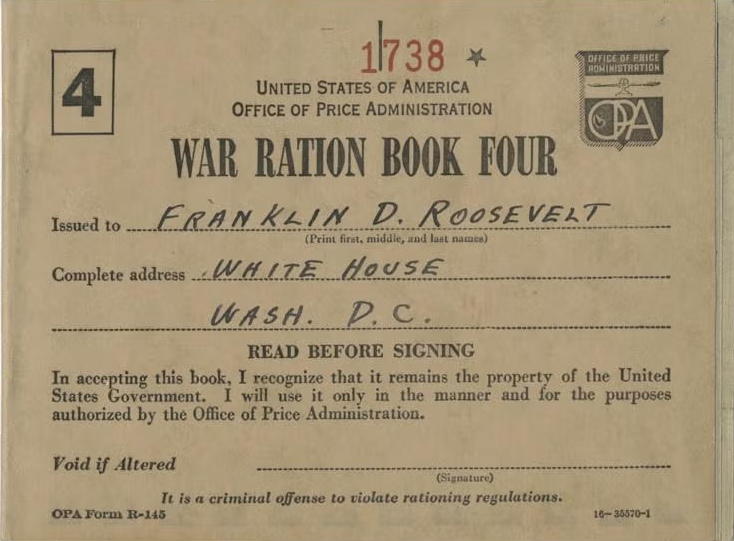
I haven’t studied the numbers, but I strongly suspect that most US government food rationing during the war was effectively theatre to encourage more support of the war effort: except in a very few areas, the US was more than self-sufficient in most foodstuffs. At the Foundation for Economic Education, Lawrence W. Reed recounts one of the least effective government moves in food rationing:
According to an old joke from the socialist and frequently underfed Soviet Union, Stalin goes to a local wheat farm to see how things are going. “We have so many bags of wheat that, if piled on top of each other, they could reach God himself!” the farmer told Comrade Stalin.
“But God does not exist,” the dictator angrily replied. “Exactly!” said the farmer. “And neither does the wheat.” Nobody knows what happened to the farmer, but at least Stalin died in 1953.
Soviet socialism, with its forced collectivism and ubiquitous bread lines, gave wheat a bad name. Indeed, it was lousy at agriculture in general. As journalist Hedrick Smith (author of The Russians) and many other authorities noted at the time, small privately owned plots comprised just three percent of the land but produced anywhere from a quarter to a half of all produce. Collectivized agriculture was a joke.
America is not joke-free when it comes to wheat. We are a country in which sliced bread was both invented and banned, and a country in which growing wheat for your own consumption was ruled to be an act of “interstate commerce” that distant bureaucrats could regulate. No kidding.
On this anniversary — July 7 — of both the birth in 1880 of sliced bread’s inventor and of the day in 1928 that the first sliced bread from his machine was sold, it’s fitting to recall these long-forgotten historical facts.
The Iowa-born jeweler and inventor Otto Rohwedder turned 48 on the very day the first consumer bought the product of his new slicing machine. The bread was advertised as “the greatest forward step in the baking industry since bread was wrapped” and it quickly gave rise to the popular phrase, “the greatest thing since sliced bread.” Before 1928, American housewives cut many a finger by having to slice off every piece of bread from the loaves they baked or bought. Sliced bread was an instant sensation.
Rohwedder earned seven patents for his invention. The original is proudly displayed at the Smithsonian Institution in Washington, D.C. He likely made a lot more money from the bread slicing machine than he ever did as a jeweler. He died in 1960 at the age of 80.
Enter Claude Wickard, Secretary of Agriculture under Franklin Roosevelt from 1940 to 1945. On January 18, 1943, he banned the sale of sliced bread. Exactly why seems to be in dispute but the most likely rationale was to save wax paper and other resources for war production. He rescinded the ban two months later, explaining then that “the savings are not as much as we expected.”
I’m sure Hitler and Hirohito were relieved.
Comments Off on Bread rationing in the United States during WW2
July 12, 2023
“[E]lite colleges are machines for laundering privilege”
Scott Alexander ponders the reasons our elite universities operate as they do:

Harvard University Memorial Church.
Photo by Crimson400 via Wikimedia Commons.
We could think of “the best college” as a self-fulfilling prophecy; for whatever reason, one college has gotten a reputation as the one whose signal is most valuable. Everyone naturally tries to get in there; if they fail, they go to the college with the next-best reputation, and so on. The system is stable; the “best” college will keep its reputation (since it gets the best students) and the best students will always want to go to the best college. If, as Matt’s son suggests, all the Ivies started accepting the worst students instead, an Ivy degree would soon become a signal that you’re bad, and employers would stop respecting it.
I heard a fascinating variation of this hypothesis from Matt Christman of Chapo Trap House: elite colleges are machines for laundering privilege.
That is: Harvard accepts (let’s say) 75% smart/talented people, and 25% rich/powerful people. This is a good deal for both sides. The smart people get to network with elites, which is the first step to becoming elite themselves. And the rich people get mixed in so thoroughly with a pool of smart/talented people that everyone assumes they must be smart/talented themselves. After all, they have a degree from Harvard!
The most blatant form of this obfuscation: suppose you own a very successful family business. You can leave your son your fortune, you can leave him the business, you can leave him your mansion, but you can’t (directly) leave him an aura of having deserved all these things. What you can do is make a $10 million donation to Harvard in exchange for them accepting your son. Your son gets a Harvard degree, a universally-recognized sign of being a highly meritorious person. Then when you leave him the business, everyone will agree he deserves it. Who said anything about nepotism? Leaving a Harvard graduate in control of your business is an excellent decision!
This happens a little, but I think it mostly isn’t this obvious. More often the transactions are for abstract goods: prestige, associations, favors. The Maharaja of Whereverstan sends his daughter to Harvard so that she appears meritorious. In exchange, Harvard gets the credibility boost of being the place the Maharaja of Whereverstan sent his daughter. And Harvard’s other students get the advantage of networking with the Princess Of Whereverstan. Twenty years later, when one of them is an oil executive and Whereverstan is handing out oil contracts, she puts in a word with her old college buddy the Princess and gets the deal. It’s obvious what the oil executive has gotten out of this, but what does the Princess get? I think she gets the right to say she went to Harvard, an honor which is known to go mostly to the meritorious.
People ask why Harvard admissions can still be bribed or influenced by the rich or well-connected. This is the wrong question: the right question is why they ever give spots based on merit at all. The answer is: otherwise the scheme wouldn’t work. The point of a money-laundering operation is to take in both fairly-earned and dirty money, then mix them together so thoroughly that nobody can tell which is which. Likewise, the point of a privilege-laundering operation is to take in both fairly-earned and dirty privilege, then stamp both with a Harvard degree. “Fairly-earned privilege” means all the brilliant talented ambitious youngsters admitted on the basis of their SAT scores and grades and impressive accomplishments; “dirty privilege” means the kids of various old-money aristocrats, foreign potentates, and ordinary super-rich people. Colleges mix them together, with advantages for both groups.
Is this good or bad? It’s good insofar as it provides a justification for making some elite positions dependent on merit and accessible to anyone, but bad insofar as it helps defend and obfuscate the ones that aren’t. It’s good if you think it’s good for all the elites (meritocratic and otherwise) to know each other and be on the same page; it’s bad if you don’t want them to be (maybe because it helps them oppress people more efficiently).
I expect that without such a system the elites would do their own thing without any concession to merit whatsoever – so maybe it beats the alternative.
“Folksy” Joe Biden has always been a nasty piece of work
One of the most puzzling things about how Joe Biden has been represented in the legacy media is that — despite mountains of evidence that he’s a hot-tempered bully who has always been eager to belittle and demean other people — he still gets fawning coverage of his supposed kindly personality:

Joe Biden likes to present himself as a folksy type, the kind you’d think of as a kindly old uncle or something. He tells stories about Corn Pop and virtually anything else and the press eats it up.
But it’s a veneer, a mask Biden wears so the public will like him.
We’ve seen it slip a time or two, but Axios has a story that hints that what we’ve seen is just the tip of the iceberg.
In public, President Biden likes to whisper to make a point. In private, he’s prone to yelling.
Behind closed doors, Biden has such a quick-trigger temper that some aides try to avoid meeting alone with him. Some take a colleague, almost as a shield against a solo blast.
The president’s admonitions include: “God dammit, how the f**k don’t you know this?!,” “Don’t f**king bullsh*t me!” and “Get the f**k out of here!” — according to current and former Biden aides who have witnessed and been on the receiving end of such outbursts.
…
“There’s no question that the Biden temper is for real. It may not be as volcanic as Bill Clinton’s, but it’s definitely there,” said Chris Whipple, author of The Fight of His Life: Inside Joe Biden’s White House.
Whipple’s book quotes former White House press secretary Jen Psaki as saying: “I said to [Biden] multiple times, ‘I’ll know we have a really good, trusting relationship when you yell at me the first time.'”
Whipple notes: “Psaki wouldn’t have to wait long.”
Zoom out: Biden’s temper comes in the form of angry interrogations rather than erratic tantrums.
He’ll grill aides on topics until it’s clear they don’t know the answer to a question — a routine that some see as meticulous and others call “stump the chump” or “stump the dummy”.
Being yelled at by the president has become an internal initiation ceremony in this White House, aides say — if Biden doesn’t yell at you, it could be a sign he doesn’t respect you.
Go and read the whole thing, because this is troubling, and not just because I dislike Biden.
While Axios goes out of its way to paint this as just an impassioned politician who demands much of his staff, that’s not what I’m seeing here.
Instead, I’m seeing an abusive man who is taking advantage of his powerful position to bully his subordinates.
I won’t pretend I’ve never lost my temper before. Doing so would be a lie. However, my yelling at someone has never been a sign of respect. It’s been a sign that I lost control.
And if Biden is doing it this often, there’s not much chance the man has any control over much of anything.
Of course, this is a report from Axios. Maybe it’s not really a thing. Maybe I’m just reading too much into it because I can’t stand Biden.
DOES YOUR FLAG FAIL? Grey Grades The State Flags!
CGP Grey
Published 2 Apr 2023
(more…)
Comments Off on DOES YOUR FLAG FAIL? Grey Grades The State Flags!
QotD: Media gullibility on military issues
The Media, of course, does not do this. They’d be happy to write up a whole big feature story about how the Russians’ Q-35 matter modulator wasn’t nearly what Vlad Putin, that lying bastard, bragged it up to be. And with the new Lepage gun gluing all those Russian planes together, the brave Ukrainians will be in Moscow for Easter!
Are they lying? Not really. Some very serious-looking persyn in a snazzy uniform with a lot of very colorful ribbons told them that the Q-35 matter modulator isn’t all that, and why would some brave freedom fighter lie to them? And besides — this is crucial — “fact checking” the stats on the Q-35 matter modulator would entail that you’ve never heard of it before …
… which is anathema to our intrepid reporterette’s sense of xzhyrself as a hard-hitting newshound who is very very Smart. After all, she scored a 35,000 on her SATs and graduated from the Assjammer School of Journalism with a 9.98 GPA. She’s got fellowships and awards and whatnot out the yingyang, plus 1.2 million Twitter followers. And it says “war correspondent” right there on her Facebook page. If the Q-35 matter modulator weren’t actually a thing, surely she would know.
Severian, “The Becky Cycle”, Founding Questions, 2023-02-27.
Comments Off on QotD: Media gullibility on military issues
July 11, 2023
Western legacy media is suffering from an overdose of Professionally Correct speech
David Friedman can’t help but notice this phenomenon:
When the question of alcohol and health came up on “Doctor Radio”, a satellite radio program, all of the participants agreed that evidence showed that consuming a moderate level of alcohol, something like one beer a day for a woman, one or two for a man, or the equivalent in other drinks, was good for you, better than no alcohol at all. All of them also agreed that they would not advise their patients to do so.
Why? They mentioned that there were problems with prescribing something that depended on the exact dosage and that a higher level of consumption was likely to lead to auto accidents, but distinguishing one beer a day from three is not a difficult problem even for those who are not doctors. My conjecture was that the real explanation was the reluctance of doctors to appear to be on the wrong side. Everyone knew that alcohol was a bad thing, a source of auto accidents and various medical (and other) problems. By giving a truthful account of the medical evidence the doctors on the program might appear to be pro-alcohol; all good people are anti. Hence they had to qualify their conclusion as a purely theoretical matter, not something that would affect what they told their patients. Think of it as a different version of PC — Professionally Correct speech.
A similar pattern exists for ice cream. Multiple independent studies have found evidence that consuming ice cream reduces the chance of getting diabetes — and found ways of explaining the evidence away. In several cases they have gone so far, in public statements, as to report that yogurt is protective against diabetes, other dairy products are not, when ice cream in their study showed as strong, in some studies a stronger, effect than yogurt.
Yogurt, as everyone knows, is a healthy food. Ice cream, as everyone knows, is bad for you.
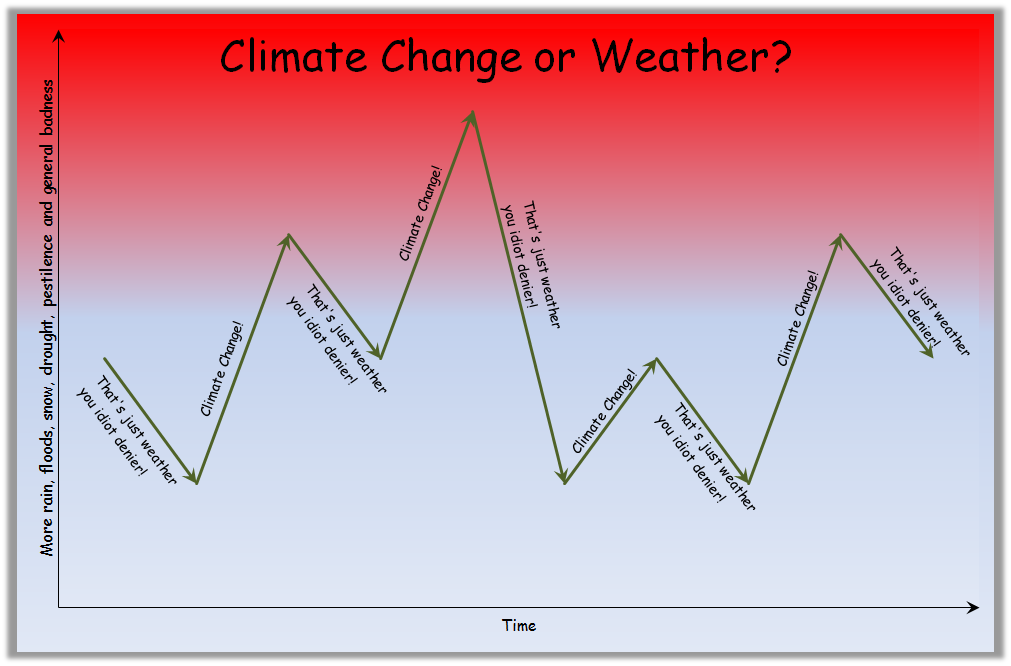
From time to time I see a news story on some piece of scientific research that somewhat weakens the case for taking strong action against global warming. I believe that every time I have seen such a report it was accompanied by a quote from the researchers to the effect that global warming was a serious problem and their work should not be taken as a reason to be less worried about it. They almost certainly believed the first half of that, but their work was a reason to be less worried even if not to stop worrying.
Good people are on the side that believes that warming is happening, is anthropogenic, is a serious problem that needs to be dealt with immediately. Bad people deny one or more of those claims. If that is what all the people who matter to you, such as the fellow members of your profession, believe, and you are so unfortunate as to produce results that strengthen the bad people’s case, it is prudent to make it clear that you are still on the side of the angels. Just as, if you are so unfortunate as to be an honest doctor aware of the evidence in favor of alcohol, it is prudent to make it clear that you have not transferred your allegiance to demon rum.
Comments Off on Western legacy media is suffering from an overdose of Professionally Correct speech
What is a HUMP Yard?
V12 Productions
Published 24 Oct 2022Hump yards are amazing pieces of engineering that allow railroads to use gravity to sort cars and build trains. Of course, not all railroad equipment can be humped.
(more…)
Comments Off on What is a HUMP Yard?
July 10, 2023
Echoes of War: Accounts of Operation Husky and the Allied Landings in Sicily
OTD Military History
Published 9 Jul 2023On July 9/10 Allied forces launched Operation Husky, the invasion of Sicily. This video presents accounts from various Allied military personnel who were there that day.
(more…)
Comments Off on Echoes of War: Accounts of Operation Husky and the Allied Landings in Sicily
Remington-Lee Model 1885
Forgotten Weapons
Published 5 Sept 2015The model of 1885 (a modern collector designation; Remington called these the “Remington Magazine Rifle” and did not differentiate between the different versions) was the final iteration of James Paris Lee’s bolt action rifle made by Remington. It incorporated a number of improvements from the earlier versions, including a relocated bolt handle, improved bolt head, and a magazine that could now hold cartridges securely without the use of a sliding catch at the nose.
These rifles were made in .45-70 caliber for US use and in .43 Spanish for export sales. The US Navy purchased most of the .45-70 guns that were made, and this particular rifle is one of those Navy guns. By the time these rifles were actually in production, Great Britain had also decided to adopt the Lee system in 1888, which would go through several iterations and ultimately become the iconic SMLE that would be the mainstay of British infantry during the First World War.
(more…)
Comments Off on Remington-Lee Model 1885


