
World War Two
Published 8 Jul 2023Operation Bagration continues, smashing the armies of German Army Group Center and taking ever more territory including the prize of Minsk; on Saipan the Americans have taken most of the island when the Japanese resort to a huge suicidal banzai charge to try and turn the tide; and in Normandy new attacks begin try to finally take Caen and St. Lo.
(more…)
July 9, 2023
The Destruction of Army Group Center – Week 254 – July 8, 1944
Comments Off on The Destruction of Army Group Center – Week 254 – July 8, 1944
“… corporations sit in the late adopter phase of the marketing curve”
Elizabeth Nickson reminds us that the mass media corporate messaging is trailing edge, not leading edge:
Now everything is filtered through a warped looking glass, a Mad Hatter tea party of nonsense, run by the grimmest socialist operatives who ever lived, backed by buckets and wheelbarrows of stupid corporatist/fascist money. They are running a demoralization program on us.
It’s not working.
Never forget that corporations sit in the late adopter phase of the marketing curve, which is to say the lifeless part, the raking-in-the-money-from-stupid-women part. Women too, as a class, are part of the late adopter curve, because as Jordan Peterson once pointed out, women instinctively see humans as helpless babies needing protection and SAFETY FIRST. We are easily manipulated by our compassion, as is clear from the fact that only women and those who want to be, support the left now. The left traffics faux compassion and it is a killer drug. Included of course are beta males, hornswoggled by mommy, the wet diaper babies of Antifa and BLM. And of course, the paid operatives of the stinking cabal, the truly horrid public sector unions, the vicious thugs at AFL-CIO and the humanity-hating environmental movement.
The people the left cultivated so carefully over several generations have all fled to populism and eventually their vicious operatives won’t even be able to steal the votes they need. How big is it? Imagine 2000 Trump rallies. And then ten times that. And then quadruple it. Double and double and double again. And they are having the best time, more fun than you can imagine, working away in obscurity, asserting their human right to determine their own future.
[…]
Normals have turned, all of them. They are not available to the Trudeaus, Macrons and Rishi Sunaks of the world. They are wised up. Some of them know more than me about the filth at the heart of “environmentalism” and I know a lot. They are not Russian serfs or Chinese peasants. There is no way they are going to be corralled in 15 minute cities. They are going to bring the house down.
They/we are the people that Richard Haas, when resigning from the Council of Foreign Relations, a nest of nasty neo-liberal, neo-con oppressors if there ever was one, warned against when he said the greatest threat facing the world is American populists. Sure, buddy.
One of the those dreadful people (as they call us) is Kevin Fernandes82 on Instagram. Probably not his real name, but he is not aiming for public recognition. What he does, methodically, every day many times, is chronicle the slow crumbling of the old regime. I am using a lot of his reporting and as he shows, we are beating the pants off them every single day.
Their jobs are untenable. People are resigning from every safe berth in the world or being fired from plush jobs because the world the neo-liberal hegemon has created is counter-rational, so chaotic, it is unstable. It is unstable because we know it is stupid. We are opposed. And our opposition is slowly slowly bringing it down.
This is long. You don’t have to read it all to get the point, but give it to the despairing, keep it for when you despair. All these wins happened in the last two weeks. People, judges and administrators and politicians within the system, are starting to dance to the populist tune. Many of the worst are running as fast as they can.
We are the future.
Time to start thinking about what we want the new world to look like.
Herewith:
The Sound of Freedom has outsold the new Indiana Jones film, on 2,000 fewer screens and with no PR, against the full force of the Hollywood machine.
The Dutch government has reportedly fallen over asylum policy. Farms confiscation is wildly unpopular. Mark Rutte, architect of the prosecution of farmers has resigned.
The decoupling of the BRICS from the dollar means the death of the neo-liberal hegemon. Mark Wauk and Tom Luongo do a neat job of wrapping up this particular mess. As they say: there are no neo-liberals in a multi-polar, decoupled world.
The BRICS are set to introduce a new currency backed by gold, against the US backed dollar which depreciates in value every day because of inflation caused by choking energy supply and crazed overspending by governments.
EU laws that let banks shut accounts over political views to be scrapped.
Federal judge in Louisiana prohibits DHS, FBI and DOJ from working with Big Tech to censor posts.
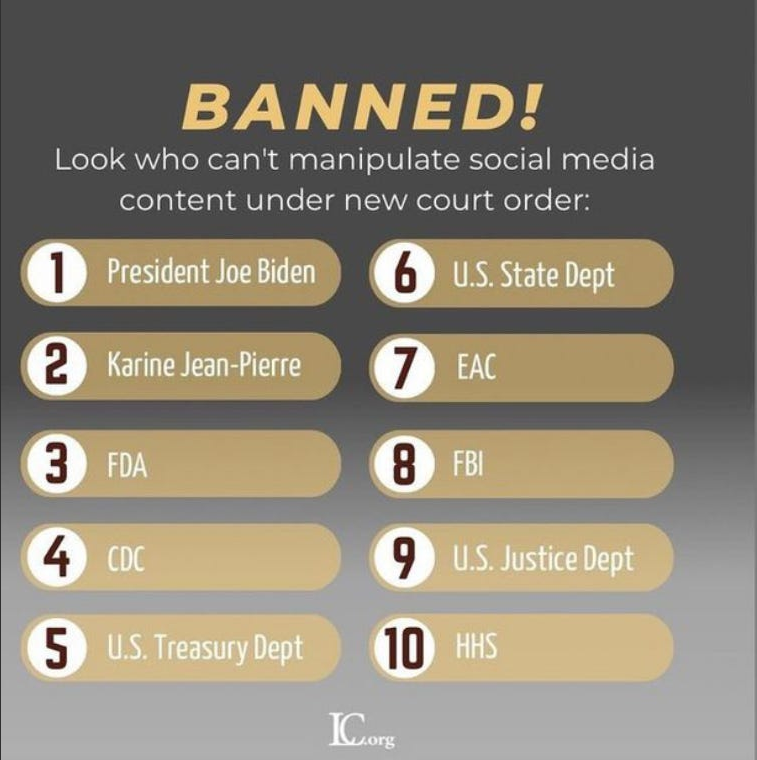
The list goes on for quite a lot longer…
Comments Off on “… corporations sit in the late adopter phase of the marketing curve”
July 8, 2023
Iowa votes to re-impose child labour in ways that violate federal labour laws
Chris Bray covers the breathless excitement of national media covering recent changes to Iowa labour laws:
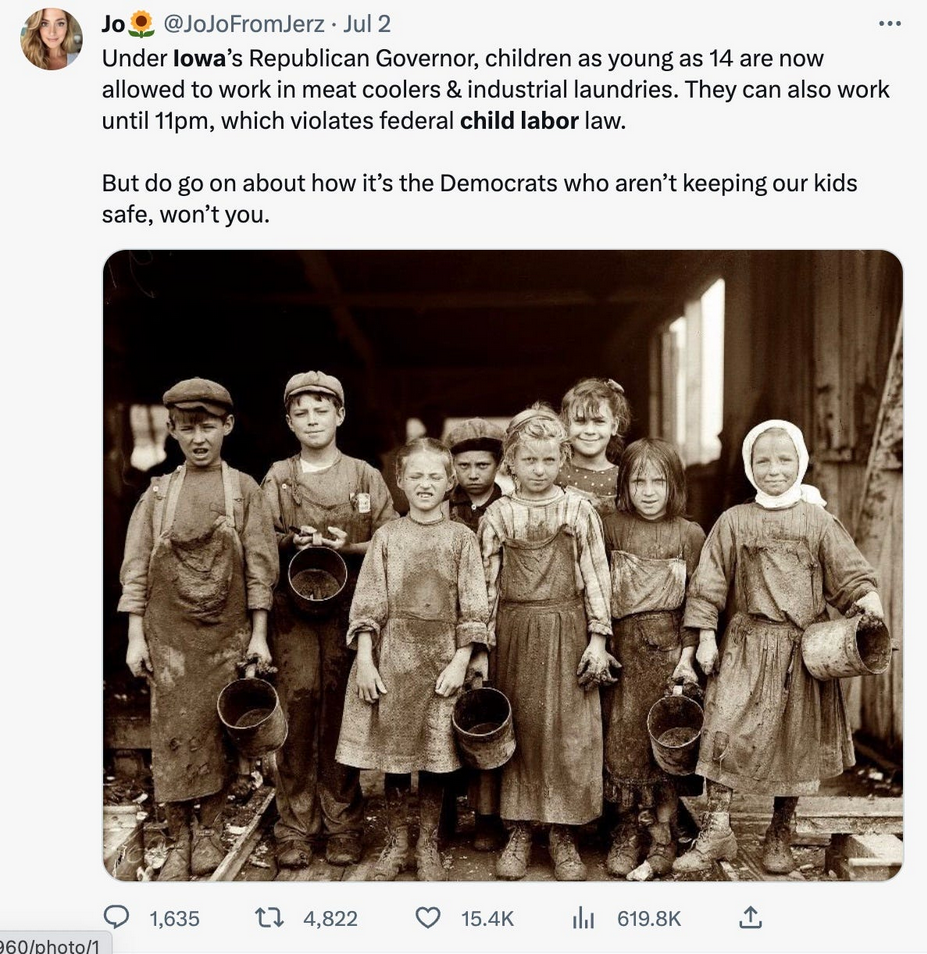
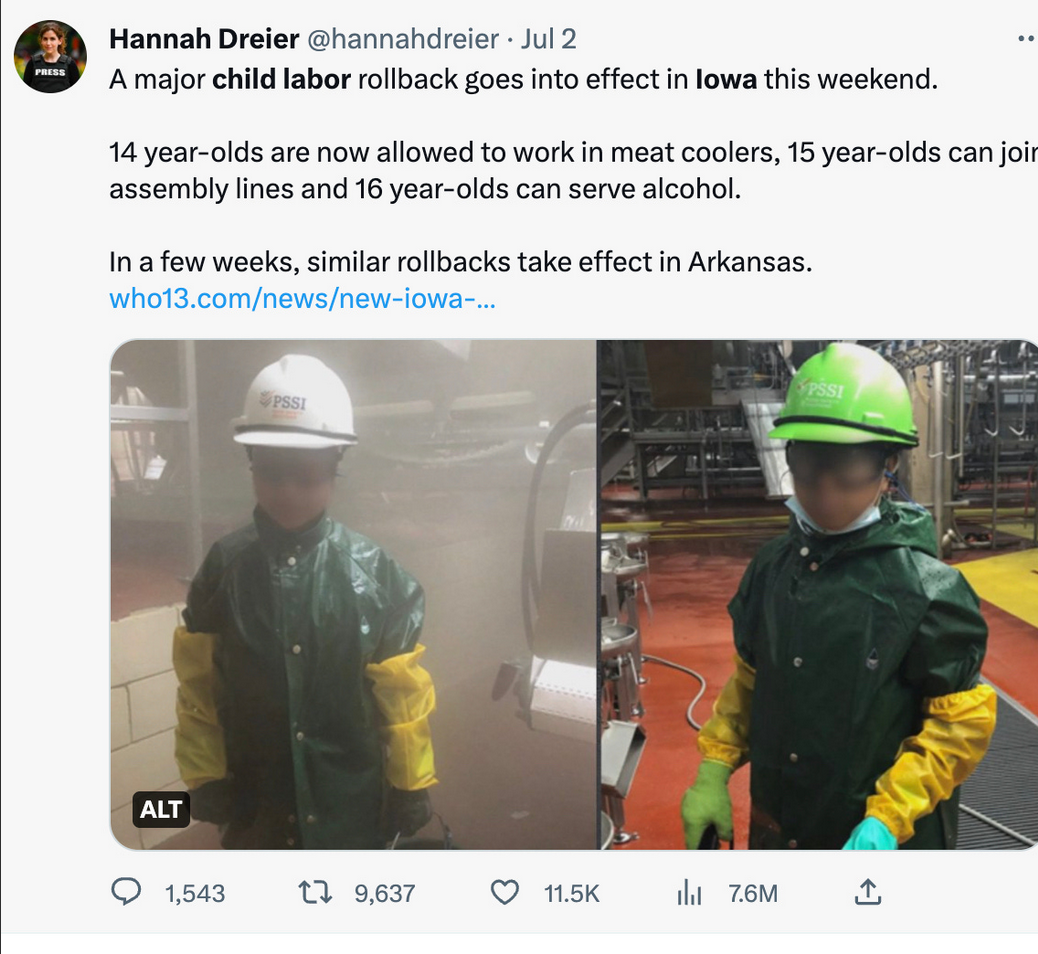
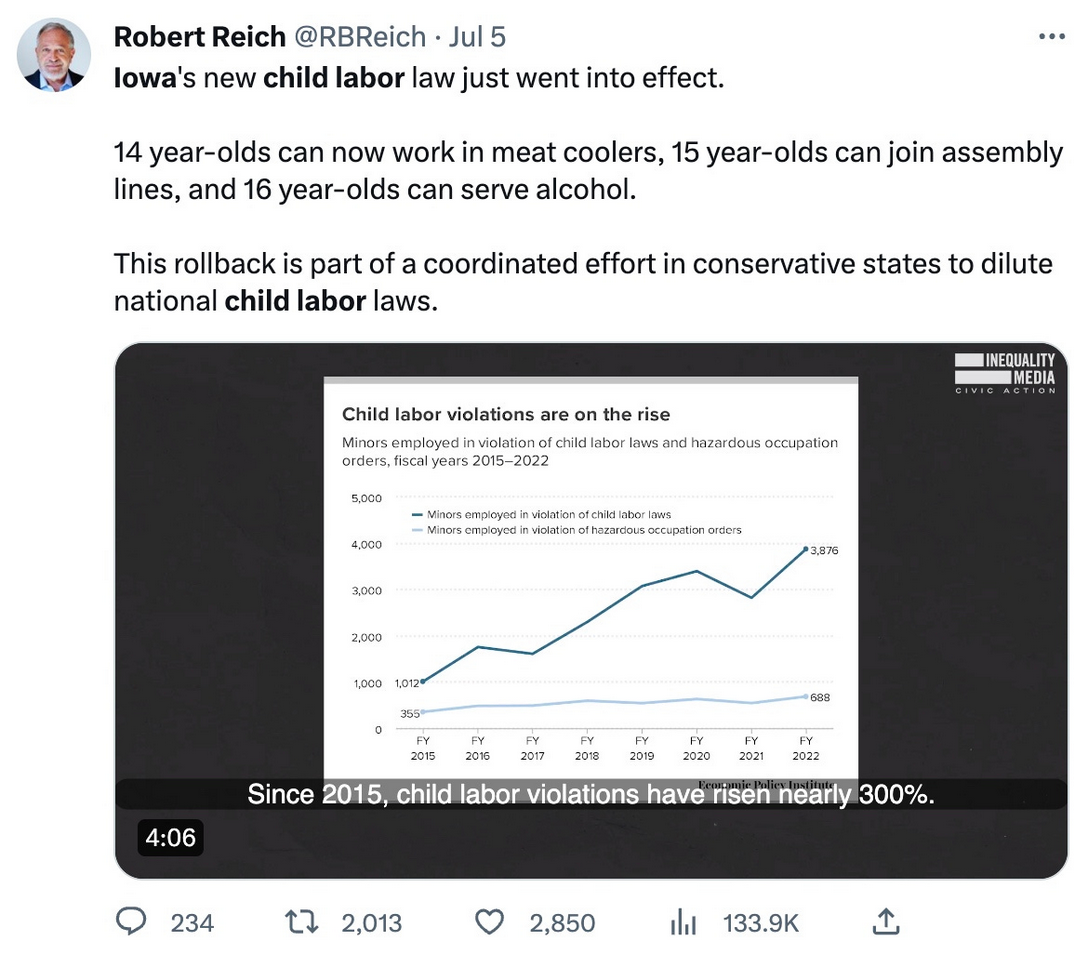
Suddenly, though, this message is all over social media:
These messages are not exactly false, and not entirely true. They take note of a real development, but strip away all the limits and caveats to fake up the creation of a 21st-century Upton Sinclair novel. But the effects of this successful legislation — this is where it gets complicated.
Start here (or here) with Iowa Senate File 542: signed into law in May, took effect on July 1. A bunch of the first-glance shocking details are more complicated than the outrage-farming Twitter takes suggest: 16 year-olds can serve alcohol in restaurants, with at least two adults to supervise, but not in bars; 15 year-olds can work on assembly lines in school-based work training programs, with parental permission; teenagers can work until 11 p.m. in the summer, but not during the school year. Allowing a 16 year-old coffee shop waitress to bring you a beer strikes me as … not the end of the world?
But all of those details aside, the new Iowa law expands child labor (while ending some earlier measures allowing even younger workers to do a few jobs like migrant farm labor), and will, in fact, put 14 year-olds to work in what will look a great deal like adult settings. So red state legislatures are expanding child labor at the moment they’re banning gender mutila— uh, gender-affirming medical care for teenagers, and making that latter choice on the highly defensible grounds that teenagers lack the maturity to make decisions like that. So a 15 year-old working in a factory lacks the maturity to make adult decisions, is where we end up when we put all of this together.
Comments Off on Iowa votes to re-impose child labour in ways that violate federal labour laws
The Perfect D-Day That History Forgot
Real Time History
Published 7 Jul 2023The summer of 1944 saw the Allies land in France not once but twice. Two months after Operation Overlord, the Allies also landed in Southern France during Operation Dragoon. It was “the perfect landing” and opened up the important ports of Marseille and Toulon for Allied logistics.
(more…)
Comments Off on The Perfect D-Day That History Forgot
During the pandemic, governments across the world chose the worst way to respond
In City Journal, John Tierney explains why western governments’ almost universal grabbing of extraordinary powers was the worst possible way to handle the public health crisis of the Wuhan Coronavirus:

Long before Covid struck, economists detected a deadly pattern in the impact of natural disasters: if the executive branch of government used the emergency to claim sweeping new powers over the citizenry, more people died than would have if government powers had remained constrained. It’s now clear that the Covid pandemic is the deadliest confirmation yet of that pattern.
Governments around the world seized unprecedented powers during the pandemic. The result was an unprecedented disaster, as recently demonstrated by two exhaustive analyses of the lockdowns’ impact in the United States and Europe. Both reports conclude that the lockdowns made little or no difference in the Covid death toll. But the lockdowns did lead to deaths from other causes during the pandemic, particularly among young and middle-aged people, and those fatalities will continue to mount in the future.
“Most likely lockdowns represent the biggest policy mistake in modern times,” says Lars Jonung of Lund University in Sweden, a coauthor of one of the new reports. He and two fellow economists, Steve Hanke from Johns Hopkins University and Jonas Herby of the Center for Political Studies in Copenhagen, sifted through nearly 20,000 studies for their book, Did Lockdowns Work?, published in June by the Institute for Economic Affairs (IEA) in London. After combining results from the most rigorous studies analyzing fatality rates and the stringency of lockdowns in various states and nations, they estimate that the average lockdown in the United States and Europe during the spring of 2020 reduced Covid mortality by just 3.2 percent. That translates to some 4,000 avoided deaths in the United States — a negligible result compared with the toll from the ordinary flu, which annually kills nearly 40,000 Americans.
Even that small effect may be an overestimate, to judge from the other report, published in February by the Paragon Health Institute. The authors, all former economic advisers to the White House, are Joel Zinberg and Brian Blaise of the institute, Eric Sun of Stanford, and Casey Mulligan of the University of Chicago. They analyzed the rates of Covid mortality and of overall excess mortality (the number of deaths above normal from all causes) in the 50 states and the District of Columbia. They adjusted for the relative vulnerability of each state’s population by factoring in the age distribution (older people were more vulnerable) and the prevalence of obesity and diabetes (which increased the risk from Covid). Then they compared the mortality rates over the first two years of the pandemic with the stringency of each state’s policies (as measured on a widely used Oxford University index that tracked business and school closures, stay-at-home requirements, mandates for masks and vaccines, and other restrictions).
The researchers found no statistically significant effect from the restrictions. The mortality rates in states with stringent policies were not significantly different from those in less restrictive states. Two of the largest states, California and Florida, fared the same — their mortality rates both stood at the national average — despite California’s lengthy lockdowns and Florida’s early reopening. New York, with a mortality rate worse than average despite ranking first in the nation in the stringency of its policies, fared the same as the least restrictive state, South Dakota.
Comments Off on During the pandemic, governments across the world chose the worst way to respond
Canada’s Nuclear-Armed Cold War Interceptor: the story of the McDonnell CF-101 Voodoo
Polyus
Published 14 Aug 2020When Soviet or unidentified aircraft approached Canadian airspace in the 1960s and 70s, they were met by an iconic cold war interceptor. Armed with both conventional and nuclear weapons, they were a formidable foe in their day. It served to support NORAD and protect the Northern approaches into the North American heartland during the height of the Cold War. Although it was neither designed nor built in Canada, the reliable Voodoo remains a Canadian Cold War icon and was well loved by its ground crews and pilots.
0:00 Introduction
0:29 McDonnell F-101A development
1:06 F-101B Interceptor
3:11 Canada becomes involved with the Voodoo
4:15 The Nuclear question
5:08 Comparison with contemporaries
5:36 Operational History
8:04 Legacy and Retirement
8:48 Conclusion
(more…)
Comments Off on Canada’s Nuclear-Armed Cold War Interceptor: the story of the McDonnell CF-101 Voodoo
July 6, 2023
QotD: Liberalizing the US Army after WW2
In 1861, and 1917, the Army acted upon the civilian, changing him. But in 1945 something new happened. Suddenly, without precedent, perhaps because of changes in the emerging managerial society, professional soldiers of high rank had become genuinely popular with the Public. In 1861, and in 1917, the public gave the generals small credit, talked instead of the gallant militia. Suddenly, at the end of World War II, society embraced the generals.
And here it ruined them.
They had lived their lives in semibitter alienation from their own culture (What’s the matter, Colonel; can’t you make it on the outside?) but now they were sought after, offered jobs in business, government, on college campuses.
Humanly, the generals liked the acclaim. Humanly, they wanted it to continue. And when, as usual after all our wars, there came a great civilian clamor to change all the things in the army the civilians hadn’t liked, humanly, the generals could not find it in their hearts to tell the public to go to hell.
It was perfectly understandable that large numbers of men who served didn’t like the service. There was no reason why they should. They served only because there had been a dirty job that had to be done. Admittedly, the service was not perfect; no human institution having power over men can ever be. But many of the abuses the civilians complained about had come not from true professionals but from men with quickie diplomas, whose brass was much more apt to go to their heads than to those of men who had waited twenty years for leaves and eagles.
In 1945, somehow confusing the plumbers with the men who pulled the chain, the public demanded that the Army be changed to conform with decent, liberal society.
The generals could have told them to go to hell and made it stick. A few heads would have rolled, a few stars would have been lost. But without acquiescence Congress could no more emasculate the Army than it could alter the nature of the State Department. It could have abolished it, or weakened it even more than it did — but it could not have changed its nature. But the generals could not have retained their new popularity by antagonizing the public, and suddenly popularity was very important to them. Men such as Doolittle, Eisenhower, and Marshall rationalized. America, with postwar duties around the world, would need a bigger peacetime Army than ever before. Therefore, it needed to be popular with the people. And it should be made pleasant, so that more men would enlist. And since Congress wouldn’t do much about upping pay, every man should have a chance to become a sergeant, instead of one in twenty. But, democratically, sergeants would not draw much more pay than privates.
And since some officers and noncoms had abused their powers, rather than make sure officers and noncoms were better than ever, it would be simpler and more expedient — and popular — to reduce those powers. Since Americans were by nature egalitarian, the Army had better go that route too. Other professional people, such as doctors and clergymen, had special privileges — but officers, after all, had no place in the liberal society, and had better be cut down to size.
T.R. Fehrenbach, This Kind of War: A Study in Unpreparedness, 1963.
Comments Off on QotD: Liberalizing the US Army after WW2
July 5, 2023
Intersectionality showdown
Chris Bray on the major break in progressive solidarity caused by non-white American Muslims’, Ethiopian Christians’, and Peruvian Catholics’ unexpected reaction to woke teachers wanting to sexually indoctrinate their children:
We’re wading through this culture war sewage because we have a political class that’s deliberately pumping it into the culture to keep us from noticing that, how can I put this in a sophisticated way, they suck.
But this really tedious maneuver is increasingly leading to moments like this — and Twitter still won’t let Substack writers embed tweets, so click to watch video, but here’s the substance of the thing:
The fake conflict is increasingly likely to be a dozen sanpaku-eyed AWFL’s against a thousand genuinely multicultural parents, battling over insane questions like the “book bans” that remove highly explicit sexual content from elementary school libraries. In 2023, the culture war is rapidly cooking down to STOP PREVENTING US FROM TALKING TO YOUR EIGHT YEAR-OLDS ABOUT SUCKING DICK, YOU NAZIS.
If you’ve never read what I wrote about Jim Jones and the Peoples Temple, please take a moment to go read this. About 900 people died at Jonestown in 1978, but Jones started in Indianapolis in the 1950s. He moved his church to a rural property in California, and then to Guyana, by constantly telling his parishioners that they were threatened by hostile forces outside the church that were maneuvering to destroy them. The frequent recourse to invented threats is a sign of a sick movement, not a sign of something the grows and flourishes.
That’s where we are. We’re watching a sick thing die. The question, now, is how long it takes to die, and how much damage it does in its death throes. But the increasingly hysterical tone, against an increasingly matter-of-fact response — a thousand parents saying calmly that no, we won’t let you inflict this curriculum on our children — suggests that the inflection point is getting closer.

Comments Off on Intersectionality showdown
The “orgasm gap”, yet another problematic front in the war of the sexes
Janice Fiamengo discusses the faked orgasm scene in When Harry Met Sally and its role in the ongoing arguments over the “orgasm gap”:
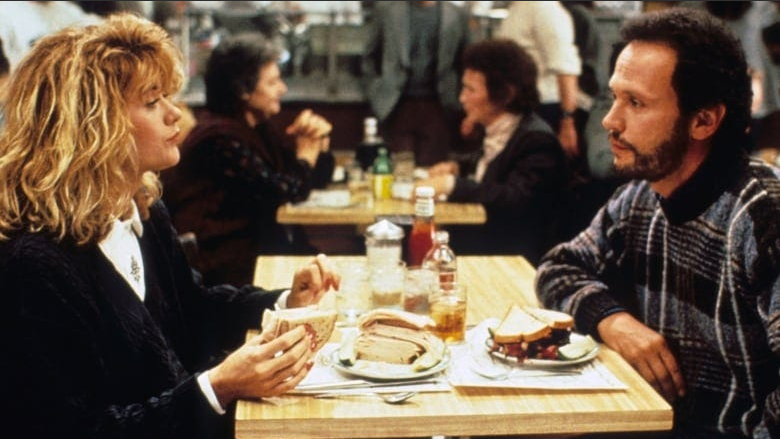
An iconic moment in modern movie history is the diner scene from When Harry Met Sally (1989), when Sally stuns an incredulous Harry with her rendition of a convincing orgasm. Her bravura performance causes shocked silence in the restaurant until one woman, sitting nearby, says admiringly (or enviously), “I’ll have what she’s having.”
The scene and the woman’s amused reaction told of a simple reality with wit and without judgement: some portion of women — perhaps many — are convincing fakers, and even a sexually experienced man will find it hard to be sure.
Many women in the movie audience laughed in recognition, and many men likely scratched their heads, wondering why anyone would need to fake sexual enjoyment. Some men may have remembered times when they faked it too. In the romantic-comedic world of the movie, the scene symbolized one of the differences between the average woman and the average man that only a generous and committed love could bridge.
A few years ago, When Harry Met Sally turned 30 years old, and its anniversary prompted a number of reflection pieces, some turning a harsh feminist lens on the film’s gender politics. In “‘I’ll have what she’s having’: How that scene from When Harry Met Sally changed the way we talk about sex,” Lisa Bonos at The Washington Post found in the fake climax scene a salutary revelation of male sexual arrogance. For Bonos, Harry is a typical macho man, someone who doesn’t care about a woman’s pleasure. The fact that the whole point of his conversation with Sally had been his confidence that he was giving women pleasure simply confirmed his emetic masculinity.
According to Bonos, the fact that some women fake orgasm supposedly reveals that women’s sexual pleasure is “not prioritized” in heterosexual relationships, and Sally’s performance gave sobering evidence of a gendered pleasure gap. It was implicitly the man’s fault that his partner felt the need to lie to him about her sexual satisfaction, and his desire for her to orgasm proved his typically male ego. Bonos’s analysis was an egregious violation of the spirit of the movie but was eminently faithful to the feminist perspective. The politics of grievance had come a long way in three decades.
Right on cue, studies in human psycho-sexuality are now taking up the same theme, alleging a culturally imposed “orgasm gap” between men and women in which men outpace women in the frequency with which they report orgasm during sexual intercourse (86% for men vs. 62% for women, according to one national survey).
Remembering how consistently feminist pundits have expressed outrage at male incels‘ (alleged) sense of “entitlement” to sex, I cannot help but find it ironic how unapologetically researchers assume a female entitlement to orgasm. Apparently, the whole society is to be concerned if women fail to climax every time they have sex, while no one has compassion for young men who face a lifetime of sexlessness. The prime exhibit is “Orgasm Equality: Scientific Findings and Societal Implications“, a paper published in 2020 by three female researchers at the University of Florida. The paper not only surveys the literature on the subject but also makes recommendations for “a world of orgasm equality”.
Comments Off on The “orgasm gap”, yet another problematic front in the war of the sexes
Why Engineers Can’t Control Rivers
Practical Engineering
Published 4 Apr 2023💧 The unintended consequences of trying to change the course of rivers
(more…)
Comments Off on Why Engineers Can’t Control Rivers
July 4, 2023
From the American Revolution: Short Land Pattern Brown Bess
Forgotten Weapons
Published 22 Mar 2023The standard weapon of the British Army in the American War of Independence was the “Brown Bess”, and today we are looking at a 1769 Short Land Pattern example of the Brown Bess. This was a smoothbore .75 caliber, 10.2 pound flintlock with a whopping 42 inch barrel (the Long Land Pattern it superseded had a 46” barrel). Adopted in 1769, it would serve as the British standard infantry arm until 1797.
This particular example was issued to the 53rd Infantry Regiment, otherwise known as the King’s Shropshire Light Infantry. This regiment arrived in Quebec City in May 1776 and participated in the fighting at Ticonderoga and Saratoga, where several of its companies were captured and interned until the end of the war.
(more…)
Comments Off on From the American Revolution: Short Land Pattern Brown Bess
QotD: The (arguments over the) founding of America
No, in its ambitious and often excellent 1619 Project, the New York Times wants to do more than that. So it insists that the very ideals were false from the get-go — and tells us this before anything else. Even though those ideals eventually led to the emancipation of slaves and the slow, uneven and incomplete attempt to realize racial equality over the succeeding centuries, they were still “false when they were written”. America was not founded in defense of liberty and equality against monarchy, while hypocritically ignoring the massive question of slavery. It was founded in defense of slavery and white supremacy, which was masked by highfalutin’ rhetoric about universal freedom. That’s the subtext of the entire project, and often, also, the actual text.
Hence the replacing of 1776 (or even 1620 when the pilgrims first showed up) with 1619 as the “true” founding. “True” is a strong word. 1776, the authors imply, is a smoke-screen to distract you from the overwhelming reality of white supremacy as America’s “true” identity. “We may never have revolted against Britain if the founders had not understood that slavery empowered them to do so; nor if they had not believed that independence was required in order to ensure that slavery would continue. It is not incidental that 10 of this nation’s first 12 presidents were enslavers, and some might argue that this nation was founded not as a democracy but as a slavocracy,” Hannah-Jones writes. That’s a nice little displacement there: “some might argue”. In fact, Nikole Hannah-Jones is arguing it, almost every essay in the project assumes it — and the New York Times is emphatically and institutionally endorsing it.
Hence the insistence that everything about America today is related to that same slavocracy — biased medicine, brutal economics, confounding traffic, destructive financial crises, the 2016 election, and even our expanding waistlines! Am I exaggerating? The NYT editorializes: “No aspect of the country that would be formed here has been untouched by the years of slavery that followed … it is finally time to tell our story truthfully”. Finally! All previous accounts of American history have essentially been white lies, the NYT tells us, literally and figuratively. All that rhetoric about liberty, progress, prosperity, toleration was a distraction in order to perpetrate those lies, and make white people feel better about themselves.
Andrew Sullivan, “The New York Times Has Abandoned Liberalism for Activism”, New York, 2019-09-13.
Comments Off on QotD: The (arguments over the) founding of America
July 3, 2023
The Battle That Prevented A Nuclear World War Three | Kapyong: The Forgotten War | Timeline
Timeline – World History Documentaries
Published 2 Jul 2023On April 24, 1951, following a rout of the South Korean army, the Chinese People Volunteer Army pursued their enemy to the lines of Australian and Canadian troops still digging fall-back defences, 39 kilometres to the rear. Here, sometimes at the length of a bayonet, often in total darkness, individual was pitted against individual in a struggle between a superpower and a cluster of other nations from across the world. They fought for a valley, the ancient and traditional invasion route to Seoul. If it fell the southern capital and the war, was lost. The United Nations troops had the military advantage of the high ground and artillery support: the Chinese relied entirely on vastly superior numbers. As a result, young men from both sides found a battle which was very close and very personal.
The Battle of Kapyong became the turning point of China’s Fifth Offensive in that Korea spring. The aim of the offensive was to finally drive the foreign troops out of South Korea and into the sea. What happened instead, changed the history of the Korean War. The Chinese were denied victory and forced back into negotiations. Had they succeeded, another crushing defeat for the US could have triggered events that led to a nuclear holocaust in Asia — and World War Three.
(more…)
July 2, 2023
Of course they’re lying – the interesting thing is how they sell the lies
In his Friday Mailbag, Severian answers a reader question about the reports coming out of Ukraine about casualties in the recent fighting:

Back in the worst of the covid days (so far), I often said that we’re stewing in so many obvious lies, I’m starting to question the very existence of a country called “China”. Not to mention the germ theory of disease. Is there actually a war at all in Ukraine? How do we sift and weight sources?
My rules of thumb (two thumbs, two rules) for judging the underlying truthiness of a Media story are what I’ll call “the Goebbels factor” and “admission against interest”.
The “Goebbels factor” is that fellow’s well-known dictum that the best propaganda is mostly true. Outright lies — straight up, 100% false-to-facts whoppers — are actually extremely rare, even in the AINO Media. This is because out-and-out lies take a tremendous amount of effort to maintain. Not only that, their opportunity cost is off the charts, because once you’ve peddled the lie, you’re stuck with that specific lie forever. You have to keep investing in the lie, and you must also keep investing in what I guess we’ll call the “information infrastructure” surrounding that lie. It’s just not cost-effective.
The second factor — “admission against interest” — is, of course, just the second step in everyone’s favorite dance, the Media Shuffle. The first step is “That’s not happening!” The second step is “… and here’s why it’s good that it is.” Think of it as the retooling of the previous “information infrastructure.” Lies have to be supported, one way or the other. If the lie is “there’s no inflation!”, then the “information infrastructure” consists of semi-plausible (for Juggalo values of “plausible”) “explanations” of all the very obvious inflation that’s very obviously happening. You know the drill: Putin’s price hikes! Global Warming!! Systemic Racism!!!
It’s much easier to flip those around, to “explain” why all those are actually good for you, than it is to keep investing in the original lie. It’s important to note — as if y’all need the reminder! — that the “admission against interest” is ALSO chock full of lies; you have to cross check the new lies against the old lies to reach an approximation of the truth (the discipline known as FNG-ology; the practitioners of which are stoyakniks).
Given all that: Yeah, the war in Ukraine is real, and the Ukrainians really are getting keestered. My heart goes out to the Ukrainian people, who did nothing to deserve it, and I only ask that you remember who did this to you: Brandon and the Juggalos. It’s ALL on them. Putin really had no choice.
Comments Off on Of course they’re lying – the interesting thing is how they sell the lies
Allies Liberate Cherbourg – WW2 – Week 253 – July 1, 1944
World War Two
Published 1 Jul 2023Several weeks after the invasion of Normandy began, the Allies finally take a port city there, though the actual harbor has been destroyed. On Saipan the Americans have the advantage, in Finland, the Soviets do, but the big news is the Soviet destruction of huge chunks of German Army Group Center, demolishing entire Army Corps, and surrounding tens of thousands of the enemy.
(more…)
Comments Off on Allies Liberate Cherbourg – WW2 – Week 253 – July 1, 1944


