
So, up top, when I said that Facebook “can’t or won’t” stop this kind of stuff? I lied. There’s no “can’t” about it. It’s “won’t”, for the simple reason that Facebook understands its market and the Daily Mail writers obviously don’t. You’d think that the legendarily trashy British tabloid media would get this — and as I understand it, the Daily Mail is somewhere in the bottom half of the barrel — but Facebook’s market isn’t its users. Not even big companies like Starbucks. Facebook’s market is advertisers, and what they, Facebook, are selling is views. Eyeballs. “Engagement”, I think the Ad Biz term d’art is. In short: It doesn’t matter what the comments are; it matters that the comments are.
Ad company execs are walking into a meeting with a Starbucks-sized company right now. They’re pitching a bold new social media strategy to their clients. And they know it works, these ad men say, because look at all this data from Starbucks. Their posts average so much “engagement” every time, but look, when they post on “social justice” topics, their “engagement” jumps 350%!!
In case you were wondering how all this “social justice” shit keeps appearing in ads, despite the well-known effect of pissing off companies’ established client base, well, there you go — the company execs, being #woke Cloud People, want to do it anyway, and they’ve got whole binders full of data from the marketing department that prove “social justice” ups social media “engagement” with “the brand” umpteen zillion percent.
Severian, “Internet Tough Guys”, Rotten Chestnuts, 2021-05-10.
February 22, 2024
February 21, 2024
“College attendance is our society’s only meaningful initiation ritual, and it thus assumes an existential importance that renders it near-impossible to replace until an alternative is found”
Johann Kurtz believes the modern university’s survival despite its increasingly irrational and counterproductive actions can be explained as the last modern example of an initiation ritual:

Harvard University Memorial Church.
Photo by Crimson400 via Wikimedia Commons.
Our understanding of the college system is incomplete. Until we correct this, we won’t be able to fix or replace the system.
First, consider a paradox: college attendance remains near all-time highs [Link], yet the majority of Americans no longer believe it is worth the cost [Link].
The college system seems irrationally resistant to declining value. We must therefore ask: is there an important non-rational reason for college attendance which we have failed to acknowledge?
I believe the answer is “Yes”. College attendance is our society’s only meaningful initiation ritual, and it thus assumes an existential importance that renders it near-impossible to replace until an alternative is found.
Our culture is historically anomalous in lacking explicit initiation rituals.
Mircea Eliade, the great religious historian of the 20th-century, defined initiation rituals as “a body of rites and oral teachings whose purpose is to produce a decisive alteration in the religious and social status of the person to be initiated“.
In philosophical terms, initiation is equivalent to a basic change in existential condition; the novice emerges from his ordeal endowed with a totally different being from that which he possessed before his initiation; he has become another.
— Mircea Eliade, Rites and Symbols of Initiation: The Mysteries of Birth and Rebirth
In Europe, fully expressed initiation rituals were common until the end of the Middle Ages, and in the wider world, until the end of the First World War. Now, they only persist in the West in the sacramental practices of devout Christians (baptism, confirmation, and so forth).
Once, however, these practices were of tremendous importance to us, as Eliade makes clear:
To gain the right to be admitted among adults, the adolescent has to pass through a series of initiatory ordeals: it is by virtue of these rites, and of the revelations that they entail, that he will be recognized as a responsible member of the society. Initiation introduces the candidate into the human community and into the world of spiritual and cultural values. He learns not only the behavior patterns, the techniques, and the institutions of adults but also the sacred myths and traditions of the tribe, the names of the gods and the history of their works …
In the absence of local community rituals, the universities are a natural site for their replacement. These have always been religious sites, although the nature and expression of this religion has transmuted over time.
H/T to Bruce Gudmundsson at Extra Muros for the link and his additional comments:
This hypothesis accords with the argument, made often in this blog, that education and schooling are two very different things. At the same time, it suggests that one of the definitive purposes of Extra Muros, the encouragement of young people to eschew the conventional college experience in favor of a combination of practical pursuits and systematic self-tuition, may be a fool’s errand. After all, if four (or five or six) years of drinking second-rate beer from red plastic cups does for the office-bound folk of North America what fear-filled rites of passage do for members of the bone-in-the-nose set, then I might well be sailing against the wind.
Upon second thought, I find hope in the possibility that the parasite (or, to be more precise, the cancer) promoted by d’Angelo, Kendi, and company will soon deal the coup de grâce to its mortally-wounded host.
The coming-of-age ordeals of warrior tribes demand that boys who would be men prove possession of such martial virtues as courage and self-command. The rites-of-passage of the modern middle classes, however, require that postulants demonstrate a mixture of conformity, conscientiousness, and, to a diminishing degree, intelligence. (Readers familiar with the oeuvre of economist Bryan Caplan will recognize the source of this troika. However, it is worth noting that, while Professor Caplan will occasionally tip his hat in the direction of the campus-based building of basic brain-power, he devotes far more attention to the collegiate cultivation of the two components of Sitzfleisch.)1
The cult of Marx, Mao, and Marcuse demands complete compliance, not only with its basic tenets, but also with any changes in the party line that, from time to time, may occur. (I am old enough to remember the days when campus commies of the caucasian persuasion could don dashikis without facing charges of “cultural appropriation”.) Thus, those who sit at the feet of the acolytes of critical theory learn an art of great value to people who wish to thrive in a large organization, that of discarding the old hat, and putting on the new one, at just the right time. (Think, if you will, of the mid-level employees of the McDonalds Corporation, who, over the course of the last four decades, were obliged to alter their opinion of the McRib sandwich more often than they changed the oil in their cars.)
1. Bryan Caplan, The Case Against Education: Why the Education System is a Waste of Time and Money (Princeton: Princeton University Press, 2018), pages 9-21.
February 20, 2024
Welcome to Dopamine culture
Ted Gioia thinks the annual “State of the Union” address is boring, but a much more relevant thing would be a “State of the Culture” address … and he’s got lots of concerns about modern day culture:
Many creative people think these are the only options — both for them and their audience. Either they give the audience what it wants (the entertainer’s job) or else they put demands on the public (that’s where art begins).
But they’re dead wrong.
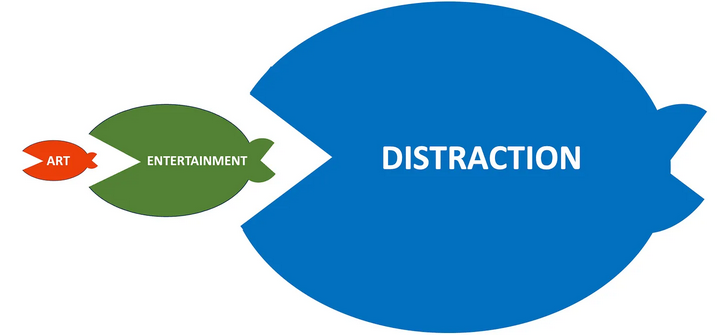
Maybe it’s smarter to view the creative economy like a food chain. If you’re an artist — or are striving to become one — your reality often feels like this.
Until recently, the entertainment industry has been on a growth tear — so much so, that anything artsy or indie or alternative got squeezed as collateral damage.
But even this disturbing picture isn’t disturbing enough. That’s because it misses the single biggest change happening right now.
We’re witnessing the birth of a post-entertainment culture. And it won’t help the arts. In fact, it won’t help society at all.
[…]
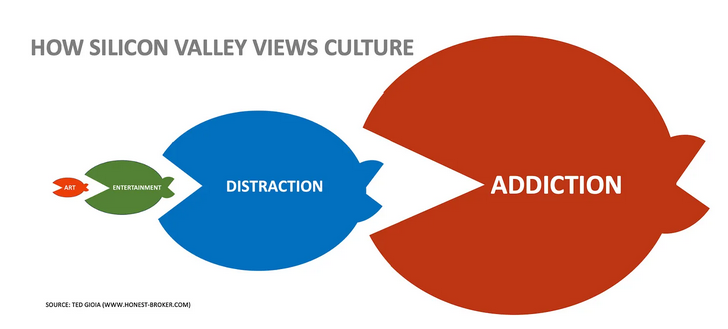
Here’s a better model of the cultural food chain in the year 2024.
The fastest growing sector of the culture economy is distraction. Or call it scrolling or swiping or wasting time or whatever you want. But it’s not art or entertainment, just ceaseless activity.
The key is that each stimulus only lasts a few seconds, and must be repeated.
It’s a huge business, and will soon be larger than arts and entertainment combined. Everything is getting turned into TikTok — an aptly named platform for a business based on stimuli that must be repeated after only a few ticks of the clock.
TikTok made a fortune with fast-paced scrolling video. And now Facebook — once a place to connect with family and friends — is imitating it. So long, Granny, hello Reels. Twitter has done the same. And, of course, Instagram, YouTube, and everybody else trying to get rich on social media.
This is more than just the hot trend of 2024. It can last forever — because it’s based on body chemistry, not fashion or aesthetics.
Our brain rewards these brief bursts of distraction. The neurochemical dopamine is released, and this makes us feel good — so we want to repeat the stimulus.
[…]
So you need to ditch that simple model of art versus entertainment. And even “distraction” is just a stepping stone toward the real goal nowadays — which is addiction.
Here’s the future cultural food chain — pursued aggressively by tech platforms that now dominate every aspect of our lives
The tech platforms aren’t like the Medici in Florence, or those other rich patrons of the arts. They don’t want to find the next Michelangelo or Mozart. They want to create a world of junkies — because they will be the dealers.
Addiction is the goal.
They don’t say it openly, but they don’t need to. Just look at what they do.

February 19, 2024
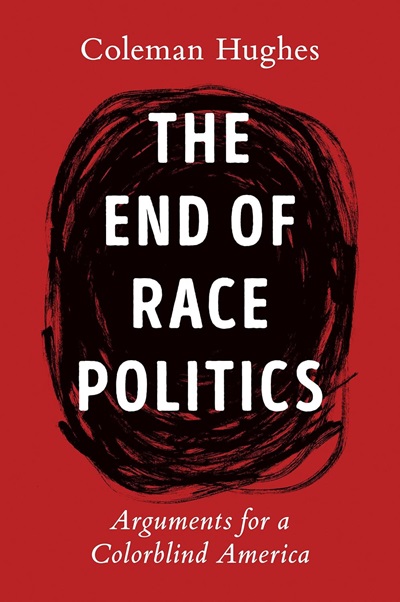
The End of Race Politics by Coleman Hughes
Given how far race relations in the United States (and in Canada) have disintegrated since 2009, it’s almost surprising to find someone taking up arms against the race preferences and active discrimination being implemented by governments, organizations, and companies across North America, but Coleman Hughes’ first book does exactly that:
… almost as soon as the 1964 breakthrough in overcoming racial classifications took hold, it was abandoned. In a perverse echo of the past, sanctioned preferential treatment for blacks slowly began to replace sanctioned preferential treatment for whites. Set-asides, quotas, affirmative action all proliferated, all rooted in the old, crude racial classifications. The notion that affirmative action was a temporary adjustment, to be retired in a couple of decades at most, gradually disappeared. In fact, it was extended to every other racial or sexual minority and to women. Even as women and many blacks and other minorities triumphed in the economy and mainstream culture, they were nonetheless deemed eternal victims of pervasive misogyny and racism.
The more tangible the success for women and minorities, the more abstract the notion of “systemic oppression” became. Critical race theorists argued that color-blindness itself was a form of racism; and that all white people, consciously or unconsciously, could not help but be perpetuators of racial hate, whether they intended to or not. That’s how we arrived at a moment when Jon Stewart decided he’d tackle the subject of racial inequality in America by hosting a show called “The Problem With White People”, and when “The 1619 Project” actually argued that the American Revolution was not driven by a desire to be free from Britain but to retain slavery, which Britain threatened.
The poignancy of Coleman Hughes’ new book, The End of Race Politics, lies therefore in the tenacity of his faith in the spirit of 1964. “Color-blindness” is not the best description of this, because of course we continue to see others’ race, just as we will always see someone’s sex. No, as Hughes explains: “To advocate colorblindness is to endorse an ethical principle: we should treat people without regard to race, both in our public policy and private lives”.
That’s a principle the vast majority of Americans, black and white and everything else, support. It was the core principle for Frederick Douglass, Zora Neale Hurston, Martin Luther King Jr, and Bayard Rustin. “If I have advocated the cause of the colored people, it is not because I am a negro, but because I am a man,” insisted Douglass. Henry Highland Garnet — the first African-American to speak in Congress after the passage of the Thirteenth Amendment — even apologized for speaking of various different races, “when in fact there is but one race, as there was but one Adam”.
Fast forward to 2015, when the University of California called the phrase “There is only one race, the human race” a “micro-aggression”; or 2020, when the phrase “All Lives Matter” was deemed evidence of “anti-blackness”. The 21st Century, the brief era of color-blindness behind us, reached back to the 19th to insist that race defines us at our core, can never be overcome, and marks us all either an oppressor or a victim. The left, including the Democratic Party, has now adopted this worldview, along with a legal regime to actively discriminate against some races and not others: “equity”. That’s why Hughes cuts to the chase and calls these reactionaries in progressive clothing “neoracists”. They are. What else would one call them?
They are race-obsessed. They view any human interaction as a racial power-struggle, and compound it with any number of further “intersectional” power-struggles. They do not see two unique individuals with unique life experiences interacting in a free society. They see group identity as determinative everywhere; and therefore want to intervene everywhere, to discriminate against whites and successful non-whites in favor of unsuccessful non-whites. Individual rights? They come second to group identity.
[…]
One in five “black” Americans are immigrants or descended from them, Hughes observes. Only 30 percent of Asian-Americans think of themselves as “Asian” at all, rather as a member of a specific group — like Korean or Indian. Within the Asian box, you also have huge diversity: “In 2015, 72 percent of Indians over 25 had at least a bachelors degree. yet only 9 percent of Bhutanese did.” Ditto “Hispanic”. Any formula that conflates Cubans with Mexicans and Colombians is absurd. And don’t get me started on the LGBTQIA+ bullshit.
The woke also have a staggeringly crude understanding of power. Economic power? No doubt many whites have a huge edge in accumulated wealth in America; but the cultural power of African-Americans is global in reach and far outweighs the cultural clout of, say, white evangelicals or conservatives at home. Political power? Blacks, who are about 14 percent of population, are represented proportionally in the House — covering 29 states — and can claim the last two-term president, the current vice president, the House minority leader, the secretary of defense, the chairman of the Joint Chiefs, the mayors of the four most populous cities last year, and more than a fifth of SCOTUS.
For the neoracists, all racial disparities are entirely explained by “systemic racism”. But this obviously obscures the complexity of American society. “Culture” is a loaded and complex term, but it sure matters. A child with two engaged parents in the home has far more chances to succeed than a kid who barely sees his dad. Now look at the difference between family structure among many Asian-American groups and that of black Americans. And how can one blame “white supremacy” for the constant murderous mayhem of urban black spaces? Only by removing from young black men any concept of their own agency and humanity.
The CIA’s covert operations … as inspired by Vladimir Lenin
Along with most people who’ve been paying attention to history since the start of the Cold War, I hold the CIA in dubious regard. They seem to have been involved in so many underhanded escapades in countries around the world — certainly by reputation, if not in reality — that they stand almost in direct opposition to how most Americans liked to think of their country. Jon Miltimore thinks that among their inspirations was the founder of the Soviet Union himself:

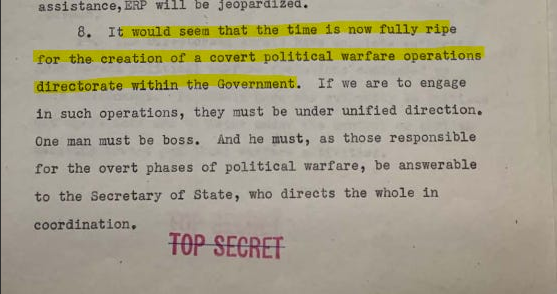
I bring all of this up because I recently came across an old document of some significance that I’d never heard of before titled, “The Inauguration of Organized Political Warfare“.
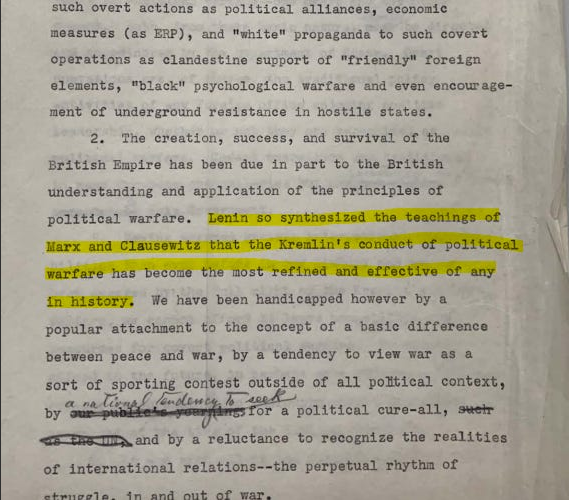
It was authored by George Kennan, the State Department Policy Planning Director who’d go on to be a successful US diplomat, for the National Security Council (which governed the CIA), and the document explained how the US government had to mobilize national resources “for covert political warfare” to combat the Soviet Union.
Kennan was not, in my opinion, a bad man. He had good instincts and sound motives, at least compared to others in the US intelligence apparatus. He was an early opponent of the Vietnam War and later was one of the first diplomatic leaders to warn against the US policy of expanding NATO up to Russia’s doorstep, something he predicted would be “the most fateful error of American policy in the entire post-cold-war era”.
That said, it’s clear that Kennan was not appalled by the Soviet Union’s use of covert political warfare. He was impressed by it.
“Lenin so synthesized the teachings of Marx and Clausewitz that the Kremlin’s conduct of political warfare has become the most refined and effective of any in history,” Kennan wrote in the document.
We have been handicapped however by a popular attachment to the concept of a basic difference between peace and war, by a tendency to view war as a sort of sporting context outside of all political context, by a national tendency to seek for a political cure-all, and by a reluctance to recognize the realities of international relations — the perpetual rhythm of [struggle, in and out of war].
The document is fascinating because it appears to mark the genesis of the US government’s first formal steps into the world of political warfare — a well-documented history that includes toppling governments, assassinating world leaders, tipping elections, and torturing enemies.
All of these efforts, of course, initially targeted external parties and countries to serve “the national interest”.
This is no longer the case. The CIA, NSA, and other intelligence agencies no longer restrict their covert political warfare to foreign states, and I’m not talking about just Operation Mockingbird and other domestic propaganda efforts.
The CIA is clearly putting its thumb on the scales of US elections in ways that should terrify all Americans.
February 18, 2024
German Counterattack in Pomerania – WW2 – Week 286 – February 17, 1945
World War Two
Published 17 Feb 2024The Germans finally launch a counterattack into the Soviet flanks, but it does not go as well as was as hoped. The Siege of Budapest comes to an end, also not well for the Germans. The Soviets have now also surrounded Breslau. In Burma, the Allies cross the Irrawaddy River, in the Philippines the fight for Manila continues, and in the Pacific preparations are underway for an American invasion of Iwo Jima Island.
01:50 The fight for East Prussia
04:08 German counterattack in Poland
07:00 Breslau Surrounded
07:57 The Siege of Budapest
09:14 Operation 4th Term in Italy
10:07 Operation Veritable Continues
11:36 Allies cross the Irrawaddy
14:43 The Fight in the Philippines
17:52 Preparations for Iwo Jima
(more…)
Does the Chieftain Fit Into … a Ford Model T
The Chieftain
Published Nov 19, 2023Filmed during a down-moment on a maintenance day at the Ontario Regiment Museum. The Model T is small and so old that I have to ask someone else at the end of the video how to drive it.
(more…)
February 17, 2024
The pronoun police claim another scalp
Brendan O’Neill recounts the very sad tale of a 90-year-old woman who has been cancelled by the charity she’d volunteered for over 60 years for questioning mandatory “preferred pronouns”:

Two people at EuroPride 2019 in Vienna holding an LGBTQ+ pride rainbow flag featuring a design by Daniel Quasar; this variation of the rainbow flag was initially promoted as “Progress” a PRIDE Flag Reboot.
Photo by Bojan Cvetanović via Wikimedia Commons.
This strange case tells us so much about our times. It confirms that pronounology is tantamount to a religion among the godless new elites. Showy declarations of one’s pronouns play an entirely doctrinal role. They’re the means through which the new establishment – and those who aspire to enter its rarefied ranks – signal their fealty to the god of political correctness, and to that especially angry god of transgenderism. This is why anyone, like Mrs Itkoff, who questions the faddish mumbo jumbo of putting “he / him”, “she / her” or “they / them” after one’s name must be dealt with severely – because they’re not only querying a way of speaking; they’re blaspheming against the entire cult of correct-thought that the new elites have built in order that they might distinguish between good people and bad people, between in-group folk and out-group folk.
Ostentatious pronoun declaration serves no practical purpose. Consider that even Joe Biden has declared his pronouns. No one is going to mistake this 81-year-old fella for a she / her or they / them. We know dozy old Joe’s a bloke. No, he says “he / him” not to be helpful but to signal his unswerving allegiance to elite opinion, to demonstrate his devotion to the new ruling ideologies. This is why the political class, the corporate world and sharp-elbowed youths who want to get their hands on those levers of cultural power make such a big deal of declaring their pronouns – because they know this religious incantation is a door-opener par excellence.
The reason I never use “preferred pronouns” is simple: I don’t subscribe to the neo-religion of gender ideology, which would have us believe that there are two you’s – your mysterious inner gendered soul and your outward biological appearance. Every time we declare our pronouns, or genuflect to someone else’s “preferred pronouns”, we are implicitly buying into this very modern delusion, this woke hocus pocus. I’m with Mrs Itkoff – the idea that people can choose their pronouns, rather than being allocated pronouns that accord with the truth and reason of their biological sex, doesn’t “make sense to me”.
The Itkoff case also confirms how cavalierly despotic woke has become, especially its post-sex, post-truth trans wing. The trans ideology has enacted numerous cruelties on women. Rapists in women’s prisons, men in women’s domestic-violence shelters, women’s sports almost entirely upended by an invasion of mediocre blokes who’ve changed their name to Crystal or whatever – there is no female right, no basic tenet of decency, that cannot be sacrificed at the altar of gender validation. Now, even the charitable urges of an elderly lady can be thrown on to the bonfire of the cruelties – goodness erased in the name of never offending men who think they’re women. That so-called progressives back this sacrifice of women’s right to organise and speak as they see fit in the name of appeasing delusional men is concerning in the extreme.
Then there’s the ageism. We need to talk about the searing hostility of the woke towards older people, especially older women. You don’t even have to be 90. Witness the ceaseless haranguing of “Karens”, a derogatory term for middle-aged, mostly white women who dare to stand up for themselves in public. They’ve become the hate figures of our time. The author Victoria Smith refers to it as “hag hate”, an “ageist misogyny” aimed at women who are perceived not only to be past their supposed sell-by date, but also, even worse, to be possessed of “incorrect” beliefs. The old ducking of hags in open water has been replaced by the shaming of hags on open web forums.
Partly, it’s just old-world ageist sexism rehabilitated in PC lingo. It should not be surprising that the cult of transgenderism – an ideology that indulges men’s jealous coveting of the hyper-sexualised female body – should be so staggeringly hostile to older women. To women who have “sagged”, whether physically or morally, and thus put themselves beyond the cravings of trans activists who seem to value only the young, the pert, the sexualised. That women are human beings, who go through every stage of human existence, seems to be beyond the moral grasp of trans ideologues for whom womanhood is costume and little more.
But there’s something else going on, too. Today’s fashionable ageism is not only misogynistic – it’s Maoist. When I read about the case of Fran Itkoff, it was Maoism that came to mind. For wasn’t that also a crusade against “the old”? Those hotheaded cancellers of 1960s China openly declared war on the “Four Olds” – old ideas, old culture, old customs and old habits. They demonised and tortured those who gave voice to “old” ideals. Are we not witnessing something similar today? Statues of “problematic” historical figures are torn down, “offensive” old literature is rewritten, old people – like Fran – are sent into social oblivion. Wokeness is Maoism with better PR. We need to do something about it before we arrive in a world where people like Mrs Itkoff are not only cancelled but are also made to stand in public squares with placards around their necks identifying them as rancid old wrongthinkers. It is time to defend “the old” from the crazed young of the woke crusade.
QotD: Lessons for today from the decline of the Western Roman Empire
Luttwak has a charmingly racist bit about how some client states have the IQ and sophistication to understand the true nature of the arrangement, while others are too dumb or barbaric to remember who’s boss without having their faces regularly rubbed in it. In the Roman case, the former camp contained the various Hellenistic kingdoms in Asia Minor and the Levant, who didn’t need legionaries standing around and supervising them, because they could imagine the existence of those legionaries and what they would do to them if provoked. The latter camp included many of the Germanic tribes, who tended to forget their place if the legions weren’t garrisoned within eyeshot, and even then would rise up in fruitless rebellion every couple of generations. We can make this marginally less racist by positing something more like a spectrum of how tolerable the client arrangement was, and consequently a spectrum of how coercive it had to be. The Greeks were relatively compatible culturally with the Romans, and the warrior spirit of their ancestors had been sufficiently sanded down that they didn’t mind being told what to do. The Germans were more foreign, and also retained the barbarian’s yearning for freedom, so a careful eye had to be kept on them.
A true cynic might think that there was something similar going on with America’s imperial dependencies … sorry, with America’s “allies”. There are no American garrisons in Canada, because the Canadians are culturally-compatible, and also because they’ve been thoroughly cowed and do not dream of an independent national destiny. But look overseas, for instance at some of our Middle Eastern “allies”, and you will see a situation more analogous to the Germanic tribes. What a coincidence that these same “allies” host a much heavier American military presence! Even here, however, the situation isn’t strictly coercive, and insofar as it is, the coercion is mostly outsourced to local elites. Those elites, in turn, can mostly be handled with carrots: the imperial power subsidizes their trade and security arrangements, not to mention keeps them in charge of their respective countries! The Romans commonly rewarded loyal clients with citizenship and a cushy sinecure for a job well done. It would be rude of us to do otherwise.
Maybe this was already obvious to everyone else, but reading the “rules-based international order”1 as a concealed hegemon/client system feels a bit like having the skeleton key to understanding current events. Like why do European countries so often act in ways contrary to their own economic or geopolitical self-interest, but consonant with America’s interest? How do the political and business elites of these countries maintain such an impressive unified front in the face of popular discontent? Why do the rulers of all these very different countries have seemingly identical tastes, worldviews, and mannerisms? What is the meaning of “populism,” and why do people treat it like it’s a single, consistent thing, despite the fact that “populist” parties in different countries often seek diametrically opposite policies?
Just pretend, imagine with me, that these European “allies” are client kingdoms. They are permitted a certain amount of latitude, but when the chips are down they do not have an independent foreign policy. Their ruling classes are client rulers that administer certain territories, and there is tacit agreement with the imperial overlord on what they may and may not do. Over time, the client rulers identify less and less with their countrymen, more and more with their counterparts in other client states, and most of all with the distant metropole, whose social approval they desperately desire. The “populists” are simply the anti-imperial party, in whatever country. The thing the “populists” have in common is a desire to be free of the suffocating imperial embrace,2 but they all have a thousand different stupid ideas about what to do with that freedom. This includes the “populists” in the United States itself, by the way. The American Empire is called that because it started here, but it has long-since burst free of the host in which it incubated, and the rot of our own political institutions can be understood as our transformation into the biggest client kingdom of them all.
None of what I’ve said above is meant to be a value judgment. I think many people resist the notion that America is an empire because empires are “bad” and we’re obviously the good guys. But others, including myself not too long ago, resist it because we have an overly-simplistic notion of what an empire looks like, especially what it looks like from the inside. Empires exist on a spectrum — America’s subjects certainly have more ability to act independently than Rome’s did. But many empires also go to some lengths to conceal their true nature. Around the time of the birth of Christ, the official story in many of the lands ruled by Rome was that Rome was merely their largest trading partner and a staunch military ally. Some of them might even have believed it.
John Psmith, “REVIEW: The Grand Strategy of the Roman Empire by Edward Luttwak”, Mr. and Mrs. Psmith’s Bookshelf, 2023-11-13.
1. The rules-based international order which has no rules, isn’t based, and opposes order.
2. They may also have in common the payments made to their bank accounts by the empire’s enemies.
February 16, 2024
Regional Power: North Korea
Army University Press
Published Feb 13, 2024This film examines the current political and military situation in North Korea. Subject matter experts discuss Korean history, DPRK current affairs, and KPA military doctrine. Topics include the rise of the Kim family to political leadership of the DPRK, its influence in the region, and how the U.S. works in partnership with the Republic of Korea.
QotD: The PUA (Pick-up artist)
This was two decades or more ago, and College Town was in Podunkville. Imagine what they’re charging to get into the hot nightspots on the Sunset Strip. I bet just getting into the clubs costs these aspiring PUAs a couple hundred bucks, every week, for months. Then there’s all the other stuff Strauss said he did to transform himself into “Style” — laser-whitening his teeth, tanning beds, classes on elocution and posture, a whole new (and ever-changing) wardrobe, surfing. I can’t even begin to calculate it, but at one point he and three other PUAs are living in a Hollywood Hills mansion that once belonged to one of the Rat Pack — monthly rent, $50K. Then throw in the fact that all of this takes a tremendous amount of time, and consider the toll that must take on your body. I hit the sauce pretty hard back in my day, and one of the reasons I stopped was that the hangovers really started hurting — one night of bar-hopping now, and I’d be bedridden for days. I’m getting exhausted just typing this, and do you see what I mean?
And all this without getting a single girl. I think everyone here has been in at least one relationship, so we know that no matter how casual you keep it, bare-bones relationship management, even of pump-and-dumps, takes a fairish bit of time (so I’ve heard, anyway). I might be misremembering, but at one point Strauss claims he was managing something like four or five more or less long-term hookups simultaneously. I don’t think there are enough hours in the day …
Much better, then, to just say you’re a PUA. To do it Tyler Durden style, in other words. I’m pretty sure you could sell the illusion of yourself as a hardcore PUA with one not-too-expensive night on the town. Just dress up like one of these goobers, hit up one bar, and take selfies with a bunch of girls, making sure to alter the shot angles enough that no one can tell you’re in the same bar the whole time. Post one or two stories of your conquests a week, and you could portray yourself as some kind of pickup master in no time at all.
Of course, that’s if you want to consciously fake it. I have no idea what “Tyler Durden” was doing, not being a sociopath myself, but as Strauss tells it, his disciples got snookered into it. They really did want to learn how to pick up girls, but since dressing up like a PUA and talking about getting girls is much easier than actually getting girls, a night on the town with those guys ended up being an endless series of “approaches”. Again, it’s how you define “effective”, and Strauss lets the cat out of the bag a bit when he informs us of the PUA’s weird lingo for “closing”. There’s the “f-close”, of course, which should be obvious, but there’s also the “kiss close” and even the “phone number close” … and both of those count as complete successes.
Severian, “Mental Middlemen”, Rotten Chestnuts, 2021-05-05.
February 15, 2024
Artillery! A WW2 Special
World War Two
Published 14 Feb 2024The modern artillery of the Great War was responsible for the vast majority of military deaths in that conflict, but how has artillery developed from that war to this one? Today we take a look at some of the artillery of WW2.
(more…)
Tune in for the propaganda, stay tuned for the epic meltdowns
Are you old enough to remember when “news” in the legacy media was, well, calmly presented factoids (accurate or not) that might get you upset, but the emotional content wasn’t heightened or enacted by the hairspray heads in front of the camera? Those days are long enough past that they might never have happened, as Chris Bray illustrates:
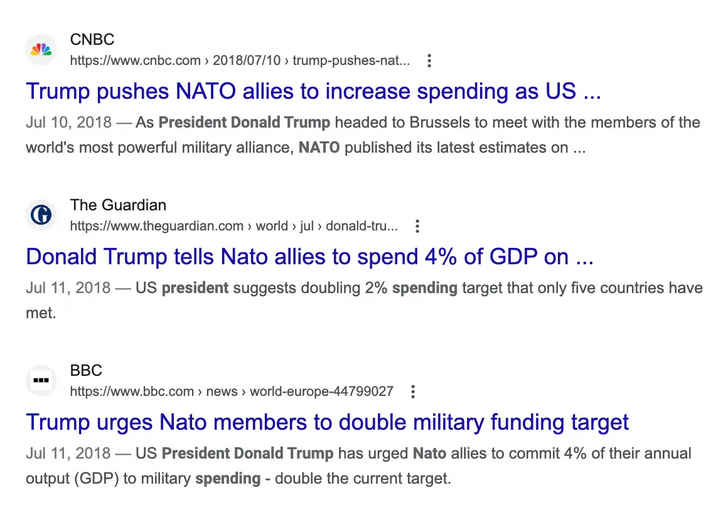
Spend a minute of your life looking at a chart that shows how much countries spend on their militaries as a percentage of GDP. The US spends about 3.5%, while Germany spends about 1.4%. For years, hawks have argued that the US should spend 4% of GDP on defense, in a well-known debate about reasonable funding for security. NATO members commit to a target of 2% or better, and many don’t make that goal. Donald Trump says he told the leaders of NATO countries that they should make or beat their military spending targets to ensure their own security, and as a negotiating ploy he poked at them and said that he wouldn’t bother to defend people who wouldn’t bother to pay for their own defense.
You can agree with his argument or disagree with his argument, and make whatever argument you want about the carefulness or recklessness of Trump’s rhetorical style, but none of this is obscure.
And so now we’re living through an ORANGE MAN LITERALLY HITLER CRISIS, as Orange Satan Drumpf tells the Putin Devil to absolutely MURDER all the Europeans and the world teeters in agony at the very brink of a harvest of slaughter. Here, let Forbes just give you the news, straight and factual and to-the-point:
THE MEAN MAN SAYING FOR THE PUTIN DEVIL TO MURDER ALL THE LITTLE BABIES professional journalists calmly explain, absolutely biting through the rubber nipple on their pacifiers. Sackcloth, ashes, endlessly refillable SSRI prescription: journalist starter kit.
In the car a few minutes ago, I turned on the radio mid-interview to hear a hysterical NPR anchor begging a European pundit to agree that Trump is a vicious monster, and the European — I missed his name — sighed and said that look, this is a debate that we’ve been having for a while, it’s a pretty normal discussion. BUT DON’T YOU THINK HE’S AN ORANGE MURDER DEVIL!?!?!? Then they played an important clip of Slow Joe Biden slurring and fake-shouting about Trump’s un-American cruelty, sounding almost as angry as he was when he talked about how many actual chips they put in the potato chip bags. This is why I listen to NPR in short bursts, like a gun run from an A-10. Brrrrrrrrrt, and off.
But what’s inescapable about this extremely dull moment, yet again, is that an allegedly elite layer of political, academic, and media figures are taking something routine and willfully inflating it into a five-alarm global crisis. It … must be a day ending in -y? Nothing is ever bad, or disagreeable, or arguable; every event is The Absolute Worst. Every development must be discussed in hyperemotional terms; every objectionable act is devastating, terrifying, destructive, ruinous, treasonous, unforgivable. No one disagrees with us; rather, they are ENEMIES OF EVERYTHING WE STAND FOR!!!!!

The Big Picture – NATO: Partners in Peace (1954)
Army University Press
Published Nov 13, 2023NATO: Partners in Peace follows the creation and impact of the North Atlantic Treaty Organization (NATO). Created in April 1949 with twelve founding members, this organization’s goal was to protect the inherent rights of individual states through collective defense. In this episode from The Big Picture series, General Dwight D. Eisenhower offers a speech before he deploys to Europe to become the first Supreme Allied Commander Europe (SACEUR). This is followed with footage of the buildup and training of European forces. Once Eisenhower leaves NATO to campaign for the presidency, General Matthew Ridgway replaces him as NATO commander. One significant problem NATO forces faced was the fact that each nation had its own weapon systems and ammunition, an issue the U.S. wanted to address with the standardization of the 7.62mm cartridge. Perhaps as a deterrent to the Soviet Union, NATO: Partners in Peace depicts new weapons that could be used against a large enemy force such as remote-controlled missiles, napalm bombs, and the massive atomic cannon.
February 13, 2024
Step aside, puny humans, here comes “the new Marxist Homo tabularasa“
At Postcards from Barsoom, John Carter considers what might occupy the god-shaped space in the new secular religion of wokeness:

Ryan T. Hancock, via Postcards from Barsoom
It’s trite to observe that the Great Awokening is a fundamentally religious phenomenon, representing a sort of secular Abrahamic heresy mining the latent guilt swirling within the hearts of post-Christian whites and thereby activating the messiah complexes of the Anglosphere’s Protestant populations, who have exhibited other similarly self-destructive enthusiasms throughout their ethnoreligious histories. It’s trite because it’s so obviously apt, but it raises an obvious question: if Woke is a cult, what is its god?
I don’t mean whichever symbols or causes they flock to from one moment to the next. These are merely mortal embodiments of archetypal forms, rising perhaps to the level of heroes or saints should their celebration become widespread enough. George Floyd was not deified but beatified, not because of anything he did in his life (which no one really argues wasn’t a sewer of petty criminality), but because in his death he was filled with a holy spirit of some kind. What spirit was that?
One answer to this question is provided in the title of Lorenzo Warby‘s ongoing series “Worshipping the Future“. As Warby explains in “The Deep Appeal of Marxism“, progressivism is besotted with the transformational future, an imaginary utopia qualitatively different from and superior to the Tartarus of antiquity in every way – an Elysium of peace, stability, equality, wealth, ease, comfort, and bliss, existing in a perpetual state of liberatory ecstasy in which the war, chaos, poverty, strife, suffering, and misery of the past have been permanently eradicated.
As Warby writes, there is no limit to the delights of the transformational future:
As a thing imagined, it can be imagined to be as perfect as one likes. This means politics grounded in an imagined future can be as morally grandiose as one likes, with whatever moral urgency goes with such imaginings.
This is deeply intoxicating.
Grounding one’s politics in an imagined future also provides huge rhetorical advantages, precisely because said future is as perfect as one wants it to be. Anyone who wishes to defend some actually existing thing has the problem that it will be the product of trade-offs and human failings.
An “imagined future” believer, by contrast, can just wish all that away for political purposes while hanging current imperfections on those who wish to defend what exists. In any contest between the actual and the imagined, the imagined sparkles ever so more brightly.
This utopia is of course always at some point just over the horizon. Just one more revolution, bro, and we’ll reach the Promised Land! Just one more gulag, and we’ll get to utopia, I swear! C’mon bro, just one more mass grave, we’re almost there, you gotta believe me!
There is a fatal epistemic flaw at the heart of this faith: no information can be extracted from the future, because information can only be obtained from the past.
Not only does the imagined future have no reality test, it distorts one’s use of the information to which we do have access. The past is profoundly discounted by its distance and difference from the imagined future. It is both morally discounted — a record of sin and depravity — and structurally discounted, because it has not undergone the social transformations that are imagined to change everything.
If the imagined future is a secular heaven, then the past becomes a moral hell from which we must escape. All information from it is tainted as profoundly impure and corrupt: the record of sin.
This means that when policies fail to obtain the desired result, for example erasing ethnic and sexual distinctions through affirmative action and thereby producing the new Marxist Homo tabularasa, no corrective action is possible. Policy failure exists in the past, which is ignored as sinful, and which therefore cannot be learned from. The only permissible answer to failed progress is to progress faster, with the only possible consequence being to fail harder.


