
Forgotten Weapons
Published Nov 27, 2023The Portative was an attempt by the Hotchkiss company to make a light machine gun companion to their heavy model (which had found significant commercial success). The Portative used the same feed strips, albeit loaded upside down, and the same gas piston operation, but a very different locking system. Instead of a tilting locking block the Portative had a “fermeture nut” that rotated to lock onto the bolt with three sets of interrupted thread locking lugs. In addition, many of the traditionally internal parts were mounted externally on the Portative, and it was quite the awkward gun to use.
The Portative was adopted by the American Army as the Model 1909 Benet-Mercié, and by the British early in World War One as a cavalry and tank-mounted gun. The remainder of Portative contracts were relatively small from second-tier military forces, including several South American countries.
(more…)
February 29, 2024
Hotchkiss Portative: Clunky But Durable
February 28, 2024
The rise of the “Pretendian” is an inevitable consequence of academia’s ultra-woke culture
Freddie deBoer summarizes why we’ve seen a vast increase in the number of Pretendians in western academia, but especially in Canada and the United States (and we can be almost certain that there are a lot more who haven’t yet been revealed, because the incentives to pretend are so enticing):

“The Pretendians”, a CBC documentary – https://www.cbc.ca/passionateeye/episodes/the-pretendians
- Certain jobs in academia are highly prized
- There are far more applicants than openings for those jobs and so competition for them is incredibly fierce
- Representing yourself as a member of an underrepresented minority significantly improves your odds of getting such a job, and in certain fields representing yourself as a person of indigenous descent improves those odds dramatically
- Indigenous identity is easy to fake and difficult to disprove, and the cost of accusing someone else of faking it, in academia, can be very high indeed
- Most crucially of all, the social culture of academia strongly prohibits speaking frankly about these facts
Jay Caspian Kang’s new piece on the “Pretendian” crisis in academia is deeply researched and compulsively readable, and read it you should. But fundamentally everything you need to know about the problem is in the numbered list above. You’ve created a fiercely competitive process in which a segment of people are given a very large advantage, there are few if any objective markers that can disprove that someone is a member of that segment, and you’ve declared it offensive to question whether someone really is a member of that segment, outside of very specific scenarios. (When I was in academia people spoke very darkly about the concept of ever questioning someone’s indigenous identity, called it the act of a colonizer, etc etc.) The obvious question is … what did you think was going to happen? Humanities and social sciences departments have, through the conditions described above, rung the dinner bell for people pretending to have indigenous heritage. They now act shocked when such people show up. I find it disingenuous and untoward. This behavior is the product of the incentives that you yourself built. Of course it’s a stain on the integrity of the fakes. But you made it inevitable that this would happen. Reap what you sow.
Why Germany Lost the First World War
The Great War
Published Nov 10, 2023Germany’s defeat in the First World War has been blamed on all kinds of factors or has even been denied outright as part of the “stab in the back” myth. But why did Germany actually lose?
(more…)
QotD: When the rules in the dating market all changed
So far we’ve only been talking about guys, but the gals went through their own version of the same process way back in the days. Indeed, it’s because the girls changed that the guys got into PUA in the first place.
Under the old dispensation, back before the Clinton Era (1988-2001), everyone acknowledged that there were a lot of users and abusers, douchebags and parasites and losers, out there in the world. That being the case, simply being an all-around ok guy with a steady job — what the PUAs came to term “beta providers” — was, in itself, a pretty solid resume in the dating market. “Just be yourself” was every guy’s dad’s advice when it came to dating, and back then it was pretty solid, since it was assumed that the decent job etc. flowed from being a decent human being. And since every girl’s mom was telling her complementary things, the system worked … until it didn’t, and you can date the change precisely: June 6, 1998, the premiere of the HBO series Sex and the City.
[…] Everyone has met one of those “one of the guys”-type girls. They’re great fun, and while you know what I mean when I say they’re not necessarily marriage material as-is, you therefore also know what I mean when I say they really are what feminists all claim to be: Strong, confident women. They are what they are, and they know it, take it or leave it.
The problem is, most women — and, it goes without saying, all feminists — aren’t “strong, confident women”, in the same way the vast majority of guys aren’t naturally “alpha males”. That’s the dialectic I’ve been trying to get at in this series of posts. Sex and the City, as much as every episode needs to be burned and the ashes shot into deep space, was just the manifestation of a long-developing process. Thanks to all that “self-esteem” shit that started in the Seventies, sometime in the Clinton Era a critical mass of young women decided that what they needed was to be “strong” and “self-confident”. But they didn’t know how to do that, because the people telling them this were fat lesbian college professors. Then HBO, sensing a valuable market niche, got into the act …
Sex and the City […] is the gayest show in the history of television. Carrie and the Gals don’t act like women; they act the way women think men act — which is to say, they act like gay men. Recall that the late 1990s also saw an explosion of female “comedians”, whose one “joke” was some version of “I got my period today, but damn, I still crave dick.” (Sex and the City, you’ll recall, was pitched as a comedy). And that’s a serious problem, because as every straight guy has said at least once in his life, being gay would be fabulous if not for the “sex with guys” part. I mean, how awesome would it be (every young man thinks), if you could reorient your whole life around your crotch?
Severian, “Mental Middlemen III: SATC”, Rotten Chestnuts, 2021-05-06.
February 27, 2024
The Company that Broke Canada
BobbyBroccoli
Published Nov 4, 2023For a brief moment, Nortel Networks was on top of the world. Let’s enjoy that moment while we can. Part 1 of 2.
00:00 This is John Roth
02:04 The Elephant and the Mouse
12:47 Pa without Ma
26:27 Made in Amerada
42:15 Right Turns are Hard
57:43 Silicon Valley North
1:07:37 The Toronto Stock Explosion
(more…)
February 26, 2024
FN Model 30: The First Belgian BAR
Forgotten Weapons
Published Nov 22, 2023FN played a role in the production of Polish wz.28 BARs, and in the process obtained a copy of the technical package for the weapon, and converted it to metric measurements. Under the supervision of Dieudonne Saive, this was used as the basis for FN’s own BAR production, called the Modelé 30. Production was done with a license from Colt, who owned the rights to Browning’s patents on the BAR.
The Model 30 was basically a Colt R75 (Model 1925), but incorporated a few improvements. Most significantly, the male and female parts of the gas system were swapped, which prevented carbon from building up and eventually jamming the gas piston. In addition, the bolt removal latch was improved from the US pattern, and the Polish wz.28-style rear sight was used. Lastly, a rate-reduction mechanism on the fire control group gave the gun “slow” and “fast” settings, of roughly 350rpm and 600rpm instead of the traditional semi and full auto settings.
Production began in 7.65mm, and the Belgian Army adopted the weapon, taking deliveries from 1930 until occupation in 1940. The Model 30 was also made in 8mm Mauser, and exported to China and Ethiopia. The design was fairly quickly supplanted in 1932 by the FN Modelé D, which added a quick-change barrel mechanism to the design, and this pattern sold more widely.
(more…)
QotD: Lockdown rebuttal
Nor were lockdowns “essential”. As Nocera and McLean note,
… the weight of the evidence seems to be with those who say that lockdowns did not save many lives. By our count, there are at least 50 studies that come to the same conclusion. After The Big Fail went to press, The Lancet published a study comparing the COVID infection rate and death rate in the 50 states. It concluded that “SARS-CoV-2 infections and COVID-19 deaths disproportionately clustered in U.S. states with lower mean years of education, higher poverty rates, limited access to quality health care, and less interpersonal trust – the trust that people report having in one another.” These sociological factors appear to have made a bigger difference than lockdowns (which were “associated with a statistically significant and meaningfully large reduction in the cumulative infection rate, but not the cumulative death rate”.)
Second, the lockdowns were, contra Mr. Orrell’s claim, utterly unprecedented. Isolating individuals known to be infected, such as Typhoid Mary, is a categorically different measure than locking down whole societies. Such lockdowns were never used until China locked Wuhan down in early 2020. Here again are Nocera and McLean: “On April 8, 2020, the Chinese government lifted its lockdown of Wuhan. It had lasted 76 days – two and a half months during which no one was allowed to leave this industrial city of 11 million people, or even leave their homes. Until the Chinese government deployed this tactic, a strict batten-down-the-hatches approach had never been used before to combat a pandemic. Yes, for centuries infected people had been quarantined in their homes, where they would either recover or die. But that was very different from locking down an entire city; the World Health Organization called it ‘unprecedented in public health history’.”
It’s jarring to encounter in an essay that features many excellent arguments – as Mr. Orrell’s does – such irrational and utterly uninformed claims as Mr. Orrell offers about lockdowns.
Donald J. Boudreaux, responding to an article by Brent Orrell in Law & Liberty, 2023-10-31.
1. “COVID Lockdowns Were a Giant Experiment. It Was a Failure.” Intelligencer, October 30, 2023.
February 25, 2024
Iwo Jima! – WW2 – Week 287 – February 24, 1945
World War Two
Published 24 Feb 2024This week the Battle of Iwo Jima begins and American forces raise the Stars and Stripes on Mount Suribachi. Elsewhere, the Allies fight the stiff Japanese defences in Manila. The Red Army continues fighting through East Prussia and Pomerania as Stalin plans the next stage of the advance on the Reich. There are Allied advances in Western Europe and Italy too.
00:01 Intro
00:54 Recap
01:16 Iwo Jima Begins
06:32 The war in the Philippines
07:56 The Battle of Manila
11:12 Fighting in Burma
12:14 Operation Grenade
13:46 Operation Encore
14:38 Soviet plans for new offensives
21:28 Moscow Commission Meets
(more…)
QotD: From the M1903 Springfield to the M1 Garand
Lt. General George Patton famously called the M1 Garand “the greatest battle implement ever devised“, a quote often repeated reverently in the context of World War II nostalgia. The US Government after the war gave away millions of M1 Garands, making it a popular civilian rifle for hunting and competitive shooting.
But nostalgia aside, it is also possible to view, from the high perch of hindsight, the M1 Garand as a missed opportunity. The most advanced battle rifle of World War II ultimately looked back too much to the past rather than pointing the way to the future. During its development, senior military officials applied the perceived lessons of the Spanish American War to a rifle designed to solve the problems of the Great War. This intervention prevented the M1 Garand from becoming something closer to a modern assault rifle, with an intermediate power cartridge and higher magazine capacity. The army was in no hurry to ditch the rifle that had won World War II, meaning that the United States did not field its first true assault rifle until two decades after the concept had been invented by the Germans in 1943 and soon successfully adapted by the Soviets in 1947. The first American assault rifle, the M16, would not debut until 1965.
First a necessary caveat: rifles were not the decisive weapon in World War II. For the most part the small arms deployed by the United States had been designed to fight World War I: the Browning Automatic Rifle (1918), the M1919 Browning Medium Machine Gun (as the date implies, first fielded in 1919) and the M2 Browning heavy machine gun, designed in 1918 and so good it is still used over a century later. In contrast, German machine guns were somewhat more recent in design: the MG 34 (as the name implies, first fielded 1934) and the MG 42. During the war, the Germans invented the first true assault rifle, the StG 44.
The secret sauce of the US Army by 1944-45 had little to do with firearms at all: it was a combination of ready mobility through motorization combined with deadly artillery and close air support, enabled by an unmatched communication system that allowed forward observers to direct and adjust fires to lethal effect. The American way of war was rooted in fleets of trucks and jeeps, networks of radios and heaps of shells. Having a nice semi-automatic rifle was ancillary to a conflict like World War II. But the M1 Garand is a useful window into the vagaries of military procurement and technological innovation, which require developers to at once predict the operational environment of the future and analyze the lessons of the past.
Throughout the 1920s, officers at the Infantry School in Fort Benning experimented with new tactics that they hoped would again allow for mobile infantry combat and avoid the trench stalemate of World War I. The basic solution was some form of “fire and maneuver”, in which one section of a unit (say a squad or platoon) would lay down a sufficient base of small arms fire to suppress the enemy so as to facilitate the other section’s advance. By alternating suppression and assault the element might leapfrog its way forward, even against entrenched enemy machine guns.
For such a tactic to work, infantry platoons needed a lot of firepower. Some might come from light machine guns, like the Browning Automatic Rifle, which was issued to individual infantry squads. But it was generally realized that individual infantrymen needed to be capable of a far higher rate of fire than could be provided by the standard issue rifle, the bolt-action M1903 Springfield, fed from a five round magazine. To this end, the US government set about developing a semi-automatic rifle.
The charge was taken up by John C. Garand, a Canadian-born, self taught firearms designer who worked for the Springfield Armory in Massachusetts. Garand’s solution to make the rifle self-loading was to insert a piston beneath the barrel. When the gunpowder exploded in the cartridge, the gas produced in the explosion propelled the bullet out the barrel. But some gas was bled off into a cylinder below the barrel (which gives the M1 its peculiar appearance of seeming to have two barrels); the pressure of the gas in the cylinder drove a piston.3 This piston attached to an operating rod which pushed the bolt of the rifle back, ejecting the spent casing, and allowing a spring in the internal magazine to insert another cartridge into the chamber before a separate spring pushed the operating rod forward and closed the bolt for the next shot, all in a fraction of a second.
Garand had initially worked on a rifle chambering the standard .30-06 cartridge used by the M1903 Springfield rifle (the .30 indicates that the bullet had a diameter of .30 inches, while the 06 indicates that the cartridge had been adopted in 1906; the round is often pronounced “thirty-ought-six”. But when a rival designer named John Pedersen, also affiliated with Springfield Armory, developed a semi-automatic design that chambered a lighter .276 (7mm) round, Garand retooled his project for the lighter round as well, producing a prototype known as the T3, with subsequent refinements labeled the T3E1 and T3E2. The smaller round meant that the internal magazine of the T3E1/2 could accept clips of 10 bullets, doubling the magazine capacity of the M1903 Springfield.
Army officials were very interested in the new round, but wanted proof that a lighter bullet would be sufficiently lethal in combat. A series of grisly ballistic tests were therefore ordered, pitting the .276 round against the traditional .30-06. In 1928, anesthetized pigs were shot through with both rounds. To the surprise and consternation of traditionalists, the .276 did far more damage in the so-called “Pig Board”. This is not paradoxical: the lighter round was more likely to “tumble”, precisely because it was lighter and so more likely to have its trajectory disrupted by bone and tissue; the tumble meant that more of the kinetic energy was expended inside the target, causing far more damage. The .30-06, meanwhile, as a more powerful round, was more likely to punch clean through, retaining its kinetic energy to keep moving forward after passing through the target. Eventually, tests of this sort would be used to sell the army on the lethality of the 5.56mm round used by the M16/M4, which has an even greater tumble, and causes even more grievous injuries. Out of concern that the fat bodies of pigs did not accurately replicate the human teenagers that the new round was designed to kill, a new test was inflicted upon goats, seen as more appropriately lean and therefore better analogs. The result was the same in favor of the .276 (a lighter .256 performed even better). With two rounds of tests vindicating the .276, the Army demanded that its new rifle chamber the .30-06. The final decision was made by Douglas MacArthur himself.
The .30-06 round itself had been the product of a painful lesson learned during the Spanish American War. Here, American troops, armed with Krag M1892 rifles, had found themselves badly out-ranged by Spanish troops armed with Mausers; the famous charge up San Juan Hill occurred after US troops had advanced for some distance under a hail of unanswered rifle fire. Given the importance of sharp shooting to the American military mythos, getting handily outranged and outshot by Spanish forces was a painful embarrassment. The first order of business had been to adopt the Mauser design: the M1903 Springfield was essentially a modified Mauser, as the US government had licensed a number of Mauser’s patents. By upgrading the M1903 to take the heavy .30-06 round, the Army ensured that soldiers could engage targets over a kilometer away. Beyond the deeply ingrained “lessons learned” from the Spanish American War, the mythos of the deadly American sharpshooter was strongly entrenched. Even as disruptors at Benning developed new infantry tactics that stressed volume of fire over accuracy, the phantoms of buck skinned frontiersmen sniping at British redcoats from a thousand paces still occupied the headspace of military leaders; they wanted a rifle with long distance accuracy. The sights on the M1 Garand adjust out to 1200 yards.
But MacArthur’s reasoning seems to have been primarily motivated by administrative and logistical concerns, as he cited the generic difficulties of fielding a lighter round. Some of these challenges may have been related to production and distribution of a sufficient stockpile of new caliber ammunition. There may have also been a concern with the new round complicating the logistics of line companies. The army also used .30-06 for the BAR and Browning medium machine gun, and having all of these shoot the same round in theory simplified the supply of line companies, and allowed for cross-leveling between weapons systems. Similar concerns have the US Army maintaining a policy of only having 5.56mm weapons at the squad level (thus the M4 and M249 Squad Automatic Weapon both shoot 5.56, and the SAW can shoot from M4 magazines).4 Still, MacArthur’s concerns seem unfounded in hindsight. The United States was about to produce billions of bullets during World War II. American troops were about to be so lavishly supplied that distributing two types of bullets would have been readily feasible given the soon to be proven quality of American logistics.5
With MacArthur’s edict, Garand retooled his rifle back to the .30-06 caliber, and his design was finally accepted in 1936. But the larger and more powerful round required a design change: the internal magazine now took clips of eight bullets instead of ten. Two rounds may not sound like much, but every bullet can be precious in a firefight, and this represented a 20% reduction in magazine capacity. Spread over a company sized element, the reduced clip capacity represented over two-thousand fewer rounds that a company commander could expect to fire and maneuver with. Indeed, the M1’s volume of fire proved generally insufficient to suppress the enemy on its own during the war, evidenced by the habit of equipping rifle squads with two Browning Automatic Rifles, instead of one. Marine divisions by the end of the war often deployed three BARs per squad.6
Michael Taylor, “Michael Taylor on The Development of the M1 Garand and its Implications”, A Collection of Unmitigated Pedantry, 2023-09-08.
1. TM 9-1005-222-12.
2. Thus George Wilson, a platoon leader and later company commander in the Fourth Infantry Division, describing a platoon scout stumbling upon the enemy: “The second scout emptied the eight round clip in his M-1 so fast it seemed like a machine gun … the rest of us moved very cautiously and found three dead enemy soldiers in the road.” (G. Wilson. If You Survive. Ivy, 1987).
3. John Garand’s initial design, and early production M1s, had a gas trap inserted over the muzzle to catch the gas after the bullet had exited; when this proved prone to fouling, a design modification drilled a small hole in the barrel just before the muzzle to allow the gas to bleed into the cylinder, most M1 Garands had this “gas port” system.
4. In 2023, US Army infantry will begin transition to the M7 carbine and M250 Squad Automatic weapon, which will both use a 6.8mm bullet, out of concerns that the 5.56 NATO is insufficient to penetrate body armor.
5. Editor’s Note: I agree with Michael here in principle: US logistics could have managed this. But I would also note that part of the reason American logistics were so good is that they applied MacArthur’s reasoning to everything, reusing vehicle chassis, limiting the number of different ammunition calibers and demanding interchangeable parts across the whole range of military equipment. Take one of those decisions away and the whole still functions. Take all of them away and one ends up with the mess that was German production and logistics.
6. Editor’s Note: BAR goes BARRRRRRRRRRR.
February 24, 2024
Never mind the unfunded liability … money printer go brrrr!
Kulak at Anarchonomicon points out that the US government’s debt situation — which was alarming 20 years ago — has continued to get worse every year:

Libertarian Economists have been predicting this collapse of the federal system would happen “By About 2030” since before 2008. I remember in high school in the early 2010s listening to Ron Paul lectures and visiting USDebtClock.com, this was a hot button issue after 2008 … (then of course there was no political will to do anything and everyone just stopped talking about it)
I honestly forget that everyone around me doesn’t already know this, this is so common and accepted in libertarian and economic circles, and everyone who knows it got bored of eyes glossing over when they tried to explain it (in an autistic panic) decades ago.
US Unfunded liabilities:
Social Security, Medicare, Medicaid, US Debt, and Federal employee benefits and pensions, are all basically intergenerational ponzi schemes that require constant 1950s level population growth amongst the productive tax paying middle-class to maintain. By 2000 it was obvious this population growth was not happening, that population was beginning to age and collapse, and NO, the illegals at the border weren’t adequate replacements … (they weren’t adequate to prop up federal expenses in 2000 when they were still Mexican, now that they’re Guatemalan, Haitian, and Senegalese they’re almost certainly a net drain).
The Specter of Mass Boomer retirements with few to no children and grandchildren to replace them and pay for all the costs of their retirements and healthcare was maybe the slowest but most assured crisis ever to be seen in human history … Demographics is destiny.
This was a foreseen problem in 2000 when US Debt to GDP (just the portion that’s already been spent and interest has to be paid on) was 59% of GDP. Today the US Debt to GDP ratio is 122% of GDP whilst just in the past 24 years. Absolute US Federal Debt (not including state or local) has grown from 5.6 trillion dollars to 34 trillion dollars (102k per citizen: man, woman, and child). just the interest that has to be paid out of your tax dollars on that debt is set to eclipse ALL US Military spending sometime this year … And by 2028 Debt to GDP will be 150% (46.4 Trillion, 132k per citizen, 12 trillion more in 4 years, with no additional spending bills) and the Interest (at current estimates) will be over 2.5 trillion dollars, over a third of all Tax Dollars brought in will be spent on just interest, because dollar confidence has collapsed and the only way to keep inflation from destroying the dollar has been to radically raise the interest rates the Federal Reserve offers.
Now all that, That catastrophic state of things, is just the debt, the money that’s been spent … The real crisis is the Unfunded liabilities, all the promises the US has made to Boomers (who dominate the vote) and others about money they’re GOING to spend.
As of now total Unfunded liabilities stand at 213 trillion dollars, $633,000 per US Citizen (Man woman, and newborn babe)… These are all dollars the US has promised to pay to someone somewhere at some point: Social Security, Medicare, Medicaid, Federal pensions, VA Benefits, etc. And cannot in any politically feasible way restructure or get out of.
If no one ever contributed another dime to social security, and in so doing was promised in turn significantly more than that dime (it’s a Ponzi scheme, it loses money in proportion to and at a greater rate than the money being contributed to it (every dollar you contribute you’re promised multiple dollars in return, and your dollar is not invested, it just pays off previous contributors)) … If everything froze and every young person was locked out of ever receiving Social Security, Medicare, or Medicaid, the Unfunded Liability would be $633k per every man, woman, and child … that’d be the debt a newborn American would be born with.
However because it is NOT frozen and it will not be, by 2028 that number will Rise to $837k and an ordinary household of 4 will have seen their, politically unavoidable, family obligation in future tax payments to the federal government increase by $804,000 in just 4 years.
If your response is that your family doesn’t even make 804k in 4 years and there’s no way you could ever pay that much in 4 years given its just going to increase at a faster rate the next 4 years … CONGRATULATIONS! 90% of families don’t make that much, and less than 1% of families could ever afford to pay that much in taxes in a 4 year time.
This has been slowly growing for decades, and in the late 2000s and 2010s Ron Paul types were screaming that those Benefits needed to be reformed NOW (in 2008) or they’d drown America. But of course, cutting benefits is political Anathema to boomers, so nothing was done …
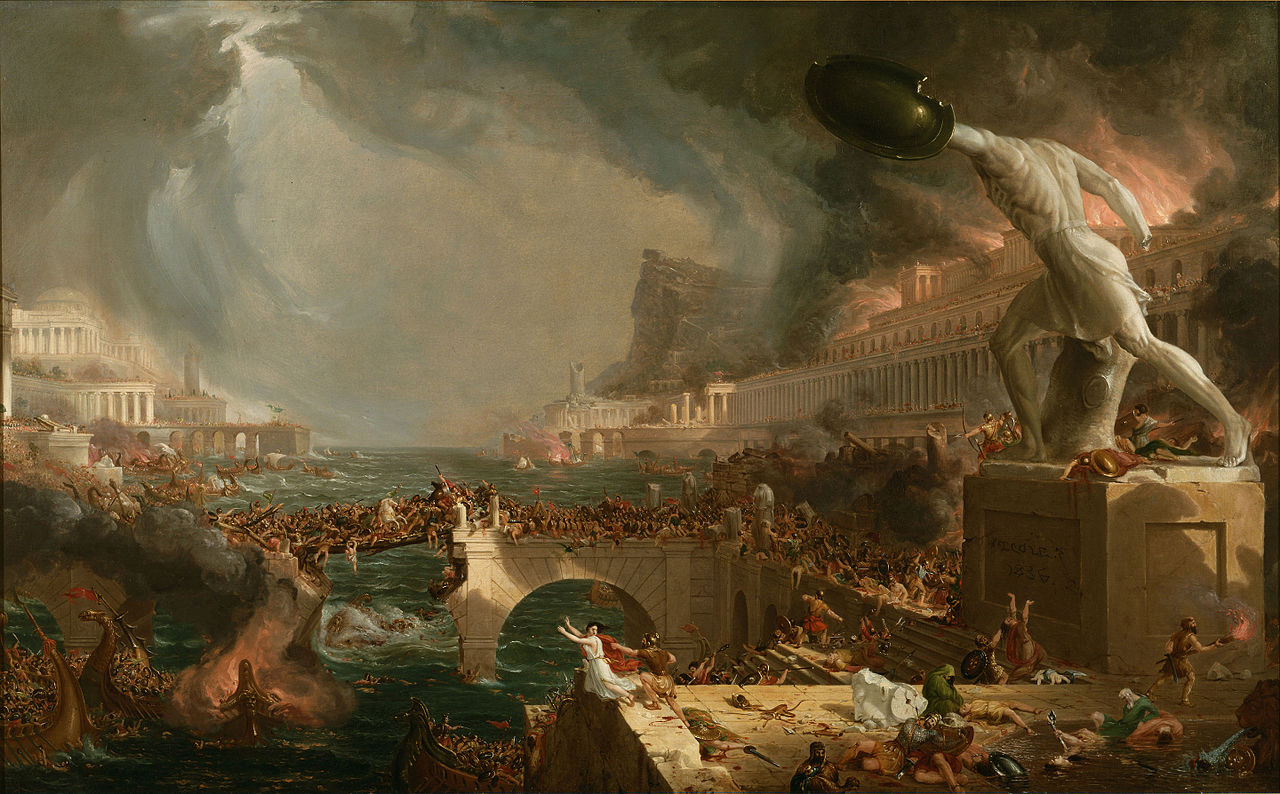
The Course of Empire – Destruction by Thomas Cole, 1836.
From the New York Historical Society collection via Wikimedia Commons.
Times might be tough right now, America, but at least you’re not Canada
You may be feeling the pinch from Bidenflation, election year stresses, and political lawfare, but at least you’re not up in America’s hat:

It’s late February, a time of year when many Americans contemplate stacks of documents and receipts, dreading the moment when they’ll have to square accounts with government extortionists. That this comes as the state grows increasingly intrusive and coercive adds insult to injury, since we pay the bill for this mistreatment. But it could be worse; we could be Canadian!
Same Inquisition, Different Dollar
“As tax season ramps into high gear in Canada, the average citizen is facing an unholy ream of paperwork so daunting that even the Canada Revenue Agency isn’t entirely sure how it all works,” Tristin Hopper wrote this week for the National Post. “An infamous 2017 Auditor General report found that CRA call centres ‘gave wrong information to callers almost 30 per cent of the time’.”
Oh, OK. That doesn’t sound much different from the experience here in the U.S., where the IRS hands out the wrong information maybe a quarter of the time. (Or more. Who knows?) But Canadians pay a high price tag for the privilege of spelling “call centre” with the “r” in front of the “e”.
But a Higher Tax Bill North of the Border
“In December 2015, Canada’s new Liberal government introduced changes to Canada’s personal income tax system,” Canada’s Fraser Institute, a free-market think tank, noted in 2020. “Even before the changes, the country’s combined federal and provincial top marginal tax rates compared unfavourably to those in the United States and other industrialized countries. … Nine Canadian provinces occupy the list of 10 jurisdictions with the highest top combined marginal income tax rates and all provinces are in the top 13 [across the U.S. and Canada].”
Umm. Ouch.
In truth, comparing tax burdens requires a deep dive because of differences in how taxes are applied, income brackets, deductions, and the like. Fans of big government always want to balance costs against “benefits” of government services, as if being mugged to support a state monopoly should be welcomed by those who’d rather shop among competitors or entirely forgo some services. Suffice it to say that comparisons of provincial and state tax burdens generally reveal a lighter touch south of the border.
Worse, though, the think tank finds overall economic freedom slipping across Canada.
Higher Taxes Reflect Less Freedom
“For the first time, every Canadian province ranks in the bottom half of jurisdictions in our annual rankings of economic freedom in North America,” Fraser announced of its Economic Freedom of North America 2023 report. “Alberta in the all-government index is once again the highest-ranking Canadian province but it has declined substantially. In the all-government index, Alberta is now tied for 31st place out of 50 U.S. states, 32 Mexican states, 10 Canadian provinces, and the US territory of Puerto Rico.”
Economic freedom is defined as you’d expect, with economic activity involving “minimal government interference”. As the report adds, “an index of economic freedom should measure the extent to which rightly acquired property is protected and individuals are engaged in voluntary transactions”.
Fraser compares the states and provinces to each other within their countries, and also across Canada, Mexico, and the United States. For the purpose of comparing jurisdictions across three nations, the report looks at six areas of economic activity: government spending; taxes; labor market freedom; legal systems and property rights; sound money; and freedom to trade internationally.
The highest ranked jurisdiction is New Hampshire, followed in the first quartile by Florida and 20 other U.S. states. Alberta ranks at 31, between Missouri and Connecticut. British Columbia comes in at 45, with Ontario at 50 and Manitoba at 54. The last-ranked U.S. state is Delaware, at 53, though the territory of Puerto Rico ranks at 61. Quebec brings up the rear for Canada, at 56.
QotD: Big government
[…]
What should have died on September 11th is the liberal myth that you can regulate the world to your will. The reduction of a free-born citizenry to neutered sheep upon arrival at the airport was the most advanced expression of this delusion. So how’s the FAA reacting to September 11th? With more of the same kind of obtrusive, bullying, useless regulations that give you the comforting illusion that if they’re regulating you they must be regulating all the bad guys as well. We don’t need big government, we need lean government — government that’s stripped of its distractions and forced to concentrate on the essentials. If Hillary and Co want to argue for big government, conservatives could at least make the case for what’s really needed — grown-up government.
Mark Steyn, “Big Shift”, National Review, 2001-11-19.
February 22, 2024
Trump’s crude, threatening rhetoric on NATO’s cheapskates is … right
In The Line, Philippe Lagassé joins all right-thinking people in condemning Donald Trump’s campaign trail threats to not defend NATO’s freeloaders if they’re attacked by, say, Vladimir Putin:

Donald Trump recently called into question the core principle of the North Atlantic Treaty Organization (NATO). As a collective defence alliance, NATO operates on the principle that an attack against one member is an attack against all. This principle is enshrined in Article 5 of the NATO agreement. Although Article 5 allows each ally to respond as they see fit, there’s an understanding that allies have an obligation to defend each other.
On the campaign trail, Trump declared that, if elected, he wouldn’t defend NATO allies if they’ve failed to spend two per cent of their Gross Domestic Product (GDP) on defence. Not only that, he said he’d encourage Russia to attack these allies. As Trump reiterated last week: “Look, if they’re not going to pay, we’re not going to protect, okay?” These comments raised serious concerns within NATO. Jens Stoltenberg, NATO Secretary General, warned that Trump is striking at the underlying logic of the alliance. The Secretary General stressed that “We should not undermine the credibility of NATO’s deterrent”.
What should we make of Trump’s threat? On the one hand, it’s clearly dangerous and evidence that a second Trump presidency could shake the foundations of the alliance. We should rightly be worried and condemn such reckless rhetoric. On the other hand, this is classic Trump. His approach to international politics can best be understood as “mobster diplomacy”. He demands personal loyalty as the head of the “family” of Western liberal democracies. When it comes to trade deals, he echoes Don Corleone in making offers that partners can’t refuse. As for alliances, he sees them as a protection racket. When it comes to NATO allies, his message is simple and direct: “Nice country you have there … pity if something happened to it”.
Allied leaders and academics can protest that the two per cent target isn’t a payment to the United States; it’s a measure of the relative amount allies spend on their own militaries, not a fee they owe Washington. While true, it’s a waste of breath to point this out. Trump and his supporters don’t care. They see most allies as freeloaders who’ve been coasting on American military power for too long. And you know what? They’re not wrong. That’s the rub for those who are understandably horrified by Trump’s comments. Far too many NATO allies, including Canada, have been content let the United States carry a heavy defence spending burden, while we focus on other priorities. That’s what Trump is ultimately getting at here, however menacingly.
Canada has been particularly unwilling to pay its agreed share, actually cutting the military budget late last year while many of our European allies were increasing theirs. We’re habitually the ones who slip out of the room when it’s our turn to buy a round, militarily speaking.
Allied War Crimes, Latin American Troops, and Top-Secret Proximity Fuzes – WW2 – OOTF 033
World War Two
Published 21 Feb 2024Did the Western Allies commit war crimes? What did Latin American troops do during the war? And, how did the top-secret proximity fuze change the face of warfare? Find out in this episode of Out of the Foxholes.
(more…)
The feminization of movies – the Luke Skywalker Effect
Like Lorenzo Warby, I was a fan of the first three Star Wars movies, but rapidly lost interest as the series progressed (I think I watched about half of Attack of the Clones before giving it up as a hack job). Here he gives his opinion on one of the biggest reasons why the later movies sucked:
I am, in many ways, a Stars Wars kid. I can remember sitting in a cinema in 1977, listening to the music play as the opening words flowed across the screen and the sound of the Star Destroyer rumbled out of the speakers and thinking “Yes, a film by One of Us”. That is, a film made by a genuine fan of SF.
A film, moreover, that gave us epic characters. Luke Skywalker: young, eager, physically skilled, charmingly gormless. Han Solo: charismatic rogue (who definitely shot first, that’s what charismatic rogues who read the room do). Princess Leia: the epitome of the competent-beyond-her-age young woman making sure the boys don’t get above themselves. Darth Vader: the looming — and yes charismatic — menace. Chewbacca: scary loyal sidekick. Obi-wan Kenobi: wise, world-weary, teacher with intriguing powers. Grand Moff Tarkin: the ruthlessly competent minion that autocrats both want and fear.
A film that was fun, that was embedded in an intriguing universe. A film that understood the need for training, the hero’s journey, building teams. The briefing of the fighters before the attack on the Death Star is a classic example of informing the audience by letting them see the process of getting everyone on the same page.
I loved the first three films: yes The Empire Strikes Back (1980) is the best of them. I was not entirely sold on the Ewoks, but they were fun. Those films were a huge success for very good reasons.
I was less impressed with the prequels. I described The Phantom Menace (1999) as “Star Wars for six year olds”. Lucas should have stuck with the pattern that worked so well for The Empire Strikes Back — get a good director and have good scriptwriters tighten up his story.
When Lucasfilm was sold to Disney, I was actually pleased. Disney, I thought, knew how to tell stories. Rogue One (2016) seemed to be a vindication of that.
When The Force Awakens (2015) came out, I was so happy to have a big screen Star Wars epic film, I just went with it. There were huge problems with the character of Rey, but I wanted to be taken for a ride, and so was: in so many senses.
Looking back, the writing down of the character of Han Solo was a big red flag. In the original trilogy, he grew as a character, as a person. In the first of the sequel trilogy, we were presented with a broken down, ageing failure as husband and father who had decayed to less than what he was when we first met him.
Meanwhile, we had the Mary Sue of a Rey who was just better than the boys as everything, including running the Millennium Falcon. She didn’t need training or experience, she was just naturally awesome because … girl.
Hollywood pretending that women have the same upper body strength as men is pretty pathetic, but never as pathetic as in the light-sabre fight between Rey and the Emo-Teenager Discount Darth Vader aka Kylo Ren. Yes, Ren was wounded, but years of experience and training counted for naught against Rey because … girl.
The Last Jedi (2017) was so much worse. Again, I wanted to like it, but things just niggled at me all the way through, despite my wish to enjoy the ride.
Once I got out of the cinema and began to consider what I had watched I became very angry. The chubby Chinese girl and belittled Black guy side plot was tired agitprop. Snope had been built up as epic villain but was disposed off with ridiculous expedition without any backstory explanation. Admiral Gender Studies was a study in pathetically bad leadership who clearly had no idea of how to build a team yet presented as a righteous authority. Poe Dameron was diminished into Male Initiative Is Bad Because Toxic Masculinity morality-play persona.
Epic military scenes do not work as parables. Parables subordinate story and character to didactic purpose. Epic military scenes really do not work as parables when the didactic purpose itself is so pathetic.
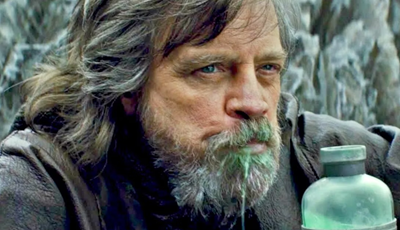
This is all bad enough, but the unforgivable crime against the entire legacy of Star Wars was what was done with Luke Skywalker’s character.
The original Luke Skywalker was a study in epic heroism. Yes, he was genetically advantaged, but he also trained to hone those advantages. He was not only physically brave, he was morally brave. Alone, captive, in the hands of his enemies — having deliberately surrendered to save his friends — he refuses to strike his father down. Alone, he defies the Emperor to his face and suffers terribly for his decision. He earned his capacities and his heroic standing.
What are we presented with in The Last Jedi? A broken and pathetic shadow of his former self. The offhand disposal of Snope has the effect of belittling the characters of Han Solo and Luke Skywalker even further. Their son, nephew and disciple had defected to the Dark Side because of … an explanation that made no character sense at all.
Seriously, the man who had shown that level of moral courage decided to kill his disciple and nephew because he had disturbing visions? It was an insult to the character, to the legacy and to the audience.
The sequel trilogy, particularly The Last Jedi, was a profound insult to legacy. To the legacy of Star Wars and to legacy within Star Wars. Thus was another parable pushed: legacy is pathetic and needs to be abandoned and subverted. The contemporary progressive contempt for all past human striving — it’s so full of male faces don’t you know, and (in the West) white ones — in fictional form.
We were presented with a universe where men fail as mentors and examples and women don’t need such. The later added-in training of Rey in The Rise of Skywalker was a pathetic patch on a deeper story-telling failure.
Any white male was pathetic, a failure, evil, stupid, toxic or some combination of the same. Meanwhile, the protagonist was great because … girl.
This was a vision that is sexist-racist, in a quite deliberate fashion.
The completion of the trilogy in The Rise of Skywalker (2019) had interest only to see how they were going to resolve (or not) all the story-telling holes The Last Jedi had lumbered the trilogy with. Bringing back Ian McDiarmid’s Palpatine — easily the best thing in the prequel trilogy — was a sign of desperation, of creative exhaustion.
Each of the films in the sequel trilogy did worse than at the box office than the one before. A very clear statement of a legacy being run down.


