
… I’m not trying to cast Thomas Hobbes, of all people, as some kind of proto-Libertarian. The point is, for Hobbes, physical security was the overriding, indeed obsessive, concern. Indeed, Hobbes went so far as to make his peace with Oliver Cromwell, for two reasons: First, his own physical safety was threatened in his Parisian exile (a religious thing, irrelevant). Second, and most importantly, Cromwell was the Leviathan. The Civil Wars didn’t turn out quite like Hobbes thought they would, but regardless, Cromwell’s was the actually existing government. It really did have the power, and when you boil it down, whether the actually existing ruler is a Prince or a Leviathan or something else, might makes right.
One last point before we close: As we’ve noted here probably ad nauseam, modern English is far less Latinate than the idiom of Hobbes’s day. Hobbes translated Leviathan into Latin himself, and while I’m not going to cite it (not least because I myself don’t read Latin), it’s crucial to note that, for the speakers of Hobbes’s brand of English, “right” is a direction – the opposite of left.
I’m oversimplifying for clarity, because it’s crucial that we get this – when the Barons at Runnymede, Thomas Hobbes, hell, even Thomas Jefferson talked about “rights”, they might’ve used the English word, but they were thinking in Latin. They meant ius – as in, ius gentium (the right of peoples, “international law”), ius civile (“civil law”, originally the laws of the City of Rome itself), etc. Thus, if Hobbes had said “might makes right” – which he actually did say, or damn close, Leviathan, passim – he would’ve meant something like “might makes ius“. Might legitimates, in other words – the actually existing power is legitimate, because it exists.
We Postmoderns, who speak only English, get confused by the many contradictory senses of “right”. The phrase “might makes right” horrifies us (at least, when a Republican is president) because we take it to mean “might makes correct” – that any action of the government at all is legally, ethically, morally ok, simply because the government did it. Even Machiavelli, who truly did believe that might makes ius, would laugh at this – or, I should say, especially Machiavelli, as he explicitly urges his Prince, who by definition has ius, to horribly immoral, unethical, “illegal” (in the “law of nations” sense) behavior.
So let’s clarify: Might legitimates. That doesn’t roll off the tongue like the other phrase, but it avoids a lot of confusion.
Severian, “Hobbes (II)”, Founding Questions, 2020-12-11.
July 30, 2023
QotD: Thomas Hobbes and Leviathan
July 29, 2023
The brief – but vastly profitable – heyday of Parys Mountain
In the latest Age of Invention newsletter, Anton Howes discusses the engine behind the meteoric rise of Britain’s “Copper King”, Thomas Williams:
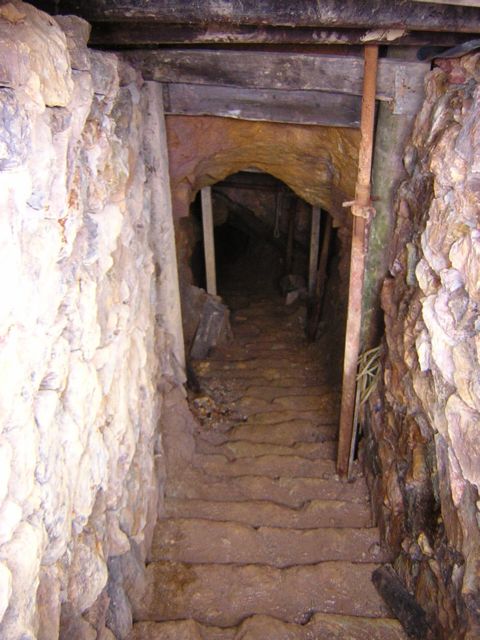
Parys Mine Shaft. View down a shaft at Parys Mine.
Photo by Stephen Elwyn Roddick – CC BY-SA 2.0
At the time More visited, Thomas Williams had only just begun his rapid rise to power. He was already a major industrialist and grown stupendously wealthy. When More asked about his stables, Williams apparently could not even estimate how many he possessed to the nearest ten. But Williams not yet even master of the mountain.
Nonetheless, the mining was well underway. The closest port, Amlwch, was already connected to the mountain by a new road that had been built for the Parys Mine Company’s sole use. Having not long ago been a village of just six houses, Amlwch had turned into a bustling port.
The mine itself was a source of fascination. “This differs from any mine I had ever seen or perhaps is anywhere else to be found, for the ore here instead of being met with in veins is collected into one great mass, so that it is dug in quarries and brought out in carts without any shafts being sunk”. Instead, the miners hollowed out the mountain itself, forming vast caverns that they supported by simply leaving vast columns of the ore untouched. He noted at least four or five of these caverns with ceilings forty feet high, with columns of yellow ore: “the whole seemed like the ruins of some magnificent building whose pillars had been of massy brass.”
It’s a fascinating insight into what Parys would have very briefly looked like, because today there is so little of the mountain left. Indeed, some of the caverns More got to see were already collapsing, with the rubble then needing to be sorted. He describes how one such piece of rubble — a two-ton chunk of ore — had to be bored, the cavity rammed with gunpowder and sealed with stones, and then exploded. “They are continually blowing up parts of the mine”, he noted, and was informed that the part of the mine he was visiting alone got through 10-12 tons of gunpowder per year. The mountain was disintegrating, punctuated by the occasional boom.
And as though that were not dramatic enough, the whole place smelled like hell. When More visited there were some seventy vast kilns upon the mountain for calcining the ore, burning off its sulphur. Each kiln held some 2,000 tons of ore, and when ignited with a little dried vegetation or coal it was so sulphurous that it took four months of furious burning for the ore to be sufficiently calcined. He noted that one had to keep to the windward side of the kilns, as “the fumes arising from them are very disagreeable and destroy all vegetables for a considerable distance around them.”
French 75mm of 1897
vbbsmyt
Published 30 Dec 2021The French 75 is widely regarded as the first modern artillery piece. It was the first field gun to include a hydro-pneumatic recoil mechanism, which kept the gun’s trail and wheels perfectly still during the firing sequence. Since it did not need to be re-aimed after each shot, the crew could reload and fire as soon as the barrel returned to its resting position. In typical use the French 75 could deliver fifteen rounds per minute on its target, either shrapnel or high-explosive, up to about 8,500 m (5.3 mi) away. Its firing rate could even reach close to 30 rounds per minute, albeit only for a very short time and with a highly experienced crew. [wikipedia: https://en.wikipedia.org/wiki/Canon_d…]
The concept for the gun anticipated future conflict being a war of manoeuver — with massed infantry and cavalry attacks — based on the experience of the wars of 1870-1872. Consequently the gun was designed to be able to be moved easily, set up quickly and fire antipersonnel shells (shrapnel) rapidly, and without the need to reset the carriage after each shot. Two critical components were the cased ammunition (shell and cartridge as a single unit) and a recoil system that completely absorbed the recoil forces and returned the gun to its original position without disturbing the gun’s position.
This animation shows the actions necessary to prepare the gun from its “travelling” state to operational state. The carriage has to be “locked” into a fixed position and levelled. The operation of shrapnel shells depends upon setting a time fuse to explode the shell just in front of an attacking force, to shower them with balls, and demonstrates the French Débouchoir mechanical fuse setter that allowed time fuses to be set rapidly and accurately. The liquid (oil) and air (pneumatic) recoil mechanism used a “floating piston” — on one side hydraulic oil and on the other compressed air. The design must keep these two separated while allowing the free piston to move rapidly. The French design laid great emphasis on seals made of silver – being soft enough to conform to the sleeve housing, but as reported by the US when they started manufacturing the 75mm, the key element was highly precise machining of the sleeve housing the free piston.
The French 75mm of 1897 was of less use with the introduction of trench warfare, where howitzers and mortars being the primary artillery, but the 75mm retained some value, one use being firing shrapnel shells at aircraft. A longer time fuse had to be developed to reach the altitude that some aircraft flew at.
(more…)
QotD: How pre-modern cities shaped the surrounding landscape
Every town or city, of course, will be different. For agricultural societies especially, local terrain sharply constrains possible land uses. Some land is simply too wet or dry or rough or rocky or infertile for this or that purpose. In a modern city, apartments or factories or offices can be built almost anywhere; the sort of land suitable for intensive farming is more limited. This is even more true for pre-modern societies working without modern fertilizer, without electric-powered irrigation and without the industrial technology to massively reshape terrain (draining swamps, filling ravines, flattening hills, irrigating the desert, etc – some of these can be done with hand tools, but not to the extent we can today).
Still, we want to begin thinking about how cities impact the land around them without all of these difficult and confusing variables. We want to image a city, isolated and alone in the middle of an endless, flat and featureless plain. This is exactly what J. H. von Thünen did in The Isolated State (Der isolierte Staat). This kind of exercise can give us a baseline of what the landscape around a decent sized city might look like, which we can then modify to respond to different terrain, technology and social organization.
(Note: I would be remiss if I didn’t note that my discussion of these ideas owes heavily to Neville Morley’s Metropolis and Hinterland (1996), where he applied this very method to the city of Rome and its hinterland (and also first introduced me to von Thünen’s ideas). That book and also his Trade in Classical Antiquity are both great books to give a read if you want to begin building a sense of how pre-modern economies work).
The key factor von Thünen looks at is transportation costs. For a society without trains or trucks, moving bulk materials of any kind over long distances is extraordinarily expensive. Moving grain overland, for instance, would cause its cost to double after 100 miles. Thus land close to our theoretical city is extremely valuable for production, while land far away is substantially less valuable (because the end goal is transporting the agricultural production of that land to the city). As a result, transit costs – and thus distance – dominates how cities influence land-use patterns (along with population, which determines the intensity of the city’s influence).
Bret Devereaux, “Collections: The Lonely City, Part I: The Ideal City”, A Collection of Unmitigated Pedantry, 2019-07-12.
July 28, 2023
Ideology and Mediocrity: Inside the 12th SS Division Leadership
OTD Military History
Published 27 Jul 2023Historian Dr. Philip W. Blood discusses how the leadership of the 12th SS (Hitler Youth) Panzer Division were a clique of ideological motivated Nazis and most were promoted into their positions because of their loyalty to Hitler and Nazism and not because they were good soldiers.
Check out my full conversation with Philip Blood at the link below.
Waffen-SS Fantasies and the Commodification of War Crimes
https://youtube.com/live/vdZf_2tooSM
(more…)
Progressive objections to Oppenheimer
Disclaimer: I haven’t seen the movie, and have no immediate plans to do so. That said, there’s a lot of discussion about the movie, its successes and its failures and how it relates to today’s issues. Over at Founding Questions, Severian felt the need to do a proper fisking of one particularly irritating take:

This is one of two Oppenheimer stories that popped up this morning. I don’t watch tv and haven’t seen a movie in the theater in decades; I doubt I’ve seen more than a handful of “new” movies in the last ten years. So I really am not the target audience for this kind of thing, but … I don’t get it. Why is this movie such a big deal? Have they decided to simply create The One Pop Culture Thing out of whole cloth?
Anyway, let’s see what they have to say:
There’s a cabal online, and even in some professional circles, arguing that Nolan has made the bombing of Hiroshima and Nagasaki a sideshow: that Oppenheimer looks away from the devastating effects of what happened on August 6 and 9 1945.
I guess this is where the Historian in me will forever override the pop culture critic. Obviously Robert Oppenheimer knew he was developing a weapon. The difference between a nuclear bomb and a regular bomb is one of degree, not kind. American firebombing had already done to dozens of Japanese cities what Oppenheimer’s nuke did to Hiroshima. Curtis LeMay knew it, too — after the war, he said that he’d have been rightfully tried for war crimes had the outcome gone the other way. I simply cannot see how this man is uniquely culpable for anything … or if he is, then Rosie the Riveter should be held accountable for every bomber that rolled off the assembly line.
Anti-nuclear groups have been similarly disappointed, with Carol Turner from the Campaign for Nuclear Disarmament telling The Guardian that “the effect of the [Hiroshima and Nagasaki] blasts was to remove the skin in a much more gory and horrible way – in [Oppenheimer] it was tastefully, artfully presented.”
That‘s your objection? That people weren’t shown getting killed in a realistic-enough manner? Jesus Christ, do you people ever listen to yourselves? That’s fucking sick. You are a loathsome excuse for a human being, Carol Turner.
Although it says much about the morals and mechanics of war, Oppenheimer isn’t a war film: it’s ultimately about the internal conflict and persecution of one individual. To painstakingly focus on the Japanese victims would have made it an entirely different film, and one at odds with the rest of Nolan’s vision. (His fellow director James Cameron, meanwhile, is said to be planning a film on the victims of Hiroshima and Nagasaki.)
“Victims”. You keep using that word.
There is currently a trend for great cultural works, such as Oppenheimer, to be denigrated if they don’t tick certain boxes, and such complaints often come from the Left. A lack of focus on victims has been a frequent criticism: it’s an argument that gets wheeled out, for example, whenever a drama is being made about serial killers. Yet I don’t think artists are obliged to do this if it doesn’t fit into their own authorial vision.
I have to admit, I’m getting that old College Town feeling right now. The one where it feels like someone dropped some low-grade acid in my coffee, and I’m hallucinating. I know what all those words mean, but put together like that they don’t make any sense at all. On the most basic level, the objection here seems to be that movies require plots. A “drama about a serial killer”, for example (“drama” … what an odd word choice), requires murders. You know, mechanically speaking. But what does “focusing” on them add? Is it any more or less awful, learning that the dead guy killed at random by a lunatic was really into soccer and had a dog and liked classic rock?
And all this is before you consider that the most vocal critics of Oppenheimer are Leftists … the very same Leftists who are determined to fight to the very last drop of Ukrainian blood, and who seem to think that giving Zelensky tactical nukes is a super idea. Reading the Left’s pronouncements on Vladimir Putin, you’d be forgiven for thinking they’d like to nuke him twice, just to be sure.
Your concern for the “victims” of Hiroshima and Nagasaki rings a little hollow, gang, when you’ve been howling for blood 24/7 on Twitter for a year and a half.
Merwin & Hulbert Revolvers
Forgotten Weapons
Published 21 Aug 2015The Merwin & Hulbert company was a short-lived firearms manufacturing partnership between designer Joseph Merwin and the Hulbert brothers as financiers. Merwin wanted to design a particularly strong and high-quality revolver, and he succeeded — his guns are arguably some of the best revolvers of the frontier era. The company made a wide variety of designs, but in this video I will be sticking to just the Frontier and Pocket Army models. Of particular note is the very clever unloading mechanism!
July 27, 2023
History Summarized: The Cities of Ancient Sparta
Overly Sarcastic Productions
Published 14 Apr 2023Is. This. Sparta???
SOURCES & Further Reading:
– “The Spartans” from Ancient Greek Civilization by Jeremy McInerney
– “The Greek Polis – Sparta” from The Foundations of Western Civilization by Thomas F. X. Noble
– “Dark Age and Archaic Greece” from The Greek World: A Study of History and Culture by Robert Garland
– “Being a Greek Slave” from The Other Side of History by Robert Garland.
– The Greeks: A Global History by Roderick Beaton
– The Greeks: An Illustrated History by Diane Cline.
– AskHistorians posts by u/Iphikrates “Is the Military Worship of the Spartans Really Justified?” (https://www.reddit.com/r/AskHistorian…)
– “This. Isn’t. Sparta.” by historian Bret Devereaux argues that Sparta was a horrible place to live, had poorly educated citizens, was militarily mediocre, culturally stagnant, and was ruled by elites who were pretty crappy too. Anything inaccurate in that assessment?” (https://www.reddit.com/r/AskHistorian…)
(more…)
July 26, 2023
Bombing France into Freedom – War Against Humanity 105
World War Two
Published 25 Jul 2023The destruction of German cities has shown how difficult it is for the heavy bombers of the RAF and USAAF to hit small targets with precision. Things will be no different when these big beasts go into action to support the D-Day landings. Thousands of French civilians will pay the price for the flawed logic of Allied bombing.
(more…)
July 25, 2023
WWI Footage: Narrow Gauge Train Lines in France
Charlie Dean Archives
Published 14 Aug 2013American forces constructing railways throughout France to help move men and supplies during World War One. We see US Army personnel laying the sleepers and track for the extensive network of two foot (60cm) narrow gauge lines, ballasting work, loading and laying of pre-built trackwork. We also see scenes of the railway in action as the little trains trundle along country lanes and through the town streets. The film ends with scenes of the train taking soldiers towards the front lines.
After the war the lines were abandoned and most of the locomotives and rollingstock simply left where they were last used, with many being salvaged by the locals to help with logging activities.
CharlieDeanArchives – Archive footage from the 20th century making history come alive!
QotD: Non-free farm labourers in pre-modern agriculture
Bret Devereaux, “Collections: Bread, How Did They Make It? Part II: Big Farms”, A Collection of Unmitigated Pedantry, 2020-07-31.
July 24, 2023
Revolutionary boredom
Chris Bray rises to passionately denounce [Comrade to be named later] as a traitor to the revolution who must be purged from the movement instantly!
Well-written histories of the Great Terror or the Cultural Revolution — or of the final years of the Roman republic, say for example — have the strange effect of becoming incredibly boring. The 94th bonfire of humanity, appearing on page 678, resembles the previous 93 bonfires. The grim machine of political purges makes brutal depravity tedious. Commissar X, Commissar Y, and Commissar Z run the Committee to Kill Wrongthinkers; then, and you always see this coming, Commissar X, Commissar Y, and Commissar Z are declared to be wrongthinkers, and are tossed on their own bonfire. The managerial tier is always consumed by its own instrument. Purge culture is the center of a politics of repression, the inevitable dynamic of a system that has degenerated to the stage of an unprincipled grasping for status and position. Someone was denounced yesterday; someone is being denounced today; someone will be denounced tomorrow.
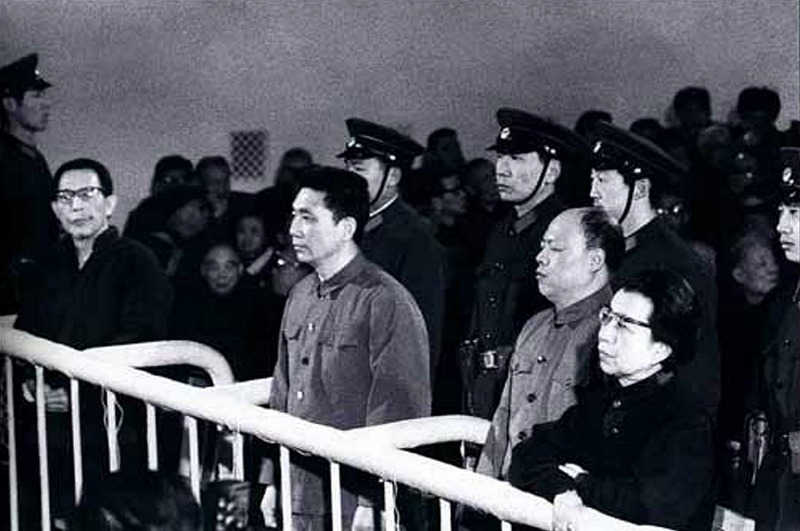
The “Gang of Four” on trial in 1981.
In two instances, now — the frenzied shark attack on Matt Taibbi and Michael Shellenberger, and the obviously insane response to RFK Jr. this week — prominent House Democrats have mimicked a cultural style that should be extremely familiar to anyone who has read some history. Debbie Wasserman Schultz is so fascinatingly horrible a figure that she echoes, a bug-eyed ranting halfwitted sociopath with a hollow core like a long historical line of hollow bug-eyed sociopaths. These are the people who are drawn to destructive political stages. Repellent and ascendant, they call to others of the type. Destroyers flock.
I assume you’ve seen some footage from yesterday’s hearing, which was widely covered and widely discussed, so I’m not going to rehash that nasty piece of Theatre of Cruelty. If you missed it, just know that Robert F. Kennedy, Jr. is OBSOLETE OBSOLETE OBSOLETE.
But I want to point at the water underneath the waves we can see in national media, because the presumptions of the Central Commissariat go all the way down.
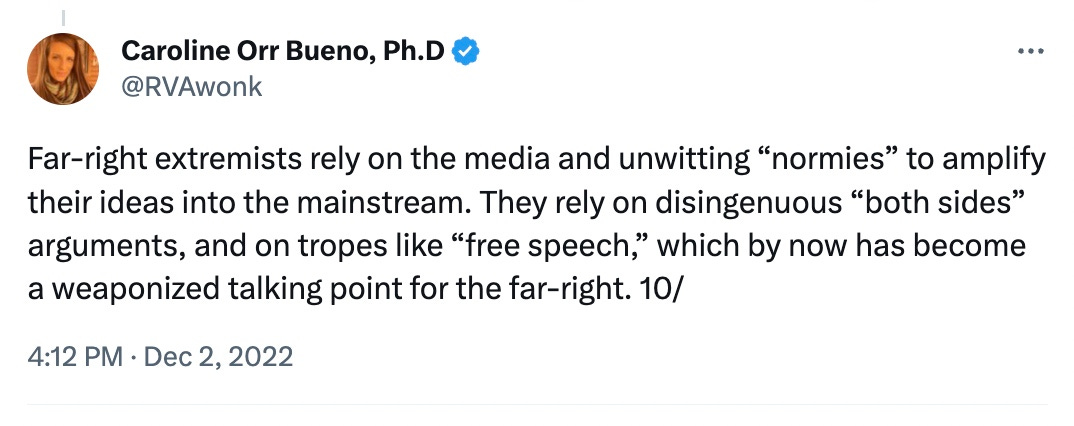
The week that led to the ritual denunciation of RFK Jr. started with a fascinatingly naked declaration in a Pasadena courthouse. Two California physicians, Mark McDonald and Jeff Barke, are suing the California Medical Board to block enforcement of AB 2098, the new law that threatens the medical license of any doctor in the state who expresses consensus-deviating crimethink about the darkly sacred Covid-19, a High Enemy of the Glorious Motherland. McDonald and Barke are relying on the First Amendment and its protection of the so-called “free speech” trope, a well-known tool of dangerous far-right extremists.
Courts have split on AB 2098, and so far some have declined the premise that this regulation of physicians’ speech is unconstitutional, so the case is now before the 9th Circuit on appeal. A three-judge panel heard oral argument in the case this week, in an architecturally pleasant forum that used to be a luxury hotel. And this is where Deputy Attorney General Kristin Liska said this to the court: “In order to effectively regulate the practice of medicine, the state needs to be able to reach the aspects of speech that are used to care for patients.”
If you take a professional license from the state, the regulatory power of the state reaches your speech acts; you can lose your license not only for harming patients or providing poor quality care, but for saying things that the state disagrees with. Your conversations belong to the government.
Flattering our modern selves by throwing shade at our ancestors
David Friedman has encountered a lot of “just so stories” about the customs and practices of earlier cultures and points out that a lot of them are derived from ignorance and arrogance in roughly equal proportion:

My favorite example is the Columbus myth, the idea that the people who argued against Columbus were ignorant flat-earthers who thought his ships would sail off the edge. That is almost the precise opposite of the truth. By the time Columbus set off, a spherical Earth had been the accepted scientific view for well over a thousand years. Columbus’s contemporaries not only knew that the Earth was round, they knew how big around it was, that having been calculated by Eratosthenes in the third century B.C.
By the fifteenth century they also had a reasonably accurate estimate of the width of Asia. Subtracting the one number from the other they could calculate the distance from where Columbus was starting to where Columbus claimed to be going and correctly conclude that it was much farther than his ships could go before running out of food and water. The scientific ignorance was on the side of Columbus and those who believed him; he was claiming a much smaller circumference for the Earth and a much larger width of Asia, hence a much shorter distance from Spain to the far end of Asia. We will probably never know whether he believed his own numbers or was deliberately misrepresenting the geographical facts in order to get funding for his trip in the hope that he would find land somewhere between Spain and Japan, as in fact he did.1
Another example of the same pattern shows up in discussions of medieval cooking, one of my hobbies. Quite a lot of people believe that medieval cooks over spiced their food in order to hide the taste of spoiled meat. A few minutes of thought should be enough to see the consequences for a cook of routinely giving his employer and the employer’s guests food poisoning. Also that, with meat available on the hoof, there was no need to keep it until it spoiled and that it made little sense to save on meat, a local product, at the cost of spices that had to be transported over thousands of miles.
I like to ask people who claim the food was overspiced how they know, given that medieval European recipes almost never give quantities. One possible source for the belief — the overspicing, not the reason for it — is a passage in the introduction to Two Fifteenth Century Cookery Books, a collection published by the Early English Text Society.
Our forefathers, possibly from having stronger stomachs, fortified by outdoor life, evidently liked their dishes strongly seasoned and piquant, as the Cinnamon Soup on p. 59 shews. Pepper, Ginger, Cloves, Garlic, Cinnamon, Galingale, Vinegar, Verjuice, and Wine, appear constantly in dishes where we should little expect them; and even Ale was frequently used in Cookery.
“The cinnamon soup on p. 59” is not a recipe but an entry in a menu, so what the editor is complaining about is not the amount of cinnamon but the fact that it is there at all, and similarly for the rest of his list. That tells us more about English cooking of the 19th century than that of the 15th.
As far as I can tell, there is no evidence that medieval food was overspiced, only that they used spices in different ways than modern European cuisine. I have twice come across evidence on the question. There is a recipe for Hippocras, a spiced wine, in Le Menagier de Paris, a household manual dated to 1490. It is one of the rare recipes with quantities, sugar and spices by the ounce, wine by “quarts of Paris measure”. When I first made it I found the result too sweet and too highly spiced, so cut sugar and spice in half to fit my taste.
Many years later, when I mentioned the recipe in an online discussion, someone asked me whether I had checked the units. I had not, just assumed that a quart was a quart and an ounce an ounce. I was wrong — the period ounce was about an ounce but the quart by Paris measure was about twice our quart. In adjusting the recipe to my taste, I had gotten back to about the original proportions.
1. There is disputed evidence that he visited Iceland and might have heard about the existence of North America there, also speculation that he might have gotten the information from European fishermen. There were European ships harvesting Cod off what is now Newfoundland not long after Columbus, but earlier dates are speculative.
Lorenzoni Repeating Flintlock Pistol
Forgotten Weapons
Published 13 Aug 2012Today we have one of the oldest guns we’ve looked at, a Lorenzoni repeating flintlock pistol. The system was designed by an Italian gunmaker in Florence name Michele Lorenzoni. They were made in very small numbers, and the workmanship is stunning, especially considering that they were first manufactured in the 1680s.
Instead of using a revolving cylinder pre-loaded with multiple shots, the Lorenzoni system utilizes powder and ball magazines in the frame of the gun and a rotating breechblock much like a powder throw tool used today for reloading ammunition.
(more…)
QotD: The Duke and Duchess of Windsor after the abdication
We are reminded that the king’s much-rehearsed coronation speech was a success. “Millions of his subjects sat at home listening to the broadcast, willing him to succeed whilst knowing of his stammer and the difficulties that even speaking a few short sentences publicly had caused him … Yet fortunately for the coronation ceremony, the king’s nerves seemed to vanish on the day, aided by his sincere religious faith: another characteristic absent from his brother’s life.”
[…]
One trait that runs through this important book is the personal weakness of the Duke and the compelling strength of his bride. Larman makes it plain that both Baldwin and Chamberlain were aware that it was Wallis who was passing state secrets to German intelligence, although her husband also expressed sympathies for Hitler’s regime. Cecil Beaton, photographer of the David-Wallis wedding in France, noted in his diary that the Duchess “not only has individuality and personality, but [she] is a strong force”. Even as he praised her intelligence and admiration for the Duke, Beaton offered the judgement that she “is determined to love him, though I feel she is not in love with him” — an interesting reflection on the woman for whom her husband had abandoned his throne. In 2015, Andrew Morton dwelt in great detail on Wallis’s treachery in 17 Carnations: The Windsors, The Nazis and The Cover-Up.
Throughout Larman’s compelling read, we are offered evidence of how tone-deaf the Duke was to international protocol, the interests of Britain and the sufferings of others. Anthony Eden, as Foreign Secretary, observed how the pair felt they should be “treated abroad by ambassadors and dignitaries, rather as they would a member of the royal family on a holiday”. This came to a head when friends of the Duke organised a visit to Germany over 11–23 October 1937. They met several leading Nazis, including Hess, Goebbels (who called the Duke “a tender seedling of reason”) and Göring, as well as renewing their acquaintance with Ribbentrop, still then ambassador to Britain. It was Ribbentrop, according to Morton’s book, who had sent Wallis 17 carnations daily “each one representing a night they had spent together”.
On the penultimate day, the Windsors met Hitler at Berchtesgaden. Larman reasons that the visit was as much to show that the Duke and his bride were still relevant in the wider world, as to form a bond with the Führer to avoid future war. As with many public figures of the era, David feared communism far more than fascism, for which he saw the best antidote in an alliance with Germany. We are left wondering whether the Duke observed in Hitler’s authoritarian state all that he admired and wished for Britain, but was now denied.
A subtext to The Windsors at War is just how much anxiety David caused the King, his younger brother, during the run up to war and during it. For most of the period, the Duke badgered for money, confirmation of his status and a royal title for Wallis. Whilst the first was forthcoming, amounting to a financial settlement of £25,000 a year (generous by any standards, considering the Windsors spent their days sofa-surfing and sponging off their rich friends), neither of the latter were. Chamberlain was forced to write that “in addition to letters of protest he had as Prime Minister … all classes stood against him. In addition to the British not wanting him to return, residents of Canada, New Zealand and America wished him to remain in exile”.
Yet, writes Larman, the Duke would not simply “languish in exile and be denied the opportunity to contribute his thoughts on the international situation. This arrogance made him both unpredictable and, with the outbreak of war drawing closer, dangerous. At a time when it was crucial that the loyalties of prominent public figures were transparent, his inclinations remained opaque”.
Peter Caddick-Adams, “The other one”, The Critic, 2023-04-18.


