
From my observations of the French, they still feel French, indeed quite strongly so. Nearly half a century after the Treaty of Rome, they can’t be said to like the Germans; to think otherwise is to mistake a marriage of convenience for the passion of Romeo and Juliet.
A common European identity therefore has to be forged deliberately and artificially; and one of the imperatives for attempting to do so is the need of Germans for an identity that is not German (the other, which dovetails neatly, is the French drive to recover world power). And since the Germans are very powerful in Europe, by weight of their economy, their need to escape from themselves by absorbing everyone into a new collective identity will sooner or later be perceived in the rest of Europe as the need to impose themselves — as a return to their bad old habits. New identities can indeed be forged, but usually in the crucible of war or at least of social upheaval: not, in the context, an inviting prospect.
Theodore Dalrymple, “The Specters Haunting Dresden”, City Journal, 2005-01
August 5, 2023
QotD: Europe
August 4, 2023
Tsar Vlad’s biography
Scott Alexander reviews The Man Without A Face: The Unlikely Rise of Vladimir Putin by Masha Gessen:
Vladimir Putin appeared on Earth fully-formed at the age of nine.
At least this is the opinion of Natalia Gevorkyan, his first authorized biographer. There were plenty of witnesses and records to every post-nine-year-old stage of Putin’s life. Before that, nothing. Gevorkyan thinks he might have been adopted. Putin’s official mother, Maria Putina, was 42 and sickly when he was born. In 1999, a Georgian peasant woman, Vera Putina, claimed to be his real mother, who had given him up for adoption when he was ten. Journalists dutifully investigated and found that a “Vladimir Putin” had been registered at her village’s school, and that a local teacher remembered him as a bright pupil who loved Russian folk tales. What happened to him? Unclear; Artyom Borovik, the investigative journalist pursuing the story, died in a plane crash just before he could publish. Another investigative journalist, Antonio Russo, took up the story, but “his body was found on the edge of a country road … bruised and showed signs of torture, with techniques related to special military services”.
Still, I’m inclined to doubt the adoption theory. Vladimir Putin’s official father, a WWII veteran and factory worker, was also named Vladimir Putin. The adoption story requires that a child named Vladimir Putin was coincidentally adopted by a man also named Vladimir Putin. Far easier to believe that an old Georgian woman had a son who died or was adopted out. Then, when a man with the same name became President of Russia, she assuaged her broken heart by pretending it was the same guy. Records of Putin’s early life are surprisingly sparse. But there are a few photos (admittedly fakeable), and people who aren’t face-blind tell me that Putin looks very much like his official mother.
As for the investigative journalist deaths, it would be more surprising for a Russian investigative journalist of the early 2000s not to die horribly. Both were researching other things about Putin besides his childhood. and had made themselves plenty of enemies. Russo was in Chechnya at the time, another known risk factor for horrible death. I wouldn’t over-update on this.
Still, I found the adoption controversy interesting as a metaphor for everything about Putin. Vladimir Putin really did seem to appear on Earth – or at least in the corridors of power in Russia – fully formed. At each step in his career, he was promoted for no particular reason, or because he seemed so devoid of personality that nobody could imagine him causing trouble. This culminated in his 2000 appointment as Yeltsin’s successor when “The world’s largest landmass, a land of oil, gas, and nuclear arms, had a new leader, and its business and political elites had no idea who he was.”
My source for this quote is The Man Without A Face: The Unlikely Rise Of Vladimir Putin by Masha Gessen, a rare surviving Russian investigative journalist. As always in Dictator Book Club, we’ll go through the story first, then discuss if there are any implications for other countries trying to avoid dictatorship.
QotD: The “knowledge base” problem in teaching history
The point is this: Even if I were an expert in that particular field (I’m not; as with Sovietology, I’m a gentleman amateur), there are zillions of people who know more of the details than I do. It seems like half the Internet can reel off, from memory, the entire command structure of the 6th Volksgrenadier regiment. Teach a “Modern Europe” class, and you’re guaranteed to have at least one of them among the studentry. Knowledge, in that sense, is over-supplied.
It’s over-supplied in another way, too. There have been tremendous recent advances in the study of, say, the Roman Empire. Computer modeling of seed-distribution patterns and asdzlsjdfjkha … sorry, my head hit the keyboard, I can’t stay awake for this stuff, but I’m sure glad someone can, because it’s important. As I understand it, there have been revolutions even in older fields like numismatics and epigraphy — you can learn a lot from coins and inscriptions, and they’re changing our understanding of some fundamental stuff (see e.g. Roman coins in Japan).
But knowledge is also under-supplied, especially from the teachers’ side. Not just “knowledge of human nature”, above, though of course that’s a biggie. Here’s a far from exhaustive list of what I was NOT taught in graduate school:
- economics
- military strategy
- ecology
- agriculture
- logistics
- Western languages
- non-Western languages
and so on. Now, some of these you’re supposed to have supplied yourself (e.g. the languages, provided you don’t need them for your specialty, and at one time I could muddle through a few), but nobody checks. Obviously nobody checks when it comes to economics, because everyone in the Biz is a Marxist, and sentence one of page one of any basic economics textbook should read “Marxism is a comprehensive crock of horseshit”, but it works that way for all the others, too. Considering that “farming” and “fighting” are two of the Three F’s that comprise “what almost all humans did, all the time, for all of recorded history”, those are some pretty goddamn big oversights … you know, if actually knowing how humans do is the point.1
Severian, “How to Teach History”, Rotten Chestnuts, 2020-12-23.
1. the third F, for the record, is “fucking”, and like the languages, you’re supposed to have acquired a working knowledge of that on your own before you arrive. Alas, that obviously didn’t work out as planned. The 40 Year Old Virgin wasn’t supposed to be a documentary, but it’s pretty much cinéma vérité in your average graduate program. Trust me: The persyn with bespoke pronouns has them because xzhey have absolutely no idea what to do with their naughty bits. When I say that a night on the town with a sailor on shore leave would cure most of these … organisms … of the majority of their problems, I mean it. Getting eggheads blued, screwed, and tattooed wouldn’t save America, but it would be a damn good start.
August 3, 2023
Behind Japanese lines in Burma – SOE and Karen tribal guerillas in 1944/45
Bill Lyman outlines one of the significant factors assisting General Slim’s XIVth Army to recapture Burma from the Japanese during late 1944 and early 1945:
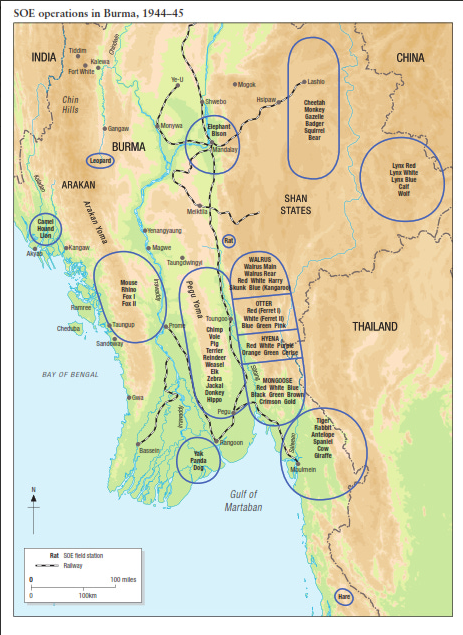
If Lieutenant General Sir Bill Slim (he had been knighted by General Archibald Wavell, the Viceroy, the previous October, at Imphal) had been asked in January 1945 to describe the situation in Burma at the onset of the next monsoon period in May, I do not believe that in his wildest imaginings he could have conceived that the whole of Burma would be about to fall into his hands. After all, his army wasn’t yet fully across the Chindwin. Nearly 800 miles of tough country with few roads lay before him, not least the entire Burma Area Army under a new commander, General Kimura. The Arakanese coastline needed to be captured too, to allow aircraft to use the vital airfields at Akyab as a stepping stone to Rangoon. Likewise, I’m not sure that he would have imagined that a primary reason for the success of his Army was the work of 12,000 native levies from the Karen Hills, under the leadership of SOE, whose guerrilla activities prevented the Japanese from reaching, reinforcing and defending the key town of Toungoo on the Sittang river. It was the loss of this town, more than any other, which handed Burma to Slim on a plate, and it was SOE and their native Karen guerrillas which made it all possible.
In January 1945 Slim was given operational responsibility for Force 136 (i.e. Special Operations Executive, or SOE). It had operated in front of 20 Indian Division along the Chindwin between 1943 and early 1944 and did sterling work reporting on Japanese activity facing 4 Corps. Persuaded that similar groups working among the Karens in Burma’s eastern hills – an area known as the Karenni States – could achieve significant support for a land offensive in Burma, Slim authorised an operation to the Karens. Its task was not merely to undertake intelligence missions watching the road and railways between Mandalay and Rangoon, but to determine whether they would fight. If the Karens were prepared to do so, SOE would be responsible for training and organising them as armed groups able to deliver battlefield intelligence directly in support of the advancing 14 Army. In fact, the resulting operation – Character – was so spectacularly successful that it far outweighed what had been achieved by Operation Thursday the previous year in terms of its impact on the course of military operations in pursuit of the strategy to defeat the Japanese in the whole of Burma. It has been strangely forgotten, or ignored, by most historians ever since, drowned out perhaps by the noise made by the drama and heroism of Thursday, the second Chindit expedition. Over the course of Slim’s advance in 1945 some 2,000 British, Indian and Burmese officers and soldiers, along with 1,430 tons of supplies, were dropped into Burma for the purposes of providing intelligence about the Japanese that would be useful for the fighting formations of 14 Army, as well as undertaking limited guerrilla operations. As Richard Duckett has observed, this found SOE operating not merely as intelligence gatherers in the traditional sense, but as Special Forces with a defined military mission as part of conventional operations linked directly to a military strategic outcome. For Operation Character specifically, about 110 British officers and NCOs and over 100 men of all Burmese ethnicities, dominated interestingly by Burmans mobilised as many as 12,000 Karens over an area of 7,000 square miles to the anti-Japanese cause. Some 3,000 weapons were dropped into the Karenni States. Operating in five distinct groups (“Walrus”, “Ferret”, “Otter”, “Mongoose” and “Hyena”) the Karen irregulars trained and led by Force 136, waited the moment when 14 Army instructed them to attack.
Between 30 March and 10 April 1945 14 Army drove hard for Rangoon after its victories at Mandalay and Meiktila, with Lt General Frank Messervy’s 4 Indian Corps in the van. Pyawbe saw the first battle of 14 Army’s drive to Rangoon, and it proved as decisive in 1945 as the Japanese attack on Prome had been in 1942. Otherwise strong Japanese defensive positions around the town with limited capability for counter attack meant that the Japanese were sitting targets for Allied tanks, artillery and airpower. Messervy’s plan was simple: to bypass the defended points that lay before Pyawbe, allowing them to be dealt with by subsequent attack from the air, and surround Pyawbe from all points of the compass by 17 Indian Division before squeezing it like a lemon with his tanks and artillery. With nowhere to go, and with no effective means to counter-attack, the Japanese were exterminated bunker by bunker by the Shermans of 255 Tank Brigade, now slick with the experience of battle gained at Meiktila. Infantry, armour and aircraft cleared General Honda’s primary blocking point before Toungoo with coordinated precision. This single battle, which killed over 1,000 Japanese, entirely removed Honda’s ability to prevent 4 Corps from exploiting the road to Toungoo. Messervy grasped the opportunity, leapfrogging 5 Indian Division (the vanguard of the advance comprising an armoured regiment and armoured reconnaissance group from 255 Tank Brigade) southwards, capturing Shwemyo on 16 April, Pyinmana on 19 April and Lewe on 21 April. Toungoo was the immediate target, attractive because it boasted three airfields, from where No 224 Group could provide air support to Operation Dracula, the planned amphibious attack against Rangoon. Messervy drove his armour on, reaching Toungoo, much to the surprise of the Japanese, the following day. After three days of fighting, supported by heavy attack from the air by B24 Liberators, the town and its airfields fell to Messervy. On the very day of its capture, 100 C47s and C46 Commando transports landed the air transportable elements of 17 Indian Division to join their armoured comrades. They now took the lead from 5 Indian Division, accompanied by 255 Tank Brigade, for whom rations in their supporting vehicles had had been substituted for petrol, pressing on via Pegu to Rangoon.
Webley 1905
Forgotten Weapons
Published 12 Jun 2016William Whiting was an engineer who spent his entire adult career with the Webley company, and was responsible for all of their in-house self-loading pistol designs. This work initially focused on a behemoth of a pistol, the Model 1904 intended for military contracts. The gun proved insufficiently attractive to the British military though, leaving Webley with a large R&D outlay with nothing to show for it. The solution was to scale the system way down and look to the civilian market with a pocket automatic in .32ACP.
The first version of this commercial pocket pistol was this model 1905 design. It proved to be a popular concept, and the gun was revised to address a few shortcomings and opportunities for simplification. In its final version, the Model 1908 would prove to be Webley’s best-selling automatic pistol, and it is still a relatively easy gun to find today. However, its 1905 predecessor is far scarcer, and it is interesting to examine the changes made between the two models.
QotD: Blacksmith forge techniques
A modern blacksmith can gauge the temperature of a metal using sophisticated modern thermometers, but pre-modern smiths had no recourse to such things (and most traditional smiths I’ve met don’t use them anyway). Instead, the temperature of the metal is gauged by looking at its color: as things get hotter, they glow from brown to dark red through to a light red into yellow and then finally white. For iron heated in a forge, a blacksmith can control the temperature of the forge’s fire by controlling the air-input through the bellows (pushing in more air means more combustion, which means more heat, but also more fuel consumed). As we’ve seen, charcoal (and we will need to use charcoal, not wood, to hit the necessary heat required), while not cripplingly expensive, was not trivial to produce either. A skilled smith is thus going to try to do the work in as few heats as possible and not excessively hot either (there are, in fact, other reasons to avoid excessive heats, this is just one).
Once hot the metal can be shaped by hammering. The thickness of a bar of metal could be thickened by upsetting (heating the center of the bar and them hammering down on it like a nail to compress the center, causing it to thicken) or thinned by drawing (hammering out the metal to create a longer, thinner shape). If the required shape needed the metal to be bent it could be heated and bent either over the side of the anvil or against a tool; many anvils had (and still have) a notch in the back where such a tool could be fitted. A good example of this kind of thing would be hammering out a sheet of iron over a dome-shape to create the bowl of a helmet (a task known as “raising” or “sinking” depending on precisely how it is done). A mass of iron can also be divided by heating it at the intended cutting point and then using a hammer and chisel to cut through the hot, soft metal.
But for understanding the entire process, the most important of these operations is the fire weld. Much like bloomery furnaces, the forges available to pre-modern blacksmiths could not reach the temperatures necessary to melt or cast iron, but it was necessary to be able to join smaller bits of iron into larger ones which was done through a fire weld (sometimes called a forge weld). In this process, the iron is heated very hot, typically to a “yellow” or “white” heat (around 1100 °C). The temperature range for the operation is quite precise: too cold and the iron will not weld, too hot and it will “burn” making the weld brittle. Once at the right temperature, the two pieces of iron are put next to each other and hammered into each other with heavy blows. If done properly, the two pieces of metal join completely, leaving a weld that is as strong as every other part of the bar.
Bret Devereaux, “Collections: Iron, How Did They Make It, Part III: Hammer-time”, A Collection of Unmitigated Pedantry, 2020-10-02.
August 2, 2023
You say you want a revolution …
The latest book review from the Psmiths is Bernard Yack’s The Longing for Total Revolution: Philosophic Sources of Social Discontent from Rousseau to Marx and Nietzsche, by John Psmith:
This is a book by Bernard Yack. Who is Bernard Yack? Yack is fun, because for a mild-mannered liberal Canadian political theorist he’s dropped some dank truth-bombs over the years. For example, check out his short and punchy 2001 journal article “Popular Sovereignty and Nationalism” if you need a passive-aggressive gift for the democratic peace theorist in your life.1 The subject of that essay is unrelated to the subject of the book I’m reviewing, but the approach, the method, and the vibe are similar. The general Yack formula is to take some big trendy topic (like “nationalism”) and examine its deep philosophical and intellectual substructure while totally refusing to consider material conditions. He’s kind of like the anti-Marx — in Yack’s world not only do ideas have consequences, they’re about the only things that do. Even when this is unconvincing, it’s usually very interesting.
The topic of this book is radicalism in the ur-sense of “a desire to get to the root”. What Yack finds interesting about radicalism is that it’s so new. It’s a surprising fact that the entire idea of having a revolution, of burning down society and starting again with radically different institutions, was seemingly unthinkable until a certain point in history. It’s like nobody on planet Earth had the idea, and then suddenly sometime in the 17th or 18th century a switch flips and it’s all anybody is talking about. We’re used to that sort of pattern for scientific discoveries, or for very original ways of thinking about the universe, but “let’s destroy all of this and try again” isn’t an incredibly complex or sophisticated thought, so why did it take so many millennia for somebody to have it?
Well, first of all, is this claim even true? One thing you do see a lot of in premodern history is peasant rebellions, but dig a little deeper into any of them and the first thing you notice is that (sorry vulgar Marxists)2 there’s nothing especially “revolutionary” in any of these conflagrations. The most common cause of rebellion is some particular outrage, and the goal of the rebellion is generally the amelioration of that outrage, not the wholesale reordering of society as such. The next most common cause of rebellions is a bandit leader who is some variety of total psycho and gets really out of control. But again, prior to the dawn of the modern era, these psychos led movements that were remarkably undertheorized. The goal was sometimes for the psycho to become the new king, sometimes the extinguishment of all life on earth, but you hardly ever saw a manifesto demanding the end of kings as such. Again, this is weird, right? Is it really such a difficult conceptual leap to make?
Peasant rebellions are demotic movements, but modern revolutions are usually led by frustrated intellectuals and other surplus elites. When elites did get involved in pre-modern rebellions, their goals were still fairly narrow, like those of the peasants — sometimes they wanted to slightly weaken the power of the king, other times they wanted to replace the king with his cousin. But again this is just totally different in kind from the 18th century onwards, when intellectuals and nobles are spending practically all of their time sitting around in salons and cafés, debating whose plan for the total overhaul of society, morality, and economic relations is best.
The closest you get to this sort of thing is the tradition of Utopian literature, from Plato’s Republic to Thomas More, but what’s striking about this stuff is how much ironic distance it carried — nobody ever plotted terrorism to put Plato’s or More’s theories into practice. Nobody ever got really angry or excited about it. But skip forward to the radical theorizing of a Rousseau or a Marx or a Bakunin, and suddenly people are making plans to bomb schools because it might bring the Revolution five minutes closer. So what changed?
Well this is a Bernard Yack book, so the answer definitely isn’t the printing press. It also isn’t secularization, the Black Death, urbanization, the Reformation, the rise of industrial capitalism, the demographic transition, or any of the dozens of other massive material changes that various people have conjectured as the cause of radical political ferment. Instead Yack points to two abstract philosophical premises: the first is a belief in the possibility of “dehumanization”, the idea that one can be a human being and yet be living a less than human life. The second is “historicism” in the sense of a belief that different historical eras have fundamentally different modes of social interaction.
Both views had some historical precedent (for instance historicism is clearly evident in the writings of Machiavelli and Montesquieu), but it’s their combination that’s particularly explosive, and Rousseau is the first person to place the two elements together and thereby assemble a bomb. Because for Rousseau, unlike for any of the ancient or medieval philosophers, merely to be a member of the human species does not automatically mean you’re living a fully-human life. But if humanity is something you can grow into, then it’s also something that you can be prevented from growing into. Thus: “that I am not a better person becomes for Rousseau a grievance against the political order. Modern institutions have deformed me. They have made me the weak and miserable creature that I am.”
But what if the qualities of social interaction which have this dehumanizing effect are inextricably bound up with the dominant spirit of the age? In that case, it might be impossible to really live, impossible to produce happy and well-adjusted human beings, without a total overhaul of society and all of its institutions. This also clarifies how the longing for total revolution is distinct from utopianism — utopian literature is motivated by a vision of a better or more just order. Revolutionary longing springs from a hatred of existing institutions and what they’ve done to us. This is an important difference, because hate is a much more powerful motivator than hope. In fact Yack goes so far as to say (in a wonderfully dark passage) that the key action of philosophers and intellectuals upon history is the invention of new things to hate. Can you believe this guy is Canadian?
1. Of course, if my reading of MITI and the Japanese Miracle is correct, popular sovereignty may not be around for that much longer.
2. I say “vulgar” Marxists, because for the sophisticated Marxists (including Marx himself) it’s already pretty much dogma that premodern rebellions by immiserated peasants aren’t “revolutionary” in the way they care about.
Britain’s troubling rise in hospital visits due to dog bites
Ed West has a dog, but he admits he’s not really a “dog person”:

American Bully Breed Dog. Male. Name: X-Men.
Photo by Verygoodhustle via Wikimedia Commons.
Dog breeds have different natures, something that would seem self-obviously true and yet which today the leading authorities in the British dog world seem to be in denial about, in particular when it comes to one of the unspoken trends of recent years – the huge increase in dog attacks.
This spike in dog-bites-man violence has led to a 50 per cent increase in hospital admissions for dog bites over ten years, the biggest rise being among children under the age of 4. Overall the number of fatalities has gone from an average of 3.3 in the 2000s to 10 last year, while dog attacks have risen recently from 16,000 in 2018 to 22,000 in 2022, and hospitalisations have almost doubled from 4,699 in 2007 to 8,819 in 2021/22.
The underlying story behind this escalation of violence is that much of it is the work of just one breed – the American Bully. And as we enter the summer holidays, the peak period for dog attacks, it’s worth pondering why the experts in the dog world are in such denial about the issue.
Public awareness of the American Bully problem has grown in recent months, spurred by some especially horrific attacks, as well as a widely-read article by legal academic and YouTuber Lawrence Newport. Lawrence looked at the data on dog attacks and observed that “a notable pattern emerges. In 2021, 2 of the 4 UK fatalities were from a breed known as the American Bully XL. In 2022, 6 out of 10 were American Bullies. In 2023, so far all fatalities appear to have been American Bullies.”
American Bullies, Newport explains, “are a breed resulting from modern mixes of the American Pitbull Terrier. They are known for very high muscle mass, biting power, and impressive strength, and come in several variations. Those that are bred for the greatest strength, weight and size are known as a part of the American Bully XL variety.”
Pitbulls are banned in Britain for a good reason, and in the US are responsible for “60–70% of dog fatalities“; yet under the Dangerous Dogs Act 1991 “the American Bully XL is currently permitted”.
What is surprising, Newport writes, is that “if you argue these dogs are dangerous, you will get a flood of comments from people … saying it’s the owner’s fault, not the dog’s. You might even be thinking this yourself, right now. But this is wrong. Whilst many Brits would contend that ‘
GunsAmerican Bully XL’s don’t kill people, people do’, the reality is different.“Labradors retrieve. Pointers point. Cocker Spaniels will run through bushes, nose to the ground, looking as if they are tracking or hunting even when just playing – even when they have never been on a hunt of any kind. This is not controversial. Breeds have traits. We’ve bred them to have them.”
Pitbulls were created for bull-baiting, and when that was banned, they came to be bred to hunt down rats in a locked pen. “This required more speed, so they were interbred with terriers to make Pitbull Terriers. In addition to this, they began to be used for dog fighting: bred specifically to have aggression towards other dogs, and to be locked in a pit to fight (some are still used for this today). These were dogs likely kept in cages, away from humans, and bred for their capacity to earn money for their owners by winning fights. These were not dogs bred for loyalty to humans, these were dogs bred for indiscriminate, sustained and brutal violence contained within a pit.”
How Shipping Containers Took Over the World (then broke it)
Calum
Published 5 Oct 2022The humble shipping container changed our society — it made International shipping cheaper, economies larger and the world much, much smaller. But what did the shipping container replace, how did it take over shipping and where has our dependance on these simple metal boxes led us?
(more…)
QotD: The Coolidge years
So-called “progressives” tell us that Calvin Coolidge was a bad president because the Great Depression started just months after he left office.
This is precisely the same, lame argument expressed in two different contexts.
In five years (August 2023), we will mark the 100th anniversary of the day that Silent Cal became America’s 30th President. I intend to celebrate it along with others who believe in small government, but you can bet there’ll be plenty of progressives trying to rain on our parade. So let’s get those umbrellas ready.
Let’s remember that the eight years of Woodrow Wilson (1913-1921) were economically disastrous. Taxes soared, the dollar plummeted, and the economy soured. A sharp, corrective recession in 1921 ended quickly because the new Harding-Coolidge administration responded to it by reducing the burden of government. When Harding died suddenly in 1923, Coolidge became President and for the next six years, America enjoyed the unprecedented growth of “the Roaring ’20s.” Historian Burton Folsom elaborates:
One measure of prosperity is the misery index, which combines unemployment and inflation. During Coolidge’s six years as president, his misery index was 4.3 percent — the lowest of any president during the twentieth century. Unemployment, which had stood at 11.7 percent in 1921, was slashed to 3.3 percent from 1923 to 1929. What’s more, [Coolidge’s Treasury Secretary] Andrew Mellon was correct on the effects of the tax-rate cuts — revenue from income taxes steadily increased from $719 million in 1921 to over $1 billion by 1929. Finally, the United States had budget surpluses every year of Coolidge’s presidency, which cut about one-fourth of the national debt.
That’s a record “progressives” can only dream about but never deliver. Yet when they rank U.S. presidents, Coolidge gets the shaft. If you can get your hands on a copy of the out-of-print 1983 book, Coolidge and the Historians by Thomas Silver, buy it! You’ll be delighted at what Coolidge actually said, and simultaneously incensed at the shameless distortions of his words at the hands of progressives like Arthur Schlesinger.
Lawrence W. Reed, “Cal and the Big Cal-Amity”, Foundation for Economic Education, 2018-07-25.
August 1, 2023
QotD: US Army culture before the Korean War
A sergeant, by shouting at some sensitive yardbird, could get his captain into a lot of trouble. For the real effect of the Doolittle recommendations was psychological. Officers had not been made wholly powerless — but they felt that they had been slapped in the teeth. The officer corps, by 1946 again wholly professional, did not know how to live with the newer code.
One important thing was forgotten by the citizenry: by 1946 all the intellectual and sensitive types had said goodbye to the Army — they hoped for good. The new men coming in now were the kind of men who join armies the world over, blank-faced, unmolded — and they needed shaping. They got it; but it wasn’t the kind of shaping they needed.
Now an N.C.O. greeted new arrivals with a smile. Where once he would have told them they made him sick to his stomach, didn’t look tough enough to make a go of his outfit, he now led them meekly to his company commander. And this clean-cut young man, who once would have sat remote at the right hand of God in his orderly room, issuing orders that crackled like thunder, now smiled too. “Welcome aboard, gentlemen. I am your company commander; I’m here to help you. I’ll try to make your stay both pleasant and profitable.”
This was all very democratic and pleasant — but it is the nature of young men to get away with anything they can, and soon these young men found they could get away with plenty.
A soldier could tell a sergeant to blow it. In the old Army he might have been bashed, and found immediately what the rules were going to be. In the Canadian Army — which oddly enough no American liberals have found fascistic or bestial — he would have been marched in front of his company commander, had his pay reduced, perhaps even been confined for thirty days, with no damaging mark on his record. He would have learned, instantly, that orders are to be obeyed.
But in the new American Army, the sergeant reported such a case to his C.O. But the C.O. couldn’t do anything drastic or educational to the man; for any real action, he had to pass the case up higher. And nobody wanted to court-martial the man, to put a permanent damaging mark on his record. The most likely outcome was for the man to be chided for being rude, and requested to do better in the future.
Some privates, behind their smirks, liked it fine.
Pretty soon, the sergeants, realizing the score, started to fraternize with the men. Perhaps, through popularity, they could get something done. The junior officers, with no sergeants to knock heads, decided that the better part of valor was never to give an unpopular order.
The new legions carried the old names, displayed the old, proud colors, with their gallant battle streamers. The regimental mottoes still said things like “Can Do”. In their neat, fitted uniforms and new shiny boots — there was money for these — the troops looked good. Their appearance made the generals smile.
What they lacked couldn’t be seen, not until the guns sounded.
T.R. Fehrenbach, This Kind of War: A Study in Unpreparedness, 1963.
July 31, 2023
RSC 1917: France’s WW1 Semiauto Rifle
Forgotten Weapons
Published 17 Nov 2015Did you know that the French Army issued more than 80,000 semiautomatic rifles during WWI? They had been experimenting with a great many semiauto designs before the war, and in 1916 finalized a design for a rotating bolt, long stroke gas piston rifle (with more than few similarities to the M1 Garand, actually) which would see field service beginning in 1917. An improved version was put into production in 1918, but too late to see any significant combat use.
The RSC 1917 was not a perfect design, but it was good enough and the only true semiauto infantry rifle fielded by anyone in significant numbers during the war.
QotD: Stranger in a Strange Land at 50
Sexual mores changed but not, for most, in that direction. Living in southern California in the eighties, the view that seemed most common among young adults — many of those I associated with would have been people I met through the SCA,1 a subculture that had noticeable overlap with both science fiction fandom and hippiedom — was very different. The ideal pattern was stable monogamy but who could be so lucky? Insofar as it had been replaced it was mostly by the increasing acceptability and practice of casual sex.
There has been some development since Stranger was published, in practice and theory, along the lines of group marriage of a somewhat different sort. Polyamory is more self-conscious and, at least in theory, more structured than what we see in Stranger. Partners are classified as primary or secondary and a good deal of attention paid to what those terms mean and what behavior they imply. The result is in theory closer to the Oneida Commune of the 19th century, on a much smaller scale, than to the nest described in Stranger.2
This fits not only what happened in the real world but what happened in Heinlein’s fictional worlds. Consider a more sophisticated version of group marriage, the line marriage in The Moon is a Harsh Mistress. It is highly organized, with new members brought in at the low age end on a regular pattern of alternating gender. There is extensive search/courtship. And the protagonist offers a plausible explanation of its social role, why the institutions developed and what purposes it served.
Finally, consider Friday, a later novel. The protagonist, surprisingly naive given her profession — secret agent — joins a group marriage, makes a substantial commitment to it and is booted out, her share of the assets stolen, when it is discovered that she is an artificial person, the superior product of genetic engineering. Her much later commitment to a second group marriage follows more careful research.
David D. Friedman, “Odds and Ends”, David Friedman’s Substack, 2023-04-29.
1. The Society for Creative Anachronism, a historical recreation organization I have been active in for a very long time.
2. The practice sometimes ends up as open marriage, monogamous for purposes of producing and rearing children but with no obligation to sexual exclusivity — an option made possible by reliable contraception.
July 30, 2023
Bradley Unleashes His Cobra – WW2 – Week 257 – July 29, 1944
World War Two
Published 29 Jul 2023Operation Cobra is the drop that finally opens the floodgates and the Allies make a breakthrough in Normandy; up in the Baltics the Soviets take Shaulyai, Dvinsk, and finally Narva, though their big prize this week is Lvov further south. This happens during the Poles’ Lvov Uprising, which ends badly for the Poles. Things also go badly for the Japanese on Guam, though, as their assault this week devastates their own troops.
(more…)
The Grave of the Man Who Never Was: Operation Mincemeat
Tom Scott
Published 7 Nov 2016In a cemetery in Huelva, in Spain, is the grave of Major William Martin, of the British Royal Marines. Or rather, it’s the grave of a man called Glyndwr Michael, who served his country during World War 2 in a very unexpected way … after his death.
(more…)


