
World War Two
Published 8 Mar 2025Today Sebastian puts Indy and Sparty in the hot seat for questions about the war in China and North Africa. Just what is the deal with the Italian Army anyway? How much fighting did the CCP do against the Japanese? And what’s the most overlooked event of the first year of war?
(more…)
March 9, 2025
Italy’s Italian Fiasco
Comments Off on Italy’s Italian Fiasco
QotD: HR metastasized
There are really only three management books anyone ever needs to read (soon forthcoming, the fourth, my own precis of those three!) and we can use all of them in explaining this.
The Peter Principle tells us that everyone gets promoted to their own level of incompetence. So, that explains why the people actually running HR departments are incompetent. The second is Parkinson’s Law, which everyone usually takes to be about work expanding to fill the time available etc. In reality the book as a whole is about how bureaucracy will eat an organisation from the inside. Like one of those parasitic wasps where the pupae eat the spider from the inside out. The lesson of this is that proper management of any organisation is a constant battle against the growth of the bureaucracy. Proper managers should — must — spend significant amounts of their time turning a blowtorch on that internal bureaucracy. Real slash and burn, proper Carthaginian Solution on their arses.
The third has the most direct and exact relevance here. Up the Organisation. In which we are told that the personnel department (what we had before Human Resources) should be the secretary of the line manager. Someone wants to hire someone? Sure. The person who decides who to hire is the person doing the hiring. He needs an assistant only in so far as someone should phone up the local rag to put the job ad in.
Now, it is necessary to have someone making sure the details for the paycheque are right, that they enrolled in the company equity scheme, health care is sorted. But that’s some beancounter preferably hundreds of miles away from any actual influence upon anything.
All of which — from that distillation of the finest ponderings upon corporate management civilisation has so far achieved — tells us what to do with Human Resources.
Turn the blowtorches on the power skirts. Possibly even the full Carthaginian. Tho’ who we’ll find to buy as drabs and doxies the usual inhabitants of HR is another matter. Dunno, might be worth ploughing them into the fields and selling the salt instead.
Tim Worstall, “The Invasion Of The Power Skirts”, It’s all obvious or trivial except …, 2024-12-06.
Comments Off on QotD: HR metastasized
March 6, 2025
Passionate belief in historical untruths
As mentioned in earlier posts, one of the most toxic exports from Australia to the rest of the Anglosphere has been the academic indulgence in believing that “settler colonialism” explains everything about the history of Canada, Australia, New Zealand and anywhere else the British diaspora touched:

Welby in Zanzibar
Throughout the English-speaking world elites are falling over themselves to believe the very worst of their own countries.
In Britain, the Church of England has committed itself to spend an initial £100 million on slavery-reparations in response to the discovery that its endowment had “links” with African enslavement. “The immense wealth accrued by the Church … has always been interwoven with the history of African chattel enslavement”, a document explains. “African chattel enslavement was central to the growth of the British economy of the 18th and 19th centuries and the nation’s wealth thereafter”. And this has “continuing toxic consequences”.
Yet almost none of this is true. The evidence shows that the Church’s endowment fund was hardly involved in the evil of slave-trading at all. Most economic historians reckon the contribution of slave-trading and slavery to Britain’s economic development as somewhere between marginal and modest. And between abolition in 1834 and the present, multiple causes have intervened to diminish slavery’s effects.
Consonant with his church’s policy, the (then) Archbishop of Canterbury, Justin Welby preached a sermon in Christ Church Cathedral, Zanzibar last year, in which he criticised Christian missionaries for treating Africans as inferior and confessed that “we [British] must repent and look at what we did in Zanzibar”.
Really? What the British did in Zanzibar during the second half of the 19th century was to force the Sultan to end the slave-trade. Indeed, the cathedral in which the archbishop was preaching was built over the former slave-market. And here’s what the pioneering missionary David Livingstone wrote about black Africans in 1871: “I have no prejudice against [the Africans’] colour; indeed, anyone who lives long among them forgets they are black and feels that they are just fellow men…. If a comparison were instituted, … I should like to take my place among [them], on the principle of preferring the company of my betters”.
[…]
St. John Baptiste church was one of many local churches to go up in flames during Justin Trudeau’s performative national guilt trip over “unmarked mass graves” at former Residential Schools across Canada.
Which bring us to Canada. The May 2021 claim by a Kamloops Indian band to have discovered the remains of 215 “missing children” of an Indian Residential School was quickly sexed up by the media into a story ‘mass graves’, with all its connotation of murderous atrocity. The Toronto Globe and Mail published an article under the title, “The discovery of a mass gravesite at a former residential school in Kamloops is just the tip of the iceberg”, in which a professor of law at UBC wrote: “It is horrific … a too-common unearthing of the legacy, and enduring reality, of colonialism in Canada”. Prime Minister Justin Trudeau ordered Canadian flags to be flown at half-mast on all federal buildings to honour the murdered children. Because the Kamloops school had been run by Roman Catholics, some zealous citizens took to burning and vandalising churches, 112 of them to date. The dreadful tale was eagerly broadcast worldwide by Al Jazeera.
Yet, four years later, not a single set of remains of a murdered Indian child in an unmarked grave has been found anywhere in Canada. Judging by the evidence collected by Chris Champion and Tom Flanagan in their best-selling 2023 book, Grave Error: How the Media Misled us (and the Truth about the Residential Schools), it looks increasingly probable that the whole, incendiary story is a myth.
So, prime ministers, archbishops, academics, editors, and public broadcasters are all in the business of exaggerating the colonial sins of their own countries against noble (not-so-very) savages — from London to Sydney to Toronto. Why?

Comments Off on Passionate belief in historical untruths
The Iron Curtain Descends – W2W 10 – News of 1946
TimeGhost History
Published 5 Mar 20251946 sees the world teetering on the brink of a new global conflict. George Kennan’s long telegram outlines Moscow’s fanatical drive against the capitalist West, while our panel covers escalating espionage, strategic disputes over Turkey, and the emerging ideological battle between the U.S. and the USSR. Tune in as we break down the news shaping the dawn of the Cold War.
(more…)
Comments Off on The Iron Curtain Descends – W2W 10 – News of 1946
HMCS Bonaventure – The Pride of Canada’s Fleet
Skynea History
Published 22 Oct 2024For today’s video, we’ll be looking at the last of Canada’s aircraft carriers. Not typically a navy you associate with that kind of ship, but the Canadians actually operated three during the Cold War.
The third, HMCS Bonaventure, is an interesting one. A small ship, that operated aircraft at the very edge of her capability. And routinely baffled American pilots in the process.
Yet, she was also a ship that came to an end before her time. Decommissioned and scrapped, right after an expensive (and extensive) mid-life overhaul. In what is generally seen as a bad political move, more than anything to do with her capabilities.
(more…)
Comments Off on HMCS Bonaventure – The Pride of Canada’s Fleet
QotD: Old Etonians
When I first started there, the traditions seemed daunting, and while you had a week of grace period to find your feet, it took a lot longer for the novelty truly to wear off. Dressed in a tailsuit that makes you look like a penguin, and that even the production team of Downton Abbey would question, it’s a complete culture shock. Teachers become “beaks”; homework becomes “EW (short for Extra Work)”, and the threat of “tardy book” (a punishment where you have to get up early to report to the School Office) is ever present. Your life is governed by a tutor, housemaster, and dame (a surrogate mother for your time there, and the most influential person in your day-to-day life), and outside of lessons (known as “schools”) you’re left to your own devices. It’s a sink or swim situation, and some can’t hack the overload of independence.
You’re constantly surrounded by things named after great men who have come before you – whether that be John Maynard Keynes (an economics society) or William Gladstone (a library) – and you can’t help but see yourself as heir to some great dynasty. Sitting in Upper School – a large schoolroom now mainly used for talks by visiting speakers – the walls are lined with marble busts of illustrious Old Etonians past, and it’s not hard to daydream about joining them. In our first ever assembly the head master put it best: “If you know that some interesting people have gone on to do some interesting things, whether it’s George Orwell or the Duke of Wellington, that does implicitly ask the question, why not you?” Success never seems far away, and often you’re regaled with tales about the time your beak caught a famous actor smoking, or how awful a pupil a noted academic once was. Neither does service, particularly when you pass the memorial boards for the First World War (as you do daily on the way to chapel): 1157 Old Etonians died, and 37 Old Etonians have won the Victoria Cross – 17 more than any other school.
In your final years, it’s fun to try and work out who’s going to be most successful after leaving, and – it never seems too outlandish – who among you could be a future prime minister. The people you consider are never confined to a particular group – it’s not “one of the debaters” or “one of the Rugby XV” – in fact, it’s often those who you can’t seem to categorize, or transverse the groups that are most magnetic. To get into Eton, you have to do well in the infamous “List Test”, composed of a computerized assessment and an interview with one of the beaks. For an eleven year old, it can be brutal (one boy left crying midway through our test), particularly as you don’t know what they want: they’re not looking for candidates that fit a particular box. Potential is valued more than current ability, and the greatest asset is that of being interesting. With only one in five getting an offer (odds stiffer than Oxbridge), and after five years of being expected to perform at the highest level, it’s unsurprising that students end up so successful.
Ivo Delingpole, “Boris and the Spirit of Eton”, Die Weltwoche, 2020-01-29.
Comments Off on QotD: Old Etonians
March 5, 2025
Trump’s next target – Europe
Andrew Doyle thinks that the next step of Donald Trump’s culture war will be highlighted by a struggle over freedom of speech with the UK and the regulators of the European Union:

British PM Keir Starmer talks with US President Donald Trump in the White House.
New battle lines are forming in the culture war. While the woke movement appears to be in retreat, the forces of authoritarianism are regrouping for a fresh assault. Rather than maintaining a straightforward conflict between right and left, the next phase of the culture war will most probably be waged between Europe and the United States. It has all the qualities of a novel by Henry James for the digital age, with the distinctions between the old world and the new brought once again into sharp focus.
Free speech will be the key issue. Most of us will have seen the footage of vice-president J. D. Vance last week in the Oval Office taking Keir Starmer to task for the “infringements on free speech that actually affect not just the British” but also “American technology companies and by extension, American citizens”. Starmer pushed back, saying “in relation to free speech in the UK, I’m very proud of our history there”. It’s a bit like Hannibal Lecter boasting about his ongoing commitment to vegetarianism.
The word “history” was apt, given that Starmer’s government is seemingly determined to ensure that free speech is consigned to the past. One of its first acts after seizing power was to ditch the Higher Education (Freedom of Speech) Act. In February, Angela Rayner revealed her plans for the establishment of a sixteen-member council on “Islamophobia” which could see the criticism of religion criminalised. Meanwhile, Yvette Cooper has been staunchly defending the police for recording “non-crime”, while the chairman of the College of Policing, Lord Herbert, has suggested that the best approach to tackling the controversy is to simply rename “non-crime hate incidents” as something more palatable. Apparently Lord Herbert believes that the problem is the nomenclature, not the fact that citizens are being investigated by the armed wing of the state for lawful behaviour.
All of this is before we get to Starmer applying pressure to the judiciary to mete out draconian sentences for offensive posts and memes on social media, and the government’s determination to crack down on online “disinformation”. Ours is an authoritarian government, and Starmer’s Orwellian denial of the truth of his position in the Oval Office is to be expected. Autocrats throughout history have enacted censorship “for the public good”. Today, they target “disinformation”, a term so vague that it can be applied to anyone who questions the narrative of the ruling class.
And so, as I say, the new front of the culture war will most likely be transatlantic. The US government will simply not tolerate the widespread censorship of its citizens by laws passed overseas. Jim Jordan, chairman of the Committee on the Judiciary of the House of Representatives, has already issued subpoenas to eight US tech companies to divulge all communications they have had with the UK government regarding “content moderation” (i.e., censorship). Jordan is particularly concerned about the Labour government’s intention to empower OfCom to regulate social media, and he has specifically mentioned UK officials who “have already threatened to use UK laws to police American speech”.
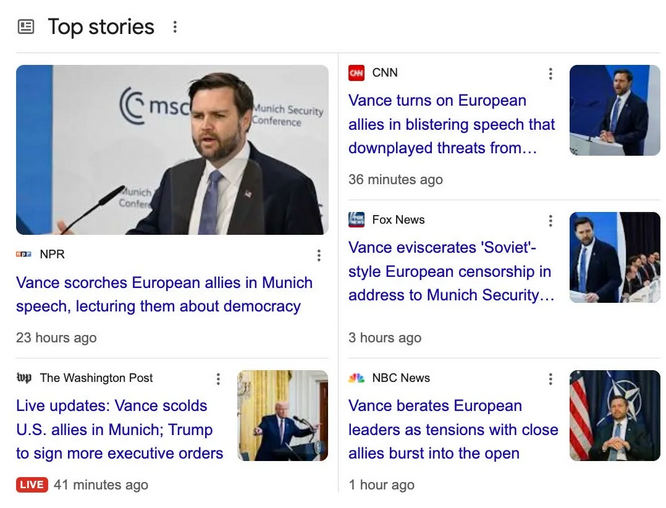
N.S. Lyons suggested in the latest post at The Upheaval that Vice President J.D. Vance’s real message to the European leaders can be rephrased as “Give Up the Information War and GTFO”:

The political elite of Europe and the Anglosphere appeared shocked by J.D. Vance’s wonderfully blunt speech in Munich last month. The U.S. Vice President declared Washington’s top security concern to be “the threat from within” the NATO alliance and castigated assembled leaders for their increasingly brazen assaults on “democratic values”, including censoring speech, suppressing popular opposition parties, and canceling elections. But if this shock isn’t feigned then it is rather remarkable, given that these elites were in their own way already effectively at war with the United States. All Vance did was point out the nature of this hidden conflict.
Vance delivered multiple messages with his speech, the broadest and most historic of which was that the era of “post-national” globalist liberalism is over. The United States, he indicated, now has a core interest in seeing a Western world that is collectively strong because its sovereign nations are strong, with the self-confidence to independently defend themselves physically, culturally, and spiritually. His emphasis on promoting free speech and democratic legitimacy tied into this message, but was about far more than the importance of “shared values” or even Washington’s new friendliness to nationalist parties. Practically, it was an implied warning that the role Europe has been playing as a proxy actor in the political and ideological conflicts raging in the United States will no longer be tolerated. More specifically, it was a declaration that ongoing transatlantic institutional, technological, and legal support for America’s embattled left-wing deep state must end – or else.
After Donald Trump’s election in 2016, America’s panicked establishment elites reacted by attempting to construct a system for managing public opinion through strict control of information, especially online information. The idea was that growing public support for populism was fueled by “low-information voters” and their consumption of “misinformation” and “disinformation”, including from foreign actors, and that if their “information diet” could just be controlled then they would stop voting wrong. The underlying assumption here was of course that the elite’s own increasingly radical policy preferences were the only rational path, opposable only by the stupid and easily manipulated. As Trump’s defeated opponent Hillary Clinton would later put it, social media platforms had fundamentally changed the information environment and “if they don’t moderate and monitor the content, we lose total control”.
This intended system of thought-control would later grow into the censorship industrial complex that was partially revealed following Elon Musk’s acquisition of Twitter. But a big obstacle initially stood in the way: the U.S. Constitution and its protection of free speech. The public might be receiving the “wrong” information on the internet, but “our First Amendment stands as a major block to be able to just, you know, hammer it out of existence”, as John Kerry lamented in a speech to the World Economic Forum.
Under the Biden administration, this legal problem was partially solved by simply ignoring it, the federal government directly colluding with technology companies and a network of “independent” (state-funded) “fact-checking” organizations to impose mass censorship on American citizens. The result was, as one federal judge later described it, effectively “the most massive attack against free speech in United States’ history”.
A more subtle and sustainable work-around was also discovered, however. This was to circumvent the U.S. Constitution by outsourcing the policing of the internet and populist movements to other countries around the world. This could be done because the internet is global and so the whole network is affected by government regulations on any local market of sufficient size. Leaders on both sides of the Atlantic immediately grasped that legal and regulatory structures imposed by the European Union, with the leverage of its huge unified market, could for example force internet companies the world over – including U.S. companies – to change their behavior in order to comply and avoid losing access (this imperialistic regulatory strong-arming was dubbed the “Brussels Effect”, becoming Europe’s only significant innovation this century).
Comments Off on Trump’s next target – Europe
QotD: British and French Enlightenments
By the time she wrote, a number of historians had accepted that the Enlightenment, once characterized as the “Age of Reason”, came in two versions, the radical and the skeptical. The former was identified with France, the latter with Scotland. Historians of the period also acknowledged that the anti-clericalism that obsessed the French philosophes was not reciprocated in Britain or America. Indeed, in both the latter countries many Enlightenment concepts — human rights, liberty, equality, tolerance, science, progress — complemented rather than opposed church thinking.
Himmelfarb joined this revisionist process and accelerated its pace dramatically. She argued that, central though many Scots were to the movement, there were also so many original English contributors that a more accurate name than the “Scottish Enlightenment” would be the “British Enlightenment”.
Moreover, unlike the French who elevated reason to a primary role in human affairs, British thinkers gave reason a secondary, instrumental role. In Britain it was virtue that trumped all other qualities. This was not personal virtue but the “social virtues” — compassion, benevolence, sympathy — which British philosophers believed naturally, instinctively, and habitually bound people to one another. This amounted to a moral reformation.
In making her case, Himmelfarb included people in the British Enlightenment who until then had been assumed to be part of the Counter-Enlightenment, especially John Wesley and Edmund Burke. She assigned prominent roles to the social movements of Methodism and Evangelical philanthropy. Despite the fact that the American colonists rebelled from Britain to found a republic, Himmelfarb demonstrated how very close they were to the British Enlightenment and how distant from French republicans.
In France, the ideology of reason challenged not only religion and the church, but also all the institutions dependent upon them. Reason was inherently subversive. But British moral philosophy was reformist rather than radical, respectful of both the past and present, even while looking forward to a more enlightened future. It was optimistic and had no quarrel with religion, which was why in both Britain and the United States, the church itself could become a principal source for the spread of enlightened ideas.
In Britain, the elevation of the social virtues derived from both academic philosophy and religious practice. In the eighteenth century, Adam Smith, the professor of moral philosophy at Glasgow University, was more celebrated for his Theory of Moral Sentiments (1759) than for his later thesis about the wealth of nations. He argued that sympathy and benevolence were moral virtues that sprang directly from the human condition. In being virtuous, especially towards those who could not help themselves, man rewarded himself by fulfilling his human nature.
Edmund Burke began public life as a disciple of Smith. He wrote an early pamphlet on scarcity which endorsed Smith’s laissez-faire approach as the best way to serve not only economic activity in general but the lower orders in particular. His Counter-Enlightenment status is usually assigned for his critique of the French Revolution, but Burke was at the same time a supporter of American independence. While his own government was pursuing its military campaign in America, Burke was urging it to respect the liberty of both Americans and Englishmen.
Some historians have been led by this apparent paradox to claim that at different stages of his life there were two different Edmund Burkes, one liberal and the other conservative. Himmelfarb disagreed. She argued that his views were always consistent with the ideas about moral virtue that permeated the whole of the British Enlightenment. Indeed, Burke took this philosophy a step further by making the “sentiments, manners, and moral opinion” of the people the basis not only of social relations but also of politics.
Keith Windschuttle, “Gertrude Himmelfarb and the Enlightenment”, New Criterion, 2020-02.
Comments Off on QotD: British and French Enlightenments
March 4, 2025
FDR – behind closed doors – was as bad as Trump while the Dunkirk evacuation was going on
Winston Churchill became prime minister of Britain the same day the Germans launched their attack against France and the Low Countries in May, 1940. The situation went from bad to appalling in very short order as the vaunted French army’s high command crumbled under the stress (even if the soldiers fought bravely in most cases). The British Expeditionary Force retreated with the French mobile forces toward the English Channel, eventually evacuating as many troops as they could from the port of Dunkirk. During this time, Churchill was appealing to the American President Franklin D. Roosevelt for whatever aid he could send.
Postwar histories tended to portray FDR as both benevolent and helpful toward Churchill in this stressful period, but behind closed doors FDR was far less a future ally, as Andreas Koureas explained on Twitter:
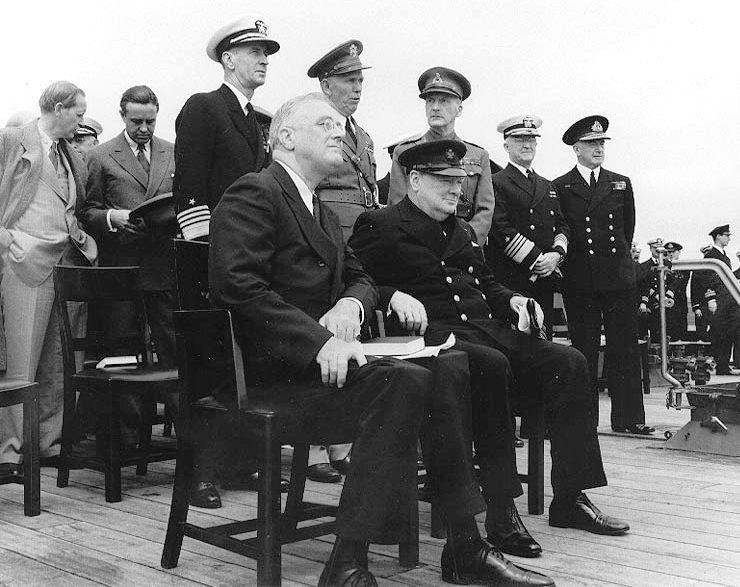
More than a year after FDR’s attempt to pry Canada and the Royal Navy away from a “dying” Britain, he and Churchill met onboard HMS Prince of Wales, in Placentia Bay, Newfoundland, during the Atlantic Charter Conference. President Franklin D. Roosevelt (left) and Prime Minister Winston Churchill are seated in the foreground. Standing directly behind them are Admiral Ernest J. King, USN; General George C. Marshall, U.S. Army; General Sir John Dill, British Army; Admiral Harold R. Stark, USN; and Admiral Sir Dudley Pound, RN. At far left is Harry Hopkins, talking with W. Averell Harriman.
US Naval Historical Center Photograph #: NH 67209 via Wikimedia Commons.
Ironically, the truth is that in 1940, Roosevelt — behind closed doors — behaved worse than Trump.
On the 20th May 1940, after multiple failed pleas for aid, Churchill wrote to Roosevelt that:
“If members of the present administration were finished and others came in to parley amid the ruins, you must not be blind to the fact that the sole remaining bargaining counter with Germany would be the fleet, and if this country was left by the United States to its fate no one would have the right to blame those then responsible if they made the best terms they could for the surviving inhabitants. Excuse me, Mr. President, putting this nightmare bluntly.”
Roosevelt’s refusal for aid was understandable given the political situation in America. As he told Churchill earlier that month, it wasn’t “wise for that suggestion to be made to the Congress at this moment”.
However, what he did after the 20th May telegram wasn’t.
Not bothering to even reply to Churchill’s warnings, Roosevelt instead sought to get Canada to give up on Britain.
As Roosevelt thought that Britain would likely collapse, and Churchill could not be trusted to maintain the struggle, he summoned a delegation for Canada.
The aim was to get Canada to pester Britain to have the Royal Navy sent across the Atlantic, before Britain’s seemingly-inevitable collapse.
Furthermore, to ensure this, the Americans wanted Canada to encourage the other British Dominions to get on board such a plan, and likewise gang up against Britain.
You can see Mackenzie King’s (PM of Canada) disbelief and horror in his diary,
“The United States was seeking to save itself at the expense of Britain. That it was an appeal to the selfishness of the Dominions at the expense of the British Isles. […] I instinctively revolted against such a thought. My reaction was that I would rather die than do aught to save ourselves or any part of this continent at the expense of Britain.”
King telegrammed Churchill on the 30th May that this was the closed-door political situation across the Atlantic.
Bear in mind, Roosevelt was trying to instigate this during the Dunkirk evacuations.
How Churchill didn’t break knowing the one ally he needed in his darkest hour thought he’d fail, I have no idea.
On the 5th June 1940, Churchill wrote back to Mackenzie King,
“We must be careful not to let the Americans view too complacently prospect of a British collapse, out of which they would get the British Fleet and the guardianship of the British Empire, minus Great Britain. […] Although President [Roosevelt] is our best friend, no practical help has been forthcoming from the United States as yet.”
(The first key mover that swung Roosevelt into entrusting Churchill to continue the struggle — and as such aid would not be wasted on Britain — was when Churchill ordered the Royal Navy’s Force H to open fire and destroy the French Fleet at Mers-el-Kébir — after Admiral Gensoul had refused the very reasonable offers from Britain, despite Germany and Italy demanding the transference of the French Fleet as part of the armistices.)
Comments Off on FDR – behind closed doors – was as bad as Trump while the Dunkirk evacuation was going on
The Titanic Survivors Arrive in New York – Hamilton Pudding
Tasting History with Max Miller
Published 18 Oct 2024A tart with apricot jam topped with a vanilla cookie-like filling, and toasted meringue
City/Region: Carpathia | United Kingdom | United States of America
Time Period: 1903 | 1912The menu from the last meal aboard RMS Carpathia before it docked in New York, carrying the survivors of the Titanic, lists Pouding Hamilton as one of the dessert options. After a fruitless search of my late 19th- and early 20th-century cookbooks, I finally found one recipe for it in a newspaper from 1903.
Honestly, I don’t know why there isn’t more mention of this tart. It’s delicious. The texture has kind of a wonderful crumbly shortcrust quality to it, and it’s not too sweet. It’s reminiscent of a vanilla cookie with jam, and you could really swap out the apricot jam for any flavor you like. I could see this being a great dessert for the holidays.
Hamilton Pudding –
Line a pie dish with a good short crust and cover the bottom with a layer of apricot jam; then fill up with the following mixture: Cream three ounces of butter with the same quantity of caster sugar, then add the yolks of two well beaten eggs and the white of one. Sift in by degrees three ounces of flour and flavor with a few drops of vanilla essence. Bake in a moderate oven and when nearly cooked beat the remaining white of egg to a stiff froth and lay it on top in tough lumps. Return the pudding to the oven till it is slightly browned.
— The Gazette, York, Pennsylvania, Sunday, August 9, 1903.
Comments Off on The Titanic Survivors Arrive in New York – Hamilton Pudding
March 3, 2025
Europe’s Imperial Giants: On the Brink of Collapse? – W2W 09 Q4 1946
TimeGhost History
Published 2 Mar 2025In 1946, Britain, France, and the Netherlands fight to regain control over shattered colonies — from Indonesia’s revolt to Vietnam’s war with France. Meanwhile, the U.S. and USSR maneuver to shape these emerging nations for their own global interests. Will independence spark true liberation, or will it simply swap one master for another?
(more…)
Comments Off on Europe’s Imperial Giants: On the Brink of Collapse? – W2W 09 Q4 1946
March 2, 2025
Which is better – Spitfire or Bf 109? – Battle of Britain Fireside Chat
World War Two
Published 1 Mar 2025Indy and Sparty answer questions about the Battle of Britain! Spitfire vs Bf 109, the Big Wing Debate, and whether Goering had any kind of plan for the battle.
(more…)
Comments Off on Which is better – Spitfire or Bf 109? – Battle of Britain Fireside Chat
March 1, 2025
“There were always scapegoats … and they were always driven out one way or another”
The second part of Nigel Biggar‘s look at the culture war in Britain includes a look at how the professional approach to young peoples’ gender issues became monomaniacal because nobody involved stopped to think for fear of being ostracized (or fired):
On the gender front, there’s plenty of reason to doubt the intellectual coherence of transgender-self-identification. When a biological male believes that his inner, authentic self is female, what exactly does he think being ‘female’ is? I’m still waiting for someone to persuade me that this doesn’t trade on gender stereotypes that feminists rightly taught us to throw overboard decades ago.
Observe how that has nothing at all to do with the care of patients, and how it has everything to do with the self-regard and political standing of the managers.
There’s even more reason to doubt that the well-being of young people is well served by taking their asserted genders at face value and allowing them to align their bodies by making irrevocable physical changes. According to Hannan Barnes’ shocking chronicle of the scandal at the Gender Identity Development Service (or GIDS) at the Tavistock Institute here in London, there was widespread doubt among clinicians about young people’s claims of “an inborn ‘trans’ nature”, awareness that these were sometimes correlated with eating disorders and self-harm, and suspicion that they might be caused by abuse or trauma. Furthermore, the long-term effects of using puberty-blockers were “largely unknown”, there was considerable uncertainty about which patients would benefit from them, and the health of some young patients actually seemed to worsen while on them.
Notwithstanding all this, “the clinical team … never discussed as a group what it even understood by the word ‘transgender'”, clinicians “never dream[t] of telling a young person that they weren’t trans”, and they always prescribed puberty-blockers unless the patient actively refused them. What’s more, expressions of doubt by staff were discouraged. “Someone would raise concerns, and someone else would move in to shut it down”, writes Barnes. “Those who persisted in asking difficult questions were not received well … those who spoke out were labelled troublemakers. [According to one witness,] ‘There were always scapegoats … and they were always driven out one way or another'”. “Junior staff looked on and learnt”.
Note the chilling effect.
The Tavistock Institute in London
Barnes’ book bears the title, Time to Think, because she identifies the general problem at GIDS as that of “not stopping to think”. That, of course, raises the question, Why? Barnes gives several reasons. One was the fact that the GIDS was propping up the Tavistock financially and that senior managers had a material interest in not disturbing its assumptions. Another was the unwillingness to offend transgender lobby groups such as Mermaids for “fear of a backlash”. But, most important of all was concern for the ‘progressive’ reputation of the management. According to David Bell, consultant adult psychiatrist at the Trust and whistleblower, “The senior management regarded [GIDS] as a star in our crown, because they saw it as a way of showing that we weren’t crusty old conservatives; that we were up with the game and cutting-edge. That was very important to the management to show we were like that”. Observe how that has nothing at all to do with the care of patients, and how it has everything to do with the self-regard and political standing of the managers. Not for the first time, the basic narcissism of progressive virtue-signaling is exposed.

Update: Added missing URL.
Comments Off on “There were always scapegoats … and they were always driven out one way or another”
February 28, 2025
Taking money from poor people in rich countries to give to rich people in poor countries
Tim Worstall explains how government foreign aid is quite literally anti-democratic (which is why it’s rare for governments to allow the voters any input about the subject):

Obviously we need to start with the observation of Peter, Lord Bauer — foreign aid is nicking money off poor people in rich countries to give to rich people in poor countries. As the sort of people who rule us went to school with those who rule the poor countries — I did, with the President of the Philippines, Bongbong, for example. V different year but still — it’s people nicking our money to spend on making themselves look good to their peer group.
You know, elite virtue signalling.
Yes, of course 0.7% of GDP should be spent upon Official Development Aid. ODA is very important, dont’cha kno’? Every chav in Britain should have near 1% of everything they do collected up and sent off to Ol’ Bongie. Obviously. Couldn’t face an Old Boys dinner without that now, could I?
Now of course that’s not actually quite how it’s put even if that is what it actually is. But just the sometimes the truth slips out from those corridors of power.
The former head of the Foreign Office has warned Rachel Reeves not to cut Britain’s international aid spending, amid signs the chancellor is willing to raid the development budget to help pay for higher defence spending.
Simon McDonald, the former lead civil servant at the Foreign Office, said it would damage Britain’s global reputation if Reeves chose to reduce aid as she looks for savings across Whitehall in this year’s spending review.
Reputation? Among whom? Among those who attended Pembroke?
He told the Guardian: “At times of financial need, development assistance is an easy target for trimming because international assistance is not generally voters’ priority”.
Remember folks, democracy is that we the people decide. We’ve even those out there insisting that all economic decisions must be made via democratic means — that true economic democracy which is to be the new socialism.
But when democracy — in the form of “We don’t give a shit about that” — bumps up against the elite desire to look good at the state banqueting table guess what? Democracy has to git to buggery and the elite get to spend our money their way all the same.
No, really. Look what he’s saying. Voters don’t care. But they must be forced to pay all the same. So much for that vaunted democracy.
Comments Off on Taking money from poor people in rich countries to give to rich people in poor countries
Everyday Life in the Roman Empire – An Empire of Peoples
seangabb
Published 28 Aug 2024The Roman Empire had a geographical logic, but was an endlessly diverse patchwork of linguistic, ethnic and religious groups. In this lecture, Sean Gabb describes the diversity:
Geographical Logic – 00:00:00
Linguistic Diversity – 00:06:57
Italy – 00:12:46
Greece – 00:17:23
Greeks and Romans – 00:21:01
Egypt – 00:28:24
Greeks, Romans, Egyptians – 00:33:00
North Africa – 00:37:27
The Jews – 00:41:20
Greeks, Romans, Jews – 00:44:10
Gaul – 00:50:36
Britain – 00:52:26
Greeks, Romans, Britons – 00:54:58
The East – 00:59:22
Bibliography – 01:01:20
(more…)
Comments Off on Everyday Life in the Roman Empire – An Empire of Peoples


