
Forgotten Weapons
Published 28 Dec 2024I was recently joined by my friends Les Winner (Polaris Logistics) and Jari Laine (Varusteleka) for an epic trek across East Falkland in the footsteps of 45 Commando of the British Royal Marines. In 1982, the Marines landed to rebuff the Argentine invasion of the islands. Specifically, they landed at Port San Carlos on the far western side of the island, planning to use heavy-lift helicopters to move east to attack the Argentine positions around Stanley. However, the Chinooks they were counting on were on the Atlantic Conveyor, which was sunk by Argentine Exocet attack on May 25. That left the Marines with no choice but to hike the 60 miles or so overland. They did so overland in the South Atlantic winter, with combat loads and full rucksacks — it was a brutal movement that they executed with aplomb.
Les, Jari, and I wanted to see the ground, and so we headed out to follow the same path, albeit without the weapons or ammunition and in the summer. We took four days to complete the distance, meeting some really cool people and making lots of blisters along the way. This video is a record of that trip.
(more…)
April 27, 2025
In the Footsteps of 45 Commando: 60 Miles Across the Falklands
April 26, 2025
A proposal for cutting the Channel crossing phenomenon
In The Conservative Woman, David Wright suggests a concrete plan to stem the tide of “refugees” arriving in the south of England from Calais and other French Channel ports:
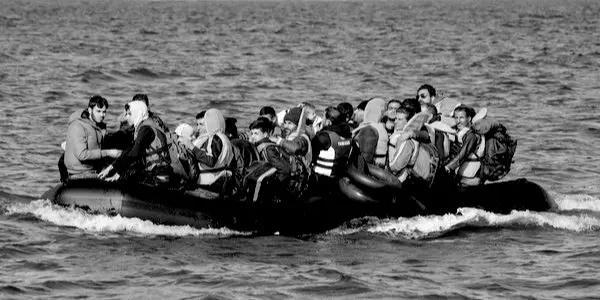
Illegal Channel crossings by rubber dinghies overloaded predominantly with young men have been an increasingly worrying trend for many years yet successive governments have made no serious or workable attempts to do anything about it.
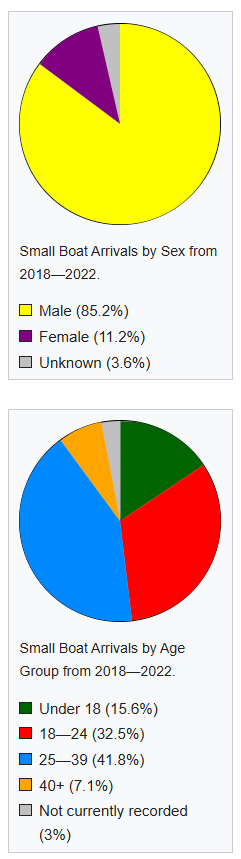
Migrant crossings are up by more than 40 per cent on last year and a record for daily arrivals has been set. A total of 705 migrants in 12 boats crossed the Channel on Tuesday April 15, days after the previous record of 656 was set the previous Saturday. The total number of arrivals in 2025, at 8,888, is 42 per cent higher than at the same point last year and 81 per cent higher than at this stage in 2023. More arrivals were recorded in January to April than in the equivalent four-month period in any year since data on Channel crossings began in 2018.
The French authorities are providing lifejackets to ensure migrants can cross the Channel safely. The jackets are returned to the French once the migrants have been escorted to the mid-point of the Channel and are rescued by the British authorities, so that they can be re-used for future crossings.
We have seen French police on the beach at Calais standing idly by while migrants board dinghies to Dover.
[…]
The boats should be painted grey, a small gun mounted on the foredeck, and manned with recently retired RN personnel. (There would be no shortage of volunteers.) A small support base should be built in Folkestone harbour, initially using Portakabins for rapid start-up, with fuelling facilities, a small workshop, an accommodation block and a canteen. This could be achieved relatively quickly and at a modest cost to the defence budget. These boats would be tasked with patrolling the Dover Strait every day from dawn to dusk, three or four at a time. Drones could also be used to detect dinghies and direct the patrolling boats to them. They would not need to be at sea in weather too rough for small smuggler-boat crossings.
They should be tasked to intercept the smugglers wherever they are in the Channel, approaching our shores, over the mid-way line or just leaving French beaches, and turned back and escorted. On approach to the smugglers’ beach the Border Force vessel should stand off and launch a RIB (rigid inflatable boat) manned by four staff who would escort them until they grounded on the beach. With two of them standing guard with weapons the others, using box cutters, would slash long holes in the rubber dinghies and remove the outboard motors and drop them into the water to render them unserviceable. On completion the RIB should return to its vessel and the vessel withdraw to resume patrol. Input from serving senior naval officers would be needed to provide detailed operating procedures. Once deployed this division would be under the command of a senior serving officer.
Of course, French President Emmanuel Macron would immediately be protesting. But he hasn’t got a leg to stand on. France is a signatory to the Schengen Agreement which requires migrants/asylum seekers to be processed in the first safe country they enter. Not only that but Britain has paid France almost half a billion pounds to stop the migrants arriving at the beaches and boarding dinghies to Dover.
France has not only done nothing but trouser this cash while its navy continues to escort the dinghies into UK waters and hand them off to our Border Force or the RNLI.
The Fairey Battle – Light Bomber, Heavy Losses
Rex’s Hangar
Published 17 Nov 2021Originally conceived in the early 1930s, by the time the first prototype of the Fairey Battle flew in 1936 it was already becoming obsolete. However, the RAF desperately needed combat aircraft, and so the Battle was put into production. It would go on to fight in the Battle of France, where it would take exceptionally heavy losses due to its slow speed and poor defensive armament. After being retired from front-line duty, the Fairey Battle would go on to becoming a successful training aircraft for the RAF and Commonwealth forces, serving the needs of combat flight schools in Canada, South Africa, Australia and New Zealand.
****
Producing these videos is a hobby of mine. I have a passion for history, and personally own a large collection of books, journals and other texts, and endeavor to do as much research as possible. However if there are any mistakes, please don’t hesitate to reach out and correct anything 🙂
April 25, 2025
What Were Georgian Attitudes Towards Sex? | Georgian Pleasures
History Hit
Published 12 Sept 2024Historian Dr Kate Lister removes Bridgerton‘s rose-tinted glasses, unlaces the corsets and unbuttons the breaches of the Georgians. Join Kate as she investigates how s*x and the world of celebrity were a big thing long before the 20th century.
The fabulous wealthy elite of Bridgerton look perfectly preened, their teeth, hair, make up, even their sex scenes are all filled with opulent glamour! But in reality a lot of people in Georgian society, including the wealthy, were dealing with a myriad of issues, from syphilis, teeth decay and scandals to laudanum and gin addictions. All of this would have been rife and incredibly visible on the big city streets during the booming industrial revolution.
Kate uncovers what went on betwixt the Georgian sheets: who’s doing what, where, how and with whom. Along the way she’ll explore extraordinary guides to s*x work in London and Edinburgh and unwrap the world of 18th century condoms, syphilis and even high profile and hidden sex clubs. All of this will help to unearth the real lives of the people stomping the streets, pubs and back alleys of these lavish Georgian cities. No stone is left unturned in the quest to reveal the real lives of Georgian society!
(more…)
April 24, 2025
Berlin Airlift: From Bombs to Candy – W2W 23 – 1948 Q3
TimeGhost History
Published 23 Apr 2025In 1948, Stalin blockades West Berlin, isolating over two million people without food, fuel, or supplies. Refusing to surrender the city, Western powers launch the Berlin Airlift, history’s largest aerial supply mission, to deliver food, coal, and even candy. As tensions soar, planes defy Soviet threats around the clock — can the Allies really sustain a city from the sky?
(more…)
April 20, 2025
Did Britain Bomb The Wrong Targets in WW2? – Out of the Foxholes Live
World War Two
Published 19 Apr 2025Today Indy and Sparty answer questions on the French colonies, Pykrete and iceberg aircraft carriers Japan’s invasion of India, and they talk about Britain’s misguided strategic bombing strategy.
(more…)
QotD: “Hate speech”
… they have convinced themselves that certain forms of speech are not free speech. That certain beliefs should not be afforded the liberty of expression. You hear it in their telling, baleful mantra that “Hate speech is not free speech”. And if “hate speech” is not free speech, but rather some kind of toxin, a pox on public life, then crushing it is not censorship. It is more like an act of public health: cleansing the public realm of diseased thoughts that are liable to harm certain groups. These people see themselves not as censors, but as public-health activists delousing the community of germs spread by evil men and women.
This is why they balk and protest when the words free speech are used against them. They detest the idea that they are enemies of liberty. But of course that is precisely what they are. Just consider that nonsensical chant “Hate speech is not free speech”. There are two profound moral problems with this idiotic tautology. The first is that, actually, even genuinely hateful speech, including racist gibberish and misogynistic blather, should be free speech. By its very definition freedom of speech should extend to all speech, even speech we detest. And secondly, “hate speech” has become a slippery, amorphous category that now covers not only foul old nonsense like Holocaust denial, but also trans-sceptical feminism, criticism of Islam, opposition to mass immigration, and so on. “Hate speech” really means thoughtcrime. It is an utterly ideological category used by the cultural and intellectual elites to demonise and censor ideas, beliefs and moral convictions they disapprove of. The war on “hate speech” is the new war on heresy, on free-thinking, on minority opinion, on challenging beliefs. It is blatant censorship.
The illiberal liberals’ conflation of genuine hatred with moral opinion, all of which then gets cynically collapsed under the name of “hate speech”, was beautifully captured in an exchange on the BBC’s Politics Live yesterday. Pushing back against the FSU’s Inaya Folarin Iman, Baroness Kennedy arrogantly predicted that the FSU would be embraced by “racists … people who hate homosexuals, who hate trans people, [and] people … who have hostile views towards Islam”. Hold on. One of these things is not like the others. What is wrong with having hostile views on Islam? Is hostility towards a powerful world religion now a form of “hate speech”? Yes, it is. Kennedy’s conflation of criticism of Islam with racism and homophobia perfectly encapsulated the way in which “hate speech” is now used to police not only genuinely hateful ideas, but also blasphemy against religious ideas. Even that key freedom human beings fought so hard for – the right to mock gods and prophets and religious ideology – is now threatened by the censorious ideology of “hate speech”.
Brendan O’Neill, “Why we must win the fight for free speech”, Spiked, 2020-02-26.
April 19, 2025
Dambusters – Part 2 – The Countdown to the Raid
HardThrasher
Published 17 Apr 2025The speed with which a theory had to be put into practice, and the opening phase of the raid itself.
(more…)
QotD: Allied air and sea operations won WWII
The Allies won the war by using air power to destroy the German and Japanese capacity both to produce military equipment and to transport it to the battlefield. By 1944-45, the Germans and Japanese could not use their economies to arm and supply their armies on the battlefield, leading to their inevitable defeat.
In the European war, American and British airpower: (a) directly destroyed a significant amount of productive capacity, (b) rendered remaining capacity far less efficient, (c) made it impossible for the Germans to defeat western ground forces, and (d) compelled the Germans to waste tremendous resources on air defense and exorbitant, ultimately ineffective vengeance weapons.
In the Pacific, the United States used carrier-based airpower, submarines, and bomber-deployed mines to isolate Japan from the resources of the empire it conquered in 1941-42. American bombers also directly destroyed factories and transportation systems, leading to similar levels of economic dysfunction as in Germany.
Anonymous, “Your Book Review: How the War Was Won“, Astral Codex Ten, 2024-08-09.
April 17, 2025
Canadian labelling regulations save us from “too many vitamins”
In the National Post, Jesse Kline points out that Canadian food label regulations have become so nit-picky that they prevent safe and accurately labelled foods from Australia, Britain, and other countries from being sold here:
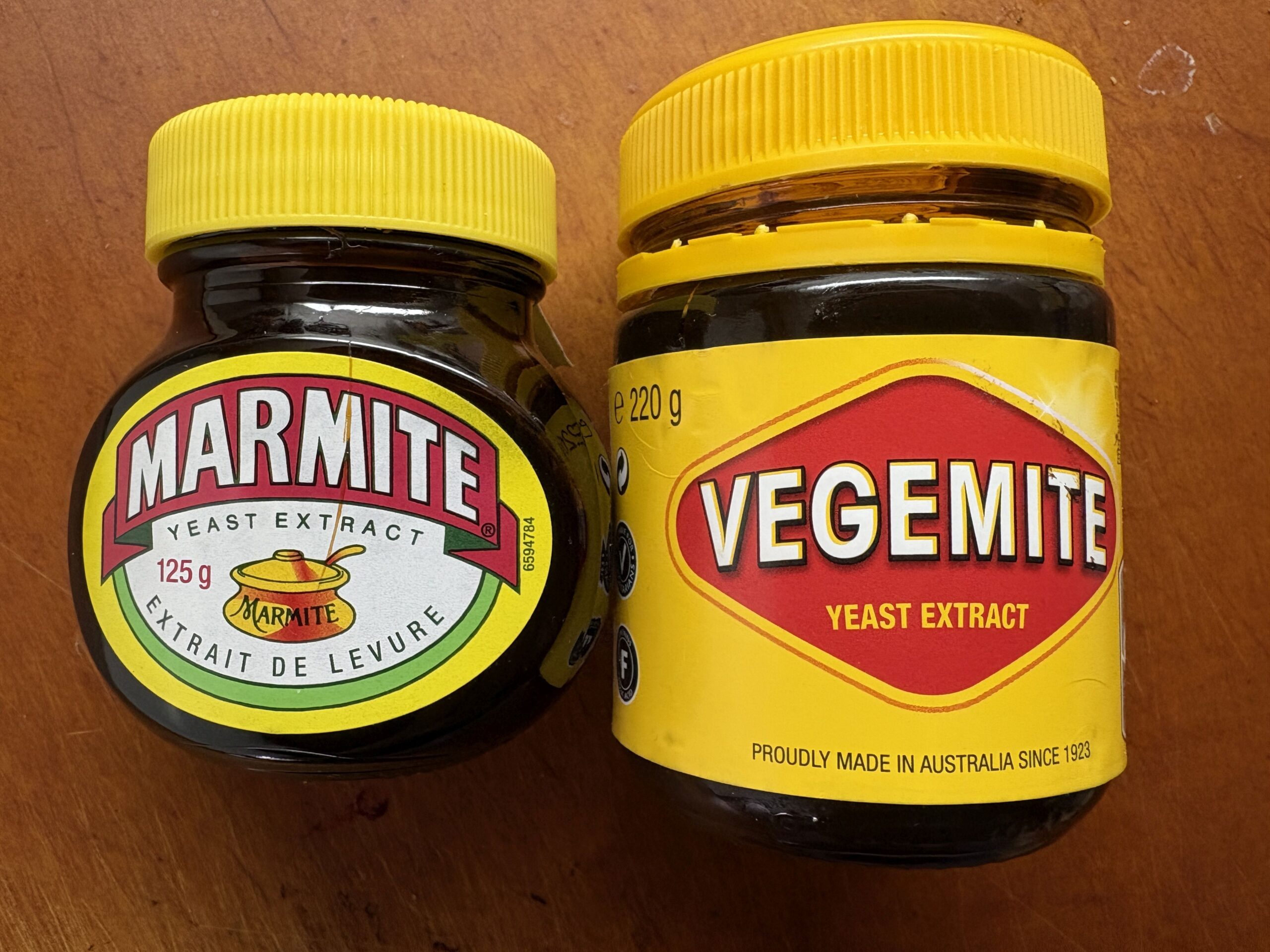
Marmite from the UK and Vegemite from Australia, two of the products at risk of Canadian over-regulatory twitches.
Shortly after winning the Liberal leadership, Mark Carney travelled to Paris and London to shore up our trading relationship with our European allies.
Yet it is noteworthy that Canada is one of only two countries that has not yet ratified the United Kingdom’s accession into the CPTPP, meaning that we don’t enjoy the benefits of free trade with the country with whom we share a system of government and a King. Meanwhile, France is one of a handful of countries that has yet to ratify the free-trade agreement between Canada and the EU.
If we can’t even agree to implement trade deals that have already been negotiated and agreed upon with countries that have such deep historical ties to Canada, what hope do we have of improving trade with our other partners around the world?
Part of the problem is that Canada refuses to follow the example of countries like Australia and New Zealand, which successfully phased out their own systems of supply management years ago with great success.
As a result, supply management has proven to be a sticking point in virtually every trade negotiation we’ve entered into, and is a constant source of tension even among countries we have free-trade deals with.
But we have also fallen into the trap, along with our European friends, of over-regulation. Modern bureaucratic states impose so many restrictions on commercial enterprises, it often becomes uneconomic to market their products in other countries.
Canada, for example, imposes stringent labelling requirements to ensure product information is available in both English and French, and that nutritional information conforms to our very specific requirements.
None of this is necessary, especially in an age in which we can hold a phone up to a box of French crackers to see what it says. But the problem extends far beyond language or disagreements over the recommended daily intake of fibre.
As the CBC reported on Monday, Leighton Walters, an expat from Down Under who owns several Australian-themed coffee shops in the Greater Toronto Area, was told earlier this year by the Canadian Food Inspection Agency (CFIA) that he was no longer allowed to sell the roughly $8,000 worth of Vegemite he had imported because it contains … too many vitamins.
Under current regulations, only a select list of products are allowed to contain added vitamins. Vitamin B-rich spreads like Vegemite and its British equivalent Marmite are not among them because … well, just because.
A similar situation arose a decade ago when reports that the government had ordered Marmite and the Scottish drink Irn-Bru to be taken off the shelves of a British supermarket in Saskatoon caused outrage on both sides of the pond.
The CFIA later clarified that only versions of those products formulated specifically to meet Canadian requirements — i.e., those that don’t contain added vitamins or a specific type of food colouring — are allowed to be sold in this country. Because heaven forbid we trust that other advanced Commonwealth nations would have reasonable enough food safety standards.
We have quite literally regulated ourselves into a corner. We can’t even import spreads like Marmite and Vegemite — which have been staples of British and Australian diets for decades — not because they’re unhealthy or unsafe, but because they don’t conform to our nit-picky regulations.
Why TOG II was BETTER Than You Think
The Tank Museum
Published 20 Dec 2024It was rejected and ridiculed for years — but TOG II is actually much better than you think.
In 1939, the UK Ministry of War issued the spec for a heavy assault tank. This hefty brief included the requirements to cross a 16ft gap, climb over anti-tank obstacles and enough firepower to penetrate 7 inches of concrete. Enter “The Old Gang”, a group of expert engineers, responsible for most of the tanks created during the First World War.
Two vehicles were created during this process — TOG I and TOG II. While the TOG projects have often been rejected as tanks out of time — relics of thinking from trench warfare — Content and Research Officer, Chris Copson, argues that these vehicles were highly innovative in terms of their mobility, armour and firepower.
Despite fulfilling their brief, TOG was sidelined in favour of other projects, and the lone survivor — TOG II — arrived at The Tank Museum in the 1950s. This lumbering beast that never saw active service, sat sidelined whilst surrounded by WW2 legends like the Churchill, Sherman, and the infamous Tiger 131.
But in 2012, a miracle happened. World of Tanks included the super heavy tank in their online video game — launching TOG II into viral popularity. Since then, interest in this unique vehicle has skyrocketed, and now more than ever people want to see TOG II in real life and find out more about its interesting history.
Shop TOG II merch at our online shop: https://tankmuseumshop.org/
00:00 | Introduction
01:24 | An Innovative Spec
05:00 | Innovations in Mobility
10:11 | Innovations in Armour
11:49 | Innovations in Firepower
16:21 | Would TOG II Have Worked?
18:46 | The Legend Lives OnIn this film, Chris Copson unpicks the misconceptions surrounding TOG II — that it was a ridiculous super-heavy tank built for a war from 30 years ago. Instead, this is a vehicle that was highly innovative and represented a significant engineering achievement. Thanks to videos games such as World of Tanks, TOG II is now celebrated as the goofiest super heavy tank in history, and lives on as an internet legend for a whole new generation of tank nuts.
(more…)
April 15, 2025
How the UN Plan Tore Palestine Apart – W2W 20 – 1948 Q2
TimeGhost History
Published 13 Apr 2025In 1948, the British departure from Palestine plunges the region into chaos. Amid bombings, massacres, and forced displacements, a brutal civil war escalates into the Arab-Israeli conflict, reshaping the Middle East forever. As Israel declares independence, Arab armies invade, and atrocities on both sides deepen hatred and tragedy. Can either side emerge victorious, or has the cycle of violence become unstoppable?
(more…)
April 14, 2025
QotD: Pax Americana replaces Pax Britannica
The British government spent most of the next century being dragged – reluctantly – into being arbitrators of conflicts they wanted nothing to do with. Finishing with being stuck with the Great War, and then responsibility for some of the most hopeless basket-case states handed over to “Mandate Powers” by the Versailles peace … as one British minister presciently pointed out, no one wanted Palestine, and it would be nothing but a disaster for whoever gets stuck with it … (Fortunately for the US, their Congress repudiated Wilson’s ridiculous League of Nations before the plan to lumber the US with the Mandate for places like Georgia – the Russian bit on the Black Sea that is! – could be put through.)
It is unsurprising that the British taxpayer spent the next 50 years trying to get out of international police-keeping obligations. With the sole exception of reluctantly agreeing to fight against the expansionary dictatorships in World War Two, British taxpayers voted for disarmament and de-colonisation whenever they could. (Abandoning some states – particularly in Africa – that might eventually have developed into safe and secure states, way before they were ready for independence … much to the cost of world peace and security since …)
The United States has had a similar experience more recently. Having inherited responsibility for maybe 50 years of the “Pax Americana” by the simple expedient of being the strongest economy standing after the Second World War. (Their only potential rival being the British Commonwealth of Nations — who between them had 5 of the next 10 biggest and healthiest post-war economies — being more than happy to let the dumb Americans have a go at being world policemen for a time, and see how they liked being blamed by everyone else for absolutely everything.)
The Americans discovered pretty quickly that the things they had been complaining about the British doing for the last 200 years were exactly what they had now signed up for, and finding even quicker that their taxpayers simply weren’t willing to carry the can, and take the blame, for very long at all.
Arguably the US’s fun with being world policeman was already pretty much over after Korea, and certainly after Vietnam. It is notable that the first Gulf War was NOT paid for by the US taxpayer … the US troops turned up but only if Saudi Arabia and Europe paid for them to do so (and preferably with a British Division on one flank, Australian warships on the other, and NATO fighters overhead …) none of this “we will carry the can and our taxpayers will just cope” crap for post-Vietnam American taxpayers.
Nigel Davies, “Types of Empires: Security, Conquest, and Trade”, rethinking history, 2020-05-02.
April 13, 2025
The Most Pointless Battle of WW1? – Passchendaele 1917
The Great War
Published 11 Apr 2025For more than three long months in 1917, Allied and German soldiers fought tooth and nail over a battlefield churned into a sea of sucking mud and shellholes by the guns. Hundreds of thousands were killed and wounded, some of them drowning in the soupy ground — for Allied gains of just a few kilometers. So why did the Battle of Passchendaele happen at all, and was it the most pointless battle of the First World War? (more…)
They really are trying to shut down “wrong” speech on the internet
I’ve always been a huge fan of free speech, which has been under continuous and escalating threat by many governments both in person and online. A side-note in the ongoing Canadian federal election has been Liberal leader Mark Carney’s commitment to addressing “online harm” as he defines it:

At a campaign rally in Hamilton, Ontario, Liberal leader Mark Carney unveiled what can only be described as a coordinated assault on digital freedom in Canada. Behind the slogans, applause lines, and empty rhetoric about unity, one portion of Carney’s remarks stood out for its implications: a bold, unapologetic commitment to controlling online speech under the guise of “safety” and “misinformation”.
We announced a series of measures with respect to online harm … a sea of misogyny, anti-Semitism, hatred, conspiracy theories — the sort of pollution that’s online that washes over our virtual borders from the United States.
He then made clear his intention to act:
My government, if we are elected, will be taking action on those American giants who come across [our] border.
The former central banker, who now postures as a man of the people, made it clear that if the Liberals are re-elected, the federal government will intensify efforts to regulate what Canadians are allowed to see, say, and share online. His language was deliberate. Carney condemned what he called a “sea of misogyny, anti-Semitism, hatred, conspiracy theories” polluting Canada’s internet space — language borrowed directly from the Trudeau-era playbook. But this wasn’t just a moral denunciation. It was a legislative preview.
Carney spoke of a future Liberal government taking “action on those American giants who come across our borders”. Translation: he wants to bring Big Tech platforms under federal control, or at least force them to play the role of speech enforcers for the Canadian state. He blamed the United States for exporting “hate” into Canada, reinforcing the bizarre Liberal narrative that the greatest threat to national unity isn’t foreign actors like the CCP or radical Islamists — it’s Facebook memes and American podcasts.
But the most revealing moment came when Carney linked online speech directly to violence. He asserted that digital “pollution” affects how Canadians behave in real life, specifically pointing to conjugal violence, antisemitism, and drug abuse. This is how the ground is prepared for censorship: first by tying speech to harm, then by criminalizing what the state deems harmful.
What Carney didn’t say is just as important. He made no distinction between actual criminal incitement and political dissent. He offered no assurance that free expression — a right enshrined in Canada’s Charter of Rights and Freedoms — would be respected. He provided no definition of what constitutes a “conspiracy theory” or who gets to make that determination. Under this framework, any criticism of government policy, of global institutions, or of the new technocratic order could be flagged, throttled, and punished.
And that’s the point.
Mark Carney isn’t interested in dialogue. He wants obedience. He doesn’t trust Canadians to discern truth from fiction. He believes it’s the job of government — his government — to curate the national conversation, to protect citizens from wrongthink, to act as referee over what is and isn’t acceptable discourse. In short, he wants Ottawa to become the Ministry of Truth.
In Britain, their equivalent to Canada’s “online harms” legislation has induced Bitchute to discontinue service to users in the UK:

A READER alerted us to this statement posted on the Bitchute homepage, visible to geolocated UK users:
After careful review and ongoing evaluation of the regulatory landscape in the United Kingdom, we regret to inform you that BitChute will be discontinuing its video sharing service for UK residents.
The introduction of the UK Online Safety Act of 2023 has brought about significant changes in the regulatory framework governing online content and community interactions. Notably, the Act contains sweeping provisions and onerous corrective measures with respect to content moderation and enforcement. In particular, the broad enforcement powers granted to the regulator of communication services, Ofcom, have raised concerns regarding the open-ended and unpredictable nature of regulatory compliance for our platform.
The BitChute platform has always operated on principles of freedom of speech, expression and association, and strived to foster an open and inclusive environment for content creators and audiences alike. However, the evolving regulatory pressures — including strict enforcement mechanisms and potential liabilities — have created an operational landscape in which continuing to serve the UK market exposes our company to unacceptable legal and compliance risks. Despite our best efforts to navigate these challenges, the uncertainty surrounding the OSA’s enforcement by Ofcom and its far-reaching implications leaves us no viable alternative but to cease normal operations in the UK.
Therefore, effective immediately, BitChute platform users in the UK will no longer be available to view content produced by any other BitChute user. Because the OSA’s primary concern is that members of the public will view content deemed unsafe, however, we will permit UK BitChute users to continue to post content. The significant change will be that this UK user-posted content will not be viewable by any other UK user, but will be visible to other users outside of the UK. Users outside the UK may comment on that content, which the creator will continue to be able to read, delete, block, reply and flag. Users outside the UK may share UK-user produced content to other users outside of the UK as normal. In other words, for users in the UK, including content creators, the BitChute platform is no longer a user-to-UK user video sharing service.
This is the exactly the kind of consequence we at TCW feared a result of the overly restrictive and poorly written Online Safety Act 2023, which has now come into force.
The way the technology works is that websites can use a geolocation service to analyse the IP address your internet service provider has given your service, and use this to determine where you are. Google does this to tailor ads to you, Amazon does this to get you the most convenient version of their website.
Now Bitchute are using this service to protect themselves from the UK Government’s overreach.
The good news: there is a way round this.


