
TimeGhost History
Published 23 Apr 2025In 1948, Stalin blockades West Berlin, isolating over two million people without food, fuel, or supplies. Refusing to surrender the city, Western powers launch the Berlin Airlift, history’s largest aerial supply mission, to deliver food, coal, and even candy. As tensions soar, planes defy Soviet threats around the clock — can the Allies really sustain a city from the sky?
(more…)
April 24, 2025
Berlin Airlift: From Bombs to Candy – W2W 23 – 1948 Q3
Comments Off on Berlin Airlift: From Bombs to Candy – W2W 23 – 1948 Q3
April 20, 2025
Did Britain Bomb The Wrong Targets in WW2? – Out of the Foxholes Live
World War Two
Published 19 Apr 2025Today Indy and Sparty answer questions on the French colonies, Pykrete and iceberg aircraft carriers Japan’s invasion of India, and they talk about Britain’s misguided strategic bombing strategy.
(more…)
Comments Off on Did Britain Bomb The Wrong Targets in WW2? – Out of the Foxholes Live
QotD: “Hate speech”
… they have convinced themselves that certain forms of speech are not free speech. That certain beliefs should not be afforded the liberty of expression. You hear it in their telling, baleful mantra that “Hate speech is not free speech”. And if “hate speech” is not free speech, but rather some kind of toxin, a pox on public life, then crushing it is not censorship. It is more like an act of public health: cleansing the public realm of diseased thoughts that are liable to harm certain groups. These people see themselves not as censors, but as public-health activists delousing the community of germs spread by evil men and women.
This is why they balk and protest when the words free speech are used against them. They detest the idea that they are enemies of liberty. But of course that is precisely what they are. Just consider that nonsensical chant “Hate speech is not free speech”. There are two profound moral problems with this idiotic tautology. The first is that, actually, even genuinely hateful speech, including racist gibberish and misogynistic blather, should be free speech. By its very definition freedom of speech should extend to all speech, even speech we detest. And secondly, “hate speech” has become a slippery, amorphous category that now covers not only foul old nonsense like Holocaust denial, but also trans-sceptical feminism, criticism of Islam, opposition to mass immigration, and so on. “Hate speech” really means thoughtcrime. It is an utterly ideological category used by the cultural and intellectual elites to demonise and censor ideas, beliefs and moral convictions they disapprove of. The war on “hate speech” is the new war on heresy, on free-thinking, on minority opinion, on challenging beliefs. It is blatant censorship.
The illiberal liberals’ conflation of genuine hatred with moral opinion, all of which then gets cynically collapsed under the name of “hate speech”, was beautifully captured in an exchange on the BBC’s Politics Live yesterday. Pushing back against the FSU’s Inaya Folarin Iman, Baroness Kennedy arrogantly predicted that the FSU would be embraced by “racists … people who hate homosexuals, who hate trans people, [and] people … who have hostile views towards Islam”. Hold on. One of these things is not like the others. What is wrong with having hostile views on Islam? Is hostility towards a powerful world religion now a form of “hate speech”? Yes, it is. Kennedy’s conflation of criticism of Islam with racism and homophobia perfectly encapsulated the way in which “hate speech” is now used to police not only genuinely hateful ideas, but also blasphemy against religious ideas. Even that key freedom human beings fought so hard for – the right to mock gods and prophets and religious ideology – is now threatened by the censorious ideology of “hate speech”.
Brendan O’Neill, “Why we must win the fight for free speech”, Spiked, 2020-02-26.
Comments Off on QotD: “Hate speech”
April 19, 2025
Dambusters – Part 2 – The Countdown to the Raid
HardThrasher
Published 17 Apr 2025The speed with which a theory had to be put into practice, and the opening phase of the raid itself.
(more…)
Comments Off on Dambusters – Part 2 – The Countdown to the Raid
QotD: Allied air and sea operations won WWII
The Allies won the war by using air power to destroy the German and Japanese capacity both to produce military equipment and to transport it to the battlefield. By 1944-45, the Germans and Japanese could not use their economies to arm and supply their armies on the battlefield, leading to their inevitable defeat.
In the European war, American and British airpower: (a) directly destroyed a significant amount of productive capacity, (b) rendered remaining capacity far less efficient, (c) made it impossible for the Germans to defeat western ground forces, and (d) compelled the Germans to waste tremendous resources on air defense and exorbitant, ultimately ineffective vengeance weapons.
In the Pacific, the United States used carrier-based airpower, submarines, and bomber-deployed mines to isolate Japan from the resources of the empire it conquered in 1941-42. American bombers also directly destroyed factories and transportation systems, leading to similar levels of economic dysfunction as in Germany.
Anonymous, “Your Book Review: How the War Was Won“, Astral Codex Ten, 2024-08-09.
Comments Off on QotD: Allied air and sea operations won WWII
April 17, 2025
Canadian labelling regulations save us from “too many vitamins”
In the National Post, Jesse Kline points out that Canadian food label regulations have become so nit-picky that they prevent safe and accurately labelled foods from Australia, Britain, and other countries from being sold here:
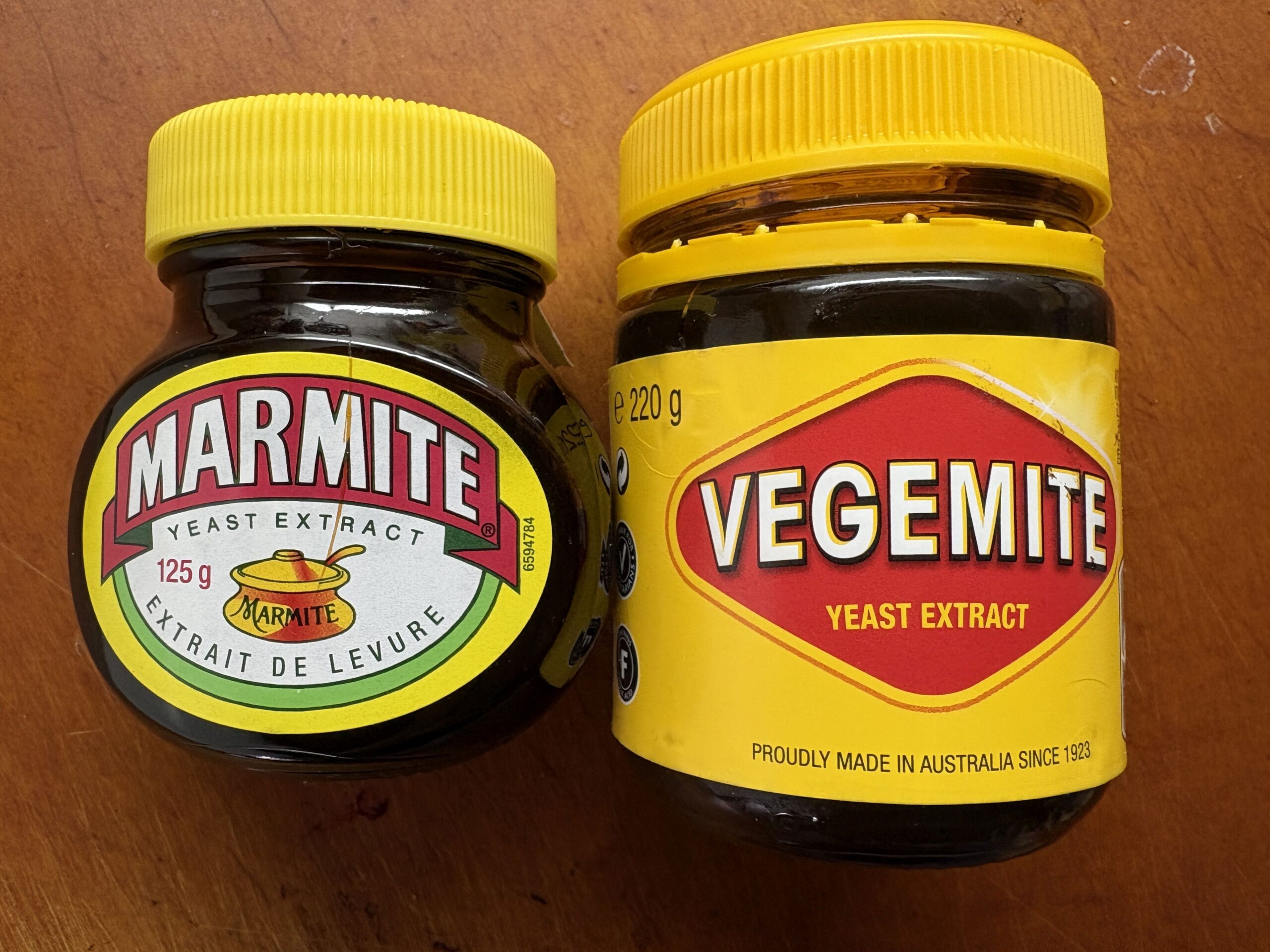
Marmite from the UK and Vegemite from Australia, two of the products at risk of Canadian over-regulatory twitches.
Shortly after winning the Liberal leadership, Mark Carney travelled to Paris and London to shore up our trading relationship with our European allies.
Yet it is noteworthy that Canada is one of only two countries that has not yet ratified the United Kingdom’s accession into the CPTPP, meaning that we don’t enjoy the benefits of free trade with the country with whom we share a system of government and a King. Meanwhile, France is one of a handful of countries that has yet to ratify the free-trade agreement between Canada and the EU.
If we can’t even agree to implement trade deals that have already been negotiated and agreed upon with countries that have such deep historical ties to Canada, what hope do we have of improving trade with our other partners around the world?
Part of the problem is that Canada refuses to follow the example of countries like Australia and New Zealand, which successfully phased out their own systems of supply management years ago with great success.
As a result, supply management has proven to be a sticking point in virtually every trade negotiation we’ve entered into, and is a constant source of tension even among countries we have free-trade deals with.
But we have also fallen into the trap, along with our European friends, of over-regulation. Modern bureaucratic states impose so many restrictions on commercial enterprises, it often becomes uneconomic to market their products in other countries.
Canada, for example, imposes stringent labelling requirements to ensure product information is available in both English and French, and that nutritional information conforms to our very specific requirements.
None of this is necessary, especially in an age in which we can hold a phone up to a box of French crackers to see what it says. But the problem extends far beyond language or disagreements over the recommended daily intake of fibre.
As the CBC reported on Monday, Leighton Walters, an expat from Down Under who owns several Australian-themed coffee shops in the Greater Toronto Area, was told earlier this year by the Canadian Food Inspection Agency (CFIA) that he was no longer allowed to sell the roughly $8,000 worth of Vegemite he had imported because it contains … too many vitamins.
Under current regulations, only a select list of products are allowed to contain added vitamins. Vitamin B-rich spreads like Vegemite and its British equivalent Marmite are not among them because … well, just because.
A similar situation arose a decade ago when reports that the government had ordered Marmite and the Scottish drink Irn-Bru to be taken off the shelves of a British supermarket in Saskatoon caused outrage on both sides of the pond.
The CFIA later clarified that only versions of those products formulated specifically to meet Canadian requirements — i.e., those that don’t contain added vitamins or a specific type of food colouring — are allowed to be sold in this country. Because heaven forbid we trust that other advanced Commonwealth nations would have reasonable enough food safety standards.
We have quite literally regulated ourselves into a corner. We can’t even import spreads like Marmite and Vegemite — which have been staples of British and Australian diets for decades — not because they’re unhealthy or unsafe, but because they don’t conform to our nit-picky regulations.
Comments Off on Canadian labelling regulations save us from “too many vitamins”
Why TOG II was BETTER Than You Think
The Tank Museum
Published 20 Dec 2024It was rejected and ridiculed for years — but TOG II is actually much better than you think.
In 1939, the UK Ministry of War issued the spec for a heavy assault tank. This hefty brief included the requirements to cross a 16ft gap, climb over anti-tank obstacles and enough firepower to penetrate 7 inches of concrete. Enter “The Old Gang”, a group of expert engineers, responsible for most of the tanks created during the First World War.
Two vehicles were created during this process — TOG I and TOG II. While the TOG projects have often been rejected as tanks out of time — relics of thinking from trench warfare — Content and Research Officer, Chris Copson, argues that these vehicles were highly innovative in terms of their mobility, armour and firepower.
Despite fulfilling their brief, TOG was sidelined in favour of other projects, and the lone survivor — TOG II — arrived at The Tank Museum in the 1950s. This lumbering beast that never saw active service, sat sidelined whilst surrounded by WW2 legends like the Churchill, Sherman, and the infamous Tiger 131.
But in 2012, a miracle happened. World of Tanks included the super heavy tank in their online video game — launching TOG II into viral popularity. Since then, interest in this unique vehicle has skyrocketed, and now more than ever people want to see TOG II in real life and find out more about its interesting history.
Shop TOG II merch at our online shop: https://tankmuseumshop.org/
00:00 | Introduction
01:24 | An Innovative Spec
05:00 | Innovations in Mobility
10:11 | Innovations in Armour
11:49 | Innovations in Firepower
16:21 | Would TOG II Have Worked?
18:46 | The Legend Lives OnIn this film, Chris Copson unpicks the misconceptions surrounding TOG II — that it was a ridiculous super-heavy tank built for a war from 30 years ago. Instead, this is a vehicle that was highly innovative and represented a significant engineering achievement. Thanks to videos games such as World of Tanks, TOG II is now celebrated as the goofiest super heavy tank in history, and lives on as an internet legend for a whole new generation of tank nuts.
(more…)
Comments Off on Why TOG II was BETTER Than You Think
April 15, 2025
How the UN Plan Tore Palestine Apart – W2W 20 – 1948 Q2
TimeGhost History
Published 13 Apr 2025In 1948, the British departure from Palestine plunges the region into chaos. Amid bombings, massacres, and forced displacements, a brutal civil war escalates into the Arab-Israeli conflict, reshaping the Middle East forever. As Israel declares independence, Arab armies invade, and atrocities on both sides deepen hatred and tragedy. Can either side emerge victorious, or has the cycle of violence become unstoppable?
(more…)
Comments Off on How the UN Plan Tore Palestine Apart – W2W 20 – 1948 Q2
April 14, 2025
QotD: Pax Americana replaces Pax Britannica
The British government spent most of the next century being dragged – reluctantly – into being arbitrators of conflicts they wanted nothing to do with. Finishing with being stuck with the Great War, and then responsibility for some of the most hopeless basket-case states handed over to “Mandate Powers” by the Versailles peace … as one British minister presciently pointed out, no one wanted Palestine, and it would be nothing but a disaster for whoever gets stuck with it … (Fortunately for the US, their Congress repudiated Wilson’s ridiculous League of Nations before the plan to lumber the US with the Mandate for places like Georgia – the Russian bit on the Black Sea that is! – could be put through.)
It is unsurprising that the British taxpayer spent the next 50 years trying to get out of international police-keeping obligations. With the sole exception of reluctantly agreeing to fight against the expansionary dictatorships in World War Two, British taxpayers voted for disarmament and de-colonisation whenever they could. (Abandoning some states – particularly in Africa – that might eventually have developed into safe and secure states, way before they were ready for independence … much to the cost of world peace and security since …)
The United States has had a similar experience more recently. Having inherited responsibility for maybe 50 years of the “Pax Americana” by the simple expedient of being the strongest economy standing after the Second World War. (Their only potential rival being the British Commonwealth of Nations — who between them had 5 of the next 10 biggest and healthiest post-war economies — being more than happy to let the dumb Americans have a go at being world policemen for a time, and see how they liked being blamed by everyone else for absolutely everything.)
The Americans discovered pretty quickly that the things they had been complaining about the British doing for the last 200 years were exactly what they had now signed up for, and finding even quicker that their taxpayers simply weren’t willing to carry the can, and take the blame, for very long at all.
Arguably the US’s fun with being world policeman was already pretty much over after Korea, and certainly after Vietnam. It is notable that the first Gulf War was NOT paid for by the US taxpayer … the US troops turned up but only if Saudi Arabia and Europe paid for them to do so (and preferably with a British Division on one flank, Australian warships on the other, and NATO fighters overhead …) none of this “we will carry the can and our taxpayers will just cope” crap for post-Vietnam American taxpayers.
Nigel Davies, “Types of Empires: Security, Conquest, and Trade”, rethinking history, 2020-05-02.
Comments Off on QotD: Pax Americana replaces Pax Britannica
April 13, 2025
The Most Pointless Battle of WW1? – Passchendaele 1917
The Great War
Published 11 Apr 2025For more than three long months in 1917, Allied and German soldiers fought tooth and nail over a battlefield churned into a sea of sucking mud and shellholes by the guns. Hundreds of thousands were killed and wounded, some of them drowning in the soupy ground — for Allied gains of just a few kilometers. So why did the Battle of Passchendaele happen at all, and was it the most pointless battle of the First World War? (more…)
Comments Off on The Most Pointless Battle of WW1? – Passchendaele 1917
They really are trying to shut down “wrong” speech on the internet
I’ve always been a huge fan of free speech, which has been under continuous and escalating threat by many governments both in person and online. A side-note in the ongoing Canadian federal election has been Liberal leader Mark Carney’s commitment to addressing “online harm” as he defines it:

At a campaign rally in Hamilton, Ontario, Liberal leader Mark Carney unveiled what can only be described as a coordinated assault on digital freedom in Canada. Behind the slogans, applause lines, and empty rhetoric about unity, one portion of Carney’s remarks stood out for its implications: a bold, unapologetic commitment to controlling online speech under the guise of “safety” and “misinformation”.
We announced a series of measures with respect to online harm … a sea of misogyny, anti-Semitism, hatred, conspiracy theories — the sort of pollution that’s online that washes over our virtual borders from the United States.
He then made clear his intention to act:
My government, if we are elected, will be taking action on those American giants who come across [our] border.
The former central banker, who now postures as a man of the people, made it clear that if the Liberals are re-elected, the federal government will intensify efforts to regulate what Canadians are allowed to see, say, and share online. His language was deliberate. Carney condemned what he called a “sea of misogyny, anti-Semitism, hatred, conspiracy theories” polluting Canada’s internet space — language borrowed directly from the Trudeau-era playbook. But this wasn’t just a moral denunciation. It was a legislative preview.
Carney spoke of a future Liberal government taking “action on those American giants who come across our borders”. Translation: he wants to bring Big Tech platforms under federal control, or at least force them to play the role of speech enforcers for the Canadian state. He blamed the United States for exporting “hate” into Canada, reinforcing the bizarre Liberal narrative that the greatest threat to national unity isn’t foreign actors like the CCP or radical Islamists — it’s Facebook memes and American podcasts.
But the most revealing moment came when Carney linked online speech directly to violence. He asserted that digital “pollution” affects how Canadians behave in real life, specifically pointing to conjugal violence, antisemitism, and drug abuse. This is how the ground is prepared for censorship: first by tying speech to harm, then by criminalizing what the state deems harmful.
What Carney didn’t say is just as important. He made no distinction between actual criminal incitement and political dissent. He offered no assurance that free expression — a right enshrined in Canada’s Charter of Rights and Freedoms — would be respected. He provided no definition of what constitutes a “conspiracy theory” or who gets to make that determination. Under this framework, any criticism of government policy, of global institutions, or of the new technocratic order could be flagged, throttled, and punished.
And that’s the point.
Mark Carney isn’t interested in dialogue. He wants obedience. He doesn’t trust Canadians to discern truth from fiction. He believes it’s the job of government — his government — to curate the national conversation, to protect citizens from wrongthink, to act as referee over what is and isn’t acceptable discourse. In short, he wants Ottawa to become the Ministry of Truth.
In Britain, their equivalent to Canada’s “online harms” legislation has induced Bitchute to discontinue service to users in the UK:

A READER alerted us to this statement posted on the Bitchute homepage, visible to geolocated UK users:
After careful review and ongoing evaluation of the regulatory landscape in the United Kingdom, we regret to inform you that BitChute will be discontinuing its video sharing service for UK residents.
The introduction of the UK Online Safety Act of 2023 has brought about significant changes in the regulatory framework governing online content and community interactions. Notably, the Act contains sweeping provisions and onerous corrective measures with respect to content moderation and enforcement. In particular, the broad enforcement powers granted to the regulator of communication services, Ofcom, have raised concerns regarding the open-ended and unpredictable nature of regulatory compliance for our platform.
The BitChute platform has always operated on principles of freedom of speech, expression and association, and strived to foster an open and inclusive environment for content creators and audiences alike. However, the evolving regulatory pressures — including strict enforcement mechanisms and potential liabilities — have created an operational landscape in which continuing to serve the UK market exposes our company to unacceptable legal and compliance risks. Despite our best efforts to navigate these challenges, the uncertainty surrounding the OSA’s enforcement by Ofcom and its far-reaching implications leaves us no viable alternative but to cease normal operations in the UK.
Therefore, effective immediately, BitChute platform users in the UK will no longer be available to view content produced by any other BitChute user. Because the OSA’s primary concern is that members of the public will view content deemed unsafe, however, we will permit UK BitChute users to continue to post content. The significant change will be that this UK user-posted content will not be viewable by any other UK user, but will be visible to other users outside of the UK. Users outside the UK may comment on that content, which the creator will continue to be able to read, delete, block, reply and flag. Users outside the UK may share UK-user produced content to other users outside of the UK as normal. In other words, for users in the UK, including content creators, the BitChute platform is no longer a user-to-UK user video sharing service.
This is the exactly the kind of consequence we at TCW feared a result of the overly restrictive and poorly written Online Safety Act 2023, which has now come into force.
The way the technology works is that websites can use a geolocation service to analyse the IP address your internet service provider has given your service, and use this to determine where you are. Google does this to tailor ads to you, Amazon does this to get you the most convenient version of their website.
Now Bitchute are using this service to protect themselves from the UK Government’s overreach.
The good news: there is a way round this.
Comments Off on They really are trying to shut down “wrong” speech on the internet
April 9, 2025
QotD: Legitimacy and revolution
But though the English Civil War produced the first truly revolutionary regime, they were able to effectively co-opt most of the old regime’s symbols …
Let’s back up for a sec: As you recall, a revolution seeks to replace a people’s entire mode of living, whereas rebellions are just attempted changes of government. England had faced many rebellions before 1642, some of them successful, by which I mean they replaced one ruling faction with another. The usurpation of Richard II’s throne by Henry IV was extremely problematic, political theory-wise, but nobody was openly challenging the institution of monarchy as such. So too with the Wars of the Roses, the Peasants’ Revolt, the Pilgrimage of Grace, and so on: Those were all about the person of the king and his methods of rule, not about the legitimacy of his government.
The English Civil War was different. Charles I wasn’t the first English king executed by rebels (the aforementioned Richard II was starved to death; Henry VI died under extremely suspicious circumstances in the Wars of the Roses), but he was the first one found guilty of treason. To the kingdom he was king of. That’s a far different thing than “oopsie, I guess we forgot His Majesty’s lunch for two months running” or “we sent a whole bunch of goons with knives to the Tower, only to find His Majesty dead of melancholy”. A king who is guilty of treason is necessarily somehow inferior to his own kingdom, which forces us to confront the questions of 1) what, exactly, IS the kingdom? and 2) where does its legitimacy come from?
That’s why the rule of first the Council of State, then Lord Protector Cromwell, was a true revolution. In both cases, it was all too obvious where their legitimacy came from: out of the barrel of a gun, as Mao would so pithily put it 300 years later. And thanks to that power, they were free to remake the “lifeways” (as anthropologists say) of the people how they saw fit. Puritan England was as close to a totalitarianism as 17th century technology and information velocity would allow …
… but that wasn’t very close at all, as it turns out, and so most people in most places could get on with their lives pretty much as before. And even for those people directly under the State’s gaze, the Protectorate looked enough like the old monarchy that if you squinted and tilted your head sideways, you couldn’t really see the difference.
Severian, “Repost: National Symbols”, Founding Questions, 2021-10-27.
Comments Off on QotD: Legitimacy and revolution
April 8, 2025
Free trade, the once-and-future left wing cause
Let’s join Tim Worstall on a brief trip into economic history, when free trade was a pet issue for the left (because it helped the poor and the working class) and protectionism was the position of the right (because it helped the wealthy and the aristocracy):
The people who suffer here are the consumers in the US. The people who benefit are the capitalists in the US. Which is why free trade always has been a left wing position. True, many lefties in recent decades have somewhat strayed from the one true path but given that it’s Trump imposing them some seem to be coming back. Although how much of that is about TDS and how much about reality is still unknown.
We’ve also got that little point about what happened last time around:
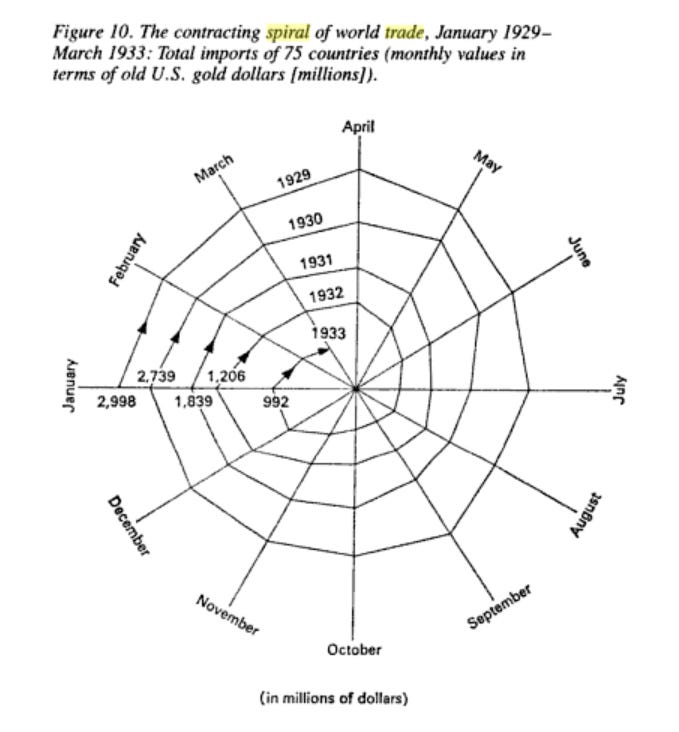
That all started with eggs. There’s fuss about eggs in the US at present. My, how history echoes, eh?
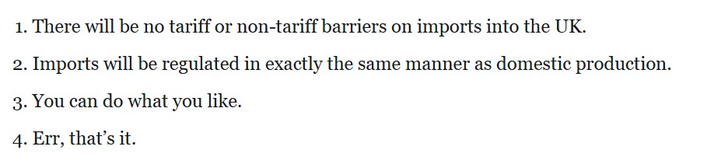
There’s only the one logical, moral or ethical position to have upon trade. As I’ve pointed out before with my model trade treaty:
Note that this applies to all ideas about tariffs — with the one exception of national security where we are indeed willing to give up direct economic benefit in order to keep the French at bay. To tariffs for industrial policy, tariffs for Green, tariffs for trade wars, tariffs as revenue raisers, tariffs, see?
We should remind ourselves that the opposition to Adam Smith and his ideas came from the conservatives. Cobden and the Manchester Liberals were the left wing betes noires of their day. The Guardian was actually set up as a newspaper to push their ideas including that dread free trade.
We did actually get free trade too, in 1846. Which, not by coincidence, is when the Engels Pause stopped happening. Which was, itself, the observation by Karl’s buddy that while the British economy had grown lots — industrialisation, capitalism, etc. — the living standards of the base people hadn’t, not very much. Of course, he was missing a bit — that ability to have a change of cotton underwear even for skivvies (aha, skivvies for skivvies even …) would only feel like an advance to those who had, previously, had to wear woollen knickers. This changed, living standards for the oiks began to rise, strongly, once we had free trade.
Now, there are a few of us still keepers of that sacred flame. But just to lay out the basic argument.
Average wages in an economy are determined by average productivity in that economy. Trade doesn’t, therefore, change wages — not nominal wages that is. Trade does change which jobs are done. That working out of comparative advantage means that we’ll do the things we’re — relative to our own abilities — less bad at and therefore are more productive at. Trade increases domestic productivity and thereby, in the second iteration, raises wages.
Trade also — obviously — gives us access to those things that J Foreigner is more productive at than we are — those things that are cheaper if Foreign, J, does them. This raises real wages again because we get more for our money. We’re better off. This is true whatever the tariffs our own exports face.
Finally, trade doesn’t affect the number of jobs in an economy — that’s determined by the balance of fiscal and monetary policy.
So, who benefits from trade restrictions? Well, the people who lose out from free trade are the domestic capitalists. Pre-1846 it was the still near feudal landlords in fact. What killed those grand aristocratic fortunes was not war nor tax — pace Piketty et al — it was free trade which destroyed agricultural rents.
The same is true today. The people who benefit from tariffs are the domestic capitalists who get to charge higher prices, make larger profits, as a result. The people who lose are all consumers plus, over time, all domestic workers as well. Tariffs increase the capitalist expropriation of the wages of the workers that is.
Tariffs are a right wing, neo-feudal, impoverishment of the people. Free trade is the ultimate leftypolicy to beat back the capitalists.
Comments Off on Free trade, the once-and-future left wing cause
The Broken Promise of Free Palestine – W2W 19 – 1948 Q1
TimeGhost History
Published 6 Apr 2025By 1948, Britain’s conflicting promises in Palestine have created a powder keg ready to explode. Contradictory pledges made to Arabs and Zionists during WWI set the stage for rising tensions, violent uprisings, and ultimately civil war. As Britain prepares to withdraw and the UN votes for partition, violence escalates, and the hope for a peaceful, free Palestine shatters into chaos. How did the broken promises lead to such tragedy?
(more…)
Comments Off on The Broken Promise of Free Palestine – W2W 19 – 1948 Q1
April 7, 2025
Dambusters Part 1 – The Battle of the Ruhr
HardThrasher
Published 5 Apr 2025The background to the Dams raid; how it came into being and how it fitted into the assault on Nazi Germany. In which we discuss Banes Wallis, Arthur Harris and a man called Winterbotham.
THESE LINKS ARE ONLY FOR THE SERIOUSLY SEXY
Merch! – https://hardthrasher-shop.fourthwall.com
Patreon – https://www.patreon.com/LordHardThrasherBibliography
James Holland – Dambusters: the Races to Smash the Dams 1943
Max Hastings – Chastise – The Dambusters Story
Alan Cooper – The Battle of the Ruhr
Adam Tooze – The Wages of Destruction
Martin Millbrook and Chris Everett – The Bomber Command War Diaries
Edward Westerman – Flak German Anti Aircraft Defences [sic] 1914-1945
Tami Davis Biddle – Rhetoric and Reality in Air Warfare
Donald A Miller – Masters of the Air
Comments Off on Dambusters Part 1 – The Battle of the Ruhr


