
Communitarianism is on the rise. The Left has its “Blue Labour” project, and writers like Giles Fraser and Paul Embery. The Right has its “One Nation Conservatism” project, and writers like Nick Timothy and Tim Montgomery. They differ in emphasis, but the commonalities outweigh the differences. It appeals to both right-wingers looking for an alternative to economic liberalism, and to left-wingers looking for an alternative to “woke” hyper-moralism.
What is communitarianism? Communitarians would probably define themselves as people who recognise the importance of community and social relations, but that is a bit like saying that environmentalists are people who care about the environment, or that feminists are people who believe in gender equality. Defining a political outlook in motherhood-and-apple-pie terms, so that you could not disagree with it without coming across like a complete psychopath, is not particularly useful. Apart from Britain’s four or five Randians, everybody recognises the importance of community and social relations. (And presumably, Britain’s four or five Randians tacitly recognise it too.)
In practice, communitarianism is little else but a knee-jerk anti-liberalism. Communitarians define themselves in opposition to an imaginary hyper-materialistic, hyper-individualistic liberal, who sees life as no more than a long string of financial transactions, and society as no more than a bunch of isolated individuals who happen to live side by side. Communitarians never identify any specific person who actually holds that view, which is not too surprising, because, apart from Britain’s aforementioned four or five Randians (who, on a bad day, might come a little bit close to that caricature), no such person exists.
Kristian Niemietz, “Communitarianism: the art of passing off trivial clichés as profound wisdoms”, Institute of Economic Affairs, 2020-02-14.
May 28, 2025
QotD: Communitarianism
May 27, 2025
QotD: Refuting the “state of nature” argument in Leviathan
Alas, Hobbes’s method is so seductively useful, and his “state of nature” so seemingly correct (if you don’t think about it too hard, which is easy to do, as Hobbes’s prose is entrancing), that in their haste to reject his conclusions, later thinkers like Locke didn’t stop to question whether or not the premises behind the method are actually true. It helped, too, that Locke (born 1632) came of age as the civil wars were winding down (his father was briefly a Parliamentary cavalry commander); he made his philosophical bones with the Restoration (1660). […]
It’s easy to get too far into the weeds with this stuff, but I trust everyone takes my point: Because Hobbes presented such a seductive vision, and because he took such sustained criticism by such high-level guys as Locke even as they were adopting his premises and methods, we — later generations of thinkers, almost without exception — behave as if Hobbes really had done what he said he did, which was to naturalize political philosophy. Political science, he would’ve said, and unlike the pretentious dweebs who staff those departments in modern universities, he wasn’t kidding — he really thought the arguments in Leviathan were as unassailable and compelling as geometry proofs.
But they weren’t, and even he knew it. Hobbes is a fascinating personality, but he’s a hard man to like, not least because he’s so irascible. I sympathize, Tommy, I really do, I’m no mean curmudgeon myself, but dude, you were wrong. Recall the fundamental premise of the “state of nature” thought experiment: All men are functionally equal.
That’s not just wrong, it’s arrant nonsense. It’s hard to think of a statement this side of Karl Marx that’s so backasswards as that one. Far from naturalizing political philosophy, Hobbes made it totally artificial, completely mechanical. His social contract requires a bunch of armed-to-the-teeth free agents, of sound mind and body, all ready and willing to defend themselves to the hilt at all times. Women have no place in Hobbes’s world. Nor do children, or the weak, or the halt, the sick, the old …
In short, although Hobbes is a brilliant observer of human nature, full of acute insight into man and his works, the most famous passage of Leviathan, the one to which all modern political philosophy is mere footnotes, has nothing at all of Man in it. It’s baloney, and therefore, everything derived from it is also, on some deep philosophical level, horseshit.
Severian, “Range Finding III: Natural Law”, Founding Questions, 2021-11-23.
May 25, 2025
Rommel’s Dark Secrets in North Africa – WW2 Fireside Chat
World War Two
Published 24 May 2025Indy and Sparty handle your questions on the German intervention in North Africa. Why did Rommel make such an impact so quickly? What was the war like for the local populations? How deeply involved was Rommel in the persecution of North African Jews?
(more…)
May 24, 2025
History of Britain, II: Stonehenge; The Druids, Vates, and Celtic Religion
Thersites the Historian
Published 15 Jan 2025In this episode, I briefly examine the presence of prehistorical megaliths on the British Isles and talk about the religion of the Celts, which was ascendant at the time that Britain entered entered the historical record.
May 22, 2025
Lucy Connolly, political prisoner
I’m no firebrand on social media — I’d probably have a lot more followers if I were — but I can easily imagine a situation like the one that got Lucy Connolly sent off to the British gulags for an ill-judged social media post:
In what has become an emblematic case of the UK’s betrayal of free speech, Lucy Connolly has now lost her appeal for early release. This mother and childminder had posted an offensive tweet in the direct aftermath of the Southport murders, in which a psychopath brutally attacked children with a knife at a yoga class. She had believed the false claim that the perpetrator was an asylum seeker, and written online that she had no objection to people burning down hotels where immigrants were residing.
The tweet was taken as evidence that Connolly had intended to “stir up racial hatred” and incite violence during the febrile climate of the summer riots. It had been deleted within hours, no violence occurred as a result, and yet she was sentenced to 31 months in prison. Given that the severity of Connolly’s sentence was doubtless related to unofficial government pressure on the judiciary, many have made the case that Connolly is a political prisoner.
For all our shared revulsion at the tweet, we must remember that we are still talking here about words, not actions. It was completely right that Philip Prescott, a man who attacked a mosque as part of a mob during the riots, was sentenced to 28 months in jail. But Connolly has received an even longer sentence having committed no acts of violence at all. Many rapists and paedophiles have been treated far more leniently. I know of no sound argument that could possibility justify this state of affairs. It is the very definition of two-tier justice.
Let’s get the caveats out of the way. Nobody is defending what Connolly wrote. It was unpleasant, rash, misjudged, and much else besides. Here is the post in full.
Grim stuff. But it by no means fulfils any serious definition of incitement to violence. For one thing, she is not calling on hotels to be torched, but is rather making clear that she would not care if that occurred. This distinction is key, but has been overlooked. Moreover, Connolly has zero influence or clout. It is not as though anyone reading this could have taken it as an instruction or order and acted accordingly. Those wishing to appreciate the full context of why Connolly behaved as rashly as she did should read this excellent piece by Allison Pearson for The Telegraph.
It should go without saying that in a free society some people are going to say ghastly things. That’s the price we pay for liberty. The judge in this case made a statement in his ruling that has been widely interpreted as political: “It is a strength of our society that it is both diverse and inclusive. There is always a very small minority of people who will seek an excuse to use violence and disorder causing injury, damage, loss and fear to wholly innocent members of the public and sentences for those who incite racial hatred and disharmony in our society are intended to both punish and deter.”

May 21, 2025
The Butt Report – Nadir of the RAF – The Bomber War Episode 3
HardThrasher
Published 15 Dec 2023As the powers that be on YT have decided that this video is Evil and naughty they’ve removed the ads — which, like, is great from your point of view but a bit shite from mine. So if you wanted to it’d be awesome if you’d consider either hitting the Super Thanks button or consider becoming a super cool kid and joining my Pateron.
If you’d like to email me send a message to lordhardthrasher@gmail.com
In this episode, the Butt Report, what happened next and the arrival of Bomber Harris. Despite this being more than 50 minutes, I’ve skipped some detail e.g. The Singleton Report which basically said “eh – bit difficult this bombing thing” nor Tizard’s rubbishing of Cherwell’s Memorandum, nor really the detail of the Cherwell Memorandum. You’ll live. However if you want more on the subject then I recommend the Official History of Bomber Command to get more into the civil service fire fights.
(more…)
May 20, 2025
QotD: The autohagiography of the NHS
I grew up, for example, in the inculcated belief that the National Health Service was, according to the slogan of the time, “the envy of the world”. Millions of people believed this, and indeed it was an assertion heard for many years whenever the subject of health care came up. The slogan was last wheeled out in any force in 2008 for the 60th anniversary of its founding.
Oddly enough, it never occurred to the people who repeated the slogan to examine the basis of the claim. Who, exactly, were the people doing the envying — not just one or two of them, but en masse? It is no doubt true that immigrants from very poor countries were pleased enough to receive care under the NHS, comparing it with what they would have received at home. But is it really much of an achievement for a developed country to have health care better than that offered in Somalia or Bangladesh?
A war of anecdotes, while always gratifying to the human mind, is not the way to decide important questions such as the superiority or inferiority of a system of health care.
It never occurred to those who repeated the “envy” slogan to look to comparable countries across the Channel or North Sea to see whether, in fact, those countries had anything to envy. In fact, between 1948 and 1975, even Spain under Franco performed better in the matter of improving the health of the population than did Britain. In most respects, in fact, Britain lagged or limped behind other countries, always in the rear and struggling to catch up.
What eventually struck me, then, was the willingness of so many people to repeat and believe a slogan without any compulsion whatever to do so, and without the slightest inclination to examine its truth — indeed without any awareness of the need for such an examination. There was no oppressive force to prevent or deter them from intellectual inquiry, but they preferred the comfort the slogan offered to the effort and possible discomfort of finding the truth. The NHS, or rather the idea of the NHS, played the role of teddy bear to a population with many anxieties.
True enough, many individuals may have experienced deficiencies in the service — long waiting times, offhand or disagreeable interactions with the bureaucracy, etc. But like Russian peasants of old who believed that the Tsar knew nothing of the oppression which they suffered, and would have put an end to it if he had known, the British continued to believe that the National Health Service had been born with original virtue and that the defects they experienced were exceptions. Repeated scandals of gross neglect or sub-standard treatment were shrugged off in the same way. And in a certain dog-in-the-manger way, the British were inclined to believe that if the NHS was unpleasant to negotiate, at least (being more or less a monopoly) it was equally unpleasant for everyone. Fairness and justice were equated with equal misery. Anyway, being ill is always unpleasant, so what did anyone expect?
Theodore Dalrymple, “Worshipping the NHS”, New English Review, 2020-05-07.
May 19, 2025
Best of Cunk on Shakespeare – Part 1
Philomena Cunk
Published 20 Dec 2023Are you saying I’m a liar?
Sharing all things Cunk – a fictional character from Charlie Brooker’s Weekly Wipe, Cunk on Britain, Cunk on Shakespeare and Cunk on Earth – Portrayed by the incredible Diane Morgan.
QotD: Food for Medieval English peasants
Jane Psmith, “REVIEW: The Domestic Revolution by Ruth Goodman”, Mr. and Mrs. Psmith’s Bookshelf, 2023-05-22.
1. We’re used to thinking of plants as being seasonal, but until quite recently animal products were seasonal too: chickens won’t lay in the winter without artificial lighting, cows stop giving milk when their calves reach a certain age, and generally one would only slaughter an animal for its meat at the right time of year. Geese, for instance, were typically eaten either as a “green goose”, brought up on summer grasses and slaughtered as soon as it reached adult size around the middle of July, or a “stubble goose”, fattened again on what remained in the fields after harvest and eaten for Michaelmas (in late September). Feeding a goose all autumn and half the winter only to eat it for Christmas would have been silly.
2. It’s also typical of New England, which makes sense; the New Englanders by and large came from East Anglia, which is right on the Newcastle-London coal route and a region that adopted coal cookery relatively early.
May 18, 2025
Why it Sucked to be an Italian Prisoner in North Africa – WW2 Fireside Chat
World War Two
Published 17 May 2025Today, Indy and Sparty tackle some questions on the North African theatre. Why did the Italians think invading was a good idea in the first place? Was Allied treatment of Axis POWs a war crime? How did Italian and Allied tanks stack up?
(more…)
The FAL for British Troop Trials in 1954: X8E1 & X8E2
Forgotten Weapons
Published 21 Feb 2020The NATO rifle trials of the early 1950s eventually chose the 7.62mm x 51mm cartridge, and the British and Belgians agreed on the FAL rifle to shoot it (and they thought the US would as well, but that’s another story). The British government formally accepted the FAL for troop trials, and in 1954 an order for 4,000 X8E1 rifles (with iron sights) and 1,000 X8E2 rifles (with SUIT 1x optical sights) was placed. These rifles were mechanically the same as what would be finalized as the L1A1 rifle, but they include a number of differing features. Both models had 3-position selector switches allowing automatic fire, and they also had manual forward assists on the bolt handles. The iron sights had top covers with integrated stripper clip guides, as there was concern that troops would have to manually reload their magazines, and stripper clips would speed this process up.
(more…)
May 17, 2025
Battle of the Atlantic, 1939-1940
Real Time History
Published 3 Jan 2025In the summer of 1940, Great Britain is under attack in the air and at sea. German U-Boat wolf packs prowl the Atlantic and sink over a million tons of shipping. German skippers call this the “happy time” — but was the German Navy actually that successful early in the Battle of the Atlantic?
(more…)
May 16, 2025
Those scary “Brexity books”
Andrew Doyle on the sudden interest British police seem to be taking about what kind of books you may have on your shelves at home:
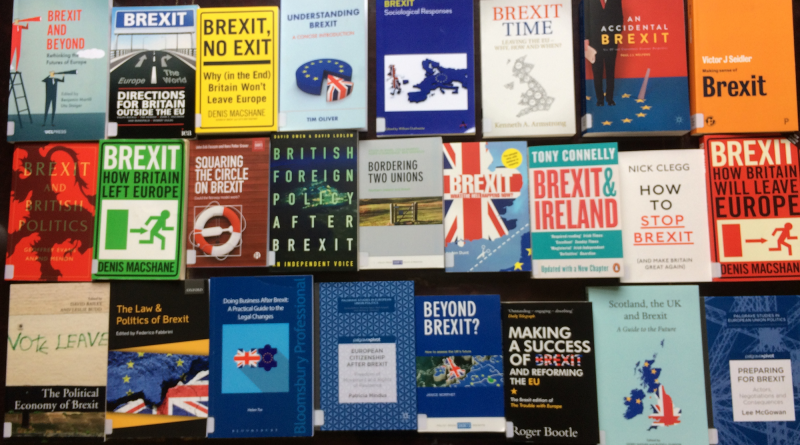
If the British police saw this collection, you’d be lucky to get out of prison in fifty years!
The UK police certainly seem to believe in that old aphorism that that “You can tell everything you need to know about a person from their bookshelf”. There has been much press coverage this week of the case of Julian Foulkes, a former policeman who was arrested at his home in Gillingham for tweetcrime. It took six officers to handcuff the pensioner and take him to a cell, and bodycam footage from the arrest shows them assessing the contents of his bookshelves. One was seen singling out The War on the West by Douglas Murray and another remarked that there were “very Brexity things”.
I have a fair few “Brexity” books on my shelf too. I have just as many “anti-Brexity” books, as it happens. It seems to have escaped the attention of these officers that it is possible to read multiple points of view without necessarily subscribing to any of them. They have also apparently forgotten that “Brexity” views are fairly commonplace, enough so to win the largest democratic mandate the country has ever seen. If it’s a majority view, is it really all that controversial?
I recall during the lockdown I was scheduled for a television interview and, having set up the webcam, I suddenly realised that the two volumes of Ian Kershaw’s excellent biography of Hitler were not only visible, but prominent. The design of the books’ spines is such that the word “HITLER” is displayed in huge letters. Very dramatic and marketable, but not so helpful if you’re about to appear on live television. I must confess that I repositioned my chair to ensure that the books were obscured.
But why? It isn’t as though any sensible person could possibly believe that my interest in the history of tyranny implies an endorsement of it. I could just as easily have a copy of Mein Kampf on the shelf and still retain my wholehearted opposition to its author and everything he stood for. If I owned a copy of the Koran, would that make me a Muslim? If I owned a copy of Jilly Cooper’s Riders, would that make me prone to passionate romps in stables? As a chronic hay fever sufferer, this hardly seems likely.
The assumption that the books we choose to read are a mirror-image of our private thoughts, or that we are so malleable that any opinion we encounter will automatically be assimilated, is very much a core tenet of faith in today’s woke mindset, one that has quite palpably infected the justice system. Those who are currently serving prison time for offensive tweets will be aware that the unevidenced belief that the public act on cue to the language they read has some very authoritarian consequences.
May 13, 2025
Mao Wins the Civil War – Chinese Civil War Part 4 – W2W 28
TimeGhost History
Published 12 May 2025By early 1949, Chiang Kai Shek’s Kuomintang is falling apart. Hundreds of thousands of Nationalist troops surrender as city after city fall to Mao Zedong. Beijing falls without a fight and the Communists cross the Yangtze. Chiang’s final plan is escape and he moves tons of gold and his best troops to Taiwan. Meanwhile, Mao declares victory and the birth of the People’s Republic of China.
(more…)
May 11, 2025
History of Britain, I: Hail Prettanike! Early References to the British Isles
Thersites the Historian
Published 6 Jan 2025The natural starting point for examining the history of Britain is to look at how the island and its inhabitants first entered the historical record.


