Quotulatiousness

July 22, 2026

Andy Burnham’s “Manchesterism” at the national level

Filed under: Britain, Economics, Government, Politics — Tags: , , , , — Nicholas @ 06:00

In The Critic, Shimeon Lee looks at Andy Burnham’s time as Mayor of Greater Manchester and what his record there says about how he will try to run Britain from No. 10:

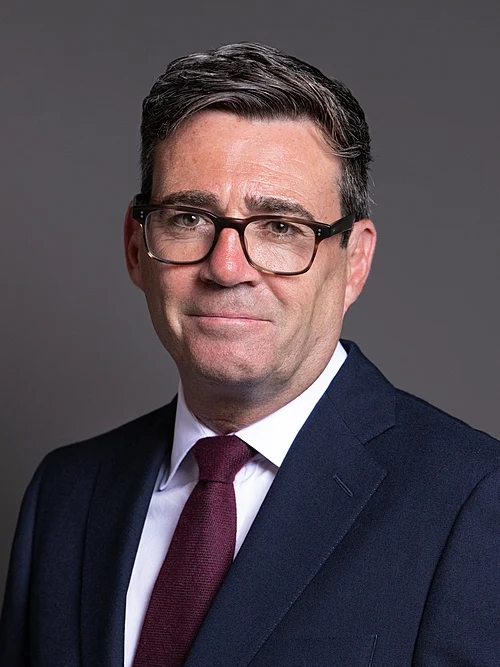
Prime Minister Andy Burnham’s official MP portrait, July 2026.
© House of Commons via Wikimedia Commons.

Andy Burnham is now Prime Minister, and the country soon to discover what “Manchesterism” means when applied to the British state. Burnham’s nine years as mayor, alongside his earlier national record, offer a clear guide to the instincts he is likely to bring to No.10: a willingness to raise taxes, expand the state and prioritise policies that sound good but ultimately deliver poor value for money.

It is revealing that after being elected mayor in 2017, one of Burnham’s first acts was to impose a new charge on households in Greater Manchester. The new mayoral precept was initially set at £8 for the average band D property, funding the mayoral operation, including Burnham’s £110,000 salary. As so often happens with new charges, it did not remain modest for long. The charge more than doubled the following year, rising again in 2020-21, 2022-23, 2025-26 and 2026-27. By the time Burnham resigned to contest the Makerfield by-election, it had risen to £61.75, nearly eight times the original amount in less than a decade.

As residents paid more, the mayor built an increasingly elaborate network of advisers, commissioners and panels funded by taxpayers. These included a young person’s advisor paid £500 per day, a transport commissioner and an active travel commissioner each paid £650 per day, and an LGBTQ+ advisor paid £177 per day. He also established seven equality panels facilitated by “culturally appropriate organisations” which cost £392,435 a year. Taxpayers can only speculate how much larger that ecosystem could become when he takes control of Whitehall.

The mayoral precept was not the only tax rise implemented by Burnham. As mayor, he raised every tax under his control. The band D police precept rose from £162.30 when he entered office to £285.30 by the time he left, a 76 per cent increase. At the same time, the fire precept increased from £59.95 to £92.20, a 54 per cent increase. Both increases substantially outstripped cumulative inflation of 37.5 per cent during that period.

Even that understates his tax-raising ambition, as it only includes the charges he managed to implement. In 2019, Burnham proposed a clean air zone for Greater Manchester which would impose a daily charge on commercial vehicles that did not comply with environmental standards: £7.50 per day for taxis, £10 per day on vans and £60 per day on buses, coaches and heavy goods vehicles. These would have added thousands of pounds a year to local businesses’ costs.

Sensible climate spending

Filed under: Environment, Government, Politics, USA — Tags: , — Nicholas @ 05:00

On his Substack, John Robson suggests some spending on environmental issues where we actually can make positive changes as opposed to the spending on climate change which is mostly wasted:

As noted in our latest Green Money Machine, there’s no question that humanity faces real environmental problems and that some worthwhile organizations and people are trying to do something about them. It’s an important reason why we oppose, and even resent, the way the overwhelming focus on “climate change” drains off so much effort, time, and even money. So let us tell you about some actual environmental issues that have caught our attention lately. For instance “the Mediterranean Sea’s critically endangered population of great white sharks”. Of course we also recognize that some ecologists may be taking a worldly, not to say cynical, approach and leveraging concern about climate to raise money for other actually more useful activities. But in the long run cunning isn’t a good plan any more than obtuseness is.

When it comes to great white sharks it is also of course easy to imagine that anyone planning to swim in the Mediterranean might regard their scarcity as a plus. But the fact that such a comment would be controversial today reminds us of just how far the environmental movement has come since the 1960s, and frequently in good ways.

Indeed, being historically minded, we even recall a jibe by the New York Times after US president Franklin Roosevelt’s crushing 1936 reelection victory (he won every state but Maine and Vermont) that “If he were to say a kind word for the man-eating shark, people would look thoughtful and say perhaps there are two sides to the question”. But just in case you were frightened by Jaws in your youth, we could also mention (also from National Geographic) efforts to save the Mekong River’s “megafish”, a catfish bigger than a person that … no, wait. Poor choice. Also scary.

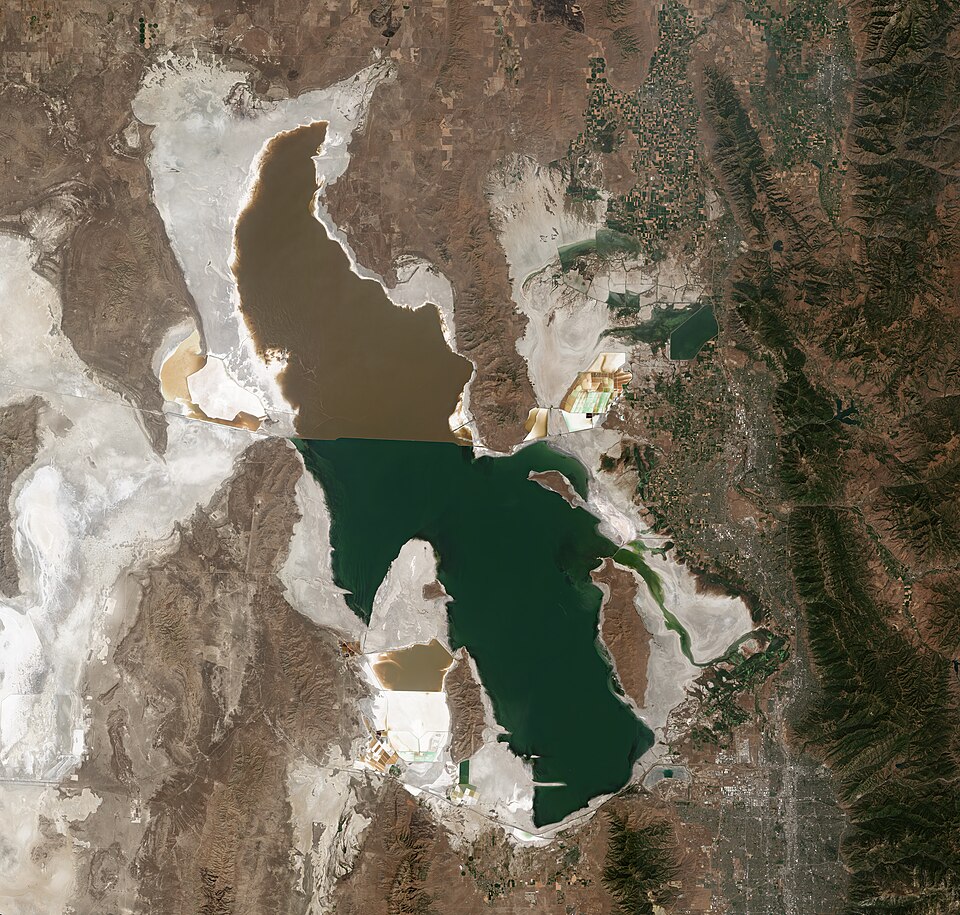
Satellite photo of the Great Salt Lake from August 2018 after years of drought, reaching near-record lows. The difference in colors between the northern and southern portions of the lake is the result of the Lucin Cutoff, a railroad causeway. The image was acquired by the MSI sensor on the Sentinel-2B satellite (Resolution: 20m, RGB Composites: True color, Band 4-3-2).
Wikimedia Commons

OK then. How about the shrinking Great Salt Lake? Because according to National Geographic (yes again they do serve a useful purpose when not banging on about climate):

    Since 1850, the lake has lost 73 percent of its water and 60 percent of its surface area, and as more people move to the region, the water that typically feeds the lake is increasingly being diverted for agricultural, municipal, and industrial needs. What’s more, over the past few decades, a series of challenges – including climate change and the worst megadrought in at least 1,200 years – has impacted the cyclical climatic conditions that have sustained the lake for millennia.

Aaaargh. Banging on about climate. It’s a hard habit to break. And a bad one to keep, because it’s ridiculous to describe the loss of water going back to 1850, attribute it to human folly diverting the flow, and throw in the worst megadrought in at least 1,200 years (which necessarily means there was a horrific one 1,200 years ago which can’t have been our fault) and then toss in “climate change” which again is a description of alterations in weather not a causal force, and then speak of all these things having “impacted the cyclical climatic conditions that have sustained the lake for millennia”.

Bosh. In the first place, they cannot possibly know what cyclical climate conditions were like thousands and thousands of years ago. Nor what kind of pattern of megadroughts occurring millennia apart is natural, especially since interglacials don’t last that many millennia. Second, it isn’t possible that diverting water to agriculture, or swimming pools, has disrupted climate cycles. It just isn’t. Critical thought seems to be among the first and worst victims of “climate change”. The mind virus not the weather thing.

Especially as we regard it as intensely desirable that our fellow human fools stop draining the lake. Really. Take some of the tens of billions governments squander on trying to fix the weather, which honestly has always been bad, frequently dreadful, and put it to sensible uses.

Why progressives are always so eager for more gun control

Filed under: Law, USA, Weapons — Tags: , , , , , — Nicholas @ 03:00

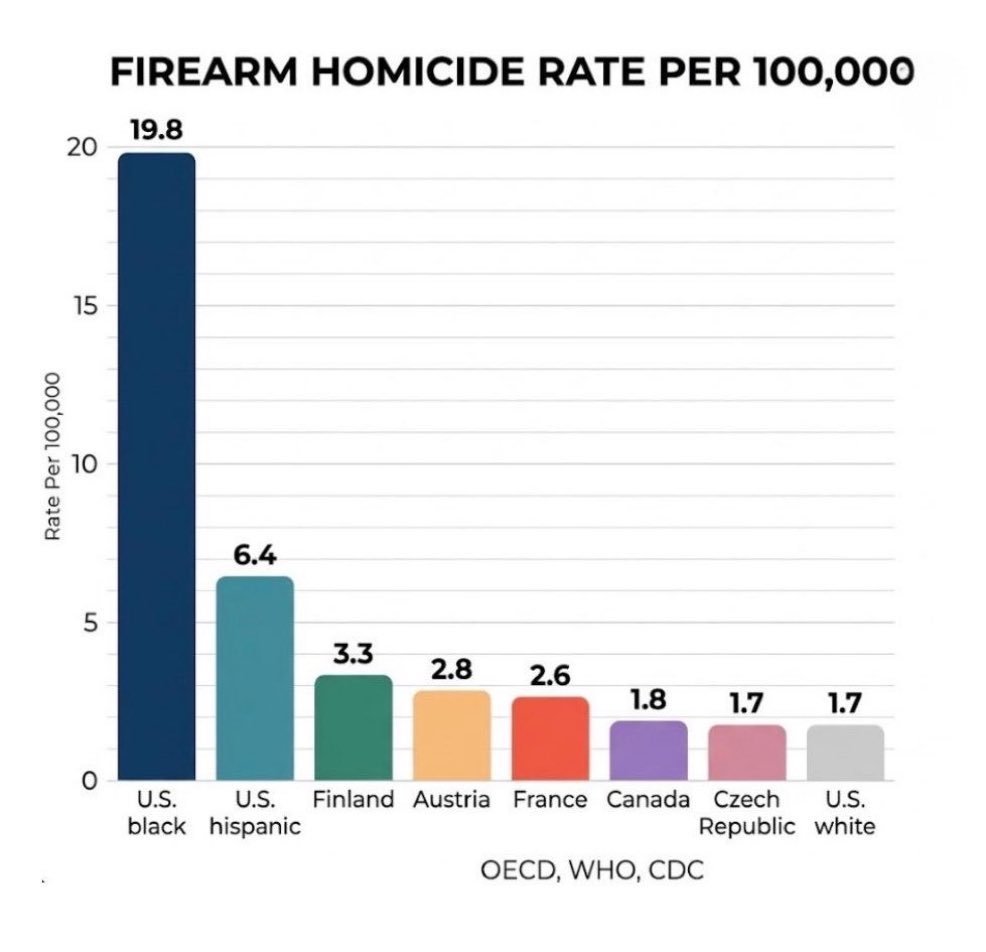
ESR discusses a recently posted chart about firearm homicide rates:

I’m not certain this chart is true, but looking at it shook something loose in my head. I think it explains why ordinary liberals are so obsessive about gun control despite the fact that it’s both bad policy and a persistent election-time loser.

This isn’t a trivial question. I understand why Communists are obsessive about gun control; the last thing they want is a population capable of armed resistance to tyranny. What I have never figured out is why Communists have been so successful at selling gun control to their dupes as an urgent moral necessity.

This chart could be exaggerated, but the figures are at least possible. In the United States, murder and other forms of criminal violence are heavily, heavily concentrated among Blacks. Usually with other Blacks as their victims.

And that’s a problem for your typical normie liberal, because not being “racist” against Blacks is the core of their moral and political identity.

What I now understand — forgive me because I probably should have noticed this sooner — is that gun-control advocacy is a sort of reaction formation. When you’re not an evil Communist, it’s something you do frantically to avert your eyes from unbearable reality.

The truth: outside of a relatively small cohort at the right-hand end of the Black IQ distribution, the people liberals want to treat as sacred victims deserving of infinite indulgence are savages that even intelligent Blacks fear and despise.

That’s the message in the left hand column, there.

IQ denialism, blank-slatism, “poverty causes crime” — these are all defensive formations. They cluster with gun-control advocacy as ways of avoiding the horrible, intolerable truth.

Which makes me wonder: what happens when the strain becomes too great and the protective illusion snaps?

The Ancient Greeks 03 – Enter the Persians 4 – The Ionian Revolt and the Fatal Intervention

Filed under: Greece, History, Middle East — Tags: , , , , , , , — Nicholas @ 02:00

seangabb
Published 16 Feb 2026

The Persian Wars begin not in Athens, but in Miletus. In this lecture we explore the failed Naxos expedition, Aristagoras’ desperate gamble, and the outbreak of the Ionian Revolt in 499 BC. We examine Aristagoras’ appeals to Sparta and Athens, Herodotus’ famous scene before Cleomenes, and the fateful decision of Athens to send twenty ships.

We also analyse the burning of Sardis, Darius’ calculated response, and the suppression of Ionia. This is not yet a world war — but it is the moment when Athens introduces itself to empire.

QotD: Burnside’s Army of the Potomac

Filed under: History, Military, Quotations, USA — Tags: , , — Nicholas @ 01:00

It was not a genteel, restrained, orderly country that was feeling this changed emotional current. It was a nation with the infinite raw strength of graceless youth, moving with gigantic careless energy into a future that was not known to have any bounds whatever. It was feeling its oats and it was flexing muscles bigger than anybody else ever had, and if people got hurt along the way it was not even going to notice. It had been like that from the beginning and it had not yet grown mellow and thoughtful, and it was not for nothing that its national air was a little tune called “Yankee Doodle”, which has no words to speak of and expresses no sentiment on earth but sheer perky impudence.

This was the country of the boisterous forty-niner, the hell-roaring lumberjack, and the riverman who was half horse and half alligator. Without rancor (and also without the slightest hesitation) it annihilated Indian tribes so that it could people a wilderness, asserting that the only good Indian was a dead Indian and remarking casually of its own pioneers that the cowards never started and the weak died along the road. As it faced the cathedral aisles of endless virgin forests it shouted for immediate daylight in the swamp, even if whole generations must be brutalized for it. It was the country that invented the bucko mate and the Shanghai passage, and if the skysails of its incredible clippers gleamed on the farthest magic horizon they were taken there by men under the daily rule of clubs and brass knuckles. This nation accepted boiler explosions as the price of steamboat travel and it would boast presently of a dead gandy-dancer for every cross-tie on the transcontinental railroad. It wore seven-league boots and scorned to look where it planted them, and each of its immense strides was made at immense human cost. And the army of this country, buckling down to it at last in a fight which had to go to a finish, was going to be very rough on enemy civilians, not because it had anything against them but simply because they were there.

Of genuine hatred this army had practically none. The wild young men who ruined ancestral portraits and pranced in the smoky streets wearing the embroidered undergarments of gentlewomen were expressing nothing but plain hooliganism, which somehow was the obverse side of the medal that had laid nine hundred corpses in front of the stone wall west of town. Both sides of the medal bespoke raw youth which cheered and guffawed by turns, whose noble best forever went arm in arm with its ugly worst.

Bruce Catton, Army of the Potomac: Glory Road, 1952.

July 21, 2026

Exit Starmer, enter Burnham

Filed under: Britain, Media, Politics — Tags: , , , — Nicholas @ 06:00

Britain swapped out Prime Ministers on Monday, pushing Sir Keir Starmer out to the curb and installing former Greater Manchester mayor Andy Burnham in Number 10 Downing Street. In The Critic, Robert Hutton reports on the day’s events:

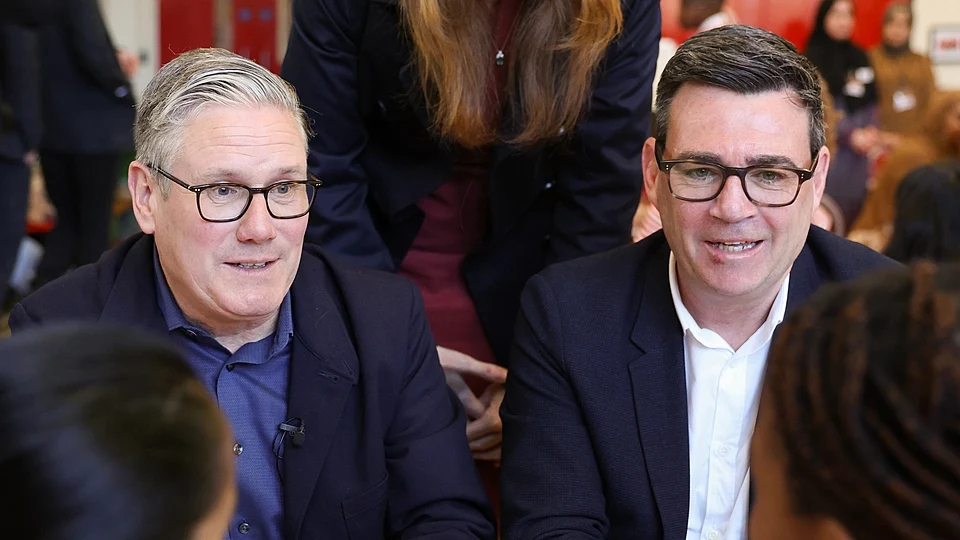
Then-Prime Minister Sir Keir Starmer visiting Holy Trinity Church of England Primary School in Manchester on 13 April 2026 with Andy Burnham, Mayor of Greater Manchester.
Picture by Lauren Hurley / No 10 Downing Street via Wikimedia Commons.

As Keir Starmer walked out of Number 10 for the last time, he was greeted by a huge cheering crowd. Wow, this guy is popular! He should consider running for office. “My work is done”, he told us, offering possibly the most misguided example of marking your own homework since George W Bush declared “Mission Accomplished” six weeks after invading Iraq. Although we shouldn’t be harsh: Liz Truss listed leading the nation in mourning the late Queen as her big achievement in office.

Starmer’s, as he pointed out yet again, was winning the election. The list of things done since then was slightly more vague. But again, Boris Johnson’s departing speech claimed credit for a high-speed train line to Manchester and a number of hospitals that still do not, as such, exist. At least Starmer could truthfully say that he was leaving “with a smile”. Was he also, as he claimed, going “with good grace”? Well, unlike Johnson, he managed to get through the speech without attacking the people who forced him out.

It wasn’t entirely cheery. His wife Victoria was wearing black, and Rachel Reeves was crying, once again. The departing prime minister warned us not to succumb to division and to “unite different people under our common flag”. Although he completely failed to help that happen while he was in office, and showed little interest in trying.

With that, he was off to Buckingham Palace, where the band was playing a medley of Bon Jovi songs. Shot through the heart, and only himself to blame, he gave Labour a bad name.

But if Starmer was going out in a blaze of inglory, the rest of us were only halfway there. While the King conducted his exit interview in the Palace’s Chinese Dining Room (imagine having a different space to eat every takeaway) we had to hold on, ready or not, through the hour in which we were without a prime minister and living, as it were, on a prayer.

Andy Burnham had put on a suit for the day, a concession to the soft southern ways of the monarch. We half-expected him to leap out of the car in Downing Street and rip off the whole ensemble, Full Monty-style, to reveal black jeans and a T-shirt underneath. Perhaps he felt that would be taking his personal branding too far.

A fresh crowd of Labour types had gathered, looking more convincingly happy than the ones who had stood behind the last guy. They included the incoming prime minister’s mum, and the youngest person present: Liverpool Mayor Steve Rotheram’s 10-week-old grandson, currently scheduled to become the King’s 49th prime minister, in about 2038.

Not everyone is as excited as Burnham’s Labour Party supporters:

In Spiked, Brendan O’Neill bids an unfond farewell to Two-Tier Keir:

Sir Keir Starmer: the PM who did nothing about the sense of doom pervading Britain, but he did ban “doomscrolling“. The man who did zilch to mend our fraying social fabric, but he did stop kids from perusing its consequences on TikTok. The man who failed – catastrophically – to alleviate that bleak feeling many of us have that Britain is broken, but he did cover the next generation’s eyes to just how broken we are.

Starmer should be remembered for his social-media ban for under-16s, that mad, illiberal law, due to come into force in spring next year, that promises to liberate youth from the angst-inducing “doomscrolling” inflicted on them by Big Tech’s wily algorithms. Not because it’s a “landmark” policy, as he claims. And not because it will be effective – kids will find a workaround. No, it’s because leaving intact the social conditions of doom while tweaking the machine so that fewer people can ‘scroll’ those conditions is Starmerism summed up: a regime of hollow theatricality, devoted more to managing the optics of crisis than mustering up the competence to avert it.

Starmer is a man without a legacy. He promised competence over charisma and delivered neither. His was a phantom premiership: government without governing. You could ask a hundred Brits to name a policy he enacted and I reckon five, at best, could do so. Even his vanishingly small number of apologists usually only squawk about what he didn’t do. He didn’t drag us into the Iran-US War. He didn’t follow through on his promise to cut the winter-fuel allowance for pensioners. He didn’t murder anyone. A man so staggeringly insubstantial that even his fans prefer his inertia to his initiative.

For me, the terrifying nothingness of Starmerism is best summed up in the fact that he recently said his “proudest achievement” was scrapping the two-child benefit cap, the Tory-introduced measure that meant families could only claim additional welfare payments for their first two kids. But Starmer opposed cutting that cap. For ages. In fact, in July 2024, he withdrew the whip from seven Labour MPs who voted to scrap it. It was only under pressure from his parliamentary colleagues that he relented. What can you even say about a man whose “proudest achievement” is a course of action foisted on him by others? That’s Sir Keir: the political weathervane who mistook a gust of wind for his own internal moral compass.

Making out like a bandit – Christopher Nolan’s sweet deal for The Odyssey

Filed under: Business, Media, USA — Tags: , — Nicholas @ 05:00

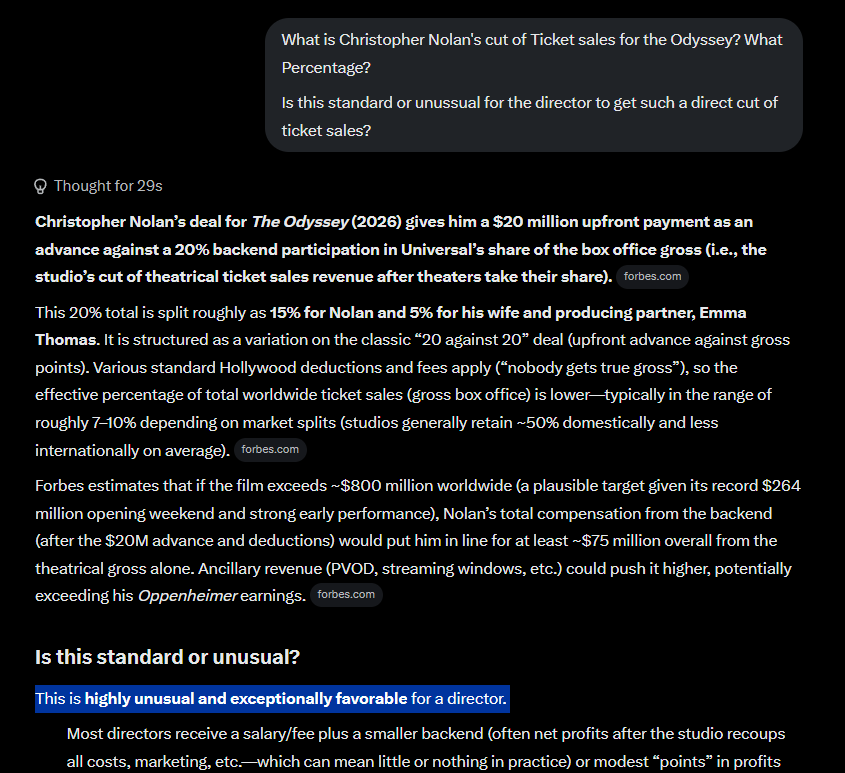
Hollywood accounting is always a murky pool to wade into … unlike accounting in the real world, it’s very, very difficult for outsiders to understand how the money is spent and where the profits go. Christopher Nolan’s new film seems to have broken new ground in Hollywood accounting, very much to Nolan’s benefit:

So Nolan is getting 15% off direct revenue, (not profits, gross, and his wife another 5%) from the Odyssey, basically risk free, AFTER his 20 million up front.

That’s a better cut than a lot of mob bosses take off drug dealers (which tend to vary between 5 and 30% depending on how much violence they can command).

And probably core stars (Damon and Hathaway mostly) are getting some smaller percent of the same deal.

This is unheard of. Basically a violation of fiduciary duties to the investors.

Studio execs paid all these people to make this movie this way against their own investors’ interests.

So if another 10-30% of gross is divided across Damon, Hathaway, Holland, Pattinson, and Theron … You know the real stars (Zendaya, Nyong’o, and Page don’t draw crowds and aren’t getting that) …

Then you might have to effectively cut all revenue first by 50% for theaters, then by another 40-50% for the star power.

It other words … The Odyssey would need to make 800 million – 1 billion before it could even hypothetically start to turn a profit for investors.

All the Woke casting etc. Is actually a cover for basically outright money laundering and embezzlement by the entertainment class. And because its “sticking it to the Chuds” business news and institutions are covering for the fact a bunch of studios just defrauded Universal Studios’ parent Comcast, to possibly the tune of hundreds of millions.

Comcast is a publicly traded company. That’s 401Ks and pension funds.

And all the woke stuff is in there so that no studio execs, corporate leaders, media, or corporate watchdogs will call them out for basically transferring hundreds of millions of retiree dollars into their own pockets.

All the discussion of “Will the Odyssey make its money back” is missing the point that there is almost NO WAY for the Odyssey to actually produce a reasonable return to investors … BY DESIGN.

It is a pure, basically fraudulent, wealth transfer from American middle-class investors to Hollywood insiders irrespective of whatever money the film does or does not make … intentionally.

And all the woke window dressing is chaff, or a bonus to prevent any institutions from having the nerve to call them out lest they get called, racist, sexist, and transphobic.

Frederick the Great’s 1741 book, The Anti-Machiavel

Filed under: Books, Germany, History, Italy — Tags: , , , , , , — Nicholas @ 04:00

At SteynOnline, Tal Bachman continues his look at all things Machiavelli, including Prussian king Frederick the Great’s polemic against the author of The Prince:

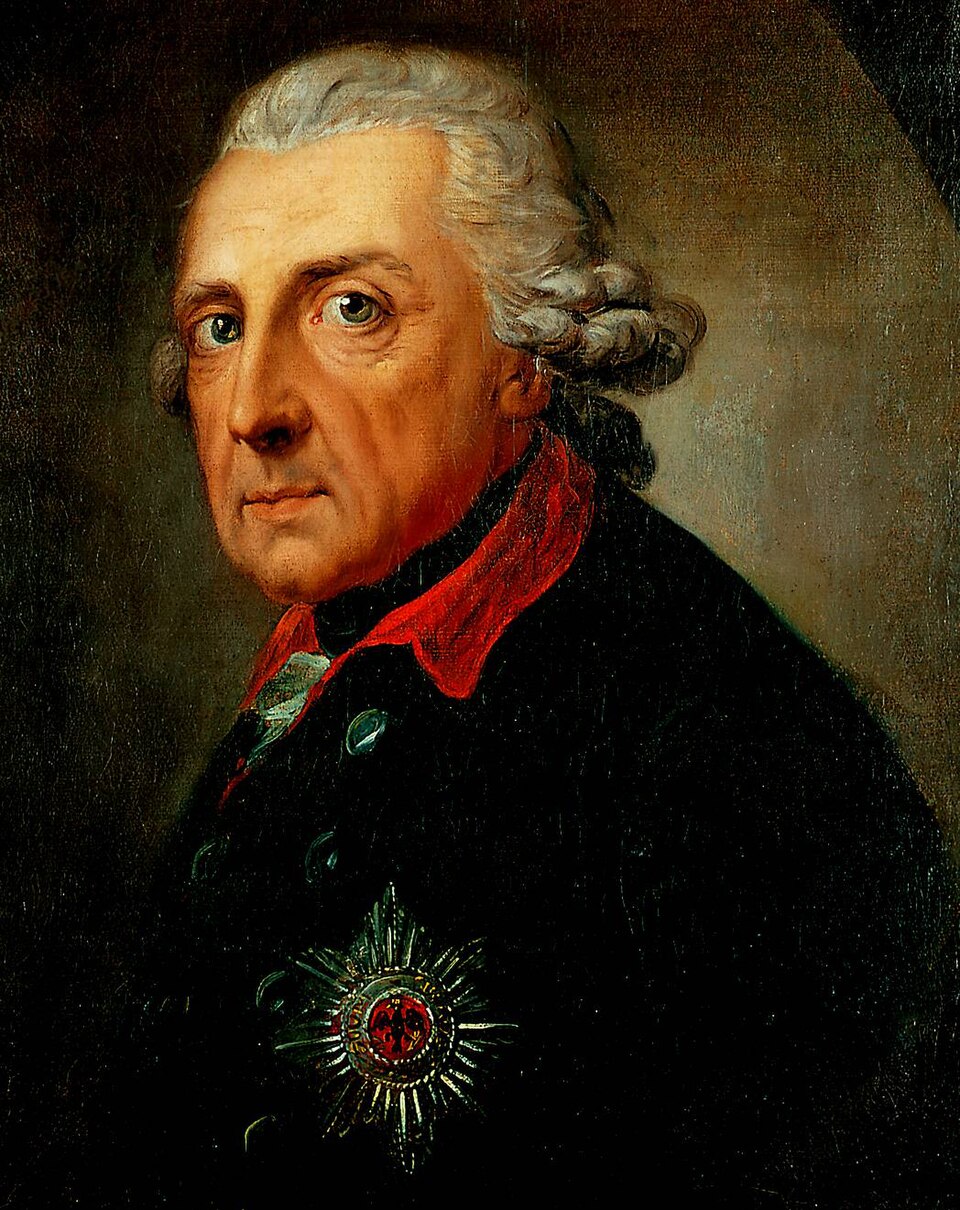
Frederick the Great, 1781
Oil portrait by Anton Graff (1736-1813) in the Sanssouci Palace collection via Wikimedia Commons.

Maybe Machiavelli’s teachings have no relevance in any remotely civilized political system. Maybe they’re far worse than irrelevant: maybe they’re all entirely evil (as they appear), and in addition, would prove the ruin of both the people and their ruler.

This was, as it happens, the view espoused by one important ruler: the Prussian king Frederick the Great. In his 1741 book, The Anti-Machiavel, he claims Machiavelli’s book is “one of the most dangerous that ever appeared in the world”, in that the political crimes it encourages would impose “a lasting misery upon whole nations”. Truly great rulers, says Frederick, aren’t the avaricious, amoral, self-serving, shape-shifting demons that Machiavelli describes. Rather, they are those “whose business it is to administer justice, and to set examples of justice to their subjects; and who, by their magnanimity, mercy, and goodness, ought to be the living images of Deity”. Thus, Frederick sees his rebuttal as “a defense of humanity against a monster who would destroy it”; it is “an antidote to poison”.

Frederick ruled Prussia for nearly 50 years. Most historians rate him a success. On the face of things, he seems like the kind of critic who knows what he’s talking about.

But Machiavelli would say, not so fast. What did Frederick do almost immediately after assuming power? Without any provocation, he launched a war to seize the large, prosperous, populous province of Silesia (now in southwestern Poland) from the Habsburg Monarchy. And he did so on a convoluted, centuries-old dynastic claim which sounded as unconvincing to his contemporaries as it does to us now. In the three Silesian wars which followed (the third turning into the Seven Years War), well over a million soldiers died fighting. Millions more wound up maimed, psychologically scarred, or otherwise ruined. Of course, millions of non-combatants also suffered: wives lost husbands, mothers and fathers lost sons, children lost fathers and uncles and brothers. Those non-combatants also suffered displacement, terror, deprivation, and injury. Over two decades, Frederick’s wars — particularly the Seven Years War — convulsed Europe. Frederick gained 30% more territory and 50% more citizens, but the cost was losing 10% of the Prussian population to combat or disease (the modern equivalent of 35 million Americans, 6 million English, or 3 million Australians). The point is: if his actions are anything to go by, Frederick didn’t oppose Machiavellian power moves as much as he professed, if at all. Machiavelli might even argue that in taking pains to proclaim his opposition to Machiavelli even as his wars of acquisition injured and killed millions, he was doing exactly what Machiavelli had advised: seeming to be good even as he was doing whatever the hell he wanted, for his own purposes. Most people will buy the act anyway, says Machiavelli, so why not?

This brings me back to Machiavelli’s claims about how rulers do in fact act, and how they must act to avoid ruin. And that in turn brings me back to the original wording of The Prince, and what real-world credibility Machiavelli might have as a political commentator.

As it happens, Machiavelli was no armchair quarterback. Even if he hadn’t spent nearly fifteen years at the highest levels of Florentine government (which he did), he might well have qualified as a political expert just by virtue of growing up in the tumultuous time and place he did. Between the jockeying Italian states, the myriad (and ever-changing) foreign alliances and enemies and designs, the political influence of the papacy, and Florence’s own internal politics, Machiavelli’s home city furnished more than enough lessons in how the political world could, and often did, operate.

Business idea – socialist-themed holiday camp

Filed under: Business, Education, Politics, USA — Tags: , , — Nicholas @ 03:00

This idea is a banger, but it won’t attract the audience who really could benefit from the experience: the camp experience is what they want you to have, not for themselves.

New startup idea: a socialist-themed holiday camp where affluent Westerners pay premium prices to experience the system they keep voting for.

Picture it. You arrive at Camp VS (Virtue Signal) and hand over your passport (you won’t need it, exit visas take eleven years to process). Staff assign you to a concrete panel block, 320 square feet, shared with two other families you’ve never met. The heating works from 6 to 8 a.m. The elevator works never. Authentic Khrushchyovka construction, guaranteed.

Your daily itinerary: Wake at 5 a.m. Stand in the bread line until noon in minus 15 Celsius. The bread runs out at 11:40, but the queuing builds character, and character is the only thing not in shortage. Afternoon activities include a second line for toilet paper (there is no toilet paper) and a mandatory lecture on how the shortages prove capitalism sabotaged the harvest.

For guests seeking the deluxe package, we offer the Gulag Experience: rock-busting in a quarry under armed supervision, with optional whipping for anyone who fulfills less than 110 percent of quota. Aleksandr Solzhenitsyn wrote 1,800 pages about this amenity. Rave reviews, in a sense.

Every fourth guest works as an informant. You won’t know which one. Complaining about the food earns you a midnight interview with camp security, and the food gives you plenty to complain about: it’s cabbage. All of it. Abolish market prices and you abolish economic calculation, so nobody can know what to produce, in what quantity, or for whom. The planners guess. The planners guess cabbage.

Checkout is where the theme really lands. You can’t. The wall around the camp faces inward, and East Germany shot 140 people at theirs between 1961 and 1989 to keep paying customers from leaving the workers’ paradise.

The irony here is that this business would only survive under capitalism, because it needs voluntary customers, market prices, and profit signals to exist at all. Run it as an actual socialist enterprise and within a year the camp has no bread, no rocks, and no guests. Just like the original.

Mauser M90 DA: Not Mauser and Not a High Power

Filed under: Germany, History, Weapons — Tags: , , , , , — Nicholas @ 02:00

Forgotten Weapons
Published 25 Feb 2026

In the late 1980s and early 1990s, the Mauser firm was not in good shape. It had no new products, and its ability to survive marketing its name and legacy pistols was waning. Without much vision for the future, it turned to rebranding production from other companies, like Renato Gamba in Italy and FÉG in Hungary. From FEG they got the “Mauser Model 80” — a licensed copy of the Browning High Power — and the “Mauser Model 90” — a rebadged FEG P9R.

The P9R / Mauser 90 is often assumed to simply be a double-action modification of the High Power, but this is not true. The slide is almost identical in appearance to the High Power slide except for the decocking lever, but the frame has several important differences. The barrel lockup is taken from the S&W series of automatic pistols instead of the High Power, and the trigger mechanism is a stirrup around the magazine well instead of moving through the slide like a High Power.

In total, FEG made 26,000 of these pistols for Mauser. The plan was to sell them in Europe, but by 1995 sales remained poor and about 18,000 remained in Mauser inventory. In order to get rid of them, they were offered on the American market, where they were gobbled up by importers like Century between 1995 and 2001.
(more…)

QotD: Why Tiktok?

Tiktok found a way to connect you to strangers who don’t make you angry. By offering performers money if they produced media that you “engaged” with, Tiktok offloaded the work of convincing you to conduct your online activities in a way that maximized opportunities to show you an ad onto an army of global theater kids who would spend every hour that god sent trying to figure out how to keep you looking at Tiktok.

This was hugely successful – so successful, in fact, that Tiktok was able to cheat, overriding its own algorithmic guesses about which of its billion cable-access television channels you’d stare at the longest with a “heating tool” that lets the company trick some of those theater kids into thinking that Tiktok was actually more suited to them than other platforms […]

For zuckermuskian social media bosses, Tiktok became an object of fierce envy. Here was the ultimate Tom Sawyer robo-fence-painter, a self-licking ice-cream cone that motivated people to convince each other to make money for you. Facebook, Instagram and Twitter took a hard pivot away from showing you the things that the people you loved had to say, in favor of showing you short videos of people whose parents didn’t give them enough affection in their childhood, desperately shoving lemons up their noses in a bid to win your approval (and a revshare split with the platforms).

It worked. Sorta. Thing is, some of those “content creators” are actually very good, and none of them appreciate being jerked around. They quite rightly see their reason for being on the platforms as improving their own lives, not the bottom line of the platforms’ owners and executives. They may be more “engaging” than your friends, but they’re also a lot mouthier and feel entitled to a say in how the platform operates.

What’s a billionaire solipsist to do? Obviously, the answer is “AI creators”. An “AI creator” is like a “creator” in that it works to maximize your engagement with the platform – and thus the number of ads that can be crammed into your face-holes – but, unlike a “creator”, it makes no demands upon the platform and exists solely to serve the platform’s shareholders and executives. It’s the perfect realization of the solipsist fantasy of a world without people […]

But there’s a problem with this plan: your friends are not a liability for a platform. Your friends are the platforms’ single most important asset. Your friends are why the platforms are so “sticky”. The platforms don’t “hack your dopamine loops” – they just take your friends hostage, and even though you love your friends, they are a monumental pain in the ass, and if you can’t even agree on what board-game you’re going to play this weekend, how are you going to agree when it’s time to leave Facebook, and where to go next?

So long as you love your friends more than you hate Zuckerberg or Musk, you will remain stuck to their platforms. The platform bosses know this, and they inflict pain on you that is titrated to be just below the threshold where you hate the platforms more than you love your friends.

But as much as the platform bosses rely on your love of your friends, they still view your friends as liabilities, thanks to those friends’ unreasonable insistence on structuring their relationship with you to maximize their own satisfaction, rather than how much time you spend looking at ads. So the platforms are deliberately disconnecting you from your friends by minimizing the fraction of your feed that is given over to posts from people you follow, and replacing those friends with a succession of ever-more fungible posters: trolls, creators, and chatbots.

Cory Doctorow, “Tiktokification shall set us free”, Pluralistic, 2026-04-17.

July 20, 2026

“Blame Canada”: evergreen. “Invade Canada”? It’s been done before

Filed under: Cancon, History, Military, USA — Tags: , , , — Nicholas @ 06:00

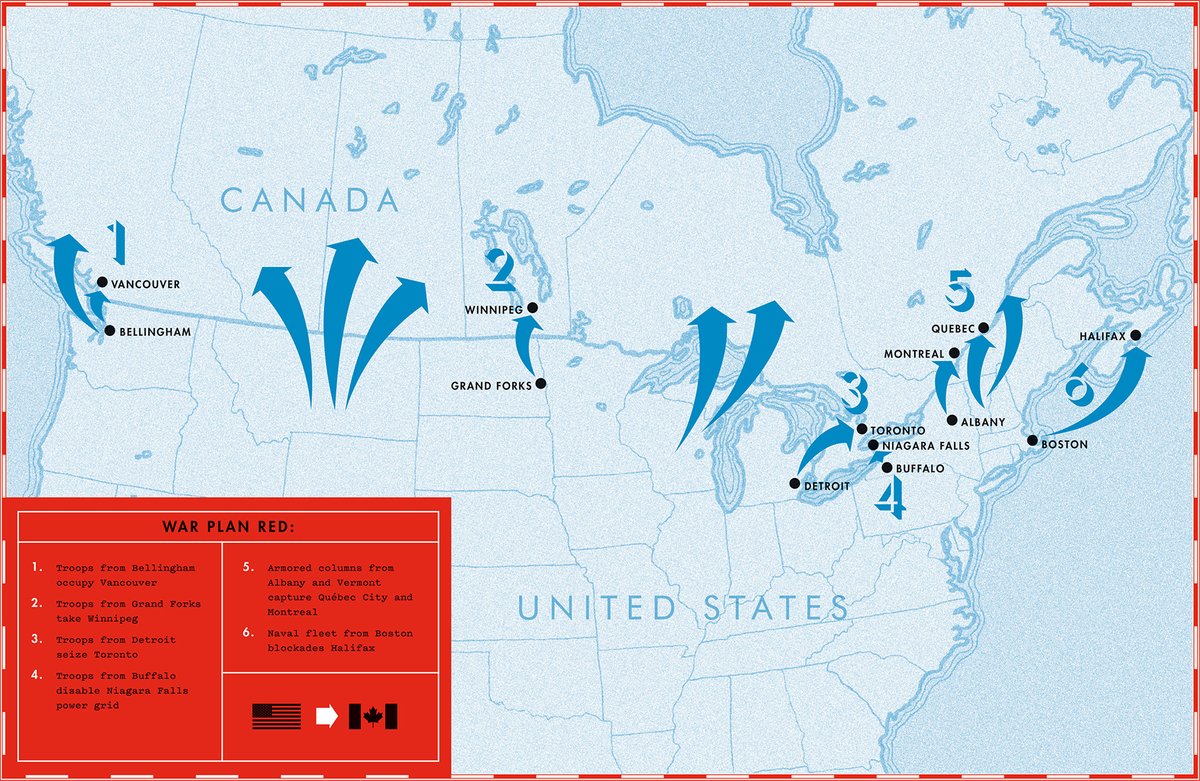
Upper Canadian Cavalier points out the obvious … that the United States absolutely could invade Canada and there’s not a lot the Canadian Armed Forces could do to stop them. But that would be the easy part:

“A mere matter of marching …”

The question of “could America ever invade Canada?” is wrong before it is even asked. Picture the MAGA politicos huddled in D.C. and the anon poasters spamming maps of how America could take Canada, as if it were even a question, as if the border were a wall and the wall the point. The whole conversation is midwits who never grasped what America already occupies.

Occupation is the crude instrument of the conqueror who arrives too late, who finds the ground already held by another and must break it by force, and that has never once been the American position in the north. The American position is that of the covert shareholder rather than the invader, and a shareholder does not knock down the door of a house whose deed already sits in his desk.

Empire in its highest form neither occupies nor marches, because it has learned to administer instead, and it does not plant a flag on the palace, since the flag is a confession that the palace was not yet yours. The genius of the modern Global American imperium has been to take without ever confessing, to hold Canada so completely that Canadians experience the holding as their own free choice. To reach for the army now would throw all of that away, trading a profitable and invisible dominion for a visible and bloody one, and teaching the empire at ruinous cost the difference between owning a country and holding it.

The republic was born reaching north with a bayonet, and it should remember how that went. In the winter of 1775 it sent Brigadier General Richard Montgomery and Colonel Benedict Arnold (yes, that Benedict Arnold) up through the snow to seize Quebec. The spirit of the country rose up in the snow to meet them, and Quebec killed Montgomery in a blizzard at the walls, the land itself passing sentence on the invasion before a single treaty could be signed.

That was first offensive act of the American project, it was a failed invasion of Canada that froze to death in the cold for its own arrogance. There is a symmetry waiting at the end of this essay that the reader should carry from the beginning, because a republic that opened its history reaching north may yet close its history the same way. America could invade Canada, but then it would not be able to conquer it, and in that attempt it would destroy the very thing that made its northern dominion worth having, because the soft empire cannot survive being seen and that invasion is nothing other than the act of trading quiet profits for overt pain and suffering.

Carneynomics in action

Even though the relic media are all singing from the government’s hymn book — because they might lose their generous subsidies if they don’t — a few dispiriting details about the real state of Canada’s economy still slip through:
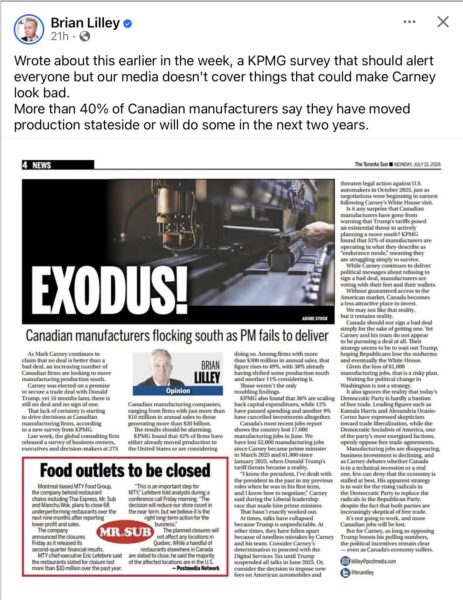
This is the Carney economy in one picture.

He sold himself as the adult in the room. The banker. The international dealmaker. The man who could handle Trump and restore confidence.

Instead, Canadian manufacturers are preparing their exit.

According to the KPMG survey, 42% of manufacturers have already moved some production to the United States or are considering doing so. Another 36% are cutting investment, 12% have paused spending and 9% have cancelled projects altogether.

Manufacturing jobs are disappearing. Investment is drying up. Factories are moving south.

Businesses respond to incentives, costs and uncertainty. They do not remain in Canada because Mark Carney gives polished speeches about nation-building. They go where taxes, energy prices, regulation, labour costs and access to markets make production worthwhile.

Carney promised competence. What Canadians are getting is stalled trade talks, falling investment, disappearing jobs and another Liberal government that seems incapable of understanding how private-sector wealth is actually created.

A great many Canadians now see Carney as an incompetent ideologue in a good suit, surrounded by the same Liberal machine that helped create this mess.

And what consequences does he face?

Very few.

Carney is rich. His family is secure. His pension, investments and connections are intact. He will never worry about a mortgage payment, a grocery bill, a lost factory job or whether his children can afford a home.

The people who pay for his failures are workers, families, small-business owners and young Canadians whose futures are being shipped across the border.

That is the ugliest part of modern government. The people making the decisions are often insulated from the consequences. They can damage an economy, lose jobs, drive away investment and still retire wealthy, respected and welcomed back into corporate boardrooms.

A résumé is not an economic policy. A banker’s vocabulary cannot hide factories closing and investment leaving.

Canada is not being built. It is being hollowed out, while the people responsible remain comfortable.

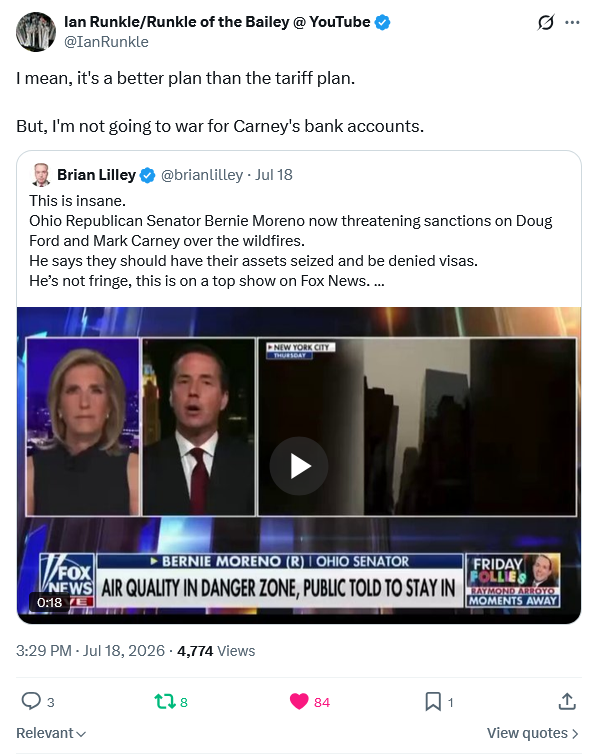
This is why I thought the announcement on Friday that a Republican senator is calling for Carney’s assets in the US to be seized and to refuse him a visa … it’s beyond weird that a Canadian Prime Minister would have over 90% of his personal assets invested in the United States rather than in Canada. This gives Trump another handle on Carney, if he chooses to use it.
On her Substack, Melanie in Saskatchewan envisions how this may play out:
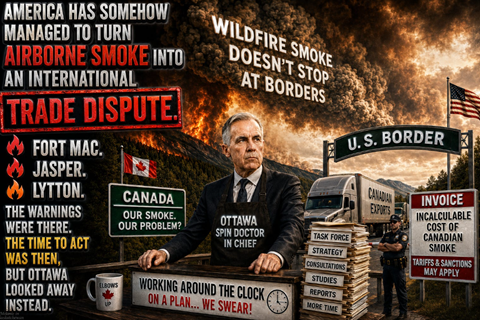
AI image from Melanie in Saskatchewan

So let me make a prediction: Any day now, your government will solemnly discover the importance of proper forest management.

There could be a task force, or a federal strategy, a minister standing solemnly in front of some trees. Perhaps an announcement that Ottawa has been “working around the clock” on a comprehensive plan that, by a miraculous coincidence, became urgent only after the American president threatened tariffs and a U.S. senator started talking about sanctions.

Should that happen, Canadians will be entitled to ask a very simple question: What finally changed Ottawa’s mind?

Was it concern for Canadians living through evacuations, destroyed communities and weeks of choking smoke? Was it the economic damage caused by recurring fire seasons? Was it pleas from provinces, northern communities and forestry workers for better prevention, mitigation and emergency capacity?

Or did the urgency arrive only when Washington threatened to slap another charge on Canadian exports and Senators possibly sanctioning Canadian officials like yourself? You personally have A LOT at stake if you are sanctioned since the majority of your wealth investment portfolio is in America.

The timing on this matters a great deal. It matters whenever a government suddenly treats a long-standing domestic problem like a national emergency only after somebody powerful outside the country attaches a financial consequence to it.

Trump has accused Canada of “wilful negligence” in maintaining its forests and says he intends to ask you what Canada plans to do. Your emergency management minister responded that governments have invested billions in fire prevention and forest sustainability since 2020. That defence deserves to be examined very closely and very carefully, because Canadians can reasonably ask what those billions purchased, where they went and why so many communities remain frighteningly vulnerable. To say it plainly … Canadians simply do not see any value for the dollars spent.

You announced spending of $317 million to lease 10 water bombers and heavy helicopters for rapid deployment to provinces because the wait time for them to be built is too long. So, here’s a fun little arithmetic exercise for Ottawa: water bombers are built right here in Canada — jobs, sovereignty, the whole patriotic package you’ve been selling — yet the federal shopping list remains stubbornly empty.

With $317 million, you could buy three heavy scoopers and have pocket change left for spotter planes or a helicopter, or — and this is where it gets embarrassing — you could roll out 45 to 55 single-engine Fire Boss aircraft, scattering an actual national fleet across every province that needs one. But apparently the government prefers its firefighting budgets theoretical. It is here that I will remind you, Fort Mac, Jasper and Lytton should have already provoked this response to act years ago.

The United States is hardly in a position to lecture anyone without hypocrisy. It is enduring its own brutal wildfire season, and fires do not stop at customs booths to declare their country of origin. Climate, drought, lightning, forestry practices and emergency capacity all play a role. There is plenty of responsibility, contradiction and political theatre to go around here. America has somehow managed to turn airborne smoke into an international trade dispute, because apparently even oxygen now requires a customs declaration. But that doesn’t absolve Ottawa. Again … Fort Mac. Jasper. Lytton. The warnings were already there. The time to act was then, but Ottawa chose navel gazing instead. In my books, that means today’s consequences lie with the governing Liberals.

Eating the Food of Homer’s Odyssey

Filed under: Food, Greece, History — Tags: , , , , , , — Nicholas @ 04:00

Tasting History with Max Miller
Published 14 Jul 2026

Skewer of roast pork covered in seasoned barley meal, accompanied by the Ancient Greek potion, Kykeon

City/Region: Greece
Time Period: c. 1650-1100 B.C.E., Mycenaean Period

When Odysseus finally makes it back to his home of Ithaca, he goes to the home of the swineherd Eumaeus. Disguised as a beggar, Odysseus is welcomed into Eumaeus’s home, and Eumaeus prepares skewers of roasted pork sprinkled with barley meal.

While I could just make plain roast pork sprinkled with plain barley flour, let’s assume that Eumaeus does the disguised Odysseus the courtesy of seasoning the meal. Archaeologists have found evidence that the people living in Greece during the Mycenaean Period, when The Odyssey is supposed to have taken place, commonly used coriander, cumin, celery, and fennel, so that’s what I used to season the barley flour coating.

This dish is very simple, and surprisingly flavorful. I made mine in the oven, but if you can cook it over an open fire, it would be even better. The cumin and fennel seeds are both very strong flavors, so choose one or the other so as not to completely overpower everything else.

    Eumaeus went off to the sties where the pigs were penned. Choosing two sucklings, he carried them in, slaughtered and singed them both, then cut them in pieces and spitted them on skewers. Then, when all was well roasted, he served it to Odysseus piping hot on the skewers, sprinkling the meat with white barley meal.
    The Odyssey, Book XIV

(more…)

Markets reject Carney’s official carbon price, so Canadians have to pay more

Canada is one of the last remaining bastions of Net Zero zealotry … in fact, Prime Minister Mark Carney may be the only national leader trying to turn back the tide of economic reality over this:

AI image posted by L. Wayne Mathison on X.

Mark Carney wrote a book called Value(s) lecturing the world about fairness, responsibility, sustainability and humility. His real governing value appears to be this: when markets reject his climate scheme, force Canadians to rescue it.

Carney now admits the official carbon price is supposedly above $100 while actual credits have traded near $20. Any honest banker would recognize the message. The market does not believe these credits are worth the imaginary price politicians assigned to them.

Carney’s response is classic central-planner arrogance. He will not reconsider the product. He will rig the price, tighten the rules, compel companies to buy it and call the resulting coercion “investment certainty”.

He praised carbon pricing in Value(s) as one of the most important and effective ways to reduce emissions. Then the consumer carbon tax became politically poisonous, so he scrapped it. The industrial version survives because its costs are easier to bury inside electricity, transportation, groceries, construction materials, wages and lost investment.

Carney also boasts that Canada continues sending climate-finance money abroad while other G7 governments pull back. Canadian families are struggling with food, housing and energy, yet our philosopher-banker remains determined to finance his international reputation with their money.

His book preached humility. His government practises price fixing.

His book preached responsibility. His government transfers the risk to taxpayers.

His book preached fairness. His policies protect the climate-finance class while ordinary Canadians absorb the costs.

Carney spent years wrapping political ideology in the language of banking. Now the numbers are exposing the sales pitch. When a theoretical $100 asset trades for $20, the market has delivered its verdict. Ottawa can falsify the price, but it cannot manufacture genuine value.

Value(s) may be hundreds of pages long. Carney’s philosophy fits into one sentence:

When reality refuses to validate the climate fantasy, force Canadians to pay until it does.

« Newer PostsOlder Posts »

Powered by WordPress