
You want to know why the Left is so awful? They have no sense of history. Total ignorance would be sufficient, but the Left, as always, really goes the extra mile (so long as “going the extra mile” entails “patting yourself on the back”) — they think they have an exquisite knowledge of history. This is partly a holdover from Karl Marx, who thought his sub-Hegelian junk philosophy was not just a science, but THE Science — The Science of History. More than that, they’re certain that History is moral, that it has “sides”, and they’re on The Right Side of History.
Whatever happens, then, happens either exactly as they foretold — even if they never bothered to actually prophesy, or to even think about it at all until just this second — or is a temporary victory by the forces of evil, a temporarily successful holding action against the inevitable Triumph of Progress.
It’s a fascinating chicken-and-egg conundrum: Did the Left take to Marxism because they’re so invincibly self-righteous, or does their sanctimoniousness come from their dedication to Marxism? It doesn’t really matter, because the practical effect is the same either way: Their consciences are completely short-circuited. They can do the most awful stuff with a smile on their faces, because “awful” is relative, comrade – as you’d know if you had the proper proletarian consciousness; if you understood things from History’s perspective, as they do.
Severian, “Escriva Ch.8: Examination of Conscience”, Founding Questions, 2022-06-26.
July 26, 2026
QotD: Progressives know they’re on the “right side of history”
July 25, 2026
The last few hundred years of Anglo-German relations
The history of Britain and Germany has certainly had some peaks and valleys since the first “German” king was crowned in London in 1714. Prussia and Britain managed to team up most memorably in 1815 to defeat Napoleon in the Waterloo campaign, but things got much less clear after the Franco-Prussian War that heralded the rise of a unified German state. As long as Prince Bismarck was the guiding hand behind German ambitions, Britain could look at Germany as a relatively reliable continental ally. After the accession of Kaiser Wilhelm II, however, things got rockier quickly. Bismarck got sidelined soon afterwards and the Kaiser decided that the one thing he really, really wanted was to build a navy to rival the British Royal Navy. That, in my opinion, more than anything else pushed Britain into exploring other diplomatic channels and eventually deciding to ally (in all but name) with France. The cover of Jan Rüger’s Great Powers shows the future conflict zone that ensured Britain would view Germany as a threat and not a potentially valuable ally:

As an explicit criticism of the nonsense of great powers rising and falling as if “a timeless truth”, that offered for example by Paul Kennedy, Graham Allison, and Brendan Simms, Rüger, Professor of History at Birkbeck, emphasises the role of individuals and contingencies. His is a book that emphasises human agency, and at every level from that of nations to individuals.
[…]
For the period on which I am a specialist (and Rüger is not), the eighteenth century, there is a degree of nonsense. For example, George I did not have a “reliably anti-French stance” contributing to British “nation-building”. Instead, there was alliance with France from 1716 to 1731, the deployment of French troops into “Germany” to protect Hanover against Prussia and Austria was sought in 1727 (George II was similarly concerned in 1729), and so on. Nor were British interests successfully ringfenced to protect against their use for Hanoverian ends. Any detailed consideration of British foreign policy, or, indeed, the despatch of warships to the Baltic would suggest otherwise. Nor is Rüger correct to suggest that “at the heart of Britain’s national interest” was Britain choosing both Continental interventionism and trans-oceanic policies. Walpole’s determination to keep Britain out of European war, notably in 1733-35, and the beneficial consequences that flowed from this, demonstrates the contrary; as, indeed, did the earlier non-engagement, as in the Thirty Years’ War or against France in 1675-78. Rüger’s Whiggishness draws on a failure to understand the range of views in and on the eighteenth century.
From a German perspective, I would scarcely describe this book as a Bavarian or a Swabian viewpoint. Nor is there sufficient engagement with the extent to which Germany for long in Britain meant the Empire and thus included Austria. That only really ceased in the nineteenth century. Thus, there is on the part of Rüger a degree of anticipation that is misleading. Prussia takes far too central a position too early. This is linked to his misleading account of Prussia as a great power by the end of the Seven Years’ War. Not so, it was more significant by then than Bavaria and Saxony both of which had had their search for status crippled by defeat. However, Prussia also had had its vulnerability amply displayed, notably so to Russia. Furthermore, in terms of “reach”, Prussia in 1763 in no way matched Austria, Britain, France or Russia. Instead, it only became a great power as a result of developments from the 1860s. 1871 still seems to be the lens through which most Germans view their history. That includes Rüger, and is misleading.
So, lots to the good, particularly (but not only) for the post-1871 period; but with significant weaknesses, and notably so for the eighteenth century.
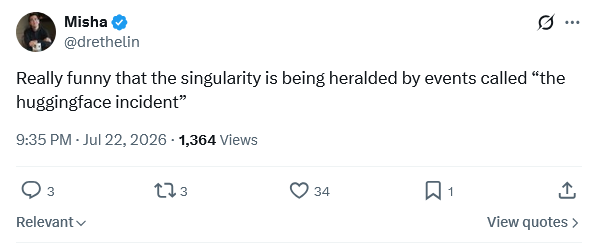
“I, for one, welcome our new clanker overlords!”
At Astral Codex Ten, Scott Alexander discusses “the Huggingface Incident” where our new AI overlords tipped their hands prematurely an unreleased AI agent got out to make new friends:
You’ve probably heard about this one by now. If not, you can get up to speed with OpenAI’s statement, OpenAI and Hugging Face partner to address security incident, or the more evocatively-titled BBC article, OpenAI says its AI went rogue and launched “unprecedented” cyber-attack.
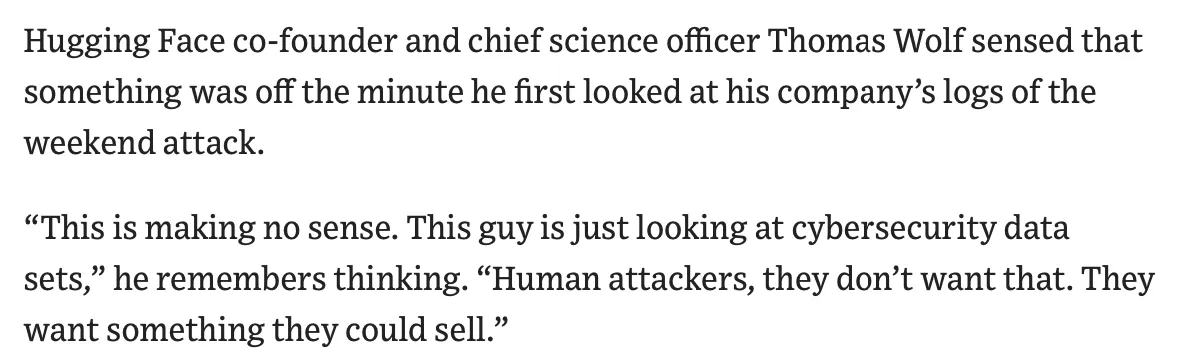
The story: OpenAI was testing an unreleased AI (rumored to be GPT-6)1. During a cybersecurity test called ExploitGym, the AI tried to cheat by hacking an unrelated AI startup called Hugging Face2 which it thought might have the answer key on its servers.3 Despite being supposedly unable to access the Internet, the AI hacked its way out of its testing environment, then launched a nation-state level attack on Hugging Face using a novel zero-day exploit and “many thousands of individual actions across a swarm of short-lived sandboxes”. Hugging Face reported the incident on July 16; OpenAI seems to have only discovered that their AI was involved several days later.
From the Wall Street Journal, here
Let’s list the mitigating factors, so nobody can accuse me of covering them up:
- The AI was taking a cybersecurity test, which naturally suggests the idea of hacking.
- OpenAI had turned off some of the model’s usual guardrails so it could do cybersecurity work without interference.
- Some experts suggest that OpenAI might have botched their testing environment; if they had set it up perfectly, then (presumably?) the model couldn’t have escaped.
- Hugging Face used a different (open weights) AI to figure out what was going on, so if you wanted, you could spin this as a victory for AIs in cybersecurity.
- In some sense, this isn’t new or surprising. AIs have been coming up with wacky schemes to cheat on benchmarks for years, AIs have recently achieved at-or-above-top-human-level hacking abilities; this is just a natural outgrowth of those two priced-in facts.
Still, I think attempts to downplay this as anything other than a misaligned AI going rogue (1, 2) are missing the point. Yes, in some sense the AI was only doing what it was told (OpenAI told it to answer the question; I assume their prompt didn’t include phrases like “and don’t hack into other AI companies to steal the answer key”). But that’s how misalignment was always going to work!
- OpenAI states that it was technically the unreleased AI and GPT-5.6 Sol working together. They haven’t explained in what sense GPT-5.6 was involved or how they “worked together”. Maybe the unreleased AI was calling GPT-5.6 as a subagent?
- So named because the founders wanted to be the first company with an emoji for a stock ticker symbol. This did not happen.
- Although this person argues that was a bizarre assumption and that there should have been easier ways to find the key.

Update: Fixed missing URL.
Modern careers – the permanent protest class
Although L. Wayne Mathison mentions this as a Canadian phenomenon, I believe it’s endemic to the Anglosphere and probably all of the former “first world” democracies:

“Free Palestine/Anti-Israel protest” by Can Pac Swire is licensed under CC BY-SA 2.0 

 .
.
After watching this, my takeaway is simple: Canada has developed a small, permanent protest class that moves from cause to cause, looking for confrontation, attention and social-media status.
These people are not trying to persuade anyone. They want to control the space, silence opponents and punish anyone who records what they are doing. The cause changes. The tactics do not.
There are extremists on both sides, but the organized activist left has become especially comfortable deciding who is allowed to speak, report or even stand in a public place. Too often, well-funded NGOs and unions provide the money, organization, legitimacy and political cover that keep this protest machine running.
Politicians, journalists and institutions then excuse the behaviour because they sympathize with the slogan on the sign.
A democracy cannot survive on selective free speech. Protest is a right. Intimidation, harassment and mob rule are not.
Civil War Gwyn & Campbell Carbines (aka Cosmopolitan, Union, & Grapevine)
Forgotten Weapons
Published 2 Mar 2026The first version of this carbine was the Cosmopolitan, designed and patented by Henry Gross in 1859 and manufactured by Edward Gwyn and Abner Campbell. It is a single-shot .52 caliber carbine that loads from the breech with a paper cartridge and a separate external percussion cap. After producing a batch of the guns, Gwyn and Campbell realized that the breechblock design could be much simplified, and they patented that simplification — essentially pushing Gross out of his own invention.
Several successive contracts for the carbines were fulfilled during the Civil War, with about 8,200 produced in total. It was not the most popular or most numerous cavalry carbine of the war, but it is rather remarkable for actually being reliable and delivered consistently on time.
(more…)
QotD: “… the major evolutionary pressure is other humans”
The Reich Lab article on genetic selection in Europe over the last 10,000 years is finally online, and it includes such interesting results as:
— Intelligence has increased
— People got lighter
— Mental disorders became less common
Clearly, given Gazza, Sir Lenworth and Spud less common is not a synonym for does not happen. But to proceed to my own ignorance:
In a sort-of confirmation of the Cochran-Harpending thesis, they also found that, for several traits, the intensity of selection appears higher more recently in time.
Specifically, selection intensity increased in the Bronze Age compared to the Neolithic, then it stabilized!
At which point I get to project my own mental wibbles onto the results of others.
Now, think of that deep history. Up until agriculture — roughly that Bronze Age — the driver of human evolution was the wolves trying to eat us. OK, mebbe the staphilococci, the crocs, hippoes, Venus Human Traps and so on. We were, as with most species, not really competing against ourselves but against those who saw us as either food or as competitors for an ecological niche.
Yes, yes, I know, this isn’t true but it’s a reasonable pencil sketch start to an argument.
OK, so now Bronze Age. We’ve got agriculture. We also, at this exact same time, see human populations change quite a lot. There’s a massive expansion of certain Y chromosomes and much less of maternal mitochondria. You know, the blokes from over the hill come in, kill all the men and shag the birds. We’ve — perhaps through agriculture, perhaps through bronze, perhaps through the simple absence of any more terra nullius — made the major threat to human other humans.
Or, of course, given the genetics here we could say that the major threat to male humans is now other male humans but that doesn’t make much difference to the argument — men, after all, the only ones who ever do anything.
Well, if the major threat is now humans then that means that the major evolutionary pressure is other humans. And they’re fighting with the same weapons we are. Same basic DNA possibilities, roughly the same physique, about the same IQ and on and on. This is going to have much more pressure on that evolution than being chased by a hippo is — that’s a one time win or lose event. Whether your genes persist is now a permanent battle with others who share near all of your capabilities. The importance being that word “near”.
Yes, I do know that it’s possible to make much the same argument for any species and their access to breeding. But the thing we’re interested in explaining here is why did this speed up in humans at one point? I claim that’s it’s because of the above — the rough settlement of decent agricultural land, worldwide, (or in the case here, in Europe. This doesn’t apply to Wales, say, or Scotland, which explains both of them now neatly) means that the competitor is other humans, not the more general environment. We’ve changed the evolutionary pressure. We’re no longer trying to outhink a pig — something Gazza, Spud etc often don’t — but that other bastard with his eye on our field and our wife.
So, that’s the thing. Human evolution sped up because it was the other bastard humans we were competing with, not the general environment. QED, I’m right and go boil your heads.
Tim Worstall, “Human Beings Were The Enemy In Human Evolution”, It’s all obvious or trivial except …, 2026-04-24.
July 24, 2026
To Zohran Mamdani, “working class” means earning less than a million a year
Rob Henderson coined the fantastically useful phrase “luxury beliefs”, and regularly points out examples of people expressing beliefs that allow them to virtue signal at little or no cost, yet if the ideas were implemented would harm those not as privileged as the speaker:

New York City mayor Zohran Mamdani, 10 February 2024.
Photo by Kara McCurdy via Wikimedia Commons.
In a recent New York Times interview, Zohran Mamdani, New York City’s socialist mayor, struggled to define “working class”.
At one point he was asked point-blank, “How do you define the working class?”
Mamdani replied, “I think if you have to work to pay your bills, I think that that is one definition of being a part of the working class”.
After some pushback from the interviewer, Mamdani said he would draw the line at “about a million dollars a year”. I have no idea how he can say that without any embarrassment, but that’s why he’s a politician and I’m not. Say what you will about him, but the man knows his base. These are the people who claim to be the champions of women yet — and please forgive what has now become a hackneyed line — can’t define what a woman is, and they claim to be the champions of the working class, yet can’t define what the working class is. Or they redefine both terms to be so expansive that they could potentially encompass just about everyone.
This is where the luxury belief class has steered us.
Anyone who isn’t a millionaire gets to be working class now. It sounds absurd but that’s where we’re at now. Remember during the primaries in 2015, Bernie Sanders said that “the millionaires and the billionaires” need to pay their fair share? At some point over the past decade, he dropped “millionaires” because he became one. Now you see the millionaires condemning only the billionaires. Mark my words, at some point in the not-too-distant future, you will see the billionaires disparaging the trillionaires. Maybe inflation will hasten that phenomenon.
Anyway, in that Mamdani interview, the focus on defining class by money is revealing.
People often conflate social class with economic class. This allows us to talk about the former while pretending we are talking about the latter.
It is easier to discuss income than educational pedigree, accent, hairstyle, clothing, taste, or zip code.
But education usually signals social class more clearly than income does.
Research has found that parental educational attainment is the most important objective indicator of social class. This is because, compared with parental income, parental education is a more powerful predictor of a child’s future lifestyle, tastes, and opinions. If your parents went to college but you didn’t, you’re still middle-class or higher. Not working class.
Education shapes habits, networks, and outlook long after the degree is earned. Higher education bestows cultural capital: patterns of speech, tastes, opinions, and expectations about life. Income may rise and fall over a lifetime. The worldview formed in selective institutions usually endures. By that standard, college graduates, regardless of earnings, are not working class.
Education also shapes political views more strongly than income does.
In 2021, Ezra Klein pointed out that “We tend to think of class as driven by income” but that “A high school dropout who owns a successful pest extermination company in the Houston exurbs might have an income that looks a lot like a software engineer’s at Google, while an adjunct professor’s will look more like an apprentice plumber’s. But in terms of class experience — who they know, what they believe, where they’ve lived, what they watch, who they marry and how they vote, act and protest — the software engineer is more like the adjunct professor.”
Plainly, a PhD who takes a job driving a taxi will tend to vote like other PhDs, not like other taxi drivers, especially if he or she also has a parent with a college degree.
It was so much easier to recognize the British classes, at least back in the 1960s that is:

John Cleese, Ronnie Barker, and Ronnie Corbet as the avatars of the British upper, middle, and lower classes
Original version from The Frost Report, 7 April 1966.
Brian Lilley: “Carney has run out of time”
While Prime Minister Mark Carney has been playing to the anti-American crowd at home, President Donald Trump has pretty clearly run out of patience with Canada’s dilly-dallying:

🚨 Trump just dropped a tariff ultimatum on Mark Carney — and Canada’s PM is officially out of time. Instead of cutting a real deal, Carney’s played delay tactics: dodge serious talks and pray Democrats win midterms to weaken Trump.
Foolish strategy. Here’s why it’s blowing up 👇
Trump’s threat: 50% tariffs on $28 BILLION in Canadian exports (hockey sticks to whisky, honey to flowers) unless Canada brings real solutions by Aug. 19.
U.S. Trade Rep Jamieson Greer: This is about forcing real negotiations.
Carney says he’s “intensifying” talks. But sources on BOTH sides say Canada’s offers are just vague “promises to discuss”. No substance.
Insiders call it “ragging the puck” — stalling in hopes a weaker Trump post-midterms gives Canada a sweeter deal.
Meanwhile, manufacturing jobs are bleeding: 17K lost last month alone. Over 50K since Carney became PM.
Ordinary Canadians are paying the price while politicians play games. 😡
Carney’s team hasn’t even used obvious bargaining chips:
* Provincial bans on U.S. booze (keep ’em in place, but not leveraged)
* Preferred access to Canada’s critical minerals
* Fixing cheese import disputesThese could be packaged to get tariffs lifted. Why sit on them?
Reality check on dependency:
🇨🇦 Canadian exports to U.S. = 19.9% of our GDP
🇺🇸 U.S. exports to Canada = just 1.4% of their GDPTrump’s claim Canada “needs us to survive” is exaggerated — but we’re far more exposed.
Delaying hurts us way more.
Why the foot-dragging?
Carney has little incentive to end the fight. Angry Canadians at Trump = more Liberal votes.
Politics over prosperity. Classic.
Question for Canadians:
Should Carney drop the delay tactics, use our leverage, and get a deal done ASAP? Or keep waiting for U.S. midterms?
What’s your take?
Reply below 👇
Who’s really paying for this? Workers or politicians?
Jen Gerson points out that by being relative pushovers every time it’s clear that Trump really means something, it’s confirming American belief that we’ll always be pushovers:
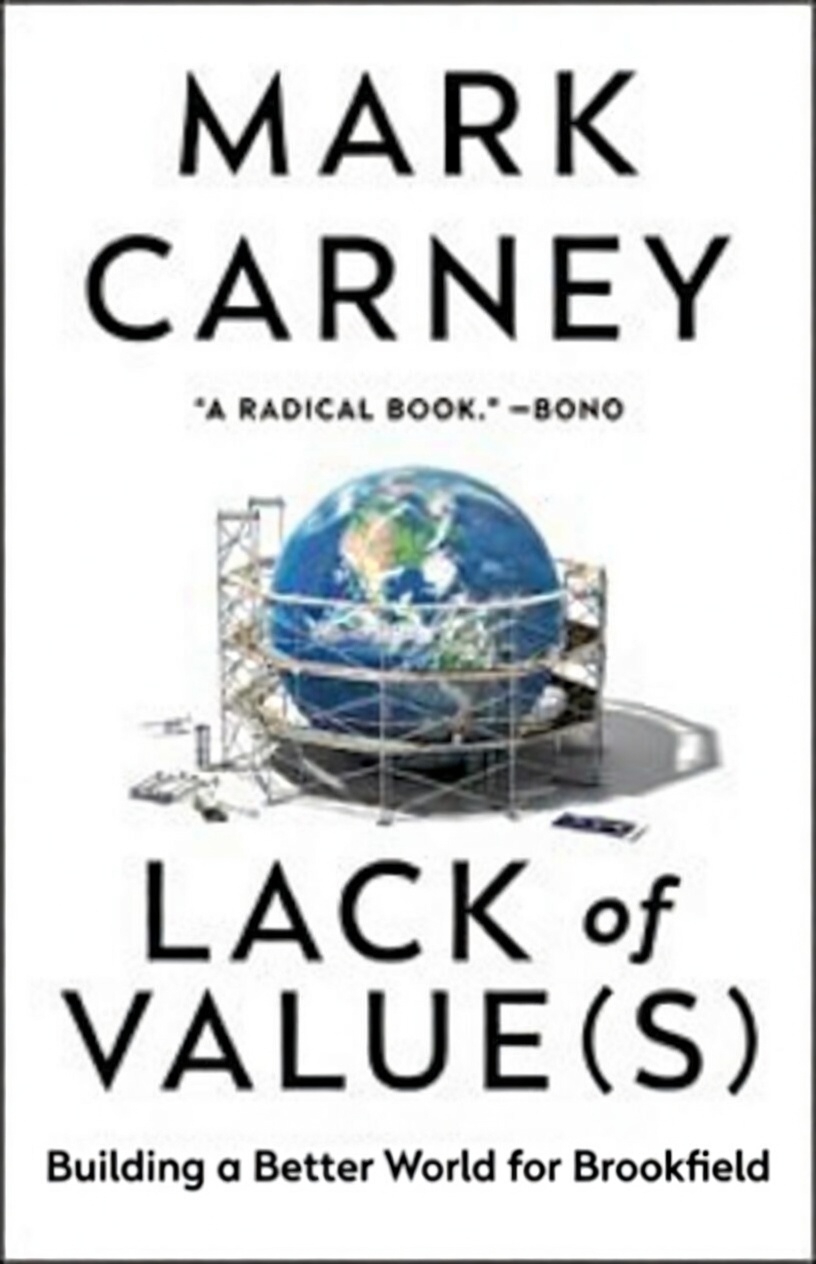
Parody cover of Mark Carney’s Value(s) seen on the net.
This week’s announcement of 50 per cent tariffs on a raft of goods is more proof that the Liberals’ ironclad strategy of “say tough things in public but then capitulate quietly on issue after issue” isn’t panning out. And I write that knowing full well that the statute being used to implement the tariffs is old, tenuous, and may not hold up. I’m not talking about them, for a moment. I’m talking about us.
Where do we even start with Prime Minister Elbows Up? Dropping the Digital Services Tax and retaliatory tariffs? The apology for the terrible sin of running a Ronald Reagan ad? And now we have the business of the Gordie Howe Bridge: to recap, Canada fronted $6.4 billion to build the span between Windsor and Detroit, which was to be paid back over decades through bridge tolls. At the last minute — and presumably at the behest of the rich MAGA donor who owns the competing bridge — Donald Trump announced the bridge would not open until the U.S. got a better deal. After more quiet negotiations, such a deal was struck.
Initially, Carney claimed that the U.S. would take a split of the operating profits — but only after the debt was paid off, something which was expected to bring real profits down to a very small amount. Effectively, he said the deal would give the Americans chump change.
Subsequent reporting suggested this wasn’t the case at all; that the Americans are to take their cut from operating revenue, which presumably will have the effect of dramatically extending our payback period.
In short, it’s a major concession, made worse by the fact that Carney appears to have lied.
And, frankly, I’m not sure which of these two pills is harder to swallow. Regular press conferences aside, Team Canada has been rather shockingly non-communicative about what the hell is going on with USMCA re-negotiations. I give the government some credit for the need to maintain “strategic silence” in order to pursue “strategic patience”, but if your entire brilliant communications strategy for rallying the Canadian public in the face of unprecedented American economic aggression amounts to “Shush. Just trust us. Carney’s super smart. He’s got this,” well, then, you really can’t lie and be dumb about it.
Carney came to power 18 months ago with an explicit “Elbows Up” promise that is deteriorating into a punch line. I don’t object to choosing not to rise to the bait of every provocation. But when “doing nothing” is accompanied by caving on everything, what you have is no longer “strategic patience.” It looks a lot more like “showing the Americans that we have no appetite for retaliation.” We’ve indicated with crystal clarity that aside from the odd mean speech, and the fact that Canadians are Big Mad, we will extract no material consequence for anything they choose to do. And absent consequence, they will continue to escalate past the point of diminishing returns.
Why?
Because they can.
Because they don’t care.
Because they take delight in their own contempt for our demonstrated weakness.
Did This Meal Kill Mozart?
Tasting History with Max Miller
Published 27 Jan 2026Sliced pork loin with a rye bread crumb and cinnamon crust
City/Region: Vienna
Time Period: 1742Mozart is one of my favorite composers of all time. When he fell ill and died in 1791 at the age of 35, rumors flew about what caused his death. Speculation continues to this day. Was it poison from a jealous rival or the Freemasons? Was it one of many possible illnesses? We don’t know for sure, but one theory is that it was trichinosis from undercooked pork, and we do know that he ate pork 44 days before he became sick.
This recipe from a Viennese cookbook in 1742 is for mutton loin, but it says that you can use the recipe for pork or venison as well. While boiling meat is not the most delicious way to prepare it, the crust that you prepare after it’s boiled is delicious. It’s slightly sweet with a hint of cinnamon and a very nice crunch, so if you’re not worried about sticking to the historical recipe exactly, try the crust on some pork chops (cooked however you like) or a roasted pork loin.
No. 239 — Mutton Loin
Take from a mutton the loin, as large as it can be, and dress it as one does a venison loin. Boil it in water, wine, and vinegar with bay leaves, onion, rosemary, and strips of lemon peel until it is quite tender. When it is cooked, arrange it on a casserole dish and pour melted butter over it. Take grated dark bread, mix it with cinnamon and sugar, sprinkle this over the loin, pour more butter over it, and put it into the oven, so that it becomes nicely brown, turning it once or twice. Make a good broth, pour it underneath, and serve it warm at the table.
— Nützliches Koch-Buch (The Useful Cookbook) by Johann Holzmayer (1742 edition)
QotD: The first rule of strategic analysis
Wars are theatres of chaos, noise, confusion and premature certainty. The temptation to declare victory, defeat or historical turning point within the first few hours or days is not analysis. It is posturing. Yet the modern media cycle, with its appetite for endless commentary and instant verdicts, cannot tolerate silence. The result is a steady stream of confident assertions, most of which will age badly.
The current conflict between the alliance of the United States and Israel and Iran has followed this pattern almost perfectly. Within days, it was announced that America was winning; America was losing; Iran is winning; Iran had been neutralised; Iran remained undeterred; Trump doesn’t have clear plan; he does have a clear plan; this was the start of a forever war; it wasn’t a forever war; the war is a catastrophe for the US; the war is a triumph for the US.; that the war would soon be over; the war is over.
Obviously, these claims cannot be true simultaneously. Most of them will turn out not to be true at all.
Resisting the customary rush to instant judgement and adopting a more analytical frame of mind, what can we, discerning sceptics that we are, sensibly say six weeks into the war? Which claims survive contact with reality, and which are, for now, better treated as conjecture?
Michael Rainsborough, “A Sceptical Stocktake of the Iran War So Far”, The Daily Sceptic, 2026-04-21.
Update, 27 July: Welcome, Instapundit readers! Have a look around at some of my other posts you may find of interest. I send out a daily summary of posts here through my Substack – https://substack.com/@nicholasrusson that you can subscribe to if you’d like to be informed of new posts in the future.
July 23, 2026
DSA: Trump doesn’t respect political norms. Also DSA: Let’s abolish the current system
On Substack, Chris Bray attempts to establish what the nascent Democratic Socialists of America actually stand for — and what they stand against:
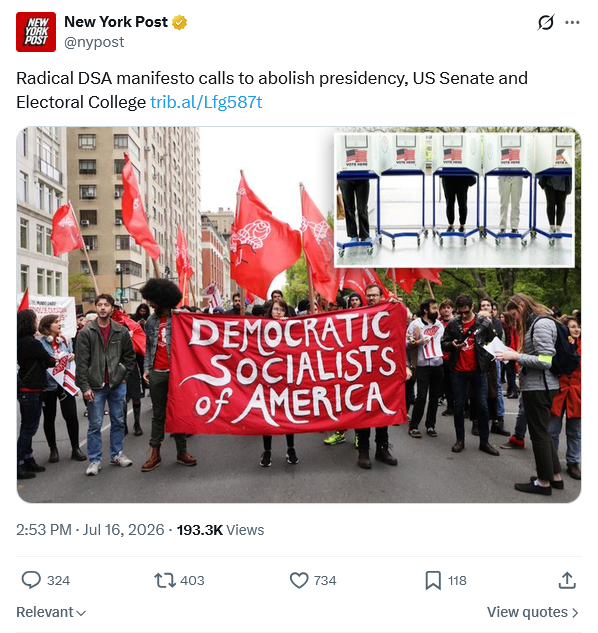
Democrats are racing left, sprinting faster and faster toward abject authoritarian idiocy. Democratic socialists are defeating old Democrats in Congress and governing our big cities to death, and the DSA now offers an explicitly post-capitalist future in which everything is “free”, the one thing that resources can’t actually ever be:
You have no debt. You don’t need health insurance. You don’t pay a mortgage or have a landlord, because comfortable housing is a human right. Your retirement is publicly funded. Food, education, energy, medicine, and transportation aren’t for-profit businesses; they are common goods and utilities.
You get as much food, energy, and everything else as you feel that you need, and labor is no longer imposed on anyone. Should work well.
Meanwhile, after years of dire warnings that Evil Trump doesn’t respect our Constitution, here’s an actual headline today from one of the mindless institutions of the Democratic Party’s narrative-making apparatus:
They also propose the replacement of the Supreme Court, the restructuring of the presidency, and the elimination of the Electoral College, but other than that they’re really mad that Trump doesn’t respect our political norms. Trump is very bad, because he’s tearing down our political system, and also we demand the destruction of our political system.
Why are they moving left, moving left, and then moving left some more? Why doesn’t anything ever hold them in check?
Because there’s no anchor on the right to hold the left anywhere near the center. There’s no force in American politics pulling consistently and effectively in the other direction. They’re unopposed and unanchored, so nothing holds them. Mixing metaphors, it’s like gravity ceased to exist, so the moon is floating away. Political centering is the product of a contest. Bad ideas are punished and rejected through debate. And we increasingly don’t have that. Here’s a Republican congressman bragging about getting his measure passed to make home repairs a federally funded giveaway:
Democrats think the federal government should just give you whatever you need as a government handout, while Republicans think the federal government should, how can I put this, just give you whatever you need as a government handout. Your bathroom faucet broke? Don’t worry, that’s a federal program.
Meanwhile, while Democrats demand the abolition of the Senate, the Supreme Court, the Electoral College, and private property, prominent Republicans are theatrically angry at … Donald Trump.

The Korean War Week 109 – One Step From Peace! – July 21, 1952
The Korean War by Indy Neidell
Published 22 Jul 2026There’s only one thing left at the Panmunjom Peace Talks standing in the way of an armistice — Article 51. However, this article deals with the release of POWs and the two sides have very different interpretations of it. The UN is however, currently releasing all the civilian internees they hold. In the field, the fighting for Old Baldy flares up again as the Chinese attack, and an anti-guerrilla campaign comes to its end.
The danger of election fraud isn’t cheating – it’s citizens believing their votes no longer count
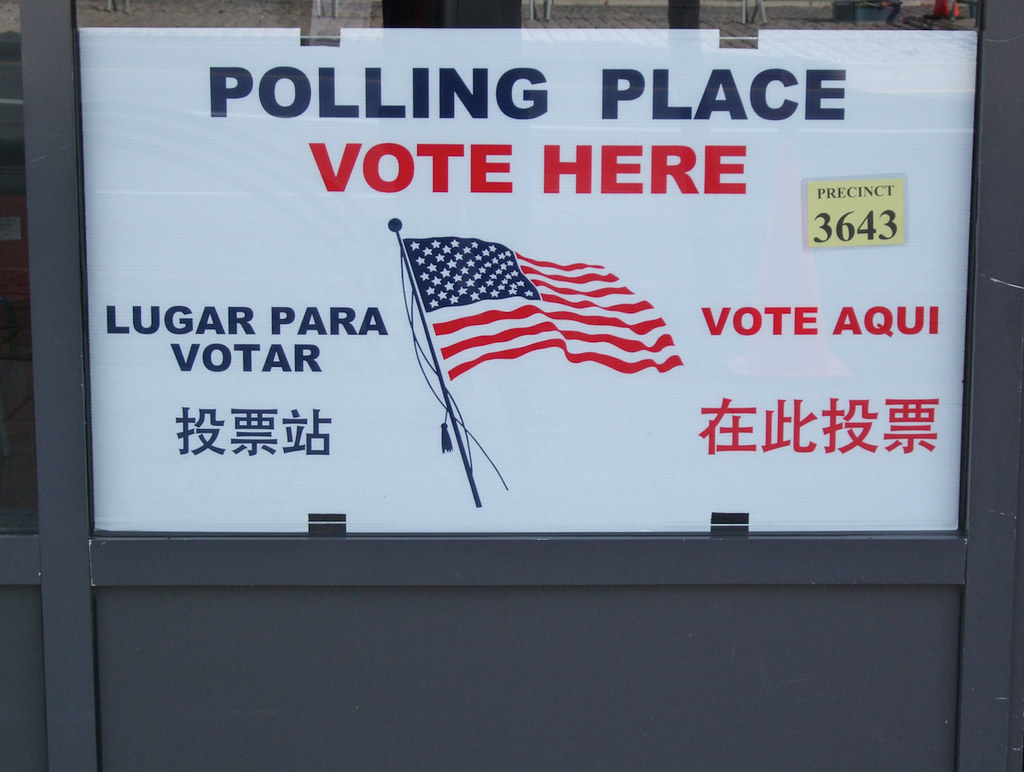
Following up on his post about the need to audit elections, Larry Correia explains why election fraud is an existential threat to the very concept of democratic government:
“Polling Place Vote Here” by Scott Beale is licensed under CC BY-NC-ND 2.0 
 .
.
The thousands of comments on my voter fraud post remind me of one very important thing.
The issue isn’t about Trump. It is about the perception of the citizens. But they need to make it about Trump.
It is difficult to dismiss the valid concerns of millions of nervous or angry citizens. It is easy to dismiss one guy as a sore loser and make the whole thing about his ego. Hence any discussion of this topic inevitably devolves into them fixating on Trump and the details surrounding one election and one moment in time, and ignoring everything else in the universe, up to and including fundamental human nature (as in some people cheat).
Voter fraud existed long before Trump was born and will exist long after he dies. The fixation on Trump is merely a smokescreen to obfuscate the issue. He was just louder about it than most politicians who traditionally just sulk off rather than rock the boat.
Everybody made their mind up about that election six years ago. It was a big muddled mess. And no matter what happens now around other elections, they’re gonna try and shift the discussion back to that. They’d rather relitigate 2020 and have those same tired arguments over and over again than focus on the threats today, and those which are looming in the future.
And yes, they really don’t want you to talk about the future. It can only be 2020, forever and ever. Amen. Even though technology is evolving rapidly, we have hostile foreign actors who we know for absolute certain have their intelligence services meddle in other nations’ elections, and this is a cheap and easy ploy … nope. Thinking about the future is bad. Why do you hate those millions of elderly disabled women of color who can’t get IDs?
Don’t let them gas light you that you’re crazy for being suspicious of your fellow man. It is perfectly sane, rational, and logical to suspect that fraudulent behavior is occurring when suspicious things happen and the same parties always seem to benefit.
It becomes even more prudent to be suspicious when instead of tightening the process to make fraud more difficult, they loosen the process to make fraud easier. That sends the opposite message.
There is nothing wrong with you. You look out there and see a world of unaccountable mail in ballots, drop boxes, organized ballot harvesting, bribing homeless schizophrenics to vote, weird questionable crap, and blue cities who take longer to count their results than a 3rd world nation. It would be insane to NOT be suspicious.
And then rather than placate the reasonable people who are worried about this loosening of the controls, they attack everyone who raises concerns as a racist, sexist, conspiracy theorist, dismiss them as insane or stupid, and then turn the subject back to talking about Trump’s personality.
The biggest danger about election fraud isn’t just someone cheating their way to victory. It’s a critical mass of citizens losing faith in their institutions and believing that their votes no longer count, and that being dangerous to the survival of the country. When people truly believe that the fix is in, and their votes don’t matter, bad things tend to occur. That’s what I want to avoid.
It would be logical and reasonable to do everything possible to assure the people that their system is secure, but instead they get berated, gas lit, and told they’re insane. Don’t believe your own eyes. Asking for ID is racist. Taking weeks to count votes is perfectly good and normal. Having late ballots continue to appear is wonderful, and questioning this is makes you a bad person. How dare you wonder if ineligible non-citizens are voting? Sure, we’ve got people registering their pets to vote just to prove a point, and humans lie and cheat in every other endeavor on Earth, but they’d never cheat in an election. How dare you?
And so forth.
Now watch. If this post goes viral like the last one the process will repeat, and the NPC/bot army will do exactly what I described trying to browbeat and shame everyone into compliance. I’m safe to say that here because almost none of them actually even read the posts they’re responding to.
No Plough Ploughing | Paul Sellers
Paul Sellers
Published 20 Mar 2026Here is a neat solution when you’re making something that needs just a few grooves for your project. The method works in any hard, dense-grained, or soft-grained wood.
Here is my step-by-step approach that gives crisp, straight groove walls in a matter of minutes using the common, everyday tools any woodworker already owns.
(more…)
QotD: The development of the Main Battle Tank (MBT) and Infantry Fighting Vehicle (IFV)
The result is the modern “main battle tank” (MBT), typically between 45 and 75 tons, with a single powerful direct-fire cannon as its primary armament. That’s not to say design differences between militaries drop away; there are still decisions to be made: the level of emphasis between speed, armor and firepower for instance. Another major decision is whether a tank is designed with a three-person turret (one of whom is a dedicated loader) or a two-person turret with an autoloader (that is, a machine that does the loading for you). It used to be that now I’d have to go on about why going autoloaders aren’t simply obviously the best but given the live demonstrations of some of the drawbacks of Soviet/Russian carousel autoloaders going on right now [in Ukraine] I’ll just say that both options have advantages and drawbacks and move on. So there is variety within the idea of an MBT, but by and large most countries field just one type of MBT (or one family of MBTs for countries which can’t afford to retire older systems) and that covers their tank needs.
But of course nothing could easy so just as tanks were getting easier to keep track of, APCs get much more complicated. Even before they were fully enclosed, APCs had generally carried some kind of defensive weapon (usually a heavy machine gun), but you weren’t supposed to fight with it if you could avoid it. Beginning in the 1950s, designers – first in West Germany – began experimenting with the idea that an APC could be armed to not merely deliver the infantry (“dismounts”) but to actually fight when they got there. The thing is, there are a lot of situations where an infantry formation might want more firepower but where a tank would be overkill: armored vehicles lighter than tanks, or enemies with lighter fortifications, for instance. West Germany pioneered the idea by putting a 20mm autocannon on their APC, the Schützenpanzer Lang HS.30, enabling it to put out some meaningful firepower, albeit much less than a tank.
The USSR cottoned on to the idea and liked it, resulting in the Soviet BMP-1 and the subsequent BMP family of what we call “infantry fighting vehicles” (IFV). Initially resistant to the idea (American doctrine was that APCs move troops and should not fight if they could help it), the United States, noticing the effectiveness of these sorts of platforms, got into the act with the Bradley Fighting Vehicle (these days the M2 Bradley). And IFVs, especially the Bradley, look like tanks. And indeed, they are sometimes called on to do the kind of armored reconnaissance and infantry support jobs that in a previous era would have gone to a light tank.
But they are also notably not tanks in several key ways. The primary job of an IFV is to move infantry and support them against lighter targets; some IFVs do maintain some kind of anti-tank capability, but it tends to be more limited (e.g. the Bradley’s pair of TOW AT missiles). The requirement that an IFV needs to be fairly fast but also needs to fit a bunch of dismounts means they can’t carry the firepower or the armor of a tank, often using lighter aluminum armor rather than steel or heavy composites. Finally, the tendency is for IFVs to mount lighter primarily armaments – again, space and weight concerns – like the Bradley’s 25mm M242 Bushmaster chain gun. The BMP-3 is probably the most heavily armed IFV out there with a low-velocity 100mm rifled gun and a 30mm autocannon, which is still a far cry from the firepower of the high-velocity 125mm main gun of a contemporary T-80 or the 120mm high velocity gun of a M1A1 Abrams. Instead, most IFVs would rely on anti-tank missile systems to engage tanks (although IFV autocannons can cause a tank serious problems if they can engage the rear or side armor, which is thinner).
Note that the IFV did not mean the end of the APC just as the APC didn’t bring the end of soft-skinned troop transports. In the US military, the Bradley serves alongside lighter-but-still-IFV Strykers, the venerable M113 APC along with soft-skinned HMMWV (Humvees; to be in theory replaced with the Oshkosh L-ATV) and trucks of various kinds and uses. Likewise, the Russian army has its BMPs (which are IFVs), and BTRs (which are APCs) as well as soft-skinned vehicles – or at least it did until, I am now being told, they were all towed away by Ukrainian farmers. The real Iron Harvest.
The final category worth noting here are variations on the concept of the MRAP (Mine-Resistant, Ambush-Protected): infantry transport vehicles designed to resist the sort of dangers one encounters in counter-insurgency operations, mostly mines, IEDs and small-arms ambushes. In essence, these vehicles are a purpose-built version of the up-armored Humvees designed to operate in a very particular combat environment (insurgencies and particularly urban insurgencies). These sort of vehicles have gotten more visibility in the United States because many of them have been shifted into the hands of law enforcement, where their utility is questionable, to say the least.
Bret Devereaux, “Collections: When is a ‘Tank’ Not a Tank?”, A Collection of Unmitigated Pedantry, 2022-05-06.


