
Asymmetric Warfare is a term used to describe warfare between two belligerents with either starkly different amounts of resources or different warfare styles or systems. It is crucial to note this term denotes something about the relationship between two belligerents, not something essential to one of them; an army or a state is not asymmetric except in relations to another (the mistake here is often to set the modern western industrialized form of warfare as the “norm” against which all other forms are somehow asymmetric). While this term has been used to describe the war in Ukraine, it is ill-suited for it: both Ukraine and Russia are attempting to make use of a similar set of equipment (including the use of artillery and airstrikes) using a uniformed soldiery; they are both, to borrow one of my earlier definitions, attempting to operate within the “third system of war“. Ukrainian efforts to have uniformed soldiers use maneuver and surprise to engage Russian logistics and rear echelon units are not “asymmetric”, but rather a standard part of both Russian and Ukrainian warfighting, albeit one that Ukraine appears more skilled at in the present moment. Likewise, both sides are attempting a parallel “political struggle” of demonstrations and information warfare; Ukrainian success here too does not make their methods asymmetric.
Bret Devereaux, “Miscellanea: A Very Short Glossary of Military Terminology”, A Collection of Unmitigated Pedantry, 2022-03-25.
July 29, 2026
QotD: Asymmetric warfare
July 28, 2026
The establishment pretends not to understand why AfD is still on the rise
Normally, I get my updates on German politics from eugyppius’ Substack, but this article is from the New English Review with Bruce Bawer reporting:

… even as the problematic aspects of Islam become increasingly manifest, mainstream politicians and journalists in Germany feign puzzlement over the growing popularity of AfD, which ever since its founding in 2013 has been characterized by the German establishment as heralding a Nazi renaissance. How, the German elites pretend to wonder, can so many voters transfer their loyalty from seasoned, sensible, upright political leaders to ragtag radicals who bring to mind Munich putsches and Nuremberg rallies? How on earth can they have become so misguided? Such is the coy approach of Jochen-Martin Gutsch in a recent article for Der Spiegel, in which he takes a spin around the former East Germany in purported search for an explanation as to why the “far-right” AfD has won majority backing in that part of the Bundesrepublik.
Gutsch’s first move is to act astonished at the fact that an AfD gathering in Salzwedel, Saxony-Anhalt, drew ordinary-looking families, plus “[a] surprising number of young people in their twenties, smartly dressed in blazers”. What, no Hitler Youth uniforms? Gutsch’s line is that he’s just plain perplexed by the numbers: “in the state of Saxony-Anhalt, the AfD is currently polling at more than 40 percent. In the ARD Deutschlandtrend poll, the AfD is in first place; it’s even the most popular party, nationwide.” But it’s one thing to read the numbers, another thing to see all these – gasp! – ordinary-looking people flocking to show their support. This is what really blows Gutsch’s mind, or so we are meant to believe: the “normalization” of AfD, the party’s growing “acceptance”, its rapid “transformation into a mainstream party in the east”, all of which was, in Salzwedel, brought to vivid, terrible life before his eyes.
Ten years ago, Gutsch recalls, AfD received 20 percent of the vote in Saxony-Anhalt, and he, for one, was sure that it had peaked. He’s from eastern Germany himself, and he thought he knew his neighbors. He was wrong, and now, he claims, he’s alarmed – unlike his “friends and colleagues sitting in Hamburg, Cologne, or Munich, who give a friendly, bored look when I talk about the AfD. For them it’s still far away. Somewhere ‘over there’, whereas for me it’s a reality I can’t escape.” Therefore, he tells us, it’s important for him to make unravel the mystery of the AfD‘s remarkable rise in the polls.
Of course, the reason for the rise of AfD is obvious to anyone who’s been following developments in Western Europe for the last quarter-century or so. More and more voters have been demanding that immigration, especially from Muslim countries, be drastically curbed, if not altogether ended, and that the unassimilated masses who’ve already relocated to Western Europe from the Muslim world – only to swell the welfare rolls and the crime statistics – be sent back to where they came from. We’re told that the Berlin Pride killer, Abdul Ballout, belongs to “Islamist circles” in Germany. Why, ask AfD voters quite reasonably, should there be “Islamist circles” in Germany?
Yet Gutsch is, or pretends to be, blind to such concerns. His initial hypothesis, as he heads into the east, is supposedly that AfD is gaining popularity there because of economic hardship. But no, when he drives through Brandenburg now, he encounters prosperity. The city of Großräschen, once the Ruhr of East Germany, became a “ghost town” after 1990; now it’s thriving again, with the unemployment rate a mere seven percent, the old lignite mine converted into a lake with “a lovely beach” lined by “white houses” with “luxury SUVs parked out front”. Why, then, asks Gutsch, are the residents of these stately homes casting their ballots for AfD?
A veteran local politician tells Gutsch that he travels often to Bochum, in western Germany, which, compared to Großräschen, is an economic basket case. And yet the residents of Bochum are “more easygoing” than those in Großräschen. They possess a “fundamental optimism”. They “trust” and “respect” their political leaders. “What beautiful words”, Gutsch comments. He’s not being ironic. To be sure, he understands why eastern Germans aren’t brimming over with love for their leaders, whether in Berlin or Brussels. Many of them are old enough to remember 1990, when the once-mighty East German state “crumbled … before their very eyes.” One might add that before 1990, that same state was the very picture of totalitarian tyranny, as chillingly depicted in the film The Lives of Others. And before that – well, you know. Then there’s 2015, when Angela Merkel opened the floodgates to insufficiently vetted Muslim immigrants, who proceeded to cause mayhem in both east and west.
But why, then, do so many western Germans still “trust” and “respect” their leaders? It seems baffling. Yet to listen to Gutsch, loyalty to the political establishment remains the way to go – the only intelligent, mature, and reasonable option. When he talks with an AfD politician, Karsten Hilse, to get the latter’s perspective on things, he’s lost at sea. In Hilse’s opinion, mainstream German politicians are too obsessed with “tolerance”; they have at least a degree of hostility toward Germany; and they accept without question the preposterous ideologies of gender and climate-change.
Mis-, Dis-, and Malinformation defined
Gawain Towler kindly provides a précis of a behind-the-paywall essay discussing misinformation, disinformation and the less-well-known malinformation, as governments on both sides of the Atlantic rush to codify new laws to further restrict the freedom of speech of their citizenry:

The essay examines “malinformation”, a term coined in 2017 and now embedded in official doctrine on both sides of the Atlantic, and I argue that it exists for one purpose, to give the state a category under which accurate speech can be treated as a harm. I start by Channelling Ambrose Beirce’s Devil’s Dictionary, with a dictionary entry defining the word as information whose defect is that it is true. Thereafter I proceed to trace its origins, its spread through British and American officialdom, its intellectual kinship with behavioural government, and its practical operation, before closing with a demand for its formal abolition.
First the taxonomy itself. The doctrine of “information disorder” rests on a triad. Misinformation is false and innocent, disinformation false and deliberate. Both turn on falsity. The third category does not. CISA, the American cybersecurity agency, defines malinformation as based on fact but used out of context to mislead or harm, and the Department of Homeland Security’s advisory council calls it the intentional spreading of genuine information with intent to cause harm. The offence, the essay observes, is not lying but telling the truth on purpose. The term’s coiners, Hossein Derakhshan and Claire Wardle, applied it narrowly to revenge pornography, miscaptioned photographs and weaponised leaks, and the essay concedes these are real phenomena. But the concept escaped its paddock. Within four years it had migrated from a Council of Europe research paper to the letterhead of a federal agency and thence into British government training materials.
The British chapter centres on RESIST 2, the Cabinet Office counter-disinformation toolkit issued to government communicators in 2021. The toolkit reproduces the triad, admits the categories are hard to distinguish in practice, and resolves the difficulty by instructing officials to stop asking whether material is true and to focus instead on the harm it can do.
The essay treats those five words as the whole doctrine laid bare, truth demoted from test to complication. From the Cabinet Office the word trickled downward, into Local Government Association guidance, a Stockport Council webpage, even a Met Office blog. The essay notes a telling exception. Ofcom and the Electoral Commission, bodies with statutory exposure and lawyers, avoid the word entirely. Its distribution across the state maps the distribution of accountability. Where courts can reach, the concept hides.
The American experiment, the essay argues, ran to destruction. CISA’s mis-, dis- and malinformation team spent the early 2020s flagging content to platforms, much of it neither foreign nor false, drawing a House Judiciary Committee report accusing it of collusion and camouflage. When Missouri and Louisiana sued, the case reached the Supreme Court as Murthy v. Missouri, where the government prevailed not on the merits but on standing. The essay relishes the irony of a Justice Department litigating for its own right to withhold context. Britain played a damper version. After Big Brother Watch revealed that the Counter Disinformation Unit had monitored lawful speech by journalists and parliamentarians, the government refused substantive disclosure and renamed the unit National Security Online Information Team (NSOIT), in the tradition of Windscale becoming Sellafield.
The essay then traces the doctrine’s parentage to the habit of mind exemplified by the Nudge Unit. RESIST had different midwives, but both traditions live in the Cabinet Office and both treat the citizen as an object of professional influence. They embraced during Covid, when SPI-B recommended raising the perceived level of personal threat through hard-hitting emotional messaging while the information machinery flagged sceptical commentary, some of it correct. Fear turned up on one wing, information turned down on the other.
“The gun is the most misunderstood object in Western civilization”
On the social media site formerly known as Twitter, Krzysztof Szczawinski discusses the history of the right to bear arms from ancient Greece to modern America:
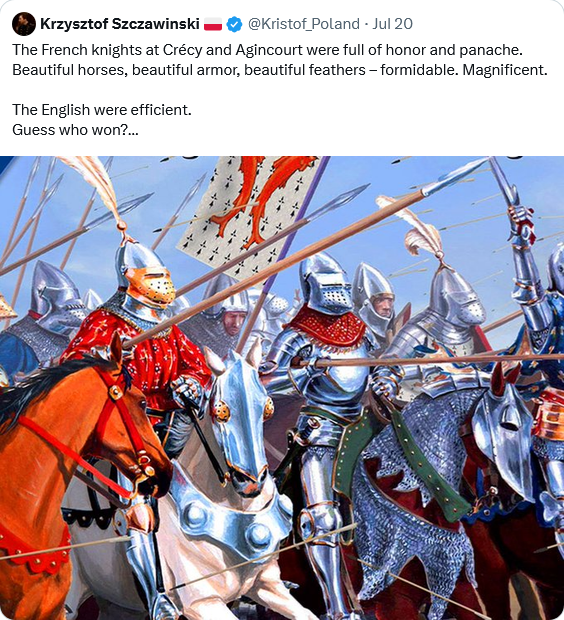
The gun is the most misunderstood object in Western civilization. Not a weapon. A technology. The technology that made the idea of equality physically real.
1. The longbow democratized warfare – a peasant could kill a knight with a stick and a string, and Agincourt proved it. The gun completed the process. The armored warrior class whose claim to social dominance rested on physical superiority became obsolete. The aristocratic monopoly on violence ended not with a philosophy but with a mechanism. The gun is the physical enforcement of the idea that all men are created equal. Which is why the American founders put it in the second amendment – not as an afterthought, but as the guarantee of everything else.
2. The Roman citizen had the right to bear arms. The Greek citizen had it. The English yeoman had it. The Swiss canton built its entire civilization on it. The disarming of the population has always been, in every civilization, in every century, the first act of the government that intends to stop being answerable to that population. Show me a disarmed population and I will show you a population that lost something else shortly after.
3. The Second Amendment is not about hunting. It is not about sport. It is about the relationship between the armed citizen and the state – the explicit constitutional acknowledgment that the citizen’s right to defend himself, his family, and his civilization against any threat, including the government itself, is not granted by the state and cannot be revoked by it. Power flows upward from the armed citizen, not downward from the armed state.
4. The gun defends the family. The woman alone with her children. The farmer on the edge of civilization. The shopkeeper in the neighborhood the police no longer patrol. The gun is the equalizer – the technology that makes the physical difference between a large man and a small woman irrelevant. Every argument for disarmament is, at its core, an argument that the state will protect you better than you can protect yourself. The evidence for this proposition is not encouraging.
5. In Europe, the disarmament is now nearly complete – and it happened precisely as the state’s ability and willingness to protect its citizens began to decline. The timing is not coincidental. A population that cannot defend itself must trust the state to defend it – which is a population that cannot effectively question whether the state is doing so. The dependency is the design.
6. The gun is a civilizational technology in the deepest sense: it requires responsibility, judgment, and the willingness to accept the consequences of your decisions. You cannot outsource it. You cannot have a committee fire it. It is the most anti-bureaucratic object ever invented – a direct, personal, consequential instrument that puts the full weight of the decision on the individual holding it. Which is precisely why the administrative state finds it intolerable. Not because it is dangerous. Because it is sovereign.
7. The family that can defend itself does not depend on the state for its most fundamental security. The civilization that can defend itself has not yet outsourced its survival to an institution that will negotiate the terms of that survival on its own behalf. The gun determines who controls violence – and therefore who controls everything that violence can threaten. Which is everything. The Sobieski who rode down the hill had a sword and sixty thousand horsemen. The equivalent today is the armed citizen who understands what he is defending and why. Every civilization that forgot this discovered it the hard way. The ones that remembered it are still here.
Adventures in Surplus! Type 38 Arisaka Carbine in World War One
Forgotten Weapons
Published 4 Mar 2026In the fall of 1914 it became apparent that the minor fracas in Serbia was going to stretch a lot longer than anyone had expected, and governments began scrambling to secure weapons production. Japan was one source of small arms for the Entente powers, and Britain purchased about 150,000 Arisaka rifles and carbines from the Japanese in late 1914 and early 1915. These were used to equip Royal Navy crews and Army raining and reserve units, but by late 1915 Enfield production had caught up and the guns were no longer needed.
In the fall of 1915, the British sent most of their Arisakas (about 128,000) to Russia, which had also been purchasing large numbers from Japan. There they were again used to arm second-line units, including troops occupying the Grand Duchy of Finland. When Finland declared its independence in December 1917, most of the Russian soldiers went home and left their weapons in Finland. As a result, the Arisaka was the second most common type of rifle available at Finland’s independence, and was used by the Civil Guard until about 1927.
This particular Type 38 Carbine was made at the Tokyo Army Arsenal in 1910, then sold to the British where it was given a set of unit marks on the stock. It was subsequently transferred to Russia, where a metal clip was added to prevent accidental magazine release. It stayed in Finland through the Finnish Civil War and afterwards, only being imported into the US recently by Postrock of Garden City, Kansas.
(more…)
QotD: Projecting the effect of a maximum wage law
We cannot know exactly, because we would struggle to find a real-world example of it in a comparable country. But we could think of it as, effectively, a 100% marginal tax rate on incomes above £100,000. We could then look at the empirical literature on how responsive top earners are to tax incentives, and extrapolate from that.
We know from previous studies that the behaviour of top earners is quite sensitive to tax changes. Last year, the Institute for Fiscal Studies (IFS) tried to model the impact of a proposal to increase the tax burden on the top 5% of earners. In this case, the proposal was to lower the threshold for the 45% additional rate of income tax from £150,000 to £80,000 per annum, and to introduce an “additional additional rate” of 50% for incomes above £125,000.
If nobody changed their behaviour, such a policy would increase tax revenue by just over £9 billion per annum. But people would, of course, change their behaviour. Some top earners would switch to less demanding positions, some would retire earlier, some would reduce working hours, some would engage in more proactive tax planning (i.e. legal tax avoidance), some would simply emigrate, and so on.
We know for certain that responses of that kind exist. But we cannot exactly quantify them. So the IFS came up with a range of plausible outcomes rather than one definite number. It turns out that at the most optimistic end of the spectrum, behavioural changes would still knock over a third off the potential additional tax revenue, reducing it from over £9 billion to under £6 billion. At the most pessimistic end of the spectrum, the policy would fail to raise any additional tax revenue – it would, in fact, reduce revenue by almost £1 billion. (Stop smirking, Dr Laffer.)
If a tax rate of 50% can be predicted to trigger such strong behavioural responses, you can guess how much damage an implicit rate of 100% would do.
Kristian Niemietz, “The public love it, so what’s wrong with the idea of a maximum wage?”, Institute of Economic Affairs, 2020-10-14.
July 27, 2026
The shambolic Fifth Crusade, or “Waiting for Fredot”
In The Critic, Anatoly Grablevsky reviews a new book on one of the less well-known attempts to wrest control of the Holy Land from the Islamic conquerors:
By the early 13th century, the military and geopolitical situation of the Crusader Kingdom of Jerusalem was dire. After the Third Crusade (1189-92) had failed to retake Jerusalem, the Frankish realm in the Holy Land was reduced to a thin coastal strip centred on the heavily fortified city of Acre. The rest of the Near East was in the hands of the Ayyubids, the successors of Saladin.
In response to Ayyubid encroachment, in 1213 Pope Innocent III called for a new holy war to reinforce the Kingdom of Jerusalem and reclaim the Holy City for Christendom. The bulk of the expedition was recruited in the Holy Roman Empire, whose young emperor, Frederick II, the wonder of the world himself, ostentatiously took up the cross. He was, however, in no hurry to join his countrymen in the east.
Learning from their bitter past experiences, this time around the Crusaders adopted a novel strategy. Instead of focusing their efforts on the Holy Land, the Christians targeted Egypt, the political and economic heartland of the Ayyubids.
The Crusader army’s first port of call was the coastal city of Damietta, which, after a lengthy siege, fell in 1219. This was a major victory for Christendom: Crusaders had not captured a city of Damietta’s size, wealth and strategic importance since the fall of Jerusalem in 1099.
The Ayyubid Sultan Al-Kamil, under pressure from Mongol attacks at the rear, now offered attractive peace terms that included the return of Jerusalem to the Christians. The Crusaders, overconfident and under orders from the absentee emperor, rebuffed Al-Kamil and instead decided to march on the Ayyubid capital of Cairo.
Here, the crusade took a shambolic turn. The Christians wasted precious months awaiting the arrival of Frederick II, but the emperor never bothered to show up (Smith might have called his book “Waiting for Fredot”). By the time the Crusaders finally began the march south, Al-Kamil had gathered his strength, and the Franks were quickly outmanoeuvred by the Sultan, who used his superior knowledge of the Nile’s flooding patterns to trap them against the river.
The Crusaders reacted by launching an all-out assault on their substantial wine provisions so that, when the Muslims attacked, the Christian army disintegrated in a drunken rout.
In the ensuing peace deal, Al-Kamil regained Damietta, in return for giving safe passage back to Europe to the Christian survivors.
Timeō Danaōs et dōna ferentēs
The tag in my chosen headline means roughly “beware of Greeks bearing gifts”, which anyone who has read anything about the Trojan War can understand. A huge problem for modern translators of works like The Iliad and The Odyssey is that there’s a double layer of cultural change built in before you start: the Mycenaean Greek culture of the Bronze Age — the setting of the Trojan War — is significantly different from the Greek culture of the classic era — when the oral tales were first written down (and attributed to Homer).
Classic Greek culture is often misunderstood by modern audiences through the most prominent survivals of that time: especially Greek philosophy, as the philosophers we think of as most representative of Athenian and the wider Greek culture were actually a fairly small and relatively powerless subculture at odds with the mainstream of their times.
All that said, going from a translation to an on-screen interpretation requires a lot of picking and choosing of elements to highlight and others to leave unrepresented or actively suppressed. In the most recent film of Odysseus and his extended return journey from Troy to Ithaca, director Christopher Nolan chose to portray Odysseus as a modern man in ways that may suit today’s audiences, but don’t accurately portray the Homeric interpretation or the times in which it is set:
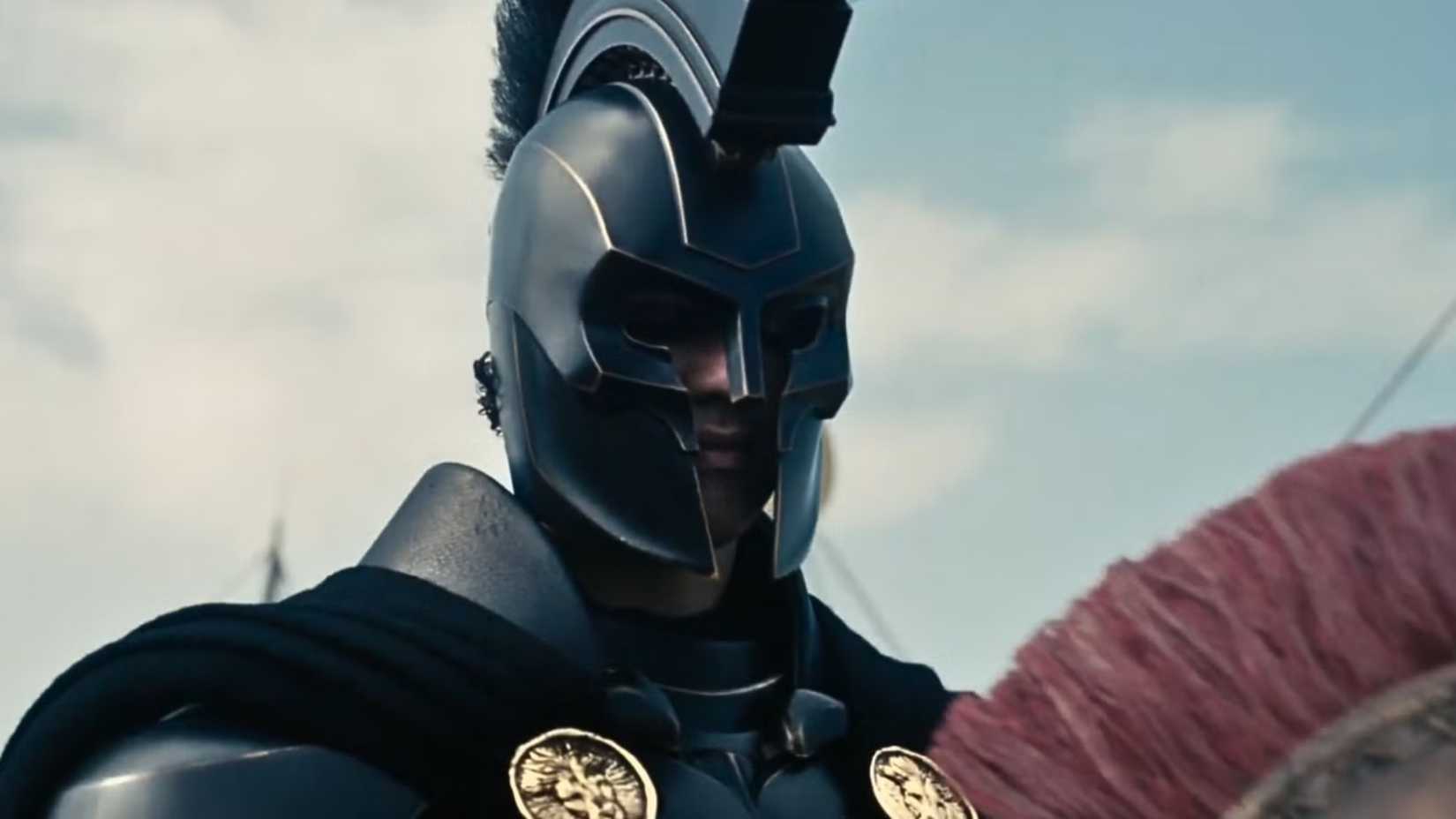
Some viewers have described Nolan’s version of Odysseus as suffering from post-traumatic stress disorder. But moral injury is the more accurate term. It overlaps with PTSD, but it’s not the same thing. Moral injury occurs when a person commits, witnesses, or fails to prevent an act that violates his moral convictions. In war, moral injury can arise when a person does something that violates his own ideals, loyalties, or sense of right and wrong. The result is lasting guilt. A combat veteran comes to see himself as corrupt, unworthy, or beyond forgiveness.
In the film, Odysseus describes his guilt over the violence he witnessed during the sack of Troy. He is conscience-stricken about his Trojan Horse gambit. Odysseus took an object that appeared to be a gift of peace and used it as a weapon of deception. His stratagem allowed the Greeks to enter Troy, destroy the city, and slaughter its people.
But the Trojan Horse is Odysseus’s crowning achievement. Homer’s Odysseus is a wily trickster, and a trickster would not be tormented by the fact that his trick succeeded.
During his journey, he repeatedly deceives his own men for what he believes is the greater good, and these acts clearly trouble him. The war itself is remembered as grim and pointless. Men are drafted rather than rushing eagerly toward glory.
This is not Homer’s moral universe. In the poem, the Greeks rape, rob, enslave, and pillage without displaying anything like modern guilt. We can tolerate this when reading an ancient text. It is harder to tolerate when those acts are placed directly before us on a movie screen.
This may explain Nolan’s decision. Had he shown the violence of the original story without softening it, would the audience still have been able to sympathize with Odysseus?
Consider what happens to the enslaved women accused of consorting with the suitors after Odysseus returns home. Odysseus orders them to be killed, and Telemachus hangs them. Homer does not present the scene as morally complicated. Their punishment is part of restoring order.
Modern films sometimes allow their heroes to inhabit moral worlds very different from our own. Robert Eggers’s 2022 film The Northman asks us to sympathize with Viking characters who obey codes that most moviegoers today would find reprehensible. But The Northman was a mid-budget film. Nolan made a summer blockbuster that cost hundreds of millions of dollars. A blockbuster can’t afford to depict a hero from whom audiences recoil. Eggers could let his Viking be a Viking. Nolan needs his Greek warrior to be one of us.
Yet such individuals lived in societies that existed before Christian morality reshaped the Western understanding of guilt, mercy, and the value of every human life. The moral injury that afflicts Nolan’s Odysseus belongs more naturally to the AD world than the BC one.
In the film, Odysseus grieves for the men he lost and appears to blame himself for their deaths. But Homer presents that suffering as the result of pride, fate, divine anger, and human foolishness. The original story does not depict Odysseus as a man tormented by the fear that he has violated his own moral code.
The difference is clear in the episode of the lotus-eaters. In Nolan’s film, Odysseus eats the lotus because he seeks mental relief, a kind of ancient Greek version of using psychedelics to treat combat trauma. In the poem, Odysseus does the opposite. He refuses to eat the lotus and orders his men away from it.
Biosphere 2
Sama Hoole on a now-obscure experiment in the early 1990s which didn’t produce the expected results at all:

Eight people sealed themselves in a glass dome to prove humanity could feed itself on plants, and spent two years starving in front of the world’s press.
Biosphere 2 cost a hundred and fifty million dollars. Three acres of Arizona desert under sealed glass, eight crew, door shut on 26 September 1991, nothing in or out for two years. The farm inside was worked intensively and by any agronomic measure it was superb, out-producing the most efficient smallholder farming on earth by a wide margin.
It produced 83 per cent of what they needed.
Which left Roy Walford, the crew doctor, in a sealed box with seven hungry colleagues and his own life’s work. Walford was a UCLA pathologist who had spent thirty years arguing that severe calorie restriction extends lifespan. He had doubled it in mice. And here was reality handing him his own hypothesis with the door welded shut.
So he called it a health programme.
The menu became vegetables, half a glass of goat’s milk a day, and meat or fish about once a week. The men lost close to a fifth of their body weight, the women about a tenth. And the markers Walford cared about behaved impeccably: blood pressure, glucose, cholesterol and triglycerides all down at least twenty per cent, into ranges any doctor would frame. He published it in PNAS in 1992.
The bloodwork was magnificent. The people were falling apart.
Jane Poynter wrote the book afterwards. Fatigue, depression, mental fog, and a preoccupation with food that ate the entire interior life of the crew. They stole from each other. They split into two factions that stopped speaking. The ecological research the building had been constructed for was largely abandoned by people who no longer had the headroom for anything past the next meal. The ants and cockroaches, by contrast, were thriving.
The air was leaving too. Oxygen started at 20.9 per cent and kept dropping and nobody knew where it was going. Columbia eventually worked it out: the concrete was quietly eating it. So oxygen had to be pumped in from outside, which is an interesting result for a sealed world.
Walford’s verdict on the mutiny is the whole thing in one sentence. He said afterwards that any other physician aboard would have panicked and declared they were starving, but that he knew they were on a programme of health enhancement.
He knew. Seven other people, visibly wasting, were simply mistaken.
He came out in 1993, developed ALS, blamed the conditions inside, and died in 2004 aged 79 after years on 1,600 calories a day in pursuit of a longer life. The mice got double. He did not make it to average for an American professor.
Every argument you have heard this decade was already in that building. Grow it locally. Take the animals out. Eat less. Watch the numbers improve.
Eight of the most motivated humans alive, handed three acres of the best-managed farmland on the planet and no meat, could not feed themselves.
The press reported the fighting as a personality clash.
And he updated:
I left something out of that one.
Biosphere 2 had a working farm, and the farm had pigs, chickens and goats. Only one of those three was still alive when the door opened, and the reason why is the most useful thing the entire two years produced.
Biosphere 2 had livestock, and the crew ate the pigs first.
Zazu and Quincy were Ossabaw dwarf pigs. In the first year one of them produced a litter of seven, which inside a sealed glass building where every calorie was counted should have been the best news anybody had.
They killed them anyway.
The chickens went too. Mrs Fruitcake and the rest, slaughtered because they were eating more than they were laying.
Neither animal was killed for meat. They were killed for competing.
A pig and a chicken have one stomach, and it wants exactly what a human wants: grain, roots, beans, anything starchy or dense. Inside Biosphere 2 there was no outside, no feed lorry, no surplus. Every mouthful a pig took came off the plate of one of eight visibly starving people. The crew did the arithmetic and reached for the knife.
Now notice which animals survived the cull.
The goats. Milky Way, Stardust and Vision, three African pygmy goats, milked daily for the full two years. And in the crew’s own scientific write-up, published in Advances in Space Research in 1995, they recorded that the goats were the most productive domestic animals in the entire system.
The most productive thing in a building where the humans lost a fifth of their body weight was the ruminant.
It is the four stomachs. A goat is a fermentation vat on legs. She runs on stalks, leaves and crop residue, the fibrous rubbish that comes off any farm and that no human gut can process, and turns it into milk. She was never taking food off the crew. She was manufacturing food out of what the crew threw away.
So that sealed box did test the great modern argument, the one about feeding crops to animals being a waste of land and calories.
It found the argument correct for pigs and chickens.
It found it wrong for the animal that eats grass.
Biosphere 2 gets quoted endlessly as proof we should grow plants and drop the livestock. Eight people with the most productive farmland on earth ran that experiment properly, went hungry for two years, and kept exactly one kind of animal alive throughout, because she was the only one paying rent.
They killed the pigs to feed the people and kept the goat to feed the people.

The Total Erasure of Carthage | Part Four
The Rest Is History
Published 12 Feb 2026Three decades after the defeat of Hannibal, how had the Roman Empire managed to conquer vast swathes of the known world? Why did the predatory eyes of this terrifying behemoth turn once more to Carthage? And, could this mighty city defy the odds and repel Rome one last time …?
Join Tom and Dominic as they reach the climactic, final phase of the Punic Wars; the greatest military struggle of all ancient history.
(more…)
QotD: The art of management
A nanosecond’s reflection will tell you that the techniques needed to manage computer programmers, movie actors, and the boom-town roughnecks that inspired Conan the Barbarian are going to be very different. What if we restrict our analysis to just one category, say the computer programmers?2 Well, consider another similarly restrictive category: children. The great limitation of parenting books is, as every parent of more than one child knows, that children are extremely different from one another. One child may need strict discipline, while another actually needs to be encouraged to take rules less seriously; one needs to be reassured constantly and showered with love, while another needs to have firm boundaries. The techniques that work brilliantly with one child will not work unmodified with another. If the goal is the Aristotelian mean, then some need to be nudged to one side, and others in the opposite direction.
If that’s the way it is with kids, imagine how much more so this all applies to adults, who in addition to having different innate personalities and temperaments and aptitudes also carry with them extensive life histories, experiences, and scar tissue. Any generic advice, any “management turpentine”, needs to be heavily customized to the personalities and the dynamics of a particular team. But the catch is that mastering the ability to apply this sort of generic management advice in a particular situation is pretty much just the same thing as mastering management itself.
To a very great degree, management just is the art of taking a set of discordant personalities and welding them into a harmonious whole. A great manager sizes up his or her team, sees the ambitious go-getter, the resentful and self-defeating genius, the timid and awkward newbie with leadership potential, the lazy slob who secretly glues them all together — sees not just these categories but sees the individuals and the unique ways they subvert these archetypes, and instantly and intuitively knows how to fuse them into a machine for achieving a common purpose. Or as Hilaire Belloc once put it:
There is one element in the [management of men] which is all-important, and the possession of which is a gift, like the gift of verse or “eye” in a sport. It is not to be prayed for. It is not to be acquired. It is granted by the unseen powers. This element is that which you have in the good management of a pack of hounds, or in any other kind of good generalship. It consists in a mixture of detailed and general appreciation; for when those two faculties are combined — the faculty of seeing the individual, the faculty of seeing the whole — you have the genius of the human helmsman; as rare a sort of genius as there is among men.
But why does he say that this particular talent is not to be acquired? Go back to Johnson’s line about the management turpentine and read it again, but this time note how deftly the magic trick is performed. Do you see it? Hey presto, there are only two options as to what a book on painting could be about — “Form and Structure and Meaning,” or where to buy turpentine. This is important, because left to your own devices you might prefer a third possibility: namely a book about how to make great art. But as soon as you say it, it becomes clear why that option needs to be hidden from view — no such book has ever existed, no such book can exist, you can’t learn to make great art from a book.
John Psmith, “REVIEW: Scaling People by Claire Hughes Johnson”, Mr. and Mrs. Psmith’s Bookshelf, 2023-08-28.
- Fewer and fewer every day though. A United States military friend recently pointed out to me that the high ratio of senior Russian officers killed in Ukraine and Syria speaks well of their military culture, because it means that even their general officers make a custom of occasionally leading from the front (there’s a long history of this in the Russian armed forces). He then reflected bitterly that an American general being killed was simply unthinkable, since to a man they sit in air-conditioned offices and command their troops over satellite link.
- Johnson’s book is marketed towards those managing computer programmers, which is interesting since she worked on the operations side of the house and as far was I know has never been in charge of a crew of engineers.
July 26, 2026
Woodworking workbenches – the earliest artistic representation
On his Substack, Christopher Schwarz recounts a visit to the historical remains of the town of Herculaneum under the volcano that erupted in 79 AD, killing many thousands, but preserving a lot of the Roman town under many metres of volcanic ash:
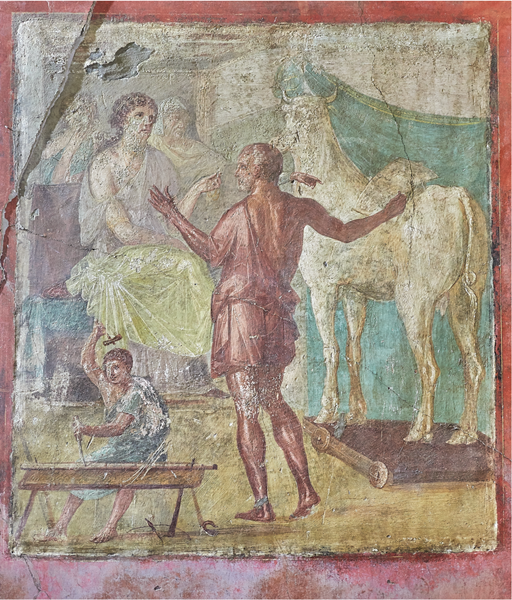
The beginning. In the House of the Vetti, this dining room fresco is perhaps the earliest depiction of a workbench in the West. (Photo by Narayan Nayar)
The journey to the summit of Mount Vesuvius has all the romance of visiting an unlicensed reptile farm. It begins in Ercolano, Italy, a touristy village in the shadow of the volcano and home to Herculaneum, one of the towns buried by Vesuvius’s eruption in 79 C.E.
As Narayan Nayar (the photographer for the journey) and I stepped off the train from Naples we were assaulted by young, attractive Italians. Their job: Bait tourists to nearby restaurants. We glanced around and saw only one escape route from the train station’s cul-de-sac. So, we plowed through the crowd of eager human fishing lures.
We emerged from the other side a bit relieved. Then we realized we’d scurried past the bus company that was supposed to drive us up the volcano. We turned around and dove back into the swarm of too-perky people in order to catch our bus.
The twisty-turny bus ride ended 660 feet below the volcano’s summit, and we then climbed a steep trail to the volcano’s rim. The top resembles a gravel pit where one of Frank Herbert’s worms might emerge. There’s no deep hole for tossing human sacrifices – throw a virgin into Vesuvius and she’s only going to get skinned knees and a sunburn. I looked around the volcano and promptly excused the early settlers of the area for building their homes at the base of Vesuvius. The only evidence you’re on a volcano (besides the little gift shops) is the occasional tiny plume of gas and the odd rocks below your feet.
I picked up a few rocks. For rocks, they were young – likely the result of the 1944 eruption, which destroyed several villages. I looked out from our 4,200-foot perch at the buildings in every direction below, which are built on top of villages that were covered in ash from earlier eruptions. It’s a grim scene if you think about it too much – 600,000 people now live in the so-called “red zone” for a future eruption.
And yet, as I fondled the rocks in my hand I felt only gratitude for this deadly, fire-breathing mountain.
The Earliest Workbenches
The recorded history of woodworking begins with the Egyptians. But the recorded history of workbenches begins (for now) with Vesuvius. Its massive eruption in 79 C.E. buried Pompeii, Herculaneum and other sites, preserving frescoes, buildings, pottery, human remains and even wooden furniture.
At Pompeii, the ash blanketed a fresco showing a low, four-legged workbench being used for mortising by a man in Greek attire. At nearby Herculaneum, the eruption preserved a fresco showing “erotes” – what we might call “buck nekkid cupids” – sawing a board at an eight-legged low workbench. It features a holdfast and other holdfast holes. This fresco has since been destroyed, but we have engravings that were made soon after its discovery (more on both the frescoes’ stories is ahead).
These two images are the earliest representations of workbenches of which I’m aware. And they launched my interest in exploring knee-high workbenches and how to use them to build furniture, boats, storage containers and wagon wheels.
The conventional wisdom is that these low benches were used in former times for simple work and were replaced by superior modern benches, which are thigh-high or taller. But the more I studied low benches, the more I found that they never disappeared. They are still in use. Additionally, these low benches can be used for complex work, including steam bending compound shapes and lutherie.
The low bench is more than a thick plank of wood with legs. It’s also a collection of simple jigs and appliances that allow you to do remarkable work while sitting comfortably on an easy-to-build platform. For centuries, these simple jigs remained hidden in plain sight in paintings and drawings in museums. And their appliances have been proven to work, both at my low benches and by the modern craftsmen who still use them.
How to Provoke a War – Death of Democracy 25 – Q1 1939
World War Two
Published 25 Jul 2026By March 1939, appeasement has failed.
Hitler’s Germany has moved from threats and persecution inside the Reich to the destruction of Czechoslovakia, the seizure of Memel, and renewed pressure on Poland. No shots have yet been fired between the great powers — but Europe is now locked on a course toward war.
In this episode of Death of Democracy, Spartacus Olsson reports from Berlin at the end of Q1 1939: the “Israel” and “Sara” decree, Schacht’s dismissal, Göring’s Central Office for Jewish Emigration, Hitler’s genocidal Reichstag threat, the launch of Bismarck, the coerced occupation of Prague, the Memel ultimatum, and Britain’s guarantee to Poland.
This is the moment when the Munich illusion collapses. Hitler is no longer pretending to unite Germans. He is dismantling states.
The Alchemy of Finance by George Soros
Handre discusses the book George Soros wrote (or had written) after he gained a huge sum of money by speculating against the Bank of England in the 1990s:
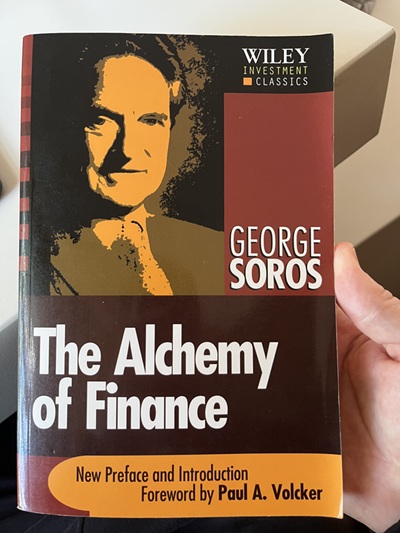
George Soros made a billion dollars betting against the Bank of England in September 1992, and then he wrote a book explaining that markets are fundamentally irrational. Notice the tension there.
The Alchemy of Finance, published in 1987, gives you Soros’s theory of reflexivity. The idea runs like this: participants in a market do not observe prices from the outside. They shape the reality they are trying to measure. Their biased expectations feed into prices, prices feed back into expectations, and the whole thing spirals away from any “equilibrium”. Soros presents this as a devastating blow to the neoclassical economists who model markets as tidy machines grinding toward a single clearing price.
He is right, but misses one fundamental point. The equilibrium fetish deserves a beating. Ludwig von Mises and Friedrich Hayek spent decades explaining that the market is a process, not a photograph, and that no equation captures the discovery going on inside it. Prices carry dispersed knowledge. Entrepreneurs guess, act, and get corrected by profit and loss. Soros rediscovered a slice of this in his trading room, and called it “alchemy”.
But, Soros treats his “far from equilibrium” boom-bust sequences as proof that free markets are inherently unstable and require an adult (usually a central bank, sometimes Soros himself) to supervise them. He points at the credit bubbles of the 1980s and sees capitalism failing. He never asks who prints the credit.
The Federal Reserve does. Cheap money floods in, entrepreneurs misread the artificially low interest rates as real savings, and they pile into projects that cannot pay off. That is the boom. The bust arrives when reality collects its debt. Soros describes the symptom with real skill and misses the pathogen entirely.
So the man who broke sterling by exploiting a currency that politicians pegged at a lie somehow concludes that governments need more discretion, not less. The 1992 pound was a government price-fix collapsing, exactly as Mises predicted such fixes always do.
The reflexivity part is spot on, but send the bill for the bubbles to the people with the printing press.
The Ancient Greeks 03 – Enter the Persians 5 – Earth and Water: The Logic of Empire
seangabb
Published 16 Feb 2026Why does Persia turn west? In this lecture we examine Persian strategic thinking after the suppression of the Ionian Revolt. We analyse the demand for “earth and water”, the meaning of submission in Persian political culture, and the diplomatic crisis that follows.
Most Greek states comply. Athens and Sparta do not. We also explore the Persian expedition of 492 BC under Mardonius and the calculated preparation for renewed intervention.


